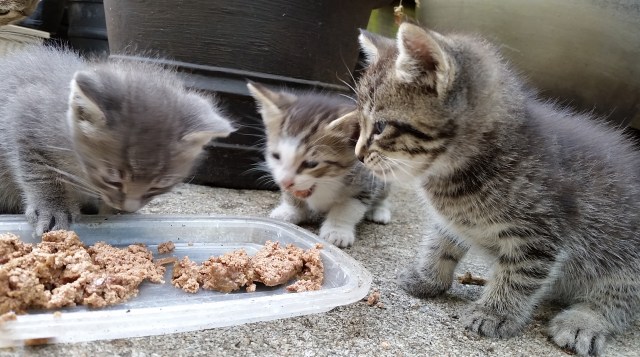
Sekhnet’s photo and her caption of the week, spoken by the little guy in the middle, obviously.
Sekhnet’s photo and her caption of the week, spoken by the little guy in the middle, obviously.
When a goat calls, be glad. It is cool that animals can talk and wonderful when they pick up the phone.
An error does not become a mistake until you refuse to correct it, somebody said, correctly.
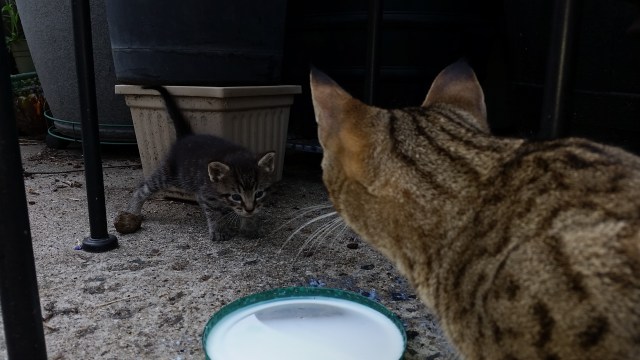
photo: Sekhnet
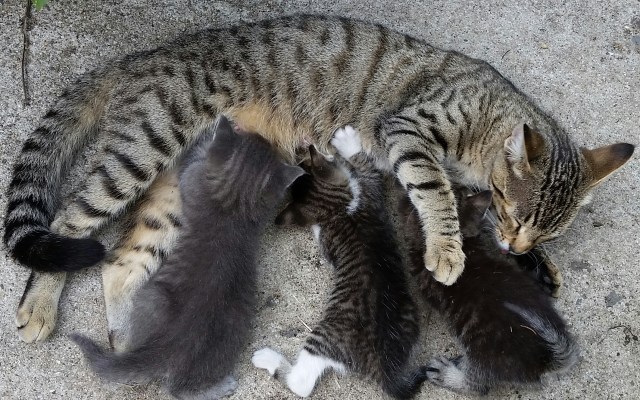
Sekhnet, who caught this great shot, calls this one “breakfast with paw”. Note how the little white pawed kitten is getting purchase with the back foot as it pushes with front paw to get breakfast a little faster.
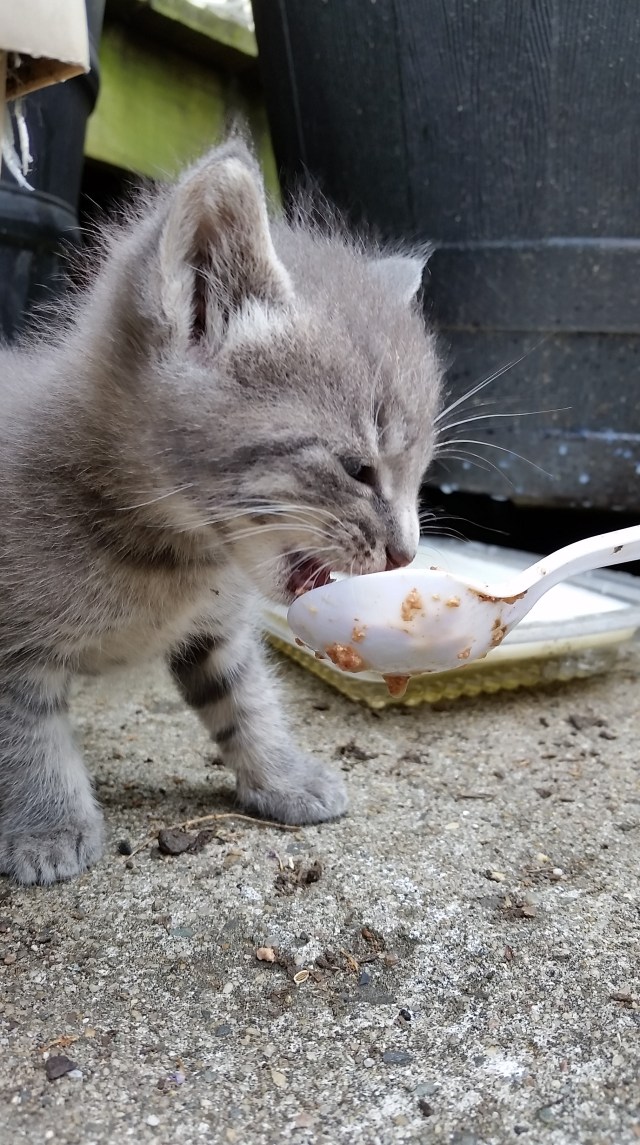
There is no shortage of irony here.
I am striving to bring interactive creativity and fun into places where these things are spoken of highly but rarely practiced; myself, creative, yes, but not having much fun.
The program I’ve already implemented is capable of injecting some encouraging news into the depressing discussion of American education, the non-discussion of real participatory democracy; I am a marginal participant not actively discussing the issue with anyone who cares.
The program is therapeutic, I saw haggard women with chronic disease transformed into laughing girls at the end of our sessions; it gratified me, but, burdened with logistics, I was not laughing with them.
I’ve solved dozens of logistical and psychological problems so far, though some very large, possibly insoluble, ones remain. With the best of intentions, as I try to maintain my focus on promoting this inclusive, participatory program, I have somehow become a kind of hanging judge.
Nuance has become harder for me to discern; holding multiple truths in mind, and choosing the one that casts the best light– not always possible. I listen to the prosecutor making his relentless case, nod my unsmiling head. Fine, I think, give the guy the chair, let the Court of Appeals worry about it, there are many worse tragedies happening everywhere. Bang the gavel, next case.
I’m not always able to refrain from doing what was so hateful to me watching my father do it: reducing a person to the sum of his faults. We are flawed, all of us, and gracefully accepting the flaws of others is an important part of being a decent person. Whipping a fucking goat? Really? I take pride in not being the sort of person who inflicts harm, particularly on those with limitations. Lately I couldn’t rest until I’d given a particular animal a hard kick in the ribs. The thing was perhaps less than perfectly thoughtful, or even characteristically oblivious, but in either case, why the need to kick it?
The seventh stage of Erik Erikson’s theory of psychosocial development is called Generativity vs. Stagnation. Being productive, successful and involved in the world during the middle and later stages of adulthood versus being isolated and removed from the world, dogged by feelings of failure and hopelessness. The eighth and final stage, Integrity vs. Despair, takes place at the end of life, looking back, when one feels satisfied at a life well and authentically lived or is bitter and full of regrets.
I embarked on a project of encouraging expression, using free play as an educational strategy. I undertook this ambitious project knowing nothing about how to plan and build a business, how to run an HR department, how to secure funding to hire professionals needed for several live or die jobs. I have no connections or friends who can fill these gaps.
The program is a success, as far as implementing it in five minutes anywhere, as far as how easily it does what it purports to do. The student-run workshop vindicated my best hopes for how it would work. The creativity and competencies of young kids, and ailing adult women, for that matter, exceeded my expectations. Yet, not having a network of people in a position to participate productively… so far enforced stagnation.
Those who don’t understand what I am striving for, or who take no interest in it, who now quite sensibly avoid the subject, I can’t help thinking of as partial jerks, even as I know I have only a passing interest in all the details of their working lives. I was surprised and touched when a hard-working friend took a few moments to enquire about the progress of my program a couple of months ago. I told him the program itself, curriculum and all, works smoothly and wonderfully wherever we’ve done it, and that now I am focused on packaging, promoting and selling it.
I described my initial hope– that kids would work together to produce original animation in a workshop setup where adults would set things in motion and step back as children learn and teach each other. This big taste of autonomy fosters students’ confidence, brings out peer-mentoring and leadership skills. It has happened quickly every place we’ve done the workshop, about a hundred times so far.
Now that the program itself works smoothly, I told my friend, I am wrestling with the crucial tasks of packaging and promoting it. I told him I’m optimistic that someone in di Blasio’s administration would be quite interested in the presentation that I have recently put together, that is just about ready to roll.
He told me he now understands the important goals I set for the program, the workshop’s many great applications. He said he was impressed by how well thought out it was, acknowledged the tremendous amount of work I’d done and the ingeniously simple design of the program. He wished me success, strength to my arm and told me he agreed that di Blasio’s people would be very interested in a program capable of producing a cadre of peer-teachers entering Middle School.
This reaction was as wonderful as it was rare. We have but one measure of success in our society and until friends read about the program in a NY Times piece, or hear a well-crafted moment about it on NPR, it is a dream I am dreaming alone as I sleep my fitful sleep.
One more note in the polyphony of my imperfect sleep: my attempts to avoid bitterness in old age seem ironic to me much of the time these days. These attempts are hampered by the difficulty of living by words I have written on pages many times with various calligraphy pens, words I must inscribe in my heart as I find ways to become more actively and productively involved in the world: cultivate mindful empathy. Everybody we encounter is fighting a hard battle against killer odds. Just because somebody almost never keeps their word, for example, is no reason to write off the rest of their virtues.
Now, if you will excuse me, there are some kittens in the garden I have to go be sarcastic to.

“Did it occur to you that this person you refer to as a ‘goat’ may have performed a great act of friendship by calling to say he wouldn’t be an obstacle to your spending a day with two old friends at the beach? Do you get that maybe it was hard for him to do, that he was trying to be considerate and not irritating? Isn’t it possible that you are the merciless, passive aggressive bastard and not him?”
“Yeah,” I said, leaving every muscle in my face exactly where it was before the question.
When a goat calls, be glad. It is cool that animals can talk and wonderful when they pick up the phone.
An error does not become a mistake until you refuse to correct it, somebody said, correctly.
Went back to buy the guitar today. As I passed through the main room there was a quiet vibe in the electric guitar section. A young woman played quietly with a phone propped on her thigh, maybe jotting down a song idea. A guy, who looked, with tattoos and serious Scottie Pippen profile, like a possibly dangerous gang member, was playing some meditative lines that brought Jerry to mind. A few other people played, thoughtfully, none of them too loudly. I reproached myself mildly, perhaps I’d been too harsh the day before about those exhibitionist wankers I pictured driving themselves into dividers.
Into the acoustic guitar room where a guy was checking out a booming electric acoustic bass. I took the guitar into the other room, with the acoustic amps, and slid the glass door closed. An introverted kid with dark hair dyed blonde on top sat facing the wall, a big acoustic/electric guitar plugged in. The kid played some interesting open chords, paused as I got in tune. I played for a moment and the kid started again, an open chord the young guitarist could not have spelled. The raga bass note was D and it was not hard to find things to play that complimented the kid’s strange chord changes.
The notes you finger on the strings form harmonies, chords. Some are basic ones every beginner learns, G, A, D, Dm, E, Am. You can spell these chords by naming the notes you finger: G-B-D-G-B-G forms a simple G major chord, spelled 1-3-5-1-3-5, the places of these notes on the G major scale. You can make the harmonies fancier, and weirder, by changing a note or two of a familiar harmony. You can also change the voicing, the order of the notes. A G chord can be played with a B, its third (a strong harmonic partner) on the low string. Lower that B one fret to a Bb and you have a cool fingering of a G minor chord, with the minor third in the bass. You can add notes to harmonies, subtract notes, play open strings that give unusual sounds — there are many possibilities. Jazz guitarists can tell you that you have fingered an inversion of a C6-9 chord, called that because the notes added are the sixth and ninth degrees of the C major scale, but many guitarists, particularly young ones, just find cool sounding chords and mess around with them up and down the neck.
These odd chords and eccentric invented voicings are among the first amazing things creative young guitarists discover, and this young player was working with these ideas as I was checking out the guitar I was going to buy. The young guitarist was not insistent, in fact was somewhat reticent, but from time to time some of those odd chords would flower into the air from the amp, a rhythm would be tapped out. I’d catch a chord and bend a bass note along to it, let it shimmer, then play a little run ending with the flavorful riff from Norwegian Wood. It sounded good to me, this interplay, and it felt good, too. There could not have been a greater contrast between this interactive guitar player and the showy jacked up masturbator of a few days earlier.
I lingered, checking out the guitar, listening to this kid’s ideas, adding notes and ideas of my own. The guitarist was making musical sense, there was logic to the choices and a sensibility, a poetry, that made it easy to follow. Most importantly, he left generous patches of silence among what he was playing, inviting oxygen-rich spaces where music can breathe and grow.
It put me back in time to when I was first learning the guitar, the magic feeling when something accidentally turned musical. I thought of my friend Paul, a young man who couldn’t spell even a simple chord to save his life (and once, when his life literally might have depended on it, he couldn’t be bothered to learn to spell) but who is probably the most intuitively brilliant and inventive guitarist I’ve ever met. He’d stumble on a chord shape he loved the sound of and would soon fashion a song out of it, then another, then five variations on that. I remember his beautiful solo arrangement of By The Time I Get To Phoenix, a song that caught his fancy, though he couldn’t have told you the key or the names of any of the chords he was playing.
This kid in the acoustic guitar room was no virtuoso, but he played with great taste. The way he lovingly took a sound and played with it reminded me of Paul, of my own early experiments with guitars. I could have played there until the store closed, the guitar was nice to play, the room was air-conditioned, the amp had a great reverb, our levels were perfectly adjusted so we could hear the nuances of what each of us was playing. I suppose we played for about an hour.
I got up, unplugged my new guitar and bought it. As this was going on the kid left, head down, eyes avoiding everyone else’s. I wanted to say “hey, you sounded good. It was a pleasure playing with you.” It would have meant a lot to the kid, I think. My reflexes were too slow. I said nothing to the kid, but I note here; things may be horrible sometimes, but without warning, the opposite may also be true. Be alert for the small miracles that make the rest of this worthwhile.
The pursuit of excellence for its own sake is regarded as idiocy in a society that values only the creation of value– that is, the creation of the dough re mi — money you can buy things with. Things are given value according to how much they’re worth — in dollars and cents. Nothing could be more basic and immutable than this first law of the marketplace, no? Why bother to write clearly, if not to hone your craft for money? Why be meticulous about playing in tune, and in time, if nobody is paying — if, in fact, nobody is listening? I am listening.
I was checking out a guitar yesterday, a 3/4 size Martin that felt good in my hands, sounded good. I’d been thinking about it, realizing I’d probably have to buy it, even though it’s not really made of wood. “How does it sound amplified?” I asked the kid with very long hair. He handed me a cable and led me to a room with padded stools and amps.
“It sounds good,” he said. He was right. Damn, it sounded very good. I began to play, now with a pick, now using fingertips to pluck the chords of One Note Samba; I strummed with my thumb, with the pick. A nice rich, round tone. The pleasure of playing this little guitar was considerable, my hands relaxed, playing things they’d played enough to play smoothly, improvising, checking out the harmonics.
Somebody came into the room after a few minutes and began to play another guitar. At first I was annoyed at the intrusion, but when I realized the guy was playing a straightforward thing in E, I played in E, some fills, a couple of chords. It was OK, I could continue to check out the guitar. My back was to the guy, he’d sat behind me. He soon got very ornate, playing a fast, elaborate finger-picking piece that was tricky to follow. He turned up his amp.
It was quickly obvious that this was the common exhibitionist wanker in a guitar store, there are dozens of them, wailing away, fancying themselves gunslingers, striving for supremacy, the spotlight, the admiration of their flailing peers. If you walk through the main room of any guitar store there are many of them, bashing away at guitars, in every key, in no key, with varying degrees of skill, playing over each other, all of them way too loud. The cacophony is unbearable. They get into cars, if they have them, tailgate, ride the horn, pass on the shoulder cursing as they go, spin out of control, ultimately wind up totaling their cars into a divider. On a good day.
I never turned to look at him, unplugged the guitar and brought it back to the salesman. I’ll buy it tomorrow, I decided, when I’ll be in the neighborhood next.
In the subway on the way home I am fleshing out an idea that struck me while walking across 18th Street. I’d paused to write: reading is magic, think about it. Marks on paper tell you what I’m thinking.
Picture that animated. That’s what I was doing on the subway. I drew a pen, took a brush and painted a shadow under it. The train swayed, jerked, but I have always written and drawn on trains, am an experienced surfer that way. It is a very rare stroke that goes wrong for me on a train. I soon had a 3-D looking calligraphy pen drawn on the page. I made a note to animate the drawing and then cut the pen out. I’d take the cut out pen, dip it in a drawing of an ink bottle, the cruder the better, and write the words, in stop-motion, as though they were flowing from the moving pen:
Reading is magic, think about it. Marks on paper tell me what you’re thinking.
True. A simple but powerful illustration of the amazing human invention of writing and reading — communicating anything you can think of to express using combinations of 26 symbols. Also a powerful evocation of the potential of animation to get kids interested in literacy. I drew in my book for about ten stops, was pleased and shut my eyes. It felt wonderful to shut my eyes on that air-conditioned train.

Inevitably I had the second thought, which caused my eyes to open and which I began to note on another page — in black and white.
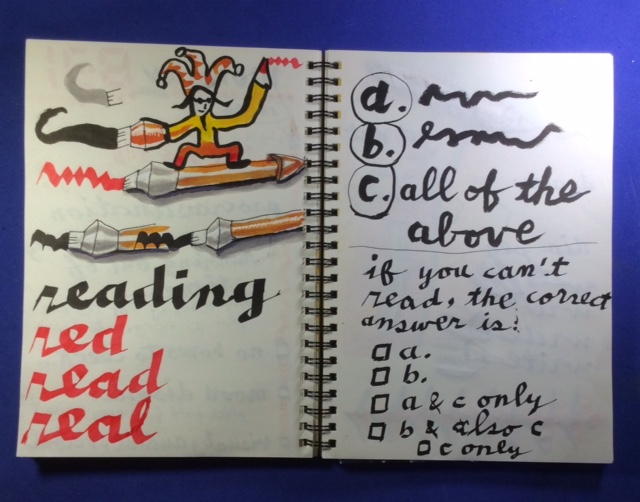
We do not, as a society, give a fuck if you can read, have a rich mental life, consider ideas and solutions to problems you might not have imagined. We do not, as a society, give a rat’s ass if you can write, beyond clicking a box assuming liability for any and all debts incurred in the course of your dealings with our corporation.
Our society does not have work, or any productive use, for a good chunk of its people, tens of millions of them. The young versions of these unneeded people are sent to schools to prepare them for a life where they are not needed. The lesson many of them learn clearly is: fuck you, asshole, bend over and spread your cheeks. Lift up the nutsack. Cough.
Life’s work: knowing this, all of it, and living calmly and productively, doing everything your talents allow to inspire, give hope, make a small ripple of change. Death is waiting for you anyway, why be aggravated by the many aggravations this life dispenses so generously for free?
It’s wrong to abuse people gratuitously, or even trying to be funny. There, I said it, fuck you. Seriously, there is most often no humor in abuse, no matter how otherwise witty. Abuse masquerades as humor to apply the talent for malice, seizing a jocular tone to wield the lash with the deniability of “only kidding… Jesus, stop being such a pussy.” A “roast” on TV can be occasionally funny, it’s all in good fun, blah, blah, but a roast in real life is rarely fun for the roastee. It is uncomfortable for most people to be put on the spot.
If I put you on a spit and turned you slowly and lovingly over the flames, basting you with your own juices to keep your skin from burning, no matter how otherwise hilarious my patter was while doing this, I know for a fact you wouldn’t find it all that adorable. We do this to each other from time to time, and it’s no joke, it’s a sign something sick is going on.
Not to be all judgmental about it, but when someone who has just been kicked in a delicate place is crying, the most humane first reaction is sympathy, not a smirking admonition not to be a pussy. “Everybody gets kicked there, whiner. Stop fucking crying and finish listening to my problems, asshole. I have problems too, you know. I kneed you by accident, ACCIDENT– pussy.”
I am thinking about this because when being polite is the only reason for doing something, against many good reasons for not doing that thing, experience teaches that it is a mistake to do the thing out of politeness. Being polite is a good thing, especially with strangers and potential assholes, and politeness has an important place in civility. Being polite as the only reason to do a thing? A weak ass reason indeed, and almost weightless against any reason not to do the thing at all.
Years ago, after an unhappy, brilliant, talented, witty and often abusive friend turned her abuse on me at a particularly bad time for me, I replied to her hurtful email with a long explanation of why I’d been so hurt by it. She declined to respond to my wimpish complaint. I never heard from her again. It was the quiet whimper at the end of a long, troubled friendship between two damaged people.
A year or two later, her husband’s mother died at 99 or 100. The old woman had been severely demented for the last decade or two, and when she finally died, the husband’s sisters began screaming for him to do something. He jumped up and applied mouth to mouth resuscitation to the dead woman, until, presumably, nurses intervened.
Sekhnet and I spoke to him shortly after learning, by email, that his mother had died. He was very grateful to us for a long call that gave him some comfort. I had nothing against him. In fact, it had been a source of stress and pain to watch him severely verbally pummeled by his unhappy wife every time the four of us got together. I always took his side, tried to pour some humor on the ugly situation, distract the wife from her assaults. Sekhnet was also very troubled watching this brutality at every meeting. When the woman turned that same whip on me one time too many, I was not having it. That was the end of our long, troubled friendship. Against my better instincts, I yielded to Sekhnet’s persuasion that I attend the wake in Chinatown. It would mean so much to our lapsed friend’s husband who had just lost his mother, she convinced me. Sentimentality and a misguided sense of duty and kindness triumphed over Reason and self-interest.
I have never had a reason not to regret going to that wake. I rushed from something I needed to concentrate on to be there, and needing to rush off had distracted me from the important thing I’d needed to focus on. I stood in line to have a meaningless hug from my former friend who made a smiling, breezy comment, only gently barbed, and it was the only exchange we had. Her husband thanked me several times for coming, and even took a moment, at a family dinner after the wake that I should also have not been persuaded to take part in, to find out if I was still trying to do that ridiculous animation business with kids.
I have never had a reason to think I did the right thing going to that wake. I did the wrong thing, for myself, thinking it was the right thing. Lesson learned, and now I move on slightly wiser.
Politeness for its own sake? Complete fucking lying bullshit.

