On the Pope’s upcoming visit

This Pope seems to be a very good man.  Not all of the Popes have taken the teachings of Jesus so much to heart, it seems to me.  

It’s hard for me to think of the Pope, any Pope, without recalling the answer Riddick Bowe, former world heavy weight champion and Boxing Hall of Famer, gave to a reporter as he was leaving to visit the Pope in the days leading up to a fight to defend his title.  Wikipedia seems to be silent on this important matter, (though the NY Times of Feb. 1, 1993 mentions the private audience with the Pope)  but my memory is not.  

The reporter asked Bowe, who grew up in Brownsville, Brooklyn, what he was going to say to the Pope during the meeting.   Bowe’s unforgettable reply:  “yo, Pope, you gotta bless me, man.”

NOTES:  (from Wikipedia)

They saw fit to include this, however:

Though ahead on points, Golota was penalized several times for low blows, and was finally disqualified in the seventh round after a volley of punches to Bowe’s testicles.

(and during the rematch)  Golota, after dropping Bowe in the second round, and being dropped himself later, was leading on the scorecards, only to be disqualified in the ninth round, once again for repeated shots to the testicles.[15]

Talking to Myself

I mentioned to a friend a while back that I often speak aloud when alone, sometimes in thick foreign accents.  At times these outbursts greatly amuse me.  I felt a little mad mentioning the laughing fits I sometimes have while alone.  

“I do the same thing,” said my friend, another fellow who loves a good laugh.

Late at night exhausted Sekhnet has been maniacally practicing her Spanish with an app called Duolingo.   She’s also mastered a lot of French vocabulary using Duolingo, though she has no idea how to pronounce the language, which, as all Americans know, is very fwah tah tahn.  For some reason one night I heard the words “el pais” pronounced enough times over her smart phone that I soon found myself, in moments of silence, lowering my voice an octave or two and saying “el pais!”.

Sekhnet has a new surveillance camera for her apartment in Sekhnetville where I spent a few hours yesterday.  It apparently catches snips of any motion it detects.  She was chuckling over the snip of me, by the door, saying “El Pais!” to nobody, in a deep voice and with great emphasis.   This is ridiculous enough, but then I turned to pick up my sandwich on a plate and apparently said to it “come on, Pah-eesy” and took it into her other apartment to watch the latest episode of Ray Dawnovan.

Reason vs. Emotion, redux

Here we go again, goddamn it, tap tap tap like a blind man here at the keyboard instead of picking up the phone and being in contact with other humans, like my wonderful nephew or my very cool niece, instead of going visiting, renewing ties with living, breathing creatures.    

Although here on the blank page, things can be set out and pondered in a way that is rare when we sit with others, listening, waiting, thinking we know what they are not hearing, hearing what they are, possibly, not saying.  

“I thought that piece about the ticking time bomb was another screed against Dick Cheney, the personification of evil, I just couldn’t take another one….”  

“Was it about Cheney?”  

“No, not really, but the opening made me think it would be.”  

“Ah-HAH…”

Expectations.  There is what there is and what we think there is.  More precisely, what we feel there is.  Our thoughts and expectations are influenced by our emotions, obviously.   There is no truth-based reason for general optimism or general pessimism, these are features of general mood.  Genetic, perhaps, a tendency toward the major key or the minor key.  Me, I steeped myself in the blues, a five note minor key, that music is in my soul.  The major key, often considered happy and optimistic, set against the sadder minor scales, always gave me an uncomfortable shudder of church.  

The church, to me, in the abstract, an institution that long sanctioned the mistreatment of my kind.  Bad-smelling incense, a super-wealthy institution that tolerates terrible crimes against the most helpless of its own innocents, using shameless threats about God to shame the victims into silence.  And let us not mention the swords wielded and oceans of blood spilled in the name of the Prince of Peace.  “What you do to the least of us you do to ME!” warned Jesus.  The fighting popes had infallible reasons why Jesus didn’t really mean this, skewering the least of us, disemboweling and plundering in the name of Christendom.

 “You mean, I’m sure, to exempt from this merciless portrait of Christianity hundreds of millions of good, kind, generous Christians who take the proper lesson from the life and teachings of Jesus.”  

Yes, thank you,  of course. I certainly do– along with a few billion fine Muslims, Hindus and Buddhists too, and everyone else who practices their religion for the right reasons.  The righteous of all nations have a share of the world to come, no doubt.  I’m painting with a broad, savage brush today, but it doesn’t change the larger truth.  Most people in the world are decent people, most religious people are humble and good in their practice.

The hellishness of the world was set out brilliantly in Catch 22, the concept of Catch 22.  You can get out of the army if you’re crazy.  Plain, clear, merciful.  There is one small caveat, Catch 22.  If you can prove that you actually are crazy —  wanting to leave the army shows that you are actually not crazy, therefore, in the army you will stay.  Catch-uh 22!  This merciless catch sums up the world of men as well as any single concept.  

The precepts of the church are mercy, charity, peace, gentle practices, service, devotion, loving our neighbors, even our enemies, but those precepts do not always translate into following the way of Jesus.  Unscrupulous religious demagogues have always carved out exceptions to Jesus’s love edict for those neighbors who hate our freedom, disagree on any significant aspect of our Christian belief (a sect of religious Christians once fought a hundred year war against another over whose love of Jesus was set out the right way), for people who insist they were born homosexual, or those who shrilly try to hold the church accountable for life-altering crimes against children, or blah blah blah.  

“Oh!  Taking a stand against the institutionalized hypocrisy of the worst of the Church on a Sunday!  Very bold.”

No, that’s not my goal today.  I give the example to show how mood colors our interpretation of the world.  Everything I’ve written above is true, even if not the entire picture.  Does it cancel out the comfort widows and orphans have always taken from the church?  The deep Christian faith that sustained American slaves generation after generation?  

“Why do you have to bring slavery into it, pantload?”  

Because Christianity was indispensable to ‘the Peculiar Institution’, as you know.

“Jeez, you’re in a mood today….” 

One slave ship captain had a revelation as he was steering another ship full of captured Africans across the murderous Middle Passage to lives of almost unceasing torment.  According to the story he turned the boat around, released all the prisoners, got out of the human trafficking business.  He wrote Amazing Grace, the hymn about God saving a wretch like him.  One of the most popular hymns around, they probably sang it at Klan rallies too.

“They didn’t sing it at fucking Klan rallies!  Have you no decency?! What the hell are you on about?”  

Catch-22.  

“The thing you need to do is shave, shower, go outside and visit a sick person.  Put on a clown nose and cheer up a dying child in a cancer ward.  Go find homes for one or two of those adorable, doomed little kittens.  Spread some goddamned joy, instead of ruminating on the horrors of the church.  The horrors of the church, the horrors of the church…  Jesus, how goddamned original….” 

Catch-22– the things that would help my mood the most today, my mood prevents me from doing.  

Suddenly, in my head is the Temptations great version of “I Can’t Get Next to You”, one of the greatest tracks ever spun on a piece of vinyl. I can turn the grey sky blue-uh, I can make it rain, whenever I want it to… but the things I want to do the most, I’m unable to do.

“Unable, or unwilling?”

You clearly know nothing of my work.

Sekhnet’s last photo of Dobby

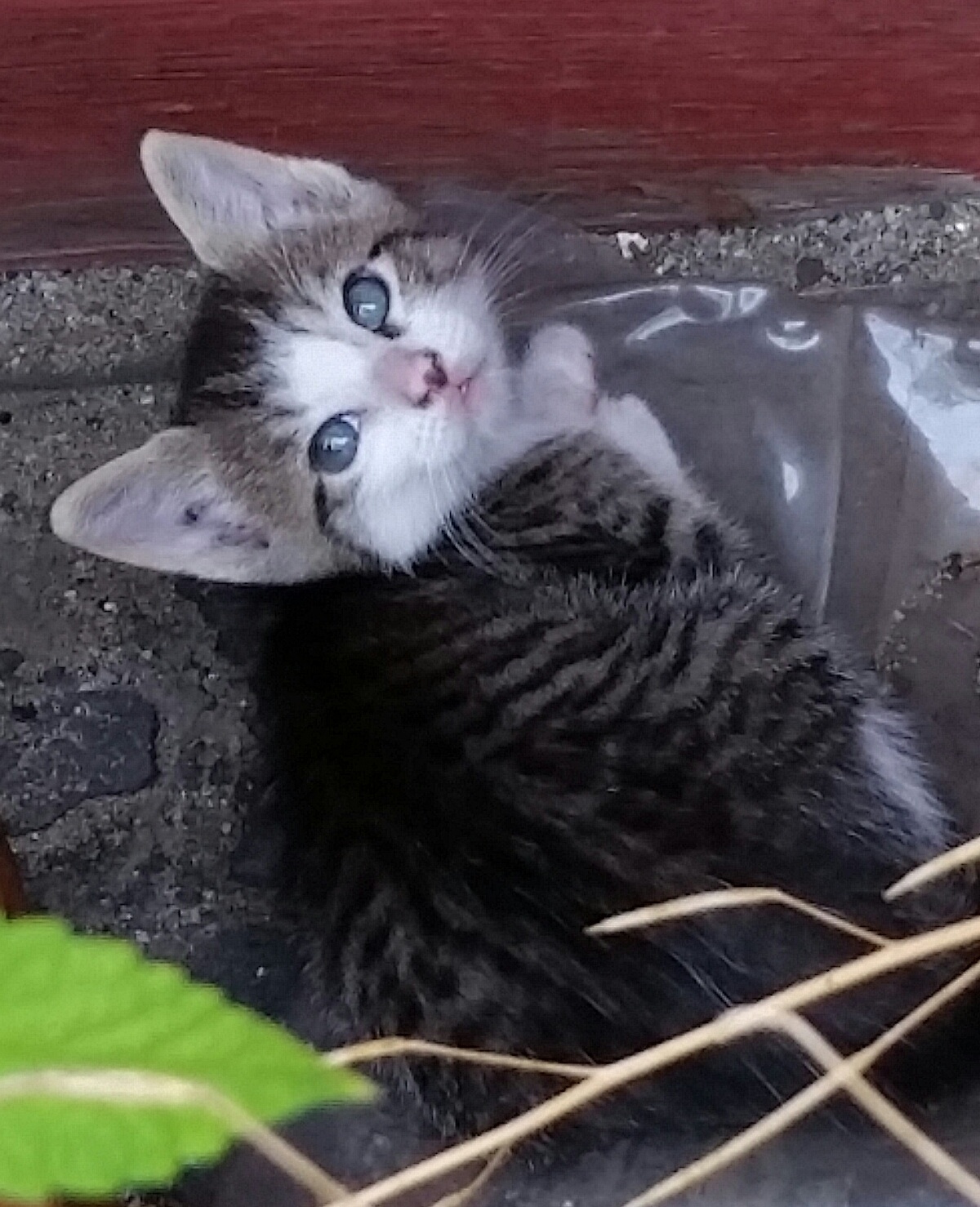
She called this shot 6 Eared Fur Ball, Dobby’s the one with the white face.  Taken on 9/11 it is the last portrait of the smallest of the kittens.  His fate and final whereabouts are unknown.  Feral cats have very short lives living outside, it is rare that they make it to two years old.  Makes it all the more urgent that I find homes for these other three friendly, playful young cats.6 eared fur ball 9-11-15

The short, adorable life of Dobby

Sekhnet delivered the news, heartbroken.  The cutest of the three kittens of the feral kitten in the garden, the only one we’d named, Dobby, last seen by me two nights ago, characteristically toddling off to hide, is no more.  Nature, knowing that death is only a matter of time for every living creature, gave the handsome, timid runt of this litter about five weeks of life.   Here is the rest of the family the other day: three cats 9-17-15

Head in Hands (labored re-creation)

This afternoon, at a loss for anything better to do, and having written that piece referencing Cheney that activated Sekhnet’s PTSD and made her cry one sentence in (where I stopped), I found myself sitting in the universal pose of resigned inaction, head in hands.  My few chores done and a futile attempt at a restorative nap aborted, I sat wearily at my desk near the window overlooking Sekhnet’s farm and my head sank into my hands.  I sat that way for a long moment.  The symbolism of this posture dawning on me, I lifted my head, opened this computer and resolutely tapped out a few hundred words that disentangled some tendrils, put it about as well as I can.  

It was a different kind of post than most of these and it felt like a good day’s work.  Writing it put my thoughts and feelings in order, explained some things I was hard pressed to understand or express and salvaged an otherwise fairly bleak and low-energy day for me.

Sekhnet and I went shopping and after the long trip I opened the blahg to read it to her.  There was no sign of the new piece anywhere, not in drafts, not in the trash.  “Head in Hands” does not exist, I was informed.  I was sure I’d hit publish, I’d definitely selected the categories, which appear below this post now, which I have already saved now three times.  It was hard to believe I had never even once saved the draft.  I hadn’t shut off the computer or logged out of WordPress, yet, no trace of the ninety minutes of writing.  

Seeing it wiped away at the moment I was going to read it to Sekhnet I felt panic and then rage, at once it became the most profound thing I’d ever managed to write, of course, being now irretrievably lost.  In despair I realized how impossible it would be to recreate the integrity of the piece, whatever music it had contained.  It took all I had not to scream or smash something.  Sekhnet was sympathetic, immediately reminded me I should always save my work, no matter what, we’ve both learned the hard way, blah blah blah, helpful advice I couldn’t listen to.  850 something posts on this blahg with no hitch that I can recall, maybe one.   Fitting reward at the end of a day I dragged myself through, to have some of my best work wiped away without a fucking trace and for no explainable reason.  I went outside and stalked for a mile.   

I’d started off wondering if dysthymia had me by the neck lately and posted a link to a wiki describing the condition.   I compared the inevitable hopeless feeling to music, the depressed theme striking a familiar chord, persistent fatigue providing the bass, empty stretches of senseless inaction like a sad string section, the dulled, receding emotions forming amusical harmonies to a background music as pervasive and hideous as the sickeningly effective ad jingle that plays involuntarily in your head.  

I mused about the genetic component of dysthymia and described my mother setting out for work every day, carrying dysphoria on her shoulders, working all day, coming home on the train, cooking us dinner, watching TV, reading, looking forward to the emotional release of the opera Live from the Met that throbbed from the stereo every Sunday (it may have been every Saturday).  She became tearful easily, was often angry, over-ate, reported feeling blue when she was alone, though she was always convivial and had a good sense of humor in company.

I spent hours alone in the basement, listening to blues records, the same sides over and over, playing along on an acoustic guitar, learning the ropes.  Friends came and went, I never questioned their qualifications or motives.  I enjoyed interacting with them, cherish a few of them still, but probably spent much more time by myself than in their company.  When alone I worked in one expressive medium or another, it always seemed important to me to express myself well.  I follow the same practice now.  

This tendency to isolation is quite possibly a symptom of dysthymia, a diagnosis I dismissed, a hazy condition easily waved off because it lacks the sharp drama of a scary depression, or a rising anxious terror, or the wild mania that will land one in the Emergency Room.  The proclivity to oversensitivity and introspection could also be called part of an artistic temperament, I suppose, but that temperament famously comes at a steep price.

I was considering, in far less words than this, that I should probably go off to work every day, or at least several times a week.  Any work, meaningful or not is not important, the main thing is to keep oneself busy.  This is universal therapy practiced by most people in the world and much mischief and violence are the result of enforced idleness, too much time on one’s hands.  Working people have routines and stay busy, the validation they get from doing their jobs well is part of what makes their lives make sense to them, makes them feel productive.  At the end of the day they have a good reason to be tired, to relax and unwind, and they have to be ready to get up for work early the next day so too much emotional heavy lifting is out of the question.  

Unlimited time to ponder and imagine is not a good thing in the long run.  It is difficult, maybe impossible, to sustain vital creativity in isolation anyway.  Creativity is intended to be shared, it’s collaborative by its nature.   You may sometimes create fine work, hone it to a great smoothness and clarity, provoke thoughts and feelings in a unique way, but such work, done primarily for yourself, has an element of madness to it, is not complete as expression until it is received by another.  It is necessary to find a partner or two, it seems to me, if the work is going to have real meaning and resilience.  Things I write here for a small handful of readers, sometimes true things, at times elusive but obvious when pinned down, a good in and of itself.  But in another sense: what the fuck?

I noted that with no warning, today, I find myself again in that hot August night outside Vishnevitz, the tortured little town where we’d been forced to fence ourselves into a crowded quarter six months earlier, using barbed wire, splintered boards, chicken wire, plaster.  They’d forced us to pay for it too, with money we needed for food and medicine, and now had finally marched those of us who survived to the side of the ravine, my tiny nephews and nieces walking at the unnatural pace of the feeble, hobbling elders I’d assisted up the road.  

This forced march was supervised by our neighbors, people who cursed their difficult lives and had for centuries looked with superstitious ignorance for someone to take it out on, to make pay.   These captive fellow citizens of Vishnevitz had been ordered to murder by conscripted German men brainwashed by a madman in a society conditioned by generations of militarism, conformity and war.   The Ukranians collaborated gladly, having the chance to freely pour out the hatred and humiliation that had been boiling in them for generations.  

They made the night stink with their drunken anti-Semitic songs and their infernal banging to cover the groans and cries.  I tried not to look at them, what was the point?  There was nothing to say.  Why give them the satisfaction?  Humans, these were not exactly that.  The deadly play was written in blood and shit by people who hated themselves, murderers.

“Goddamn it Vasily, I hate this fucking life, I curse my goddamned mother for bringing me into this fucking life, Vasily.  Give me the goddamned vodka, Vashke, and we’ll do what we have to do.  Fooh!  It tastes like your stinking spit, Vasily.  That’s OK.  It’s good.  Let us do what we came here to do to these fucking kykes, OK.”

There was no point to run, nowhere to go and the old people and the children couldn’t run anyway, there was nothing to be done, no expression to even have on your face.  Running would only provide a moment of challenge and excitement for these reptiles, and they have excellent depth perception and three dimensional vision, reptiles.  I said nothing, my face two eyes, a nose and a mouth.  I flattened myself into two dimensions, both eyes on one side of my profile, fuck you, reptile.

Why invent the time machine for this particular trip, I cannot say.  Pessimism is wrong, nothing good can come from it.  It is not always right to be optimistic, of course, but hope is a better mistake than hopelessness.  In a world of miracles and atrocities there comes a time to simply sit with your head in your hands sometimes.  It just is what it is, as they say and, as I did not make the world, I just live in it, for whatever time I am given.

The Ticking Time Bomb Scenario

One of the great bullshit hypotheticals, used to justify medieval barbarity that is both immoral and useless: the ticking time bomb scenario.   In this fantasy you have captured the insane fanatic who’s planted a powerful bomb somewhere where it will imminently kill thousands.  Make it a dirty bomb, or a suitcase nuke, even better, poised to take out two million innocent citizens in a major city.  You have the undeniably guilty guy, handcuffed to a chair, smirking, the bomb ticking away somewhere: what do you do?  You spend five seconds consulting your lawyers, who nod grimly and turn away, and then you do whatever it takes to get the insane fanatic to tell you where the bomb is hidden.

Of course, if it’s planted in Grand Central Station he’ll tell you St. Patrick’s Cathedral, send you up to the Bronx where the President, the Pope and dignitaries of all nations are visiting Poe Cottage.  It’s such a bullshit scenario it’s not even worth thinking about– if the guy is ready to die for what he believes is his cause, and knows the bomb is set to go off in twenty minutes, what’s his motivation to tell you the truth just because you’ve attached electrodes to his testicles?  The real terror of torture is that it will be endless.  Most fanatics can take twenty minutes of the worst you can dish out standing on their heads, naked in an icy room full of hissing snakes.

The real ticking time bomb is us, our lives.  Not that we’re going to explode, necessarily, the end, in the words of an immortal anti-Semitic poet, is as likely a whimper as a bang, but our personal extinction is certain.  That suspicious mole on my left leg just above the knee?  Too bad you didn’t have it looked at six months ago, the dermatologist will say, we could have saved the leg, your life.  Melanoma is treatable when it first appears– now you’d better start going through that mass of papers in your apartment, there may be time for a cruise with Sekhnet, if you schedule it today and make it a short one.  

A week stealthily turns into three weeks, to a month of Sundays, to the limit of human endurance.   Your great idea, the unwritten novel, the memoir…. pffffft.  For some the certainty of an unknowable end drives them to make the most of every moment.  For others, the vague dread causes them to steer as far from the heart of it as they can.  If I do not think about my death, well, maybe… oh, you know, I’d better stay busy!

I listened to another interview with a famous writer yesterday.  They very matter of factly discussed the prolific author’s bouts of depression, uncertainty, paralysis.  The lot of every creative, introspective person, it would appear– a certain amount of torment and self-doubt.  Most creative people are troubled, it seems, the greatest comedians are often tortured souls.  Are you surprised when a great poet puts her head in the oven?  The only surprise is the lack of a farewell note.  Not to bring up a sore subject, but, Bill Cosby, at the height of his fame, when he was a handsome rock star with a killer wit who could have any woman in the world, and in the years that followed, preferred his women unconscious.  I mean… what?  

The trick, I suppose, when trying to ride this impossibly high horse– the view from which often makes old friends invisible, they can’t be expected to understand the things that drive someone to practice arts they do not even try to sell– is to maintain a kindness toward oneself, toward the world.  Remain interested in others, be mild, do not complain, do not raise the lash over your own back for failures to move an impossibly heavy boulder endlessly up an endless hill.  

The clock is ticking, true, but it ticks in any case.   Set reasonable goals, take human bites.  The clock may well run out on you, as it does on us all, but succumbing to the pressure of the relentless ticking… as good an option as futilely torturing that sick fuck in the chair who smiles as you slice at him.  He ain’t telling you where the goddamn bomb is, Dick, no matter what your lawyers tell you about the tortured legality of the unspeakable things you are doing to him. 

The Spirit of Rosh Hashanah Past

My father grew up in an orthodox Jewish home, in ‘grinding poverty’, as he always phrased it.  My mother’s cousin, whose family moved many times during the Depression to get a free month’s rent here and there, told me a few years ago “we were poor, but your father’s family was really poor.”  I don’t doubt my father’s childhood was a nightmare.  He was still clawing his way through it on his deathbed in a Florida hospital seven decades later.

His tyrannical, violent mother was the religious one.  I don’t know that his father particularly cared one way or the other, though he swept the synagogue for a dollar or two a week.  My paternal grandfather was described to me as eternally deadpan; his face simply two eyes, a nose and a mouth.   My father’s mother would give generously to the synagogue, even though they had almost nothing themselves.  Nobody there was in any position to question this practice.    

My father became less and less religious over the years.  Bacon started being cooked in the house at some point during my childhood (he didn’t eat it) and eventually, and much to my disappointment, somehow, he tasted pork in a Chinese restaurant.  He liked it, though, to my knowledge he only did this once.  Growing up we’d hear: I’m so hungry I could eat ham!  Something he got from his days in the army when Corporal Israel ate side dishes at meals of ham.  Like many modern American Jews, he took the High Holidays seriously, bought his expensive ticket and sat and stood and sat (“please be seated”) and stood (“please rise”) all day at the services I found so hypocritical and meaningless.  

My mother had no use for religion, although she proudly identified as a cultural Jew, could not have been mistaken for anything else, really, except, maybe, ethnic Italian.   My sister and I stayed out of the synagogue too, for the most part, after experiences there that probably turned off many to the rituals of our ancient religion.  I often said my experience at Hillcrest Jewish Center Hebrew School turned me into an anti-Semite, though that’s an overstatement for effect.  The heart of religion is good.  I’d have to think the heart of every religion is.   The practice is where the trouble generally comes in.  

I have a few friends who take deep comfort from the rituals of religion; I don’t.  I cannot look past the dark side, the crimes and bloodshed so many avowedly religious people take part in, with the monomaniacal self-righteousness that comes from believing God smiles on their horrible acts.  The examples are too well known to require any listing here.   But the experience of wonder, of gratefulness for the many gifts of this world, the impulse to create, to be gentle, to laugh, to share, to care, to repair what is in need of fixing, all these are encompassed by most religious teachings.  

The religious background I had was Judaism and my values were informed by its stories.  There are two Jewish holidays I find very meaningful and that have shaped my life to a great extent.  One is Passover, the holiday that commemorates the eternally incomplete journey from slavery in Egypt to freedom in the world.  A Jew is commanded to retell the story at the seder, an ordered meal that sets out a template for the discussion of values.  This was always a serious discussion in my childhood home, as it is at the seder Sekhnet and I now attend every year.   The value expressed is realizing there is no difference between the children of the rich and the children of the poor and oppressed.  

We are encouraged to take the lesson of our people’s persecution to heart: to identify with the stranger, the other, the underdog, the slave, the oppressed, and reaffirm our commitment to fighting for justice for everyone.   I find this holiday very meaningful and important.  It has probably influenced me more than it should have, I haven’t separated out the symbolism to the extent most practical people do.  

The other holiday I find profound and valuable is the New Year tradition of seeking forgiveness and releasing others from our anger.  We are commanded to make amends with those we’ve injured in the past year during the ten days of repentance, between New Year’s Eve and Yom Kippur, when our fate for the coming year is metaphorically sealed by our imaginary protector with the long beard, the Creator, blessed be He, who created everything miraculous and, because he is all merciful, left humans to figure out what to do about the Hitlers, Stalins, Pol Pots, Cheneys, the raping priests and bloodthirsty preachers.  

The blessings are all from God, the man upstairs; the curses of mankind, as theodicy concludes, are all the result of humans’ misuse of the free will generously bestowed by the Holy Name.  Yeah, yeah.   Fuck all that shit.  The part that interests me is the tradition of righting our psychic accounts at this time of year.  We are supposed to honestly search our lives over the past year for times we have behaved badly, acted wrongly, hurt others.  It is our duty to humbly seek to make things better, to apologize, forgive, offer peace instead of further bad karma.  Prayer and good intentions won’t do it, we have to humbly approach humans and keep our vows to act better.  

It is far easier to see the harms others have done to us than to take an honest inventory of our own hurtful actions and cruel inactions.  I see this more clearly every year as I ponder.  Also, how hard it is to forgive the unrepentant, even as I am challenged to sincerely repent for things I’ve done that I can’t imagine were as hurtful as they may well have been.    

I always think of one Yom Kippur when I went, as usual, to meet my father outside the synagogue after a long day of fasting and services, everybody ashen faced and bad-breathed, trudging off in the gathering darkness with quick, tottering steps to break their day-long fast.  I walked down there as services were getting out, met him and we walked back home, less than a half a mile along Union Turnpike in Queens.   I had a long list of bad things my father had done and would never apologize for, including many terrible failures that had undermined my sister and me over the years, but I’d formulated it as one thing I needed to put on the table.  I’m sure I’ve written out this story before, but I’ll offer the fast version of it here.  

I am reminded of this because my closest friend, a very good man, about the best man you can imagine, has too much pain from his mother’s long betrayals to find it in his heart to truly forgive her for her considerable limitations.   I don’t hammer at it often, though I’ve brought it up over the years, he will be gentle with her as she lays dying, there is no doubt, and it is a shame the healing won’t start until then.  Life is a very painful matter sometimes.  

Anyway, the particular Yom Kippur I’m describing my mother was putting the finishing touches on some no doubt delicious dinner and I sat across from my father in the living room.  I had fasted, as I always do on Yom Kippur, not in fear of God, if there is such a thing, but because it is a good practice, and I always think I should do it more than that one day a year.  If we never feel hungry how do we remember what it is that much of the world experiences every day?

My father was a brilliant, adroit and witty man.  He used these skills brutally much of the time.  His humor had a sting to it, more often than not.  His skills in constructing arguments were used to build impregnable walls around his vulnerable childish heart.  He regretted these things on his death bed.  But walking back from the shul that Yom Kippur he was silent as a sphinx, cautious, waiting to defend himself against anything I might say.  

What I said when we sat in the living room in the little house I grew up in was that I was glad to hear his fatherly advice, provided he stopped using it as a delivery system for his hostility.  I would no longer tolerate being reduced to the sum of my faults while listening to the harsh things “your friends are too spineless to tell you.”   Whether my friends had spines or not, I needed to be treated respectfully by my angry father.  I told him if this did not happen we would no longer have the pretense of a relationship.  I reminded him of my many attempts to make peace with him and he fought as hard as he could not to give a millimeter.  I was determined, and undeterred, and in the end he agreed that he would try to do better.  We broke the fast.

“That’s what you have to do with a bully,” my friend would agree, “be direct, do not back down, do not give in to fear or anger.  Keep pushing the fucker back, it is the only thing a bully understands.  Good for you.”   So, for the next fifteen years or so my father and I had a superficially better relationship.  

At the end of that fifteen years he revealed, during an argument in which he was for the first time overmatched, that he’d only pretended to change his feelings toward me, that if he ever told me what he really felt it would do “irreparable harm” to our relationship.  Checkmate, Dad, have it your way, you win.  And for the last two years, as unbeknownst to both of us he was steadily dying from undiagnosed liver cancer, we kept things cooly superficial.  In the meantime I realized how damaged he was, and that he could not do any better, that it was up to me to make some kind of peace with it.  I made some kind of peace with it, lucky for both of us it was a couple of months before he started actively nosediving toward death.

As he was dying, of course, he lamented his lifelong inability to be truly open to people, to experience real intimacy, to express love.   “I wish we could have had this kind of conversation fifteen years ago,” he said weakly toward the end of the last conversation of his life, “but I was just too fucked up.  It’s my fault, I felt you reaching out to me many times over the years…”.  I recall thinking at the time what a modest and pathetic wish that was– thirty-five years of senseless war and fifteen years of peace.

Of course, I’d take it now, fifteen years, five years, one year, a week, another 24 hours.  There is not time enough to heal certain wounds and it is an uncertain process at best.   We are all left to heal ourselves, as best we can, and to stay open and caring to those who share our best hopes for a good world.  There is no time to struggle with drowning souls determined to take us with them to the nightmare depths as they irrationally defend their right to drag us with them, but the time for healing– very important time.
A painful death

Sekhnet is very protective of the little mother kitten in the back yard.  The little beauty is about nine months old, all alone, and raising three kittens she gave birth to a few weeks ago (you can see their recent baby pictures here).  A very good mother, by the looks of it.  Talk about babies having babies.   We’ve seen several generations of these feral cats, it is rare that any live more than a year or so. This one is a beautiful cat who lives in Sekhnet’s garden where she is now raising her offspring.  

We could easily get her adopted– except that as she was born wild and abandoned young, she does not let anyone touch her.  She seems to be a diminutive serval cat, more wild than most, closer to her wild ancestors than a cat that will jump into your lap, as affectionate Cathead, who lasted about a year in the wild, used to.  She eats from a spoon now, looks at us expectantly when we come outside, doesn’t object to me petting her kittens and will occasionally brush against you, but is not trusting enough that anyone would risk having the little beauty as a pet.  Hard to have a pet you can’t pet.  Nor could we catch her without somehow trapping her.  Plus there are the kittens she’s now caring for.

So it’s tricky not getting attached, and at the same time being protective.  Sekhnet is fiercely protective, and so, while I was in the back checking some brussel sprouts on the grill I heard Sekhnet yell in her most threatening growl.   Raccoons, the usual troop, were fighting in the yard next door.  Sekhnet, thinking they might have been threatening the kittens, yelled to chase them off.  As she ran to the front of the house she startled another raccoon that was in her driveway.   Then I heard a heart-rending scream from Sekhnet and dashed to where she was.  “It’s Skinny Tail!” she wailed in despair, her favorite raccoon, the underdog, undersized, an outcast.

Lying motionless in the service road was a raccoon, there were no cars at that moment.   Cars come flying down that stretch of service road at ridiculous speeds, assholes in a hurry.  There should be speed bumps on this section, and cameras to catch speeders, but there aren’t.  Sometimes cars come by at 50 miles an hour preferring horns to brakes.   “He’s still alive!” Sekhnet wailed, through her tears, and I saw the raccoon was indeed breathing.  I felt an instant of relief as I saw it shake its head.  This is going to have a happy ending, I felt myself think.  A second later he staggered to his feet, took two steps and then Sekhnet screamed.  A speeding car ran him over but somehow didn’t kill him.    

Completely fucked him up, though.  He fell on to his back in obvious agony, hands pulled up on his chest as though praying, but every part of him seized by paroxysms, like in a Russian novel, the soul struggling against the agony of the body.  His legs kicked as his head jerked on the pavement, drawn up hands twitching in agony.  It seemed to last an eternity.  It was incredibly painful to watch and impossible to look away.  Another car hit him finally and blood poured from his mouth.  He didn’t move any more.

Poor Sekhnet was wailing, as she went out into the road to prevent cars from pulverizing the dead raccoon.  I gave her my flashlight, which I’d been using to check the grill and then to spotlight the raccoon, and she kept it trained on the little corpse as she continued waving cars around the body and crying.  I called 911, then 311, told them the story, was told they’d eventually send somebody from animal control to collect the little cadaver, could be up to 48 hours.  Sekhnet later told me I should have said the animal was wounded, they’d have come sooner, because a wounded animal is dangerous.    

Meanwhile she couldn’t stop crying and waving at the cars to go around the body.   I noticed the dead raccoon’s thick, bushy tail.   “Sekhnet, it’s not Skinny Tail,” I called, then, after a moment trying to console her, went to get a shovel.  With multiple flashlights and Sekhnet directing traffic I managed to get the dead animal all the way over to the far side of the service road.  

He’s lying there now, white marked face facing toward the oncoming cars on the drivers’ side, by the far curb.  Lying on his side in a comfortable sleeping pose against the far curb he looks peaceful.  It would take a drunk asshole or sociopath to hit it again, though there are always those flying down the service road too.