Blues for Sammy Worst

two and a half years of mostly iPad images presented in a semi-snappy 3:49

Blues for Sammy 2

sorry, boys and girls, I had to take the link to the movie down.  Too much personal content up there for any unscrupulous content collector to collect and pass off as original.   I will put the soundtrack up for  music collectors to enjoy and for the more unscrupulous to claim as their own odd composition.

Decant de whine, sir?

When I taught public school a couple of decades back I had a wonderful third grader named Karina in my class.  She was larger than the rest of the kids, and very whimsical.   Her non-English speaking mother had moved to an area where there were almost no Spanish speaking people, I guess she couldn’t read the signs pointing to Spanish Harlem.  She wound up in regular Harlem and so Karina was one of only a few Hispanic kids in the school.

Aside: I remember once a white mother brought her young, Bart Simpson-looking kid into the office to enroll him.   My droll, brutal “assistant” Miss June was walking by the office at that moment and didn’t miss a beat.  Pointing as we passed each other she said “Look, Whitey, we integrated now.”  I got a big kick out of this.  June was quick.

Karina came up to me repeatedly and asked, in a singsong, whiny voice “Mr. Widaen, can I drink water?”  

And in the humanistic teaching style I am so rightfully reviled for aspiring to I said “I’d be happy to let you go have a drink, if you can ask me without whining.”   As she clearly had no idea what “whining” was, I explained it to her.  

“Mr. Widaen,” she said at once, without a hint of complaint, self-pity or cringing entreaty, “can I go drink water?”  I smiled and told her she certainly could.   This lesson took immediately and our pleasant exchange was repeated whenever she asked me something and I always happily obliged.

One day toward the end of the year she came up to me at the end of class and began whining my name.  I said “Karina, what are you doing?”

“I’m whining, but….” and then explained that Sean had thrown a chair at her and was threatening to beat her up.  

“Good explanation,” I said, going over to intervene with volatile, doomed Sean.

Here we pause to consider Mel Brooks’ enlightening definition of comedy and tragedy.  Tragedy: I break my fingernail.  Comedy: you fall into a manhole and die.

The difference between whining and a valid, respectable complaint? Whether it’s my fingernail or your manhole, on one level, though we’d hope for something more universal.

If a customer complains that the store, quite legally, will not tell him the price of the product he is buying until after the sale is finalized, you might tell him to go to another store.  If he tells you that under a new law every store has a right to do this for the particular product he is shopping for, you might dismiss him as nuts.  If you find out he is not nuts, is his complaint a whine or a valid, respectable complaint?

Under the Patient Protection and Affordable Care Act the private insurance company you buy health coverage from cannot tell you in advance what a given procedure or office visit will cost you out of pocket.  You have to wait, they say, until the provider sends his bill to the insurance company and the amount they have contracted for will be sent back to the provider and you will then be informed how much the 100% covered service will cost you out of pocket.

“Surely you are making this up.  This is your typical whiny bullshit, sir,” a defender of President Obama’s bold and groundbreaking, if admittedly flawed, health insurance plan will say.

I wish I was, son.  But that’s just the “whine” that comes to mind as I have just returned from a two hour visit, for an undisclosed price (on top of my monthly premium) to be referred to another doctor (a specialist– for another impossible to predict out of pocket fee) to be actually examined.

Here’s a hypothetical ass-twister:  you complain that people are distracted, apt to assume and to argue about the perceived flaw in your thinking rather than take in the point you are making.  

“Humph,” you might snort, “nobody has a right to complain about that. Nobody fucking listens to me, nobody responds to my needs, why should I listen to someone else complain that nobody listens or responds to what he is actually saying?  I have troubles enough and long ago gave up thinking that anyone gave a real shit about anything I have to say.  I’m the first one to dismiss the things I have to say. It’s called being a goddamned adult and living in the real, flawed, world.”

Fair enough, I suppose, if you have managed to truly lower all expectations to zero.

“Let’s backtrack a minute.  You were whining about Obamacare above, how you are expected to pay out of pocket for ‘100% covered’ services.  This has to be bullshit.”

Once would so hope, in vain.  Preventive care (subject to unimaginable exclusions) is 100% covered under the PPACA.  So my colonoscopy, billed at thousands of dollars, was paid by insurance, to the tune of about $800.  Patient responsibility: zero.

“So you were fully covered, whiner.”

Yes, I was, except for the new PPACA mandated pre-colonoscopy doctor’s office visit to the specialist, with the $50 co-pay and the repeated bills and collection letters for the additional $81 dollars insurance had agreed I would pay for the remaining balance due on the short pre-preventive care visit.

“So you were billed $131 for a procedure that costs thousands, oh boo fucking hoo.”

“Well, for some reason I was also required to pay $100 towards the colonoscopy by check, before the procedure could be done.”

“$231 — oh, boo fucking hoo!”  

There were additional expenses related to the 100% covered colonoscopy that insurance wouldn’t pay:  $189 for the lab report on the polyps.   If there had been no polyps, no need for a lab test, the preventive procedure, outside of the $231, would have been 100% covered, as it arguably was.

But, clearly, this doesn’t effect you, is just me stumbling into a tiny pothole that is not even a manhole and grousing into the sky about it.  It may well be frustrating, Obamacare is quite possibly the insurance industry-authored scam some claim it is, but the larger question is: why should I expect anyone not directly effected by it to give a shit in this world of limitless sources of aggravation?

If a friend repeatedly fails to keep promises, why must I be so judgmental as to demand an apology or cast that friend into the sea of people not worth being friends with?  Why the moral condemnation? Why the necessity to characterize human failings with loaded terms like “liar” and “unreliable” even if repeated promises turned out to be untrue and the things you were urged to rely on turned out not to be things you could rely on?

If a stranger has no response but a too-late warning or after-the-fact criticism you cannot put into effect, why ask me to confirm that you have the right to be irked?  If the uselessness of such feedback is acknowledged, what more can be expected?  

All complaining is whining, in one way.  Unless one takes into account the cause, which is sometimes quite understandable.  It seems little enough to acknowledge another person’s right to feel hurt by something objectively annoying.  Such acknowledgement is worth a lot, and something most people, given the choice, would do for each other gladly.

But since nobody does that for me, one can reason, how dare someone demand that of me and what gives them the right to get all snippy if I am not Johnny on the Spot with the fucking sympathy?

Know what I’m sayin’?

Different Styles

Given the leisure to do what they most want to do in life, a privilege few get in any case, many people would be at a loss.  I’ve received the sometimes sarcastic blessing of knowing what I’d most like to do.   Absurd as it no doubt seems, I’d like to give otherwise doomed children a creative workshop to do their stuff in.

I walked into a beautiful suburban kitchen the morning of Joe’s funeral.  Joe, a gentle and universally beloved man, fought lung cancer to his last breath, and when his last breath was too weak to let him fight, his wife continued the fight on his behalf.  In the end, as after every battle against an implacable foe on a steeply tilted battle field, the good guy lost. Arrangements were made for Joe’s funeral.  An hour before the drive to the funeral home, the smell of coffee came from the kitchen.  Two men, one around 60, the other 70, were talking about the older man’s recent retirement.

“Jesus, what do you do all day?” asked the younger man.

“Well, I work out on my treadmill.  I’ve started to play golf, I do that a few days a week in the nice weather.  I watch a lot of TV.  I even read a book once in a while, believe it or not.  It’s not bad,” he said with a weak smile.

“I’d shoot myself within a week,” said the younger man, shaking his head “I gotta go to work.  I’d go crazy if I wasn’t working.”

Not me, I thought.  It could be because I am already crazy, of course.  I don’t rule that out.  It could be because I have things I love to do that I do whether I get paid for them or not and at the moment am eking by without having to get paid.  It could be because I believe in something bigger than myself that I am working towards.  It could be because I am already crazy.  It could be I am repeating myself.   It could be many other things.  The world could be wrong in its cyclops-like focus on the  material “bottom line” and I could be right.  I could be wrong and the world could be right.  We could both be wrong, but in the end the world wins anyway.

One thing I will say, and it should be clear enough to go even without my saying it:  work is the most universally practiced form of therapy in the world.   Without work to give focus and identity, not to mention a livelihood, life can seem meaningless, a rudderless float in a thirsty ocean.   Go to work and you will mostly not be thinking about the hundred things that might drive you insane.  At work you earn money, sometimes get thanks, recognition or respect, feel productive (at least sometimes), have colleagues to talk with, spend the bulk of each day in purposeful activity of some kind.  Those who do not work, can’t work, can’t find work, are prone to depression, anger, hopelessness, violence even.  

L. Paul Bremer’s biggest boner as unqualified ruler of Iraq after Shock and Awe was firing everyone in the Iraqi army instead of keeping them employed and on the payroll.   Bremer sent these unemployed men home with their guns and told them sternly to fuck off.   Bremer and his bosses didn’t expect them to react like such enraged assholes, not after they’d been liberated from the tyranny of a modern-day Hitler.   No good deed goes unpunished, they say.

I am not knocking work, though my attitude toward it may deviate from the prevailing Calvinist ethic.  We live in a work and profit-driven society and it has long been thus.  Go fight City Hall, Bremer-breath, one may well tell me.  Work liberates, work is a good in and of itself, doesn’t matter what the work is — it’s better to work than to day dream.  That much every school child is taught.   Better to be productive than think about being productive in some weirdly personal, non-monetary way.  

Better to do work that doesn’t mean much in the larger scheme, or work that arguably does harm, but pays you decently.  In fact, meaningless work that pays well is preferable to most people to meaningful work that doesn’t pay much.  Doesn’t take a highly paid quant to crunch those numbers and arrive at the correct answer.  Certainly meaningless work that pays decently is infinitely better than meaningful work that not only doesn’t pay, but sucks the life out of you.  Pursue that kind of unpaid work long enough and hardworking people will begin to resent your insistence on your right to meaningful work, curse you as the unredeemed prick you no doubt are.

Different styles, that’s all I’m saying.

Cone of Learning and Albert Goering

cone of learning

This convincing, and intuitively true-looking baby, it turns out, is a tissue of bullshit.   The impressive, invented percentages were apparently put in by someone using Edgar Dale’s illustrative Cone of Experience.  Based on the famous maxim from Confucius:

I hear and I forget,
I see and I remember
I do and I understand
 

Cone of Experience[edit]

An example of the false “cone of learning” attributed to Dale

Dale’s “Cone of Experience,” which he intended to provide an intuitive model of the concreteness of various kinds of audio-visual media, has been widely misrepresented. Often referred to as the “Cone of Learning,” it purports to inform viewers of how much people remember based on how they encounter information. However, Dale included no numbers and did not base his cone on scientific research, and he also warned readers not to take the cone too seriously. The numbers may have originated as early as the 1940s, when a scholar at the University of Texas at Austin created visual aids for the military.[5] [6]

http://en.wikipedia.org/wiki/Edgar_Dale

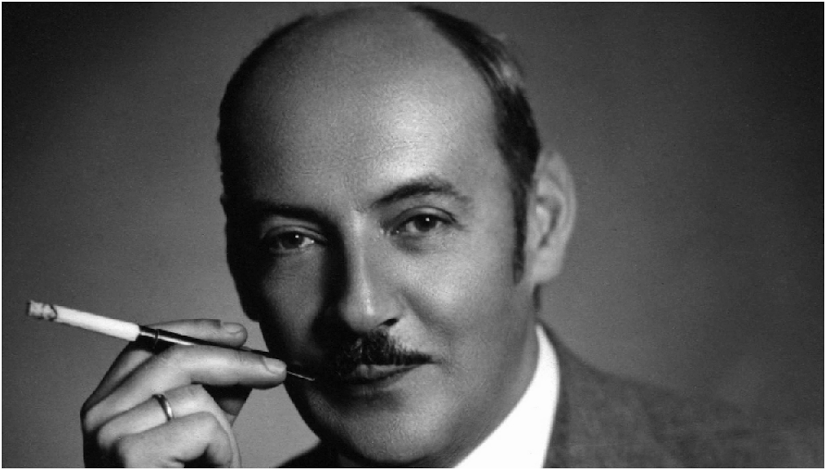
Albert Goering, looking elegant in this studio portrait from the early 1930s, was the brother of Nazi number two (literally– big, unflushed number two) Hermann Goering. Albert was quietly but resolutely anti-Nazi, and actively saved people during the Thousand Year Reich.  He was on the Gestapo’s radar several times, but Hermann stepped in to squash the investigations.  After the war he was imprisoned and interrogated with the rest of the war criminals at Nuremberg.  He was locked up for a long time before people he saved began to come forward and he was eventually released.  The rest of his life was pretty much fucked– his name was Goering.

Albert Goering

The Long Slog

I had the image of pushing a heavy, almost round rock up a steep hill. This is how my project often feels to me.  A friend told me that even if this Sisyphean image was accurate, thinking so was not a helpful way to imagine a difficult undertaking that requires patiently applied perseverance.

“Why not think of it instead as rolling a hoop down the road?” he said.

I did, and it was a huge help.  At first.  I have found, as time goes on, that the hoop is not completely round, that its edges are sharp, that it weighs as much as the rock I’d been pushing, that the road is gutted and long, and devilishly inclined, that cars now whiz by, often very close by, and rarely miss spraying a plume of filthy water.

“What else would you rather be doing?”  I ask myself.  I have no better answer than this, truly nothing engages my imagination and my various skills more.  So I continue slogging the long slog.  Strength to all of our arms!

Communist

Back before free markets ruled the world, before freedom was on the march everywhere, before we all enjoyed the true, universal democratic freedom afoot in the world today, there was a serious debate over the most just way to organize societies.   This debate goes back centuries, to the earliest times.  It was formally ended  by Ronald Reagan, already possibly demented, when he caused the Russian Communists to tear down the Berlin Wall, ending the Cold War between Capitalism (freedom) and Communism (repression).

During what’s known as the Enlightenment in Europe, after dim centuries of monkish superstition and misery, the lives of human individuals were put at the center of the debate.  For the first time inalienable natural rights were discussed– the rights to life, liberty and, in Jefferson’s felicitous phrase– the pursuit of happiness.  

Rhetorical phrases are just that, and how ironic or accurately descriptive they are depends on experience down here on the ground where most of us are compelled to live.  “Freedom on the March” means something different to those stirred by their president declaring it and those who find themselves homeless and orphaned, lives trampled by the boots of their liberators as freedom, not always graceful, marches in.  

But I am hopped up, trying to motivate myself somehow to get on with my day.  A thought, then, and into my work:

My grandmother grew up in a town in the Ukraine where Jews were treated harshly for centuries.   Two decades after she left all the Jews in her town were murdered, some slowly, the rest shot and left in a ravine in the summer of 1943.  When she was a teenager in Vishnevitz, for a brief period, the Russian Revolution brought the promise of freedom, equality and inalienable rights in the form of Communists on horseback, with machine guns mounted on carts, with books and organizers and the burning idea of shaking off centuries of murderous repression.  A bright girl, she seized on this hopeful dream and was, for the rest of her life, in spirit if not in actual party membership, a Communist.

Your grandma was a fucking Commie, you will say.  Yes, I will reply, and she was not wrong.  There was once a debate about the most just way to organize human affairs.  Karl Marx, whatever virtues and flaws were in his idealistic system, underestimated one thing: the fatal resolve of Capitalism.   Regarding the famous apocryphal Lenin quote that capitalists will sell you the rope to hang them with, they will.  Right after they’ve poisoned the last drop of water you will drink to wet your whistle after doing the sweaty deed.

The Wages of Futility

The contacts list on my smartphone has bloomed like an eruption of brilliantly colored flowers after a long early spring rain.  Color and shadow all over.  Childish designs in thumbnail, the grey and white face of Baron von Doghead, snips of my own drawings, the brilliant pattern of my favorite Origami paper.  

Wherefore do you cause your phone to be so beautiful, sirrah?  

It can’t be helped.  The minimum and maximum wage of futility are the same.  ‘Tis like the breath of an unfeed lawyer, as the Fool told Lear.  I’m preparing to exhale some of that breath in the Bronx Civil Court, alternating that prep with research on pink mucus in stools.  

Please, what are you on about?  

Creativity, man, for its own sake and for the sake of the joy it brings, cannot help but bring.  Drawing cannot be helped, for example.  In a grey, futile and slightly queasy day there is also this: invention, beauty, mastery.   These things are excellent in and of themselves.  

Package and sell them and they are even more excellent, if you can find a way not to make dainty little trollops out of them.

Screenshot_2015-04-21-14-50-27

“No worries of anyone making a dainty trollop out of me, boss”

We take our laughs where we can get them

There was a woman, a very good looking young woman, actually, who had a small business running after-school programs and seemed to grasp the educational and group dynamics potential of the student-run animation workshop.   When I increased the price to about double what the first after-school program was paying, she barely hesitated before agreeing to pay it.   Her assistant was a great and supportive fan of the workshop, she urged me to organize the little mini-animation festival I put on for the kids and their parents.  One day a week or so before the festival the usually cheerful assistant came in and told me her boss had died the previous day.  Cancer she never revealed to anyone she worked with had ended her life at 34.  Her business winked out of existence a few months later.

Fast forward a few challenging months and, temporarily (or permanently) out of public school programming, I am conducting a four session workshop for women with chronic serious diseases.  Some are in recovery from cancer, others show up straight from chemo, some show up once and not again, others make half the sessions.  A core of four is there every week.  These first time animators all produced very cool animation, worked beautifully together, got more and more demanding about seeing the day’s rough cut before they left, high fived each other at the end.   One woman in particular, Liz, was a great innovator.  She came in with brilliant and ingeniously different ideas week after week.  Her animation for the four sessions is here. 

She was excited about assisting at the recent Stevenson workshop, the first I’ve done since last summer.  The day before the workshop she was hit by the flu and couldn’t make it, she expressed her sincere regrets.  I assured her there’d be more sessions, promised she’d be at the next one, whenever I could arrange it.  A few days later I sent her the clip from the Stevenson session, telling her how difficult it had been and that she hadn’t missed much fun.  I didn’t hear back.  I wrote again a few days later, telling her I hoped she was up and around and that I’d be sending her the new website soon.

When the website was done I sent her the link, since she had grasped the idea so well and run with the ball so enthusiastically, once she’d had her head down on the table for the first forty minutes or so of each session.  I emailed her once more after not hearing back, and was beginning to fear the worst for this talented woman I barely know.  I have gleaned that she is living with cancer, and that it is not easy living.

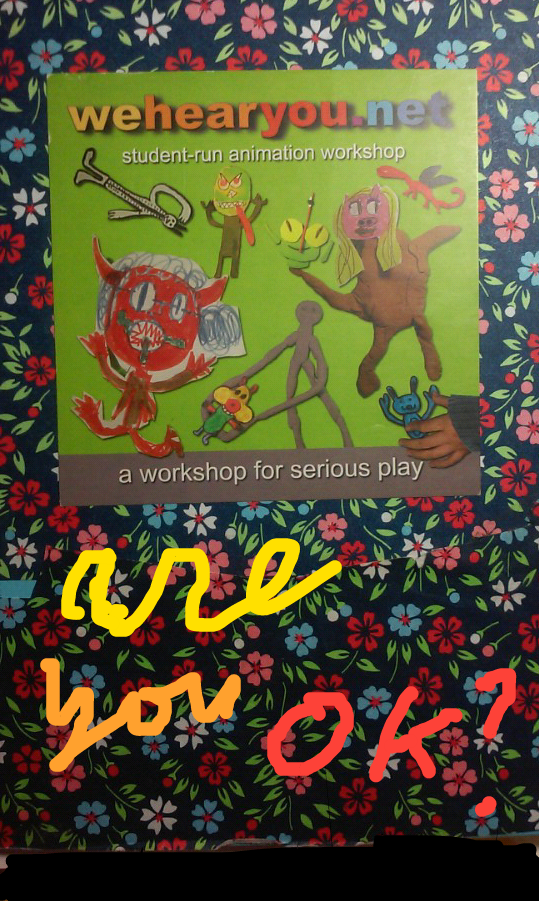
When I got a smart phone I texted her that I’d joined the 21st century, hoped she was over the flu and feeling better and added this picture.

Are You OK ?

Several days passed, and hearing nothing from her, I imagined the worst.  A gloomy thought twisted its way into my head: this workshop is the accursed kiss of death to the rare women who really get its potential and find it compelling.  

Then tonight, at 1:35 a.m. a tiny bell in my pocket sounds, and she’s texted:

Congratulations!  Sorry for the delayed reply.  I’m so so happy flowers are growing (emoticon of red flower) Rain makes it happen (yellow umbrella) Happy Spring!

I wrote back:

Thanks.  Good to hear from you — and happy Spring to you, too!

I hope you don’t have any objection to this wonderful bit of work being here (and I sent her the link)

3:42 a.m.  I’m glad you sent this.  I’m very upset and can’t sleep.  Seeing this animation was uplifting.  Thank you . … (emoticon of girl holding up hand)

3:45 a.m.  I’d share this on my Facebook (emoticon of two people holding hands) except one thing.  If it’s not too much bother, I’d like an edit…

Here I had an actual laugh.  A small one, yes, but genuine (nobody here to impress with a fake laugh) and, like I said up top, I’ll take me larfs where I can get ’em.

3:49  the part with the butterflies has the cat jumping in. (Cat head emoticon)  At one point its head changes to a dog.  That’s not my taste (slightly disgusted looking emoticon)

3:52  I’d post your page without hesitation if that part were eliminated (a series of emoticons animating a round yellow face bursting into a laugh)

3:55  Thanks for replacing maddening thoughts with delightful ones.

She made my day with that one.

4:08  I enjoyed Jesse’s project!  (gold star emoticon)  The patterns in the beginning are well done.  The tumbling guy has fun hair.  (emoticon of a thumb up)

4:14   I will try to sleep and think of (emoticon of rowboat, I think) being inside (angel fish emoticon) animation (some kind of water emoticon).  Thank you. (emoticon of little angel head with halo).

Honor Anemia

The man who made the case that many in our society suffer from Honor Anemia was himself a highly respected member of our civic society.   He was treated with deference in restaurants he frequented and he always handled this attention with smiling graciousness.   It seemed strange that the theory about people craving respect was his, but here it is:

We live in a society where many people feel disrespected.  They crave the honor of being treated fairly, recognized for their efforts, they suffer greatly from the lack of it.  If you give somebody a title, special recognition, it goes a long way.   Honor anemia can only be palliated by giving honor of some kind.

Dale Carnegie noted the same thing a century earlier, if you want to make friends and influence people, and sell things to them or get them to do you favors, you need to make them feel appreciated and important.   Carnegie, and my friend decades later, noted it and it will be noted again, as the lack of respect many people feel is a major cause of anger, depression and violence.   Anger, depression and violence– aren’t those really phases of the same thing?  

We live in a culture where the bottom line more and more requires the individual to be placed on hold, thanked for patience he doesn’t have, forced to talk to robots, get calls from recordings asking him to press numbers so he can get in line to speak to a human who will give him shit about something, usually a bill.   We live in a culture organized on the myth of the free individual and his inalienable rights, yet very few get to be treated as unique individuals.   Much suffering flows from this anonymizing of most of us.

“You think too much, you write too much and you’re giving me a head ache.  Would you do me the honor of shutting the fuck up, please, at least while I bolt this crappy, high-fat, low-nutrition fast food dinner I’m trying to get down?”

“Of course, sir, my bad.”