Two Jiggers, Elie

It’s an odd exercise, memory.   Things float in, connect with other things, sometimes the fragments form stories, other times they’re just fibers stuck between molars, impossible to remove and impossible to stop worrying with your tongue.  

I’m often told what an excellent memory I have, yet others regularly remember things in detail that I’ve completely forgotten.  It could be that those who praise my memory don’t recall the many things over the years I have irretrievably forgotten.  Maybe I do have a better than average memory.   I told a fragmentary little fifty year-old story to a friend the other day and observed that it belonged in the Book of Irv.  Afterwards I had no recollection of the story.  Then I remembered it.  Here it is.

My father got home from work one day with a funny story.  It was funny and it was bad, a bad story, though we had a good laugh about it back when I was about ten years old.  A black colleague of his was on his way home to Rochdale Village.  From the subway he took a bus to reach his apartment.  On the bus was an ad for Bacardi Rum, I think it was.  It had a recipe for mixing a popular new drink.   The recipe called for two jiggers of rum, a jigger of something else.  

“You actually looked up a jigger, didn’t you, to appear more erudite,” said the skeleton.

A jigger or measure is a bartending tool used to measure liquor, which is typically then poured into a cocktail shaker. It is named for the unit of liquid it typically measures, a jigger or shot, which measures 1.5 US fluid ounces (1.6 imp fl oz; 44 ml).[18] However, bar jiggers come in other sizes and may not actually measure a fluid jigger.

“A fluid jigger,” said the skeleton, impressed.

“He tells me ‘I’m heading home, tired as hell, and of course there’s no seat on the bus, why run enough buses to Rochdale so the people can sit down, you know?  I’m standing there and looking at this Bacardi ad that’s right in front of my face and some little asshole with a magic marker has corrected the sign to make my fucking day.   I’m reading ‘take three niggers Bacardi dark, two niggers Bacardi light, two niggers this, one nigger that.’  I’m standing on a bus, in my neighborhood and I can’t get away from it, you know what I’m saying Irv?  It’s literally in my face.  Irresistible to the little fuck with the marker, perhaps, but, I mean, Irv, what the fuck?'”

The skeleton, completely sympathetic to his friends’ torment, nonetheless gets a hearty laugh out of the story when he tells it to us.  So do I.  

“It’s hard to see him as funny,” my sister said the other day, “since he was so cruel.  He could be really sadistic.”  

“Your sister is a fluid jigger,” said the skeleton. “Look, obviously, humor is a defense mechanism and its hilarious or not depending on the context.  It often comes at the expense of somebody else, quite often a person with more power, or someone perceived as having more power, or trying to get it– you know, to take them down a peg.  What we can’t do in the world, which is a brutal place, we can do with a droll aside to the person next to us.   It must be said with a straight face, because when the person next to you cracks up he gets a rifle butt in the ribs, a kick in the stomach when he’s on the ground.  You must look forward as he’s getting his ass kicked for laughing, and show no emotion whatsoever.”

What are you talking about, dad?

“Humor is a defense mechanism.  It’s the best there is in many circumstances, and there’s nothing like a good laugh to cleanse the emotional palate, to remind you of the sweetness of life, even, and especially, when life is most bitter.  It’s a good defense mechanism, except against things like clubs, nooses, brass knuckles, guns.   I mean, you can laugh about those things, but don’t get caught laughing.  That’s all I was saying.  

“A joke…you remember those sections you read about humor in the Third Reich.  There was state sponsored humor, you know, which you’d hear on the radio, or told by the local gauleiter and such, how funny it was that Jews actually thought they were loyal Germans, things like that.  Which is kind of funny, in a sick way, if you think about it.  Nazi humor was not to everybody’s taste, but as long as they were winning a lot of Germans found it hilarious, or pretended to.   There was another school of humor that could get you killed.  People made jokes about Hitler, Goering, Goebbels, at the risk of their lives.  

“You remember what the ‘Hitler Cut’ was, right?  Castration.  If they heard you refer to the Hitler Cut, one of the Fuhrer’s favorite correctives for bad comedians, you’d get… that’s right, the Hitler Cut.  Funny, no?”

Not really that funny, no.  Some would accuse me of being obsessed with Hitler as it is.  

“Well, why wouldn’t you be?  He was the driving force that whipped centuries of anti-Semitism into the frothy intoxicating sludge swilled by countless murderous mobs over the course of his thousand year Reich.   Some of these hopped up people killed our entire family, outside of the half dozen that made it here, to the Land of the Free and the Home of the Brave.

“But you know, on a more serious note, maybe your sister was right.  I mean, on the one hand, I was funny, I made a lot of people laugh.  I had a quick wit, let’s say, I was irreverent and I saw the dark side of things clearly and mercilessly.  On the other hand, how funny can somebody be if they also are cruel? That’s a fair question, you know?   Now that you know Bill Cosby was a serial rapist who drugged otherwise willing women so he could diddle them while they were unconscious, do you still find his pudding commercials that adorable?   I remember you had this discussion with your mother, could someone be a great artist and also a Nazi?”  

Interesting you bring that up.  I had a great moment of clarity on that issue the last time I saw Florence Siegel.  I’d gone to visit her in Brooklyn, she was 92 and living on the ground floor of her daughter’s brownstone.  The question came up and we both immediately agreed that it was impossible to be a great artist, or any kind of artist, if you were a hater of any kind.  Negates whatever else the pretentious fuck is attempting to communicate, pollutes it, makes it disgusting.  It was so clear to both of us in that moment, it was hard to imagine my mother and I had ever puzzled over it.  Three days later Florence was found dead, the New York Times spread in front of her and a bowl of M & M’s next to her.  

“Way to go,” said the skeleton. 
Shopping for Grandma’s coffin with my father

I had nothing to do with the inscriptions on my grandparents’ tombstones.  My father’s parents were gone long before I arrived, and my mother’s parents, buried in a section marked by a monument to the slaughtered Jews of Vishnevitz,  got the standard beloved parent and grandparent things chiseled into their headstones.   Thinking about it now, they were the only two family members of their generation to be buried in coffins.  

It was my father’s parents’ headstones in a parched area of the First Hebrew Congregation of Peekskill cemetery that got me thinking.  My grandfather was immortalized in Hebrew as a “simple, straight man.”   I don’t recall at the moment what is carved into my sainted paternal grandmother’s stone.  It was “simple and straight” that I read and translated off my grandfather’s headstone that caught my attention.

“Yeah, Ben came up with those epitaphs,” said the skeleton, from his grave on top of the hill, closest to the road but also above all the other graves in the cemetery.  “He was a rabbi, he knew Hebrew.  I guess with my father that was the best Ben could do.  You notice they’re buried in a crowded little area at the bottom.  That was the pauper’s section, you see how the stones are crammed together down there, some of them are crooked?”  

I had noticed that.  I also took care to come up with accurate Hebrew epitaphs for my parents after my mother picked out their headstone.  My father is immortalized on his headstone as “איש צנוע ונבון” a modest, brilliant man.   My mother’s inscription, which I labored long to find, reads “לב  של משוררת” heart of a poet.

But this is years earlier, when Yetta died a long, painful, clawing death from colon cancer.   She died in the bedroom I grew up in.  I remember how deathly her feet looked after she finally gave up the ghost.  They seemed unnaturally long, stretched, the toenails dark.  My parents were at that time considerably younger than I am now.  I went with my father to the funeral parlor on Queens Boulevard.  

The solemn salesman in the dark suit took us into the coffin showroom.  He guided us toward tasteful, beautifully finished coffins, with polished brass, or even gold, handles and trimming, some costing thousands of dollars.  Years later Sekhnet’s cousin, who died suddenly at 62, was buried in one of these Cadillac coffins, a stately mahogany model that gleamed next to the open grave.  It appeared to be top of the line.  His grieving sons had a lot of money and his dying wife, who had never expected to have the love of her life go before her, probably endorsed the expenditure.   

“This is a beautiful model,” the salesman in the black suit said.  My father and I pretended to inspect a $4,000 model, my father cutting his eyes toward the price tag and nodding to me.   We eventually selected a more modest one, I don’t remember the price, but it was one level above the plain pine box.  The coffin salesman, who clearly worked on commission, was disappointed.  When he saw where this sale was heading, he had pointed to a shoddy looking particle board coffin behind the door and said, dismissively, that it was their least expensive option.

“Did you see how that floor model of the particle board coffin had a warped lid?  I mean, you couldn’t even hammer the pegs in to get that sucker to close,” chirped my father cheerfully as soon as we left the disappointed ghoul at the funeral home.  We laughed about it, and the whole solemn dance the respectful slug in the black suit had performed for us.

“When I go, I want a plain pine box, remember that,” said my father that summer day in 1979.  

I did.

The $64,000 Question

There was a televised game show of this name, around the time I was born.  It was one of those hits of early TV that everybody stayed inside to watch when it was broadcast live.  The streets would become deserted, apparently.  Crime numbers dropped to zero while the show was on.    President Eisenhower did not want to be disturbed during the $64,000 Question.  The producers of the show would soon enough be hauled before Congress for fixing the show, but that was after a few years of fabulous success.

One night at dinner my parents described my father’s appearance on a live TV game show.  The show could not have been, I’m sad to say, the famous $64,000 Question, which I just read up on, but due to that show’s popularity it’s safe to assume there were many imitators.  My internet research did not reveal the name of this imitator, but my father was a contestant on the show.  Either I was a very young baby when he was on TV or it was just before I was born.

On this show the contestant stood in the gondola of a hot air balloon.  If he answered the question correctly his winnings went up.  Each time he answered incorrectly a tether rope holding the balloon to the ground would be cut.   When the last one was cut the balloon floated up out of camera and the contestant was done.

My father stood in the gondola and answered the questions.  I don’t recall how well he did, although he certainly did not win life changing money.  He had an excellent memory and a good command of history, current events, sports and general trivia.  They cut a rope whenever he missed a question.  He was hanging on by one rope when he missed another question.

My mother was watching this on live television, with everyone in the neighborhood.  My parents lived at the time in a garden apartment complex called Arrowbrook.  They were one of the first couples to get a TV, from what I understand.   Everyone gathered to watch my father on the game show.   One family was Mexican, as far as I can recall.  They had a little boy.   

When my father missed that last question they cut the last rope and my father waved as he floated off.  The little boy called out “bye bye, Irv!”


Redacted and Misdirected

It is very difficult to ever know, let alone fully relate, the complete story about anything.  This is especially true when recalling a parent, relying on memories of your early life, seen through the veil of your own perceptions and in light of how the events remembered affected you, how they played out later.

There are facts, actual events, specific words spoken, which can be shown with some degree of certainty (as with a recording or in a letter or diary), then there is the way these undisputed facts are spun by each party according to their needs and how they play into everything that follows.  When reconstructing our past each of us is, of necessity, an inventor relying on a good deal of conjecture, based on our experiences and prejudices.

“That’s a proper observation at this juncture.  That’s what critical history is supposed to be, the nuanced exploration of historical artifacts, placed outside of conjecture and prejudice, shown in light of the actual effects the artifacts produced and good luck with that enterprise.  Life is much more an art than a science, as I’m sure you’ve noticed,” the skeleton said.

“You were brought up short when your sister was momentarily stunned when you mentioned my keen sense of humor yesterday.   How is it possible, you wonder, that your sister could not remember the many great laughs we had together, even on some of those merciless battlefields where we spilled each others’ blood?”

It was surprising, I have to say, that she had no immediate recollection of your dark sense of humor.  You were almost always a prick, and grimly determined to win every ‘battle’ at any cost, there was no price too high for you to pony up, but you were also, without a doubt, a clever, funny man with a distinct and sardonic wit.  

I reminded my sister of how Arlene and Russ would howl at your tossed off remarks.  I reminded her of Murray Susskind, gasping for breath, completely at your mercy that night he came to dinner.  Over and over he wheezed “oh, that’s funny!  oh, that’s funny!!!!” as he struggled to breathe and howl at the same time.  We thought at a certain point he might die of laughing while trying to explain how funny it was.  My sister barely recalls that.

“Go figure,” said the skeleton.  “Memory is a funny thing.”

I’ll tell you something that’s not funny– crucial things that are never told.   You taught me on the one hand to operate like a critical historian, get the facts, primary sources whenever possible, weigh the competing versions, give credence to the version that aligns better with the agreed on facts.   At the same time, you gave us a very spotty, redacted version of things that was tailored to your need to control every narrative.

“We’re back to the abstractions that were your mother’s twelve murdered aunts and uncles and their entire families?” asked the skeleton wearily, warily. 

That’s the most striking example, yes, but it’s one example.  Look, I understand you were at a loss to tell your nine year-old that he was right to be upset by the shooting of everyone in his mother’s family, not to mention everyone on your side of the family.  This was not ancient history, after all, it had happened about 20 years before I found out about it.  OK, you couldn’t open that painful can of worms, fair enough.   What you did, though, was much worse than just clamming up about a difficult subject.  

“Here we go,” said the skeleton, “haven’t we already had this out, haven’t I already apologized, told you it was unforgivable?  What is it you fucking want from me now?  I’m dead, if you haven’t noticed.”

When you redacted those people from history you felt it necessary to give me something else to chew on.  Your reaction was not to acknowledge an unknowable horror and explain that it was impossible for you to think about what happened to them because the pain was too great; you turned it into a chance to tell your son that he was being an overly dramatic little wimp whining about a few dozen people with his DNA, not one of whom he never knew, who were, tragically, machine gunned into a ravine.  

That’s what I was left with, from the authoritative source that was my father, that I was being the whiny asshole for inquiring, for having strong feelings about, the terrible subject.  That is what is necessary for the reshaping of history, recasting the story completely into a counter-narrative.  You made the story about my weakness, as a narcissistically dramatic nine year-old, not someone seeking to understand an incomprehensible horror you could not touch yourself.

“Well, you were a kid with a hyperactive imagination, subject to nightmares, and that was my sick way of trying to protect you,” said the skeleton.

A sick way, we can agree now.  What was the necessity of making me feel like a weak, melodramatic little turd for asking about the slaughter of our entire family?   It closed the subject once and for all.  Like you were saying: suck on that, asswipe.    

“Well, that’s a harsh way to put it,” said the skeleton, “but accurate, I suppose.  But you are making a larger point, I suspect?”

I am.  The most brutal enemy of the seeker of truth, or at least understanding, is secrecy.  In our origin myth, we the People are an informed populace participating directly and knowledgeably in deciding the issues that effect us all.  In reality, the information we have to base any real discussion comes to us in a carefully controlled trickle and our influence on policy nil.  The record we get access to is increasingly redacted, classified, off limits.  There can be no free and open discussion about facts that are hidden.   

This was the way it was in our house growing up.    You redact something shameful and then, whenever there is an attempt to dig deeper, you bury it in further attacks on the digger.

“Well, I was a master at that redirection, misdirection.  I really was.  Not to pat myself on the back, but framing the discussion, as it took you more than forty years to figure out, is 99% of winning the argument.  That’s why conservatives have spent millions and millions creating terms to frame every debate: right to life, death tax, collateral damage, friendly fire, Second Amendment.   ‘A well regulated militia, being necessary for the security of a free state…” spun, by the brilliant and destructive Scalia, is now an undisputed American individual’s right to keep and carry guns and ‘Second Amendment’ is all you have to say.  Redirection is most of the game, and redaction certainly helps in that, the less real information available, the easier it is to misdirect the conversation,” said the skeleton.

“When you don’t want discussion of something uncomfortable, shift the ground.  It is no longer about a secret kill list that the president signs off on now, launching deadly attacks in dozens of countries by drone, it is about disloyal Americans seeking to endanger national security by prying into these highly classified national security areas.  You see how that works, right?  It’s not about whether killing all these people is right or wrong, whether it makes us safer or increases the resolve of those who hate us, it’s not a question of a precedent an American president can be happy to set for President Trump, it’s about keeping the entire program as secret as possible.  I know I’m preaching to the choir director,” said the skeleton.  

Indeed you are, pop.  I heard a JFK speech yesterday that spoke so eloquently to this very issue.   As to the importance of free and open access to the facts the citizens of a free society deserve to know, JFK said it all, then they killed him.  

The very word “secrecy” is repugnant in a free and open society; and we are as a people inherently and historically opposed to secret societies, to secret oaths and to secret proceedings. We decided long ago that the dangers of excessive and unwarranted concealment of pertinent facts far outweighed the dangers which are cited to justify it.

…No President should fear public scrutiny of his program. For from that scrutiny comes understanding; and from that understanding comes support or opposition. And both are necessary. I am not asking your newspapers to support the Administration, but I am asking your help in the tremendous task of informing and alerting the American people. For I have complete confidence in the response and dedication of our citizens whenever they are fully informed.

I not only could not stifle controversy among your readers–I welcome it. This Administration intends to be candid about its errors; for as a wise man once said: “An error does not become a mistake until you refuse to correct it.” We intend to accept full responsibility for our errors; and we expect you to point them out when we miss them.

The text of this wonderful speech to the American Newspaper Publishers Association is here.   

“Yeah, it was a great speech, justly famous in its day, one more reason the people who loved him so much loved him.  You know, he was fucking all kinds of women in the White House, and the press kept quiet, he was doing plenty of secret things, like all presidents do, but this was a great statement of our democratic values.  JFK was a lot like Obama in that way, off-the-charts rock star charisma, intelligence and elegance in stating our deeply held beliefs,” said the skeleton, watching a red-tailed hawk make off with dinner struggling in its talons.

“You know, Elie, it’s virtually impossible to tell anyone’s story in a way that makes sense.  A man with all of my gifts should have done a much better job as a father.  Instead of using my powers for good…” the skeleton continued to watch the raptor carry his next meal away.

As I told you as you were dying, you did the best you could.  That’s all a person can do, the best you can.  Do we hope to be better than we are?   The most idealistic among us, for sure.  

“How do you keep idealism alive in a world that stomps it lustily with every step?” asked the skeleton.

The $64,000 question, dad.  

“Hey, tell them about my appearance on that game show, would you?”

OK.


Irv and Mom

The woman who gave birth to my father always called him “Sonny” just as she always whipped him in the face when he was first learning to stand.   There was a terrible distance between Irv and his mother Chava, I always got the feeling, though Chava died young a few years before I was born and so I never got to meet her.  I don’t get the sense that my father ever trusted his mother or felt very close to her.  Why would he have?

It was his mother-in-law, Yetta, who he called Mom.  My father adored Yetta and Yetta loved my father unconditionally.  In Yetta Irv found a mother’s tender love for the first time.   Beyond that, he was Yetta’s clear favorite, the number one son she’d never had, my mother being her only child.   Yetta was a dynamic, opinionated, bright and talented woman who inspired hyperbole.

“Your grandmother could make a battleship with a needle and thread,” my father rose to the heights of poetry to tell my sister and me.  Yetta had worked for a famous designer, Helena Troy, perhaps (my mother would know the name, but she’s silent on the matter now) attending fashion shows to steal the ideas of other designers, which she would smuggle out in her head, committing them to memory and making the mock-ups without patterns or, apparently, any hesitation.  She was a genius dressmaker, had been since she was a girl.

“She had a business in Vishnevetz, making clothes.  She had several women working for her, she was still a teenager,” my mother told me once.  It didn’t surprise me.

“Grandma could have been the first female president of the United States, if she’d been born here,” my mother told me from time to time.  I never gave it any credibility, Grandma was not, to my knowledge, a great reader, or a serious student of politics, or a born organizer or a party stalwart or any kind of expert in the distasteful arts all professional politicians must master.  She had strong beliefs she was deeply committed to. She was blunt, brutally honest and unable not to be.

“I know, I know,” she would say sympathetically, smiling warmly, waving her big hands after a cruel remark came out of her mouth, “the truth hurts.  I know, I know….”

That Yetta and Irv deeply loved each other there could be no question.  In fact, I’m pretty sure Yetta had a hand in choosing Irv as a husband for her rebellious daughter Evelyn.   Evelyn had been born Helen, didn’t like the name and changed it to Evelyn.  A beautiful girl, extremely bright, with a good sense of humor and a lively personality, Evelyn had numerous suitors.  Yetta locked horns with the most persistent of these suitors, a handsome, dashing, headstrong fellow named Art Metesis, a young man her daughter was madly in love with.

My mother and Art wanted to get engaged, may have already become engaged.  Yetta would not hear of it.   Like Aren and Tamarka busting up young Chava’s romance with the red haired Jewish postman, like Chava and Eli busting up young Irv’s romance with that Connecticut widow, Yetta apparently busted up the romance between her daughter and Art.

After my mother died I searched everywhere for the blue leather- bound poetry journal I remember my mother having when I was a kid.  In the very last box I found not the notebook, but a folder with about a dozen poems, most of them corny ones written for her fellow senior citizens on special occasions.  One poem was a passionate love poem I scanned and sent to my sister.  My sister blushed when she read it and said it was surely not written to our father.  It had, to the best of my knowledge, been written to Art Matesis.

Art was hot-blooded and so was Yetta, when it came down to it.  There was a horrible scene in Yetta’s kitchen on Eastburn Avenue, just off the Concourse, and nobody was backing down.  At the climax of this shouting match Art apparently crushed the glass he had been holding in his hand, in a show of superhuman strength, and left, one imagines, cursing and bleeding.  As far as I know my mother never saw Art Matesis after that.

I don’t know how long it took, but Yetta eventually convinced her daughter to go out with Stamper’s cousin Irv.  Stamper was Yetta’s good friend, Dinsche was her name, and the Stamper she married was a Communist and all around good guy.  Dinsche grew up in Truvovich and had come over on the same boat with her cousin Chava, my father’s mother.  

Chava would bring the boys on the train from Peekskill and they’d visit their cousins a few floors above my mother’s apartment.   My mother’s kitchen window looked out over the courtyard of her building, it was on the first floor.  She glared at the two hicks from Peekskill as they walked toward the front door, following behind their evil looking little religious mother.  

Yetta eventually convinced Evelyn to go out with Irv, who Yetta thought was a wonderful boy.  Evelyn eventually relented and went out with the hick, just to get Yetta off her back.  To her amazement the hick was urbane, funny, self-effacing and seemingly interested in, and informed about, everything.  They went out again and had another great time.  Yetta welcomed Irv with great shows of warmth that must indeed have warmed him.   After a short while Evelyn and Irv were going steady, then engaged and then married. They made a handsome couple on their wedding day.  My mother adored Irv, maybe more than Yetta herself did.  

My mother almost always took my father’s side and so, for the most part, did my grandmother.  There is only one incident I can recall when Yetta took my side against both of them.   I had been on crutches for a month, and my first day off crutches, on a blazingly hot Saturday, my father kicked me out of the Jewish camp he directed and made me walk a few miles up hill to the nearest restaurant to wait out the Sabbath.    

Ironic, the timing of the injury that put me on crutches.  The near severing of my left flexor hallicus longus,  the long tendon on the underside of the foot that moves the big toe, happened on Father’s Day, 1978.   The Yankees had just had their asses handed to them in Fenway Park, I’d been in the bleachers watching the Red Sox use the Yankee pitchers for batting practice, launching countless home runs over our heads.  

We were cooling off after the game in an icy pond in Wellesley.   When I put my foot down, feeling for the muddy bottom, I felt a sharp sting.  My friend almost fainted when I held my foot up, urged me not to look at it, there was blood everywhere.  He had me keep pressure on it as we rushed to a doctor.   Apparently the sting had been a slice from a razor sharp broken bottle on the bottom of the pond, the severed tendon was hanging out like a gruesome white tongue.   When the shock passed, and the pain killer wore off as the sun was coming up the next morning, I woke up in agony that must have been similar to crucifixion.  I hopped into the next room and woke my friend who dashed off to a 24 hour pharmacy and brought me more pain killers.

The doctor had warned me not to put any weight on the foot for at least a month.  “If you do,” he said, “you will never dance again, never run, never walk properly.  You will tear that flexor, which is more than 3/4 severed already, and that will be that.  If you let it heal, you will be fine.”   He didn’t have to tell me twice.  I had no intention of never again chasing down a long fly ball in the outfield of Inwood Park.

I’d been off crutches a day or two when my girlfriend’s father offered me a ride past the camp where my parents worked.  They were on their way to a bungalow a few miles away.  I hadn’t seen my parents in a while, and the plan was that the following day my girlfriend and I would spend the day at camp, where she had also gone, and head back to the city in the evening.  For some reason, a loudmouth I knew slightly also hitched a ride with us.   My girlfriend’s father dropped the two us at the camp and continued on with wife and daughter to the bungalows.  

The loudmouth immediately began braying loudly like the donkey he was, trumpeting our presence as we walked, waving his muscular arms over his head like a returning hero calling for applause.  I told him to keep the noise down, not really sure about coming into the camp on a Saturday, although we were walking, not riding in a car, which is forbidden to religious Jews on the Sabbath.   He told me to calm down, that my father was the director of the camp and that nobody was going to do anything about it.  He continued to bray and strut triumphantly.  

Word of our arrival reached my parents’ cabin before I did, and my father was already furious when I got there.  “What the hell is the fucking thought process here?” he wanted to know.  

I explained that we hadn’t driven on camp property, were obeying the laws of the Sabbath, I’d told my acquaintance to be cool but he was, apparently, incapable of it, and so forth.  My father was not having any of this.  

“You know exactly how this makes me look, and you did this deliberately,” my father said.  “I can’t have one set of rules for the camp and another set for my son.  You can’t stay here. You have to leave.”  

My mother protested, “Irv, it’s a hundred degrees outside, there’s no place for him to go within miles, he just got off crutches, can’t he just stay in the house until Shabbat is over?”  These were all reasonable  arguments, but my father was having no part of them.

“Well, good shabbas and fuck you too,” I said, leaving their little white cottage, the screen door slamming behind me.  Up the long steep hill on the rocky road, along the gravelly shoulder of the parched highway for a couple of miles.

When my grandmother found out about this, she was outraged, did not take kindly to my father’s position.  My mother tried to justify it and Yetta uttered the immortal line, in Yiddish.  “You stick to his ass like a wet house dress!” she said.  The ass being a tuchis and the wet house dress being a nassah shmatta, a wet rag.

Outside of this one incident, however, I remember no other time Yetta found fault with her beloved son-in-law Irv.

Truvovich to Vishnevitz

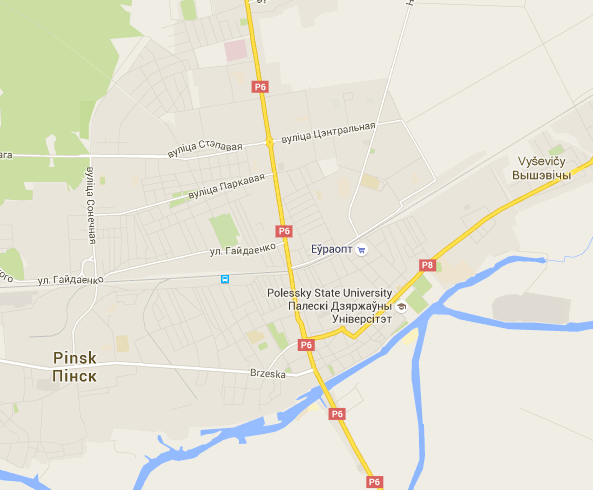
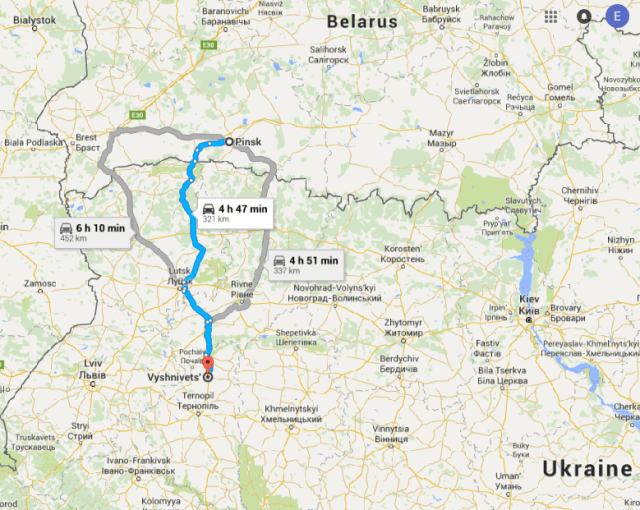
My father’s mother came from Truvovich, just across the Pina River from Pinsk, as far as I can tell.  My mother’s parents came from Vishnevetz, about 200 miles due south of Pinsk.  

Today the 321 km. can be covered by car in under five hours.  In 1922, the last time any of them where there, the trip, by horse drawn cart, would have taken about thirty-three hours on the dirt roads, assuming they followed the route of the later highway.  The horses would have had to stop every so often, so it would likely be a trip of four or five days.

In any case, it would take a well-calibrated time machine to make that trip to visit anyone in my family.

Screen shot 2016-07-08 at 8.13.54 PM

Looking for Truvovich

“I don’t know why it actually matters where it was on the world map,” said the skeleton.  “It’s gone, irretrievably, and all the people who lived there, outside of Aren and my mother, they were disappeared along with the place itself.  

“You found out the dates the Jews of Pinsk were massacred in those aktions, as the Nazis used to refer to those long days of genetic cleansing, you wrote to Azi about that.  Find the email,” said the skeleton.  

The pertinent part of the email reads:

On 4 July 1941, the Nazis occupied Pinsk. Within a few weeks they established a Judenrat and in the first week of August conducted aktions, murdering about 11,000 Jews by gunshot and burying them in mass pits. The Pinsk ghetto was established on 1 May 1942, and more than 3,600 of its some 10,000 inhabitants worked outside of the ghetto. On 29 October–1 November 1942 the ghetto was liquidated, with approximately 10,000 Jews shot to death. Less than 200 essential workers and others were herded into a “mini-ghetto” in Karlin and murdered on 23 December 1942. When the Soviets liberated Pinsk on 14 July 1944, they found 17 Jews surviving in hiding.

“So, does it make you feel better to know what happened to Chaski, Yuddle and Volbear, if they were still alive, and to any children and grandchildren they might have had?  In those years they would have all been around 60 years old, if they’d lived that long in Truvovich,” the skeleton either yawned or grimaced, it was hard to tell.  He could have been roaring too, I suppose.  

No it doesn’t make me feel better, not really.  For some weird reason knowing that Truvovich was probably on one of these three spits of land divided by the Pina River, on the southeastern border of Pinsk does make me feel a tiny bit better, though I’m sure I could not say why that is.

Screen shot 2016-07-08 at 1.32.21 PM

Preface [stab #1]

When Pat Conroy died, NPR played a piece of an interview with him that struck me.  He said that he writes to explain his life to himself.  I realized I’d been doing exactly this, in concentrated form, for a couple of months at that point, for years, in one form or another, before that.  

Conroy, a highly successful writer from a young age, with a series of valuable mentors and all the adulation and reward a writer could want, found himself paralyzed and suicidal at various times, unable to overcome the traumas of his earlier life.  His father had been an angry, brutal man.  

My suffering has been much less acute, though my father, without using his fists, hit as hard and as relentlessly as Conroy’s paternal tyrant.  Relative suffering, I believe, is largely a matter of luck.  I think Conroy must have known, as I know, that one can never fully explain this inexplicable life to oneself, coherently as one might set out parts of it for somebody else.  

I am attempting to describe the contradictory life of my father as clearly, colorfully and three-dimensionally as possible.   I hope this account will be engaging and, also, resonant and useful to others who have experienced the terrible accident of a damaged, inconsolably angry parent.   Although my father and I were adversaries for virtually his entire life, we are adversaries no more.  For his whole life he was determined never to lose, even to someone who posed no threat to him.  It was an idiotic determination, but I no longer judge him for it.  

In the end, he was grateful to have been so wrong about the possibility for human growth, something I demonstrated one last time as he struggled to make sense of things in those final hours of his life.  The tragic poignance of his life overwhelmed the anger of it, at least for me.  The lesson I take from the long struggle with my sensitive, insightful, witty, often willfully blind father is that one can overcome almost anything, given enough motivation.  His life gives me abundant motivation.

 My father’s funeral service was conducted by a gentle soul with a beautiful voice who had long been liberated from the need to earn a living.   When he left the work place for good over creative differences a former colleague observed that it’s probably easier to have artistic integrity when your wife is a millionaire.  Today, for a variety of irrelevant reasons, I am no longer in touch with the gentle volunteer cantor who so movingly read the eulogy at my father’s open grave, chanted so hauntingly.  I am confident he isn’t aware of my silence. 

My father was a very judgmental man.  For his part, he would have snorted derisively about this kind of gentle, pampered soul, seemingly buzzed on his talents, the humble servant of his artistic passions and others’ appreciation thereof.  I have to own the judgmental tendencies the old man imbued me with.  They will no doubt be on display throughout this ms.  I leave it to an able editor to one day comb through these pointed prejudices, leaving only those that advance the telling of my father’s story.

It was not long after I began writing these pages that my father’s skeleton began piping up.  Although long dead, he understood my project immediately, and though he sometimes expressed paranoia and anger, sometimes scoffed, he remained keenly interested in the project from the beginning, as one might expect the subject of a biography to be.  As often as not he was gracious and understanding, as he might have been had he been given the chance to proceed from the last conversation of his life, the first time he’d ever apologized for the harms he had inflicted.   More than once his comments or insights surprised me, even as I had apparently made the words come out of his sardonically grinning skeletal mouth.

“You are walking a tightrope, Elie,” the skeleton said. “Trying to make the reader care about a person who was in many ways a monster.  I realize the supreme difficulty of that.  The things I did to you and your sister were not normal, not healthy, were in no way defensible or excusable.  The fact that I lived to be almost eighty-one without ever apologizing for the harm I caused, or even taking responsibility for my sometimes insane actions, is enough to make most people close the book on someone like me.  

“That I was only able to ask forgiveness at the very end of my life, through the dumb luck of having a son who had done hard work to reach a place of acceptance, is pitiful. If you hadn’t been so mild that last night of my life, I’d never have been able to tell you how sorry I was.  You allowed that spark of decency in me to burn as a flame one time before I breathed my last.

“I have to give you credit for attempting this seemingly impossible work.  I don’t know exactly why you are doing it, or why start with my story, but I appreciate the fair treatment you are trying to give me.  God knows, I never treated you very fairly.  

“I know you understand, finally, what I tried to explain to you the last night of my life. The enmity I expressed toward you was truly nothing personal, as hard as that is to understand, coming from the person who is supposed to be your father.  You grasp what Arlene told you that time on the hill near her home: it wasn’t you– it was me.  You could have been any kid in the world, I would have acted the same way.  Nothing I ever did held my demons at bay for more than a moment.  You and your sister didn’t have a chance against the demons I was battling.  I give you credit for a life long struggle not to be the kind of person I was.”

Life long struggle it is.  Bon voyage and enjoy the trip.

Leah and Azriel

My father’s mother, Chava, came from the doomed Belarusian (then Polish) town of Truvovich.  More of a hamlet than a town, from what Eli told me.  As far as I can tell it was on an elbow of the Pina River just southeast of Pinsk, a short ferry ride from that Polish city.  My uncle always said the family was from Pinsk.  My father’s cousin Gene told me that Truvovich was on one tine of a three tined fork in the river, on the other two tines were Vuvich and another muddy hamlet with a similar name.

There is no trace of any of the three hamlets anywhere now. My numerous searches, and the searches of a friend in Poland and my cousin in Israel, who spent a day with the researcher from Yad Vashem, have all come up empty.  There is one further source, a large format world atlas my friend’s uncle had, printed circa 1935.  The town should be in there, now that I know where to look.

I have seen two pictures of my paternal grandfather, whose place of origin in Eastern Europe is unknown to me.  I’ve seen perhaps a half dozen photos of my grandmother, born and raised in Truvovich.  I was surprised when my uncle told me to make sure to take the two framed portrait photos of his grandparents when we were emptying his house for sale.  He was in assisted living at the time, needing the assistance because he lost the use of his legs after his stroke.  

His mother had, apparently, lugged the two almost life sized head shots, in their heavy wood and glass frames, across Poland to the port and then across the ocean and from Ellis Island to her brother’s home, then to a couple of slum dwellings on Manhattan’s lower east side, then to the house on Howard Street in Peekskill where she lived out the rest of her life.  

My uncle was a meticulous man, and though he hadn’t seen the photos in a long time (and I’d been unaware of their existence until then) he told me they were in one of three places.  I was intrigued by the existence of these portraits of my great-grandparents.  My search of the attic, basement and other likely storage place, like my search for Truvovich, turned up zip.  

As we were leaving the house for the last time something told me to look in the sunroom.  For some reason, probably related to her encroaching dementia, my aunt had locked the sunroom.   We unlocked it and went into the airless chamber.  Looking around there was really no reason to look behind the white wicker couch against one wall of the pretty much empty room.  Yet that’s where the two portraits stood, against the wall behind the couch.  I studied their ghostly images (probably captured in a photographer’s studio in Pinsk early in the twentieth century) and tried to imagine their life in that vanished little town.

Leah and Azriel Gleiberman, my father’s maternal grandparents.

image

Man who kills his 14 year-old not guilty

I watched Hillary Clinton give a speech in North Carolina this afternoon, it was broadcast live on MSNBC.   She did pretty well and then gave way to the Campaigner-in-Chief, one of the great campaigners in American history, President Barack Obama.  As Mr. Obama hit it out of the park over and over, smiling, loose, feeling good, interacting smoothly with the audience, there was a constant loop of texts crawling over the bottom of the screen.

This constant flashing of unrelated text and images on the screen during other programming is a relatively new thing that has quickly become ubiquitous.  Advertisers and sales executives realized there was valuable real estate at the bottom of the TV screen going completely to waste.  Now, during many shows, ads for other shows will pop up, little characters cavort, ads and other messages scroll continually.  The modern American attention span is not fractured enough, I suppose, so why not put another 60 penny nail through its nervous system?

As the president spoke there was a scrolling caption about South American authorities looking for a former Guantanamo detainee, out finally and apparently mad as hell and hating somebody’s freedom.  Then this bit that caught my eye:

Father who accidentally shot his 14-year old son at a shooting range will not be charged, witnesses and surveillance video confirm the shooting was an accident.  The boy, apparently an asshole– the father, no intention of shooting the contumacious little bastard in the face and killing him, the kid is dead and so be it.  A well-regulated militia being necessary for the security of a free State, and so on and so forth, witnesses say the kid was shot by accident, so does the video footage.  Video footage does not lie, neither do witnesses.  Case closed.  Stay tuned for details of this purely accidental tragedy at eleven.

I could not help but make the immediate connection to Trayvon Martin, the black kid shot by an armed white man who’d taken it on himself to patrol the neighborhood and confront the kid with deadly force to find out what a black kid was doing in his neighborhood with a bag of Skittles and a cell phone.  The boy was shot after a possible struggle and Skittles were found near the dead boy.  

The boy, we learned, was four inches taller than the man with the gun and, at 17,  was fit, while the young man with the gun, at 5’7″ and 204 pounds, was ‘clinically obese’.  The boy’s blood tested positive for recent marijuana use, and so there’s that.   He is alleged to have used the f-word and not shown this armed civilian the least bit of respect when the white man got out of his truck to confront the boy and “stand his ground” with a handgun, as he was permitted to do under a Florida law underwritten by the Koch Brothers and their ilk, operating under the name of ALEC (American Legislative Exchange Council, you can visit these dangerous, sharp-toothed cocksuckers here; a less self-serving version is here and here with Bill Moyers).  The killer also claimed the kid viciously attacked him and that, in fear for his life, he shot and killed the boy in self-defense.

The killer’s father was a local judge and there was a long period, perhaps a month or more, before charges were brought against the judge’s son for the killing of the unarmed teenager Trayvon Martin.  Martin, in addition to marijuana in his bloodstream, also had been in a fight at school and, additionally, was wearing a hooded sweatshirt, a “hoodie”.  Pictures of him in the hoodie were shown on TV, he did present a slightly menacing aspect in those pictures.  There was an outcry when the man with the gun was not being charged with anything in connection to the boy’s death which had come directly from the barrel of the man’s gun.  The man with the gun was named George Zimmerman.  

The president went on TV during the rising tensions over whether the killer was going to be charged with a crime.  He gave his first speech about race in America, after several years in office.  It was an eloquent speech, as all of his speeches are.  He identified with Trayvon Martin and his family, said he could have been Trayvon Martin, or his son, if he’d had one, could have been Trayvon.  He told everybody to be cool, to wait and see what American justice had to say about the events leading up to the killing of the unarmed boy.

So we stayed cool, we waited and we saw what American justice had to say about the apparently completely justifiable killing of an unarmed boy with a bag of Skittles and, apparently, a big chip on his shoulder.  Zimmerman was acquitted of all charges.

I saw a crawl a couple of years later claiming that Zimmerman had been involved in a second domestic violence incident, allegedly throwing a wine bottle at his then girlfriend and possibly threatening her with a gun, as he had another ex, who declined to press charges.  Zimmerman, in his own home, had every right to stand his ground, though he did seem to lose some of the moral high ground after that alleged beat-down of a third unarmed woman (his estranged wife was in there too).  You can read some sordid details about the piece of garbage here.  Or just wait for the next crawl.

Or just read this, from USA Today:

In September 2013, his estranged wife, Shellie, called 911 claiming he had punched her father and was threatening her with a gun. She did not press charges. Two months later, Zimmerman was arrested and accused of domestic violence by girlfriend Samantha Scheibe.  Scheibe dropped the charges.

(rest of the sordid story)