Eliyahu

Eliyahu was the name of my father’s father.  I am named for him.  He was named after God’s favorite prophet, Eliyahu, known in English as Elijah the Prophet.  We were named for the humble, supremely loyal prophet whose name means, as Wikipedia teaches: Elijah: אֱלִיָּהוּ, Eliyahu, meaning “My God is Yahu/Jah.”  Wikipedia also teaches that it is said of that when dogs are happy for no reason, it is because Eliyahu is in the neighborhood.  Eliyahu is generally associated with reverence, hope and love.

If you go far enough back in our uprooted family tree people actually believed that righteous men like Eliyahu were so loved by the omniscient, omnipotent Creator that He chose to converse with them, have them convey His wishes to humans.  The prophet Eliyahu was apparently God’s most beloved,  although his namesake, my unlucky grandfather, a poor and meek man all his life, died at fifty-five of liver failure though he never drank alcohol.

“Well, my father was an unlucky man, no question.  In the bigger picture, though, this takes us back to Harari’s book Sapiens.  Our troubled, violent, insane species has believed any number of remarkable and awesome things to make sense of life in a terrifying world,” said the skeleton.

John Lennon called God a concept, by which we measure our pain.

“John was a clever bastard,” said the skeleton.

There is irony — and I know, I know, where is there not irony?– in your father having that name, and in my being named after that father, by a man who quickly came to regard his baby son as an implacable adversary, both named for a prophet whose mission, in preparing humanity for the coming of the Messiah, is to return the hearts of  fathers to their children and the hearts of children to their fathers, as it is written, in Malachi 4:5-6:

“Behold, I am going to send you Elijah the prophet before the coming of the great and terrible day of the LORD. He will restore the hearts of the fathers to their children and the hearts of the children to their fathers, so that I will not come and smite the land with a curse.”

“That’s our Lord,” said the skeleton, “do this so I will not have to come down there and smite the land with a fucking curse.  My favorite is when he threatens the disobedient that they will eat their own children if they continue to disobey Him.  He sticks that in the middle of a long, long list of blood curdling curses that He will bring down upon those who do not believe in His infinite love and mercy.

“But, look, this is all well and good, and ironic, sure, irony is the most plentiful element in the universe, certainly the Jewish universe, but the fact is– you were an implacable adversary.  That’s my fault, I realized about 47 years too late, but my understanding of such things was limited, unfortunately.  I was raised by an implacable enemy myself, as you know.  I’m talking about my mother, olav hashalem (may she rest in peace).  

“My father was a nonentity, a self-erasing man who just didn’t want to be beaten up any more.  I have no idea what he ever thought about anything, he was mostly silent, though when he spoke, as I recall it surprised you to learn, it was without a trace of a Yiddish accent.  

“Would he have returned the hearts of fathers to their children and the hearts of children to their fathers if he could have?  The jury will have to remain out on that one.  I will say that you, personally, seem to take this crucial mission seriously, even if it is manifestly impossible in our world of fear and hatred, and the genius moral justifications for why we are right to fear and hate.”   

Hmmmm.  Well, I can make use of all that somehow.  As Nike says, or maybe it’s Adidas: Impossible is Nothing.  Fuck impossible, dad.  I’m going for the impossible.  

“Clearly you are,” said the skeleton, “that’s my boy.  But look, Elie, everything that cannot be imagined is impossible — until it is imagined and articulated, and that previously unimaginable leap is taken.  I’m not talking about supernatural belief systems, I’m talking about all human progress.  It all starts when the unimaginably is imagined.

“We have a language that is capable of communicating virtually anything we can imagine, plus tools like drawing to show things we are unable to fully describe.   The universe inside a human imagination is virtually without limits.  But we use only a tiny fraction of our minds, only a sliver of our stunted imaginations.

“Look, by all means, use the concept of Eliyahu, friend of the poor, righteous man, servant of God’s benevolence, if it helps you.  This conversation we’re having now, much as I came to wish we could have had many like it while I was alive, look, we both realize this is all in your head now.  

“But there’s something larger here– you are moving toward understanding something most people cannot even imagine exists.  There may be a way to forgive someone who has brutalized you and draw out their deeper humanity, see beyond the pain they inflicted to their actual heart of hearts, access the great love they have hidden, even from themselves, if it is important enough to you.  

“I’m not talking about friends who cross a line and become toxic.  You just have to get away from those people.  But if your parent has poisoned part of your life, well, nobody can really help you with that but yourself.  I commend you, and by doing that, of course, you commend yourself, for grappling with this seemingly impossible thing.”

I suddenly saw my grandfather’s face, which I recognized from the two photos I have of him.  It was a mysterious, mischievous face that betrayed nothing.  It was truly, as Eli said, two eyes, a nose and a mouth.  He turned to me.  

“You’re imagining all this,” he said, with only the faintest hint of a smile.
Try to Do Better with that Elevator Pitch

The task of Elijah the Prophet, a man God loved so much he didn’t let him die but took him straight up to heaven alive, is to return the hearts of parents and children to each other.  This loving task, a precondition for the Messiah’s arrival, was conceived at a time when it was still considered pious to put an adulterer in a pit and stone her to death. The generation gap didn’t start at Woodstock, baby, read your damn Bible.  

“Now, that’s what I’d call an elevator pitch, Elie.  Bravo, now you’re cooking with Zyklon B,” said the skeleton. “Am I insulting your readers if I point out that Zyklon B was the highly toxic insecticide-derived gas the architects of the Final Solution used to expedite their important work?”

I think it would take more than that to insult my readers, pops.  

“OK, now straighten up and fly right,” said the skeleton.

There’s no school that teaches how to be a parent, or a child.  We do the best we can.  Sometimes parents and children do terrible things to each other, and then what?  We either learn to forgive and do better or we keep blaming, herding our loved ones into metaphorical fake showers with nozzles for, not water, but…

“Hitlerious, dood.  Again,” said the skeleton.  

Parents and children do the best they can with each other, without much help.   The only way to break the cycle of anger that may sometimes arise is with gentle bravery and a kind heart.  

“I’ve got your gentle bravery and kind heart right here, motherfucker,” said the skeleton, gripping what once was his crotch.  

Thanks, you’re, as always, a yoooooge help.  

My father was an idealist, lover of animals, champion of the underdog, smart, funny, endowed with a certain charisma.  My father was a pessimist, an abuser of the weak, cruel and cowardly.

“It was the best of times, it was the worst of times,” said the skeleton.  

My father’s ass was the wisest part of his body.

“It was also his most eloquent,” said the skeleton.

Parents and children hurt each other all the time.  It can be the work of a lifetime to break this cycle, if you’re lucky.  Color me Lucky.

“You wouldn’t know luck if it came up to you and ripped your balls off with its teeth.  You are lucky, you poor bastard.  Look all around you, would you trade places with anyone?”  

No, honestly, I would not trade places with anyone.  

“You poor, lucky bum,” the skeleton looked off to where a pair of red-tailed hawks rode the thermals.

“Do you remember what Babe Ruth said about that Called Shot in the 1932 World Series, when he pointed at the bleachers, after Charlie Root quick pitched him, as the Cub bench jockeys rode him mercilessly, and slammed the next pitch right where he had pointed?” asked the skeleton.  

Obviously I do.  

“Geh head, then,” said the skeleton.

Ruth was always coy about whether or not he’d called the shot, his last World Series home run.  It was the stuff of legend and I have read (in Robert Creamer’s excellent biography) Ruth always danced around whether he called the shot, had pointed menacingly at Charlie Root, or gesturing to try to shut up the screaming bench, or whatever.  There is a grainy 1932 amateur film clip of him pointing to the spot where the home run landed one pitch later.  But he never claimed anything about it one way or the other (Ruth’s voiceover on this clip notwithstanding).  

Toward the end of his life a sportswriter friend asked him what he was feeling after clouting that famous home run, as he trotted around the bases, waving derisively at the Cub bench as he rounded first.

“I was thinking, Babe, you lucky bum.  You lucky bum!”

Putting a bow on the story

The art of persuasion, selling,  winning over, converting, is the art of great storytelling.  We love good stories, live by ’em, we need stories to make sense of a largely incomprehensible universe.   I heard a master storytelling salesman at work the other night at the Democratic Convention, weaving a long, compelling story about his wife.   Former president William Jefferson “Bill” Clinton, considered by many our first black president until one with 50% African blood was elected.

“Also considered the finest Republican president of the twentieth century,” said the skeleton.  

“To hear him tell the story, he and his brilliant wife have always been humble servants of the People, selflessly doing everything they could to make sure the tide kept rising and that the rising tide lifted all boats.  He has that down home Elvis charm, calls people ‘man’ and has a deft touch with humor and pathos.  Blacks loved him when he was their president, he spoke their language to them, played the saxophone.  Shucks, he was a charming southern white boy who was completely comfortable with blacks, clearly liked and even admired ’em.

“Meantime, in the name of compromise (and in the worst sense of the word) he did the bidding of some rabidly bad people, over and over again.   Welfare ‘reform’, his 1994 crime bill*, with three strikes and mandatory sentencing, and NAFTA did more to make things harder for blacks than anything Reagan, a president who clucked at racism, had done.  Not to mention the farcical and emblematic “Don’t Ask; Don’t Tell”.

“I recall we had a chat about then governor Bill Clinton’s return to Arkansas, during his first presidential campaign, to oversee the execution of some brain damaged killer on death row, a shooter who’d turned his gun on himself and blown most of his brains out without actually dying,” said the skeleton.  “Show them the Times article to refresh their recollection, to tell it to those too young to remember.”

Well, we’ve talked about the psychopath test for president.  You don’t qualify to run for the office unless you demonstrate that, among other things, like lying convincingly, you can kill when needed, for the good of the country, of course. Plus, you have many Americans who believe in an eye for an eye, literally, death for those who kill, and they need to be satisfied that their president will unflinchingly see justice done. 

“Kill whoever you like, if you’re the president, as long as you tell the story properly, or keep the killing properly secret like your current president’s kill list.  Admittedly, sometimes the president has to be willing to kill, but much of the time it hurts more than it helps.  Framing the story of the killing is the most important part, if you do that, kill away, man.  

“You remember on TV we used to see those numbers like insanely lopsided basketball scores, the kill numbers they’d show every night during dinner?   US: 19  Viet Cong: 345.   Low score meant you won.  So piles of dead Vietnamese would be added up, and if any of the dead were males between the ages of 15 and 50, you had dead Viet Cong for the tally.  William Westmoreland and Robert MacNamara’s people came up with that body count system.  Great for morale, it told the story, every night, of our irresistibly mounting victory.  What did you guys yell when unfair teams were chosen: slaughter sides!!!

“How about Agent Orange?  You remember that amazing stuff, defoliant, highly concentrated herbicide, I think it was also called Dioxin.  They called the destruction of jungle and crops ‘Operation Ranch Hand’ — how cool is that?  Spray it from a bunch of airplanes and it dissolves all plant life underneath.  Neat.  Except that it may have killed almost half a million civilians and caused birth defects in probably many more than that, plus what it did to many American boys.   Luckily for us, about half of those Vietnamese killed were males between the age of 15 and 50, like the many terrorists we’re secretly killing today in the president’s brilliant and legally complex drone war.  

“These are the hard calls a president has to make, Elie.  Would Clinton have won that election if he couldn’t go back to Arkansas and sign the death warrant for a severely brain-damaged person’s lethal injection?  He probably would have lost his own state, like Gore would eight years later.”  The skeleton looked around, weary.  

“But, look, you started off talking about telling a story and now we’re talking about psychopath presidents.  You know what telling a good story involves?  Seeing the whole story before you start to tell it and not getting lost in digressions that detract from the story you want to tell.  

“You need to have a good beginning, to hook your listener, an interesting story-line that’s easy to follow and a satisfying pay-off at the end.   The story has to hang together as an organic whole.   People have to know why you told the story and everything you need for people to grasp and digest the story should be explained as you go.  

“You should never have to go back and add something you belatedly realize you’ll need for the punchline.   You need to see the whole picture you want to paint before you lift your brush to start painting.

“Which places you in an unenviable position here, telling my story.  What is my story even about?  I was born in poverty, had certain ideals, worked my ass off, had a certain amount of luck, accumulated enough money that when I died my son could take a year off to write my biography.  What kind of story is that?  

“Hey, I got it, here’s your story: the loser’s son, at the end of the final withered branch of a family tree rather crudely pruned by hate-filled Ukrainians, anti-Semitic Poles, Nazis and Belarusians, in his mad hubris, thinking anyone in the world actually gives a shit about another anonymous loser.  The story could actually be about you, you know, the meta-story, with the story of me kind of floating by in the background, like a hallucination.  

“We see the author sitting in an unbelievably depressing rented one-bedroom apartment, with decaying walls, etc. cracked ceiling, bathroom floor disintegrated.  All around are papers, some beautiful, most not, but a colorful jumble that defies description.  Why is he in his underwear in front of a fan at 2 pm? Is this a mental patient, tapping away as he stares at the computer screen with no expression?”

Point taken, I should put on some pants, although it’s 88.3 degrees in here at the moment.   Here’s the story in a nutshell for you, then.

The cards dealt to you were a daunting hand.  You were born poor, Jewish, at the dawn of the Great Depression, less than twenty years before the organized mass-murder of poor Jews.   The human helplessness that is the birthright of every human being who does not get help was laid heavily on you, over and over.  The small town you grew up in was anti-Semitic.  You wore a jacket with a Jewish star on it because your mother insisted, as only a few years later Hitler would insist all Jews do.  Drafted into the army’s air force in 1942…

“Blah, blah, blah, I don’t see a story here.  No hook.  Next!” said the skeleton in the manner of a distracted record company executive forced to listen to his mother’s friend’s son’s demo.

 “Ha! You remember that, don’t you, you rascal, Robbie’s big break, when Caroline got the A & R guy son of her friend to listen to his cassette.  It was like your letter from that nice girl at Farrar, Strauss and Giroux way back when:  I don’t see the hook.  Robbie learned, eventually, to put the hook way up front.  He told you about the ‘elevator pitch’, right, you’ve got to be able to put the hook into them within a short elevator ride, you have maybe fifteen seconds.”

Yep, yep.  And in fairness to the gatekeepers, everyone thinks they have a book in them, that their life should be a book.  Most books, like most lives, and particularly the imagined but unwritten books of most lives, are dull, stupid, vain, too predictably depressing to be bought and sold.   I have to package you and sell you, simple as that.

“What’s your fucking story?  Give me the angle.  What’s your fucking elevator pitch, bitch?”

I was raised by a brilliant, funny father who was full of self-hatred.   He fought me from the time I was a baby and the fight continued up until the last night of his life.  On that night he told me, for the first time, that he was sorry he’d been….

“Time’s up, bitch, we’re at my floor.  Nice meeting you.  If you want to blow me some time, set it up with my secretary.  Otherwise, have a nice day and most excellent life,” said the skeleton, his face as vacant, inscrutable and mad-looking as Andy’s.


NOTES

* Again, we’re dealing in a story element, a passing example of how Clinton was the best Republican president in recent history.  For those purposes the 1994 Crime Bill works nicely, it contains some heinous provisions that played a part in increasing American’s off-the-hook, disproportionately poor and black prison population.  But fairness dictates telling the rest of the story, a snippet of which follows, more of which can be read here:

The trend toward increased incarceration began in the early 1970s, and quadrupled in the ensuing four decades. A two-year study by the National Research Council concluded that the increase was historically unprecedented, that the U.S. far outpaced the incarceration rates elsewhere in the world, and that high incarceration rates have disproportionately affected Hispanic and black communities. The report cited policies enacted by officials at all levels that expanded the use of incarceration, largely in response to decades of rising crime.

“In the 1970s, the numbers of arrests and court caseloads increased, and prosecutors and judges became harsher in their charging and sentencing,” the report states. “In the 1980s, convicted defendants became more likely to serve prison time.”

Indeed, this trend continued with tough-on-crime policies through the 1990s as well, but to lay the blame for the incarceration trend entirely, or even mostly, at the feet of the 1994 crime bill ignores the historical trend…

…So while it may go too far to blame the 1994 crime bill for mass incarceration, it did create incentives for states to build prisons and increase sentences, and thereby contributed to increased incarceration.


History, Anyone?

History is a story.  It is woven from an infinite number of facts, fictions and pieces of stories, fervently believed and often in dispute.  Dramatic details tend to become recorded in history, though they are just as easily deleted completely, which may shock you, at first, if you participate, with two hundred thousand others, in a historical moment that is never recorded in the New York Times.

“The New York Times is the first draft of history, Elie,” said the skeleton, who read the paper cover to cover every day of his adult life.  “It also serves the masters it serves, as you know very well.”  

It struck me the other day that the Grey “Lady” is a reasonable voice for reasonable people who are reasonably comfortable.  If that’s your world, they are speaking to you, and for you, and making the objective-looking, well-written  record future historians will pick from.  

“Fair enough, but I thought you came here to correct the historical record, somehow,” said the skeleton.  

I did.  Following up with Azi, who has done a lot of research on family history, I learned that your mother came to the United States, with Gene’s mother Dinsche, on the Grosse Kurfurst, a steamship that embarked from Bremen.   Your brother found this out on Ellis Island, where he presumably saw a passenger manifest that had them leaving Europe on November 8, 1913 with 1,481 others.

According to Gene, who got the information from his mother, she and Chava left Europe on the last ship out before World War I was declared.  That ship, the Grosse Kurfurst, left Bremen again on July 11, 1914, two and a half weeks before World War I began.   The voyage was twelve days, according to Gene, so they and 357 other passengers arrived at Ellis Island (Dinsche, Chava and the other steerage passengers did, anyway)  mere days before the war kicked off in Europe.  The Grosse Kurfurst, as Gene had said, spent the remainder in the war in America, as shown by ship schedules which do not record any voyages until after November 1918.

“Which story do you like better?” asked the skeleton.  

That’s a no-brainer, dad. Then there’s the fantastical theory that Aren, Fishl and Fleishman dashed across Asia, crossed the Pacific, found their way to San Francisco and on to New York City, in 1904.   Wyatt Earp was Deputy U.S. Marshal in Tonopah, Nevada at that time.  How did these three Russian/Polish Jews hightail it 3,000 miles across the prairies and the Rocky Mountains to the slums of Lower Manhattan?  Why would they?  

“You would have recalled this detail if Eli had mentioned it to you.  You know you would,” said the skeleton.

 Azi debunked this for us.  Nehama had told him that Aren came to America on the Hamburg-Amerika line’s Patricia.   He arrived in New York (records show this ship sailed between Hamburg and New York in those years), according to Nehama, on December 25, 1904.   All she knew about his desertion from the Imperial Russian Army on the eve of the Russo-Japanese War was that “the train with the troops went in one direction, we took the train in the other direction.”  The train with troops would have been heading east, toward Japan.  Aren and his fellow deserters went west, to Hamburg.

“Interesting,” said the skeleton.

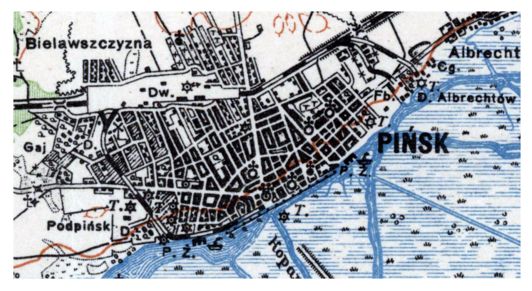
As for Truvovich, Vuvich and Misititch, this is the best clue I’ve found so far, a map of Pinsk from around 1925.  If you follow the main N-S street down to the Pina River at the bottom of this selection you will see, just on the other side, a short ferry-ride away, a spot in the marshes marked with a Jewish star and a capital T.

Truvovich maybe

“Star marks the spot of that muddy hell-hole, you say?” said the skeleton.

Death Benefits

These conversations with the skeleton of my father snuck up on me the first few times.   At first the skeleton simply interrupted, popping up to give me a detail from his point of view.   I indulged him when he had something to say and, also, when he had little to say.  

I came to look forward to our discussions, even as I was aware they were taking place in my imagination.  His answers had the ring of truth to them, he could be disarmingly honest and diabolically dishonest at the same time.  

He sometimes surprised me, like when his tone turned mid-sentence, the familiar merciless prosecutor yielding to the humble, remorseful man he became as he was dying.   The skeleton is once in a while the carping bully but more often he speaks in the voice of the man with the too-late perspective of suddenly having less than a day to live. That second voice is the one he would have preferred to have had all along.  The skeleton character speaks for both sides of my father,  what he was and what he could have been. 

By the time I got the call that he’d been rushed to the Emergency Room, yellow and unable to move his legs, I had begun to heal.   Our confrontations had made little sense to me as a child, all I knew was that the war was constant and unavoidable, except for the unpredictable ceasefires with a few hysterical laughs thrown in.    

I would come to know this hideous dance by the supremely ironic name my grandmother Chava used to describe the violence between my father and his brother: “seenas cheenam”  senseless hatred born of jealousy, pettiness, inexplicable malice.  

Seeing my father suddenly dying jarred me fully awake.  The experience in the dying man’s room is about person who is dying, not about anyone else.  He had things he needed to say.  I made it possible for him to say them.  Luckily for both of us I had attained at least that much empathy and common sense by then. 

I’d begun to see by that time, thankfully, and I was almost fifty already myself, that he had been unable to do better, would have done better if he’d been capable of it.   My father tried to explain, during that last conversation, that “on one level it was really nothing personal”.  I didn’t really get it at the time. This is a hard idea to truly grasp, but I think I’ve come to understand it.

Treating people badly is often the first reflex of people who’ve been treated badly themselves.  They will lavish the bad treatment on anyone they can safely do it to, a child is ideal.  Making the victim feel like it’s his/her own fault for the mistreatment is a satisfying two-fer my father was a master of.   He never recovered from being a two year-old, whipped in the face by his enraged mother.   How does one go about recovering from something like that?

Add to it the unutterable rages and sorrows that bubbled up from the lost souls of our murdered family in those doomed little Eastern European towns, rising like poisoned gas from the mass graves of our indecently slaughtered ancestors.  These unspeakable things can only be raged about.  The dead themselves, if they could speak, would bitterly complain it was so unfair and terrible, what they did to the powerless people who gave us life, people who only wanted to live, like everyone else.

                                                  ii

When my mother died, five years  and 22 days after my father died, I learned my sister and I were entitled to free grief counseling anywhere in the United States because our mother had been a patient at Hospice by the Sea at the end of her life.    My sister saw somebody in Florida, she went a few times.  I went every week for several months to 32nd and Broadway to sit with an Episcopalian priest named Paul who was an excellent listener and a kind man.  He recommended a book he’d found helpful — Death Benefits, by Jeanne Safer.  It was a book I marked up extensively when I read it.

The big idea of the book is that once a loved one dies their life can be seen, for the first time, as an organic whole.   There are gifts and lessons left behind when a loved one dies, from even the most miserable and ungenerous of them.  Seen in the context of one’s life and values, these gifts can be cherished and put to good use.  

Jeanne Safer had begun to see this after her own larger-than-life mother died.  Being a therapist, she had a wealth of patient stories as illustrations of death benefits large and small.  There was an overweight woman whose critical father’s death freed her to live a healthier, more satisfying life.  A frustrated accountant quit a job he hated to do what he’d always wanted to do, become a chef.  Old jury-rigged terrible things replaced by better, more refined and useful things by processing difficult lessons and seeing the gifts inside them.   

As I said, I took a pencil and bracketed sections of text that seemed particularly important or profound to me.  This is my practice when I want to mark text to find later, instead of underlining.  Underlining ruins a book, sometimes even crosses out some of the words it wants to remember.  I curse the underliners of library books, a tribe of unthinking, selfish morons.  A penciled bracket next to the text makes the section easy to find, in conjunction with a bookmark with a note and page number.  A bracket in the margin does nothing to make reading the prized section any more difficult.

I found the book very helpful.  I realized I’d learned many excellent and useful values from my parents, had inherited valuable traits.  I loaned my marked-up copy of the book to an old friend whose mother had died within weeks of my own mother’s death.  She never read it, and it was with a bit of drama, not without some ugliness, that I got it back a year or two later.  

I loaned it to another old friend who had lost her mother.  I never heard a peep about it and, in spite of her later promise to send it back to me, it vanished like the muddy little hamlets in the marsh where my grandmother’s family went into the night and fog.


Historical Revelations over shumai

Had dinner the other night with my father’s first cousin once removed, Gene, who grew up, from the age of five, in 1933, in the same Bronx apartment building on Eastburn Avenue where my mother lived with her parents.   Gene’s wife Sally grew up on the other side of the Concourse, just a few blocks away.   Sekhnet and I ate with them in a Chinese restaurant in Teaneck, where they have lived for many years.

I learned that Gene and Sally, like my parents, had little real information about their parents’ lives before they came to America, or about the families left behind. Gene’s father Morris had been one of eighteen children in a Polish town near the German border. Nine of the eighteen lived, including his father’s twin sister.  

Of these children only young Morris made it to America, having been sent for in 1909 or so by an uncle in New York.   He arrived after a two-week Atlantic crossing; was greeted by his uncle, who, three days later, died. Thirteen year-old Morris had to make his way alone in New York, learned the needle trade, became a union shop steward and a Communist.

“Stamper was a Communist,” my mother always said, without any judgment attached.  Although, it turned out, according to Gene, that after von Ribbentrop signed that pact with Stalin’s underling Molotov in 1939, the fatal non-agression deal between mass-murdering Josef Stalin and soon to be mass-murdering Adolf Hitler, Morris Stamper resigned from the party.

My grandmother Chava, Irv’s mother, had come across the Atlantic, with Gene’s mother (Morris’s future wife), on one of the last ships to leave the port at what was then probably called Danzig, now Gdansk, before the outbreak of World War I.     This was in the summer of 1914.

I was mostly listening, and filing details away, but I got the impression, from Gene’s description of his mother Dinsche as a brave, beautiful “leader” and Chava, two years younger, as a complaining, far less intrepid type, that it was due to the spirit of Dinsche that the two were able to cross the Atlantic in steerage during the summer of 1914.  

Dinsche had regarded the crossing as something of an adventure, charming the crew and getting special privileges for the two of them.  Chava, apparently, complained about the food, though the food they got was better than the food most people in steerage received, thanks to the socially adept Dinsche.   After their German-registered ship discharged its passengers in New York it was quarantined in the U.S. for the duration of The Great War.

As for the muddy hamlet the two of them came from, Truvovich, a place no longer found on any world map, it had been one of three such tiny Jewish hamlets located across the river from Pinsk, in a swampy area, as far as I can tell.  The other two doomed hamlets were Vuvich and Misitich.   Pinsk at the time was a town of about 70,000 people, about 30,000 of them Jews (of whom 37 are known to have survived the Nazi occupation).  

It was a short ferry ride from Truvovich across the Pina River (though Gene called it by a different name). It must have been after a ferry ride to that metropolis, in the earliest decade of the twentieth century, that Leah and Azriel were immortalized in a photo studio in the two large portraits Chava dragged with her to the New World in 1914.

The most amazing bit of history Gene imparted, along with descriptions of his childhood train trips up the Hudson River to visit Chava and her kids in Peekskill, was about my father’s uncle Aren’s Marco Polo-like voyage across Asia, the Pacific, the entire American continent just after the turn of the twentieth century.   If I’d heard this amazing and unlikely tale, I’d forgotten it.  

Aren had three children, Eli, by his first wife, who died of complications from Eli’s birth, and Nehama and Dave by his second wife. Aren sent for his little sister Chava in Truvovich after he remarried. Eli, I did the math just now, was about six when he went with his father to greet his beautiful, red-haired aunt in NYC and the two fell immediately into lifelong love.

Aren’s story I heard mostly from his son Eli. I spent many days, often until late at night, talking with Eli in the final years of his life.   Much of the talk was family history, the entanglements and devilish details of it.   Aren had arrived in New York City in around 1905, I had understood, where he learned to vulcanize rubber. Getting in on the ground floor of the brand new automobile industry, he would work with cars for the rest of his life.

I knew Aren had escaped from conscription in the Czar’s army around the time of the Russo-Japanese war, which history books tell us was in 1904-05. In those days a Jew drafted into the Russian army served for thirty years, absent early release via death or dismemberment in battle (partially untrue, actually, see note*).

Aren and two friends, Fischl Bobrow and Fleishman, decided not to be among the 40,000-70,000 dead Russian soldiers in that war.  They escaped the Imperial Russian Army together and arrived in the United States.  It’s possible Fleishman opted for Canada instead, which is where I think he settled.  I believe Fischl was the eventual connection to the Widems, Irv’s father’s family, from outside of Hartford, Connecticut.

According to Gene, their flight took them across Siberia, the Pacific (or perhaps the Bering Straits) and eventually to San Francisco.   San Francisco in 1904 or 1905, before the Great Fire of April 1906.  I picture Aren now, arriving in California, having crossed the massive Pacific Ocean somehow, a trip of about 6,000 miles.  Then he heads east, presumably on the transcontinental railroad, for another three thousand miles.  Next we hear from him, Aren’s in Manhattan learning to vulcanize rubber.     A few years later he sends for his little sister, who becomes my father’s mother, and the rest, as they say, is history.


* Apparently Jews, who were not allowed to serve in the Russian army until 1827, had been drafted for a twenty-five year hitch prior to the reforms of Alexander II.  Therefore Aren and his friends were likely only in for a five year military stint at the time of the Russo-Japanese War.  They were not alone in disobeying the Czar’s military orders.   From the summer of 1905 to the fall of 1906 there were apparently 400 mutinies in the Imperial Russian Army.

Things were made worse for the Jews at this time by circulation of the infamous forgery The Protocols of the Elders of Zion, published in Russian 1903,  confirming the worst about The Chosen People, in the minds of many, and unleashing a renewed flood of pogroms.

The Brutal Finality of Silence

It’s been noted, astutely, that the opposite of love is not hate, it’s indifference.  Both love and hatred require tremendous emotion and engagement with the object of the emotion.  Indifference?

“Yeah, yeah, it looks profound at first blush,” said the skeleton, “but given the choice between a mother who whips you in the face and a mother who is merely indifferent?”    

Context is everything, as you have noticed during your long dirt nap, as you may have known all along.  You tell a story with your life, hopefully.  Oddly enough, that helpful young woman from Farrar, Strauss and Giroux was not all fool, the story of life is about change, evolution, becoming a more nuanced and able person, learning from a lifetime of mistakes.  Becoming more humane.

“Well, your friend Adolf bragged in Mein Kampf that his philosophy of life, his weltanschauung, was fully formed by the time he was fifteen.   He had hardened into the mature genius he would later become by the time he was a pimply, enraged adolescent.  Impressive, no?”

My point exactly.  The mark of the complete asshole is a refusal to change, no matter what transpires.   It may seem like a small thing, but when I used to accompany Francoise on guitar and I’d make her so nervous and self-c0nscious she’d sing out of tune, I came to recognize something ugly in myself I had to change.

“A little spark of the man who made you, eh?” said the skeleton.

Which was transmitted to my father directly from the woman who made him, who had in turn had received it from Leah, Azriel or some combination of people in Truvovich prior to her journey to a life of misery and privation here in America, starting in the summer of 1914.   It’s a choice between a cycle of blame and anger or striving for change.  

“Well, blame and anger are much more immediate, they’re right there in front of you in a given moment.  Anger is tangible and blame is straightforward, they’re satisfying in some immediate way.   Change is subtle, chimeric, it moves backwards, forwards, sideways, it’s unpredictable, often invisible.  Rage is dependable and easy to hold on to.  

“That’s not to disagree with what you’re saying, that it’s better to learn not to be a complete asshole than to insist on your right to be one.  It’s just not something that most people feel they have the luxury to do.  Or the self-confidence to try to do, maybe.

“Look, we fought about this your whole life– how much people can or cannot meaningfully change.   We’re born hard-wired with certain abilities, talents, predispositions, reflexes.   Not everyone is born with the same degree of equanimity, for example.  Some babies are more easily frustrated than others, they’re cranky little fucks and they give their parents a hard time from day one.  Other babies are by nature placid and easy-going.  

“You can change many of the surface things about yourself, I’ll grant you that, but the deeper ones, the hardwired reflexes — it’s an open question.  I’ll leave it at that, it’s a coin toss, although my personal view is that the propensity to easy anger, for example, can’t ever really be defeated.”  

Fine, but you overcame the understandable impulse, instilled by your violent, enraged little mother, to whip your own children in the face.  You never did it.  

“Well, I never used a whip and lashed either of you in the face, though what I did was just as bad, really.  You know, when I think of those brutal skirmishes around the dinner table I’m ashamed of myself.  I was the fucking adult, even though I acted like a two year-old.  All you and your sister wanted were parents who had some wisdom and sympathy to offer.   How powerful are the words ‘I understand’ to a child who has just poured their heart out to a parent?   Those are two words you and your sister never heard from us.  That’s my fault, you’re supposed to develop some fucking insight as you go along.”  If a skeleton had eyebrows, he would have furrowed his.

This brings us right back to the point I was getting at above.  Being shouted down when you’re trying to express your frustrations is aggravating as hell, but at least there’s engagement.   Worse by far, oddly enough, is getting no reaction at all.

“Well, that’s why you started acting out so much in school, class clown, playing the harmonica in class when the teacher was trying to teach, ostentatiously pretending to sob every time the class sang ‘Puff the Magic Dragon’– a song about pot, by the way, according to a long time urban myth, anyway–  all the rest of that attention-seeking behavior.  

“Your mother would get into shouting matches with you and your sister, I learned early on how much more effective it was to just clam up at crucial moments.  Elegant, simple and very direct way to whip a child across the face with complete moral deniability.”

Well, moral deniability is important, I’ll grant you that.  As long as you can deny moral responsibility, you’re home free.  Hey, do you remember mom shaking me that time, demanding to know…

 “‘What did anybody ever do to you to make you so fucking angry?!!!’ and she chanted it rhythmically as she shook you by the shoulders.   That was great.  I mean, you have to love something like that, looking back on it,” said the skeleton cheerfully.  

Oh, I do, absolutely.  That was great, makes a cool anecdote, even struck me at the time as brilliantly insane.  You know, the mother shaking the upset kid and demanding to know what his fucking problem is.  It’s classic.  But you were the real stylist in that scenario.  Do you remember what you were doing?

The skeleton said nothing, just regarded me with that inscrutable rictus.  

Exactly.  

“Well, I did a pretty good job fucking you and your sister up with that silent movie sphinx routine.  And look, the beauty part was, by doing nothing I could always insist I hadn’t done anything. You know, what could be more satisfying than having the person you abuse believe they did it to themselves?  You say nothing, it’s their word against your non-word.”  

Yeah, like Switzerland during Nazi times.  Neutral, you know, fair is fair.  We don’t like the Nazis, we don’t dislike the Nazis.  We are even-handed, you know, and we are nobody’s enemies.  We don’t take a moral position, we deal strictly in wealth and discretion.  They were ahead of their time, the Swiss.  

And you know, it worked.  It was years before it dawned on me that the Swiss were not peace loving people who took a principled stand that two wrongs don’t make a right.   They were the bankers for the fucking Nazis.  

“You know, Nazis are going to give you a lot of shit about the constant Nazi trope in this ms.,” said the skeleton, “not to mention the fucking Swiss.”

Well, at least I won’t be like Switzerland about it, eh?


Reading

Reading a well-written page is like having a delicious snack.  I noticed this as I read Jon Katz’s “Saving Simon” just now, as I do whenever I read a bit of Umberto Eco’s masterfully hateful “The Prague Cemetery”.   Reading a good sentence is just a pleasure.

Vibrato, dynamics, the attack of a string, playing in and out of time, laying in a succulent part, leaving space– incomprehensible abstractions to most people, unless they play guitar and have the sensitivity to notice such things.

A well-written sentence?  Even a cat will nod, when the words are set out just right.

Irv as Eulogizer

I have an old friend who, on the side, studied to be a rabbi and for years worked a second job as the rabbi for an old congregation in Revere, Massachusetts.  A very bright guy, well-read, hilarious, sensitive, it was no surprise to discover what a wonderful funeral speaker he became.   He writes out his eulogies, it turns out, and reads them word for word.  He’s an excellent reader of his work, writes clearly in his own voice.  You would never know he was reading, his delivery is so smooth and natural.  He’s one of the best eulogizers I’ve ever heard.  

I did a memorial service for my mother, speaking largely off-the-cuff, and I felt I did a pretty good job of conjuring her life, her personality.  

My father, as I have mentioned, was on another level entirely.

He worked from notes of a few words.  “Prisoners” might be written on the index card, or the back of an envelope or other scrap.   We found some of these in his suit pockets after he died, usually written in a sharp pencil in his small, clear print.  He would glance at the key word and then launch into the story, fully formed in his head.  

“As a 22 year-old in France, during the Battle of the Bulge, Phil and his platoon captured some Germans behind enemy lines.  It was one of those things fate places in your path, in the fog of war, as they say, things that happen at random and change the course of your life.  Phil’s lieutenant ordered Phil and three other young G.I.s to take the German prisoners to the other side of the hill and shoot them.  They had to keeping moving fast through enemy territory, they were cut off from their unit, surrounded, and had to catch up, the lieutenant said the prisoners would jeopardize all their lives,  it was us or them, no time to lose.  Phil and three other young Americans marched the Germans over the hill, young Germans the same age as they were, frightened, begging the Americans not to shoot them.  Phil and another guy executed the prisoners, the other two Americans couldn’t shoot the unarmed men.   Every night for the rest of his life Phil saw the faces of the German soldiers as they were begging for their lives, as they were dying.  He never had a full night’s sleep for the rest of his long life.”

I wasn’t at that funeral, so I didn’t hear him tell the story.  He told it to me at one point.  But I am hardly capturing anything but its contours here.   When my father told the story at Phil’s funeral it was silent in the chapel, except for the sniffling and sobbing.   A moment later he had everybody laughing, the tears still in their eyes, wetting their cheeks.  Then a somber story had everyone dry eyed, then another laugh.

“He could do that at any funeral, he didn’t have to like the person, or even particularly know them.  He hung out with Phil, mom was friends with Louise, and he liked him, but he could have done the same kind of moving eulogy for someone he hated.  He just had that gift, you could wake him from a sound sleep, put him in a suit at a funeral and he would do the same thing,” my sister once said.

I’m not sure about that.  I’d only seen him at work eulogizing people he loved, Arlene and Eli.  Both times he seemed uncertain when he stood at the podium.   It was almost like he was a medium, unsteady at first, the hazy connection wavering and out of focus. Then he would find his note and begin to sing.  

Not to make any moral comparison to the most compared man-monster in the world, certainly in my world, but just as an image– I’d read that the early Hitler speeches began very much this way.  He spoke to many small crowds at first and whenever he gave a speech he’d start out tentatively, halting, slightly confused, almost disoriented.  He felt out the crowd in these first wavering, incoherent moments.  Sometimes a crowd did not respond to hatred of the Jews, for example, he would see that and shift ground to another topic.  The writer compared him to a geiger counter, a sensitive instrument calibrated to measure invisible forces, taking the reading of the crowd and, once he had the pulse of the room he’d leap into that flow state, transforming instantly into the performer the crowd wanted.  He was mesmerizing.

My father’s intent was not to mesmerize, it was to create a personal, living connection to the recently deceased loved one, express the loss that everyone was struggling with.  At his best, the person who had just died would be standing in the room, laughing or crying with the rest of the mourners.  I saw him do it with Arlene and I saw him do it with Eli.  

“Tell them about my eulogy for Eli,” said the skeleton.  

The funeral was at some odd hall near Yonkers Raceway, on the service road of the highway, near where the Major Deegan turns into the New York State Thruway.  It was a sunny Spring morning in 1995.   I’d written a page or two of a eulogy, which I can cut and paste into this account, though I don’t have it here with me.  I got up to read it and, seeing Eli’s three adult children looking up from the front row, a generation older than me, I improvised an important disclaimer.  

I read to the surprisingly large crowd that Eli and I had become close friends in the last years of his life when I visited him often in his tidy cottage in Mt. Kisco. Knowing how brutal he’d been to his children I added “it would not have been as easy to have been such good friends with him if he had raised me, of course”. I saw the grateful nods, in unison, and the smiles of his children.  They were now ready for what I had to say.  

I am not a great reader of my words, though I’ve improved recently, reading sections of this ms. to Sekhnet almost every day has been a big help.  I read the pages about Eli, as you will read them here (insert pages) and they gave a condensed, colorful, realistic slice of the fierce, loving, hating character.  I went down the three steps and back to my seat, receiving a few smiles and pats on my back as I went.

My father got up next, and I will never forget how dazed he appeared when he first took the stage.  He fumbled for a moment, gathering his thoughts, his feelings.  He glanced at a card, told everyone he’d flown in late last night, made a few notes while thinking about Eli, who was pretty much a father to him and his brother, he shuffled an index card and a torn envelope. Then he began to roll, and Eli was alive in that hall, brutal, funny, honest, deluded, vain, generous.  You could hear his rough voice commanding his two urchin cousins, Irv and Paul, to run and wash their goddamn hands before they sat down to eat with him.  It was all there in a long improvisation.  I’ve never seen anything I can really compare to it.  

“Tell them what I said,” the skeleton said.  “It’ll help you paint the portrait of this important character in my life.”

I have to say, honestly, I am not a good enough writer to do it justice.  

“Please,” said the skeleton, waving his hand in the universal Jewish ‘feh’ motion of dismissal.  

I’m not trying to make excuses, even though the funeral was twenty one years ago, even though I could be forgiven for not having any details at this point.  There are two things here, memory and writing ability.  I am trying to say that in addition to not remembering any specifics, I don’t have the ability to convey what you did, the way you did, at Eli’s funeral.  All I can do is describe the effect.

 “Well, you’re being modest,” said the skeleton.  “Which is not a bad thing, of course, except in our society where modesty is considered a form of inferiority complex that needs to be treated pharmaceutically with something like ‘Abilify’.   Look, you can’t afford to be modest, not if you want to sell this ms. to some publisher.”

I get that.  At the same time, as I am selecting remembered facts from your life, from Eli’s, from my own, I’m aware of the limited amount of material I have to work with, even though we’re talking about lives of over eighty years each, and sixty now in my case.

“Said the man who has been working steadily with the mere 480 pages worth of limited material he has set out to work with.  Look, the problem you’re going to have is not the amount of material, it’s going to be making a coherent story out of it.  What did that haughty little bitch, the Ivy League literature graduate granddaughter of Farrar, Strauss or Giroux, write to you way back when she rejected your unsolicited sample of Me Ne Frego?  You’ve got to find that letter, Elie.  One more reason to cull that vast nest of papers in that mass of collapsing plaster you live in.

“She wrote, after reading a few sample pages, that while it was well-written it did not contain that dramatic arc that every good narrative must contain: the moral transformation of the main character. Your narrator was much the same at the beginning of that ten page sample as at the end, in her dispositive opinion.  You remember that?” the skeleton smiled, or yawned, or yelled.

Obviously.  Which reminds me of that great remark you made when I asked how your brother was, my uncle.  

“‘Let’s just say he remains unchanged’,” quoted the skeleton.  “And I note here, about primary sources, the only reason we remember that throwaway line is that you jotted it on a telephone drawing you were doing while we were talking and never threw it away. And so it lives on, capturing that fleeting moment.  

“And there, in that captured moment, the basis for your fear of throwing away the hundreds of thousands of jottings that litter your place, I suppose.  The hoarding is a stand in for fear of death, like workaholism, like consumerism, like every desperate, compulsive behavior we do instead of enjoying life– we push ourselves and keep slapping a thin veneer of bullshit over everything that reminds us– one moment we will breathe for the last time and then….” the skeleton held his thumb against two fingers, then released them into the air.


Redacting History

I will speak in generalities here, because the particulars are too harmful to discuss openly.  I  understand the irony in this better than most, feel the grotesqueness of it more stingingly than most, I imagine, but there we are.  I don’t want to get into a fight about any of it at the moment.   Pat Conroy lost half of his family after he revealed details of his father’s insane brutality in The Great Santini.  

People who love somebody don’t want to hear that he’s actually got an Adolf Hitler side, and they’ll kill anyone who persists in highlighting the resemblance, particularly to outsiders.    Conroy was dead to his father’s side of the family after publishing that book openly detailing their beloved relative’s monstrousness.  They were furious that Conroy insisted on describing a trip to the E.R. after a near fatal beating from his highly respected war hero father.  

Conroy and his father eventually reconciled, due largely to the immense success of that book and the movie with the charismatic Robert Duvall as the brutal elder Conroy.  Such reconciliations with toxic people who learn from life and actually try to mend their ways are exceedingly rare, however, and matters of extraordinary grace and luck.

The other piece, of course, is that nobody is simply Adolf Hitler, outside of maybe Mr. Hitler himself.   You can portray a difficult to forgive side of somebody while also recognizing many excellent, admirable qualities in that person.  It is not always easy to do, but it can be done.  We tend to view people on a kind of moral see-saw, balancing their good and bad attributes until something tips it one way or the other.   Somebody saves your life, it’s easier to forget the many faults that used to annoy the shit out of you.  

So, while I don’t believe that the truth will set you free, except in rare cases, I know that lies will keep you tied up in knots and make it impossible to ever free yourself.  That’s my point here.  When people are crippled by shame or guilt, they lie, construct alternate explanations, elaborate rationales for why they are not crippled, or why the fact that they’re crippled is of little consequence: pay no attention to those twisted, shrunken limbs, I am Superman!  

Back in Egypt guys working for the new Pharaoh and his dynasty would go into the tombs of the preceding Pharaohs and scrape the faces off the paintings on the walls, literally erasing these once all-powerful god-kings from history.   This is how we do it, homo fucking sapiens.  We live by stories, myths, and whenever necessary, we scrape the previous records right off the walls of history, replace them with myths that serve us better.  

Millions of people killed by the Nazis?  Bullshit!  It was only a few hundred thousand, and they died of disease and insanity, they were subhuman filth, and liars.  There were no gas chambers, no crematoriums.  Six million Jews?   Jew please!  There you go, again, it was more like two million, at most, you lying goddamn Jew.  Ten million Africans killed during the American trans-Atlantic slave trade?  Prove it, bitch. It was no more than a couple of million, and they were mostly the psychos who wanted to kill their captors, plus the slave trade was necessary to the Land of the Free’s prosperity, and, anyway, it was outlawed more than two hundred fucking years ago!!!!  

Not all re-writing of history is bad.  Evil myths need to be corrected, rewritten.  Homosexuality, for example, was long considered a form of deviance punishable by ostracism, beating, imprisonment, even death in many parts of the world, including the U.S.A. (where, in fairness, death sentences were rare, and not strictly legal) until very recent times.  While still persecuted in many places, it is now recognized in many countries as a naturally occurring sexual preference whose practitioners deserve every right to practice, openly, legally and, in an increasing number of places, with marriage equality.   These former deviants now have the same right to love each other, under the law, that heteronormative couples do.  Not bad, not bad at all.

So, leaving aside the generalities of myth, and with sadness, because describing the particular relationship I am thinking of would show more about my father’s life and beliefs than any other I can think of, and because I witnessed 100% of it as an adult myself, I scrape this descriptive relationship off the painting of my father’s life on the tomb wall before I even paint it.  I redact it.  So what can I actually tell you about it without actually telling you about it?  That is what I’m trying to figure out.    

When someone is angry, and they never get to explain the causes, it creates a loop, a kind of insane loop.   They appear to be irrationally angry, since they cannot openly discuss what they’re angry about, it will never make sense to anybody since the cause of it, however reasonable, however clearly understandable, remains hidden.  They cannot seek help, or even sympathy, because they keep the cause of their anger secret, become complicitous with their tormentor.  Repression of a shameful and damaging secret is a route to madness, I’m pretty sure, or at least to an unbelievable amount of pain and misunderstanding.  

I once loaned a large sum of money, my life savings, actually, to a man who expressed great gratitude and promised he’d pay it back quickly.  He did not pay it back, quickly or otherwise.  When I pressed him he admitted that he owed many people money, that I was actually at the end of a very long line, that I’d have to wait, perhaps a year or more, before he could start paying me anything at all.  

I told him I was going to go to the others in the line and tell them about the tight spot I was in and that I needed to go to the head of the line.  He tried to extract my promise not to do that, told me it would be humiliating to him, and an unforgivable betrayal.  I would not let myself be convinced that the stream of steaming piss on my leg was a sudden targeted, body temperature mini-rain storm.   He became very angry about my inflexibility, my self-righteous refusal to recognize the tight spot he was in, what an unbearable position I was putting him in.  

If he had been my size, I’d have bashed him in the face when he started to rage at me.  Being much bigger than me, I just cursed back at him and did what I could to get my money back, which took years and cost me a lot of money.   More than that, it caused a lot of anger and resentment all around.

After this, it was impossible for me to ever see this guy as someone I could trust.  He made a habit of lying whenever he was in a tight spot and was very often caught in these lies, which at least a half dozen times involved the unauthorized transfer of thousands of dollars.   He was never repentant, always made an excuse for why it was the other person’s fault for being a fucking judgmental prig, forced people close to him to keep his shameful acts secret.  After years of this, I was done with him.  How can you keep having conversations with somebody who reflexively says whatever he feels is necessary to get himself out of an untenable position he’s put himself in?   

On the other hand, depending on how this person is situated in the world, it makes things more or less complicated.  I had a friend play peacemaker with his wife and her sister.  The two women had a long simmering rage against each other and the peacemaker’s work lasted a very short time, with ugly repercussions for him.   There are certain toxic types that we simply must avoid, for our own sake, for theirs.  For their sake because “fuck you, you don’t get to poison my life.”  My father considered such people without integrity and therefore without value as human beings and avoided them like the plague they arguably are.

But I have already said too much here, and revealed little enough about Irv, except to say, he was acutely aware of the point where things became toxic with another person, and although he was able to appear civil, and even casual, there was no mistaking the depth of his actual malice, even as he bantered cheerfully with a person he despised.