first do no harm.

first do no harm.
A person who is gently loved growing up matures into an adult who loves herself. This is not the shallow self-love of the insecure egotist, it is a grounding in love that includes the self. A person subjected to cruelty, brutality, disinterest, develops self-hatred, blames itself for the meanness it has experienced from others. The person with love in her heart will be inclined to have a generous spirit. The one who hates himself tends to hoard the things he holds dear, and, in bad cases, becomes an abusive person. [1]
A trait of self-love is an inclination to comfort others. A loving person naturally helps, is protective of anyone who is suffering. A person who has known only negativity and bitterness will be challenged to give freely of themselves. Self-hatred hardens the heart against what each of us really needs, and, in the end, self-hatred kills.
We live among millions of penitent monks, dragging and bearing heavy weights, living lives of unconscious penance for things they should have long ago forgiven.
I realized at one point that teachers and fellow humans break down into Encouragers and Discouragers. It was an illuminating moment in my progress as a teacher to look at these two qualities directly. You want a teacher who lights a spark of curiosity and fun, a sense of shared adventure rather than one who grimly gets down to business, performing a business transaction, expecting little in return. This is not to say a teacher should never criticize, but should always lean toward doing it in a way that won’t harden the heart of the student.
Think of the best teachers you had, they gave you the confidence to learn a challenging thing, made the learning a shared adventure. An encourager has natural enthusiasm, love of the thing they teach, likes to collaborate, gets pleasure watching progress, the development of a skill. The openness of the encourager ensures that the interaction is play, never dull, unrewarded work. The fun of doing and mastering the thing is the encourager’s greatest tool. The genuine joy in the encourager actually gives courage to the timid and hesitant.
The discourager, a dogged realist, will always tell you the brutal truth, no matter what. The discourager speaks with the voice of the rest of the world: what you most dream of doing is stupid, ill-conceived, far-fetched, preemptively doomed to failure. The discourager has already been defeated, tried what you are attempting, is much better at it than you, and failed in spite of starting with much, much greater odds of success than you will ever have. The unrealistic wishfulness of what you are proposing, says the discourager, is just another example of your neurotic terror of life, your rigid refusal to see the world as it actually is. Your giddy dream is just another gruesome illustration of the fact that you are, objectively, a complete loser.
The discourager has a thousand such ready remarks, instantly popping up, since he speaks in a popular voice. It is much easier to break a complex thing apart than to conceive, design and build it. The discourager has the advantages of being often right in his foreboding predictions, many ideas fail out in the world, and echoing a voice already implanted in most people’s heads, the internalized victimizer. The discourager always confirms the worst and immediately endorses your deepest fears.
The encourager is glad to see you, happy to be spending time with you, eager to interact. It is not merely a guitar lesson, it’s a chance to discuss the deepest matters of life philosophy. What does it tell us about life that you can play a grooving bass line or even a solo with just one note? The trick is to play the right note, to play it with an easy sense of time, keep it even, place it cleverly against the beat, as part of a swinging arrangement. The encourager and the rest of the band can play many parts and arrangements against that single note. The creative possibilities for each additional track are virtually endless.
A discourager will remind you that less than 0.01% of all people who play a musical instrument ever become huge music stars. For every Brittney Spears there are a thousand Friedmans and Speeds, talented, sophisticated, unique musicians, at one point energetically composing, arranging and performing beautiful music that nobody will ever hear. Most musicians, the discourager is quick to point out, give up their instruments eventually, after their dreams of becoming rock stars die. The stink of a failed dream will always attach itself to playing music for most people who picked up an instrument for the love of music many years earlier and dreamt of musical glory, the discourager adds.
An encourager would hand you a guitar, or a hand drum or percussion instrument, perhaps offer you a hit, to remind you of your original love of music. Somebody could hammer a low E note on the guitar, like a bass, and then someone overlays a rhythm lick over that, now a keyboard, with a low, thick, soft sound, a pleasing note perfectly in the mix in that same space in each bar. Each instrument could be playing only one or two notes, forming all the harmonies to suggest melodies. The possibilities for the person improvising the next track are literally endless.
A discourager would point out that in all of your long guitar and piano playing life, you had only one gig, unpaid, and that your only audition, for a wedding band in Sheepshead Bay, went disastrously.
The encourager would add: for successful collaboration, everybody in the group should learn to be an encourager, or at least learn not discourage creativity by word or attitude. Encouragers are the only good collaborators, really, since collaboration without mutual enthusiasm is a recipe for trouble. Invention requires risk and some of the best ideas start off as the most outlandish. Going with a ridiculous idea is the only way to see where it might take you. Inspired melodies often started off as ridiculous improvisations.
For the love of your fellow creatures, stay open to the impulse to create.
When you forget to stay open to creative ideas, to being playful, you begin to die. Death is a process that, once begun with any real determination, there is no turning back from.
The future is a brightly colored wheel of fortune against the beautiful gradient of blue and green between sky and ocean. Every pleasure you will ever feel, every connection, every great satisfaction, every discovery, are in that future. There is every reason to be encouraged, if you love your life.
If you dislike your life — be encouraged. It is a wake up bell: live a life worth living.
Pay no attention to the words of unhappy people who carp and cavil, barking out a hundred reasons why your expectation of happiness is stupid and unrealistic. Seriously, yo, pay no attention to those sad souls. Keep love of yourself and the things you love in your heart, it will keep your steps light and those around you less morose.
Be not discouraged by the words of those who tell you the lie that you are already doomed. Their doom is not your doom.
[1] Note fucked up attempt to use non-sexist pronouns. In enlightened law schools twenty years ago they taught us to use the feminine pronoun instead of the ubiquitous he, him and his of standard English. Instead of “a person himself” we were encouraged to use “a person herself” (pretend you can picture a sentence where that phrase would be used). It was a good idea, an important one, even, but in practice, well… you see how awkward it is to write that way. You can see how awkward that is, right, girls?
Context matters greatly in human affairs. If you have the proper context you can understand cause and effect, see what could have been done better, what could have been worse, where the argument falls short. Without context, everything has to be taken out of context — on faith. You are left with an unreasoning “hooray for our side!”, a collective huzzah or curse, depending on the context-free thing you’re responding to.
Context provides nuance, detail, background, and while we may dispute the significance of certain details, without context we are looking through a pinhole. We have a very limited ability to analyze anything presented out of context, as many things are presented, particularly in politics. I heard a great illustration of context, I don’t recall where [1], but I’ll share it now.
A guy is on the subway when a man and several children enter the subway car he’s in. The man sits down and the children proceed to go wild, screaming, swinging from the hand rails, jumping on the seats, snarling, chasing each other. The guy endures this wilding for a moment, goes over to the guy and tells him he ought to control his fucking children.
“You’re right, and I’m very sorry,” the man says, his head down, “I’m at a loss for what to say to them right now, we just came back from their mother’s funeral.”
Bingo, from asshole to wholly sympathetic character, in a few seconds, purely as a result of seeing his situation in context.
I recently offered a friend an anecdote about how we often buy ridiculously oversimplified explanations as the plausible final story about something. Racist historians attacked the brilliant W.E.B. DuBois when he pointed out that their rewritten history of Reconstruction, and defense of southern apartheid as good for the blacks, was standard anti-black bullshit. “He’s a fucking communist!” was their response, since DuBois was busy analyzing the systematic economic inequality that led poor whites to hate poor blacks instead of finding common cause with them. Can we have some context?
The anecdote I told this friend was about our mutual friend’s view of his father’s sudden outburst of anger. I spent many days in their house when I was growing up and this particular father took a tremendous amount of shit daily. He took it with style and some grace, a drink usually in his hand. His ancient widow and their son told me about a period when he was suddenly, unaccountably, berserk with rage on a daily basis. Turns out it was a reaction to the steroids he was taking. Nobody had told him that a common side-effect of steroids was rage. In their telling he was sent to a psychiatrist who taught him to meditate. Problem solved. Suddenly the old, placid, droll, lovable man was back with his family, no more rage.
My friend wrote back that this seemed to make sense. Mediation is a good skill to have when you’re trying to calm agitation between people. I’d omitted the second T of meditate, leaving “mediate”. I wrote back that he’d been taught to MEDITATE, and that meditation, in this history I’d been given, taught him to look within, calm himself and not get angry anymore. A world of context erased in the time it took the son and his mother to tell me the authoritative anecdote and nod in agreement at the end.
Do we really not need the rest of the story to understand the incompleteness of their history? The man took steroids for relief of a nervous condition that had long plagued him. Medicine did not have an answer for his particular condition, though it was observably driven by stress, probably exacerbated by swallowed anger. He was prescribed the wonder drug of the day, a steroid. My father was given steroid shots once in a while for his psoriasis, for the same reason. No more context needed than that the person had a mysterious emotion-driven disease, had a bad reaction to the treatment and learned to look within?
To tell the rest of the story, give the context I’d observed many times, the widow would have had to make the difficult acknowledgement that while she took good care of her husband, she also could not resist riding him with sharp spurs whenever the mood was on her. The son would have had to realize that the treatment his father was often subjected to in front of guests would have made anyone angry. Based on what I observed as a boy, the guy had every right to scream “enough!” Not acknowledging that right? I don’t know how you can understand the man’s life and ongoing dilemma without that piece of the puzzle. And the story the family had agreed on reduced the problem to a matter of a simple bad reaction to a drug and a wise psychiatrist teaching him how to overcome that side effect. Easier to swallow, for them, harder for me.
Context, context. Without it we lose the ability to analyze and depend on experts to give us insight into how we should react. The New York Times published a critical review of Dave Chapelle’s recent stand-up special on Netflix where the comedian discussed the wave of sexual harassment that is suddenly coming into public light. I’d watched the show with Sekhnet and we both thought it was thoughtful, sensitive, sometimes very funny, sometimes just thought-provoking. Chapelle said at one point that women were going to have to realize that some of the men who would be helpful to them going forward in solving this shit would be “very flawed allies”. He made many good points. The New York Times found him insensitive, thought he was making light of a very serious problem.
I found the Grey Skank typically tone deaf, predictably sanctimonious. My friend who’d read the review in the Times was hesitant to watch the special, after reading the cautionary piece in the paper of record. He thought he might read the transcript of Chappelle’s show, he told me.
I thought of Dustin Hoffman (recently accused of fondling beautiful young starlets on the set, or something like that) as Lenny Bruce in “Lenny”. At the end of the movie, beaten down by the long obscenity prosecution he was fighting, he jumps up in court to interrupt the police witness who is reading from his notes. The police witness is reciting his transcript of Lenny’s act, emphasizing each “fuck” and “pussy” and “motherfucker” and “asshole” as he puts the final nails in the dirty mouthed comic’s coffin. Lenny pleads to the judge to let him just do his act.
“This witness is mutilating my act, your Honor. Let me do it for you, and if you don’t think it’s funny you can find me guilty right now and sentence me, I can’t afford to keep fighting this case anyway, I’m broke. It’s comedy, your Honor, let me just…” He is drowned out by the pounding of the judge’s gavel, threatened with being found in contempt of court, and the witness continues hacking Lenny’s routine to death. The next shot is Lenny on his bathroom floor, finally broken, dead of a heroin overdose.
“That’s comedy from a transcript,” I tell my friend. No context.
[1] most likely source is a talk on forgiveness by Zen teacher Jack Kornfield

ii
I had an adversarial relationship with my father. My sister named him The Dreaded Unit (D.U.), not inaccurately. He embraced the name, often signing his neatly printed notes “The D.U.”, but he was also a great humanist, a broken-hearted idealist, reflexive champion of the oppressed, friend of the underdog, a man with a dark, wicked sense of humor, a great lover of animals and of soul music. He was also a keen student of history and could speak flowingly on a variety of subjects without notes of any kind.
I should explain our adversarial relationship, since the roots of such things are important and you will want to know up front who is writing this book you are thinking about reading. I started our long war myself as a week-old infant, staring implacably into my new father’s face from my crib with wide, black, accusatory eyes, never making a sound.
This creepy, aggressive behavior soon forced him to move the crib from his side of the bed to my mother’s side. Not nine weeks later, upping the ante dramatically, I threw a precocious and violent temper tantrum, scaring the shit out of my poor parents. The pediatrician laughed, he’d never seen such a contumacious little ten week-old as this rigid, purple bastard lying on his table. My senseless fight against my parents escalated in a straight line from there. When I abruptly learned to speak, at ten months, all hell broke loose between my father and me.
On the last night of his life, from his deathbed in a Florida hospital, my father apologized for being such a desperate, clueless, angry man. He acknowledged that he’d felt me reaching out to him many times over the years, but that, sadly, he had been too fucked up to respond to his son’s natural human impulse. He took the entire blame for our contentious relationship, then he died.
Ten years later, when I began this short memoir of my father’s life, 1,200 pages ago, I had little idea where the project would take me. I thought that almost fifty years of prosecutorial back and forth with a highly intelligent, highly principled adversary, often related to the enormous social upheavals going on around us, would make an interesting memoir.
A few pages in, by complete surprise, the skeleton of my father popped out of his grave to give me shit about something I’d written about his childhood. This struck me as a stagey, hokey literary device, a literary rubber crutch, but I wrote down what he said anyway, figuring I could always lose it in the rewrite.
I didn’t lose it in the rewrite. The skeleton was soon back, virtually every day thereafter whenever I sat down to write. The fucker was waiting for me some days, in his new interactive persona as the skeleton. On those days he was always cheerful, urging me on, collaborating breezily in the telling of his story, adding details I’d forgotten to mention, bringing up things I could not have known. The focus of the writing soon shifted from attempting a straight narrative of his life to our ongoing dialogue about his life, my life, the beautiful, complicated, perplexing world we are all required to live in.
I came to see that there was the D.U., my father during his life, an implacable enemy who would resort to brutality to achieve his ends, and the skeleton of my father, a personality much closer to the great friend and mentor my father was always capable of being. It struck me that, along with the realizations he’d had right before he died, he’d also had a decade to mull everything over.
I then… blah, blah, blah.
“OK, Elie, tear it out of the typewriter, crush it into a ball and go for a buzzer beater,” said the skeleton. “The game clock is winding down, Knicks down by one point, Widaen alone at the top of the key — four… three… two…”
I persist here almost every day, frequently encouraged by the previously adversarial voice of my dead father’s skeleton. I write these pieces in spite of many sensible reasons not to spend so much of my time this way. I’m often cheered by my appetite to set the words down, get my thoughts out clearly, express sometimes difficult feelings, in spite of the almost universal silence that greets this unpaid work. Still, it is an untenable life.
I console myself: I write because I’m compelled to write, because it helps me, and may help someone else. I assure myself that I’ll eventually sell some of this writing to support myself, however slightly, going forward. I am better about not being pissed sitting in the middle of the almost universal silence that hisses around even my best efforts here, I remind myself. Some days, like today, for example, it feels like an untenable life I am living. A random page ripped senselessly out of Ecclesiastes.
My idiopathic life-threatening disease is as vague and slow-unfolding as my life itself. Norton Juster had a character in The Phantom Tollbooth who reminds me of myself in regard to my writing life. “Worlds tallest midget” said the sign, and a man of average height opened the door. Around the corner was the “World’s smallest giant”, same guy. If I wrote half as well as I do, but had twice the ambition, twice the marketing and branding skills, I’d probably be able to make a living. If I wrote a third as well, and had ten times the marketing and branding smarts, and the unquenchable drive, I’d be a wealthy man by now. But who am I fucking kidding? My life is untenable.
Look, all of our lives are untenable in the end. Fuck– look at this guy, his lungs just went kaput. She could have lived to be a hundred, if not for that drunk driver. Nobody knows how this one died, put “WTF?” for cause of death. In those last moments, given the chance to take stock of one’s life, how many take consolation in the many good business deals they made? I have no idea, having almost never made a good business deal.
It seems to me that, except in the case of monsters, those last moments are probably spent thinking about love, shining forth from the world we are about to lose. The thought of being loved could be a comfort, or it could be unbearable, smothering, I suppose. That was one reason my father sent his family away right before he died. How do you die with a small audience of people desperate not to lose you looking on? The nurses told me afterwards that many men do this, send wives and children away before they breathe their last.
It’s not the thought of my eventual death that bothers me now, it’s thoughts of my untenable life, a life I must continue to live today. You can be a moral person, strive to be kind, and mild, to listen, to be responsive, use a gentle phrase to turn aside wrath. With that orientation to the world, if you have a metrocard with a ride left on it, you can get on a bus, and probably you will be one of the nicest kids on the bus.
Years ago, as I was caring for my dying mother long distance with long daily phone calls, a literary agent was blown away by a long, convoluted story that spilled out when I arrived, soaked and dehydrated, at a party. “If you can write that down just the way you told it, I can sell it!” she assured me with great confidence. It was an exciting assurance. At the time I had no clue how to write it down just the way I’d told it. I sent her what I thought was my best effort and she responded that I was a very nice guy and that she’d like to take me to lunch at the Harvard Club, where she took her professional clients. I never called her to arrange that lunch, nice fucking guy that I am.
These days, having the time, patience and solitude to concentrate, I have a pretty good idea how to go about writing it all down. Little idea how to organize it, or even review, say, the 1,200 pages of a first draft, but a much better sense that I am hitting the target pretty consistently when I sit down to write. Nonetheless, the life I am currently waking up to is untenable. Today it is about 2,000 pounds of untenable.
Wrestling with my themes every day, I’ve developed muscles that most people I know, people much more muscled and capable than I am in most other ways, are not aware they even have. Today this rippling musculature mocks me, feels like an even shittier consolation prize than it does most other days. I turn the goddamn thing I am looking at five different ways before setting it in final form. There are subtle details that must be lit just so. Impossible to show these things, unless you take pains to set them at the right angle, against the right backdrop, light them correctly. Leave out a step and you might as well piss in the ocean from a high cliff.
“Schmuck,” I can hear the voice, “instead of writing about what a good writer you are, why don’t you write a great letter to a top literary agent and see what you can get them to do for you and your untenable life? Nobody gives a rat’s toned and sculpted cuisse for your self-regarding opinions about your fucking untenable life. Live a tenable life or die — your choice, bitch.”
Leonardo, looking for a patron, once wrote a remarkable letter to some rich guy, maybe the King of France (see letter to the Duke of Milan). He boldly set out a highly improbable list of many things, in a dozen disparate fields, he could do for this rich guy. The rich guy was impressed, gave the prototypical Renaissance man a lifetime stipend to live in a villa and conduct his life of contemplation, exploration and the pursuit of knowledge and excellence. It may have been some other rich guy who eventually gave him the lifetime stipend, his letter may have had no greater effect than being a wonderful example of self-confidence and seeming hyperbole that is actually, possibly, understatement.
“Yes, that’s what you do, write that understated, hyperbolic letter and send it to everyone you can find who might be an advocate in getting you some rich people’s money. The people you know can’t help you, and, more to the point, cannot stand to hear about your untenable, if also highly fortunate, life. You want silence? You’ve got it now.”
I’m all ears.
“Thinking about the last couple of chats, where you bring up self-hatred versus self-love, you speak about it a little glibly, I think, no?” said the skeleton of my father. “We humans love simplicity, that’s why the black and white worldview is so seductive to us — we can be 100% right and the people who don’t agree with us are evil fucks we can feel virtuous taking flying shits on.”
I grant you all that. Obviously, it took me many years, many of them fairly painful, to come to the point of view about our relationship that I have come to now.
“Granted, but, look, Elie, it goes beyond that. We are talking about the nature of certainty, what we know, what we think we know. You’re living in a time when the basic nature of knowledge itself is under attack. It’s like one of those jokes that killed vaudeville: the guy’s wife finds him in bed with a bimbo and he says ‘it’s not what it looks like! Who are you going to believe, darling, me or your lying eyes?’ It’s like your war criminal buddy Rumsfeld said, ‘we have the things we know, and the things we know we don’t know, and the things we don’t know we don’t know, and I know you are but what am I?'”
“It’s like the nature of history, what version of the past we accept is based on a belief system that will determine what facts you accept as facts. If you think it’s evil that one man can own a hundred others, have them whipped, rape them, etc. you will have one view of The Peculiar Institution. If you believe that Africans kidnapped and brought over on ships to serve as slaves were better off on a Christian plantation than in the state of sin they lived in back in Africa, you will have another view.
“If your very rich Planter father was ruined by the end of slavery, and your brother was killed standing up for your family’s right to own people, you will, in your old age, find yourself, with other white southern former debutantes, determined to support the writing of history that makes both men look like idealistic martyrs for a glorious lost cause. You get William Archibald Dunning and the fucking Dunning School of history at my alma mater, The Birth of A Nation and the rest of that Klan coddling history. Take a look at this footnote, Elie, and tell me who has the better analysis of what happened after the Civil War? [1]”
“Of course, that analysis will be agreeable or disagreeable to you depending on your interests, and the beliefs shaped by those interests. Not to say there are not many facts that are beyond dispute, there certainly are such facts. They are increasingly slippery in the age you live in. You have an alienated populace, powerless and lazy, who increasingly watch zero sum reality TV game shows where the entire draw is believing that watching an artificial, loosely scripted TV show gives them a voyeur’s view of someone else’s ‘reality’. So it’s fascinating to them, you know, getting to tune in to ‘reality’ and watch people vie for meaningless things and watch every one of them lose and one of them win it all.”
“You will have a young genius harness technology to tap into alienated people’s need to feel connected to each other. A hermit can suddenly have 1,000 virtual friends, a virtual farm with virtual animals and crops, a virtual conversation with ten million like-minded people. The young genius will be challenged to monetize this great platform he’s built and will come through brilliantly. The guy’s thirty-three, his ubiquitous platform, and the algorithms that drive it, were instrumental in deciding the last presidential election, and he was worth $74,000,000,000 last time you checked, making the octogenarian Koch boys and their combined lifetime $100,000,000,000 look like a pair of pikers.”
“So we have winners and losers, which is exactly what your frenemy Mr. Hitler was always selling to his beloved countrymen. You have Aryans, pure blooded supermen like the club-footed runt Goebbels, and you have enemy polluters of the Aryan race, Jews, Gypsies, Communists, homosexuals, Freemasons, Christian Scientists, immigrants, socialists, what have you. See, very simple. Today you have millions of Americans who suspect foreign thieving rapists are trying to sneak in by the millions to steal our wealth and rape our purebred Christian women. It’s the same shit over and over, Elie, that’s the tragedy of history. You think this fuck you have by the nuclear button has ever read a history book, outside of a few of the speeches of Adolf Hitler that he supposedly kept on a gold table next to his bed?”
“There is no end to the examples, as you are well aware. It shocked you to find out that until I was twelve, if the economy had been better, I could have been legally rented out to work in any factory around, for as many hours as my parents wanted to rent me out for. There was no child labor law, no minimum wage, no maximum hours of work, until FDR. Think about that for a second. And it’s not like FDR waved a wand, there were thousands of labor strikes when he was in office. An ocean of blood had been spilled for decades, by desperate workers organizing and putting their asses on the line against hired thugs, before they were finally able to force a sympathetic president to do the right thing. In this area, FDR did what he had to do to keep the lid from blowing off our exceptional capitalist nation, and only because the historical moment demanded it. The Koch boys, of course, through decades of determined spending, were able to roll back many of those hard won workers’ rights with the help of freaks like Scott Walker that their money got elected and kept in office, but that’s the pendulum of history for you.”
“Back to what I was saying before, though. I appreciate that this long process of talking to what you imagine I’d have become, if I’d kept the realizations I had as I was dying, was your way of working out some important unfinished business. I’m glad it has given you a feeling of greater understanding and even a bit of serenity. I just question whether you can really say you always felt loved, respected, esteemed by me, in spite of the poison gas, the relentless propaganda, the nightly strafing, bombing, etc.”
You have every right to question.
“Mighty white of you, Elie, particularly toward a man who, when you had a pressing question, often gave you silence by way of an answer,” said the skeleton.
It just underscores my point, dad. When somebody hates himself on a fundamental level, that’s what they fucking do when their child comes to them in need, asking for something the self-hater never got in his life. I get the dynamic, I don’t see the confusion on your part.
“It’s not confusion, I just think you’re oversimplifying, or rewriting history, if you prefer.”
Yo, it’s like some jazz great, usually Satchmo in the legend, told a square who asked him to define jazz…
“Yeah, ‘if you got to ask, daddy, you ain’t never gonna know.’ OK, I respect your position. And, anyway, you’re only at the end of draft one now. You will presumably refine the whole stinking 1,200 pages into something that smells like a fresh, winning 400 page memoir of your troubled and troubling old man, the large family that was all but wiped out with no trace but what you have learned, the tumultuous history that swirled around all of us, personal and out in the world, the shit that continues to swirl. I get it, I really do.”
“I guess I have one last thing to add. You have high hopes, I think you’d admit, about transmitting some of what you have learned about history and this life to the younger generations. You want to leave a little more light in the world than there was when you came in. I admire that ambition and like to feel I contributed to it, in some small way.”
I’m standing on your shoulders, dad.
“Here’s the thing, though. It’s easy to oversimplify. That’s all I’m saying. You know, everyone has their way of dealing with their fear of death, their fears of the past, of opening wounds. You were not a brave kid, you were cautious, you had many fears, and nightmares. I think you are a lot braver now, as a man on the cusp of dotage. It takes more bravery to be uncertain, I have come to realize, than to wrap yourself in certainty. Any idiot can be certain, most of them are.”
The skeleton looked around him with shadow eyes that could not see. He appeared to be following the flight of two vultures, turning lazy circles in the sky above the bucolic country cemetery where his bones were interred.
“Turkey vultures, Elie,” he said. “I know you feel that difficult truth that is hidden is inevitably fertilizer for unresolvable future trouble. I think you may be right about that too, but you cannot underestimate the power of shame in human affairs. I understand why one relationship that would shed the most light on me as a person, on my M.O., had to be left out of the story of my life. You are right to leave it out.
“You are left with a tiny family, and if you did not leave that particular story out, fascinating, interesting, tangled, perplexing, illuminating as it undoubtedly is, important as it also is, you would have Sekhnet and your handful of friends, and no family at all. So let it be, Elie. I’ve done the math, there is no way it comes out well. Write the rest of the book, there is plenty else there to tell.”
A turkey vulture landed on either side of the skeleton, who put an arm around each, and with what could have been a wink, bid me, and all of you readers, a fond farewell.
[1] Historian Eric Foner writes that the Dunning School “offered scholarly legitimacy to the disenfranchisement of southern blacks and to the Jim Crow system that was becoming entrenched as they were writing,” and that “the alleged horrors of Reconstruction helped freeze the mind of the white South in bitter opposition to any change in the region’s racial system.” Foner adds that “the fundamental flaw in the Dunning School was the authors’ deep racism,” and that “racism shaped not only their interpretations of history but their research methods and use of historical evidence.”[4][14]:x–xi
For example, Dunning referred to the freedmen as “barbarous” and defended the racist black codes as “a conscientious and straightforward attempt to bring some sort of order” out of the aftermath of war and emancipation. Dunning wrote that the freedmen were not “on the same social, moral and intellectual plane with the whites” and that “restrictions in respect to bearing arms, testifying in court, and keeping labor contracts were justified by the well-established traits and habits of the negroes[.]” [15]
In Black Reconstruction in America (1935), Du Bois characterized Dunning’s Reconstruction, Political and Economic as a “standard, anti-Negro” text. Du Bois noted, “Dunning admits that “The legislation of the reorganized governments, under cover of police regulations and vagrancy laws, had enacted severe discrimination against the freedmen in all the common civil rights.” [16]
Dunning’s followers generally rejected Du Bois and his Marxist interpretation of the history of Reconstruction. Publishing in the midst of the Great Depression, DuBois believed that the poor, both black and white, had common cause against the rich. Part of his analysis of Reconstruction was an assessment of how the classes were aligned, and how the white elite struggled to keep power, withholding it from blacks and poor whites both.[17]
My nephew, a young man of few words, is an excellent writer. In speaking he doesn’t waste words, neither does he waste them when he writes. It is a rare gift, saying exactly what needs to be said and not saying everything else.
I tend to talk too much. I speak in long, implausibly complicated sentences. When I write I’m able to compose and compress my thoughts, refine my feelings, comb through and untangle my sometimes challenging syntax. It is like anything else one loves to do. You practice it every day, and after thousands of hours, doing a thing you love, it becomes more graceful. It also never feels like work to work at improving your skills, it is a pleasure to do because we love the thing itself.
Not that we can master everything we love to do, but the regular doing is essential in any case. Like calligraphy, which I attempt intermittently but without enough commitment to do gracefully. I love the flow of ink on paper, and the look of beautiful writing, but my attempts at calligraphy are clumsy, endearingly, idiosyncratically clumsy, if you like, but lacking the flowing grace of masterful calligraphy. In lettering beautifully the practiced hand must dance lightly, in perfect harmony with the ink and the paper. My hand is heavy, jerky, my loops quirky, but so be it, I don’t practice the fundamental strokes of calligraphy every day, with enough devotion.
I’ll say only this about writing. If you do it carefully, and seriously, without taking yourself too seriously (as I am right now, taking myself too seriously) you’ll find it easier and easier to write well. Hah! Look at me. Took a perfectly beautiful piece of paper and made an unartful blotch at the bottom, while giving a pert little lecture on the ineffable harmony between ink and page. I don’t crumble it up, though it would be easy enough here to select this offending paragraph and hit “delete”.
Whatever else you can say about writing, and it is a beautiful and rare thing to be able to go back over and over and fix your mistakes until the words fit together as clearly as you can assemble them, it is far, far better to be able to write, and set things out coherently, than most of the alternatives available when you are faced with a thing that could otherwise choke you to death.
When I turned sixty I assembled those near and dear to me and told Sekhnet I wanted to celebrate by “holding forth”. She was filled with dread at the prospect. Her fears were in vain. In the end, between the two sessions of my improvised stories (they demanded a fucking intermission) I’d only insulted a small handful of old friends. I’d told a few endearing tales about people in the room, trying to keep them concise, but you know how these things go.
I recall thinking, at one point, that some of my friends must have been thinking (or maybe all of them were, at one point or another during my long holding forth) “who the fuck does he fucking think he is, holding forth this way, like his life is… why, I oughta…..” I quickly put the thought out of mind, it was distracting.
Better to hear poems about me recited by friends? I thought not. And, anyway, my bumpy life makes little sense to any would-be poet trying to put a few stanzas together to commemorate my life achievements. Thought it better to attempt it myself, by saluting those I’d chosen as my lifelong friends, than leave that pressure on befuddled loved ones. I don’t know if it’s related to my long birthday lecture or not, but I’ve seen relatively few of the assembled nearest and dearest since that day a year and a half ago.
Sixty years from now, I will hold forth again, if time permits. In the meantime, I refine the best of myself here, in carefully selected words, in the manner of my nephew. I have to say, I love this shit very much, writing. It comes with an added bonus. If I do my work properly I will get a “like” from none other than Tetiana Aleksina herself. She has a knack for picking the ones I would pick myself. Hello, my dear, you have excellent taste.
My sister sent me this poem, which was featured dramatically in Godless [1], after a life Sekhnet and I both loved ended, like a candle blown out as gently as possible. It is a beautiful poem and touches that climbing sorrow we feel at the death of those we deeply love, sorrow that crushes the lungs and makes breathing hard, the shadow of our own death drawing close. Not only sorrow but the awe and terror we foolish mortals feel when death takes a soul we love. I had difficulty reading it aloud to Sekhnet last night. Today I am practicing.
Tis a fearful thing
to love what death can touch.
A fearful thing
to love, to hope, to dream, to be –
to be
and, oh, to lose.
A thing for fools, this,
And a holy thing,
a holy thing,
to love.
For your life has lived in me,
your laugh has lifted me,
your word was gift to me.
To remember this brings painful joy.
Tis a human thing, love,
a holy thing,
to love
what death has touched.
Yehuda HaLevi (1075 [or 1086]- 1141)
After my mother died, years of denying her approaching death from an aggressive, eventually untreatable cancer finally done, I was alone in her apartment. I’d been alone there for the several days she was in hospice, but each previous night my mother had been alive. Now I was alone in her apartment in the dark night and she was gone.
I walked from room to room, looking at her things, the paintings she’d done that were on the walls, her books, the collected owl figurines in their custom-built glass and metal case.
At one point I went into her walk-in closet, a little room where she must have gotten dressed after her shower. Her housecoat and nightgowns were hanging on hangers along with her other clothes. Her special orthopedic shoes were lined up on a shelf near the floor. Her family photo albums were arranged on a high shelf. The air in there smelled like the powder she dusted herself with. The little room smelled like my mother. My breath suddenly caught in my chest. I felt like no air would ever go into my body again. I felt overwhelmed by the grievous irrevocability of death, the reality that I would never see my mother again. I stood there for a long moment, unable to take in a breath, sobbed hard for a few seconds, and walked back into the other room, probably to tap at the computer, as I am tapping now.
[1] a gripping drama, set in the old West, on Netflix
Years back, when I was studying the Nazi rise to power in Germany (which is what my work in history often boiled down to) I found and read Mr. Hitler’s famous pages about how essential galvanizing propaganda is to any great cause. Propaganda, he pointed out in a surprisingly coherent section of his hastily dictated Mein Kampf, must enflame the passions of its audience. For that reason Hitler applauded the ruthless, lying propaganda of the Allies in World War One which made Allied soldiers righteously hate the Germans. Propaganda must arouse strong feelings and inspire fervent faith in the rightness of the cause.
That’s propaganda in a nutshell.
Back in the days before the internet, when research was conducted in libraries, I pulled down and read through books that referred to other books. You would consult the bibliographies, jot down the titles and authors of other books that promised to deal more directly with the exact question you wanted to grapple with. In one such book I found that the word “propaganda” was first used by a Pope who decided to use the mass media of the day to propagate the faith. If you were so inclined, you could find the encapsulated story, the exact year, the name of the Pope and all that, in seconds, by saying a few words into your phone. [1]
Pope Gregory XV was late to the party. The first to arrive was a highly principled monk named Martin Luther, who propagated his faith almost a hundred years before Pope Gregory XV coined the phrase. I saw a documentary about the life of Martin Luther recently that opened my eyes. I’d read quotes of Luther’s over the years about the Christian duty of obedience to rulers that made him sound like an authoritarian type. He’d stated that the duty to obey one’s masters was clear because God had not put a fox tail in the hands of the rulers, but a knout. Here is what a knout looks like:
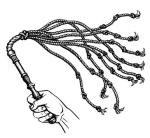
I also knew him as something of a famous anti-Semite [2]. I watched the biographical movie with great interest, it was very well-done. Here is what I gleaned.
Young Martin Luther studied law. His father wanted him to become a lawyer, to assist him with his business troubles. At some point the Lord called Martin Luther and he abandoned his legal studies. His father, feeling betrayed and bereft of the badly needed brilliant legal counsel his son should have provided him, was furious. Martin Luther felt intense guilt over his decision to abandon his father. Luther did what any devout Christian monk with a troubled conscience would do, he mortified his flesh, flogged himself, fasted for days, wore a hair shirt, burdened himself with heavy chains, and he prayed. One assumes that none of this made a favorable impression on his disappointed father.
Martin Luther took a principled stand against the corruptions of the Catholic church of his day. It burned him, for example, that rich people could buy “indulgences” which exempted them from penance for certain types of sins. He preached against these corrupt practices and eventually was given the choice of publicly recanting his blasphemies or facing excommunication, which sometimes came with a gruesome execution. He braved the consequences, stuck to his principles, and his faith in God, and was not flayed or burned to death by the Church.
He had begun writing about his beliefs, and apparently had a genius for it. Gutenberg’s new printing press, invented 43 years before Luther’s birth, would become the vehicle for propagating Martin Luther’s writings. The filmmakers suggested that it was the popularity of his writings, mass distributed in the manner of sixteenth century Europe, that may have saved the heretic Luther from gristly death at the time of his excommunication. The world’s first best-selling author, writing powerfully on matters of conscience, Christ, and the relation of humans and God, he was simply too popular, too loved by many in the rabble, for local authorities to burn at the stake. The filmmakers didn’t mention it, but it probably didn’t hurt that he spoke with authority of the rabble’s duty to obey those who wielded the knout.
We are told that Luther preached a message of liberation to the masses that millions of hardworking Christians were delighted to hear. You pray directly to God, not through a paid, corrupt, intermediary. A poor man has the same access to his Creator as a baron or a king. You don’t need a priest to interpret what God expects of you, read God’s words for yourself, in your own language. Luther himself translated the scriptures into the vernacular.
All over Europe people would read his writings and rush to set more copies in print, churn them out on the printing press, the Twitter or Facebook of its day. Luther himself was shocked at how quickly his writings spread. He was, apparently, an inspirational writer who wrote things like:
Even if I knew that tomorrow the world would go to pieces, I would still plant my apple tree.
So, but for the invention of the printing press, which spread Luther’s ideas to every corner of Christiandom, who knows if there would have been a Protestant reformation? It certainly would not have gotten underway during Luther’s lifetime, anyway.
Propaganda can be as tricky to identify as pornography. It can be slippery to describe. People of good faith may differ on what is pure manipulative propaganda and what is good information to base your decisions on, but we can all say, as a famous Supreme Court justice wrote in a famous ruling on pornography, “I know it when I see it”. Leaving aside, of course, as in any discussion of The War on Terror, the jarring fact that one person’s terrorist is another person’s freedom fighter.
The world is complicated. Propaganda makes it easy to understand. Vote for me and I’ll set you free. Ball of confusion, that’s what the world is today. [3].
[1] today any snot-nosed bastard can come off like an authoritative genius, the accumulated knowledge of the world one click, or voice command, away:
The term “propaganda” apparently first came into common use in Europe as a result of the missionary activities of the Catholic church. In 1622 Pope Gregory XV created in Rome the Congregation for the Propagation of the Faith.
[2] The filmmakers took some trouble to explain the unfortunate strains of anti-Semitism in Luther’s later writings. It appears he expected the Jews, once the corruptions of the Pope’s church were cleared away, to flock en masse to his perfected version of Christianity. He’d been quite nice to the Jews in the beginning, in expectation of welcoming them as brothers and sisters in Christ. The Jews, for their part, stubbornly refused to give up their ancient religion and convert to Luther’s. After that, understandably, Luther had little use for the Jews and concluded there was no saving them. He began to write mean things about them, but, the filmmakers suggested, you shouldn’t really hold those unfortunate writings against him.
[3] Ball of Confusion (1970) The Temptations
Songwriters: Norman Whitfield / Barrett Strong
Ball of Confusion lyrics © Sony/ATV Music Publishing LLC

