Shout out to invisible friends

The people we know are the people in our family and people we’ve met by chance, gotten to know, kept in touch with.   For most, this is a fairly small circle. Back in the old days, as in more primitive societies today, kids were raised by an entire village, knew everybody there.   The psychological advantage of this is easy to grasp:  the odds of knowing someone attuned to your particular personality are much higher, I would think, when you know everybody and have known them since you can remember.   

Today, here in the West, we keep in touch digitally, with little electronic messages, birdbrained tweets, posts on Facebook walls.   In law school a classmate used the term Cyberia to describe this void where we often exchange our modern intimacies.  I don’t know if she coined the phrase, but it’s a pretty good image.   A vast stretch of darkness, and coldness, with little blips of this or that, personal messages coming through, dinging our phones nowadays.

Luddites are always among us, and I am not disparaging this latest technology, even as I see some inhuman tendencies in it.   It has always been this way with new technologies for communication.   I’m aware that people were aghast when the printing press came in, convinced that it would ruin interpersonal communication. The telephone must have alarmed people who were initially horrified by a mysteriously disembodied voice in their ear.  I’m sure there were people railing against the radio, the way it turned everyone’s attention to disembodied voices coming through a speaker, mysteriously in the house via wireless waves.  

It must have been scary to some, being in a room full of people who in earlier times would have been talking, reading to each other, playing musical instruments and singing, now passively sitting around, wholly focused on a box.  TV, same shit.  These days we have the internet in our pockets, and on a day when I wake up and the monopoly that provides my internet service is asleep at the switch and I have no internet connection, I truly feel cut off.  Hanging precariously in the world by my cellular phone.

Way back in our hunter/gatherer past, every individual had to know pretty much everything.   This was before the agricultural revolution, when people could do one or two repetitive jobs for the planting, growing and harvesting seasons, and eat every day without knowing everything about the world around.   The early homo sapiens individual had to know which plants were edible, which were deadly.   How to make clothes, tools, weapons, how to stay warm, how to find water, how to make fire using flint and sticks, how to not die from a wound, how to survive a blizzard, a heatwave, a snake bite.

In our increasing specialization as a species we have produced millions and millions of individuals who can survive knowing very little about the world aorund them.   Everything we need to know is on our phones, available in seconds, as long as the power grid is up and running everyone is cool, we are all geniuses.  This diminution in general knowledge of the world is one price we’ve paid in becoming a consumer society.   Our main value is consuming, having the coolest shit, the best brands, the things that make us momentarily forget we are all connected to whatever happens on our planet.  Buy a nice car and for a few days drive around with no thought of death, disease, global climate catastrophe, the enraged Tweeter-in-Chief angrily preparing for the next senseless, endless war.    

An old woman is on her deathbed, waiting for death.   She is in and out of pain thanks to the medicines now available.   Her grandson hears her talking to somebody, goes into the room– there is nobody there but the dying woman.

“Who were you talking to, grandma?” the boy asks. 

“I was talking,” the grandmother begins to explain, but she is too out of it to explain.   She was talking because we humans need to talk, need to connect.  If there is nobody physically available, we will write a letter, or today, a text or email.

“Who the fuck are you talking to?” a demon asks me pointedly.

Same answer, motherfucker, I tell the demon.
 

The consistency of these motherfuckers is impressive, if also sickening

There was a 911 call in Sacramento the night of March 18th, about a guy running through the neighborhood breaking car windows.   A police helicopter tracked a suspect to a backyard, where police on foot patrol converged on him.   Two officers shouted at the young black suspect to “show us your hands!”.  The man, Stephon Clark, after circling to the back of what turned out to be the house he lived in, took a step toward them, still a fair distance away.  The police then fired, twenty shots, killing him, as the audio on the police body cameras both suddenly went mute.   This can all be seen (and heard) in the video footage the policemen’s body cameras recorded. 

The audio on their body cams goes silent for a couple of minutes, and then, five minutes after their hail of twenty bullets, they are back on line, still calling for the prone, unmoving Stephon Clark to show them his hands.   They continue to demand compliance from his dead body before they will send in medical backup.  Clark was pronounced dead at the scene, his grandmother’s back yard, when medics eventually attended to him.

This kind of sudden, senseless, violent death happens with hideous regularity in our great, violent, gun-toting nation, in virtually every region of our country.  These police killings happen disproportionately to unarmed black men of a certain age.  It is not an isolated atrocious mistake that happens a few times a year, it happens way too frequently in America.   This legally sanctioned murder is not a problem isolated in racist enclaves, it is a nationwide horror, like mass shootings, thousands of annual military veteran suicides (thank you for your service), 67,000 dead from opioids in the last annual count.  

Unarmed young black men are killed by law enforcement in every corner of our exceptional nation.   It is virtually always, somehow, ruled justifiable homicide, terrible, regrettable, but understandable shit that just happens in a dangerous profession where police are justified to be scared shitless in a backyard during a helicopter manhunt for a guy smashing car windows.  

Some smart-ass reporter raised the question of this shooting of an unarmed man (the police video shows only a cell phone next to his dead body) to the President’s press secretary, daughter of a religious, right-wing former presidential candidate.   She answered the reporter with a hint of the smugness of her kind.  In fairness to her, she has an unenviable job, a job it is almost impossible to do with grace, a job affording a hundred opportunities a day to be quoted like this:  

Press Secretary Sarah Huckabee Sanders: “Certainly a terrible incident, this is something that is a local matter, and it’s something that we feel should be left up to the local authorities at this point.”

“States’ rights”, of course, the sovereignty of the local community, is always invoked by status quo types whenever the question of who should deal with the sticky problem of unruly local blacks comes up, or even ruly ones who are sometimes caught in an admittedly unfortunate situation that results in their violent deaths.   Back in the day, when the state and local governments of the former Confederacy were run by KKK members and sympathizers, (many of them very fine people, very fine people… our current president reminds us) it was frequently stated that, but for outside agitators, paid rabble rousers, professional trouble makers, Commies, Jews, and other unsavory, miscegenating social activist types, there had never been any damned trouble in the local communities between whites and blacks, we all got along great, as long as the niggers knew their place.

I know, of course, that as a reasonable white person I’m supposed to put “niggers” in quotation marks.   It is worse today to write the word, just as it is pronounced, than to tell a national audience that the killing of a person we will now all give the respect of calling an “n-word”, is a local matter.   Nothing to see here.  People like this young man Stephon Clark, who disobeyed cops after quite possibly smashing car windows, would at one time have been taken down a dark road, mutilated and hung from a tree.  Until very recently there was no law against local law enforcement keeping the peace any way it saw fit.   If it came to it, and the matter came to a court of law, it was up to a jury of peers in the local community to decide if the dead black person had been way out of fucking line.   In 2018, just like in the good old mythical days when this country was great for proud racists of all stripes, we leave it up to local authorities to decide what process is due, what justice is and where the lines are that separate ordinary police practices from murder.  

A local matter, nothing to see here, certainly no bigger picture, no pattern, no practice.   And it irks me out of proportion to the remark, because Sarah just said, what sounded to me like ‘uh, you know, Manifest Destiny,’  or “I know you are, but what am I?’ even if what she may have actually meant was no more than that at the present time this terrible tragedy is a local Sacramento investigation.   Thank God no policeman got hurt in the altercation between a man suspected of raging vandalism and those trained to protect and serve.  

Here’s where it chafes a bit more.   We leave this piece of a gigantic national horror story to the local authorities, even as those local authorities are tasked by this administration with assisting the feds in a nationwide hunt for deportable Mexican “rapists” and killers and those undocumented residents who are not allowed to apply for a driver’s license in many states, who we can then, in many states, stop at traffic checkpoints, detain and legally deport, for the serious crime of not having a valid driver’s license.  Same goes for purveyors and users of the evil weed, no quarter for you nationwide, and to hell with your “state’s rights” for those immoral malefactors who live in immoral states who vote that it’s just fine for people to smoke that awful drug.

In more enlightened times the Department of Justice might take on these police shooting cases as a kind of nationwide class action, attempt to craft a national solution to this hideous practice once and for all.   Of course, presently, the DOJ is headed by a man who was deemed too racist to be confirmed as a federal judge (imagine how racist you have to be not to slide under that bar…), a man who works for a beleaguered administration that has many more serious problems than probing why the occasional young black man, usually unarmed, continues to be shot to death by cops across every part of our once great nation, often for very minor infractions, or no infractions.  

A more pressing problem, to our nation’s top law enforcement official, is to root out those damn trouble-making illegal foreigners who are the cause of every ill that afflicts this great nation and to finally stamp out the Devil’s weed that so many states now flout federal law by allowing their citizens to use, some even allowing its use “recreationally”.    If you read a history of this country, you might swear you stepped through a warp in the fabric of time, are right at the end of Prohibition, when Herbert Hoover doubled down on deportations, protective tariffs and fighting a lost war of dubious morality, a war against intoxicating spirits, in the name of morality.

Makes me wanna holler.   I salute the young people who are not taking this shit lying down.  You have every goddamned right not to be shot to death when you are going about your business, even if you’re out of control and your business is trouble.  Even if you shoved a store owner and stole a box of cigars, smashed a car window, called the armed vigilante who stopped you on the street a provocative name, sold illegal cigarettes, informed the cop who pulled you over that you had a legally registered gun in the car, the death penalty, without a trial of any kind, except a two second one conducted by an adrenalized man with a gun, is a bit severe for most suspected crimes.   I think even self-righteous Sarah Huckabee Sanders might agree to that, privately, of course.


How they kill you, part 2

On March 10th the rent check I’d sent to my landlord was returned to me, without explanation.   I took it to the post office the following Monday to have it re-sent and the clerk who examined the envelope was a very dim bulb.   She studied it for a long time before realizing her supervisor was the only person with the wisdom to do anything for me.

The supervisor was a brusque man, blunt, using the word “sir” like a shit-covered baseball bat he casually waved around as we spoke.  A machine had made a mistake, sir, not a human.  Have you never made a mistake, sir?   I can’t guarantee anything, sir.   The machine will hopefully do better after I draw arrows on the envelope.    I can’t give you a receipt, sir, unless you pay me.   You want to make a complaint, sir?   Knock yourself out, call the number on PS Form 3849, here you are.  Complain away, sir.   That’s really all I can do for you.  Tell ’em Umar treated you badly, sir.

I did not react particularly well to this fucking lying asshole (the number on form 3849 does not allow a caller to make a complaint of any kind), and some might say I deserved what I got, the rent check to my landlord returned to me a second time, almost a week later.  In the meantime I’d made a complaint, a guaranteed confidential one, that I was promised would be followed up in two to four business days.   A few days later I learned the confidential complaint had been forwarded to Umar himself to investigate and resolve.  In the end I went to another post office, paid postage again and sent the check to my landlord.  It arrived, I was told, on March 23.

On March 26 I had a message from a woman who seemed to have a hard time pronouncing her own last name.  The voicemail was recorded at 3:10 pm.   She said: Hi, this is Kathy … at Inwood post office, in reference to your complaint, your service issue.  Please call me tomorrow, I’ll be leaving at three today.  Call me at 212-567-7821 in reference to it.   I want to go over it before I close the case out.  Thank you.

The phone rang, at great length, when I called back the next day, each time I called.  Nobody ever picked up.   Not a business you’d ever like to deal with again.

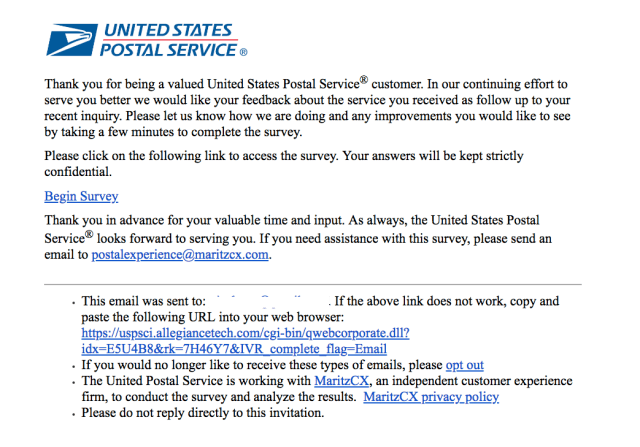
Then I had this email, under the subject “Your feedback is vital to serving you better” and immediately thought of the grinning Martian chirping ‘we come in peace’ as he vaporizes your genitals with a death ray. 


USPS.png

Another great public/private partnership, working harder to serve you better.  Would you like to take a survey for the service you are about to receive?  LOL!

It reminded me of many things, including the almost two hours I’d spent the other night trying to resolve an ATM error.  The machine sucked my $100 bill into the “checks only” slot, a second before I noticed that this machine, unlike any other at this bank, had a “cash” slot on the other side of the keyboard.  No receipt, no return of the bill.  Almost two hours on the phone with poorly paid, ill-trained, overworked women who apologized and thanked me over and over for being a preferred customer, as they placed me back on a brief hold while they waited for someone from claims to come on the line.  The four bar loop of hold music that they unfortunately had no control over played demonically, over and over and over.  

It was not until two days later, when I called and spoke to another rep, that I had the $100 ‘provisionally credited’ back to my account.  I’d told the kid that being apologized to and thanked as a ‘preferred customer’, while being treated like a grifter trying to shake this bank down for $100, after years of no such desperate acts, was kind of a crappy way to do customer service.  Imagine if I was not a “preferred customer”!   The kid got it, and as far as I can tell, fixed it.  

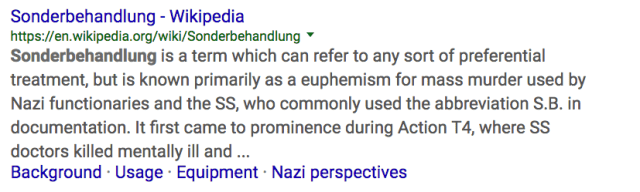
The first thought I had with this ‘preferred customer’ shit was echoed by this dark, dark, puckish (to my sick mind) entry in Wikipedia for one of the few German words I have committed to memory:

Screen shot 2018-03-26 at 9.31.20 PM.png

source

Fuckin’ A, yo.   Nazi perspectives, indeedy.  Getting a lot of those perspectives lately, from some very fine people, the finest people, the best people.  You got a problem with Nazi perspectives?   Call the complaint number on PS Form 3849 and please hold for a customer service survey that will only take ten minutes and will help us serve you better!

The Right to Your Feelings

“I’ve been thinking about this a lot lately, Elie,” said the skeleton of my father from his quiet grave on the outskirts of Peekskill.  “And I know you’re taking a break from the long research and first drafting of my life story and all that.   Something just occurred to me.  In every case in our family, where rage lasted thirty, forty years, as long as it took, neither party would acknowledge the feelings of the other party.   It was like a mirror offense, if you want to think of it like that, each one denying the other one the right to their genuine feelings of being unfairly attacked. 

“Think about it, Elie, Eli didn’t speak to his sister for what, forty something years?  I think of other grudges in the family.   It always boils down, it seems to me, to a refusal to grant somebody else the right to their feelings.  I was as guilty of it as anybody.  More guilty than many, actually.  When you take the trouble to make yourself vulnerable and express how you’re feeling, expose your weakness, your fear, there is nothing more damaging, more infuriating than being told you’re crazy, off-base, an asshole.   I had that down to an art form, of course, because I could always redirect any discussion to whatever direction I felt it had to go.  I was an expert in that sort of conversational jujitsu.

“It seems like a small thing, not to tell a crying kid to grow the fuck up, not to say to a moody teenager that she’s a victim of hormones coursing through her, making her irrational, not to deny somebody’s right to a feeling, to just offer a soothing word.   What is hard about offering a soothing word?  Or just being respectfully quiet as the person expresses how they’re feeling?   Maybe we’re all ego-driven beasts designed to feel our own pain much more than anyone else’s.  I don’t know.   It is not always our reflex to soothe, even our loved ones, sad to say, especially our loved ones.  We may rush to offer a solution, but that is a much different thing than acknowledging the other person’s true real-time suffering.   Should be easy, like not killing, or not stealing, but there is nothing easy about sitting with another person’s uncomfortable feelings.   If it was easy, not as many people would be killing each other, killing themselves.

“So I guess that tit-for-tat insensitivity leads to the classic vicious cycle:  you were brusque with me when I was in pain, so, what goes around comes around.    ‘Now you want to cry to me, you insensitive motherfucker?  Who gives a shit about your tears?  What about my fucking tears?’  

“That is always the question: ‘what about my fucking tears?’   Like that great formulation by Mel Brooks: tragedy is when I break a fingernail, comedy is when you fall into a manhole and die.  

“It’s quite a world, Elie, quite a twisted work of fiction, and facts worse than the most twisted fiction.   As Eli told you ‘this world couldn’t be more cockeyed and fucked up if I’d made it myself!’  But you already know that.  All I wanted to add today is that the right to have your feelings simply acknowledged appears to be one of the most abused rights out there.  This inability to comfort others when they are upset… hoo boy, big source of conflict, of rage.   It’s not any great wisdom I’m laying on you, it’s pretty basic stuff, but I just thought this was a helpful way to phrase it.  Someone whose feelings are routinely dismissed often goes on to shut down emotionally when faced with other people’s troubles.

“When I felt bad as a young kid, I got whipped in the face.  Not really the response you hope for from your mother, of course, but there you are.  So much easier to picture the damage when you think of it as a refusal to grant someone the right to feel the way they feel.   You can’t argue with a feeling, if you’re a kind person, anyway.   The first line of help is let the other person express how they feel, take it in, acknowledge it.    You will be lucky to find one person in your life who has this essential skill, who makes a habit of listening.  

“Usually, of course, it’s ‘well, I think you should try to think of it, not as being whipped in the face, but as your mother having intimacy issues that have nothing to do with you, baby.   You shouldn’t feel bad that you’re whipped because you’re hungry, you see, because your mother has terrible problems of her own.  Maybe if you focused on her pain when you’re feeling like a victim, you’d realize that she has it much worst than you do, and you’d stop feeling so sorry for yourself.   Phew! your diaper stinks, kid.  You really should think about using the toilet, like everybody else.  Why do you want to go around smelling like shit?’

“Do you get the point I’m making here, Elie?” said the skeleton.

I did, but I said nothing, my mind and thoughts being far away at the moment.

“Asshole…” said the skeleton, reclining back into the soft earth.

The Circle of Fifths

I’d heard the term “the circle of fifths” for years without ever really seeing the principle in action.   It is a very cool principle.   Hearing the fifth note of a scale makes the ear want to go back to the first note, the fifth note demands to be resolved to the one in Western Music.  Instead of the one,  play the five of that one, then the five of that one, and repeat, and repeat and repeat, in a perfect circle.  

It’s kind of cool to watch it in action, to play it through yourself a few times.  I saw a chart of the circle of fifths recently, and a guitarist gave a good lesson about the uses of this circle of fifths we have heard so much about over the years without learning what it actually was until the other day.  The chord structures of every melody we know are based on this circle of fifths, which is also a circle of fourths, it turns out.

Screen shot 2018-03-28 at 1.45.09 AM.png  

Clockwise this circle keeps going up a fifth, a perfect circuit of fifths.  Go the other way and the chords move by fourths.   The relative minor variations of these are also fun to mess around with, trying to play the cycle in a nice smooth circle.

The truth, the whole truth and nothing but the truth

I learned, at an otherwise soporific session on legal writing many years ago, that in the old days lawyers had their writs, complaints, answers, surreplies, etc. written by scriveners.  These professional scribes had elegant handwriting and were, one won’t be shocked to learn, paid by the word.  

So much of the seeming double-talk in the law, the endless legalistic quibbling, caviling, carping, signifying, distinguishing, synonym stringing, de-empahsizing, re-emphasizing, privilege-preserving, seemingly redundant, overstated, reiterative language in traditional legalese was the work of these craftsmen.   “Do you promise to tell the truth, the whole truth and nothing but the truth?” is more than twice as many words than “do you swear to tell the truth?”.   Cah-ching, scrivener!

But that’s not the only reason for the development of legalese, of course.  Make something complicated, convoluted, meandering, equivocating, jargonized, specific, obfuscating enough et, voila, half of your problem is solved.  

If half the country hates slavery, do not ever use the word in the founding document that preserves the right for those who love having slaves.  No “slave”, “African” “chattel”, “servant” or any other straight forward reference in the Constitution to the slaves, from Africa, who were regarded by the law as chattels, unpaid servants for life.  

Instead, in three or four discrete, discreet clauses, we read of “other such persons as the states shall see fit to admit” and nonchalant, misdirecting yet precise, legally-binding phrases like that.   You can feel better that the word ‘slave’, or even some of the horrible things these forced laborers were called, is nowhere near our sacred founding text.   Even as, of course, the legality of slavery, and its enforcement under federal law, received irrefutable, iron-clad federal protection in that same discreet document.  

We are, and have always been, a nation of laws and freedom under those laws, notwithstanding the 3/5 of such persons– and it goes without saying we use the term ‘persons’ in its broadest sense — who come into play for apportionment in Congress for grossly underrepresented slave-states (majority slave state, in the case of South Carolina).  The devil, yop, yop, in the damned details.

OK, this has been my typical ‘why I hate our freedom’ rant and you are well within your rights to treat it as such and click over to something more uplifting.  The point I am driving at today is not our national tic for concealing truths that might make millions of our citizens angry enough to rebel, it’s personal.

I recently took down some fiction I’d written and posted here, realizing that if certain parties read this work they would see themselves and feel violated, angry, perhaps even vengeful.   When a person guards a humiliating secret, which each of us has every right to do, any reference to that secret is easily seen as a betrayal.  

I once wrote a line that infuriated a very wealthy man living, closeted, as a salt-of-the-earth working stiff, by writing “it’s not as if he needed the money.”   This was construed as a betrayal of a secret he had kept from me, something I could only have learned from his ex-wife, which was how I’d inadvertently heard it.   She described a $75,000 settlement of their divorce, which I called generous when she told me about it about 30 years back.  She laughed, and agreed it was generous, although, possibly not quite as generous in the context of her ex-husband’s fortune of more than $20,000,000.   The whole thing was humiliating to him, the poisonous reference to him “not needing the money,” and my mention of these facts here, where any member of the public can theoretically see them, was an unforgivable, final betrayal, even if he was never mentioned by name.  I get that.

I am not in the habit of violating confidences.  If somebody tells me something in confidence, I will never break that trust.  I can think of many examples.   All we have is our word and our good name.  Which reminds me of something my old friend the judge told me once, on the Triboro Bridge.

I’d just purchased an iPad, which I was integrating into my student run children’s animation workshop.   We were driving along and I was using the iPad’s video camera for the first time, filming the trip.   We were chatting when suddenly the judge turned to me and asked me if there was sound on that video I was recording.  I told him, now that he mentioned it, that there was.  Our talk was being recorded, although that was not my intention when I started filming.  He told me to shut the video off and erase it, that he didn’t feel comfortable with our conversation, which he hadn’t known was being recorded, being preserved in perpetuity.  He got quite exercised about it, actually.  I assured him I had no intention of playing it for anybody and then he made a good point.

“At the moment you make a promise like that, it is inconceivable to you that you would ever betray my confidence.  That’s why contracts are drawn up when the parties are friends, with protections built in for after their falling out.   Provisions against non-disclosure are not made for when everybody is on the same page and getting along great.   They are for the day when the parties are no longer friends, for the day they are adversaries, in fact, looking for evidence to use against each other.”

I assured him that once I had extracted the video footage, isolated from the sound, I’d delete the original, with our conversation on it.   As it happened, not that long after that ride, we were on shaky ground as friends and soon after that completely estranged.  

Here’s the morally sticky part.  A loved one tells you they were threatened with particularly violent death by a husband with a long history of road rage, speeding tickets and petty crimes, including embezzlement, credit card fraud, shoplifting and who knows what else.  You are not told this in confidence, your loved one is shaken and upset when the details pour out.  You hear the same story from another party involved in the drama, which involved multiple murder threats.   Later you are told you may never speak of this.   There’s your moral quagmire for you.

The children of that couple?   Do you have any obligation to them?  

Clearly, I am wrestling with this constantly.  I think part of the reason it is a bone crosswise in my throat  is the frustrating world we live in now, our general powerlessness in this corporate age.   We live in a world run by the corporate imperative: admit no wrongdoing, cite the plain language of the contract, construct hoops for someone with a complaint to jump through, restrict options available to the aggrieved, condition any settlement on nondisclosure.   In politics it is the same: never admit fault, stick to your theory of why you were justified, state your talking points, pivot, constantly, away from any responsibility on your part, repeat talking points.

When a personal connection resorts to this intolerable bullshit more than once or twice, it may be time to dissolve the apolitical bands which have connected you.  It seems self-evident; you cannot depend on a person who routinely lies.   Depending on someone who will say whatever they feel is necessary under the circumstances is like depending on a person like Donald Trump to take the moral high road.  

“That high-road you moral fucks talk about is for you high-minded assholes to walk on, it’s a road for fucking losers.  I walk on the winner’s road, it is very smooth, and padded to be gentle on the joints, and downhill all the way.  All other things being equal (LOL!!!)  I’ll take my regular road against your moral tight-rope every minute of every day, asshole.”

If you have a problem with any of that, take a fucking chill pill and dummy up.  Word to the wise.


Sassy and thorough takedown of Facebook CEO Asshole Mark Zuckerberg

Stumbled on this witty article with details of the treacherous nature of the next billionaire weasel presidential contender (no insult intended to actual weasels, tiny, oft-maligned carnivores just doing their thing).   Confirmation bias, OK, because I do hate the shallow, greedy fuck and his data-driven social media money machine that exploits the loneliness and hunger for connection of hundreds of millions, but still — an excellent article, IMHO.  Click here for an interesting read.

A tasty bite from The Smallness of Mark Zuckerberg:  

(I’m not saying that small people are evil.  I am small myself…okay, we are totally evil.) 

View this collection on Medium.com

View this collection on Medium.com

Fiction Writers Beware

It has often been said that puckish reality is more boldly reckless than the imagination of any writer of fiction.  Check out this bully-coddling dickhead’s name, the CEO of the parent company of the National Enquirer.   The portrait of him is equally perfect.  

It got a dry little laugh out of me, though I am, admittedly, more than a bit immature about this kind of gag.  

Take it, Amy.

clickez ici