detail of paintings by young kids. The one with the periwinkle shoes is succulent indeed.
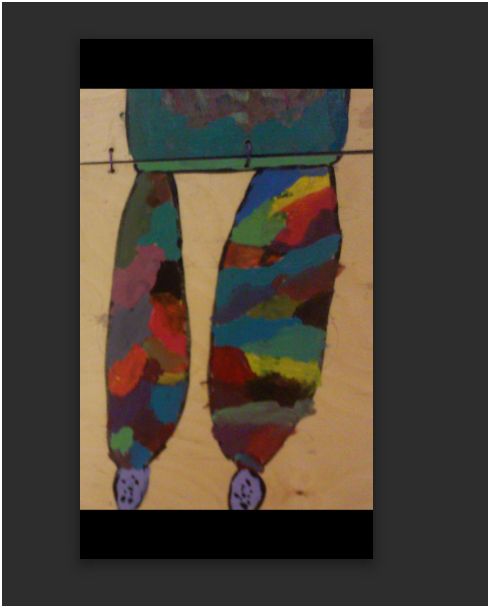
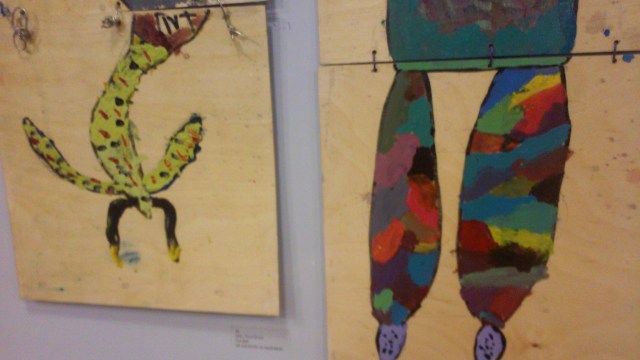
detail of paintings by young kids. The one with the periwinkle shoes is succulent indeed.
The pursuit of excellence for its own sake is regarded as idiocy in a society that values only the creation of value– that is, the creation of the dough re mi — money you can buy things with. Things are given value according to how much they’re worth — in dollars and cents. Nothing could be more basic and immutable than this first law of the marketplace, no? Why bother to write clearly, if not to hone your craft for money? Why be meticulous about playing in tune, and in time, if nobody is paying — if, in fact, nobody is listening? I am listening.
I was checking out a guitar yesterday, a 3/4 size Martin that felt good in my hands, sounded good. I’d been thinking about it, realizing I’d probably have to buy it, even though it’s not really made of wood. “How does it sound amplified?” I asked the kid with very long hair. He handed me a cable and led me to a room with padded stools and amps.
“It sounds good,” he said. He was right. Damn, it sounded very good. I began to play, now with a pick, now using fingertips to pluck the chords of One Note Samba; I strummed with my thumb, with the pick. A nice rich, round tone. The pleasure of playing this little guitar was considerable, my hands relaxed, playing things they’d played enough to play smoothly, improvising, checking out the harmonics.
Somebody came into the room after a few minutes and began to play another guitar. At first I was annoyed at the intrusion, but when I realized the guy was playing a straightforward thing in E, I played in E, some fills, a couple of chords. It was OK, I could continue to check out the guitar. My back was to the guy, he’d sat behind me. He soon got very ornate, playing a fast, elaborate finger-picking piece that was tricky to follow. He turned up his amp.
It was quickly obvious that this was the common exhibitionist wanker in a guitar store, there are dozens of them, wailing away, fancying themselves gunslingers, striving for supremacy, the spotlight, the admiration of their flailing peers. If you walk through the main room of any guitar store there are many of them, bashing away at guitars, in every key, in no key, with varying degrees of skill, playing over each other, all of them way too loud. The cacophony is unbearable. They get into cars, if they have them, tailgate, ride the horn, pass on the shoulder cursing as they go, spin out of control, ultimately wind up totaling their cars into a divider. On a good day.
I never turned to look at him, unplugged the guitar and brought it back to the salesman. I’ll buy it tomorrow, I decided, when I’ll be in the neighborhood next.
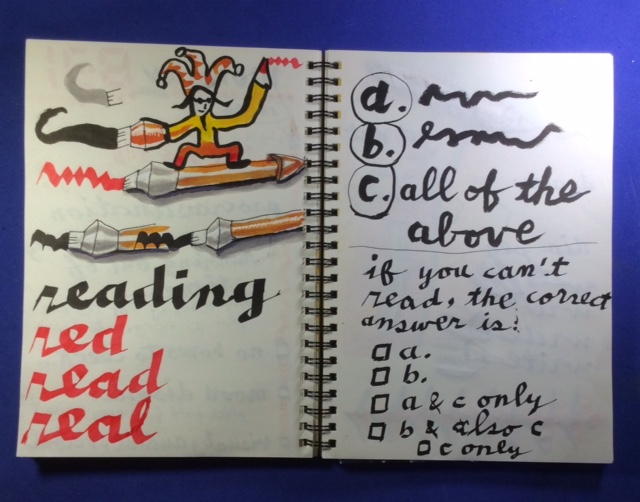
In the subway on the way home I am fleshing out an idea that struck me while walking across 18th Street. I’d paused to write: reading is magic, think about it. Marks on paper tell you what I’m thinking.
Picture that animated. That’s what I was doing on the subway. I drew a pen, took a brush and painted a shadow under it. The train swayed, jerked, but I have always written and drawn on trains, am an experienced surfer that way. It is a very rare stroke that goes wrong for me on a train. I soon had a 3-D looking calligraphy pen drawn on the page. I made a note to animate the drawing and then cut the pen out. I’d take the cut out pen, dip it in a drawing of an ink bottle, the cruder the better, and write the words, in stop-motion, as though they were flowing from the moving pen:
Reading is magic, think about it. Marks on paper tell me what you’re thinking.
True. A simple but powerful illustration of the amazing human invention of writing and reading — communicating anything you can think of to express using combinations of 26 symbols. Also a powerful evocation of the potential of animation to get kids interested in literacy. I drew in my book for about ten stops, was pleased and shut my eyes. It felt wonderful to shut my eyes on that air-conditioned train.

Inevitably I had the second thought, which caused my eyes to open and which I began to note on another page — in black and white.
We do not, as a society, give a fuck if you can read, have a rich mental life, consider ideas and solutions to problems you might not have imagined. We do not, as a society, give a rat’s ass if you can write, beyond clicking a box assuming liability for any and all debts incurred in the course of your dealings with our corporation.
Our society does not have work, or any productive use, for a good chunk of its people, tens of millions of them. The young versions of these unneeded people are sent to schools to prepare them for a life where they are not needed. The lesson many of them learn clearly is: fuck you, asshole, bend over and spread your cheeks. Lift up the nutsack. Cough.
Life’s work: knowing this, all of it, and living calmly and productively, doing everything your talents allow to inspire, give hope, make a small ripple of change. Death is waiting for you anyway, why be aggravated by the many aggravations this life dispenses so generously for free?
colors and books sent as colorful thank yous and updates
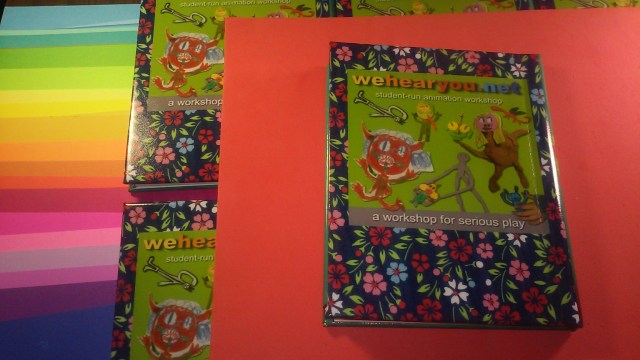


click above to see 59 second project-in-progress
click the picture having some fun animating
There’s a kind of poetry that must be spoken aloud, I’m told. It has a beat you can dance to, and play a piano behind, and hit a woodblock against, slap three bass notes into.
Sound gives flavor,
silence has a thousand smells, only,
but none of them like the thing
with that marvelous taste.
And, truly, I don’t blame anyone for not giving a shit. Happy Memorial Day, remember those who gave their lives so you didn’t have to.

Adaptation of something I wrote two summers ago, all bitter references to unhygenic assholes removed, for marketing purposes:
Think of a world without creativity. No music, comedy, repartee, great food; no movies, books or even articles, no television worth watching, no mischief, nothing worth laughing at, no cause for that good cry that is sometimes so needed.
Creativity, much spoken about by educators today, has always been at the heart of learning and good teaching.
All creativity involves a certain amount of spontaneity. It is play. The great John Cleese describes the essential conditions for creativity in a wonderful clip, unfortunately no longer available on youTube. The five factors he talks about are: place, start time, ending time, confidence and humor.
For young children, who are naturally creative when given the slightest chance to be, we’ve reduced the formula to this:
Have fun and help each other.
You can’t have fun if people are bothering you. Don’t bother anyone. If you can’t help, don’t hurt.
When it’s time to be quiet for a minute or two, be quiet.
Cleese locates the creativity, you need a space to do it. How about a room filled with art materials and a camera stand to shoot frames? With a recorder to make soundtracks and a computer to assemble the animations.
Cleese discusses the importance of a time set aside, a time with a beginning and an end, ideally about two hours. He points out that it takes up to a half hour to leave the pressures of life outside and begin to play. With luck you will play for 90 minutes or so. Then play must end, as play always does, because it doesn’t feel like play forever.
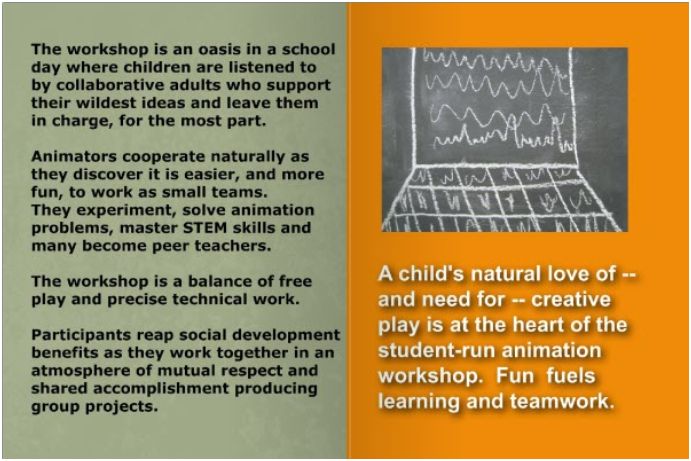
This is exactly what happens in the animation workshop. For ninety minutes the kids have all the time in the world.
The other aspect of time is patience, taking your time, having a block of time you can use for play and dreaming up ideas. You cannot be very creative while watching the clock, just like you can’t productively meditate keeping an eye on time. You have to let things develop in their time, comfortable with not much happening sometimes.
Asked what she liked best about the workshop, the Idea Girl said “it gives you plenty of time.”
Confidence is necessary, because if you think you can’t dance, or sing, or draw, or animate, you probably won’t be able to. What gives a person confidence? Another one smiling and giving a thumbs up when the idea is presented. What takes away confidence? Critical comments, ridicule, skepticism, indifference to your best efforts.
The last part, humor, happens quite naturally in a room where children are playing, relaxed, involved, having fun, trying out the craziest ideas they can think of, not worried about anyone bothering them.

