Paging Through History

“You know, I realize this is a creative re-imagining of my life, that there are many things that must be left to conjecture and inventive reconstruction on your part, but it may be time to remind readers of the trickiness of imagining history, trying to construct a realistic frame to see it through,” suggested the skeleton.  

Sure, we see it through a lens of inevitability, hindsight imparting the illusion of knowledge we can never have in real time.   It’s hard to imagine things as they were at the time, before the chickens begin coming home to roost.  When you were a fourteen year-old rooting for Hank Greeneberg as he hit fifty-eight home runs, you had no way of imagining that after driving in 262 runs in the next two seasons he’d have just 67 at bats in 1941 before missing the next three seasons defending his country.

“He’d been drafted in the pre-war draft and deferred a couple of times for flat feet, then he was re-classifed and inducted into the armed forces at the beginning of the 1941 baseball season.   On December 5, 1941 Sergeant Greenberg was honorably discharged pursuant to an act of Congress, along with any man over 28 who didn’t want to stay in the Army.   He was out and looking forward to hitting home runs in 1942.  Then, two days later, as your kids in Harlem used to say when someone got hit from the blindside, we got ‘japped’.  Greenberg re-enlisted, we actually served together, amazing as it seems now, in what was then called the Army Air Corps.  It was a little like Sekhnet’s father, at the end of his two-year hitch with a month to go when Pearl Harbor was hit, his tour extended by three or four years.”

Also, the world at the end of World War Two was at the dawn of the age of 24/7 multi-platform mass media we have been living in for decades now.   It’s hard to overestimate the power of wall-to-wall womb-to-tomb advertising noise we are subjected to now.   We elect our candidates based on the best ad campaigns, based on who presents as the best “product”.  

“Trump is a brand, has been branding himself for years.  George W. Bush was a brand.  It doesn’t matter what the brand is, mind you, Americans are trained to buy the brand name.  You want Brand X or Chef Boyardee?” the skeleton winked.   

We always had cans of that in the basement, the ravioli and, at one point, beef-a-roni.  Wow, I haven’t thought of that stuff in years.   The source of my bad eating habits, in a can, can to stovetop to bowl in just a couple of minutes.

“Advertising is really the genius of America, if you use genius in the sense of exerting an effect in the world through creative energy.  Harold Lasswell, who I know you encountered when you did research on the Nazi rise to power, said as much.  In those days, at the dawn of radio in the 1930s,  we still had an expectation, somehow, that we weren’t being constantly lied to.  Lasswell put his finger on how governments, and political factions, were increasingly unscrupulous in how they manipulated public opinion.   I remember being surprised at how enthusiastically you reacted to Lasswell, who was not without some very smart critics, then it occurred to me that, influential as he was when I was in college, he was largely forgotten by the time you encountered him a few decades later.  The things he laid out about the manipulation of public opinion, which sound prophetic when you place them in their historical context, are just taken for granted now.”

Lasswell:  Propaganda is the expression of opinions or actions carried out deliberately by individuals or groups with a view to influence the opinions or actions of other individuals or groups for predetermined ends through psychological manipulations.

“Duh. Politics 101, Elie.  Well, you always talk about that one section of Mein Kampf that Laswell mentions, where the slavering future dictator wipes the rabies foam off his mouth and gives a tight, coherent lecture on the need to say whatever is necessary to manipulate the populace, to terrify them and make them hate, and obey,” said the skeleton.  

“There it is in a nutshell, really.  Think of how many national elections are decided by discrete moments, innocuous enough in themselves, exploited with ruthless skill by the best advertising minds money can buy, going viral in the mass media — Dukakis on that tank, Howard Dean’s so-called scream.  Think of how many elections are decided by well-crafted, sensational appeals to terror— Willie Horton, Goldwater blowing up the world with nukes, Bin Laden”

“LBJ had that early success in Texas leaking the story that his opponent was a goat fucker.  Timed for a day or so before the election, to create maximum buzz and minimum time for rebuttal.  It was all they talked about in that part of Texas, why the guy was denying fucking a goat, or being suspiciously silent about it, or why he didn’t seem very convincing when he denied it.  You remember that 2004 election, after four disastrous years with Bush and Cheney?  Decided by millions of ‘values voters’ driven to the polls by their hatred of homosexuals.  Karl Rove brought out truckloads of anti-fag voters, ignorant haters just smart enough to find the Republican line on the ballot and cast their votes.   Wedge politics.  Throwing raw meat to your base.  An earnest search for solutions?  Nigger, please.”

Indeed.   I’ve heard that the Howard Dean ‘scream’ was the result of the kind of mic he was holding when he reacted with glee at that moment.  When played in the room where he whooped, with all the noise in there, it was hardly noticed by anyone, or even heard by most of the audience.  Fed directly into the board, from that unidirectional mic, with the crowd noise dialed way back by the design of the mic, it became the clear, insane squawk of a madman.  That was the clip everyone played.  He was the front-runner at the time, then, toast.  

“That’s how you do it,” said the skeleton.

“By the way, Elie, there’s one things that’s bothering me that I need to mention.   You have me saying ‘nigger’ an awful lot.  It’s not a word I ever used except quoting, and I taught you and your sister, if you recall, years before it became taboo and the most offensive word in the language, next to ‘cunt’ (and many cunts will argue to the fucking death about which is worse), not to use that hateful word.  I have no problem with the rest of the frank language, and frankly I have no problem with the fucking f-word or any other word, but ‘nigger’ is kind of in a special class.  It’s like kyke, I want only another Jew to call me a kyke, if somebody must call me a kyke.  I don’t care that blacks call each other ‘my nigga’ and shit like that, it’s their word now, not ours.  And it was never mine.”

Point taken.  I ask the reader to ignore any time the protagonist of this book seems to nonchalantly use the word ‘nigger’.

“That reminds me of that absurd movie you and your mother watched on TV one night, starring Sammy Davis, Jr.  He was the driver for an American officer in World War Two who was actually a German spy.  The officer spoke colloquial English without any accent, and had gone to spy school to learn everything about American culture.  Apparently he didn’t learn everything. When Sammy Davis, Jr. gets wise to him and accuses him of being a spy he flies into a rage and calls Davis a ‘dirty ny-jer’.  ‘It’s nigger, sir,’ says Davis, pulling his gun and placing the Nazi under arrest.  You remember how you and your mother hooted at that?”

That schvartze was one talented little Jew we were all proud of.
The 1974 NYC Human Rights Commission Report

I was struck, reading that fascinating 1974 report, how dramatically attitudes have changed, and how little facts on the ground have changed for the permanent underclass of this wealthy nation, particularly for the descendants of those kept as chattels by the supremely entitled one percent of their day.  

I need to put more of that shock into the narrative, since it tracks exactly Irv’s exasperation with the whole ongoing betrayal of decent principle that has shaped the world in the last forty years or so.  The report lays out everything in a principled way that seems quaint now in our age of Fuck You In Your Fucking Face you Fucking Piece of Fucking Shit! politics.  The intelligently written, analytic report is a vivid snapshot of what once was the cherished hope, and, in showing the brief struggle to make things better, how that hope turned to dust in the mouths of those who once worked so hard to make it more than a hope.  

“Do you know where that bending the moral arc of history quote often attributed to Martin Luther King comes from?” asked the skeleton wryly, knowing his biographer had just looked it up on the internet.  

That would be abolitionist theologian Theodore Parker, father, who defended the right of slaves to kill their masters and died on the eve of the Civil War:  

“I do not pretend to understand the moral universe; the arc is a long one, my eye reaches but little ways; I cannot calculate the curve and complete the figure by the experience of sight; I can divine it by conscience. And from what I see I am sure it bends towards justice.”  

King, of course, put it more directly:  “The arc of the moral universe is long, but it bends toward justice.”

In 1974 government agencies and people of good will were actually looking for remedies for deeply entrenched historic problems of injustice, within a few years they were privatizing prisons, unleashing the so-called Free Market, and ruthlessly enforcing punitive drug laws, based on the federal Controlled Substance Act of 1970, that hard-drinking, paranoid Nixon had signed into law to criminalize the hobbies of his enemies.  

“Well, I have to be honest, I was Nixon’s enemy, whether I made the list or not.  I was always a teetotaler and I never really understood why people took drugs, but even I could see, although I always gave you tremendous shit about it, that marijuana was not nearly as dangerous as the alcohol that Nixon was sucking down every night.  It certainly does not belong on Schedule One with the most dangerous and addictive drugs known to man, drugs with no redeeming medical use.”  

“You have the transcript of that bit of the secretly recorded tape where Nixon is telling Haldeman how important it is to put crushing sanctions on pot smokers.   He says ‘you know, Bob, they are mostly Jews, and most Jews are psychiatrists and deviants, aren’t they?  You know, homosexuality, pederasty, Communist tendencies and all the rest, good Christ, we need a law that lets us throw away the key, am I right, Bob?'” the skeleton chuckled after channeling the mad former president.  

“That motherfucker really drew a line in the sand, didn’t he?  Then Reagan came in, his revolution being to smilingly turn the hands of the social clock back to the good old days when local whites knew best how to handle their niggras, yes suh.”

OK, dad, calm down, man, calm down.  

“Nothing for me to worry about now, Elie, I’m not going to bust a blood vessel.  Look at me.  Do you see any blood vessels?  On the other hand, and I know you’re a little hopped up today, but you do realize that there’s hardly a whiff here of the 1974 report on the riots at James Madison HS, don’t know?”

Yes, I do, dad.  But as you astutely noted, I am a little bit hopped up today, and I have to start getting ready to get out of here.  I’ll pull out some of that heartbreakingly clear language from the report tomorrow or the next day.  Dinner plans have been made for me and I must not be late.  

“OK.  Bone appetit, then,” said the skeleton, inflecting the French to make sure the ‘e’ was at the end of the word “bone”.


What Irv actually did in Germany after the Nazi surrender

He and his comrades adopted a mongrel dog and named him Schickelgruber.  That unwieldy name had been Hitler’s mother’s family name.  Lenny Bruce had a character ask another if Schickelgruber was a hoof and mouth disease.   The GIs (“government issue”) no doubt got a kick out of calling this mutt Schickelgruber, until one sad day when the little dog was run over by an airplane.  I believe I once saw a black and white photo of this little black Spaniel-looking dog.  

That detail is really all I know for certain about my father’s time in Germany after the war.  I don’t know what dates he was there or exactly where he was stationed, although it was after the war ended in Germany.  

There are records somewhere in Washington, and there is probably a way to get his service record, though his service seems to have involved nothing more dramatic than reading manuals to the mechanics in his crew when they needed him to look up some detail or part number while working on a plane or truck.  

I can also do the math, he turned 18 in June, 1942.  He would have been drafted shortly after that, and served 36 months, a number he cited often enough for me to easily know by heart.  36 months from September 1942, say, puts his arrival in Germany in the late spring/early summer of 1945, since he would have been discharged in September 1945.  In April 1945 Hitler married Eva Braun in the bunker and shot her and his beloved dog the next day, before doing what he should have done decades earlier and blowing his tortured brains out.  Irv was there, we can deduce, sometime between May and September of 1945, a lovely time of year in post-Nazi Germany, I’ve heard.

Corporal Israel, as his fellow GIs often called him, I suspect, somehow continued to enjoy his freedom from the hell he grew up in.  He was surrounded by other young guys, many of whom he considered friends (though he kept in touch with none of them afterwards, Darius White– from Eagle Crotch, Arkansas, in Irv’s farcical telling–  is the only name even known to me ) and they were engaged in an important, world historic mission.  They had, in fact, just helped kick Hitler’s fucking ass.  Fascism had been defeated (or so they all believed in that heady summer).  Nazi Germany after the surrender was likely no worse for the young corporal (he may have been a sergeant by then)  than sitting in a slum with his enraged mother, being called Sonny.


Whipsawed

A law professor introduced this great phrase to us in contracts class.  It means being on the hook to perform two conflicting contractual obligations at the same time, the doing of one interfering with the doing of the other.

I’m whipsawed today: the 1974 NYC Human Rights Commission Report cries out for more description, what Irv did in Germany after the war also does.  

It’s a minor dilemma — there’s no contract here.  Write one and the other, separate them later.  

Thus you, gentle reader, will have no idea, but these paragraphs, that I was was ever whipsawed at all.

A Chat About Nazis

“Oy boy…” said the skeleton, as soon as I mention the subject.  “Here we go…”  He took a long pause, something the dead do with ease, then continued.

“You know, Elie, you’re trying to do something very ambitious here, with this whole project, now an unwieldy three hundred page monster thrashing against being organized into a narrative.  I feel you taking a breath, bracing yourself to try to run up this steep hill of a subject.  ‘A chat about Nazis’, well, that’s pretty quaint and casual-like.  Sure, we can chat about Nazis, let’s.  But the reader will want background, which, of course, you can link to, and I will want a chance to think about what I say, since you are putting it down as my final word on the subject.”

Odd to say, perhaps, but I have to agree with him.  A chat about Nazis is a bit ambitious feeling today.  It’s a fairly stupid title for this, in any event.  “Hey, dad, let’s have that long overdue chat about the Nazis, shall we?”  What is my father supposed to say about the Nazis?  

“Well, I suppose I could point out what you often do, about their original party platform, in around 1921, with its one very reasonable plank.  One out of twenty something that was not the typical Nazi stuff we came to know so well.  The Socialist element in the early party wanted to fight the tyranny of monopoly capital, the huge conglomerates who could undersell every mom and pop store in the country and take over all the business.  Like Walmart today, or any number of big corporations whose fantastic wealth enables them to put every small business in the area out of business.  Like your buddy Bill Gates, the inventive computer entrepreneur who became a billionaire and hired an army of lawyers to fight and bankrupt every other inventive computer entrepreneur who came along.   Adolf and his friends rooted out these idealists pretty quickly, there’s usually only room for one Hitler in a small political party.  But, I suspect, this isn’t what you really want to chat about,” said the skeleton.

There’s a show on cable TV called Ray Donovan.  Ray is a stone-faced tough guy who fixes problems for rich people in L.A. and has no problem taking a dozen punches in the face to get the job done.   His father, played brilliantly by John Voight, is a likable sociopath, a career criminal hated by Ray.   When the elder Donovan gets out of prison and tries to renew ties with his family Ray eventually hires a hit man to kill him.   The father talks his way out of being killed and confronts his son about the attempt on his life.

A priest, killed by Ray in an earlier episode, had fallen in love with young Ray, made him feel special and eventually molested him.  

“You remember what you did when I told you about it, Mick?” Ray asks his father, who demanded to know how his oldest son could hate him enough to want him dead.

In that moment Mickey Donovan shifts his eyes in a way so familiar to me I did a double take watching it.  

“Oh boy…” said the skeleton.

“You told me I was a fucking liar and you beat the shit out of me,” says Ray, his father still shifting his eyes.  “You were dead to me right then, Mick.  Killing you now is only a formality, to protect my family.”  

I don’t recall Mickey Donovan having any response, beyond the shifting eyes. Now that I think of it, the first thing the elder Donovan did when he got out of prison in the first episode of the show was kill a priest, trying to make amends, though he killed the wrong priest.  

“You don’t make amends,” said the skeleton. “I was wrong, I told you what a horse’s ass I’d been, and that covers this Nazi business too.”  

The Nazi business was this:  My father told me I had no right to feel personally upset about the Nazi mass-murder of our entire, once large, family.  I was in elementary school and inadvisably had gone to see a Zionist propaganda film called “Let My People Go.”  It was at a convention for the Nassau-Suffolk region of Young Judaea, a nationwide Zionist youth movement for high school kids.   My father had by then become director of the region, in addition to his full-time job at the Board of Education.  He is remembered with love by many of the kids he worked with in those years.  I saw one recently who has only the best memories of Irv, a funny, bright, hip bastard if there ever was one.  

“Your mother begged you not to go,” said the skeleton, “but, of course, nobody could ever tell you anything.  You always knew best.”  

This isn’t about the movie, Mick, it’s about what happened a short time later.

“Mick….” said the skeleton.

Feeling the cold breeze up there now, no doubt, sorry about that.  Grandma was one of seven siblings, so was Pop.  Your mother had two brothers, Yuddle and Volbear, and a sister named Chaski.  I have no idea who of your father’s family were left behind in Europe.  It took my eight year-old brain a few days to put it together but I asked you, once I had, if the killing of all these people in our family made us kind of holocaust survivors.  Do you remember what you told me?

“Yes,” said the skeleton, not looking anywhere in particular.  

All a horse’s ass can do is fart and shit.  What you did, dad… it’s still almost impossible to understand.  

“I know,” said the skeleton quietly, “I basically beat the shit out of you and called you a fucking liar.”  

The reader deserves to know that this was a metaphorical beating.  My father did much better in the physical violence department than one might expect from an infant whipped across the face by his mother in his earliest twitching memories.

“This betrayal of mine is hard to write about,” observed the skeleton.  “You could direct the reader here for some of the details, I suppose, but your real work seems to be ahead of you, figuring out how to fit this puzzle into a nice, tidy box, walk the reader through meeting me, liking me, seeing the dark side of me.  The dark side is where all the real action is, of course.”

Maybe we can walk through this together.   Your young son asks you with great trepidation about his mother’s twelve aunts and uncles killed by Ukrainians while the Nazis supervised and you brush it off.  “Abstractions,” you say, looking shiftily away like Mickey Donovan.  

“Look, what is it you want now, fifty something years later?  Do you expect closure or something?  Nobody gets that, except in a Hollywood movie.  Did my apology to you the last night of my life give you any fucking closure?  I would have liked to think it might have, but as the years go by I think you’ve come to see that last conversation as more of a blessing for me than it was for you.  You did me a great kindness, you had every right to be as merciless to me as I’d generally been to you, but they don’t give medals, or even closure, for generous acts of human decency.  You just do them, and congratulations to you for not being as big an asshole as the person you did them for was.”

You were twenty or so, stationed in Germany right after the Nazis surrendered.  You were in the land where people had very recently marched in columns, their arms raised like erect dicks, saluting the world’s most famous mass-murdering psychopath.  In the nation whose armies had invaded Belarus, the Ukraine, where special units composed of the most dedicated fanatics supervised the systematic destruction of what remained of our family.   I understand you had no way to process any of this.  You had to just fucking suck it up.   You had a job to do, which was whatever the Air Force said that job was.

“Look, I’m certainly not proud of how I reacted when you asked me about our family and the mass-murders.   Of course you were right to be upset.  Of course I was wrong to tell you that you were being a melodramatic little pussy to be upset.  I couldn’t handle it, and I know you get that.  What is it you fucking want me to say?” asked the skeleton, becoming a bit testy at last.  

Nothing, really.  I’m making a record, that’s all.  We live by stories, we understand the world by stories, our memory is organized into stories.  This story is one of the hardest to tell and the hardest to understand that I can think of.   You are born into a family that, only thirteen years before you were born, was reduced from dozens of people to a handful.  A once large tree pruned down to a single branch, the leaves trembling, the bark shuddering.  What are you to make of this?   What are you to make of this?

The Incident at James Madison High School

I must find Phil Trombino, it’s true.  Phil Trombino is a living primary source.  There is little on-line about the Human Relations Unit, its day to day operations, no trace of the sensitivity sessions I imagine, based on my father’s descriptions during the lulls in fighting over dinner.   Phil would have been in the room when the Unit went down to James Madison after the incident that began on December 7, 1973, thirty-two years to the day after another that would live in infamy.

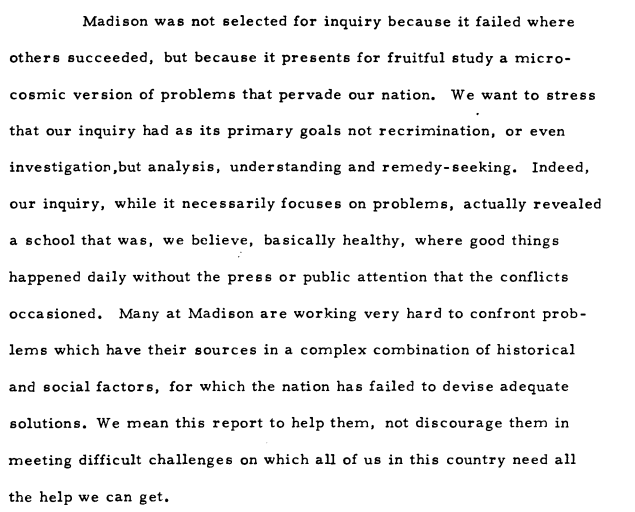
The investigation into the incident, where blacks and whites squared off several days running in a Brooklyn high school that had almost ten years of integrated coexistence by then, can be found on-line, you can read all about it here.  Within a few days 100 policemen would be called in to keep a lid on the unrest.  I got as far as the last section of the introduction (page 4) when I was stopped in my tracks by the tone of the report.   Here is one section, containing language that seems inconceivable in the age of corporate spin we now all live in:

Madison HS report

“Analysis, understanding and remedy-seeking?”  What?  What kind of idealistic jerk-off seeks that in a report on who is to blame for a riot?

“We mean this report to help them, not discourage them in meeting difficult challenges on which all of us in this country need all the help we can get.”

“Challenges on which all of us in this country

need all the help we can get.”

Challenges that more than forty years later we have all but abandoned working on, in favor of pointing fingers and fixing blame.  My father is grimacing in his grave at the abandonment of the ideals that animated this report, the creation of the Office of Intergroup Relations, his years of hard, doomed work.  

“It does make a man wonder: for what was I pelted with rotten vegetables, called a fucking kyke Commie cocksucker, cornered by snarling, red faced New York City racists who bumped me as I left the auditorium?  Why bother sending those two New York City cops with me the next time?  Why bother explaining Brown v. Board of Education to rooms full of parents and teachers who simply and unequivocally hated niggers?  And nigger was the word that foamed on every lip in those days.  Jack Roosevelt Robinson?  Nigger. No other way to put it.  We’ve come so far as a politically correct society, of course, we’re, you know, all post-racial and shit, now white people lose their jobs for hate speech for failure to refer to that magic word as the “n-word”, you know, but the condition for actual n-words on the ground, the masses of them?  They’re fucked, vilified, feared, loathed.  Thugs, yo.  Them n-words is fucking thugs, yo, you know what I’m sayin’?”

Calm down, dad.  I know what you’re saying.  You’re singing to the choir director.  The children of the poor are largely doomed.  Doomed.  There are less dramatic ways to say it, but none are as concise or accurate.  If you are born into poverty, as you know, your chances of dying an early death in poverty are incalculably greater than your chances of escaping poverty.  America, America, God shed His grace on thee.  

“You remember you had nightmares after that piece in Mad Magazine?  Wow, I just thought of that, Elie.  Mad magazine had a version of that song, illustrated with photos, and over ‘crown thy good with brotherhood’ there was a shot of a cemetery where all the grave stones had swastikas painted on them.  I think that same spread had a lynched body hanging there somewhere.   You must have been nine or ten.  It was not long after we passed the display windows along the Time and Life building at Times Square and you saw that magazine with piles of starved extermination camp inmates on the cover, you were up a few nights after that one.”  

Well, yeah, I’ve never had much love for fucking Nazis, dad.  It’s not as though they didn’t kill every member of my family on both sides except for the few who made it here to the USA, USA!   But we can chat about that another time.  I’m reading through the report of the racial tensions at James Madison– I was already out of high school by that time, and this report reads like something out of the Freedom Rides down in Alabama.

“Uppity Negroes, Elie, never satisfied with their station, you know what I’m sayin’?”    

So I get to this part– rumors fly that black high school girls are trapped by a white mob in a local luncheonette, in Brooklyn, 1973, and police are called in to stand between angry whites and angry blacks in front of the luncheonette, which was closed and empty.  And Benjamin Tucker, a black community relations officer in plain clothes, is struck by a white cop, who “mistook him for a student”.  Presumably struck the black man with a baton, probably in the head.  The report is silent on this.

“New York City, Elie, at the dawn of 1974.  I was fifty, starting to get tired.   You believe, and you fight, and even though your ideas are right, and your ideals are unshakable, you will get beaten down when nothing changes.  I think I was in NYU hospital again that winter, I don’t remember.  You wonder what the fuck any of it means, after a while.  Benjamin Tucker, I met the guy when we were at James Madison.  He was angry as hell, I remember he said to me ‘Irv, I’m on a street corner in Brooklyn, working, and I get cracked across the skull from the blind side by some fucking Bull Connor wannabe because he thinks I’m some nigger high school kid?  Crackers in Brooklyn hate niggers just as hard as those white boys down in Allybama.’  And he was right to be angry.  I had absolutely nothing to say to him, except ‘You’re right, Mr. Tucker.’  That’s what I had to give him, the respect of calling him Mister.  Nice fucking world, you know?”

OK, dad, calm down, calm down.  It is a nice fucking world, if by nice you mean infinitely fascinating.  I’m going to read the rest of this New York City Commission on Human Rights report and then go for a stroll, to think about all these nice things, and I’ll check in with you later.

“Catch you later, I’m eatin’ a pertater,” said the skeleton, sinking back into its long nap.

Basic Assumptions of Human Relations

from the report on creation of the Human Relations Unit (regarding the brainstorming sessions for NYC educators on three successive May weekends in 1967):

Finally, before they embarked on their project, the participants were given certain basic assumptions with respect to quality integrated education prepared by the Office of Integration and Human Relations.  These assumptions, which served both as a common frame of reference and as a “jumping off” point for the deliberations, follow:

1. Quality integrated education is the most desirable education for our democracy and the most realistic for our nation and world.

2. The development of good racial attitudes is important for every child, regardless of race, creed or national origin, and each school bears a major responsibility in such development, regardless of the pupil population of that school.

3. Quality integrated education is more easily achieved in a desegregated school, although with special effort many of the elements may be made to apply to segregated schools.

4. The development of academic skills must be a major goal of quality integrated education.

5. A successful program of quality integrated education requires belief in and commitment to its goals, as well as an understanding of the responsibility of the schools as one of the most important agents of our society in achieving these goals.

6. Adult fears, suspicions and disbeliefs concerning the values of quality integrated education must be met by a staff confident of these values, a program devoted to securing them, and an opportunity for adults of both races to participate in such a program.

7. Adults with an understanding of and belief in the values of quality integrated education must be reassured that the school system and staff have that same understanding and belief.

8. The search for additional avenues of desegregation must be never ending.

9. Similarly, the search for improvement in quality integrated education must be an ongoing process which is the responsibility of each and every member of the school system.

10. Our schools must exercise a major part in the leadership which inculcates in each pupil, each parent and each member of the community a sense of responsibility toward the achievement of quality integrated education.

source   pages viii-ix

Board of Education’s Office of Integration and Human Relations

Human relations was the term used to describe a desired state of harmony between different ethnic groups in America during the heyday of the Civil Rights movement of the 1960s.  It was in use in 1968, when I was twelve and my father was forty-four, when he was working at the New York City Board of Education’s Human Relations Unit.  Human relations and intergroup relations meant black students would be allowed to go to the same schools as white students, and that all reasonable steps would be taken to ensure that ancient and present anger and grudges did not interfere in the relations between these young humans or with their education.  The animating idea was that all children have potential and that it is a crime to waste that human potential.

Not to be an asshole about it, but the landmark 1954 Supreme Court decision that had finally done away with the hateful “separate but equal” doctrine in public education was already older than I was in 1968.  The Court had called for desegregation of public schools “with all deliberate speed” and, like many things the law solemnly proclaims, it amounted to a kind of mockery.  

The weasel words “with all deliberate speed”, well-meant, no doubt, but… as they say, you cannot legislate morality, and if local whites sincerely hated local blacks it would do more harm than good, perhaps, to send in troops with bayonets and defend the little Negroes from the wrath of the children of their fellow poor people who hated them.   How, in fact, could we police every playground, bathroom, elementary school cafeteria, even if we wanted to?    

A better approach, it seemed at the time, was to create groups to study the problem, issue reports, and form Human Relations programs.   New York City had a program, so did several other large cities including Los Angeles and St. Louis.   My father joined the Human Relations Unit as an experienced high school teacher with a proven talent for interacting with students, as he had for years as faculty liaison of the G.O. at Martin Van Buren High School.  The G.O. (“general organization”) was the student organization at Van Buren and my father was its faculty adviser.  He worked closely with student leaders, at least one of whom, Mike Levine, by name, called him at home regularly during dinner hours.  

Thinking about this now, my father’s move to the Board of Ed headquarters on Livingston Street in Brooklyn from the nearby high school in Queens, was his chance to make a difference in something he believed in.   He received the same teacher’s pay and benefits and commuted two or three times the distance to and from work every day, but was finally able to use his talents to do more than inspire the occasional high school social studies student.   He was returning to the front lines of tikkun olam, repairing the world, doing God’s work, fulfilling his potential to help bend the arc of history toward justice and fairness.

They did some good work in the world in those years.  Angry Italian kids, their high school turf forcibly invaded by unwanted Negro kids and Puerto Ricans, on top of the insult of the dark brown kids, literally rioted.   Cops were called to the school, the place was put on lockdown.  My father, his black hair spilling over his collar in the back, his thick sideburns showing a certain counter-cultural panache, strode into the school with a young, blonde WASP on one side, an Italian guy on the other side, a black man, a hispanic woman.  Into the vestibule of the Brooklyn shit-hole they went, getting dirty looks from the kids as they entered.

“Dass some shit,” one of the passersby would hear the black haired Jewish intellectual type say, and the tiny door would begin to come open.  

“You are free to express yourself freely here,” the big Jew would tell them.  “I’m not squeamish about language, but I am about dishonesty — I have no use for a fucking liar.  Use the words you need to express yourself, but please, out of respect for the rest of us, don’t try to feed us any bullshit, all right?  Our bullshit detectors all work very well. We have a problem at your school that can be fixed, mostly by learning that we have a lot more in common than we are led to think we do.  We are all going to fix a bunch of the problem together this weekend.  It’s going to be fine, but first we have to talk.”  

And they would talk, in sensitivity training sessions, in role playing sessions.  

“You want to know why the word ‘nigger’ is offensive, motherfucker?” the black kid would say to the leader of the Italian kids.  And my father and his trainers knew to hang back at that moment, I suspect.  This is a great moment between the leaders of the two gangs.  My father would make a note in his head, and at the proper time he’d begin.

“‘Motherfucker’ is one of the most fascinating and powerful words in our language.  Tony, you said it’s a fighting word, the last, irresistible, provocation before fists fly, which it certainly is.  Lamar gave us two or three other meanings for ‘motherfucker’.  The word is like holding lightning in your hand, if you think about it,” and they would talk about who the real motherfuckers were, and who just thought they was real motherfuckers, and soon every motherfucker in the room would be nodding their heads, some of them laughing.

 “Do you make the feeling behind a word more or less powerful when you forbid its use?”  I could hear my father asking.  “Lamar, would you prefer Tony call you a nigger or an ‘n-word’?  Any preference at all between those two?”

“Fuck no,” says Lamar, “let the nigger call me what he wants, but let him say it with love.”  And Tony bursts out laughing, he never realized what a funny motherfucker Lamar was.  The two had been implacable enemies, the most charismatic of their respective warring tribes, and now they were each seeing the other as a highly intelligent, witty young individual.  Like the Jew said, they actually did find out they had more in common than they thought.

“You know, as far as my people were concerned, and I mean the White Anglo Saxon Protestants who actually run this country,” said the blond folk singer, “Italians were niggers too.  I mean, no offense, Tony, but Italians were one tiny step above niggers, in the same category as garlic-eating Jews like Irv over here.   American history has not been pretty, in fact, in many ways it’s been very, very ugly, but going forward the future belongs to us.”

As they broke for lunch students who had never talked to each other began to chat.  The food was way better than school food, the setting, in a country campus somewhere, was a bit magical for these city kids, made them feel special.  Breaking bread, talking frankly, having adults who were not trying to micromanage and control everything, who let them talk the way they talked… these things were all good.  Friendships emerged.  The fighting at their school would stop.  For a year or two.  The friends would graduate and their little brothers and sisters would start attacking each other.

“Well, you’ve captured some of this, Elie, but you know who you really need to speak to if you want a primary source, don’t you?  You have to find and contact my man Phil Trombino.  Phil was there, he’d be sitting next to Tony as Evelyn was telling him Italians were actually niggers.  Tony would look at Phil and Phil would raise his eyebrows and nod.  ‘Ain’t dat some shit?’ Phil’s familiar expression would tell the Italian kid.  The Unit really was a great idea, until Nixon and that ventriloquist’s dummy Reagan and all the rest of them repackaged the narrative and made guys like us the problem, and, if you think about it, when have we not been the real problem?  Nixon had plenty of guys like us on his enemies list, the paranoid, drunken fuck.  Call Trombino, Elie, seriously.  This is a story that should be told, and who better to tell it than you?”

Five Good Ideas for Music

Leave space.

This gives the other players the most options for adding their parts.

Listen.  

A most important and undervalued skill in music as in life, hearing what is going on and reacting to it directly.

Keep it simple.  

This works on a similar level to leaving space, a simple part is best foundation for other ideas.  

Be playful.  

Don’t forget why they call it playing, we do it for the same reason all baby animals love to play.

Don’t look for the spotlight.  

The best ensemble playing is done by generous players who listen to each other and add only parts that make the ensemble sound better.

Anger Poisons Everything

Anger, unchecked, poisons everything, eventually.  My father learned this too late, hours before he died.   Unprocessed anger exerts a relentless downward force on the shape of a human life, I have seen it in action many times, felt it in my own life.  Why is a fifty year-old or seventy year-old filled with enough anger to distort their view of the world?  It would take a long time to explain, in the individual case.  You would have to know details an angry person would not be apt to reveal.  Anger, as we have seen, makes a person intractable and unwilling to compromise, let alone share.

Anger can gather slowly, building its case over many years, but once it reaches a certain point it turns a relationship irreversibly toxic.   Anger is poison.   Taking it in a small dose every day will not make you immune to its venom, it will eventually turn everything you look at irredeemably sour and then begin killing everything you once loved.

I watched the laughs my father shared with several highly intelligent friends turn to silence, watched the friends turn to ghosts who were never mentioned again.   I couldn’t know, at nine years old, what I would learn decades later– that most friendships also have a life span.   It is rare to have lifelong friends, and it takes a certain optimism and willingness to overlook faults to keep friendships alive.  

Irv had neither optimism nor a willingness to overlook faults, yet he managed to have a couple of lifelong friends, Arlene and Russ, whose friendships were only ended by their early deaths, and his surrogate son and business partner Benjie, a close and beloved friend until Irv’s own death.  We see in these relationships my father’s ability to be a good friend.

I understand now what my father was too bitter to really explain to me when I was a child.   We start off full of good will towards a person we like, and as we find things we have in common, and enjoy each other’s company, point of view, sense of humor, begin to do each other favors, we develop a friendship.  Many things can come into the picture to dampen these feelings of generosity toward one another.  The feeling that creeps in and always administers the final blow is anger.  And as we give the coup de grace to a dying friendship we always feel completely justified.  Always.

I think of our puny, vulnerable early homo sapiens ancestors, at the bottom of the food chain, on the run, terrified, enraged, banding together to survive.   You can fast forward through history to this very moment and you will find the masses of people, while individually decent and often quite loving, capable of every insanely human cruelty our terrified prey animal ancestors committed.  We are right to call these primitive emotions.  Among the earliest, for a hunted group, is the survival imperative to draw a thick, indelible line of hatred between us and another group member who betrays us in a moment of need.

I remember my father’s rage at his best friend Harold, a man with a genius IQ and an endless store of subjects for intelligent discussion, a man of great humor and jest.  Harold put a price of $75 on their friendship, humiliated my father and caused him to lie clumsily to his beloved mother-in-law, and she knew her son-in-law was lying.  My father’s hatred of Harold after that last straw was absolute.  My father would dismiss the idea of hatred, seeing it as an admission of weakness, but the effect was the same.  Harold was dead to him.

Fifty thousand years earlier it would have been a large stone down on Harold’s head, enough times to make the body stop twitching.   It is literally this way when the feeling of betrayal is upon us.   We have more civilized ways of killing, and it’s generally done symbolically, but the former friend is just as dead to us, if the betrayal is hurtful enough.

And, of course, the beauty part is that there is no arguing with a righteously angry person.  My father had to endure an excruciating series of moments when my grandmother found the Chinese furniture items Harold had fawned over and purchased for the ridiculously low price of $75.  “Why is that furniture in the attic, Irv?” asked my grandmother, clearly confused and hurt.  

My father, unused to lying outright, had to invent a clumsy cover story on the spot when Yetta, full of hurt, asked him to explain.  The truth, if simple, was unspeakable to my father in that moment:  Harold had changed his mind, my father had sullenly paid him the $75 back — after Harold’s fatal argument that he’d been cheated, somehow–  and, my father, unwilling to part with things his mother-in-law greatly loved, stored them in the attic.  She had never gone up there.  

And then one day, looking for something else, she apparently pulled the chain that lowered the folding wooden steps, climbed up and was shocked to find her beautiful things covered with dust in that filthy attic.  Harold then had to die, if he was still partially alive at that point.  It was not only that one incident, of course, the $75 price tag on their friendship was only the last straw of Harold’s vicious pettiness.  He was always a cheap fuck and now that my father hated him the old story about Harold pulling down the blinds on the classroom door and beating the shit out of Junior High School students who defied him was a lot less funny.  In fact, it was as good a snapshot as any of the arrogant, brutal piece of shit in action.

I do my best to preserve the old friendships I have left.  I cherish each one and guard it as best I can.  I call friends I haven’t heard from in a long time, I extend the benefit of the doubt to those I’ve always shared warmth and laughs with.   I have also come to understand that an emotional juncture may come and mutual harms can easily be exchanged that a friendship cannot recover from.

“After all, Elie, does it make a difference to you, on any level, if the person you considered a good friend ignores your reasonable need out of a deeply felt general obliviousness or is sending you a personalized message that your feelings are not important enough to pay attention to?” asked the skeleton.  “How effective is this defense: he didn’t act like an asshole because he meant to hurt you, that’s just the way he acts?   If he’d realized that doing what he did to you was hurtful, he’d feel terrible.  Poor baby, you dig?  No, Elie, there comes a time when you pick up a large stone and just bash their useless head in.  Done.”

“You like the ship metaphor, I’ve noticed, throw ’em over the side, let ’em wave goodbye, or give you the finger, from your wake as the sharks close in.  You know, at some point, when you see they have made your life toxic, that it’s a matter of survival.  We do what we need to do to survive.  Bukowski’s list of that swarm of trivialities that kill quicker than cancer and is always there has a line for people who insist they’re your friends.   Got to be smart about that, we don’t get many people in our lives who can become true friends.”

The larger question remains, dad.  How do you live to be eighty without dealing with a terrible temper and a lifelong sensitivity to a perceived slight? I will pick this sticky one up another time, I have to get on with other things now.  

“Go out into the world and live, my child,” said the skeleton in an ineffably wispy manner.