Still Looking for Feedback, you poor bastard

The breeze carried the smell of blossoms over the graves at the First Hebrew Congregation Cemetery off that lazy country road in a lush, sleepy corner of Westchester.  

“Yep, the place looks exactly the same as it did fifty years ago when my brother and I used to visit our parents’ graves,” said the skeleton, “except that there are a lot more of us here now, of course.”   My father and mother’s grave is almost at the top of the grassy hill, my aunt and uncle’s a few steps below.  

“Your mother would be cursing the Jews around now,” observed the skeleton.  

Rules in Jewish cemeteries vary, this particular one doesn’t allow the burial of ashes.   The Jewish cemetery by the Van Wyck in Queens where her parents are buried has no problem with the burial of an urn, or box of ashes.  Since my mother was cremated her gravestone in Cortlandt, saluting in Hebrew her “heart of a poet”, marks merely her life, rather than the final resting place of her mortal remains.  We plan to scatter her ashes over the Long Island Sound at Wading River, where she spent some of her happiest summers, but it was six years since she died the other day, and we are still planning.  Meanwhile her remains are sitting in a box in a very fancy paper shopping bag that is brown paper on the outside, slate grey on the inside.  

“She’d appreciate the fancy bag,” the skeleton said, “and she’s not in any hurry to go anywhere.  Though I know she’d spare a couple of harsh words for the arbitrary pricks who didn’t allow her to be interred here next to my bones in the burial plot we bought and paid for fifty times over.”  

The breeze continued to waft the smell of blooms and there was a faint buzz of insects beginning their chorus.  

“What are you waiting for?” asked the skeleton.  

Pardon?  

“At last count you have 340 something pages, 120,000 words written in this Book of Irv,” said the skeleton.  “What are you waiting for?  Do you think you are going to live forever, Elie?  You want to get my story into the hands of the public, right?  Your friends who read a snippet or two might sometimes give you a bit of nice feedback, but that’s like Bear Bryant’s moral victory, it’s like kissing your sister, you dig.  I know you still want feedback, right?  It’s long past time you had some success as a writer, recognition.  Important for you to get paid for it, too.”  

I confess.  Yes, feedback is important, so is success and getting paid for this. Picasso had a great quote about success being important to an artist not just for making a living but also to continue to work as an artist.  The appreciation one gets fuels further creativity, is confirmation of success, the external reward for working hard to build a bridge from your heart to the heart of another.  After a while an artist can’t keep creating good work in a silent vacuum.

“But you don’t believe in ‘artists’ anymore, do you?” said the skeleton.  

Well, it’s true I see them more as brands or products than as members of some lofty pantheon I aspire to belong to, the way I used to see them.  The only indisputable genius I know works as a waiter, spends a lot of time depressed and, I suspect, continues to duke it out with the bottle.   The term ‘artist’ is kind of pretentious, too.  The ‘artists’ I like best are not too fucking arty, if you know what I’m saying.  

“You are preaching to the choir, my friend.  I always found artists annoying as hell. They are people whose egos drive them to advertise themselves and the successful ones, the ones who sell themselves to the wealthy art collectors, a prissy and despicably arbitrary bunch of arbiters of taste in their own right, elevate their supposed ‘sensitivity’ to a level the rest of us mere mortals cannot even aspire to.  It’s a myth, and a pernicious one, if you ask me,” said the skeleton.  

“Of course, opinions are like assholes, everybody has one, right?” he added.  

But, at the same time, there are works that move you, books that make you see something from a perspective you didn’t have, actors who convince you of the emotional truth of their characters.  There are people out there, like Meryl Streep, who use their talents to create things that are not pure vanity, right?  

“Meryl Streep is brilliant.  You go into the cinema ready to be skeptical when she plays someone like Margaret Thatcher and within a minute or two she has you, she’s sucked you in, in spite of your determination not to be sucked in, makes you forget your hesitation to believe her.  Yeah, I’d call someone like her a great artist, that’s fair,” said the skeleton.  

A big raptor rode a thermal in a long lazy arc, high above the grave stones.  

“You’re wasting time, my man,” said the skeleton.  

The sound of a car motoring on the winding road came and went.  

“I didn’t give you and your sister what you needed when you were little.  Kids need someone to listen to them, tell them what they’re talking about is interesting.  Being listened to instills a sense of possibility in the child.  I couldn’t do that, never had it myself, had no idea how important it was to learn to do that for my kids.  I was busy holding off ten demons at any given time.  I was overworked, stressed out, living an American Dream that was only really possible during my lifetime.  A lucky break, to get out of the army after a uniquely necessary and just war, at a time of unprecedented, never to be repeated, economic growth and opportunity.  Moving toward a better world, ending poverty.  Then that fucking cheerful marionette Reagan cuts funding to social programs and chirps: ‘we fought a long war against poverty and poverty won.’  In between I took my eye off what was most important, giving love and real emotional support to you guys.”

The light spring breeze seemed to sigh.  

“You’ll lose these embarrassing flourishes in the rewrite, of course, along with the meta-narrating skeleton, right?” said the meta-narrating skeleton.  

Of course, dad, but please continue.  

“Magic words I almost never spoke at home: ‘please continue’.  The bitch of it is, I knew exactly how important that phrase was.  Those words were so useful in the workshops we did with gang leaders.  ‘Go ahead, Jose,’ would let the kid hold the floor to finish whatever point he was trying to make.  I never let you or your sister finish making a point, really.  I was always too afraid of being challenged about any of the things you had every right to challenge me about.”

“You know, on one level I understand I forced you and her to become your own parents.  How do you do that?  It takes decades, literally, and insight, which comes, largely, through luck.  Do you have someone else to bounce these things off of?  Someone in a similar struggle to compare notes with?  If not– hoo, you’re fucked. I’m not proud of doing that to my kids, you know that.  I guess that’s why you both are so much in need of positive feedback.”

“I told you during that last conversation that I’d told your sister a hundred times what a superb teacher she was.  You questioned the number a hundred.  I assured you it was at least a hundred.  Actually, it was twice.  I remember both times, and I remember how the sincere comment just rolled off her.  She was, and is, a superb teacher, any idiot who watches her with kids for two minutes can see that.  I was a huge jackass, there’s no question about that.  It took her twelve years to get the confidence to make the move she easily and successfully made just last week.  Makes my donkey ears twitch just thinking about it,” the skeleton said.  

Far be it from me to interrupt while you’re giving yourself such a good whipping, but I should interject something here.   Not that it’s a complete explanation, or defense, but you and mom never experienced anything like emotional support either.  Like the affection you said you were hard-pressed to express because you’d never seen it done, how would you have any clue about being emotionally supportive?  To you it was great progress that you weren’t whipping us in the face, instead of merely cursing at us all the time.  

“Well, I take that compliment, though, as you say, it doesn’t let me off the hook.  You’re supposed to have some fucking insight if you’re going to be a father,” the skeleton said.  

Look around, though.  How often does that really happen?  

“Well, you’re being generous.  There are many people who have the sensitivity, who just understand that sometimes you just put your arm around your kid when they’re angry, or dejected.  Those things don’t take sophistication or any kind of great insight, just basic humanity.  You’re suffering, I let you know you’re not in it alone, I’m present and suffering to see you unhappy, I’ll do what I can to help you.  Instead you and your sister always had my shoe on your necks, I was always blaming you for having an angry asshole as a father.  I can cop to that now, I only wish I’d had the sense to see it, and stop it, while it still could have made a difference,” he said.  

We all do, man, but, as you always said of your parents whenever you mentioned them: may you rest in peace.  

“That’s how we roll up here,” said the skeleton, as birds sang their seeming agreement.  

“I just want to remind you that nobody could really understand me without knowing a lot more about mom, she was the other half of me for most of my life.  You need to describe her in this Book of Irv,” said the skeleton.  

Understood.  

“She’d be very proud of you, reading these pages.  She always loved your writing, your ability to express yourself in words.  Me, I always read your words with mounting paranoia, waiting for a lurking terrible truth.  I’d go along cautiously and then, bam! from the undergrowth —  a pair of fangs right into my ankle.  Your mother was much more appreciative of your actual skill, and that’s probably a factor in your ability to write, your willingness to do it without much feedback from anybody,” said the skeleton.

Fuckin’ A, pops.  True dat.  I can see her smile to this day when she was handing me back some pages and saying “oh, that was wonderful!”  

“I rest my case,” said the skeleton, “goodnight ladies and gentle weasels of the jury.”  

A bird cackled, it sounded like a maniac’s laugh.
 

The Last Nails in His Coffin

I ask my sister about Beaver Dam, which she vaguely recalls.  She could not have been much older than two when we played.   She mentions the time our father tossed us into deep snow drifts on the side of the house after a record snowfall that came down when we were little.   I tell her about Azi’s memories of our father as a fun-loving older cousin who affectionately wrestled with him when Azi was little.  Hearing stories of her father’s playfulness before we were born confirms my sister’s theory.  

“We did it to him,” she says, “when we were born, that was the end of any chance of happiness for him.”  

I marshal my usual arguments, quote him the last night of his life about his life being essentially over by the time he was two.  She agrees, seems convinced, realizes that our existence could hardly have been the decisive factor in her father’s happiness or unhappiness, then adds:  “we were the last nails in his coffin.”  

That was part of his genius, making us feel like it was our fault he was angry all the time.  My sister quickly agrees when I mention Rodney Dangerfield’s “your father and I wanted a child so badly — imagine our disappointment when we had YOU”.  

“No, that’s true,” she says, “we were eternal disappointments to him.  I think you more than I was, since he was basically a misogynist and you were always more important to him than I was.”  

I am in danger of veering into personal terrain that is not mine to veer into, so I will stick to my perceptions here.  

I grew up unable to understand my parents’ readiness to get mad and their frequent harshness.  I had nothing to compare it to.  Like most kids, I figured on some level it was normal, just the way the world is.  Dad gets home from a long day at work, mom has had a long, trying day at home with the kids muttering “wait til your father gets home….” and then he walks in the door and she unloads a day of frustration on him.  

“Don’t call ’em my kids,” he scowls, “they’re your kids too,” then, because he has to somehow deal with this shit after a long day of work, he forgets everything he knows about sensitivity training, developmental psychology, group dynamics –it’s pure survival mode in the cold, deep water.  

“You empty-headed little thief,” he says to his little daughter, who once pilfered a quarter off a pile of change.  “What did I tell you about playing with that fucking snake?”  This sends a shudder through the little girl and the mother, both are phobic about serpents.  “If you play with a fucking rattlesnake you’re going to get bit.  Don’t I always tell you that?”   For my part, I remain coiled, vigilant, shaking the rattle on my tail.  

If you get the shit beat out of you every day by an angry bully, like the young Pat Conroy did, you know what is giving you the nightmares, the proneness to depression. If your father is an artist who never uses the crude instrument of a fist or a belt, who constructs an alternate universe where you are always wrong and he is always the victim of his child, somehow, it may take you many more years to realize what you are up against.  It is natural, somehow, to blame yourself.

I have idly thought from time to time that I’d have preferred beatings, which would have stopped by the time I was fifteen, the first time I saw real fear in his face when I stood abruptly during one of his dinnertime tirades and glared at him like I was about to lunge across the table.  Idly is the only way to think of such things, since nobody prefers beatings.  

I just think it would have made things clear: on the subject of his anger, dad is out of control.   He’s nuts.  One day there will be a law to make people like him stop doing this kind of shit.  There could never be a law against the subtle art of my father’s rage.  

Your parents are your first teachers about the world.  It happens, often, that your parents don’t really know shit worth teaching you about the world.  They are struggling themselves, victims who have never overcome the things they were born up against.  Add to it the mass-murder of virtually every relative in their parents’ generation and you have a potent brew.  

“You’re in a chipper mood today,” observes the skeleton.  

I am not in an unchipper mood.  I am carving a gigantic block of marble, these tiny fragments need to be removed to complete the portrait of you.  You recall what my boy Michelangelo used to say about carving a portrait out of a block of marble?  

“It is easy to carve a man out of marble, just cut away the parts that don’t look like the man,” said the skeleton, looking off into the distance.  

Look, that’s how I tolerated friends who barely concealed their rage at me over the years.  I can have this breezy chat with a father who psychologically bludgeoned me every day from the time I was in the crib.  

“You were a very angry baby,” the skeleton reminds me.  

No shit, Shylock.  Look who I had for a father.  

“Point taken,” says the skeleton.  

I think of my longtime friend, and now longtime former friend, Mark, a depressive young genius who could never be happy.  It took me many, many years, but in the end I realized his disappointment in me had little to do with me.   He could never be satisfied with anything in his life.  If the club would admit somebody like him as a member, the fucking club had to be destroyed.  In the end, and it was gratifying in a sick way, I reduced this man of a million convoluted words to sullen silence.  When I was finished with my final argument there was nothing left for him to say.  He had no defense.  I sat and watched him glower and quietly suck his teeth across the table in that Florida diner against the black sky as sheets of rain fell on the parking lot outside.  I enjoyed the sound of the slashing rain against the windows, the silence of this angry man who had for years tried to blame me.

“Well, I never saw how you could have been friends with such a relentlessly selfish prick to begin with,” said the skeleton.  

You always told me I was a poor judge of character.  I could go down the list.  The insane guy, now in a cult, who mooched off me for years.  Who once told me, as I laid down a perfectly serviceable piano part, “one thing for sure, you’ll never be a piano player.”  It was years, and a series of unmistakably escalating provocations, before I finally cut that guy loose.   You taught us we didn’t deserve any better, taught us to tolerate being treated badly.  

“You sound like a bitch,” said the skeleton.  

Nice.  If you weren’t already a skeleton I’d kick your ass for you.  You know why people like me sound like bitches?  Because the macho man keeps his mouth shut and uses a fist, if it comes to it.  

“I didn’t say you weren’t entitled to sound like a bitch,” said the skeleton.  “And as for your threat to kick my ass, you remind me of that brash young relief pitcher who claimed he could strike out Ty Cobb on three pitches.”  

I remember that.  When the sportswriter challenged him he said “no doubt I could do it on three pitches, Cobb would be over a hundred years old, for Christsake.”  

“There have been some clever bastards among us, Elie,” the skeleton said.  

Indeed.  Cleverness for its own sake, I don’t know about that these days.  I’m looking for something beyond the epitaph on the tombstone of a feeling.  

“Ah, Freidrich Neitzsche, Hitler’s favorite philosopher,” said the skeleton. “‘A joke is the epitaph on the tombstone of a feeling’, yes, indeed.  Sekhnet taught you that one.”  

Yes.  And let us point out, as if it needs pointing out, that Hitler understood Nietzsche’s philosophy as well as he understood the teachings of Hillel.  

“And let us also stipulate that for all of Nietzsche’s brilliance and insight he had a complete breakdown at age forty and was cared for by his sister for the rest of his life,” said the skeleton.  

But we digress.  It is necessary, if we are to present an honest portrait of you, to show your monstrous side as accurately as possible.  

“Yes, please, my monstrous side needs to be shown accurately, of course,” said the skeleton.  “After all, why leave your father to rest in peace and dignity when you can piss on the skeleton a decade after he’s gone.”  

Don’t, dad, you sound like a bitch.  

“Touché ” said the skeleton.


Beaver Dam

I visited my cousin Azi a few months back, a man I hadn’t seen in years.  My sister and I always marveled at how much he looked like our father.   The photos of him as a young man, on the walls of his home, posing with his beautiful wife and their three kids, showed an uncanny resemblance to Irv, his first cousin once removed.  (You can see the two of them, as adults, on my sister’s couch by clicking  here)

Azi, as my sister and I remembered him from our childhood, always seemed cheerful, had a good sense of humor, laughed easily and genuinely.   It is hard to imagine that, like his cousin Irv, he could possibly have a dark side.  My sister and I are both unable to imagine it.   Then again, one could have spent a day or two with my father and never have glimpsed anything but a fairly cheerful, droll, highly intelligent man.    Azi and his wife Sue were gracious and highly interactive hosts when we visited them in Israel in November.  Azi, like my father, seemed to be interested in, and knowledgeable about, every subject that came up.

“Sapiens  [A Brief History of Humankind, by Yuval Noah Harari] is a great book,” said Azi when I mentioned a fascinating lecture I’d heard by the author, an Israeli professor who wrote the book in Hebrew, the language the American-born Azi read it in.  “You can’t just pick it up and read it like a novel though,” he pointed out.  “It’s more like taking a graduate course, you need to let it sink in.  Read a chapter, think about it, digest it a little, read the next one.”   When I listened to the audio version of the remarkable book I found he was absolutely right.

I’d had some trepidation about contacting Azi when we were planning our trip.  I hadn’t heard from him in a couple of years, though he sent condolences immediately when my mother died (six years ago tomorrow).  He and Sue used to visit my parents whenever they were in Florida visiting Sue’s father.  I’d had a few pleasant meals with them over the years when we were in Florida at the same time.   The trepidation arose because of my partisan position in a long cold war in our family.  My father had chosen the losing side in that long war between his first cousins, as I too learned to do in most things.  My father loved his seventeen years older first cousin Eli.   The Eli faction had, for decades, had nothing to do with the Nehama faction.  Eli and Nehama hadn’t spoken for the last thirty years of Eli’s life.  Nehama, Eli’s half -sister, was Azi’s mother.

Eli’s mother died shortly after Eli was born, of complications from childbirth.  Eli was raised by his mother’s mother and his three aunts.   Eli’s father remarried and had two more children with his wife Tamarka.  These children were Nehama, a brilliant woman who lived to 102 and had been the first female graduate of the Jewish Theological Seminary, and David, a genius with an eidetic memory who became a lawyer but never needed to practice law as he became the family millionaire.  Nehama married a rabbi, Ben Teller, and they had Azi and his older sister.  

Eli, a rough and charming character with a ferocious temper,  carried on a more than thirty year grudge against his half-sister Nehama; they never spoke after their father, my father’s Uncle Aren, died.  My father allied himself with Eli, I became good friends with Eli in the last years of his life.  It is thanks to Eli that I know the detailed history of the family that I have learned.  

“Well, Eli had his version of history, that’s for sure,” said Azi laughing when the delicate subject of some old story came up over Friday night dinner at their home in Neve Ilan.  I agreed at once, as I have finally learned to do, about a matter of opinion or speculation I might have reflexively taken sides about in former decades.  Eli, although a very candid man, had strong opinions and was not always the most reliable narrator.  Whatever the truth of this particular story may have been, it was easy for me to agree that there were other, completely plausible, sides to it.

I realized, a moment before I spoke and in time to say something else, that Tamarka, who Eli had described as “a bitch on wheels” and “uglier than an ape”, two sentiments my father endorsed, had been Azi’s grandmother.  It was this same Tamarka, I learned from Eli, who had broken up the romance between my grandmother Chava and the red-haired Jewish postman.  It was Tamarka’s rubber tree plant that my young father and his little brother dug their fingernails into, with vegecidal intent, as they dusted the leaves when they helped Chava clean Tamarka’s house.  Chava, it seeemed, would never work off her indenture to Tamarka and Aren; her children were also required to kick in to pay off her passage from Truvovich.  

It was Nehama and Dave who, along with their father Aren and Tamarka, made all decisions regarding my father’s future.  He was to go, along with his brother, to  trade school.  

“Yeah, NYA, Sheet Metal School, ’cause we were too dumb to think about going beyond trade,” said the skeleton, quoting himself from the last conversation of his life.

I was shocked at how much bitterness my dying father still seemed to have toward Nehama, a beautiful woman who sang in a high melodious voice and served my young sister and me ice cream sodas in chilled metal tumblers whenever we visited her as children.   Nehama and Ben lived very close to us in Queens when my sister and I were kids.  They moved to Jerusalem when they retired, around the time Azi, Sue and the oldest of their three kids emigrated to found a new moshav outside of Jerusalem.    It was largely my dying father’s bitterness that made me hesitate to contact Azi until a couple of weeks before we finalized our travel plans.  

Azi at one point expressed, in the gentlest way, his perplexity as a younger man to see the hard-edged enmity I always seemed to have toward my father.  In Azi’s recollection his older cousin Irv, who he remembers with great love, was a fun-loving playmate when Azi was a boy and a kind, brilliant and humorous man when they were both adults.  “We used to wrestle all the time when I was a kid,” said Azi.   When my father came out of the army Azi was a young boy.  My father always loved young kids and interacted with them quite naturally.  

“I remember he took me aside when he got engaged to your mother,” Azi said, clearly amused by the memory.  “He told me we wouldn’t be wrestling too much any more, that he was getting a new wrestling partner.”  

This reminded me of a game my father invented that my sister and I used to play with him when we were very little.   My father would lay on the double bed in his bedroom, take off his glasses and say “Beaver Dam!”.   This was the signal for my sister and me to jump on to the bed and begin trying to roll his huge body toward the edge, and over it, as a log in our beaver dam.   We loved this game, shoving the top of our heads against his ribs and pushing as hard as we could.  One of us would dive down toward his legs to push from there, get a grip on him, try to topple him on to the floor.    This freewheeling physical fun, accompanied by our father’s humorous sounds and commentary,  was probably similar to Azi’s experience with his cousin Irv.

I have no recollection of how many times we played Beaver Dam.  I do recall that at least once the two tiny, tireless beavers managed to roll this gigantic log on to the dam, over the side of the bed on to the floor.  I think my sister will immediately remember this game too, although she couldn’t have been more than two or three when we last played it.   What I remember clearly is how every session of Beaver Dam ended.

“Goddamn it!” my father would bawl to his wife, “he kneed me in the balls!”   This confirmed what my father knew from the beginning, when as a tiny baby I’d eye him accusingly from my crib, that I would do anything to hurt him.  He’d cry out to our mother that I had deliberately kneed, or kicked, or punched him directly in the balls.    

“Did you?” asked Sekhnet when I read her the account of the game.  “Maybe you did it unconsciously,” she suggested.    It’s possible, I suppose, though I have no recollection of intent to do anything but get leverage and roll the gigantic log on to the dam.   In the grappling I don’t doubt that he may have gotten a knee or elbow in the balls.  

“Well, it’s my own fault, really.   Everyone who plays Log in Beaver Dam knows that you wear a goddamn cup, since a knee or elbow in the balls from a flailing little beaver is pretty much inevitable.   But I was a young father and naive as a baby,” said the skeleton.

“What is it you fucking want from me?”

“Oh, boy,” said the skeleton.  

Heh, yes, I’m afraid so.    This is a fundamental question for all humans, what we fucking want from each other.  I think about this now, in the context of your life, and your challenging, pointed question which, inevitably posed when I was most vulnerable, always made me feel like a needy neurotic whiningly asking for something unreasonable.  I was actually forced to ask for something that should have been naturally given between people who love and respect each other, instead of withheld.  

“Well, love and respect do not always go together,” the skeleton said, shifting, ready to rumble.  

Don’t be like fucking insane Andy, dad.  That pusillanimous turd, when I gave him the chance to offer me any version of the apology he owed me, pugnaciously challenged me about my use of the word reconciliation.   Reminded me of your old technique.  Were we talking about whether love and respect always go together?  Does that have anything to do with what we are talking about?  

“You never showed me very much respect,” said the skeleton.  

Well, take consolation in the kind of mature man you produced, then.  Twenty years ago I could not have resisted a smiling “fuck you…” in answer to that.  We’re not talking about respect, except to the extent that we’re talking about what we need from our loved ones.  Mutual respect is inherent in a fair give and take of what each of us needs, but any arguable distinction between love and respect is far from the point here.

“Bear in mind that my loved ones growing up were incapable of anything but bare survival.  My parents were in an arranged, loveless marriage.  My mother, in fact, despised my father.  She literally loathed him.  He was, as Eli described him, two eyes, a nose and a mouth.  His entire existence was devoted to not getting smacked in the head with a heavy piece of wood.  He did not always succeed in this.  Where was I supposed to learn what people give to people they love?”  the skeleton was getting a bit worked up.

Don’t you find it a bit ironic, if not also sad, that you, now dead more than eleven years, are still blaming your parents for your own failings?

“Touché, momzer.  Look,  I’m not blaming them, I’m explaining that I had no role model for giving and taking what is needed between people…”  

And therefore you are not responsible for the fact that you never took the trouble to learn how this indispensable human thing was done?   I was kind to you as you were dying, where did I learn to do that?  

“Was I never kind to you?” asked the skeleton, almost tearful, in a dry eye socketed kind of way.  

There’s the horror of it, dad.  You were kind, and showed it often, and it made the many times you mercilessly raged, and coldly refused to give what was needed, that much worse.  You were the skillful facilitator of sensitivity sessions between warring ethnic groups.  You were a longtime advocate for what was then called intergroup relations, having people listen carefully to each other, hearing what came through beyond the idioms.  You recognized how crucial it was for peace to have your concerns heard, to hear others.  Is it an unnatural thing for a child to show his parents something he’s created?  To expect some kind of sensitive reception and helpful feedback?  

“Well, you were always the little genius, you didn’t need my input.  I told you in high school that your drawings reminded me of George Grosz.  You came to admire Grosz when you were older.  What, was I remiss in not telling you that you drew like Albrecht Durer?  I don’t know what you expected.  I wasn’t a fucking art critic.  I don’t even know why you would expect me to know what to say about any of it…”  The skeleton, I saw, was truly at a loss.  

It’s a much more fundamental question and it has nothing to do with knowledge. Mom used to ask me what she was supposed to talk about with her grandchildren.  Like it was a mystery.   Ask them about their lives, I used to tell her.  Ask them to tell you what’s new and exciting, let it remind you about things from your childhood, tell them about those.  She assumed she’d be hearing about things she could never relate to, the new Game Boy, musical groups that made sounds she found hideous, the mindless fads of an incomprehensible, materialistic generation.  I always assume that a conversation goes where it goes and that two people who like each other will generally find something mutually interesting to talk about.  The back and forth, being listened to by someone who shows an interest in what you’re saying, is where most of the action is, it seems to me.  

“Well, that’s a quaint idea,” said the skeleton.  “Look, you’ve always been that way, very verbal and interactive.  You have a genuine interest in other people, that’s one of your attributes.  Not everybody has that.  Not everybody gives a dead rat’s ass.”  The skeleton pointed to a dead rat that was waiting for a hungry scavenger.  

In answer to your exasperated question “what is it you fucking want?” I offer you this.  I want to speak, and be heard, and have a reply from the other person that’s actually responsive to what I said.   I want to hear what you’re saying, and get clarification when I need it, and understand the point you are trying to make.   I want a catch, basically, a back and forth where we each throw the ball directly to each other and don’t turn it into some kind of competition to see who can catch the high heat and who is too much of a pussy to handle the hard stuff.  

“Well, you’re an idiot doomed to a lot of disappointment then,” said the skeleton.  “That’s not what life is like.  You expect the impossible.  People don’t give a fuck.  Look at the situation of the American Negro, to take just one example.”  

With respect, I’m not going to take a look at the example of the American Negro.  

“I don’t know what you fucking want me to say,” said the skeleton, petulant as a child.  

Well, you can always tell me how sad it is that I’ve propped the bones of my dead father on my knee and am using the poor pater as a ventriloquist’s dummy.  

The skeleton looked at me with dead eyes, and a grin that clearly did not match his mood.  

I’m painting your portrait, dad.  I’m showing you from as many angles as I can, making you as three-dimensionally lifelike as possible.  This is a maddening and characteristic feature of yours, this need to fight over things that reasonable people would admit are just wrong to fight about.  

“You were a very difficult child,” said the skeleton.  

There you go, way to do it, pop.   You remind me of Dubya when you act like that.  Smart as you are you remind me of the dumbest, or at least most speech challenged and idiotic looking, president we’ve ever had.  

“History has given us equally moronic presidents.  Dubya was bad, but he wasn’t the most stupid.  Apparently he had a genius for remembering people’s names and charming them,” said the skeleton.  

This is a beautiful thing I always admired about you, you could have been the producer of Hollywood Squares:  Wally Cox to block.  

“I think you missed your calling too.  I think you could have created and syndicated a show called ‘I’m Still A Snide Little Shit.’  It would be a great hit in the Age of Trump, don’t you think?”

I do.  If only my father had left me the millions presidential candidate Trump was left when he found himself on third base thinking he’d hit a scorching triple when all he’s ever… ah, what is the fucking use?  I’m talking to a dead man, after all.

 “On the other hand, Elie, these are some of the best conversations we ever had,” said the skeleton.   “Ironic, eh?”


A Grown Man Whining About How Mean His Father Was (Badlands)

It is a cliche used to describe the pathetic:  “his father was so mean to him!”  said with sideways marionette’s quake of the head and a mocking little wave of the hand.  “Her mother was a nightmare,” is sometimes said with a touch more sincerity, but, in general, hearing an adult talk about how mean a parent was brings a smirk to the cheek.  

“Well, you hit on something there, Elie.  That’s why I said the other day that I don’t hold anything against my parents,” said the skeleton cheerfully.  

“Look, there’s no doubt that I was a bastard to you and your sister, and that I did terrible harm to both of you, and put obstacles in front of you in this uphill world that made things a lot harder for both of you.  I accept all that, and like I told you right before I died, I was sorry about it.  But beyond that, as an adult, you have to find a way to move on.   You can’t keep blaming your painful childhood.”  

Well, of course, you can keep blaming your painful childhood, many people do that, consciously or unconsciously.   But I take your larger point, it’s like forgiveness.  We learn that forgiveness is not primarily for the person you forgive, though it also makes that angry, guilty asshole feel better.  Forgiveness is a gift we give mainly to ourselves.  The understanding that while you cannot change a bad thing that was done to you, you can digest it to the point where you can let it go, exhale it as some other gas.   We can learn to become like the plant that breathes in toxic gas and exhales oxygen.  We must do this for ourselves and for the larger sake of peace among those we love.  

“Uh… OK.  You’re getting a little abstract and poetic here, but I get the point,” said the skeleton.  

Plus, there are also certain things that at the time were hurtful that you can later see through more mature eyes as having been inevitable.  You remember that ass-whipping you gave my sister and me in the Badlands?  

“Heh, yes, I remember that very well.  And I have to say, you and your sister brought that on yourselves.  It was one of the few times I ever lifted a hand to either of you,” he said.  

All true.  Yes, and my sister feels the same way, so do I, in fact, even at the time we didn’t really hold it against you.  It was one of those things that, looking back on it, had been inevitable.   I don’t remember if I told the story here already.  

“I don’t think so,” said the skeleton, “and, anyway, you have to start gathering these 330 pages into themes and bunches and pruning them and adding things where more detail is called for.  Write the poor little story, what do you have to lose?”  

You were still working as a teacher back in, we’ll say, 1962, and so you had those blessed ten weeks off every summer.  Somewhere I probably still have the bit I wrote about What I Did on My Summer Vacation from the beginning of second grade.   We’d gone to the AAA on Hillside Avenue and while my sister and I gathered up tons of glossy tourist brochures, you sat with someone from Triple A and they took a green marker and made lines down a series of spiral bound map books they called Trip Tix. The long pages were bound at the top, like a meter maid’s ticket book.   The Trip Tix laid out the route exactly, mile by mile, and had notations for every historical site, or site of interest to kids, along the 3,000 mile drive.  There was also a fat book for every region we’d be passing through, with selected hotels and restaurants, each with a notation about how they felt about young children and dogs.  We were going to be traveling with Patches.  

“A brilliant dog, Patches.   She’d proven her smarts on the street as a very artful and independent little pup before she decided we were going to take her in.  You remember she used to come back from Union Turnpike munching on a chicken carcass she’d find behind the bar?”  

She was a smart dog, alright.  I remember one time she was not so smart, though, or at least, not very prudent.  

“Yosemite National Park,” said the skeleton.  

Yup.  We were stopped in a line of cars on that leafy road.  

“I remember it vividly,” said the skeleton.  

I know, this is for the reader.  Several cars were stopped in front and behind us as we came upon a small group of roadside bears, up on their hind legs, begging. There were signs all over the park about not feeding the bears, and every ranger reminded us of that warning, but some of these shameless hustlers still managed to get fed.  You and mom were obeying the law, as you most often did, and the car windows stayed rolled up.  A gigantic dark reddish brown bear was standing by mom’s window, to us it looked like a grizzly bear, it seemed to be about seven feet tall, and Patches, who was on mom’s lap, lunged toward the bear.  

“Heart in mouth moment,” said the skeleton.

The bear wasn’t about to take this shit from some little pampered pooch in a car and it swung an enormous paw at mom’s window.  The paw was almost the size of the entire window, and you could see the gigantic, sharp claws and the huge light brown pads on the underside of it as it pounded against the glass.  

“It seems like a miracle the glass didn’t shatter,” observed the skeleton.  

It does, and thinking of it now, I suppose the very size of the paw may have been a decisive factor.  The weight of the hit was apparently distributed across the glass enough that the glass didn’t shatter.  Then again, Physics was the only course I truly had no idea what was going on in.  

“Lucky for you that pinko you had in high school thought you were a cool kid and passed you anyway,” said the skeleton.  

Well, as you know, I’ve always been an extremely lucky bastard.

“As were we all that day in Yosemite.  Jesus that was a scary moment,” said the skeleton.  

Indeed.   Anyway, it was a hot summer, literally thousands of miles in the car, sweltering in places like St. Louis, and I recall that huge bag of M & Ms we had in the car turning to mush.  We started saying “melts in the bag, not in your hand” as a riff on their ad: melts in your mouth, not in your hand.  

“Well, that was before the age of air-conditioned cars.  And it was the height of summer.  We stayed out of the heart of the Old Confederacy, where it was really, really hot, in more ways than one.  We were heading across country, after all, but we stayed out of the deep South deliberately too.  That AAA guide would have also needed to tell us which hotels allowed Negroes, and Jews, along with kids and dogs.  The Klan still ran much of the south and there were no federally enforced anti-lynching laws yet,” the skeleton shook his head.  “We were already post-racial back then, see, there was no need to protect the good Negroes who did what they were told.  If some angry asshole Negro got out of hand, too uppity, well, it was a state’s right to deal with a bad apple like that as they saw fit.”

I remember passing some share croppers’ shacks on the side of the highway somewhere down south.  Raggedy little black kids moving around outside these tar-paper hovels.  That may have been on a trip to Florida, though, I think it was in South Carolina.  

“Yeah, I remember you asking about those shacks, and I think you’re right, that was probably a couple of years later when we started going to Florida,” said the skeleton.  

Reminds me of another ass-whipping my sister and I almost got in Harold’s father’s place in Miami Beach where we stayed during that first trip to Florida.  I don’t know how you didn’t beat our asses that time.  

“I was always a man of great restraint,” said the skeleton, deadpan.  “Even when I was calling you a fucking cobra with a face twisted and contorted in hate I was being restrained.  Even as the spit flew out of my mouth and my face turned colors.”  

It goes without saying.

Back to the Badlands then.  We’d been in the car for weeks by then, and going a bit stir crazy, I was probably six and my sister would have been four.  We’d seen a lot of cool stuff, but there had also been hours upon hours in the back seat of the station wagon.  We were in a rangers’ station and the ranger was showing a slide show.  For whatever reason, the slides were projected in such a tiny size that, even lying on the floor right in front of the screen as my sister and I were, it was hard to see the details of things like the Tufted Ear Squirrel that the ranger was droning on about.  We started to laugh at the absurdity of these postage stamp-sized images at the front of this large, dark room and we couldn’t stop.  You hissed at us, very embarrassed, and it only made things worse.  We were delirious.  

“When you two started laughing like that, it could get bad very fast,” said the skeleton.  

Well, it did in the Badlands that day.  You’d been driving for thousands of miles by then, and it was hot, and your kids were out of control.  Even at the time, somehow, and in spite of how young we were, we seem to have recognized all that.

“If you don’t stop laughing I’m going to whip your asses,” you finally threatened, miles from the rangers’ station, when we still could not stop howling.  This, of course, only made us laugh harder.  And we couldn’t stop.  

You pulled the car on to the gravel shoulder of that desert road, yanked us out and pulled us to the back of the car.  You threw down the little panel in the back of the station wagon and shoved us toward it, seemingly yanking down our pants, and underpants, and drawing your belt out of the loops in one motion.  Our little hands were flat on the panel and our asses were extended in the proper orientation for a good ass-whipping.  I don’t recall the feeling of the strap across my naked ass at all.  What I remember, vividly, are the faces of the kids in the passing car as we were about to be whipped.  They were pressed against the glass and laughing deliriously as their car roared past.  I know my sister saw them too.  

“Well, as President Kennedy said ‘life’s unfair’.  They got a free show of two kids being whipped bare-assed for exactly the same thing they were doing– laughing their asses off.”  

I remember hoping we’d pass their car further down that desolate road, pulled over, and get to see them getting their little asses whipped, but we didn’t.  

“Life’s unfair, Elie, and then you die,” said the skeleton, lying back down to continue his long nap.

First attempted opening to the Book of Irv

My father was like Zelig, a peripheral character uncannily at the center of some of the most important events of the tumultuous twentieth century.  His life is a great illustration of many difficult things and the light it can shed on other lives is considerable.  I can’t overestimate the light it sheds on mine, even as it’s been a life’s work, so far, to fully view everything it reveals.  He imparted enduring moral values and a humanistic worldview to my sister and me, even as he placed enormous obstacles in both of our paths.  

The dramatic arc of Irv’s life story, this likable underdog’s tremendous potential, notable achievements and terminal bitterness, is a tragedy that compels me to put things into a perspective I can use as I trudge toward old age, which does not tarry in its inexorable creep.   I remember the world of my childhood and the changes in the decades since.  The changes of our lifetime are like an echo of the titantic changes that took place during my father’s eighty years.

Born in New York City in 1924, young Irv walked into a small town kindergarten unable to speak English and was promptly mocked by his tiny classmates and punched in the face by the Great Depression.  His family, already poor, became unspeakably more poor, the poorest family in that wretched little town.  He was drafted and served in World War Two, while virtually his entire family was being wiped out by Nazis.  Against all odds he went on to get a graduate degree in History from prestigious Columbia University and remained committed to helping bend the moral arc of history toward justice while he worked hard to build a respectable middle-class life.  He then raised two kids while watching his idealism turn largely to dust over the next four or five decades.  Seeing his life’s hard work slipping down the drain did nothing to enhance his serenity during his golden years.

My father was supremely sensitive, a lover of animals, of the underdog, friend of the oppressed and an eloquent fighter for the weak.  As a young public school teacher in New York City he spoke to parent-teacher groups in support of school integration after the Supreme Court, in Brown v. Board of Ed, finally admitted the obvious, that “Separate but Equal” was a pernicious fiction that needed to die.  My young father was greeted as a “nigger-loving fucking Jew Commie” and attacked by parents and teachers alike in the cafeteria of the first NYC public school where he spoke in support of school integration in the late 1950s.  After that first scare he was accompanied by two NYC cops at the other schools where he spoke.  He later worked in a special unit at the NYC Board of Education that intervened in riot-torn high schools, and solved problems in school after school, even though the peace did not endure anywhere.

My father was scarred beyond healing by a childhood of grinding poverty, emotional and physical abuse, finished with a tart note of small town anti-Semitism.  His wounds and his great intelligence combined to make him a fierce and formidable fighter.  His most enduringly destructive battles were conducted across the dinner table in the little house he owned.  A man with a great, dark wit, a deep reservoir of compassion, able to grasp subtle nuance, he also saw the world as an eternal struggle between right and wrong and was unable to refrain from total war, especially with his children, though he’d regret this greatly, and explicitly, the last night of his life.

As my father’s most dependable adversary I was groomed from before my first memories to fight the way a pit bull puppy is trained to do battle.  The pit bull is a cute dog, trusting, loyal and friendly by nature.  It takes a great deal of calculated cruelty to transform this animal into a vicious prize-fighter.  Young pit bulls raised to fight are tortured until they become enraged enough to rip another dog’s throat out.  My father, a good man who loved the souls of animals, was horrified by such things, though he did things to his wife and children that were equally terrible.

F. Scott Fitzgerald rightly defined first-rate intelligence as the ability to hold two contradictory thoughts in mind at the same time.  My father was a good man, in some ways a great man, who frequently did terrible things to those he loved.  My father was a flawed and deeply wounded man who could not help but destroy, even as he did the best he could to protect those he loved.  He was brilliant, he was an idiot.  He was a kind and thoughtful man, he was a fucking sadist.  He was the best of husbands and fathers, he was the worst of them.  

He was an unshakably honest man, even as he denied the reality of the mass-murder of most of the family to his nine year-old son.  My father led the nation’s largest Zionist youth movement after his retirement from teaching, was a proud Jew, even as he told his young son to stop whining when the boy learned about the murder of his mother’s twelve aunts and uncles, in addition to most of his father’s family, executed and buried in mass graves only thirteen years before the kid was born.   There is no contradiction in any of this, even as it has taken me the better part of six decades to grasp this eerily simple fact.

Only a gullible school child, or a person raised to be an uncritical consumer of any toxic product that is winningly advertised,  could believe only the good about any hero.  There is no such thing, except in our longings, as a purely good hero.   Andrew Jackson, remembered as a beloved man of the people, a champion of participatory democracy, friend of the common man, was also a cunning land speculator who seized millions of acres from people he killed and used his government position to become fantastically rich while trading slaves, a vicious racist betraying allies while slaughtering Native Americans, indulging a psychotic rage whenever the mood was on him.   Gandhi, Thomas Jefferson, Martin Luther King, Mother Theresa, choose your hero, every one of them three dimensionally human.  We all have different sides to us.  The good within a person is always in a struggle to overcome the shabbier impulses.  Those we admire the most do the best job in that struggle.   Or anyway, the ones I admire the most do that.  

The biographers I admire the most, like Jane Leavy in her great book on Mickey Mantle, give us all the reasons to love and admire the protagonist while also unflinchingly providing the terrible specifics of their human flaws.  On the same page we have all the evidence that the beloved Mantle was a loyal, generous, heroic man with a great sense of humor and that he was a haunted, irredeemable asshole well-justified in his self-hatred.  A man capable of great kindness and touching gentility, he was equally adept at literally farting in the face of a young Yankee fan clutching a score card in her little hand.   “Oh, Jesus, I did that?” he said sheepishly to the little girl, now a grown-up sports writer and a supremely talented biographer.

I devoured that book greedily, thinking “fuck…” over and over as I read about one of my childhood heroes, liking him no less, understanding him much more.  I aspire to do something similar telling the story of my father’s forgotten life.  It is a life that deserves not to be forgotten.

“I Don’t Blame My Parents”

The skeleton of my father sat up in his grave in the First Hebrew Congregation of Peekskill cemetery on that tree-lined country road, Oregon Road, in Cortlandt, NY (though you won’t find it reasonably placed on any map) and summoned me.   I have to admit, these conversations with a man long dead are starting to wear me out.  On the other hand, the duty to honor our father and mother does not end at the grave.  

“Exactly,” said the skeleton, “and that’s what I want to talk to you about.  It’s human nature, as you know, to look for causes for things, particularly things that trouble us.  That impulse to find a cause for vexations without explanation animates violent mobs and great thinkers alike.  It’s tempting, when you think you’ve found a cause, to believe that it explains everything.   Nothing explains everything.  That’s one thing that begins to sink in once you are dead, Elie.”  

I knew what he was driving at, of course.   It is one thing to step forward into a life of new insight, it is another to avoid stepping back into the dimness of your previous life.  

“We had this mostly senseless debate for most of our life together,” said the skeleton, “arguing about how much a person can really change, if at all, on a fundamental level.   It is a stupid argument, really.  Of course we can change things that bother us enough, of course we can’t change other things that make us most vulnerable.  It’s not all our choice, on one level, and it’s all our choice, on another. You can talk about the role of genetic predisposition, DNA, early childhood experience, circumstance, luck — humans are complicated biological machines. But I think it’s ultimately a mistake to blame someone else for the misery in our own life.”  

Interesting pivot, dad, back to where this discussion started so many years ago.  A mistake, you say, to hold others accountable for their destructive actions and the impact those actions have on us?  

“OK, I can see the problem with that.  Fine, let’s take this away from a discussion of intangible abstractions, then.  I don’t blame my parents for what happened to me in my life.   In particular, I don’t blame my mother,” the skeleton’s neck looked suddenly stiffer, if such a thing is even possible.  “I have to imagine she suffered terrible things to make her unhappy enough to whip her own baby in the face.”  

No doubt about that, though it’s two different things to imagine the terrible things she suffered and to hold her accountable for the suffering she caused.  One can only imagine the miseries of life in that doomed little hamlet Truvovich.  In fact, one is forced to imagine them, since the place and all its inhabitants are gone without a trace.  If not for the Russo-Japanese War, and your Uncle Aren drafted for a twenty year stretch by the Czar, Aren probably never would have run away across the ocean with Fischel Bobrow and a guy named Fleischman and wound up in New York City learning to vulcanize tires at the dawn of the automobile.  If Aren hadn’t arrived, Chava, my grandmother, would have remained in Truvovich and died with everyone else in her family as the shtetl was wiped off the world map forever by anonymous murderers.  

“Well, yes, thankfully she made it to America, courtesy of her brother Aren.  What we know of the lives of Jews in that part of the world, and seeing what their eventual fate was, we do not imagine a very happy life there even for a little Jewish girl who was born happy as a clam.   I don’t imagine that my mother was born with a great talent for happiness, and she certainly found very little reason for it here in America.  As to what made her so violent toward me, it’s really impossible to say.”  

Is it, though?  How do we find it impossible to say?  She suffered enough to make her violently enraged at her infant son.   The suffering must have been tremendous to make her whip a baby in the face.  

“OK, I don’t think I’m making my point.   It doesn’t really matter what made her that way, I guess that’s what I’m saying.  Would I have preferred a mother who didn’t act like that?  Of course.   Can I blame her for everything that I suffered in my own life?  I really don’t think so.”  

Interesting perspective, for a dead man.  I will have to mull this over a bit more and get back to you.  

“You do that,” said the skeleton, then he seemed to wink.  “You’ve had a lot of practice mulling things over, haven’t you?”

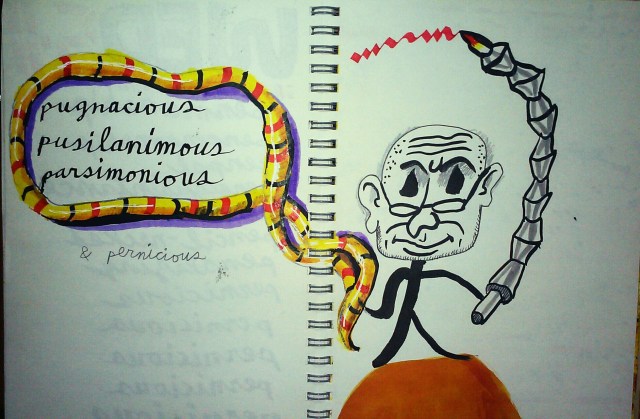
penmanship 101

20160512_035750-1~2

note to kids:  because there is no smell-checker for drawings, and visual artists frequently are not the world’s best spellers, the word “pusillanimous”, meaning ‘marked by contemptible timidity, cowardice’, has been misspelled above.  Sorry about zat.  Always spell that shit with two ‘els’, kids

The Rich Usually Prefer the Way Things Are

“Elie, I think it’s time you put that law education of yours to use here and told the concise yet detailed story of the end of blacks as ‘the special favorites of the law’ with all its gruesome irony,” said the skeleton.  “People don’t know the devilish legal details, and I think the way you can present it would give a helpful historical and legal frame to the ugly story.”

I’m glad to do that, even as I’m in the process of renegotiating repayment of that law school loan, for an eventual repayment of over $100,000, by stretching the payments out until I am 85 years old.   A new income-based option Sekhnet gives Mr. Obama’s administration credit for.  The original loan was about $40,000, mind you, but under the new terms, and agreeing to pay back much more, my monthly payment would go down by about 90%.

“I never taught you shit about money,” said the skeleton, “then again, I never knew the first thing about it myself, outside of needing to make it, working two jobs and saving as much of it as I could.  Dave eventually told me to give the money I had in the bank, at 4%interest, to an investment weasel and for many years I made 10% or more on the same money.”

“Today, I hear, banks are actually charging customers to keep money in their banks, if it’s under a threshold of many thousands of dollars.  To avoid that monthly fee you have to keep thousands on deposit at interest rates under 1%.  Capitalism eventually figures out how to squeeze the last drops of blood from the people it has already sucked almost dry.”

Luckily, I was able to lock in the historical low student loan repayment interest rate of 3.75% a few years back.  I’m told I was incredibly lucky to get such a low rate, though billionaires would be outraged to pay that interest rate for anything in today’s business climate.  One rich fuck recently whined that returning to the tax rate before Dubya’s tax cut for the rich was comparable to being sent to Auschwitz.

“Bloodsucking insects,” said the skeleton.

“OK, keep in mind that you need to tell that story of blacks kicked off the government tit in 1875, ten years of freedom from slavery deemed enough to get them on their feet, but first, this chat reminds me of something I need to discuss.  Otherwise, it’s impossible to understand how I changed from a young man with fire in his heart to radically change our society, with its famously lofty rhetoric and violent actual practices, a man long committed to racial equality and social justice, into an old man bitterly clinging to his modicum of acquired wealth and seeing blacks as an obstacle to keeping that wealth.”

Lead the way.  

“Well, I know you don’t recall the exact number, and your quick search did not reveal it exactly, but you recall correctly that when I started teaching public school in 1952, my starting salary was around $4,000.  For a year.  There had been student protests in favor of teachers in April 1950 when teachers asked for a cost of living increase of $600 a year, as you learned just now.  Do the math, it’s a more than ten percent increase over the top tier salary at the time.  The salary range for public school teachers in 1950 was in the low thousands, as that article you found showed. It ranged from $2,000 and change to $5,000.”

“Yet, in that unprecedented era of American prosperity and social mobility, I was able to buy a house, with a long mortgage and help from the G.I. Bill on the interest rate, for around $14,000.  Forty years later that house was worth about a quarter of a million dollars.  That piece of private property on that shady street in Queens was the bulk of my wealth.  And I am ashamed to tell the story of how I liquidated that investment and why.”

Look, it’s human nature to cling to what you have.  When you were a poor boy you had nothing but dreams of a better world for yourself and everyone else.  When you had some wealth your fitful dreams became more about protecting it.  It’s a natural progression.  

“No less shameful,” said the skeleton.  

“You were already in law school, if you’ll recall, so this happened almost twenty years ago, nine years or so before I took my last breath.  One spring day I saw a couple of black kids walking down the street in front of the house.  You remember when you were little the only blacks on the streets were maids, like Lilly and Dot, walking down to the bus stop after a day of work for Honey Siegel or John Towers.  This small group of black teenagers was casually walking down the street, talking and laughing.  I was sitting on the porch reading the paper and the kids and I watched each other as they went by.  I may have nodded, I don’t recall.”  

“Then I started seeing them in Fresh Meadows.  Suddenly, it seemed to me, the area was becoming integrated, something I would have welcomed twenty, thirty years earlier.  And the terrible truth hit at the same time.  Like the liberal middle class Jews in the neighborhood around James Madison High School where black kids walked from the buses and trains to the school in the years before the riot in 1973, I got a sick feeling in the pit of my stomach.  It made me doubly sick, to think that I was reacting like a fucking racist and, also, that the value of my property, my hard-earned lifetime of work, would soon plummet as whites fled the area. It was the classic ‘there goes the neighborhood’ twitch that had always disgusted me beyond words.”  

“I panicked.  Your mother and I were already snowbirds, and, already past seventy it was beginning to get hard to pack up everything twice a year and make the long drive back and forth to Florida with the dog.  It was probably time to sell the house anyway, but I also panicked.  I’m ashamed to say it, but I was no different in my panic than any other petit bourgeois white racist motherfucker about to lose a lifetime of hard work.”  

Well, you were a little different, dad.  Most petit bourgeois white racist motherfuckers have not been long-time advocates for civil rights and actively working to integrate the schools and society.

 “Hmph,” said the skeleton, ” are you trying to deny me my righteous shame and guilt?  It’s the only thing most well-to-do liberals have to cling to, the reminder that we once held values that made us better than the worst in our society.  The fact is, and it’s a disgusting fact, having something to lose makes one vulnerable to the pettiest human impulses.  The more you have to lose, it seems, the more vulnerable to this kind of hypocrisy.  That I was once an idealist only makes my reaction more despicable.” 

That’s arguable.  Anyway, I pause to note that you could have made more than $100,000 more on the house if you’d waited a year or two to sell.  Prices kept going up, those Iranian Jews who bought the place got a great deal, as those types often do.  Easy to see these things in retrospect, I suppose.  

“Ironically, the difference in price could have paid back your law school loan, with about $60,000 left over to pay your bills for a couple of years,” the skeleton looked out into the distance with its characteristic grin.  

“Oh well, no sense crying over spilled mulattos, Elie.”

It has always been thus

“You seem dismayed at the despicable slowness with which the moral arc of the universe seems to bend toward justice.  I was bitter by the end of my life about that, too, how, for the most part, real change does not seem to happen perceptibly within a human lifetime.  I can tell you from experience, bitterness about the obstinate forces of human nature is not a good play.   It has always been thus.”

“Do you think, when you read about the liberal Napoleonic code spreading the ideals of the French Revolution, the Jews, for the first time in hundreds of years anywhere in Europe given full rights of citizenship, that anyone, beyond a few Jews, perhaps, welcomed Napoleon’s invading armies to their cities?   You’re listening to Howard Zinn’s son read A People’s History of the United States.  An unending series of perfect examples, no?”

Perfect, yes, although ‘perfect’ seems a funny word to use when describing an accurate portrait of hell.  

“Sure ‘A White Man’s Heaven is a Black Man’s Hell’ as the song goes.  ‘Progress’ was hell for the mass-murdered Arawaks, the many other mass-murdered Indian tribes, the mass-murdered Africans, the Chinese, the Irish, the Italians, the Jews, for most poor immigrants.   Take one example though, say the Africans.  Do you know, if you brought say a hundred live Africans for sale in New Amsterdam, or later, New York, how much fucking money you could make?   It was, like I told you at the end about our decades of senseless contention, nothing personal, truly, as far as the fungible Africans were concerned.  One African was worth much the same as the next, if they were roughly the same age, size and strength.   There was nothing personal, on one level, when they inspected the slave’s teeth, lifted the scrotum, examined the asshole.  Strictly business, Elie.  The death of millions of African prisoners during the trans-Atlantic transport blandly called ‘the Middle Passage’ was — what’s that word you love so much?  — an externality.”  

Union Carbide puts a plant in an area in India where they can hire workers for next to nothing.   Tons of additional profit for the corporation.  Some toxic run-off runs off and causes suffering and death to the children of the locals.  An externality; you have your lawyers pay off the families of the dead kids, get your P.R. department to write something nice and write the whole thing off as a business loss.  Net gain for everybody, those Indian children who died would have been fucked in any case.

“Exactly, the cost of doing business.  That’s the genius of capitalism, if you want to call it that.  It has always been thus, those with the most power are never obliged to take seriously the troubles of those with the least.  And the real beauty part, for the rich, every injury can be reduced to a monetary sum, and the poor can always be bought off with pocket change.  In colonial times the wealth gap was probably roughly the same as it is now.  Barons were granted millions of acres of previously unclaimed land in the ‘New World’, the Indians had no concept of ownership of land, and poorly paid armies fought Indians to the death over this right of vast tracts of private property for the obscenely rich.   Poor whites and slaves worked for the baron and it was a new kind of feudalism for the new world.  It has walked a pretty straight line since then.  Take any period you like.  Some, like the present Gilded Age, stand out as worse than others, but for the people who have no power, every period is roughly the same.”  

Except for those brief periods of hope for real social change, like when I was growing up.  

“Yes, there are little windows when a Gandhi or a King can inspire millions to unite in hope and the moral wind is blowing the right way and you can see small changes that at the time look gigantic.  Gandhi, as a Jew in Poland, would not have had such a glorious biography as he did making his name during the active decline of the British Empire when the colonial ruler of India was collapsing anyway.  Timing, as they say, is everything.”

True dat.  

“We are brought up with this myth of the ‘individual’– that’s the basis of our culture here in the West.  Any individual, we are told, can rise, by his or her own efforts, to demonstrate their unique talents and become great.   This is what we are fed, even as millions upon millions have always been born into these societies without any real chance to become ‘individuals’ in the sense that Andrew Carnegie and Bill Gates, or your buddies George Steinbrenner and Donald Trump, are.”  

Yah, mon.  You yourself, without World War Two, what would have become of your chance to grow into an actual individual?

 “I would have been sent to sheet metal school, to learn a trade.  Fortunately it would have been a good time to be an American tradesman– although it’s hard to say if the prosperity that followed WW II would have been as great without the war — and I would probably have still been able to afford to buy a home, and I would have had a car.  Economically, I probably would have done about as well, during that historically rare period of widespread economic prosperity, as I did working as an underpaid teacher.  In fact, as a teacher, you’ll recall, I had to work a second job to have the middle class life I aspired to.   American factory workers were well-paid back then, I would possibly have made more as a sheet metal worker than molding the characters of teen-aged social studies students,” the skeleton seemed to be mulling something over.  

“I never would have met and wooed your mother, though,” he said sadly.  

I loved what your brother said at the memorial for mom.  

“Yeah, that was good, a great moment for him.  ‘I was the other one of those two country bumpkins who visited our cousins in Evelyn’s apartment building in the Bronx.’  You know, if not for your grandma’s pushing, your mother would never have given me the time of day.  A beautiful big city girl, living half a block from the glorious Grand Concourse, the Champs Elysees of the Bronx… she regarded me as, how did Brando put it?  ‘She looked at me like a bug.’  You should have seen her disdain the first few times I passed under her first floor window there in the courtyard on Eastburn Avenue.  As a student at FuckMe Sheet Metal Academy I wouldn’t have been able to pry a ‘hi’ out of her.   Once I got the chance, I impressed her with my collegiate brain, and my wit, things I hardly realized I even had growing up the poorest kid in Peekskill. When I became a doctoral candidate at Columbia my stock really went up.”  

What are the odds of a kid from the projects having that kind of chance?  

“Oh, maybe one in five hundred, I’d say.  I was born into historical bad luck and then had a stroke of historical good luck.  There’s no reckoning these things, there’s only working hard to take advantage of the rare moments of good luck that come your way.  I suppose you can think of yourself doing the same thing now.  You had a good idea, an excellent idea, really, for that non-profit art and technology workshop for the children of the doomed.  You had the good luck to be able to focus on it full-time, because of the money we left you.  The bad luck?  We didn’t leave you a fortune so you could have hired a capitalist to run turn it into an actual business.  You are not a born capitalist, Elie, you’re a fucking idealist.   Worse, for you, you live in a supremely materialistic society where branding, spin, marketing, sales, relentless chirping optimism, return on investment, sexiness, etc. rule the world.   Can you sell a program to help the children of the doomed?  You personally?  No.  Some people can, particularly if it works as well as what you designed, but I would say they have to have access to huge sources of funding — and never, ever, use the word ‘doomed’ in any connection to anything they ever imagine doing.”  

You grew up doomed, did you not?  

“I grew up doomed.  We were poor, hopelessly so, my father had no skills, could not earn a living, except briefly doing physical labor for the WPA.   I was like that Babel character Matthew Pavlichenko, the abused serf who comes back to his former master’s estate as a general in the Red Army, and he’s singing to that magical year when the revolution started, that changed him, unimaginably, from one form to the next.  That day that lives in infamy, December 7, 1941, turned out to be my lucky day, the start of my new life.  If not for the war, and the G.I. Bill, there would be no you, your sister would have never been born.”

Well, viva Hirohito, then, dad.  

“Yeah, every villain in history has people who salute him.  I just wanted to finish, I think that what you’re doing now, trying to set down this portrait of me, in the context of the times I lived in, with as much three-dimensionality as you can muster, is trying to put your good luck– inheriting enough to live on for a few years, having the ability to set things out clearly — to the best possible use.  You feel better getting up every day to pound at the heavy bag of this story than if you weren’t telling it, don’t you?”  

Without a doubt.  

“And are you explaining your life to yourself?”  

Yes, in some deep way I feel like I am.  It’s uncanny how I’m discovering things I didn’t realize before, through the process of combing through everything I can remember about growing up the son of a brilliant and adversarial father.

“Then it’s all good.  If you manage to whip the final product into shape as a final product you can sell–  your success will be the sweeter for being so long overdue.  And, as far as the brilliant and adversarial father, you do, of course, dig the contradiction there.  A truly brilliant father cannot be an adversary to his child, except for some perverseness in his nature.  An adversarial father cannot be a brilliant father, otherwise he would support his children, not undermine them by fighting them every step of their way.  Wait, wait, I know what you’ll say– another example of my black and white thinking.  But, hang on a second.  Brilliance includes intelligence and insight both.  And I know you know what I’m talking about,” said the skeleton.  

Obviously, dad.