My Father’s Intellectual Curiosity

I had a thought about this just now, as I quickly googled “insula” to find out more about this region in the brain where nuance-banishing anger is said to reside.  My father took quickly to the computer, but he was over seventy when he ordered one for his den, and the verb “google” had not yet been coined.  He could, conceivably, have known about Alta Vista, Ask Jeeves and other earlier, more primitive search engines that were around at the dawn of Google, learned how to do boolean or real language searches, and done a bit of on-line research.  Somehow, I don’t think he did much, but it makes me wonder about his intellectual curiosity.  If an accurate and effortless to use search engine like Google had been up and running in his day, how much would he have typed into it?

I know that he read a number of periodicals and dailies on the computer screen every day.   I know he got a perverse kick out of listening to Rush Limbaugh bend the facts to whatever explosive drug-addled theory he was bloviating about on any given day.  My father was engaged with ideas and politics and saw events in a historical perspective.  He was an avid, and blazingly fast, reader of books.  I truly don’t know what he would make of this:

In each hemisphere of the mammalian brain the insular cortex (often called insula, insulary cortex or insular lobe) is a portion of the cerebral cortex folded deep within the lateral sulcus (the fissure separating the temporal lobe from the parietal and frontal lobes).

Probably not much, since he wasn’t that interested in science as a subject.  In fact, there is little of interest in the above, really, except that the cerebral cortex seems to be where much of the higher consciousness action in the human brain takes place.  

“And, of course, the frontal lobe is the one that’s poked at and destroyed during a good old pre-frontal lobotomy,” said the skeleton.  “Although, as you rightly suspect, it’s hard for me to work up much passion about the lateral sulcus.”    

Correct me if I’m wrong, but your curiosity was more about events and personalities than anything else.  

“Well, read this entire wikipedia about the insula.  And, just as it starts getting interesting you get to the debate among neuroscientists about the role the insula plays in addiction, for example.  And you see what vain assholes these scientists are, how intractably proprietary about their highly specialized areas of jealously funded expertise they are.  I get disgusted pretty quickly when I come to that kind of discussion.  So, yeah, I prefer to read about events, and mobs, and the people who whip up mobs, and the way the movement of the pendulum of history is influenced by increasingly sophisticated hucksters.”  

Fair enough, but I also remember you being fascinated by Elizabeth Kubler-Ross’s stages of grief.  You found that fascinating.  

“Well, because it’s so true.  I mean, you can feel yourself going through the stages when a loved one is slipping away.  You’re in denial, then you’re angry, then you start trying to make deals, somehow, and then you feel defeated and depressed, Death is going to win and there’s not a fucking thing you can do about it, and the cold shadow of your own inevitable death passes over you, too.  And, in the end, acceptance, because there’s nothing else you can do, you have to go on living.  It’s profoundly human, and it’s elegantly simple.”  

True.  But it’s funny that you were not fascinated by or receptive to other things, equally profound and as elementally simple.  

“OK, look, I see where you’re going with this.  All roads lead to this, don’t they?  Your father was a very bright man, interested in many things, with deeply held humanistic beliefs but with a blind spot for what was most important in life.  This blind spot made him a monster, on some fundamental level.”  

Is that not a fair summary?  

“Oh, yes, it’s fair.  But I mean, don’t you get a little embarrassed to be pushing this one theory for your whole life?  Isn’t everybody on some level a monster?”  

Uh, no, I don’t think everybody is on some level a monster.  Everybody on some level might be a little near-sighted, prejudiced toward their own needs and conclusions, hampered or disabled in some way, but a monster?  No, not everybody is a monster on some level.  

“Fine,” said the skeleton breezily, “I’m just wondering about how you’re proceeding here.  Why would anybody want to read a book about a monster?”  

Well, if this was a book about a monster, I wouldn’t be wasting my time.  Although, obviously, there’s a big market for monsters.  A good chunk of the entertainment dollar is spent indulging our fascination with monsters.  Think of the most hideous thing you can, an ex-Nazi surgeon who did research on Siamese twins, years after the war, becomes obsessed with creating human centipedes, stitching together lines of humans, ass to mouth, one long digestive system.  Three movies in the Human Centipede franchise, everybody got paid, millions saw the hideous movies, loved them.  Human motivation?  The monster scientist was a Nazi, ’nuff said, let’s get on with the monstrousness.  

“OK, so you’re giving the human side to the monster here?” asked the skeleton, with a pang.

No, your story is a tragedy, straight up.  A man of great intellectual gifts dies believing he was somehow the dumbest Jewish kid in his little town.  A man of almost limitless compassion to animals believes his infant children want to do him harm.  It wearies me to add to this list, but you get the idea.  

“A tragedy, certainly.  I can go with that.  Do you remember that little girlfriend you once had, the artist?  She wrote and illustrated that little book you must still have somewhere: The Man with the Tragic Flaw.  It was about you,” said the skeleton.  

Like father, like son, as they say.  I was just wondering, if the research had been available to you about the damage to the actual physical brain done to children who survive abuse, how interested you’d have been in it.  A kid exposed to violence as a baby has her actual DNA changed by the trauma.  You can hear this doctor describe it.  As intuitive as Kubler-Ross’s stages of grief.   Dr. Nadine Burke Harris:

“Children are especially sensitive to this repeated stress activation, because their brains and bodies are just developing. High doses of adversity not only affect brain structure and function, they affect the developing immune system, developing hormonal systems, and even the way our DNA is read and transcribed.”

(her fascinating talk is here)

“Yes, look, of course this is fascinating, and also self-evident.  I just don’t see the connection to…” the skeleton paused, “of course I see the connection.  But, I mean, aren’t you embarrassed to be playing this one note samba for all these years?”  

You know, dad, it’s a funny thing about this one note samba.  I didn’t make up the melody, of course, I learned it.  It’s ingenious, the way this one note plays against all these different harmonies.  I never tire of it, because as I learn one part another one comes up to present new challenges.  Embarrassing?  No.  I don’t have to apologize for the song that plays in my head much of the time.  Particularly since it explains so much about the world and how it really works.  

“What did Samuel Beckett say about men being bloody stupid apes?  Is that what you’re talking about?” asked the skeleton.  

Insight, man, it can take decades to gather enough of it to light a fart on fire.  Play this one note samba long enough, dad, and certain deeper truths are bound to emerge, if you remain open to them.  I had nothing to do with your conclusion, based on the laughing grunts of a pediatric quack, that you were right to believe your ten week old baby hated you and was enraged for absolutely no reason.  I just got the benefit of it, so to speak.  Had I known then, at ten weeks, that your DNA had been deformed by repeated whippings in your baby face, I’d have been less implacable, I suppose.  Even an angry baby can understand something as simple as that, you know.  

“Fine, I get what you’re saying.  Now, if you’ll excuse me, Elie, this dirt is calling me irresistibly for my mid-day nap.”
 

The Blue Pants

I must have agreed that the blue pants were fine when my mother picked them out in the store.  I’m sure I just wanted to get out of there at that point, I was never a big one for clothes shopping.  If the clothes are comfortable, that’s 90% of the game for me.  I must have tried the blue pants on, and they fit, and I was urging my mother to get us on the road, I didn’t want to look at shirts.

I had never worn the blue pants.   The color was a bit on the hideous side, a sort of sickly greyed out light blue, and the material too was suspect, sort of a fine burlap. They sat in a drawer while I wore the jeans I preferred, the other pants I had.    

It was springtime, I must have been ten or eleven, and my father was in the hospital in Manhattan, getting treatment for his psoriasis which had flared up.  When this happened the skin all over his body cracked and bled.  It was torture and, even with his high threshold for pain, it was impossible for him to move around while bleeding from a thousand cracks.   The enforced rest was good for him, it took the pressure off.  I don’t recall all the treatments they gave him, cortisone, sun treatments, tar baths and wrapping him in plastic were all involved, but after a few days he’d come home feeling much better.

We were going to visit him and when I came down in my worn pants my mother asked if I’d change into my blue pants.  Presumably my father would like them better than the ones I was wearing.  It would please him, for some reason, to see me in the nice blue pants.  I probably argued a bit, went and changed into the blue pants and was immediately horrified.  The waist fit, the length was OK, but these pants could not have been fashioned on a human body.  The model for these pants must have been a thin- waisted, long-legged rhinoceros.

I’d never seen anything more ridiculous, as I turned side to side in the long mirror on the bathroom door.  It was like I was wearing a bag of some kind.  The ass of the pants stuck out like a whoopie cushion.  There was a baggy section around the fly that made the pants protrude oddly in the front.  The pant legs, which were enormous at the top, tapered ridiculously as they went toward the shoes.  I simply could not bear it.  I changed back into my other pants.

“What happened to the blue pants?” my mother wanted to know when I got back downstairs.  I told her impatiently that they were unwearable and she got angry.  It was just another brutal proof of how far I’d go to show how little I loved my father.  She embellished on this theme for a while, getting more and more overwrought.  I truly don’t remember in the end which pants I wore to the hospital, but I know there was a huge fight about the blue pants.  

When we got to my father’s hospital room, on an upper floor with a magnificent view of the East River and Queens, with Brooklyn in the distance, it was as if news of my truculent stand on the blue pants had reached my father before we did.  Here was another proof, as if one more was needed, of how little the son cared for his father’s feelings.   It showed, once again, the lengths to which the boy was willing to go to demonstrate to his father how little he loved him.  

Truthfully, outside of the view, and my father’s sad reaction to my latest act of treachery,  I recall very little about the visit to that room in NYU hospital.  The incident with the blue pants would be brought up many times over the years, become a rallying cry as memorable as “Remember the Alamo” or “Lumumba Died for Freedom”.  It always stirred the patriotic feelings  of the partisans around the dinner table.  

“It’s like the blue pants,” my father would say to my mother, resting his case.

In an ironic twist, some time later my sister began to display a rare talent for tapering pants.  I don’t know where she came by this skill, it must have come from our grandmother who was an expert tailor and worked without plans of any kind.   My sister had me put on the blue pants one day, made some markings, or pinned them, and a short time later handed them back, completely wearable.  I wore them many times after that, though the damage I had done in the original battle over those pants could not, of course, ever be undone.

Anger does not compromise

Homo sapiens was a puny prey animal that, by sheer Ty Cobb-like will  and guile, became the top predator in the food chain.  Homo sapiens did not come by its heedless dominance through introspection (nobody ever does).   We organized, believed, followed ruthless leaders, waded through rivers of blood, did whatever was necessary to conquer and take what was needed.  We are not always a very nice species, I’m afraid.  Some of our traits are primitive indeed, none more primitive than our reflex to get angry.  Anger played a key role in survival, and genetic selection, and all that, but… still.

My father was angry his whole life long, uncontrollable outbursts of frustration and temper were common.  At the same time, he was very smart and something of an intellectual, weighing arguments, informing himself about all sides of a matter, speed reading the New York Times cover to cover every day, like Popeye sucking down a can of spinach.  In his retirement he spent hours daily reading any number of periodicals.  He also listened to Rush Limbaugh, who reminded him of hate-spewing 1930s radio blowhard Father Coughlin, and would chuckle sometimes observing Limbaugh’s cheerful, brazen manipulation of whatever facts he was handling.  

I wrote the other day about my father’s black and white thinking, in spite of all this time he spent weighing everything he could find.  “My way or the highway,” is most often the credo of idiots, but my father felt this way too, and was far from an idiot.  

Except in his primitive attachment to his own anger.  Anger that, without a doubt, tormented him even more than it damaged those around him.  It was a double whammy– feeling the anger in the first place, which hurts, and then shoving down the insight that your outburst has once again done damage to those you love.  So you justify your helplessness, instead of working to understand, to master the urge to rage.  And it enrages you that you are powerless to stop raging, of course, and this pours gasoline on the fire.  Succumbing to rage, of course, is often the way of the average homo sapiens.

Hard to unravel this at the moment, but these words from a recent discussion Bill Moyers had rung a bell in my head when I heard them yesterday, and fortunately Moyers always has his chats transcribed on his website:

Democracy doesn’t work if everybody’s angry at everybody, because anger literally stops us from wanting to compromise. Anger emanates primarily from the insula in the brain. And when the insula is activated, we don’t compromise. When we are anxious, which is the amygdala part of the brain, that’s okay. We can be anxious about stuff and we’ll still be willing to compromise. But when we go toward this dark anger, and a majority do, everything stops and that’s really my diagnosis of why the country is in so much trouble right now.

It also works as an explanation of why my father was so inflexible much of the time.  The insula, whatever the hell that is, once inflamed, makes a person rigid.  There’s science coming to the support of philosophical observation.  

When we are angry, says science, there is no convincing us of anything.   We rage and only those who agree that we are right to rage are welcome to comment.  I feel this way sometimes, hey, you hurt my feelings and offer a dozen reasons why I shouldn’t be hurt, I’ve got one answer.  Fuck you.  There’s only a limited range of reasonable motion possible, apparently, when the insula is activated.

This is not to say that a willingness to compromise is always a good thing or that anger is always a bad one.  Is it right to be angry about slavery, corruption, mistreatment of the vulnerable? Is it ever right to compromise with Nazis?  These are reasonable and sticky questions.  

There are others, also sticky, that are not very reasonable, and the blindness to reason may be a function of an angrily engaged insula.  Is it right not to compromise over the important matter of what it means when your son refuses to wear the blue pants for a visit to the hospital?  That may be one of those times when it is better to let the insula relax, take a few breaths, look at the matter with an eye toward soothing the anger.  A compromise aimed at making everyone in the house cut each other a little slack is hard to see as a bad thing.

The function of the anger center of the brain, and how it shuts down the impulse to see another side to things, explains a lot about one of the most vexing contradictions of my father, Irv.  It explains a lot about everyone.


Irv in Connecticut, circa 1946

My father’s father,  a quiet man named Eliyahu who lived as a silent shadow, as he lives now seventy years after his death, grew up in a dirt-floored farmhouse in Connecticut.  The farm was outside Hartford.  I recall a childhood visit to my father’s aunt and uncle on that farm, as far as I can tell.   The aunt was named Elsie, and they had at least one cow.  There was a cartoon cow in TV commercials at the time named Elsie the Cow, the adorable mascot of Borden’s, I think it was, which is why I remember Aunt Elsie’s name.  I don’t think I met her more than a couple of times, maybe twice.  Her husband might have been named Uncle Peter.

I remember that visit to the farm, which I always associate with Elsie the Cow, mostly for the moment I stood behind their actual cow and watched as the cow’s tail lifted stiffly, slightly above eye level, to reveal a puckered star shaped asshole, like a giant asterisk, actually.  To my amazement the asterisk began to get bigger and bigger.  I could not look away.  It became gigantic and I instantly saw why.  A large cow plat dropped out of it on to the ground.  It fell straight down and landed safely in front of me, followed by the same mesmerizing procedure and another.  To a boy raised far from livestock of any kind, this impressed the hell out of me and I remember it clearly more than fifty years later.  

The modest farmhouse had regular floors when we visited, but my mother had been there when the floors were still dirt.  The point is, the farmers on this farm were not the kind who lobby Congress, hire illegal immigrant hands to do the dirty work or get paid huge subsidies not to grow certain crops.   This working farm was out of a life I’d only seen in black and white photos taken by WPA photographers during the 1930s, regardless of the upgrade to the floors.  My grandfather had grown up literally dirt poor and when his step-mother clouted him, he fell on to a dirt floor.  

After my father left the army he was loathe to return to Peekskill, which is not hard to understand.  He went to live in Connecticut, where he also had family.  I suppose the fact that he had a few uncles and aunts up there made it attractive to him.  I have only the haziest knowledge of this period of his life.  It appears, doing the math, not to have been a very long period, since by 1951 he was already at Columbia, a graduate student in history, struggling with Richard Hofstadter’s ego, after completing a four year degree at Syracuse.

“He was pumping gas up in Connecticut,” Eli told me once.  “He was also pumping his landlady, this young shiksa widow he was renting a room from.  Drove his mother insane, as you can imagine.  He’d just come out of the army and he’s wasting his life pumping gas and making love to a shiksa several years older than him.  Tante Chava wasn’t having it and she sent me up there to bust it up.”  

Eli told the story like his insane aunt’s reaction was completely logical and her command to go ‘bust it up’ the most reasonable thing in the world.  

“I went up there and gave him a good talking to, you know, I straightened him out.  I told him he was wasting his life, and we packed him up and I got him the hell out of there.  He then got accepted to Syracuse and did very well there and was on his way.”  

Funny to remember my father’s still bitter words on the last night of his life — about how he and his brother were slated for trade school to prepare for the menial jobs their talents fitted them for.

I have a few old black and white photos from my father and mother’s earlier lives, preserved in a shoe box and never put into any of the dozen large albums my mother assembled of all the A-list photos, that suggest another story entirely.  The story of my father’s first romance.   The first two are here.  

The thought of unearthing and scanning the other two is a bit unnerving to me, since they are somewhere in this impossible tangle of papers, boxes, books, CD cases, clothes, drawings.  But, as they are each worth many thousands of words, and shed an important and rare light on the protagonist of this book, I will try to find them.  

In one, my father is being visited at college by this pretty, almost cartoonishly Christian-looking woman.  It suggests there was an enduring relationship between them, or at least hopes for one.  She made the long trek up to Syracuse to visit him at least once.  I assume the photo was taken in Syracuse, since I don’t recognize the building they are posed in front of as being on the Columbia campus.  

In the other photo my father is smiling with a happiness unrivaled in any photograph of him.  It is springtime in the photo, he is on a picnic blanket, struggling good naturedly with a pretty young woman.  His glasses are off, meaning he could only see a very short distance.  It is likely the young woman has just pulled them off of his head, since he was rarely without them.  A thin arm is around his neck, as though trying to choke him.  He has a pretty good grip on the slender blonde’s waist.  She, also laughing, is diagonal across the picnic blanket. 


Absolutist Values (sketches)

(sketchy, and rambling both)

There is something about being uncompromising, particularly when applied to historical figures, that seems heroic to us.   My father certainly saw it as weakness to compromise about non-negotiable things.  Backing down from a moral position was something he saw as a deep personal failing and something he could not bear.  This gave him a tendency, in spite of the keen appreciation of nuance and subtlety that was also a big part of his make-up, to be absolutist about his beliefs.  

This created a tension he could not resolve, except by clinging to his belief in the right.  On a fundamental level, he saw the choice as simple: my way or the highway.  To his credit he did come to regret this simplistic stance as he was dying.  

“Well, the world’s not really like that, Elie,” he said weakly but with conviction when I reminded him of his black and white positions throughout his life.

In the days after WWII when colonialism was collapsing and the phrase ‘self-determination’ gained currency in discussions of human rights, itself also a new concept, it was thought, by some scholarly type I read in college, that the highest form of human freedom was possessed by a man willing to die for his beliefs.  

This strikes us as a sickening idea today, when men willing to die for their beliefs are also eager to kill for them, and not only that, but kill as many innocents as they can take with them.  This is what black and white thinking leads to, somehow:  the right to live without being blown up by a fanatic confers the right to blow up anyone who might have any possible connection, or even no connection at all, to anyone who might blow people up.

This is the cul du sac that the supremely human idiocy of black and white thinking ultimately drives one into.  While fair accommodation and a willingness to compromise are key steps to improving most things, the idea of principled compromise, which actually takes greater strength than absolutist thinking,  has acquired a stink.  

I’m not referring to the kind of poisonous compromise made between slaveholders and their fellow drafters of the charter of modern human liberty, though it was probably the best the parties could agree to at the time.  I’m referring to any compromise to resolve a real-world problem in today’s climate of “political” intolerance and anger.  The compromises between loved ones, for example, struck for the sake of getting along.

The false dichotomy of either/or is almost always the way things are phrased in our winner/loser society, it often seems impossible to resist.  Boots on the ground, or drones?   This bowl of stinking shit or that one?    You’re for us or against us, you love our freedom or you hate our freedom, you see the world as it is or you see it the way you want it to be.   A genius gets to think outside the box, the rest of you morons, pick the side of the box you want to huddle in and fight it out amongst yourselves.

I recall the moment when my father tore the bonds of affection between us, using this idiotic dualistic technique.  It was at the dinner table, I must have been in high school, perhaps Junior High, when he brought up the odd either/or hypothetical:  would you rather be loved or respected?  

The senseless hypothetical hung in the air for a moment while I wondered about this arbitrary and stupid choice.  Why only one?  How could a father think one possible without the other?   I remember looking at my sister as the answer was about to come.  My father then chose the wrong one.

“I’d rather be respected,” he said, and I recall my great disappointment, even disgust.  Sacrificing love for respect did not seem a remotely respectable thing to do.  I felt the love torn once more and, as for respect, there was little question of that choice being respected.  Years later I’d see this same choice illustrated starkly, in a book I never read, by Machiavelli.

In The Prince (1513) Machiavelli describes the characteristics of a leader:  

One ought to be both feared and loved, but, as it is difficult for the two to go together, it is much safer to be feared than loved, if one of the two has to be wanting …. men have less scruple in offending one who makes himself loved than one who makes himself feared.  For love is held by chain of obligation which, men being selfish, is broken whenever it serves their purposes, but fear is maintained by dread of punishment which never fails.  Never.  

This may be good advice to a prince leading a principality during a time of war among city states, but to a father?  It is safer to be feared, and easier to gain respect, perhaps, but the fearless make themselves vulnerable, no?    Can a person who wants to be safe above all ever be respectable?

My father once exploited aspects of this fear/respect thing, and a shifty black and white dichotomy, to rob me and my girlfriend, visiting from far away, of a stolen night of blissful young romance.  I should never have let the old bastard talk to her, not that I could have stopped him, she was flattered and spellbound.  The talk went on and in the kitchen, as I watched, sickened, as he amiably took our night of love apart piece by piece.  

He charmed her as he convinced the young woman who was about to stay the night at our house, a girl I was crazy about and looking very much forward to sneaking into bed with as soon as everyone was asleep, that while his son (me) was not immoral, I was amoral, choosing to make moral stands, or not, as circumstances demanded.   From here, putting our make-out session into an arbitrary moral zone, it was a short step to steeling her to take a principled stand for chastity, which she later did, and not allow herself to be manipulated by an amoral person, like myself.  This is one of the most gratuitously asshole moves my father ever made to directly torpedo my happiness and optimism about life.

It’s hard to care very much about the abstraction of a fight, unless you have a beautiful dog in that fight that you love very much.  I had a very beautiful dog in that fight that night, and the bout went to my father, unanimously, but why was there even a fight to be fought?

My Father’s Driving

The question was asked the other day what kind of driver my father was and my immediate answer was that he was a terrible driver.  As often, with immediate answers in particular, the simple answer is just the simple answer, far from the best one.   My father was never in any kind of traffic accident, that I can recall, not even a fender bender.  Statistically, and in the most important single category of driving– getting around without killing anyone– that makes him a pretty good driver. 

Of course, like everything else in life, the real story is in the stories.  My father favored powerful cars, eight cylinder engines when he could get them, usually Buicks (though the first car I remember was a large, bulbous Pontiac, pale orange and off-white, like a creamsicle– they called it the Lox Box).  He drove  powerful six cylinder Cadillacs in his later years.  He liked being able to quickly accelerate away from danger.  This also gave him the ability, at will, to floor the accelerator and lurch quickly into another lane to infuriate a driver there, sometimes a long line of drivers.  

“He never was in an accident, but there were crashes all around him on the highways,” my sister would say, recalling his Magoo-like obliviousness to the screams of road rage and middle fingers jerked in the air from the windows of the cars around him.  This was particularly pronounced in south Florida, where road rage is considered obligatory by many drivers (he also gave them fits in the Boston area whenever he was there).  

Florida highways have that combustible mix of cautious old people, fearful of their diminished reflexes, driving too slowly, and younger people, pumped up and in a hurry to drive 80 mph whenever possible, even in heavy traffic.  My father liked to drive at a decent speed, he certainly wasn’t a tortoise on the interstate, but he had his own ideas on how fast to drive.  

My father, gunning his powerful American gas guzzler, would gravitate to the fast lane where he would drive at around the speed limit, or fifteen to twenty miles an hour below the speed of the traffic.  This caused friction on the road, though it did not seem to concern my father greatly.    

Sometimes his driving defied explanation.  My sister reminded me of this the other day, when she urged me to add a few details.  

“He would sometimes brake in the middle of a long straight away for no apparent reason.  I remember him doing that several times driving north on Lyons Road.  I could never figure out what caused him to jam on the brakes with a clean and clear road ahead of him, no lights or other cars in sight.  Once, I remember him trying to drive straight ahead in a right turn only lane that merged directly onto I-95.  I think we all almost lost our lives with that one.  He couldn’t understand all the honking and yelling that his poor decision caused.”

There was also his tendency to apply a twitchy, lead foot to the brake pedal.  I suppose it was a style thing, as much as anything else.  He apparently liked lurching to a jerky stop.  That must have been it, otherwise he would have learned to gradually apply the brakes to decelerate smoothly at traffic lights, stop signs, to avoid rear-ending the car directly in front of him.   He’d often accelerate towards a traffic light that was turning yellow, the better to come to a sickening last minute stop when it turned red.   He would pump the brakes many times while slowing down, which caused a wave of nausea to travel through his passengers.  

A joke comes to mind:  I want to die quietly in my sleep like my grandfather, not screaming in terror like the passengers in his car.  

When my father was driving terror was not usually a problem, though you could wince from time to time when a screaming maniac would drive by, face twisted into a savage mask, narrowly missing the side of the car.  The real danger of driving with my father was nausea.

My sister has the best story to illustrate this.   My father was driving with my sister and her young son, our father’s beloved grandson.   The boy was maybe three or four and he sat in the back.  A man of few words to this day, at twenty (and his habit of choosing only the words that need to be said has made him an excellent poet), my nephew was a quiet boy.  

My father apparently didn’t have the air-conditioner on high enough in the back so the back seat was stuffy in the Florida heat.  His young grandson, uncharacteristically, complained a few times about the oppressive heat back there and also about the bumpy ride.  “Grandpa…” he implored, more than once when his grandfather jerked the big car to a sickening stop.  

The combination of the nauseating driving and the airless heat in the back of the car eventually got to the boy.   When my father finally stopped the car, his grandson threw his door open and vomited on the pavement.    Once again, the boy of few words spoke eloquently for all of us passengers in my father’s car.

A Note on Writing

I am a mostly unpublished writer so please feel free to ignore my opinions on the matter of writing.  I have acquaintances who’ve written for a living, and are much more qualified to opine about the profession of writing, even though I predictably dismiss their mercantile views.   They tend to be skittish about going near the deeper truth that is at the heart of the writing I love most. Their primary interest is in being good craftsmen and getting paid to write what the market demands.  

We have different ambitions when we write, different approaches to the truth, where it is, how we feel it, express it.  

That’s probably just the bitterness talking, of course.  Here’s the point.  Pat Conroy, days after he died, told me in a sound bite the reason that I write:  to explain my life to myself.  

If one is lucky enough to do this in a way others are interested in enough to read, buy, publish and sell, you are truly blessed.  If all you get is some peace and understanding for yourself from digging and writing this way, that’s better than being poked in the eye with a sharp stick too, as my father used to say.

From Conroy’s marvelous A Reading Life.  He describes a brilliant, demanding lover of books, a man who made his life about good writing and great books.   Conroy was a young writer when he first came into contact with publisher’s sales rep Norman Berg, a hard man who would become a lifelong friend, and he listened carefully to this older genius:

“You claim to be writing your first novel,” Norm said it in a voice that let me know he didn’t believe me.  

“I have,” I said, having written the first pages to the book that would become The Great Santini.  

“Does it tell me everything I need to know about leading a good life?” he asked.  “and I mean everything?”  

“No.”  

“Then throw it away.  It’s not worth writing.”  

“I’m twenty-six years old, Norman.  I don’t know everything in the world yet.”  

“That is good,” he said, softening.  “At least you know that much.  Keep writing.  If you’re lucky you’ll have one or two important things to say before you die.”  

“Here is one of them,” I said.   “Fuck you, Norman.”

(then, after describing the uncompromising older man’s eternal certainty, and fondness for Conroy’s spirited resistance to his implacable pronouncements, he comes to the beating heart of the matter)

“Always know which phase the moon is in,” he would say.  “Keep up with the transit of planets.  Know everything.  Feel everything. That’s your job as a writer.”  

“What’s your job, Norman?”  

“To suffer.  To feel everything in the world.  But it dies inside me.  I have no gift.  I can’t write.  That’s why I’m driving you crazy.”

Which makes such sense, it stopped me in my tracks, literally, there on Sixth Avenue where I paused in my listening to Conroy’s incantatory reading of his book on writing and reading.  I went to the library, to have the written words in front of me, to ponder and copy out for others to read.  This moment explained so much about the ungenerous side of the life of a supremely critical thinker, it almost made me laugh.

It happens that even gifted writers can also sometimes have this ungenerous gift for other writers, surprising as that may also sound.

FDR’s Four Freedoms and Irv’s eternal horror

I can picture my teen-aged father, on January 6, 1941, huddled around someone’s radio, probably his uncle Aren’s (I assume my father’s family was too poor to own an expensive piece of furniture like a radio) listening to Franklin Delano Roosevelt’s State of the Union speech.   Radio broadcasts were new at the time, it undoubtedly still seemed like magic to hear a president’s voice, broadcast live over radio waves, somehow entering a receiver built into a large fancy box and emerging, alive, from a speaker, to be heard in its every nuance in millions of American living rooms, over speakers in the streets.  

I can imagine my young father drinking in the part of the speech about the four essential human freedoms that American democracy, indeed common decency, was built upon.   Irv would have been a senior in Peekskill High School, going on seventeen, and the president’s words about Freedom from Want would have stirred his impoverished young heart.  

“Well, you have to understand, here was a patrician, literally to the manor born, who fought against the inborn corruption of his own class to actively expand the unheard of concept of common decency for the masses, he was actually creating America’s social safety net during the New Deal,” said the skeleton. “I was aware, even then, that most of FDR’s speech was a politician’s rhetoric to help bring the skeptical nation to an acceptance of the need to fight fascism, to join the side of the European democracies against militant, hell-bent totalitarian regimes.”  

“Still, the reason FDR was so loved by so many was because he was willing to incur the hatred of those who regarded him as a class traitor.  He told them, the same merciless fucks whose adult children and grandchildren are robustly yet casually screwing us all today, he said it with that great smile of his, ‘I welcome their hatred!’*  I remember that ecstatic moment from a newsreel I saw when I was about twelve, and the crowd at that rally went absolutely wild, as many of us in that theater yelled when we saw him say it on the flickering movie screen.”

“He challenged basic assumptions held by the rich.   Why is private college still and forever the exclusive right of the children of the well-to-do?   Because we can price the children of the riff-raff out and keep it pure, pass on our ivy garlanded love of higher learning, and higher earning, to our own DNA.  It’s always been us against them, since earliest homo sapiens war parties, but FDR articulated something more.  That’s why he was elected four times, he was fighting for the basic freedoms of the common man.” 

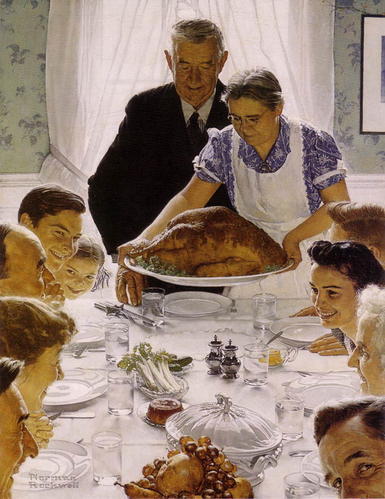
Today one has to go to google to find out exactly what these then famous Four Freedoms even were.  Sure enough, there they are, immortalized in the famous Norman Rockwell paintings, those strikingly realistic evocations of a mythical American life.  The famous one where the fat, perfectly browned turkey is being served at a big table, with the beautifully rendered greedy faces of the children at the end, one smiling lustily almost directly at the viewer, is his depiction of Freedom from Want.  One picture = a thousand words.

rockwell_freedom_from_want

“Yeah, FDR told us that the right not to go to bed hungry, in a world of abundance and super-wealth, was a basic human freedom.  Of course, any self-respecting billionaire will tell you exactly where to fuck yourself on that proposition.  Go down FDR’s list of the old enemies of peace, the first paragraph of your footnote below*,” said the skeleton. “It is now, what, eighty years later, and… hah! what do you know?!!  Same Dick Cheney types treating the government as their own piggy bank, the forces of selfishness and lust for power fucking away with insatiable, mechanized erections.  Ruthless, inhuman forces still in control of our great democracy, you say?  I don’t mean to single out Mr. Cheney, you understand, just because he’s such an unrepentantly evil motherfucker, and not even a born member of that social class FDR betrayed, still, you take my point.”

Preaching to the choir, dad.  I couldn’t have put it any better myself, self-evident as that is to say, of course.  The reality of this impossibly slippery slope of self-serving privilege and the constant rewriting of history to suit their purposes is no doubt part of what finally broke you.  

“Play the game the right way, take advantage of every bit of luck you get handed, work hard, work harder than everybody else, work as many jobs as you need to work, struggle, fight hard against ignorance and hatred, try to be a decent person and… oh, fuck, I was putting myself under so much pressure to live the American Dream that I fucked up both of my highly intelligent kids, oh, shit, and now, here comes Dick Cheney, oh, God, no…  look at that famous self-satisfied smirk…”

“And they’re not enforcing the Voting Rights Act anymore in the former Confederacy since we’re now so clearly post-racial and the f-ing ‘n-word’ is no longer tolerated, except in private among whites and among the n-words themselves, of course, and we don’t need to regulate Wall Street speculators any more, the Free Market will insure fairness, you dig, and there’s nothing wrong with a little pre-emptive ten year war on some anonymous brown bastards who hate our freedom, even with no actual causus belli, think of all the jobs we create in the lucrative war industries, and it’s so judgmental to call us ‘war profiteers’, you fucking glib, hateful class warriors, and oh, blah blah blah…  You want Hope and Change?  Vote for the charismatic black guy who will break your heart in more ways than you ever dreamed possible.  Yes, in the end, the seeming futility of it all broke me in half like a fucking dried out stick.”


*  “We had to struggle with the old enemies of peace—business and financial monopoly, speculation, reckless banking, class antagonism, sectionalism, war profiteering.

They had begun to consider the Government of the United States as a mere appendage to their own affairs.  And we know now that government by organized money is just as dangerous as government by organized mob.

Never before in all our history have these forces been so united against one candidate as they stand today.  They are unanimous in their hate for me—and I welcome their hatred.

I should like to have it said of my first Administration that in it the forces of selfishness and of lust for power met their match.  I should like to have it said, (crowd cheers begin to drown him out) wait a minute, I should like to have it said of my second Administration that in it these forces met their master.”

Reading these lines is nothing next to listening to his powerful delivery of them, hear the actual 1936 speech here.

Niggardliness of Spirit

It is understandable, if you grew up wanting, that as an adult your first impulse might be to hold on to the things you have, rather than to offer them freely.   This was certainly the case with my father.  My sister and I often noticed his difficulty giving.

Make no mistake, we had all the food, clothing, birthday gifts and other essentials that were needed, our hard-working father provided a materially comfortable middle class life.  It was his reflex to withhold, especially things that cost nothing and should have been easy enough to give, that we always noticed.   On some fundamental level, it pained him to be generous.

A cheapness of spirit, what the Brits might call a meanness of spirit, a stubborn, deeply held reluctance not to give the very thing that was needed most in that instance.  This held true for things that cost nothing but a moment’s consideration.  It was always hardest to understand his often-irresistible impulse to withhold those tiny, infinitely precious things.  Praise of any kind, for example, was very hard to come by.  

“Well, I never had praise in my life, never,” protested the skeleton.  

Hitler was mercilessly beaten by his unredeemed asshole of a Prussian autocrat father, big fucking deal.  It’s not hard to understand where the shit impulse comes from in those among us who cling to and justify our monstrousness.  It is quite a different thing to see it as a justification that means anything, except maybe to the justifier.  

“Well, that’s a little harsh,” said the skeleton.  

Well, my apologies to Hitler, then, dad, but you do get what I’m driving at, don’t you? . The horrific specifics of the humiliation a person has undergone may explain a lot about their later attitudes and behavior, but it doesn’t satisfy us as any kind of moral justification.  We can understand, and shake our heads, as we do with the poor beaten little boy who grew up to be fucking Hitler.  Of course, I’m not comparing you to Hitler in…  

“Of course not,” said the skeleton with a strong fruity over-note of slightly fermented sarcasm.

Once, you must remember this, we were walking down to the Dead Sea, I think it was, during your visit to me in Israel in my after high school year.  Mom and my sister must have gone on ahead, you had me hang back for a second at the rent-a-car.  You had something important to tell me.  You begged me, a skinny, angry teenager who regarded you with coldness at that time, not to become like you.  

“Let your mother, and other people who love you, show you affection.  Don’t push them away like I always do,” and you began to cry.  Tears as bitter as the corrosive, super-salty Dead Sea itself.  

I’d only seen you cry one other time, at a seder when speaking of those leaders who hated the Jews, and who rise up in every generation to kill us and try to destroy us, and how infamously they almost succeeded in recent times.  

As we walked the rocky, arid path downward I recall saying nothing, leaving my impassive mask on.  The mask of a kid who’d been brutalized by the man now crying at the impassive monster he’d had a significant hand in producing.

Fucked up, yes, but the point remains.  It is an exhausting struggle to overcome our pain to become fully human.  Much easier to blow up when some asshole steps up, how about I shut your fucking mouth for you, fuckface?   Easier, being eternally deprived of a kind word, to clam up when your child looks up expectantly: how did I do, dad?  I get these things and, hard ass that I am, give almost no allowance for the painful experiences that stunted your ability to refrain from doing to others what is hateful to you.  

People put in the hard work to overcome those things, learn to practice kindness, to apologize when they hurt somebody, to listen sometimes, even when they are not that interested, because they feel the other person’s need to speak and the pain behind that need.  

“Your father got much better toward the end of his life, as far as letting me show him affection,” my mother told me, not that long before the end of her’s, “he’d let me kiss him, if I held his head.”

It’s a good idea to hold the head of a dangerous creature and have a good grip before bending in close for the kiss.  

“We are all dangerous creatures, Elie, that’s what I was trying to tell you.  And if you have no teacher in the art of human decency then you somehow have to grow into your own teacher,” said the skeleton.

“To the extent that I see you doing that, I applaud you.  We’ve had our differences, and on some deep level I still don’t truly wish you well, but I have been impressed by some of the strides you’ve made.  May you live long enough to take the rest of the steps you need to take.  Don’t be like me, Elie.”

Subtle Harms

Hateful actors snarling directly in your face are hard to miss, and, when it comes time, you can at least get your hands up to defend yourself against them when they’re overcome by the need to do you violence.  It’s the subtle blows, delivered by those who profess to hold your best interests at heart, blows made to feel like something you yourself have brought on, somehow, that can really cripple you.

“Spoken like a man who has never been whipped in the face every day for the first couple of years of his life,” observed the skeleton.

Sad though it feels to me today, a grown-man on the edge of old age with the skeleton of his dead father on his knee like a chipper, razor-thin Charlie McCarthy, it’s a point that needs to be made again.  To say it more clearly: it’s a point that I need to make again.  

Jackie Robinson’s widow, Rachel, told Ken Burns’s team that she always saw, and continues to see, the subtle racism of the north as more detrimental, more destructive, than the openly racist style practiced by the genteel defenders of their traditional way of life in the south.   She pointed out that it’s much easier to see and fight good old-fashioned in-your-fucking-face racism, like not being allowed to use a bathroom, than the falsely smiling kind that denies it is anything but bad luck that bad things keep happening to unlucky blacks in cities where there are no laws, rules or even customs against them.  You can’t hit what you can’t see, though it will continue to hit you at will.

I muse about this, even as I remain unable not to provoke those who simply accept their own faults, smile about their own anger, reckoning these as small things that have not hampered them in any terrible way.  As long as you can get up every day, hit the heavy bag, the speed bag, do a little road work, spar, get ready for the next bout, what need for time-wasting introspection?  Who, outside of a self-pitying fool, would spend hours every day probing their own wounds, trying to get to the bottom of mysteries so deep they can never be plumbed? Even the Bible observes that a fool’s main desire is to lay his own soul bare. 

One has to respect their right to this satisfied opinion, or, at least to accept that this opinion is tightly held.  People who don’t seek insight into their actions are less interesting to me, and less compelling as characters or friends, than those who struggle toward understanding.   I am becoming an intolerably pompous and demanding person this way, it seems to me lately, but one has to respect my right to choose those who seek sometimes uncomfortable understanding over those who are always satisfied.  Or not.

The ass-whippings my father got from his tiny mother were direct and violent.  They came without ambiguity, explanation or commentary– what, after all, is more eloquent and self-explanatory than a series of unrestrained lashes across the face?   Most people I know who have gripes against how they were raised grapple with things much more ambiguous: being constantly undermined, slighted, mocked, ignored at key moments when it was most crucial to have been heard.  

Here, take your pick.   Which would you rather be, as a two year-old and for the rest of your days — teased and ridiculed or beaten?  Slapped hard every morning, noon and night or the victim of acerbic sarcasm?  Hardly seems there is much to choose there, most people would take the words.  

Get up every morning when the alarm rings, use the bathroom, do a few stretches, shower, try to eat a healthy breakfast, head to work, work, go to the gym, come home, try to have a healthy dinner, watch some TV or read a good book, go to sleep at a reasonable hour, do it again.  Try your best, when you can, not to do what is hateful to you to the children in your home, but, since nobody is perfect, and feeling guilty afterwards is always easier than doing the right thing in real-time, why agonize or obsess about any of it?

“Well, you hit on an important point, Elie,” said the skeleton, “it is much, much easier to apply the lash of guilt to yourself afterwards than to always overcome the urge to yank your kid’s arm out of the socket in a crowded supermarket when the kid is being irrationally insistent.  The supreme challenge of raising a kid, I hardly need to point out, is something you’ll never understand as well as a parent.  People do the easiest thing, almost always.  Look at you right now, tapping away here, putting words in my mouth instead of attending to a hundred more important things.  You can feel you’re doing important work, somehow, but that’s what everybody feels when they’re out making a living.  Which, I point out gratuitously here on your ‘gratuitous blahg’, you have never done, except in a few moments of weakness, when you absolutely had to.”

You see what I’m saying?  There are words that can stop you in your tracks, perfectly timed reminders that echo from long ago, being heard countless times:  you will fail, you are doomed, others may be worthy of the love and respect of the ticket buying crowd, have interesting things to say, things they say winningly– but people like us are born to lose, and there is no anarchistic glory in that either, no matter how proudly you might have it tattooed onto your giant bicep.  

Look it at this way: I am determined to struggle against these destructive voices, the famously forceful indifference of a world that professes to have only two categories: winners and losers.  Winners win and losers lose, simple as that, loser.  If you have to agonize over which is which, or why this is the case– hah!  You have already lost!  Loser.

Or, best of all, and most disgustingly succulent to a fellow like me, sensitized to it as my father was to that tiny twitch in his mother’s face right before she swung around and pulled open the drawer to grab her favorite whip, silence.

Not, of course, the majestic silence of nature that fills one with awe in a black night with a million stars winking overhead, but the peevish silence of humans, who most often cannot shut the fuck up, but who manage to clam up completely when it is most important for them to nod and say something as simple as “nice.”

 We are a competitive, often vicious, species and there is little benefit, except sometimes in the moment, to give another person any reason to feel courage or hope.  One more reason a true friend, an indispensable ally in the war of each against all, is so rare.