On Writing

My nephew, a young man of few words, is an excellent writer.  In speaking he doesn’t waste words, neither does he waste them when he writes.   It is a rare gift, saying exactly what needs to be said and not saying everything else.

I tend to talk too much.  I speak in long, implausibly complicated sentences.  When I write I’m able to compose and compress my thoughts, refine my feelings, comb through and untangle my sometimes challenging syntax.  It is like anything else one loves to do.  You practice it every day, and after thousands of hours, doing a thing you love, it becomes more graceful.   It also never feels like work to work at improving your skills, it is a pleasure to do because we love the thing itself.

Not that we can master everything we love to do, but the regular doing is essential in any case.   Like calligraphy, which I attempt intermittently but without enough commitment to do gracefully.  I love the flow of ink on paper, and the look of beautiful writing, but my attempts at calligraphy are clumsy, endearingly, idiosyncratically clumsy, if you like, but lacking the flowing grace of masterful calligraphy.  In lettering beautifully the practiced hand must dance lightly, in perfect harmony with the ink and the paper.  My hand is heavy, jerky, my loops quirky, but so be it, I don’t practice the fundamental strokes of calligraphy every day, with enough devotion.

I’ll say only this about writing.   If you do it carefully, and seriously, without taking yourself too seriously (as I am right now, taking myself too seriously) you’ll find it easier and easier to write well.   Hah! Look at me.  Took a perfectly beautiful piece of paper and made an unartful blotch at the bottom, while giving a pert little lecture on the ineffable harmony between ink and page.  I don’t crumble it up, though it would be easy enough here to select this offending paragraph and hit “delete”.

Whatever else you can say about writing, and it is a beautiful and rare thing to be able to go back over and over and fix your mistakes until the words fit together as clearly as you can assemble them, it is far, far better to be able to write, and set things out coherently, than most of the alternatives available when you are faced with a thing that could otherwise choke you to death.

When I turned sixty I assembled those near and dear to me and told Sekhnet I wanted to celebrate by “holding forth”.  She was filled with dread at the prospect.  Her fears were in vain.  In the end, between the two sessions of my improvised stories (they demanded a fucking intermission) I’d only insulted a small handful of old friends.  I’d told a few endearing tales about people in the room, trying to keep them concise, but you know how these things go.

I recall thinking, at one point, that some of my friends must have been thinking (or maybe all of them were, at one point or another during my long holding forth) “who the fuck does he fucking think he is, holding forth this way, like his life is… why, I oughta…..”  I quickly put the thought out of mind, it was distracting.   

Better to hear poems about me recited by friends?  I thought not.  And, anyway, my bumpy life makes little sense to any would-be poet trying to put a few stanzas together to commemorate my life achievements.   Thought it better to attempt it myself, by saluting those I’d chosen as my lifelong friends, than leave that pressure on befuddled loved ones.   I don’t know if it’s related to my long birthday lecture or not, but I’ve seen relatively few of the assembled nearest and dearest since that day a year and a half ago.

Sixty years from now, I will hold forth again, if time permits.  In the meantime, I refine the best of myself here, in carefully selected words, in the manner of my nephew.  I have to say, I love this shit very much, writing.  It comes with an added bonus.   If I do my work properly I will get a “like” from none other than Tetiana Aleksina herself.  She has a knack for picking the ones I would pick myself.   Hello, my dear, you have excellent taste.
Sorrow

My sister sent me this poem, which was featured dramatically in Godless [1], after a life Sekhnet and I both loved ended, like a candle blown out as gently as possible.   It is a beautiful poem and touches that climbing sorrow we feel at the death of those we deeply love, sorrow that crushes the lungs and makes breathing hard, the shadow of our own death drawing close.  Not only sorrow but the awe and terror we foolish mortals feel when death takes a soul we love.  I had difficulty reading it aloud to Sekhnet last night.  Today I am practicing.

Tis a Fearful Thing

Tis a fearful thing
to love what death can touch.

A fearful thing
to love, to hope, to dream, to be –
to be
and, oh, to lose.

A thing for fools, this,
And a holy thing,
a holy thing,
to love.

For your life has lived in me,
your laugh has lifted me,
your word was gift to me.

To remember this brings painful joy.

Tis a human thing, love,
a holy thing,
to love
what death has touched.

Yehuda HaLevi (1075 [or 1086]- 1141)

After my mother died, years of denying her approaching death from an aggressive, eventually untreatable cancer finally done, I was alone in her apartment.  I’d been alone there for the several days she was in hospice, but each previous night my mother had been alive.  Now I was alone in her apartment in the dark night and she was gone. 

I walked from room to room, looking at her things, the paintings she’d done that were on the walls, her books, the collected owl figurines in their custom-built glass and metal case.   

At one point I went into her walk-in closet, a little room where she must have gotten dressed after her shower.   Her housecoat and nightgowns were hanging on hangers along with her other clothes.  Her special orthopedic shoes were lined up on a shelf near the floor.  Her family photo albums were arranged on a high shelf.  The air in there smelled like the powder she dusted herself with.   The little room smelled like my mother.  My breath suddenly caught in my chest.  I felt like no air would ever go into my body again.  I felt overwhelmed by the grievous irrevocability of death, the reality that I would never see my mother again.   I stood there for a long moment, unable to take in a breath, sobbed hard for a few seconds, and walked back into the other room, probably to tap at the computer, as I am tapping now.


[1] a gripping drama, set in the old West, on Netflix

Propaganda

Years back, when I was studying the Nazi rise to power in Germany (which is what my work in history often boiled down to) I found and read Mr. Hitler’s famous pages about how essential galvanizing propaganda is to any great cause.   Propaganda, he pointed out in a surprisingly coherent section of his hastily dictated Mein Kampf, must enflame the passions of its audience.   For that reason Hitler applauded the ruthless, lying propaganda of the Allies in World War One which made Allied soldiers righteously hate the Germans.  Propaganda must arouse strong feelings and inspire fervent faith in the rightness of the cause.

That’s propaganda in a nutshell.   

Back in the days before the internet, when research was conducted in libraries, I pulled down and read through books that referred to other books.  You would consult the bibliographies, jot down the titles and authors of other books that promised to deal more directly with the exact question you wanted to grapple with.   In one such book I found that the word “propaganda” was first used by a Pope who decided to use the mass media of the day to propagate the faith.   If you were so inclined, you could find the encapsulated story, the exact year, the name of the Pope and all that, in seconds, by saying a few words into your phone.  [1]

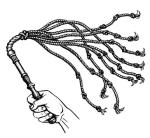
Pope Gregory XV was late to the party.   The first to arrive was a highly principled monk named Martin Luther, who propagated his faith almost a hundred years before Pope Gregory XV coined the phrase.   I saw a documentary about the life of Martin Luther recently that opened my eyes.   I’d read quotes of Luther’s over the years about the Christian duty of obedience to rulers that made him sound like an authoritarian type.  He’d stated that the duty to obey one’s masters was clear because God had not put a fox tail in the hands of the rulers, but a knout.  Here is what a knout looks like:

knout.jpg

I also knew him as something of a famous anti-Semite [2].  I watched the biographical movie with great interest, it was very well-done.  Here is what I gleaned.

Young Martin Luther studied law.  His father wanted him to become a lawyer, to assist him with his business troubles.   At some point the Lord called Martin Luther and he abandoned his legal studies.  His father, feeling betrayed and bereft of the badly needed brilliant legal counsel his son should have provided him, was furious.   Martin Luther felt intense guilt over his decision to abandon his father.  Luther did what any devout Christian monk with a troubled conscience would do, he mortified his flesh, flogged himself, fasted for days, wore a hair shirt, burdened himself with heavy chains, and he prayed.   One assumes that none of this made a favorable impression on his disappointed father.

Martin Luther took a principled stand against the corruptions of the Catholic church of his day.   It burned him, for example, that rich people could buy “indulgences” which exempted them from penance for certain types of sins.   He preached against these corrupt practices and eventually was given the choice of publicly recanting his blasphemies or facing excommunication, which sometimes came with a gruesome execution.  He braved the consequences, stuck to his principles, and his faith in God, and was not flayed or burned to death by the Church.

He had begun writing about his beliefs, and apparently had a genius for it.  Gutenberg’s new printing press, invented 43 years before Luther’s birth, would become the vehicle for propagating Martin Luther’s writings.  The filmmakers suggested that it was the popularity of his writings, mass distributed in the manner of sixteenth century Europe, that may have saved the heretic Luther from gristly death at the time of his excommunication.  The world’s first best-selling author, writing powerfully on matters of conscience, Christ, and the relation of humans and God, he was simply too popular, too loved by many in the rabble, for local authorities to burn at the stake.  The filmmakers didn’t mention it, but it probably didn’t hurt that he spoke with authority of the rabble’s duty to obey those who wielded the knout.

We are told that Luther preached a message of liberation to the masses that millions of hardworking Christians were delighted to hear.  You pray directly to God, not through a paid, corrupt, intermediary.  A poor man has the same access to his Creator as a baron or a king.  You don’t need a priest to interpret what God expects of you, read God’s words for yourself, in your own language.  Luther himself translated the scriptures into the vernacular. 

All over Europe people would read his writings and rush to set more copies in print, churn them out on the printing press, the Twitter or Facebook of its day.  Luther himself was shocked at how quickly his writings spread.  He was, apparently, an inspirational writer who wrote things like:

Even if I knew that tomorrow the world would go to pieces, I would still plant my apple tree.

So, but for the invention of the printing press, which spread Luther’s ideas to every corner of Christiandom, who knows if there would have been a Protestant reformation?  It certainly would not have gotten underway during Luther’s lifetime, anyway.

Propaganda can be as tricky to identify as pornography.  It can be slippery to describe.  People of good faith may differ on what is pure manipulative propaganda and what is good information to base your decisions on, but we can all say, as a famous Supreme Court justice wrote in a famous ruling on pornography, “I know it when I see it”.  Leaving aside, of course, as in any discussion of The War on Terror, the jarring fact that one person’s terrorist is another person’s freedom fighter.  

The world is complicated.  Propaganda makes it easy to understand.  Vote for me and I’ll set you free.  Ball of confusion, that’s what the world is today. [3].

[1]  today any snot-nosed bastard can come off like an authoritative genius, the accumulated knowledge of the world one click, or voice command, away:

The term “propaganda” apparently first came into common use in Europe as a result of the missionary activities of the Catholic church. In 1622 Pope Gregory XV created in Rome the Congregation for the Propagation of the Faith.

[2]  The filmmakers took some trouble to explain the unfortunate strains of anti-Semitism in Luther’s later writings.  It appears he expected the Jews, once the corruptions of the Pope’s church were cleared away, to flock en masse to his perfected version of Christianity.  He’d been quite nice to the Jews in the beginning, in expectation of welcoming them as brothers and sisters in Christ.  The Jews, for their part, stubbornly refused to give up their ancient religion and convert to Luther’s.   After that, understandably, Luther had little use for the Jews and concluded there was no saving them.   He began to write mean things about them, but, the filmmakers suggested, you shouldn’t really hold those unfortunate writings against him.

[3]    Ball of Confusion   (1970)     The Temptations

 People movin’ out, people movin’ in.
Why, because of the color of their skin.
Run, run, run, but you sho’ can’t hide
An eye for an eye, a tooth for a tooth.
Vote for me and I’ll set you free
Rap on, brother, rap on.
Well, the only person talkin’ ’bout love thy brother is the preacher
And it seems nobody’s interested in learning but the teacher
Segregation, determination, demonstration, integration, aggravation,
humiliation, obligation to our nation
Ball Of Confusion that’s what the world is today (yeah, yeah)
The sale of pills is at an all time high
young folks walkin’ ’round with their heads in the sky
Cities aflame in the summer time, and oh the beat goes on
Eve of destruction, tax deduction,
City inspectors, bill collectors,
Evolution, revolution, gun control, the sound of soul,
Shootin’ rockets to the moon, kids growin’ up too soon
Politicians say more taxes will solve ev’rything, and the band played on.
Round and round and around we go, where the world’s headed nobody knows.
Great googa mooga, can’t you hear me talkin’ to you, just a
Ball of Confusion that’s what the world is today. (yeah, yeah)
Fear in the air, tension ev’rywhere
Unemployment rising fast, the Beatle’s new record’s a gas,
and the only safe place to live is on an Indian reservation,
and the band played on
Eve of destruction, tax deduction,
City inspectors, bill collectors, mod clothes in demand,
population out of hand, suicide too many bills, hippies movin’ to the hills
People all over the world are shouting end the war and the band played on.
Round and round and around we go, where the world’s headed nobody knows.
Great googa mooga, can’t you hear me talkin’ to you, just a
Ball of Confusion that’s what the world is today
Let me hear you, let me hear you, let me hear you
Ball Of Confusion that’s what the world is today

Songwriters: Norman Whitfield / Barrett Strong
Ball of Confusion lyrics © Sony/ATV Music Publishing LLC

Pull the Plug

One year on my birthday, well into my adult years, my parents took me to a restaurant.  It was probably a pretty nice place, my father and I may well have been wearing sports jackets.  Assume we were.  

At some point during dinner, maybe while we waited for the appetizers, my father reached into his inner pocket and pulled out a few folded pages.  “You have a pen?” he asked me.  

I always have at least one writing instrument with me and I produced a pen. The papers he wanted me to sign were a Health Care Proxy and Living Will.  He’d had them drawn up and made me the proxy in the event he was incapacitated, and in a life or death medical emergency.   I said something like ‘what the fuck?’ and he explained.

“I thought you were the perfect person because if I was hooked up to life support you wouldn’t hesitate to pull the plug,” he said.  

 “If you were on life support right now, I’d pull the fucking plug,” I may have said.  I signed the papers, my father took them, folded them, put them back into his pocket.  

“Hell of a nice birthday present, dad,” I said, “I don’t know how to thank you.”

“As I’ve told you many times, you never have to thank me for something like that.  It’s my pleasure.”

Nothing else about that long ago birthday dinner is at all memorable.

Family Dynamics

There is a popular factoid out there, probably true, that most murder victims are killed by people they know.   It makes sense, if you think about it.   If you’re about to snap and take the extreme step of murder, why kill some random person if there is someone you know well enough to really hate?   Many murders, we are told, occur within the family.   Murderers no doubt feel justified killing some supremely provocative person close to them who has long been fucking begging to be killed.

Listening to a friend’s story last night about troubles in her family I thought of a familiar scenario.   The parents are at odds, the children are in the middle, or off to the side.   The kids naturally get drawn into the drama between the parents, forced to take sides, console, shoulder the blame for their parents’ misery, act as human shields when things get particularly ugly.

In most cases this is not a recipe for how to raise a murderer, except in cases where the parents frequently cut each other with razors, or beat each other bloody, during particularly rancorous fights.   Violence like that would up the ante, increase the chances of the child growing up with enough fear, insecurity and rage to become a killer himself.

Violence against others, widespread as it is, is less common, I think, than violence against the self.   In 2016 there were more deaths in the U.S. by opioid overdose, around 60,000 (a record for overdose deaths in the USA), than by gun violence, and that includes the tens of thousands of annual suicides by firearm the NRA angrily insists should not be included in gun death statistics.  You’ve heard the phrase “you are your own worst enemy”?   Dig it.   Be aware that you are one of the most dangerous motherfuckers out there, to yourself.  Keep an eye on that, my friend.

Much of what we suffer from is not our fault.   It doesn’t mean we don’t have to deal with our problems, mercifully, but it’s not our choice to suffer in many of the ways we do.   It’s not on us, bad as it also is for us, if we didn’t learn resilience from a family that had no clue about it.   We have to learn it by trial and error by ourselves, with great determination, over the course of decades.  If we are lucky we find a good friend or two who is on a similar journey, it helps greatly to compare notes and track progress.  Picture what kind of life skills you might acquire coming from this family scenario:

Mom is hardworking, reliable, tense, often short-tempered, or downright mean, to Dad.   Dad is not hardworking, but he is very affectionate, funny, supportive and sweet.   If you’re feeling afraid or insecure, you run to dad, who takes you in his arms, massages your shoulders, makes you laugh, makes you feel better.  If you need anything else, you go to mom.  Mom always comes through with whatever you need, no matter what.   Mom would walk through a hail of bullets for you.  The mystery is why this great person is often such a bitch to Dad. 

Picture the endless possible good reasons that Mom is such a bitch to Dad.   Dad gets drunk and rapes Mom once in a while, for example.  Or Dad is a serial adulterer and bad liar about it.   Maybe Dad wants Mom to catch him and that’s why his lies are so sloppy, so transparently stupid.   Maybe Mom has kept Dad out of jail by paying back money he stole in doomed embezzlement schemes, maybe more than once.  Could be huge gambling debts, or money stolen from a dead father’s credit cards.  Maybe he keeps getting popped for petty crimes of some kind and Mom keeps bailing him out, even the best shoplifters get caught once in a while.  Maybe Mom walked in while Dad was banging the baby sitter when you were a baby.   Maybe Dad, in a moment of rage, threatened to murder Mom’s family and then come back and burn her, her children and himself to death? Whatever fucked up scenario you can imagine, fucked up people, no matter how otherwise wonderful they are, regularly do very fucked up things.

But the statistics say that children of divorced parents have worse future life outcomes than the children of intact marriages, no matter how bad.  I’m not sure about the wisdom of that, but it’s a common belief.  I think there are marriages so toxic that everyone is better off, including, or even particularly, the children, when the hideous farce is over.  But say Mom believes that the best way to protect her kids is to project a healthy relationship between her and the husband she has many excellent reasons to be angry at much of the time.

Now this requires some complicated footwork.  The children must be shielded from their father’s dark side.   It would do nobody any good, reasons Mom, to have Dad admit that he is a serial embezzler, cheat, liar, fraudster, gambling addict, pornography addict, an immature person incapable of accepting fault, apologizing or changing, whatever the fucking thing is.  So Mom keeps the dark secret for everybody.  Nobody needs to know her issues with Dad.  It makes her ashamed, for one thing, which is a powerful reason for keeping secrets.  Some people refer to this kind of Mom as The Martyr.

In her house everything is always fine.   I grew up in a family where much was hidden.  At the same time, and though we fought viciously about it, there was some kind of commitment to being truthful with each other.   The honesty only could go so far, but we were all trying to be honest, as far as we understood things.   That value on honesty was a positive thing I took from a very hard situation.  It inclined me to search for explanations, for puzzle pieces that would help me make sense of the whole.  I am grateful for it, fucked up and painful as the surrounding circumstances were.   There was always an impulse to truthfulness, a value placed on candor, although it was also part of a terrible ongoing war in a very dark setting.

Picture the difficulty of growing up in a house where fundamental things are tightly guarded secrets.   If honesty is off the table, everybody has to agree not to seek the truth, or even imagine the many kinds of mischief and wickedness that flow from that agreement.    If there is violence that is hidden, treachery or exploitation that is covered up, the children in that house are unlikely get much insight into how to maintain an honest, intimate relationship.   They haven’t seen a healthy relationship between their parents, only a mysterious and perplexing riddle featuring a cool, laid back Dad and an indispensable, totally dependable and loving Mom, who unaccountably gives Dad an unending amount of shit.  

These children will likely be flummoxed when trying to form intimate relationships of their own, because intimacy requires mutual trust.  Mutual trust is not the same as a mutual agreement never to reveal secrets the couple considers shameful.  Trust is open, and impervious to fear, hiding shame is closed, and full of terror.   

I see this kind of shit, my brothers and sisters, the harm done to the children of people who decide to live this way, and it makes me want to weep.

“Uh… you’ve skated about as close to that line as you can comfortably skate, if you want to call any of that comfortable,” said the skeleton of my father.  

Yes sir.  Time to unlace the skates and get on with jotting down another great vignette starring you that I just recalled.    

“Well, get to it then, motherfucker!”

Final Puzzle Pieces

It struck me today, in considering what loose strings remain in my attempt to weave a coherent tapestry of your life, how these last few pieces fit together.

“About fucking time…” said the skeleton of my father.

I’m able to walk again in recent days.  I’m walking longer and longer distances.  While I was walking today it hit me.  It reminded me how walking seems to help the mind puzzle over things.

“Way to rub it in, putz,” said the earthbound remains of my father.

I’ve got to set this down fast, it’s complicated and elusive, yet elementally simple.

“Aren’t we all?” said the skeleton with a sigh. 

One essential connection eluded me.  You and I are having this fairly relaxed discussion, one we could have been having all along.  I never doubted my mother’s love for me, though she was also capable of flinging mighty mountains of dung at me.   The last piece of the puzzle was suddenly right there in front of my eyes as I walked up Broadway. 

I can’t explain it, and you did your best to obscure it, but I felt loved by you, on some level I can’t really describe.   If you have the love of both of your parents, you expect people to love you, find it odd if somebody takes a dislike to you.   If you have the implacable hatred of either of your parents, your odds go way down, you’re more likely to have your doubts.  If both of your parents hate you… I don’t even want to consider that.

I described the repetition compulsion — an irresistible need to replicate the same fundamental trauma over and over with new players in the old roles.  Many unhappy people do it in various forms for their entire lives and never see it.   I think of my old buddy Friedman, the best ready example.   Every relationship went through the identical dramatic arc: fascination, idealization, disillusionment, misunderstanding, betrayal.  It was uncanny, the motherfucker must have had a hundred of these in the years I knew him.

I noticed in my relationships with some of my closest friends a real, and eventually sickening, psychological resemblance to the abusive relationship I had with you, dad.  And I say “dad” with italics for purposes of that previous sentence, dad.   

“I get that,” said the skeleton.

I placidly took abuse from some of them that I would never have taken from you.  Doing this unconscious psychic work, I suppose.  I took an amazing amount of shit from the talented and self-hating Speed, for example, while he taught me guitar and music theory.  The music I was most drawn to, for him, was shit that was beneath contempt.  Nonetheless, he was unstinting in expressing his contempt.  After years, and learning a good deal from the musical savant, I finally had enough.   Same with Friedman. 

I realized shortly after you died: fuck, I have to take this shit from my father, there’s a psychic pay-off if I can get to the other side of it.  At the same time, there was no possible pay-off for taking shit from an implacably unhappy prick who had no insight into his own misery.  I was better off having someone like that as a stranger, addition by subtraction.   A beautiful thing, to remove a cancerous relationship from your life.

“You understood that fairly late in your life, but better late than never,” said the skeleton.  “You remember how much shit you gave me for doing the same thing?”   

You never explained the necessity of instituting that fall from grace in a way that made any sense to me.  You never took the time to understand it yourself, just went into a rage and began swinging your broad sword. 

“It was my way,” said the skeleton, with a hint of coyness. 

Yeah, so anyway, dig this.  My mad friend Andy, the one who fought with his wife, Hitler, over the Atavan? 

“A very bright and quick-witted fellow,” said the skeleton, “although the mirthful malice glittering in his eyes was also clear to me.” 

Anyway, Andy bore a striking psychic similarity to my uncle, your brother, Paul, the mild mannered enraged tyrant.

“Damn…”   

Yeah, look, he was one step away from being like you.   He turned out to be your bullied, bullying little brother.   That’s the cunning of the thing, why this last puzzle piece has been so hard to fit in with the rest.  Here’s what I realized.  The fact that I expect to be liked, even loved, is the most infuriating and intolerable thing of all to someone who fundamentally hates himself.  You loved me, but on some fundamental level hated yourself.  How does that work?  You have to destroy me. 

“I hated to do it, you know,” said the skeleton. 

I can’t account for how it turned out, after all the ugly confrontations, the senseless fucking carnage around the dinner table.  I knew that, somehow.  I think even without your deathbed regrets and apologies I knew that you held me in very high esteem, respected me, loved me.  The whole deal.   You remember you once asked us if we’d rather be loved or respected and we said ‘loved’?  You said ‘respected’, like the two were mutually exclusive.  A very reductive and idiotic way to see the world.   

“I stipulated to that as I was checking out, no need to get back into that.”

No need to get back into that.


Happy Martin Luther King Day from least racist President ever

I don’t know if the president is a dotard, as his colleague in North Korea, Rocketman, called him.   I know he’s a troubled man, you can tell by how frequently he resorts to ‘alternative facts’, as his nimble White House counsel styled his frequent, clearly demonstrable lies.   I don’t want to jump on and call him President Shithole or anything like that.   I really don’t even want to think about the motherfucker at all, but there you go, the guy owns the mass media.  Bread, circuses and fucking freak shows.  He is the best freak, the best freak, believe me, I’m from Queens, believe me.

Just thought I’d share this fifteen second clip of Mr. Trump reading prepared remarks for Martin Luther King Day, or as it’s called in Alabama and Mississippi, Robert E. Lee Day.   The face of the dark skinned man carefully positioned next to Trump as he reads is priceless.   It is the involuntary reaction even a poised, politically calculating person has to being close to an unbearable smell.   Am I wrong?

Check it out.


The view from the room my father died in

The large windows faced west, apparently.   I have no idea of such things, but that’s where the sun went down moments after my father died, staining the sky that beautiful blue orange gradient, the silhouettes of the palm trees turning black against the glowing sky.   If you want to believe in a merciful God, there’s your picture. 

My father had no sense of direction, did not know the names of trees, or birds.  He had no mechanical aptitude.  His one project, the towel rack he built in the basement bathroom out of one by fours and a couple of wooden rods, was serviceable, if warped.   He was unable to impart these practical things to me, he did not know them himself.  I understand this now and don’t hold it against him. 

That simple understanding took many years.  There was a war going on around us, we were in the middle of it.  With the constant gun fire, explosions, clouds of rolling poison gas, the trenches, the cries of dying horses, it was hard to focus on simple understandings. 

The windows of his hospital room on State Road 7 in Florida faced west.  I know that now because I have heard the sun sets in the west.   After he died, the nurse quietly came into the room.   I gave her his oxygen line, after closing my dead father’s eyes.   I said “he won’t be needing this,” like a hardboiled character in a cheap noir novel.   Nobody knows how to act around death.  My father’s death was no surprise, although the suddenness of his last moments was striking.   

“Why don’t you all go down and have some dinner?  Take a little break, you’ve been here all day. Elie will sit with me, it’s OK,” my father told my mother, my sister, my uncle, my brother-in-law.  They’d been sitting with him most of the day.  I’d been the last to arrive, after being up with him until four or so the night before.   It seemed natural enough at the time.   None of us suspected that within twenty-five minutes he’d be dead.   

An hour or so earlier he’d suddenly become agitated, grabbed my sister and me by the hands, held us tightly.  This action, so uncharacteristic of him, was like an alarm.  It was electrifying.   I asked the nurse if there was Atavan in his chart.  I knew about Atavan because my mentally ill friend loved it.  He and his despicable wife fought over the bottle of Atavan, hiding it from each other, hoarding the pills. 

“I don’t want to take anything,” said my father, dropping our hands but still clearly terrified.  I knew what he was concerned about.

“Don’t worry, dad, it will leave your mind clear.  Andy takes it, I know all about this drug.  It will just take the edge off, relax you a little.” 

The nurse brought him the pill and he took it.  Within a few minutes he was calm.  The concerned faces of his wife, brother, children began to relax a little bit.   Then he told everyone to go take a break, go down to the cafeteria for a while.   He reassured them that I would sit with him, there was nothing to worry about.  He was fine.

They got up and left.  Two nurses came into the room.  One pointed to my father’s fingernails, which were turning bluish.   She said this was a sign that oxygen was no longer getting to his extremities, one of the final signs.   The other nurse, a good looking Jamaican woman, said that if you pray, this is the time to say your prayers.   I told her we were not particularly religious.   She took it on herself to hedge our bets, sang “Dayenu”, a Passover song of thanks to God, in a beautiful voice.   The two nurses helped me lower the barrier on the side of my father’s deathbed so I could sit closer to him, then silently left.

A couple of minutes later my father said “I don’t know how to do this.”  Then he did.  Then the sun set and it was Shabbat, the day of rest.


Waiting for Death

“Well, you’re certainly not alone there, Elie,” said the skeleton of my father cheerfully.  “Didn’t your man George Harrison have a song where he sang ‘nothing in this life that I’ve been trying could equal or surpass the art of dying’?”

Yeah, on All Things Must Pass.

“All things that live and feel must pass,” said the skeleton.  “The miracle, of course, is that we live as though we and everyone we love are not fated to go the way of all flesh.  We consider our own death only when we’re losing a loved one, or are sick ourselves, up against a life-threatening illness, or surrounded by dying people.  Or depressed.”   

Or standing, for example, in a ravine on the northwestern edge of Vishnivetz, with murderous, drunken haters banging drums and playing brass instruments out of tune.   

“Yes,” said the skeleton, “there’s always that.  There’s certainly no shortage of that in this blessed world.”

My sister and I once discussed the revelations you had during the days you lay dying, the self-reflection, apologies and regrets you expressed to me the night before you died.  I wondered if you would have come to these things sooner, lived your last weeks or months differently, if one of those geniuses had diagnosed your fatal condition earlier, rather than in the ER six days before you died.  I thought you likely would have.  Your daughter was not so sure, she felt it probably would have waited til that last night, no matter how long you knew for sure you were on the Death Express. 

“Well, you know, I wasn’t able to say anything to your sister of any consequence before I died,” said the skeleton. 

You didn’t have any time with her alone. 

“Not only that.  It was just impossibly complicated.  I felt I’d let her down, in many of the same ways I let you down,  but it seemed she was clinging to the few times I was unequivocally on her side.  When I paid the downpayment on her house, when I reassured her at the lowest points of her life.  I don’t know, I wasn’t able to sort out my feelings enough to say anything of any consequence to her.”   

Well, don’t beat yourself up about it.  If you could have done it differently, you would have.

“Hah, the very thing you kept telling me that last night, as I was trying to make you my Father Confessor.” 

Look, in our case, although we were adversaries, there was a long, rich history of at least trying to have an honest conversation.   

“That’s debatable,” said the skeleton. 

There you go.  We had decades of debate, often angry and contentious, but a conversation it was.   

“An attempted conversation, perhaps,” said the skeleton. 

Whatever.  We had a history of trying to talk past our differences. 

“You did,” said the skeleton.  “I was pretty much consistent fending off that shit, as you recall.” 

My point is that we had a lot more practice struggling toward real understanding than you and my sister did. 

“You don’t get a point,” said the skeleton, “have you forgotten how this works?”   

There are times I wish I could forget more. 

“Now you’ve said a mouthful,” said the skeleton. 

Nothing in this life that I’ve been trying, could equal or surpass the art of dying. 

“It’s not a bad thought to keep in mind, if you don’t get too morbid about it, I suppose,” the skeleton moved his lower jaw around in a disquieting way. 

What the fuck is that? 

“Nothing,” said the skeleton, “just going for a cheap laugh.” 

Is it better to know you have a year to live than not to know?

“It’s better to know,” said the skeleton.  “We only get so many years to get this shit right.  Nothing focuses the mind like a good whiff of your own approaching death.   Boswell quoted Samuel Johnson to that effect,’depend upon it, sir, when a man knows he is to be hanged in a fortnight, it concentrates his mind wonderfully’.  Thus saith Jeeves.  I found it to be very true, though I had far less than a fortnight to deal with the certainty of my own demise.” 

If you had a year, with the knowledge of your fatal liver cancer whittling away your remaining days, would you have come earlier to the realizations you did just before you died? 

“A $64,000 question, Elie, I have no fucking idea.  How would I know?”

Fair enough.   

“A sense of fairness is a precious thing, Elie.  I can see that so clearly now.  A precious and very rare thing — simply being fair.  You live in a world where everything is contested, every inch of moral high ground is viciously fought over.   It’s hard to even see the extent to which that operates, while you’re swimming in a sea of it.   Everybody wants to be treated fairly, but extending fairness– whooo, that’s one of the hardest human tricks.  Reminds me of that great Mose Alison song ‘everybody crying ‘peace on earth’, just as soon as we win this war.'”