
click the picture for a reasonable statement of my credo
click the picture for a reasonable statement of my credo
Those who are offended by people who lie sometimes refer to them as “lying sacks of shit.” I get this, and so do chimpanzees, apparently.
As Yuval Noah Harari tells it, this was observed in nature. Interested humans observed a group of chimpanzees in Africa. Chimps, we learn, have a vocabulary of specific warning cries for various threats. The lion cry will send them into the trees, the threat of other predators will spur them to different evasive actions. This mutual warning system has been a key to group survival for millions of years.
Harari describes a moment when several chimpanzees found a small trove of bananas. They began to eat, but there were not that many bananas to be shared among them. One of the chimps raised a warning cry that sent the others climbing to the treetops. As they climbed, the chimp who’d raised the alarm stuffed himself with bananas. When the other chimps saw this they realized the smelly ape was a lying sack of shit. They came down, cursed him out, threatened him, shunned him, sent him packing. “Good luck on your own, you lying motherfucker.”
Sadly, this principled behavior is not always observable in homo sapiens. Liars sometimes gain a tactical advantage. If many elections post-Roger Stone are decided at the last moment, with disinterested voters stomping off to the polls after being enraged by negative ads, who cares if the negative ad is a fucking lie? You don’t have to lie in a way that a court could fault you for– you just distort, or omit, or take a sound bite out of context. The point is, make people angry enough to storm off and vote against the fucker. What you can achieve, when you are unbound from scruples, is virtually limitless.
I don’t recall the political candidate, it may have been one of Karl Rove’s early campaigns, or possibly LBJ in an early Texas campaign (or it may merely be an unverifiable, but illustrative, myth), who ran a last minute story about his opponent fucking goats. The accused goat fucker had a very short time to either high-handedly ignore or deny the story. Neither was a very good option. The election was decided by a few votes, many of them disgusted anti-goat fucker votes. After the candidate won, the goat fucker gambit, if recalled at all, was just a laugh line. The lying sack of shit who made it up had a good belly laugh.
The problem with being a lying sack of shit, of course, is that eventually people stop trusting you. This can take a long time, if you have good skills in the spinning plausible alternate fact department. In the end, though, it is almost inevitable, if you lie enough, that your lying will be noticed, and resented. Other liars will not fault you, perhaps, but it’s hard to be in the company of people who lie all the time. Imagine a world where you could never take anyone’s word for anything, where every assurance would likely be pure bullshit.
I’ve known liars. It is disorienting to deal with them. They will tell you whatever they believe you need to hear in a given moment. It’s a pathology, I understand, but still hard for me, moral fucking prig that I am, to stomach. I understand that the roots of a lying sack of shit’s need to lie are deep in childhood shame. I understand that, outside of a statistically small number of actual psychopaths who lie in a purely instrumental way to get what they want, any habitual liar was damaged early in childhood. Still.
It brings up the old Hitler conundrum. A Hitler is not just produced at random. Baby Hitler is not born to rouse a humiliated nation to humiliate the world with its ruthless superiority. Baby Hitler has to have the shit beat out of him several times every day by a vicious wife beating piece of shit, a guy like Hitler’s father, Alois. The young Hitler steels himself, teaches himself not to cry during these beatings, no matter how brutal. In his heart the ability to conceive of a campaign of worldwide revenge and domination is hatched and hardened.
It is easy to conceptualize all this. The victimized child deserves sympathy, if he was a convicted criminal his cruel childhood would be raised as a mitigating factor to get him a more lenient sentence. The conundrum is – in the case of a Hitler – it’s impossible to give a shit about his suffering, though it was real and horrible and should never happen to a child. Send me back in a time machine and I’ll give Hitler’s mother an abortion. Beings forfeit their right to sympathy when they cross certain lines, as Mr. Hitler indisputably did. Very sorry for his horrific childhood, yes. I’d have stood on line with millions of others to spare him that, along with the rest of his glorious life.
Lying sacks of shit are having their day in the sun right now. If you call a lie an “alternative fact” you have a nice confusing cudgel to whack credulous people with. Credulous people are like candy for a lying sack of shit. Ironically, good people, basically honest people, are the best suckers for a lie.
Shakespeare has the conniving bastard Edmund happily gloat over his brother’s good character — Edgar’s incorruptible honesty, and his generous, trusting nature, make him the perfect sucker for Edmund’s evil scheme. He is far too good to suspect the evil Edmund is hatching. Not being capable of betrayal himself, he does not imagine his loving half-brother capable of it. Edmund chuckles at the divine irony of it.
I’d put many who vote for evil fucks in Edgar’s category. People are basically good, as Anne Frank said, before she was dragged out of her hiding place and shipped off to the death camp right before the end of the war. People are, perhaps, basically good. I think most people, if they could, would rush to rescue a crying baby about to be hit by a train.
Sometimes lying sacks of shit have been deeply humiliated in childhood and are also psychopaths. Psychopaths tend to raise, and humiliate, little psychopaths. We have to watch out for those motherfuckers. We do, indeed.
Former president Richard Nixon explains.
I’ve been waking the last few days crushed by a sense of futility.
“Welcome to my world,” said the skeleton of my father, from his grave at First Hebrew. “Although, in my case, of course, that crushing sense is caused by a ton of soil and rocks on top of me these days. It’s not easy to crawl up to the surface to bullshit with you every other day, you know.” The skeleton gave either a wide smile or a broad grimace of agony.
“But, seriously, Elie, you know, most people in your position would have been waking that way every day for the past, oh, say, six or seven years. If you don’t go to work, don’t have an income, don’t interact with people who appreciate your work, how long can you feel productive producing things that nobody ever sees, let alone pays you for?”
Yeah, obviously. I’ll tell you something, though, and it took me years to develop this crucial ability. I’ve rarely been troubled, lately, by the indifference of the overwhelmed. Their lack of response has nothing to do with the quality of my work. I feel productive every day as I sit here typing, refining, clarifying, or even drawing or playing music. It’s like a mind/body thing — feeling as though you are tapping into your deeper potential every day just feels good. Feels productive.
“Well, lucky for you, then,’ said the skeleton. “You know, the challenge to feel productive is the reason most people crave work, and a busy schedule, and why they book structured vacations, and religiously read their daily newspaper and so forth, to have that feeling of being productive while keeping a thousand demons at bay. Not everybody, left to their own devices, has the inclination to be creative, or observe things closely, or ponder hazy connections, or express their fears and hopes, or whatever it is that seems to drive the people we formerly referred to as ‘artists’.”
I’m starting to be consumed by thoughts of death.
“Update your resume, toot sweet,” said the skeleton.
Our cat has lost a lot of weight, he’s in the final stages of chronic kidney disease. He’s actually skinny now. He has been retreating more and more, hiding in one of two new coffins he’s staked out, doesn’t come up on the bed to nuzzle Sekhnet as was his lifelong habit. Yet he wants to live, keeps trying to eat, even when he just vomits afterwards.
“That’s some heartbreaking shit, the steep decline of the Baron and the way he clings to life,” said the skeleton. “All the more so because you have friends who say, ‘fuck, it’s just a cat’. Didn’t one of them urge you to put him down, so you could join them for a little holiday?”
Well, I guess this is one I won’t be reading aloud to Sekhnet…
“Oops.”
While the cat is wasting away, and is generally too nauseated to even accept the bribe he demands after we stab him in the back with the needle from the kidney treatment bag every night, I have been pondering my own medical situation.
“Look, Elie, none of this belongs in the Book of Irv (which I note you are now subtitling “First Do No Harm”– even contemplating the pretentious Primum non nocere) but I have to point out something that you no doubt realize. You are in a tight spot, serious progressive kidney disease of unknown cause, treatable in 1/3 of patients, spontaneous remission in 1/3 (no clue if you’re still a candidate for that, no doctor has any idea, either) and kidney failure in 1/3. You don’t necessarily have to like your odds. But keep in mind, until that first chemo treatment you were regularly riding your bike 13 miles at a time and feeling much better each time you did. It’s three months now with virtually no exercise, that’s got to take a psychological toll. You have to give yourself a break.”
The trick is how you actually do that. You know, I keep thinking, whenever I consider this non-lucrative disease I have, one that inspires no pharmaceutical research and therefore no funds for any kind of research, of those fucking geniuses in Florida that treated you as, unbeknownst to any of them, you were dying of liver cancer.
“Well, look, Elie, it’s two completely different situations. You have a disease of unknown origin that corporate medicine treats as best it can, using the dartboard approach, knowing that 2/3 of patients are beyond the reach of their treatments anyway. If all goes badly, you’ll just need a kidney transplant. They’ve got millions of third world people looking to sell a kidney. It’s only a matter of money to fix, even in the worst case scenario.
“What I went through, not to compare, was a more than two year weekly rotation of doctor visits, cardiologist, hematologist, endocrinologist– none of whom had any clue I was dying of liver cancer, which is a completely different story. Those cocksuckers could only have flourished in a place like Florida. I had an appointment with Moomaswamy for the following Monday. Unfortunately for me, I was in the hospital by then, with only two or three days left to live. Had to cancel that appointment with the genius of cardiology.”
The skeleton grew quiet and neither of us broke the silence for a full minute.
“I was, obviously, not pleased to learn, six days before I died, that I had been dying of liver cancer for God only knows how long, but that’s life, Elie. We are in the hands of motherfuckers, and, ultimately, in our own hands.”
True dat, we are ultimately in our own hands. I was not able to learn this from you, except indirectly, but our own hands must be strong, and soft, and gentle. The way you were able to reassure me and my sister when we were really shaken up demonstrated your capability. It’s too bad you were never able to turn this ability toward holding your own life in a more merciful, life-sustaining way.
“Yeah. Like I said, that last night of my life, my life was over by the time I was two years old.”
Mom once told me she felt like life was a giant buffet, and everybody was filling their plates with all this delicious looking food, and she was standing there without a plate or a fork.
“Her life, in many ways, was over by the time she was two,” said the skeleton.
I have no idea where I get this feeling that I’m living at the bottom of a grave, in the words of Mr. Hendrix
“Funny,” said the skeleton, “especially considering who you’re talking to.”
Humorous, I suppose, that I turn to an imaginary skeleton, the posthumously evolved spirt of my dead father, to try to cheer myself up on a day when I wake up crushed by a sense of futility.
“Nothing humorous about it,” said the skeleton, “it makes perfect sense. Look, I’ll leave you with this thought: is there anybody you’ve ever met who you would change places with for a minute?”
You know the answer to that one.
right?

Often you can trace a line from what’s happening now, back through a series of events that made it not only possible, but, in hindsight, inevitable that the things taking place now would be taking place. Along the way the steps may be indiscernible, although looking back afterwards, the patterns often seem hard not to see. Some sense of history, cause and effect, is important for avoiding the worst of our past collective mistakes.
One trouble with tracing these lines, how we got from point A to point W, is that the world of human affairs is as complicated as the cellular and sub-cellular maze of the human body. Even though science has solved many terrible puzzles in the case of the human body, it is still a bit hazy about a lot of things that go on in and among our intricate, interactive body systems.
I am being treated, for example, for an idiopathic kidney disease. “Idiopathic” means cause unknown. Western medicine doesn’t know how people get this disease. We know that shooting certain chemicals at it sometimes cures it, or puts it into remission. We don’t know exactly how this works, but it often does. We don’t keep data on the percentages of cure, remission and failure, because… I don’t know, patients might not want to spend $88,000 for a drug that only works, say, 26% or 18% of the time. There is no point giving this depressing number, whatever it might be. You want the cure? Yes or no.
I am writing here about history and our culture’s consistent failure to make thoughtful connections as events unfold. Add to the complication of human affairs the essential roles of irrationality, chance, short-sighted greed, basic stupidity. Many reason, not unreasonably, that since there seems to be so little an individual can do about this gigantic unfolding, there is no reason to get bent out of shape about it.
Until, to the shock of perhaps 65% of the country, we get a boastful, angry, insecure, impulsive con-man as our president. On his desk, the button to instantly kill millions of people.
“How can Americans be so fucking stupid?” cry a chorus of hand-wringers from all over the political spectrum, gnashing their collective teeth.
I don’t purport to answer that question. I would just like to trace a few points, to show that this president, while undeniably unusual as a personality, is not a complete outlier as president. He is continuing the work of his predecessors, including some of the ongoing work of the beloved champion of freedom and justice, Mr. Obama, and his equally gifted, equally compelled by the tides of history, predecessor, William Jefferson “Bill” Clinton. Not to mention, of course, Ronald Reagan and the presidents Bush, father and son and every other previous chief executive.
Pulitzer Prize winning journalist James Risen, now working at The Intercept, reveals some key details of how we got to this era of “Fake News” in his recent long article about the seven years’ long government prosecution of him (by Bush and Obama) for writing about the government’s massive, illegal, top secret surveillance program, the one that Edward Snowden eventually revealed the details of. Risen’s excellent, thought-provoking article is here. Risen writes:
My case was part of a broader crackdown on reporters and whistleblowers that had begun during the presidency of George W. Bush and continued far more aggressively under the Obama administration, which had already prosecuted more leak cases than all previous administrations combined. Obama officials seemed determined to use criminal leak investigations to limit reporting on national security. But the crackdown on leaks only applied to low-level dissenters; top officials caught up in leak investigations, like former CIA Director David Petraeus, were still treated with kid gloves.
Risen’s federal prosecution began during the second term of the Bush Administration. Risen had been reporting for the New York Times when he learned, from sources within the CIA, of the government’s illegal secret domestic surveillance program, being conducted by the NSA. He began writing about it during the lead up to the Bush-Kerry presidential contest of 2004.
The Bush administration requested that the New York Times not publish this detailed account of the top secret program. The details, they argued, if revealed, would undermine U.S. prosecution of the existential War on Terror. Bush himself eventually told Times publisher Arthur Sulzberger that he would have “blood on his hands” if the Times published the story, because the secret program was so effectively squashing terrorism.
The hierarchy of the Grey Lady, ever the sober, measured, compliant, even-handed journal of record (of our beloved status quo), that genteel colleague of the powerful, agreed to keep Risen’s story out of the paper, and did so for a year. After all, revelations of widespread illegality by the Bush Administration, like conscience curdling reports on its unaccountable, secret torture program [1] and false causus belli for the war in Iraq, would only be cynically exploited by their political enemies in the upcoming election.
The Times held the story as the 2004 election campaign wrapped up, as the votes were cast and counted. Risen, in frustration, had been writing a book about some of the Bush administration’s excesses in the so-called “War on Terror”. It contained a chapter detailing the routine illegal surveillance of millions of Americans.
The Times eventually reported Risen’s NSA surveillance story, just before Risen’s book was released. Bush and Cheney, meanwhile, had won the 2004 election. Risen and Eric Lichtblau, his co-reporter on the NSA surveillance stories, won Pulitzer Prizes for their work. The Bush/Cheney Department of Justice set about investigating and prosecuting James Risen in connection with his use of leaked classified material.
Risen writes in his Intercept article of the Valerie Plame case, and how it demonstrated to the Executive branch that, given the right optics, the public would not get excited about courts ruling the First Amendment doesn’t apply to journalists, that journalists could be forced to reveal the identities of their anonymous sources who had leaked sensitive information and that the court had a right to hold reporters in contempt, and lock them up, for refusing. New York Times reporter Judith Miller actually went to jail after being found in contempt of court for refusing to identify a confidential source in the Plame case. (Miller, one could argue, deserved to be locked up for being Cheney’s ambitious, credulous shill and writing his bullshit in article after front page article for the NY Times, though Risen, gallantly, doesn’t mention that.)
Valerie Plame was an undercover CIA agent, working to monitor loose nukes, whose husband, Joe Wilson, publicly disputed what turned out to be straight up lies by the Bush Administration about Saddam Hussein’s alleged WMD program. In apparent fury over Wilson’s Op Ed piece, someone in the Bush Administration revealed Plame’s secret identity.
It was a peevish, rash, rage-driven reaction worthy of President Trump himself. President George W. Bush, in the immediate aftermath of the revelation that someone in his administration had “outed” a covert CIA agent, vowed that if anyone in his administration had committed this treasonous act they would be punished to the fullest extent of the law.
Vice President Dick Cheney’s office was, almost certainly, the source of the leak. Cheney’s assistant, “Scooter” Libby, later took the fall for ‘obstruction of justice’ for lying to cover up the source of the leak and nobody was ever punished for the act itself. Cheney, as evil a motherfucker as this sad world has ever seen, was later reportedly furious when Bush commuted Libby’s sentence instead of pardoning him outright.
Risen points out that the opposition to Bush and Cheney led many to applaud Special Prosecutor Patrick Fitzgerald’s no holds barred investigation of the leak, including the jailing of Judith Miller for refusing to divulge her source in reporting the story. Few saw at the time, Risen writes, the lesson those in power would draw from this clampdown on freedom of the press.
Obama went just as hard against Risen as Bush and Cheney had. Obama was infamously aggressive toward leakers and journalists who revealed inconvenient truths. He used Woodrow Wilson’s harsh 1917 Espionage Act, with its death penalty and no defense regarding intent, against more citizens than all previous administrations combined. Risen writes of Obama’s legacy for freedom of the press in the federal court that covers Maryland and Washington, D.C.:
That debate [Obama DOJ’s position that ‘reporter’s privilege’ was not a defense against the reporter being forced to testify in a criminal case — overturning the ruling of the trial judge] became moot in 2014, when the Supreme Court refused to take up the case. That allowed the appeals court ruling to stand, leaving the legal destruction of a reporter’s privilege in the 4th Circuit as Obama’s First Amendment legacy. source
The things that go on at the highest levels of power are often unspeakable. The people at the top are insulated by many levels of bureaucracy, and, in most cases, protect each other. There are plenty of fall guys below to take the heat, when necessary. Why bring Rumsfeld or Cheney into a legal discussion of the American torture program, or the White House lawyers who twisted language and decency to argue that torture was fine, as long as we were torturing terrorists (or even the two psychologists paid $81,000,000 to design the torture program, for that matter) when a couple of low level, selfie-snapping grunts, acting on orders traceable directly to Rumsfeld and Cheney, can be prosecuted and jailed for participating in the torture program at a notorious Iraqi prison? Justice done. Case closed.
When it was discovered that General David Petraeus had revealed a large trove of sensitive, classified information to his mistress/biographer, he was not prosecuted. He was forced to resign from his government post and went, unmolested, into an extremely well-paid position in the private sector. Even as journalists were increasingly threatened for revealing sensitive leaked information that embarrassed the Executive branch or could compromise the lucrative interests of war profiteers.
I am extremely vexed by habitual, deliberate obfuscation, in private life as well as public life. The opposite — honest openness — is frequently called ‘transparency’. It is impossible to discuss anything intelligently without transparency. Transparency is increasingly curtailed when frank and open dialogue is undesirable for any reason. A lack of transparency is essential for the continued operation of truly unspeakable practices.
A transparent government operates by law, laws which have been publicly debated and passed, in adjusted form, by our elected representatives, who cast yays and nays in our names. That is the theory of representative democracy, anyway. Corners are often cut, of course, as powerful monied forces exert pressure on campaign donor-dependent lawmakers to cut deals advantageous to their mutual financial interests. The key to cutting these corners is keeping unpopular details secret until after the law is passed and there is nothing the average citizen can say or do about it.
As was done with the recent 51-49 party-line Republican Tax law. As had been done by Mr. Obama with the TransPacific Partnership agreement, which no legislator was allowed to take notes of, photocopy or share with constituents before the “Fast Track” up-down “yay-nay” vote on approving its countless secret provisions. As was done days after the attack of 9/11 with the massive and far-reaching Patriot Act. Extended public debate on any of these bills would have had a dramatic impact on the final form of the proposed laws. Which is the point of participatory democracy, so that no minority (or silent, powerless majority, for that matter) gets screwed too vigorously by their elected representatives. Democratic decision making, which includes protections for minorities and the weak, is never supposed to be done by strict 51-49 majority rule. Lack of information makes it easier to whip up the emotions of people who already feel overwhelmed and full of anxiety. Turn up the anxiety enough and people will shrug at just about anything.
Journalism is our only way of being informed of the things being proposed and done in our names, of things being done to others acting in our names. The flow of information we get via journalists has been severely curtailed by increasing corporate consolidation of the mass media. Very few corporations now operate most of the mass media, the place where most Americans get their sketchy information about what is being done in their names.
The consolidated corporate media is a conspiracy of silence only in the sense that very wealthy media corporations have a common interest in keeping the machine running the way it brings in the most profit. War and mayhem are always good for business, except when they are clandestine wars, as many today are, in the global War on Terror.
The CEO of CBS corporation commented during the presidential campaign that while the candidacy of Donald Trump might raise some troubling issues, DJT was a goddamned cash cow and the station was making a shitload of money off the tireless tabloid extrovert’s ubiquity across mass media. Viewers were drawn irresistibly to the freak show of his candidacy — we couldn’t help ourselves, he was that good. Trump stories were great for ratings and advertising revenues. Trump had made his name in the tabloids.
There are good reasons to keep shameful things secret. You can trace secret, evil shit done in our names going back as far as you’d like to go in the history of our great republic. From the wink and two nods in the Constitution that ensured the rights of slaveholders would be protected by law in perpetuity, to the “Removal” of the “Indians” under our laws, to unprovoked wars of naked conquest against Mexico, against Spain, to the two unnecessary atom bombs dropped on Japan, down through the years to the secret overthrow of democratically elected leaders in Iran, Chile, the Congo, who knows how many other places. COINTELPRO, a long time FBI program to intimidate, marginalize and imprison suspected American dissidents exercising their First Amendment rights, was only revealed when activists broke into a local FBI office and stole files that proved its existence. The sensational patriotic propaganda following the “friendly fire” death of American hero Pat Tillman (only debunked years later due to the tireless courage and persistence of his family) is another example of lies shoved directly down the throats of Americans kept in the dark by a cynical, goal oriented administration. The recent examples are too many to detail here.
My point: you cannot productively look at the mess we are in now without examining the many concrete steps that led us inexorably to the mess we are in now. When chickens come home to roost, as the cancerous, zombie chickens of our failure to heed the small steps toward the world of shit we now find ourselves in have, well… what can we say?
“Yo, we, uh, we didn’t fucking know? Wait … wasn’t Obama supposed to reverse all this shit?”
Obama, in one instance when he wasn’t misusing his great talents, told us himself that we would have to push him to do the things we needed him to do. Too many organized, disciplined, well-funded people hated him for much of the hope and change he promised to work, maybe, but, still, he had a good point.
It’s on us. In the end, it is always on us. How we do it is a difficult question, but it is a question that is on each of us to do our part to answer.
[1] How many Americans today remember the horrifying case of Maher Arar, Canadian citizen of Syrian origin, detained at JFK airport early in the War on Terror? Pulled off an airport line where he was waiting with his family, he was locked up and interrogated for two weeks before his “extraordinary rendition” by CIA jet to Jordan en route to Syria, shackled, blindfolded, drugged, diapered and jump-suited. He endured almost a year of torture at the hands of Syrian masters of torture before his eventual, long-delayed release. No charges were ever brought against him.
Maher Arar’s imprisonment without charges (not to mention his torture) was a clear violation of fundamental legal norms in the West dating back to the Magna Carta (1215 A.D.). The Canadian government conducted an inquiry, heard from 85 witnesses, and exonerated Arar of any connection with terrorism.
Prime Minister Stephen Harper formally apologized to Arar for Canada’s role in what the prime minister described as his “terrible ordeal.” In January 2007, the federal government [of Canada] awarded Arar $10.5 million in compensation, and another $1 million to cover his legal costs.
“On behalf of the government of Canada, I wish to apologize to you, Monia Mazigh and your family for any role Canadian officials may have played in the terrible ordeal that all of you experienced in 2002 and 2003,” Harper said. “I trust that, having arrived at a negotiated settlement, we have ensured that fair compensation will be paid to you and your family. I sincerely hope that these words and actions will assist you and your family in your efforts to begin a new and hopeful chapter in your lives.” source
US courts threw Arar’s lawsuit out, citing “national security” reasons related to the ongoing, and endless, War on Terror.
One principle often cited in philosophical discussions of capital punishment is that it is better for many possibly guilty persons to escape punishment altogether than for one innocent person to be executed. Ditto for torture, no?
There is no doubt that many, many people — and many innocent people turned in for rewards, for grudges, by sloppy work, were tortured in our names. “We tortured some [no more than a thousand or two -ed.] folks”, as our former president wanly admitted a few years ago, with impressive maladroitness.
Tweeted this morning by POTUS:
Now that Russian collusion, after one year of intense study, has proven to be a total hoax on the American public, the Democrats and their their lapdogs, the Fake News Mainstream Media, are taking out the old Ronald Reagan playbook and screaming about mental stability and intelligence…..
…. Actually, throughout my life, my two greatest assets have been mental stability and being, like, really smart. Crooked Hillary Clinton also played these cards very hard, and, as everyone knows, went down in flames. I went from VERY successful businessman to top T.V. star…..
…. to president of the United States (on my first try). I think that would qualify as not smart, but genius…. and a very stable genius at that!
Whew… thank God. Here I’ve been thinking the guy is a loose cannon. By 7:27 a.m. the tweet had more than 3,500 likes, from Saturday early birds. I’m going to add my like here. *
God bless these United States.
* A few hours later the number of likes will soon exceed 100,000. Way to go, sir!
Bonus tweet:
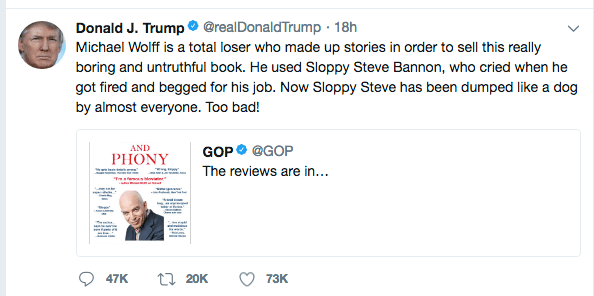
The president’s press secretary, former Republican presidential aspirant Mike Huckabee’s daughter, recently praised what she called Donald Trump’s impressive accomplishments in 2017. He had given everybody a historically huge tax break, she said, while slashing regulations to allow entrepreneurs, and all Americans, to prosper.
Admittedly, that’s one spin to give to the president’s accomplishments so far. [1] Don’t forget his appointment of a single-minded corporate extremist, to the right of Scalia, to lifetime tenure on the U.S. Supreme Court. Appointing a dependable right-wing political zealot really pleased his base. Mr. Smartypants Constitutional Law Professor Obama sure couldn’t do that for his adoring rainbow base!
I was impressed by the recent remarks of a Republican senator from Colorado, Cory Gardner by name, made while standing up for an actual democratic principle in the Senate. This is something that neither party is particularly good at, and I thought Mr. Gardner’s stand against logically inconsistent partisan political lock-step was laudable. Here is the essence of his principled remarks (as selected by the Godless commies at Democracy Now!). A tip of the yarmulke to Senator Cory Gardner. Good for you, sir. Good for you!
Meanwhile, the party of the slightly left of corporate center, the Democratic party, (or Democrat party as the southern boys now call it, coyly refraining from so much as a hint of the familiar n-word) was busy getting rid of one of their most articulate and publicly visible Senators over yucky allegations of uninvited kissing and touching that took place before he was in the Senate. The party of principles! No point setting a precedent — the accused himself calling for an ethics investigation to decide his fate. No, sir. He must resign, immediately. No political future for someone who could ever do something like that.
Even though the precedent of the accused calling for an ethics investigation of his own behavior, and the ethics committee making a ruling on, and setting a punishment for, this vexing, widespread, suddenly publicly spotlit problem, would extend the real conversation about how to fix it for good, at least in the halls and chambers of the political whorehouse in question, Congress.
Tongue kissing a Playboy model, who didn’t want to be kissed, before you went into politics is wrong and gross. It is offensive and should not be tolerated. The offender himself acknowledged this.
Then the offended at the zero tolerance party of the politically correct (donor), always playing to their proven “Identity Politics” demographic, got to work. It doesn’t matter that the victim publicly accepted Franken’s sincere and groveling apology, what he did was disgusting and intolerable (no matter when it took place). According to his generally spineless blue colleagues, backs suddenly stiffened, he must face the lightning quick no- jury-needed justice every cattle rustler in the old west used to face, if caught, or strongly suspected, or accused, or a stranger.
Wouldn’t it be ironic if the Republicans, the party that has no public beef with powerful men who grope and harass, elected the first female president? Wouldn’t surprise me, those far-right punks know how to fight to win on a national scale. My mother, as she was dying, begged me to promise her that Sarah Palin would never be president of the U.S. I did. Not so sure now, after this prissy winner who is our current president managed to bully, bitchslap and gerrymander his way to an impressive (unless closely examined) Electoral College win. It won’t be Ms. Palin, but it could well be some other equally unqualified creep.
We have fake news, left and right, in our corporately consolidated, post-Fairness Doctrine mass media. Top-rated Rachel Maddow, for example, who my mother used to love, who I used to enjoy watching, has pulled her share of howlers. The good folks on the right who grossly distort empirical reality need no introduction. Their fans simply do not care if they bend the truth a bit, or make up some things about the people they hate, or omit details needed to grasp the full context of statements or events. We believe what our emotional biases tell us is true: the confirmation bias.
The person who hated Trump, and, during the viciously gladiatorial election campaign, got a facebook link to a story about Trump and Sheldon Adelson gang-banging a 13 year-old in a Vegas hotel room was about as likely to forward it as the person who hated Hillary and got the bit about her pedophilia emporium in the basement of a pizza place (that has no basement) was likely to forward that equally rancid piece of incitement. When we hate, it is easy to believe the worst about the Other.
And when the fight is vicious, and ugly, and neither of the two champions is particularly likable, it is hard not to hate. When we hate, the insula section of our brain lights up, shutting down critical faculties. When we are enraged we are actually biologically incapable of nuanced critical thought.
The brilliant Yuval Noah Harari (who refers to himself as both historian and scientist) notes the difference between intelligence and consciousness. They are closely related in humans and other highly sentient creatures, and are often thought of as the same thing, but they are distinct from each other. Intelligence is our ability to think, use language to communicate, solve problems. Consciousness is our awareness of everything around us, our ability to feel. Both are involved in creativity and problem solving.
Only consciousness makes us able to perceive the suffering of other sentient creatures. The industrial age, made possible by scientifically organized intelligence, led inexorably to what is sometimes referred to as the Anthropocene era– the present epoch, in which humans have developed the ability to destroy all life on the planet, many times over. Intelligent people can argue over what price may be “worth” the destruction of most of the earth’s population, most of its animal and plant species. Conscious people, who can feel the suffering of other sentient creatures, are less likely to argue about how much death or extinction is “acceptable” in reaching maximum profit.
Intelligence (and its appearance) is valued greatly in our society. Consciousness, which includes the capacity to experience joy, to suffer and to feel empathy for the suffering of others, sadly, not as much. Too much consciousness is bad for business, downright unAmerican.
Meanwhile, politics continues to smell like meat. In a world of wildly self-justifying jive talking cannibals.
[1] We should leave aside, for purposes of this post, that the lion’s share of the tax breaks go, in perpetuity (under this law) to the wealthiest Americans and those profit-driven, psychopathic “persons,” the legally animated multi-billionaires we call corporations. Also, that the modest tax breaks for the lower brackets of the tax table are phased out over the next few years. Why let those losers share in an economy meant for the benefit of our greatest winners?
As for the slashing of all government regulation, and the gutting of all regulatory agencies, putting those protections back in place will take a long time. A new government can recalibrate the President’s grotesque new tax law but it could take years — if ever– to undo some of the damage President Fuckface’s (crap! I meant to type “President Trump”, damn those fingers…) crippling of regulatory agencies will cause.
Take just the tip of the iceberg — the environmental impact of deregulation. Opening millions of acres, on land and in coastal waters, for fossil fuel extraction? Hey, what could go wrong? It’s not as though offshore oil spills are any kind of concern. Not only short-sighted, greedy and stupid but dangerous and, actually, evil — not to put too fine a point on it. Our extractive economic model, heavy on disposables and eternally accumulating toxins, is unsustainable, we need a regenerative model if humans are to have any future on this little planet.
On the one hand we have the longterm habitability of our planet, its ability to sustain life. On the other hand, massively increased profits for fossilized, super-wealthy ubermenschen like Charles and David Koch, two of the fifty most important people on the earth. It’s no mystery which side of this existential argument the enraged and unbalanced dotard-in-chief and the Koch Brother’s favorite Vice Presidential uber-Christian are on. It’s, truly, a no-brainer.
Last winter, in the context of talking about the endless ms. I’m working on about my father’s world, a friend told me about a memoir of a holocaust-era family history she’d picked up. It was written by a Jewish fellow our age, who, like us, had grandparents who came to America shortly before the Nazis began their determined effort to cleanse the genetic pool of Jews.
“That’s a nice way to put it,” said the skeleton of my father. “Some very fine folks, among the Nazis, as your current president might say, very cultured, committed people.”
I’m trying to write like your New York Times.
“Effort appreciated.”
So she goes into the other room and brings me this book, a thick, glossy paperback, seemingly unread. I tell her I’ll get it from the library and begin to jot down the title and author, but she insists I take her copy. She tells me she’ll buy another. We go back and forth a few times and I thank her and take the book. I probably got as far reading it as she had, realized she’s probably not buying another copy. Not that it was bad in any particular way, this search for answers about what happened to his relatives during the Nazi’s Thousand Year Reich.
“The Grey Lady is not snarky like that, Elie,” said the skeleton.
Yeah, I know. Too dignified and evenhanded to gratuitously mock fucking Nazis that way. Anyway, the author of that book got a nice advance from a major publisher and went on a research trip back to the old country. A different memoir than the one I’m working on, but related, in the search for what happened to a world that is gone. As I read, one thing became clear at once and soon blinded me to whatever merits his book may have had.
His German-Jewish grandmother had not only been charming, talented, determined and ambitious — which could have been said of my Russian-Jewish grandmother — but also a woman of great refinement who forged great business success in America. She founded a very lucrative business empire, an eventual multi-million dollar corporation that advertises its famous wares to this day. Her children, who took over the business, were wealthy and her grandchildren were born set for life. The author of the book gratefully acknowledges these things, as he sets about thanking his Ivy League friends and connections, including, one presumes, the good folks at the major publishing house.
“I can see why your mouth began to fill with bile as you read that, Elie. But such bitterness is beneath you, and irrelevant — plus, actually destructive of your purpose here,” said the skeleton. “Even if you hadn’t fucked off in High School, gone to City College, even if you had a favorite chair at the Harvard Club, somehow I can’t see you hobnobbing and networking with the children and grandchildren, and in the case of the Harvard Club, great-great-great grandchildren of rich people anyway.”
You’re probably right. I’m still not 100% sure why I reacted that way. I lost interest in his story when I found out I was reading a memoir not of my people, poor Jews who were simply disappeared without a trace, (the two or three survivors here acting brave, never talking about it, drinking vodka) but the story of striving, refined, gifted Jews who persevered, grew rich and conquered America. The story of blessed winners living the American Dream, like the privileged Jared Kushner’s richly rewarded refugee grandparents. What kind of story is the story of my impoverished, invisible Jewish ancestors? What kind of fucking story?
“The story you write,” said the skeleton. “The story you pull together out of these 1,200 pages, and the pages you haven’t written yet. Our story will be the story you tell. You’re telling it, how can you wonder what the story is?”
Hey, fuck off! Easy for you to be a wise-ass. Your talent for it when you were alive was only the fucking beginning, I see.
“Leave me out of this, and while you’re at it, take yourself out on a nice date, get lucky and go fuck yourself,” said the skeleton, turning away.
My mother told me that her father’s family was fairly prosperous, they sold food to the goyim, they were wholesalers. In fact, Pop’s childhood home was in town and became one end of the Jewish ghetto when the Nazis showed up and drew the boundaries for where the condemned would live.
The hairs on the back of my neck stood up when I learned that detail recently. It was a jolt seeing my great-grandfather’s house mentioned. Nobody alive knows his name, or any detail about him. There are not many traces of my family back there. A publisher would be wasting money on that research trip. Shards of bones, or the place near the ravine where the bone shards used to skitter, would be about all I could find of my people.
Maybe what stopped me from reading that book by the highly literate scion was the memory of a one-time friend of mine, born the favorite grandson of a very wealthy man. An excellent writer, several years older than me, he’d expressed fascination about the ms. I was writing, the grappling with my difficult father’s complicated life. I told him I’d love his feedback and he told me cheerfully to send him some of the recent pages.
After I sent him a few samples to read I had only one direct response. It was his favorite cartoon from the New Yorker. A guy saying “I’ve never exactly had anything published, but I’ve had many of my works professionally typed,” or something equally droll.
This man always worked, and publishes short, well-crafted pieces occasionally (he’d been a journalist and later a well-paid freelance corporate writer). His main livelihood in recent years coming from a series of low paid jobs. Doing good work, helping the wretched of New York City for a few years as a JASA Adult Protective Services case worker, more recently helping striving immigrants master reading and writing English.
When I mentioned being hurt by his lack of response to the pages I emailed him, he told me he did not specifically recall any pages, and was sure, by the way, that if I had sent him pages, he had almost certainly responded. That there seemed to be no email with any response from him was a mystery, he conceded. It wasn’t long before things took a decidedly ugly turn, with his eventual multi-part if-pology making things much worse. I thought that his unyielding defensiveness had to do, somehow, with the twenty or thirty million he has tucked away, in unfathomable secrecy, as this salt of the earth man continues to work minimum wage jobs past the age of retirement.
I’ve been realizing increasingly, as I write these pages, as the base side of human nature expresses itself worldwide in fresh paroxysms of rage, hatred and violence, as our corporate democracy is finally led by the very best that inherited wealth has to offer, that humans are, for the most part, irrational and insane.
The wealthy are certainly not exempt from this plague of madness, even as many of them ‘walk around with their ass on their shoulder’ (as they used to say in Harlem), even if many, no doubt, truly believe that their excrement emits no foul odor (as the New York Times might phrase it).
My favorite Yiddish curse lately is: may you be very successful, may you grow very rich, may you build a house of a hundred rooms. And may the devil chase you from room to room. I have a very successful, rich friend (self-made wealth, baby) to whom (NYT style book) this very curse is currently happening. It’s the damnedest thing, literally. We can rarely escape, in our deepest recesses, the things we fear the most.
Which is an essential part of this Book of Irv, I realize now. For all his success, his unlikely comfortable middle class life, his education, wit, restless intellectual curiosity, his deeply held humanistic principles, my father, when he got home, was an infant fearfully waiting for his mother to fly into a rage and begin whipping him across the face with the heavy cord of her steam iron. As John Sarno’s shrink helped him understand: the worst wounds endured in childhood are as raw today when probed as when they happened. The subconscious has no sense of time passing.
“Ain’t dassum shit….” said the skeleton.
Hoy, listen, I’m sorry I lashed out at you before.
“Nay wahr-ries, mayyyt. I’m beyond holding a grudge now. Bunk dat shit, homey. You certainly know that I am not the same person, now, that I was when I was alive and dreaded. In fact, I’m not even the same person, or skeleton, if you want to be more precise, that you began talking to almost exactly two years ago.”
Ain’t dassum shit?
My father showed, by his decades-long close friendship with Benjie, that he was perfectly capable of being an appreciative, supportive, loving friend. This certainly struck my sister and me over the years, watching our father befriend young people not much older than we were, seeing how much his young friends loved and admired him. We watched this as he launched sorties against us every night at the battlefield of the dinner table.
“Well, they saw me at my best, Elie, what’s the mystery there? I never outflanked them, strafed them with machine gun fire or deployed poison gas or brutal propaganda against any of them, unless they desperately needed it. Once it was open warfare, all bets were off how about much they loved me after that,” said the skeleton of my father.
I didn’t say it was a mystery, I said it was striking to us. The reminder of how easily, it seemed, you could not be a mean and unreasonably critical person. The potential was right there in front of all of us the whole time, our little noses rubbed in it, you might say. I had a friend or two who thought you were a great guy, wished their father could have been so cool.
“Well, another person’s father always looks cooler, don’t they?”
Not necessarily, it shakes out all kinds of ways.
“But wait, you said ‘a friend or two’? What’s with that? You had more than one or two friends,” the skeleton said.
Yeah, well, as you say, I chose as my friends select ass-kissing sycophants likely to second my distorted view of whatever I was forcing them to agree with. But, on a more serious note, most of them saw more of your hectoring side than you might have shown the crew and customers at Tain Lee Chow.
“You know, it’s funny you should use that image, of Tain Lee Chow. Benjie, your mother and I owned that place, yet Benjie worked behind the counter most of the time and I stood between the kitchen and the serving area frying noodles all day. Funny, the memory of that time is about as happy a memory as I have from my adult life. It was great to be part of that little team, to be my own benevolent boss, and I used to, literally, take home brown paper bags stuffed with cash,” the skeleton looked off as nag-shaped clouds chased each other in the skies above upper Westchester.
“Your mother used to tell me I stunk of Chinese noodles,” he said.
She’s right.
“Well, as you and Benjie observed with such marvelous compression at my funeral, he and I were the father and son each of us never had. He had a hard time with his father, didn’t respect him much, felt his father never gave him the respect he needed. You know, these relationships are two way streets…”
Wow, really? I never realized that.
“You’ll lose that in the edit, Elie,” said the skeleton, “it’s beneath you. Anyway, for a variety of reasons– the orthodox Judaism, the sense of humor, the acuity as a businessman, the confidence, the mutual deference in certain matters — Benjie and I just hit it off. We naturally deferred to each other in our respective areas of expertise. We could both be stubborn, as you know, but for whatever reason, we were able to compromise with each other in ways I couldn’t with you and your sister. For example, do you remember that Benjie was totally against opening a kosher Chinese restaurant? He wanted our joint venture to be a steak house.”
I remember mom describing that conflict. She and Benjie often squared off, neither of them took any shit from the other. She used to get angry describing his face when he set himself against her, with those “little blue piggy eyes”.
“You did well to carve ‘heart of a poet’ into her gravestone . I never noticed his eyes were piggy, or little, for that matter, but, then again, he never showed me that face. He and I, I don’t know how to explain it, we gave each other the benefit of the doubt, I guess. Benjie and your mother used to fight all the time, and she eventually left the restaurant after one particularly bad one, but they loved each other too.”
Although it was a bit more love/hate, wasn’t it?
“That’s fair. Anyway, we all got things from that relationship that were important to us. We were willing to explore all options when we came to an impasse. Benjie, for example, had never tasted Chinese food, which was a big reason he was against the idea of opening a Chinese place. We all went to Moishe Peking for dinner, that was in Manhattan. He loved the food. He had nothing to compare it to, never having eaten at House of Won, or Fan Fan, or any of those other trayf emporiums, but to him it was delicious. As a businessman he recognized the value of offering something nobody else in Queens had– kosher Chinese food. He agreed after that and we never looked back. Once he was in, he was in 100%.”
It’s true that you got things from each other neither of you had. He had a head for business, you didn’t. He had confidence in his ability to make money, and you had your life savings, and confidence in his abilities. If not for your support, he probably wouldn’t have opened any restaurant at all. If not for his business acumen, you’d never have attempted it either. The place was a great success, and gave all of you a certain amount of nachas, and bags of cash, not to mention a liberating sense of autonomy after years of working for those Hadassah bitches.
“Very true. That’s the essence maybe, of a great relationship. The complementary nature of it. What I have, you lack a little, what you have, I can’t find in myself,” the skeleton paused.
“Not you personally, Elie, I mean, in a perfect world, I mean, it could have gone that way… but a good relationship, I mean, an actual mutual friendship…. there’s a give and take…”
Yes, of course, I get it. Maybe the fucking tragedy of this world is how close to a perfect world it is, and how brutally far from perfection.
“Which is one reason most murders happen between loved ones,” said the skeleton.
Yeah, homicidal love, one of the funniest, most fucked up kinds of love there is.
“Yop,” said the skeleton, pointing up into the sky where one of the nag-shaped clouds had caught another and seemed to be fucking it horsey style.

