My father’s take

As a boy, when I first learned of the Nazi period, and saw black and white filmed documentation of the worst of their handiwork, I vomited.  An appropriate response for a nine year-old that seems as appropriate now, almost fifty years later.  Some nightmares followed and then, the reality that Nazis come to power from time to time and lead mobs to do unspeakable things, and that many enraged sociopathic types scattered through daily life are glad to do their personal versions of these things with whatever power they can amass, became the background of my life. The continuing news from all over the world, Rwanda, Sudan, Iraq, the former Yugoslavia, Cambodia, El Salvador, East Timor, Syria and too many other places to list, keeps the reality alive and sickeningly well.

Hitler is supposed to have reassured his colleagues, some time before the meeting in that villa in swanky Berlin suburb Wannsee where the Nazi brain-trust secretly worked out the best way to go about the “Final Solution” — a plan that sounded like a possible public relations nightmare to some of them — “Don’t worry, gentlemen.   After all, who today remembers the slaughter of the Armenians?”   An excellent question, Mr. Hitler.  What about them?   He was speaking twenty-five years after the massacre of an estimated million Armenian souls, by the Ottoman Turks.  

It is now a hundred years later and the story of the genocide against the Armenians (the word ‘genocide’ was coined, in 1943, to describe what was done to the Armenians) comes as a surprise to most people who hear of it.   I myself knew very little about it, beyond the death marches, mass starvation, concentration camps and the fact that German officers witnessed, sometimes in horror, the brutal deportations carried out by their allies, the Turks, during World War One.  Then ambassador to Constantinople Henry Morgenthau wrote of the sickening slaughter, and how it was smiled on by Ottoman officials, in terrible detail.   The ongoing massacre was apparently regularly written about in the NY Times and widely deplored.  But the world was too busy strafing and gassing each other, and cheering the carnage or dying of typhus, to notice as trainloads of Armenians, packed in cattle cars, were taken to concentration camps where they could be gathered to die more efficiently.  

Today genocide is so common we use the shorthand “Ethnic Cleansing”, a phrase almost as innocuous sounding as “collateral damage”, the shorthand for that unfortunate externality of war, the murder of non-combatants like babies, five year-olds and senior citizens.  In recent years revisionist “scholars” have been claiming the Nazis didn’t really kill people in death camps and surely one day there will be those who deny these other sickening atrocities ever really happened.  Like the state-sanctioned mass killing of the Armenians, though it clearly happened, it’s very controversial now, to some.   Tutsis mass murdered by Hutus? What?

I saw my father cry twice.  Once was at the seder table where he was overcome while dedicating a cup of wine to those slaughtered by the Nazis.  His face turned almost purple as he struggled not to cry, and he wept suddenly and violently before quickly pulling himself together.  My little sister and I watched helplessly as this etched itself indelibly in both our souls. 

“Those people were abstractions, for Christ’s sake, you can’t claim that we were personally effected by Hitler, we never knew any of those people, their letters just stopped coming one day, that’s all, it didn’t effect our family,” my father insisted dismissively (and ridiculously) years later when I brought up the murder of our entire extended family, on both sides.  He had been a twenty-one year-old Jewish kid stationed in Germany immediately after the war, a war that had wiped out his mother’s entire town and his father’s as well.  Of his feelings about being there he said little, though my sister can also tell you the name of the little dog they adopted on the air base, Schickelgruber, and what happened to the poor mutt when it got under the moving wheels of some heavy vehicle, maybe a plane.

I have always been given to brooding, and thinking too much, it must be admitted.  “Think less– do more!” is a mantra I would do well to get in my heart, like today when I am writing this instead of researching and writing things much more practical and badly needed.  Still, reading yesterday, for the first time, what actually happened to my grandmother’s large family, and my grandfather’s, and seeing the names of family members in survivor accounts, chills me too much and I cannot do otherwise. 

Marched to a prepared ravine on the northern end of town, after two years of random killing and death by starvation, ordered to undress (but for some reason to leave their underwear on) and lie face down, they were shot and covered with dirt by local haters who were paid in the clothing of the murdered to make a devilish layer cake of fresh corpses and earth.  Then another terrified group was ordered to undress, lie on top of the previous thinly covered layer of dead bodies, be shot, another layer of dirt, more bodies, repeat as necessary until, by the time I was born, all that would be left of the local Jews was a canyon full of loose bones on the outskirts of Vishnevets.  Among them the scattered bones of every member of Sam and Yetta’s families who were still alive in August of 1943.

Abstractions.
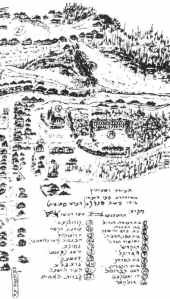
Map of My Grandparents’ little town

Vishnevets

It may be too small to see here, and the half image is oddly distorted and cropped (click on it to see entire map), but on the key provided with this hand-drawn map of Vishnevets you can see, along with the post office, synagogue, cemetery and hekdesh (poor house) a large blot on the northern end, top left center of map, marked in Hebrew “brothers’ graves”, where the victims of the most recent slaughter in that town were buried together in a pit. The English words printed on the map there, “mass graves”, need no translation.  The mass grave was necessitated by “Nazi brutality and cruelty”, (enthusiastically carried out by local Ukrainians), in (August) 1943, according to the monument at Mt. Hebron cemetery in Queens, NY, erected by the Wishnevitz Brothers Benevolent Society and the Wishnevitz Ladies Auxiliary. 

Other information about the unlucky town is summarized in this on-line excerpt from the book of memory:

In 1500 the town was destroyed by Ivan the Terrible. In 1653 the Jews were killed by the Tartars. By 1765 there were 475 Jews in the Old City and 163 in the suburbs. In 1847 there were 3,000 in Wishnowitz.

I could not stop myself from reading the gut-wrenching survivor accounts, determined to get a clear picture of exactly how my grandparents’ families were murdered.  It chilled me to read their names mentioned in one survivor account:

March 16, 1943

On that date, which was a Tuesday, the order was given to set up a ghetto. The buildings to be included in the ghetto were marked. According to the order, the ghetto had to be constructed in three days. The Jews were assigned to build the ghetto with their own hands and with materials they had to supply.

To make sure the order would be carried out in full, two hostages were taken: Yakov Markhbeyn and the writer of these lines. Any diversion from the details of the order would jeopardize their lives.

The ghetto encircled a narrow part of the town and the length of one long street. It extended from Alter Layter’s house to Beni Mazur’s house and from the road leading to Lanovits to the entrance to the Old City.

The gruesome details of the massacre, which I learned for the first time a moment ago here:

At night we could talk, and we asked the two young men from Vyshgorodok to tell us what had happened. And the two young men from Vyshgorodok told me what they had seen with their own eyes-how Vishnevets Jewry had been destroyed-and here is their story.

All the people were brought to a ravine behind the Old City on the road leading to Zbarazh. The ravine served as a readymade grave, with a capacity that met the Nazis’ needs. The ravine had been prepared by Ukrainian farmers. They stood with their tools, clearing the surface of the ravine. They leveled it, removed small mounds, scraped the stones from the sides, and dug the walls. They covered the bottom with the stones and soil they had removed from the walls in order to create a kind of crushed-soil foundation for the victims.

Once the foundation had been prepared, the first group of Jews was led to their burial place.

Two policemen ordered them to take their clothes off and remain in their underwear. They undressed, piled up their clothes on the side, and were then ordered to lie down in a row in the ravine, face down.

When they were all lying face down, the policemen ran over them with their submachine guns in their hands, shooting bullets into the heads of the people who were lying down.

Afterward, they inspected. They walked from person to person and with a handgun killed those who didn’t die immediately, using the gun butt or a bullet shot into the center of the skull.

When they were done with one group, they brought the second, and so on.

The Ukrainians walked over the bodies inside the ravine with horrifying skill. They lifted the bodies that were not level and laid them straight. The Germans sat on the walls of the ravine and supervised the work. They gave the orders, and the Ukrainians executed them.

The farmers took over after the Ukrainian policemen were done inspecting and leveling the layer after the last round of shooting. They covered the layer of bodies with soil in order to place another layer on top. They used shovels to do this. They covered it with a thin layer of soil, and the area was ready for another row of bodies. The clothes piled up on the side were given as a gift to the farmers in exchange for their work. Immediately, they collected the victims’ clothes and loaded them onto their carts, and while the others were busy with their work of killing and taking care of the bodies, they set off to sell their booty.

That was what the two young men from Vyshgorodok told me, and it is the utmost truth, because while they told us their story, they were very detailed and corrected each other so as not to distort what their eyes had seen.

========

It was with another shuddering thought of ruthless fate that I recalled that Beni Mazur’s house was likely the same place where my grandfather Sam grew up, and narrowly escaped death by typhus during the epidemic after World War One.  If my grandfather had not escaped death from typhus (which killed at least one other family member and caused the deafness of one of his parents, and which he referred to as a “very bad item”)… you know the rest.

From A Heck of A Book of Fate, Brownie

It’s a book about the invisible hand of fate, extending its fickle finger here, tickling a cooing baby there. 

In 1921, or possibly 1923, Yetta Marchbein, Yetta “Marrowbone” (her father was a butcher), about 20 years old and full of ambition and idealism (the Bolsheviks billeted in her home during the Revolution had been gentlemen and also inspired her), crossed the Atlantic Ocean from some European port, having made her way there, alone, far under the deck, terrified for life by the rats who walked the partitions there between the bunks.  She, alone, of her large family in a muddy little shtetl in the Ukraine called Vishnevitz, would be alive twenty years later.   The rest disappeared without a trace into the nightmare that was Hitler’s fondest dream. In the U.S. she’d take the Americanized name of her cousins, Miller, and two years later, long before the slaughter of her family and town, marry her strong, frightened fiance Sam Mazur, also from Vishnevitz, who followed her to the U.S. on a ship that embarked from Bremen during the presidency of Warren G. Harding.  The Mazur family, Sam’s six brothers and sisters, father, mother, extended family, was murdered along with the Marchbeins and the rest of the Jewish town of Vishnevitz.  There is a monument in the cemetery in Queens, behind the gates of the Vishnevitz Benevolent Society, where Sam and Yetta are buried, commemorating the slaughter there.

Sam and Yetta Mazur were my mother’s parents.  They had one child, a girl they named Helen, who, as soon as she was able, changed her name to Evelyn.  Evelyn grew up on Eastburn Avenue in the Bronx, a once thriving street with one end at the stylish Grand Concourse.  Eastburn Avenue, at some point in my mother’s childhood, was cut in half, literally, and its neighborhood destroyed by Robert Moses and his Cross Bronx Expressway.  In that apartment house, where the Mazurs lived on the first floor, a family named Stamper also lived.  Yetta and Dinch Stamper (who called each other “Mazur” and “Stamper”) became lifelong friends.  There is a great photo of the Mazurs and the Stampers, probably from before they had children, relaxing on the grass somewhere, in front of dense trees, dressed in the style for going out on Sunday in the early 1920s.

Dinch Stamper had been born Dinch (Diana) Gleiberman in a town in Belarus called Truvovich, a Jewish hamlet about 300 km. north of Vishnevets.  The Jews of Truvovich met the same terrible fate as their landsmen in Vishnevets, wiped away with barely a trace, Truvovich now erased from the map.  Dinch had come over by ship years earlier with a cousin named Chava Gleiberman, youngest sister of my father’s Uncle Aren.   Aren had arrived here a decade earlier from Canada after fleeing involuntary service in the Czar’s army and the Russo-Japanese War.  Chava, a good-looking, deeply religious red-headed Jewish girl, had her hopes for a happy marriage dashed when Aren’s wife broke up a romance with a Jewish postman in Peekskill who’d fallen for Chava.  When Chava’s indentured servitude to Aren and his wife ended a marriage was arranged hastily with a man named Harry Widem, a man my father described on his deathbed as “an illiterate country bumpkin completely overwhelmed by this world.”  What my father probably didn’t know about were the routine beatings, with club-like boards, that young Harry had received daily from his step-mother in the mud-floored farmhouse in Connecticut where he was raised.   What I didn’t learn until recently was that Harry spoke English with no accent, unlike Yetta and Sam whose Yiddish accents and inflections spiced my childhood.  I never met Harry and Chava, both died before I was born.  I am named after my father’s father Harry (Eliyahu in Hebrew) and my sister after Chava.  What is now well-known is how much Chava despised her husband, and that she whipped her oldest son, Israel, without mercy, from the time he could stand.

The hand of fate, gentle reader, spared these two couples, Sam and Yetta and Chava and Harry, my grandparents, while the rest of both of their large families (several of Harry’s siblings and half-siblings in the US survived to produce families, as did Chava’s brother Aren, who has dozens of descendants here and in Israel) disappeared into the night and fog the world remembers hazily as World War Two.  The good war America fought against unequivocal Evil.  

My parents met, of course, in that apartment building on Eastburn Avenue in the Bronx where my father, and his younger brother Paul, would visit their cousin Dinch and her family.   During these visits my future father spied my future mother, the beautiful, dark-haired, popular and completely haughty, Evelyn Mazur.   She had an active social life, many boyfriends, and considered the shy, skinny guy from Peekskill a laughable hayseed, and besides, he was clearly poor as a church mouse.  In time she would agree to go out with him (to get the insistent Yetta off her back) and would watch, amazed, as he transformed himself from hick to urbane, witty, increasingly sophisticated boyfriend, fiance and later husband.  They would build a middle class life together, she’d come to think of him as the most secure and brilliant man she’d ever known and he would (when not making her cry) give her all the credit for transforming his life into one worth living and striving to improve.

If Yetta, Chava and Sam had not left Europe before the slaughter of everyone they knew (Chava lost her brothers Yuddle and Volbear and her sister Chaski as well as the rest of her family in Truvovich), had not Harry (who came to the US as an infant) survived the passage and a childhood of blows to the head with whatever wooden truncheons came to hand, Evelyn and Israel would not have been born.  If they had not come to be, and meet, and procreate, neither would I have.   If the bleeding my mother endured one frightening day late in her time pregnant with me had been worse, if this, then that. 

The hand of fate, gentle reader, including its fickle, tickling finger.   More details to follow, perhaps, if fate and the spirits will it.


At the Picnic

“So what are you saying?” he asked me, understandably at a loss.

“When I say certain gears aren’t working in my head, I’m not trying to say I’m seriously impaired.  I mean, I can have a conversation, can take care of a lot of things, I have talents, feel responsible to people I love and even people I don’t know, I’m strong, I can be counted on in a pinch and all that, but I am impaired, clearly,”  I could see this was not making things clearer for him.   I felt bad, he is a likable man.

“I’m like 90%,” I said.  “I can do most everything I need to do, but I’m not 100% effective, if you know what I’m saying.”

“So, you’re like 10% off?” he said.

“Yeah, something like that.  I mean, not to say it’s not a problem for me, it’s clearly a problem.  But also, yeah, I’d say about 10%, maybe, things I can’t get myself to do.”

“Can’t get yourself to do or can’t do?” he asked, making a distinction that left it my turn to be confused.

“No, to be clear,” I said, “sometimes ten percent, which seems like a small percentage, takes on a disproportionate importance, like when the top 10% in a society own 90% of everything, things like that.”

“Oh, Jesus,” he said, looking around with a sudden determination to refill his waning red plastic cup of wine.

Clever Marketing is the Key to Success

Sekhnet came up to urge me to join every social media site linking businesses that I can find.  I am isolated and it is an increasing problem, especially for someone trying to run a shop and attract customers.   She showed me the social networking entry for an accomplished man we know, an angel investor on a site where these entrepreneurs mingle looking for opportunities.  She showed me how clearly he laid out his interests, qualifications and expertise.  She urged me to do the same, to advance my stalled not-for-profit business.   I agreed that she was right about the usefulness of joining more sites where I might meet like-minded people, then read her part of the email I’d spent the past hour writing.

I’d been led to pet one of my favorite peeves by my friend’s emailed, on target, comment:

(“You spend way too much time petting your peeves,” Sekhnet observed.)
 
I’ve grown more and more bitter over the fact that nothing succeeds on its own merits–that whatever makes it in our world, does so because someone has packaged and sold it cleverly.  Which helps to explain why we end up, in the culture, in our food, in our politics, with so much rancid shit.
 
Well said and I share the bitterness, though I try (mostly without success) not to let it stop me. A sociologist who wrote in the 1930s (Harold Lasswell, I think) whose work I read decades ago while researching Hitler’s rise to power and how ruthlessly Herr H. used the mass media to influence public opinion and promote his famously rancid ideas, concluded that “the religion of the United States is advertising”.  He proclaimed this self-evident truth before TV, in the infancy of radio, when the mass media was being cranked out and printed on pages that were disseminated by child hawkers on street corners.  He described how American industry sent Polish immigrants back to Poland to unfurl giant painted banners of American streets literally paved with gold and lie to the workers they fronted steerage tickets for to bring to work in factories.   Greek Americans went to Greece, Italians to Italy, wherever they were recruiting they sent native recruiters to lie in the mother tongue.   Woodrow Wilson’s Committee for Public Information was run by an ad man named George Creel who whipped up patriotic fervor for a war being fought by the rest of the world in muddy trenches along the lines of the worst of the Civil War, except made even more hellish by the addition of machine guns, poison gas and airplanes.   There were parades in the streets and long lines at the recruiters because of Creel’s genius in whipping up support for WIlson’s senseless (except to those who made a killing) War to End War, War to Make the World Safe for Democracy, War for Fuck You We’ll Kill You Under the Espionage Act For Trying to Use the First Amendment in Time of War to Aid Our Enemies, You Fucking Traitor!
 
The rulers of our society have always ruled by selling lies to people raised from infancy on advertising jingles and tag lines.  By the time kids are ten they’ve done their Gladwell’s 10,000 hours quota of commercials on TV, they are masters of being marketed to.  Presidential debates and elections?  Decided by image, body language, sound bites.  A few years ago promising presidential candidate Howard Dean lost his political future by cackling euphorically into a microphone at a rally.  Might have had good reason to be euphoric at that moment, he was leading in all the polls, but they played the 3 second clip of a cackling madman 24/7 until he was toast.  It’s despicable what greed and cynical marketing have done to the world and it explains much of the misery, disease and early death.   Capitalism is a cancer and the only cure, it would appear, is the total destruction of life on earth, which they are well on their way to accomplishing. God bless ’em.  But in this context, in our competitive free market society, there is only one way to successfully sell an idea– the old fascist way, the single-minded way Mr. Hitler had such brutal insight into, to put the most distasteful possible gloss on the gentle and perfectly neutral art of persuasion.  Trying to do it without retching, not always easy for the squeamish.
 
Sekhnet told me I should clean it up, lose the ending, and send it to the Nation as a letter or note, that people would be interested in the little history I’d presented, that I write these great things and never send them anywhere to find an audience for them.
 
“Did you ever read the Nation?” I asked her.  She hadn’t for a long time, but knew their politics and thought their readers would appreciate a letter to the editor containing this well presented information.

I appreciate her feelings, I really do, and her desire to help.  Motivated by love, and my best interests, and an understandable desire to see me step forward in the sticky muck.   She agreed that it wouldn’t do to send it in without cleverly packaging it, somehow, and relating it smartly to some current hot topic, the hook.   The irony was not lost on me, though I took the way of the world and said nothing about it.

Then her native optimism and desire to help rose up again– the stories of a Big Lie are so common that I won’t have long to wait until the next news cyclone generated by one, and I can send it in then!  

Meantime, I do the online equivalent of printing it out, rolling it up and sticking it where the sun don’t shine.

What We Should Say Instead

A book I read recently about making a good pitch, saying it right the first time, pointed out that the hardest question a person usually gets during an interview is the one inevitable open-ended question seemingly too simple to prepare for:  tell me about yourself.

The author suggests we prepare well for this question, practice a short, rich answer tailored to advancing the subject at hand.  If it’s a job interview the answer should convince the interviewer that everything in your life has led up to this perfect-for-me job.   If promoting a book, it is the short, crisp background story that will make the reader know why you wrote it and make them want to rush out and get the book.

Yesterday a woman at a nonprofit I hope to work with asked the famous, and obvious, open-ended question: how did you come to this?  Tell me about yourself.

What I said, without a script:

I’ve always drawn and I play music.  I was a teacher years ago.  I practiced law for a while, until, when my mother got gravely ill, I decided I should do something I really love, which is when I began developing this program.  It took me about a year to work out how to do animation in a way that kids could do everything, I invented the animation stand and perfected the program.   We’ve been working with public school kids for about a year and a half.

This answer led to the question of what kind of law I practiced, how contentious the NYC Housing Court is and the woman’s “at least you represented tenants.”  Followed by my self-deprecating remark that landlords’ lawyers wear better suits than tenants’ lawyers and some other off topic banter that advanced nothing, other than the idea that I may be a dilettante, and/or someone having a midlife crisis, and that, naturally, as a lawyer, I had incorporated as a nonprofit.

Clear lesson learned:  work on the short, punchy script for next time that advances why someone should care about what I so deeply care about.   It needs to include how much I enjoy creative play, visual, musical and otherwise; how long it’s bothered me that public school kids don’t get much chance to show their creativity and competence in this age of metrics and teaching to the test.  That creativity is not a luxury, it’s a huge part of learning and a vital part of life.  That being listened to is a rare gift easily given, and sorely needed by children in particular.  Work in how much I love to draw, and play guitar, and collaborate, and how every time I work with children in the animation workshop, the buzzing intersection of so many creative avenues, I feel energized and delighted by their creativity. 

And, note to myself, don’t ever again mention to strangers that instead of a smartphone with GPS I have my dead mother’s once state of the art Motorola Razr.  Why would anyone but a nattering madman mention such a detail?  Note how much better in every way this answer is:  “Do you have a smartphone?”  Answer: “No.”

Son of Duh!

On August 6th I discovered that one can upload a video into Google Drive and easily embed the link on a website, as I did here on August 6th.  This way it’s possible to show a video on your website without everybody instantly seeing on youTube that it has not begun to go viral.

It is a neat workaround, since on youTube disabling ‘make video statistics visible on the watch page’ does not seem to make video statistics invisible on the watch page.

I’ve spent several hours today, on four computers, on macs and my PC, trying to recreate the simple step of cutting out an embed code for a video uploaded to Google Drive.  If I hadn’t done it so easily here, on August 6th, I’d think I dreamed it.  You can click on the link to Animation by several creative adults to see what I’m talking about.

Google has a helpful link posted on the help subject of embedding a video from Google Drive.  It takes you to a forum, begun in 2012 and extending to the present, where frustrated users complain bitterly about the lack of functionality while others try to find semi-satisfying workarounds to this perplexing situation.

If it’s not the humans, forgetting to wash their asses for days on end, and insisting on dancing vigorously in the tiny, airless room, it’s the humans who program the computers, or the computers themselves, or the companies who hire the humans who do these things, or don’t.


Duh!

Here’s a big “DUH!” for you, not intuitive, maybe, but once you hear it you’ll make that exaggeratedly stupid face and say “duh!”, if you’re inclined to such things.

If you have a website to promote your business idea, and it contains links to the product you are selling, visitors must not be able to easily see that only a dozen, rather than many thousands, have visited the links.  YouTube, for example, with its counters, is good for promoting an idea if 75,000 people, or better still, 7,500,000 people, have viewed it.  It is the kiss of death if the counter reads 14, or 106.

“Loser…” the visitor can’t help but think, perhaps also “poor bastard.”

The internet is a popularity contest.  High school has nothing on the internet in that regard.  The numbers don’t lie.  If the thing is good but nobody cares, the number reads 6, maybe 28.  If the LOL cat is funny, or the baby animal irresistible, the number quickly reaches 99,000,000.

Like everything else– or like many things, anyway–  there is a way to fix it.  A workaround, like a dozen I’ve already employed in the creation of my gerry-rigged empire.  No need to show potential customers how few people actually watch the amazing and original animation small groups of strangers are creating.   I’ll get on it tomorrow, it should take no more than a few hours to fix.  Plain foolishness is the only reason to let a prospective customer see at a glance that your most popular, most amazing piece of work has been viewed less than 200 times.

Live and learn, baby.

“Duh!”


The Psychology of Self-Motivation

I watched this promisingly named TED talk with great appetite just now.  Finding the secret to self-motivation would do wonders for me as I try to stay focused on pushing this heavy, maddeningly successful but even more maddeningly unsold, program up the hill.   It will succeed or fail as a program and business based on my self-motivation, based on how well I learn to confidently and succinctly package and sell it.  It all depends, now, on my salesmanship.  Salesmanship which I must learn on my own, without dependable feedback, except for one or two people by email.

I watched the excellent presentation by an engaging psychology professor.  During the course of a snappy talk, illustrated by paradiddles, rim shots and other stages of his long ago progress on the snare drum, he reveals the secret: acquire competence by getting good feedback, be encouraged by encouragement, encourage others, avoid the fear of failure and replace it with the desire to succeed because you like what you’re doing, be part of a community of people who give good feedback and encouragement.

Fuck.  

Thanks, professor.  


The Error of My Ways

I’m going to try to reconstruct this post, wiped away as though it never existed when I decided to ponder and revisit it, thinking a draft was saved (he said, the passive voice used).   Only the title was saved, as if to mock me.   Another reminder, boys and girls:  when writing on a computer, save your work often!

I had three big ideas for books to write over the course of my life, all of them misguided.  I point out at the start that nobody ever needs to write a book, really, although many people often think:  somebody should write a book about this. Sometimes they do and the book moves, informs, enlightens or entertains readers.  Other times, eh.  Few books change lives, though many who write books probably start off believing their’s will.

The first book I attempted to write was called Me Ne Frego [1], the story of an idealistic narrator’s inevitably losing battle against a soul-crushing bureaucracy, embodied in the unreasonable person of Minnie Frego.  The reader knows how the story ends long before the naive, somewhat sympathetic narrator does.  It’s part of what makes the manuscript so hard for me to read now, more than twenty years after posing as the tough guy narrator.   The manuscript served as my thesis for an MA in Creative Writing, so there’s that.   The letter I got from the one publisher I sent a sample to informed me that, although nicely written, it was not suitable for their house because the main character had not undergone the kind of dramatic personal transformation that apparently drives every great tale.

About twenty years later I had another big idea:  Bird Wins [2].   The idea was given to me by a literary agent, actually, although the title and the subject matter were mine.   In Bird Wins the occasionally droll narrator observes countless one-sided battles between powerless people and a soul-crushing bureaucracy, embodied in the people for whom our hero carries a bucket into which, after  lifting their long robes, they relieve themselves.  These thousand mini-tragedies are set against the backdrop of the narrator’s mother’s slow death from cancer.  I was told by the literary agent I’d regaled with some of the interlocking stories that it was a natural.  “If you write the pitch just the way you told it to me now, I can sell it,” she said confidently, flashing a winning smile.   I believed her, though my attempt to recreate it was nowhere near as engaging as what I’d improvised for her and her son.  Nothing came of it in the end but a few disjointed chapters.

In the decades in between I periodically worked on a manuscript I unfortunately called Get Outta Here, Melz, taking the surname of my fictional alter-ego from an old friend who not long ago died of a rare and vicious disease.   At that time he was alive and well, as far as I knew.  In that story there is no relentless, soul-crushing bureaucracy for the narrator to fight a losing battle against, but, in a refreshing change of pace, Benedict Melzer is eventually chased by a torch-wielding mob of his former closest friends who form a posse in the mistaken belief that he has seduced and run off with one of their teenaged daughters.  They find a seemingly incriminating correspondence between the self-righteously noble Benedict and the, at one time, slightly infatuated girl, but their suspicions could not have been further from the truth.  The last letter the girl writes to BM, coldly denouncing him as a hopeless, pathetic, self-important idiot, which the readers see, is not found by his former friends among the papers.  At the time they take off after him, the girl is in another state with a young man and Melz is far away, alone, on the run from himself and his life.  It was intended as a comedy of errors, although, ideally, a comedy is funny.  I never made much progress with the book, though thinking about it now, and the unfortunately named BM’s all-consuming, impractical, slightly mad belief in the supreme importance of spontaneity and creativity, I find it tricky to escape the psychic ripples of it as a certain alienated desperation dogs me like a hellhound in the uncomfortable silence of just about everybody I know.

As I jotted uncharitably in my former gratefulness journal the other day:

My first two attempts to write a book, Me Ne Frego and Bird Wins, were ass-backwards, spectacularly unmarketable efforts.  Each featured a brave, unquestionably earnest narrator describing a detailed crucifixion, gesticulating stoically from his crude cross as the life dripped from his body.

Another equally compelling book could be written from the POV of a precocious child dying of dysentery in a toxic slum in Lahore.  The world has billions of such books, unwritten by the losers of a billion small, infinitely brutal, rigged games.

The books the world wants, and it’s hard to blame them, are stories of a remarkable individual’s miraculous triumph over the relentless machine that grinds us all down at varying speeds.  The paying world goes, by and large, for moving triumphs or dramatic, fully justifiable revenge stories, a Hollywood ending.  The world, where the scales are so often false and weighted, loves the rousing story of an honest count, against all the odds, or failing that, a good ass-whupping.  Stories by those on the wrong end of the ass-whupping do not sell as well as the other kind, as any marketing expert will tell you.


NOTES:

[1] “I don’t give a rat’s ass!” an Italian expression of contempt and bravado famously used by Benito Mussolini.

[2] named for the unbeatable tic-tac-toe playing chicken in the Chinatown Arcade on Mott Street, (the bird always went first, so you figure it out…) may she rest in peace.