Addiction to Social Media

It’s understandable, friends.  There is a human longing to be connected to…. hang on a second,  I’ve got to send a quick email, excuse me.

What’s the deal with looking at the smart phone every couple of minutes, every few seconds, what’s the …

It is addictive, this feeling of being connected, of having the world at your fingertips. A moment of total control in an out of control world when you stop to make your phone do something cool, smart, informative, interactive.

In elementary school, for me decades ago, when any of this was the domain of the smartest science fiction writers, a teacher described a psychological experiment that has a lesson in it for all of us today…. wait, got a message coming in, hang on.

They hooked an electrode up to the pleasure center of a rat’s brain.  Many rats were hooked up this way.  They had a button to push to give them a jolt of pleasure, the equivalent of an orgasm.   It took the rats a very short time to make the connection between pressing this button and the immediate jolt of pleasure.  

The scientists were not all that shocked to find that every rat died with his or her paw on this button.   There was no reason for them not to keep pressing it and it was irresistible, after all.

I had something more to say, but my phone is now fully charged and I’m thinking of downloading the electrode to the pleasure center app.  I’m sure someone is developing it… hold on, there’s a notification.  

Shoot, just an email, I’d better answer that.

Consolation?

It may be worth keeping in mind: the crazy person is generally the last to see that he is crazy.  This is consolation and worry both and reminds one of the opening assurances of the insane narrator of The Tell-Tale Heart (1843) by Edgar Allan Poe:

 TRUE! — nervous — very, very dreadfully nervous I had been and am; but why will you say that I am mad? The disease had sharpened my senses — not destroyed — not dulled them. Above all was the sense of hearing acute. I heard all things in the heaven and in the earth. I heard many things in hell. How, then, am I mad? Hearken! and observe how healthily — how calmly I can tell you the whole story.

It is impossible to say how first the idea entered my brain; but once conceived, it haunted me day and night. Object there was none. Passion there was none. I loved the old man. He had never wronged me. He had never given me insult. For his gold I had no desire. I think it was his eye! yes, it was this! He had the eye of a vulture –a pale blue eye, with a film over it. Whenever it fell upon me, my blood ran cold; and so by degrees — very gradually –I made up my mind to take the life of the old man, and thus rid myself of the eye forever.

Now this is the point. You fancy me mad. Madmen know nothing. But you should have seen me. You should have seen how wisely I proceeded –with what caution –with what foresight –with what dissimulation I went to work! I was never kinder to the old man than during the whole week before I killed him. And every night, about midnight, I turned the latch of his door and opened it –oh so gently! And then, when I had made an opening sufficient for my head, I put in a dark lantern, all closed, closed, so that no light shone out, and then I thrust in my head. Oh, you would have laughed to see how cunningly I thrust it in! I moved it slowly –very, very slowly, so that I might not disturb the old man’s sleep. It took me an hour to place my whole head within the opening so far that I could see him as he lay upon his bed. Ha! –would a madman have been so wise as this?

Listening and the Woman on the Train

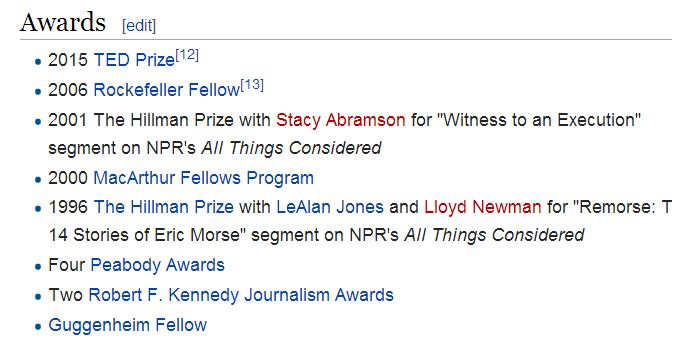
Dave Isay, creator of StoryCorps, a hugely successful oral history project that lets people interview each other about things that are important in their lives, received a million dollar TED prize in 2015 to expand this work.   His 2007 book of transcriptions from StoryCorps interviews, Listening is An Act of Love, was a New York Times bestseller, as were his other books on the subject.   Listen to Isay speak– though he has always been deliberate in keeping his voice out of the recordings of people he gives the mic to– and you will be convinced: really listening to someone is an act of respect, and hearing what they have to say gives them a rare gift.   Isay reports that has seen powerless, invisible people literally straighten their spines, infused with confidence in the face of the rare gift of finally being really listened to.  They shine as they are given the chance to speak, be recorded, and then edit what they have to say into a form that can be heard by anyone in the world.  Their interviews, mundane and extraordinary, full of candor and flashes of off the cuff poetry, all worth hearing, are cataloged in the American Folk Life Center of the Library of Congress.

A preacher in a violent neighborhood in Boston, trying to bring street kids into church, has a revelation one night after a boy who was shot ran to the church. He died 150 yards from the church, struggling to reach it.  Even though the lights were out, said the preacher, and nobody was home.  The preacher realized that if a dying kid runs to the church, the church needed to come at least half way to meet them.  The preacher began to walk the dangerous streets with a group every Friday night from 10 pm until 2 a.m.   Eventually the kids on the corners began talking to him and he discovered what he had suspected from the start, these were not violent monsters, just kids trying to survive.  He said he spoke to some of the brightest, wisest, most creative people he’d ever met, these kids trying to make it on the streets.   His initiative of listening to kids has spread to many cities, changes lives and won him awards.

We do not listen.   We have many good reasons: we are very busy, life is very stressful, we pretty much know what people are going to say, we can’t pay attention to everything, we have to tune out a lot of complete bullshit vying loudly for our attention in a nonstop attempt to sell us things we don’t need, the world is brutal and unfair, nobody fucking listens to us.  Fair enough.

Riding on the A train last night a very thin, artistic looking, slightly grimy young woman let an equally attenuated and dirty looking young man sit in the one seat that was left.  He sat gratefully and she stood over him talking almost without cease.  When the two seats next to me became available the woman moved with alarming quickness to claim them and the man slid in next to her.  The young man was next to me, clutching a nylon bag in his lap, the sharp corner of which protruded dangerously.  “I’m sorry,” he said, when I was first poked by it, but he seemed unable to make the slight adjustment that would have prevented it happening again.  I quickly learned to avoid it.

“I don’t like everybody constantly judging me,” said the haggard looking woman with a good deal of feeling, “I’m so sick of people telling me what they think I should do, people who don’t know anything about me or my life.  I purposely don’t confide in people, and I haven’t told you half of what I am thinking, even though we are very close.  You are about the closest person to me, I would say, but I will never tell you certain things.  I just can’t stand the way people look at me,” she added crossly.   I didn’t look at her, but not because I cared if she could stand it or not.  

The man, speaking with a heavy French or Italian accent, did his best to find out what was bothering the woman, but she was not having it.  “You know, if you don’t tell people what is wrong, what can they do to try to make it better?” he asked.  She had a quick, angry answer to this useless question.

Listening to their conversation,  I was slightly annoyed to be hearing it but also slightly fascinated.  It was like reading a grim but engaging short story about two desperate characters, trying hopelessly to connect but clearly being sucked down a tragic alley ending in rat poison and a decomposing body that would not be found for days. 

Listening carefully is not always the answer to the world’s lack of respect, but it can be.

Ombudsperson

I know it’s a childish thing to expect, particularly after practicing law for ten years, that there would be a fair arbiter you could appeal to to uphold basic fairness.   It’s like expecting there to be a record, and making statements for the record.  You know, when the appeals court looks over the record, you dig, they’ll see I’m right and the judge was wrong.  You think there’s really a record?   Heh.

“Watch out for that weasel,” a colleague once warned me about a certain judge.  “They have a foot switch that turns the recorder on and off so he can edit what goes into the record on the fly.  If the tiny red light on the side of his name plate goes out, you are not being recorded.   So when he takes a long pause and says ‘so, you refuse to answer the question, counselor’, right after you’ve answered the question, he already has his proof of your refusal to answer because what you just said was not recorded for the record.  You have, in fact, already refused to answer, on the record.  So don’t speak unless that red light is on, and ask him why you are off the record if the red light is off.”

“Damn,” I remember thinking, though, on reflection… duh! 

While I was dismayed, and a little angry, to finally learn that there is no corporate Ombudsperson at the Allen Pavilion to visit with a stack of Obamacare bills, some of which I owe, some of which I don’t, some of which have the wrong payment amount demanded in them, one of which is currently in collection, I am not really surprised.   That Ombudsperson would be overwhelmed, her job impossible to keep up with, the billing irregularities under the complex new law are as numerous as the stars in all the galaxies.   The guy at the billing window at the Pavilion tells me I have no idea how many problems patients have been having with multiple erroneous and ridiculously high bills.  

Want to make a record?  A better idea than worrying about that is to simply go fight City Hall.  Or practice until you find your way to Carnegie Hall.  Or go back in a time machine and buy a cheap suit from Robert Hall.   Next guest!

Don’t Take It Personally, Man

You may be correct to feel that not being told the price of a medical service until after you’ve bought it is like going into a store and not being told, until after you make the purchase, the nonrefundable price, which you are 100% responsible to pay.   Or, like a restaurant where the bill is secret until after you’ve eaten, a policemen waiting to take you in if you refuse to pay whatever the restaurant demands.  Seems unreasonable, un-American, but according to the Patient Protection and Affordable Care Act, the practice is neither of these when it comes to medical services. 

Critics will be critics, and some critics ignore the facts in their zeal to score points, but a few things about the flawed step forward that is Obamacare (The Patient Protection and Affordable Care Act– PPACA) are beyond dispute. Systemically, it is an improvement over what existed before.   The elimination of the grotesque loophole of “pre-existing condition” exclusion from coverage alone was worth the fight.  Giving the medical industry financial incentives to prevent disease rather than continuing to profit off billions in late in the game testing and end of life treatment is another long overdue step in the right direction.  It can’t be denied that millions more Americans have health insurance under the PPACA and access to preventive care, many for free.

 Those things said, huge problems remain with this compromise, authored by a health insurance industry insider,  that keeps the private health insurance and pharmaceutical industries firmly in charge of seeing their profits undisturbed.    Millions are still uninsured under the PPACA and tens of thousands of Americans will continue to die preventable deaths every year from treatable diseases discovered only in their fatal stages at ERs across the country.  

 Individuals may find also find themselves among a few million in an income category a little too high for free service, and too low to qualify for and afford the premium service members of Congress receive.  Such persons will, unfortunately, be a bit screwed by the details of the PPACA.  

The high deductibles, outsize charges for routine services, billing irregularities and other unappealable indignities may cause these patients to feel unprotected and that the mandated health care they pay for each month is sometimes obscenely unaffordable.   These Americans must take solace from the fact that it is truly nothing personal.

 Yes, it’s your individual problem, true, since the bills will be enforced by lawyers sent to collect all charges, but take courage in knowing that you are not alone in being partially unprotected by the Patient Protection and Affordable Care Act, an otherwise wonderful program.  It’s nothing truly personal, surely you can see this.  It affects millions, so stop your belly-aching!

 If you consult for twenty minutes with a physician’s assistant, for example, who has never heard of the symptom you report, repeats your google research while you sit there, and who orders a blood test to rule out certain things, you may have a little sticker shock when you get the bill for $507.   This sticker shock comes about because there is apparently no provision in the law that the patient be informed of cost prior to receiving a service.  Call your insurance company and they will tell you the doctor must first bill them for the service and then the price is determined, according to negotiated rates, and sent back to the doctor, who will in turn bill the patient the deductible amount.  

It’s all right there on the bill:  consult with physician’s assistant:  patient’s responsibility– $180.   Subsequently reduced, without explanation, on a follow-up bill thirty days later, to $110.   Blood test:  $641.  Patient’s responsibility:  $327.   Insurance, oddly, paid the corporation representing the doctor $314 for the blood test.   $437 for a visit to a physician’s assistant?   Call to ask about these charges and you will be told the charges are all correct, sir, all the proper codes were entered, these are the legal rates your insurance company agreed you would pay.   You can take it up with the attorneys who are handling the collection matter for the doctor’s office.  

 Have a nice day and, please, keep in mind that this is strictly legal, enforceable and absolutely NOTHING PERSONAL!   Only a baby would take it personally, though plenty of folks, apparently, are squawking like babies about their treatment under this inarguably great step forward. 

 To be fair, though, would you rather be treated unfairly with the right to be hospitalized (at no expense beyond your premiums and deductibles) when you finally have a stroke or without that right?  You’d have to be a fool not to see that this is a no brainer.   


Email to my sister

In the score one for madness column, this email to my sister:

I know the “review” of Tekserve is too long.  Brings to mind the famous Mark Twain apology for the long letter (sorry, I didn’t have time to make it shorter)… I have to just be done with it and get to the next task.   Each of these tasks contains some measure of frustration— which makes the entire menu a bit unappetizing.  
 
I figure if someone goes on Yelp to check reviews of Tekserve, sees zero stars and the first paragraph, fine, my job is done.   If you want more details, click “read more” and get the whole ugly story, see if I’m just being a pissy crybaby or not.   The guy who owns the company will get the whole thing emailed to him, the long, detailed YELP.  Done.  I don’t expect the prick to do anything to change anything anyway.  
What could he do at this point to make it right that his store dicked me around for a total of over 9 hours of wasted time for me (days after I dropped $2,500 there)?  And glared at me and told me silently to go fuck myself at the end?  A guy who runs a store with a culture like that is unlikely to do anything in any case, and fuck him anyway.  You know what I’m sayin’?
 
Spent 28 minutes on the phone with Columbia Doctors this afternoon, two different Patient Services numbers, both insist the $507 for the 20 minute meeting with the useless PA is what MY insurance company agreed I have to pay.  Take it up with insurance, with my senator, with The United Nations.
 
Fit to be tied, then, work keeps getting complicated with new learning curves on the new macBook, plenty of frustrations with the enormous changes they’ve made in the new operating system to all the programs the kids use.  If I brought this new macBook into a classroom, though its 4 times more powerful than the one we use now,  I couldn’t run the workshop with it.  The geniuses at Apple have finally defeated my child-friendly design for a student-run production studio with radical “improvements” to make the macBook more closely resemble an iPhone or other IOS device.  
 
Being right, having an innovative program that could help many kids, being subjected to unfairness nobody should have to put up with, none of it means anything in our corporations-are-people-too society.  Listen to Obama talk to Marc Maron on WTF– the coolest, most relaxed, reasonable guy in the world, certainly the coolest president.   Look at the details of many of the things Oybama’s doing — hoy boy, Cheney would be smiling– if only Obama wasn’t a… you know.  
 
Obamacare, his signature achievement:  Is it better that pre-existing conditions are gone, that millions more are insured, that fewer Americans will die unnecessarily every year to preserve the obscene profits of the American health care industry?   Absolutely.  Isn’t it progress?  OK, it’s a step in the right direction.  Is it perfect?  He readily admits it’s not– now we have to fix it– without unfairly upsetting the profit expectations of those private corporations who expect to keep making billions.  That this corporate calculus, admittedly (though you’ll never hear him say it) necessitates fucking a certain number of Americans, hopefully only a few million… well, that’s unfortunate for the people affected, although millions of others are still far better off than before.  Let’s not talk about the millions of Americans still not covered, OK?  Don’t let the perfect be the enemy of the good.
 
As he talks about all the progress we’ve made, his administration has made, I kept thinking of the children of recently freed slaves, born in 1868, free blacks under the amended US Constitution.   Was it better to be born free than a slave?  Absolutely.  Was Jim Crow and lynching and Black Codes for 100 years bad?  And the Supreme Court continuing to rule, until 1954, that all this was perfectly legal under the Constitution?   Yes, it was very bad.   But, on the other hand, if that baby born in 1868 lived to be 147 years old he’d get to see a day when people started realizing that flying a Confederate battle flag over a U.S. government building is the same as flying a swastika flag over a German government building.   And we don’t publicly use that terrible word anymore, we say “the n-word”, right?  And the son of an African man and a white woman as president?  See, that’s progress?  No?   You can’t say it’s not, can you?
 
After today’s rant about Obamacare Sekhnet told me, once more, to write an editorial for the NY Times on the theme of  “Don’t take it personally”.   Systemically Obamacare is an improvement over what existed before, the elimination of the grotesque loophole of “pre-existing condition” alone was worth the fight, giving the medical industry financial incentives to prevent disease rather than profiting off billions in late in the game testing and treatment, also, good idea.  Millions more Americans have health care, many for free, and if you find yourself among a few million who are fucked by the details of the Patient Protection and Affordable Care Act, feel unprotected and that the care you are mandated to buy is not affordable, you must realize that it’s nothing personal.  Yes, it’s your problem, true, but take courage in knowing that you are not alone in being fucked by this wonderful program.  It’s nothing personal.
Look at it this way: would you rather be fucked with the right to be hospitalized (at no expense beyond your premiums and deductibles) when you finally have a stroke or without that right?  Hmmmm?   Think about it.
 
Got to somehow finish the 90% done marketing stuff relating to my program, though it feels impossible to gracefully dance off that last 10% in the current mood I’m in.  
“Success is the ability to go from failure to failure with no loss of enthusiasm,” said Winston Churchill, getting drunk as a skunk and sleeping til noon.  “But the question is– what does it take to remain encouraged?”
I’d go out and walk a couple of miles, keep my streak going, but there’s a thunderstorm pissing down at the moment.
 
Wee wee wee!
Biting my own foot off,
Nnnnnngggggg