Life Lesson from Eli

Eli had a house near White Plains, where his Boxer, Taffy, once took our spaniel mutt Patches’ head in his mouth before Eli pulled Taffy away.  I was maybe seven or eight, walking with Eli in the small orchard he had there when he reached up and pulled down a ripe apple or pear.

 “Here,” he said in his sandpaper voice, “try this, these are delicious.  I grew them myself.”  

I pointed to a bruise on the side of the fruit and he took it back, drew a pocketknife and made a small, quick circle that removed the blemish.  

“Here you go,” he said, and I ate the fruit, amazed at how simply the problem had been solved.  It was pretty good, even though I can’t remember fifty years later if it was a pear or an apple.  It might even have been a peach.

What I do remember is the lesson, something I never observed in my own home.   Eli, a man with a famously brutal temper, was perfectly capable, if in the mood, of acting exactly as my father would have.   “Jesus fucking Christ!” he could have fumed, “I offer you a fruit from my own tree and all you can see is the goddamned bruise.  You are some fucking piece of work!” and he would have punctuated the denunciation by heaving the apple against a tree trunk.  It would have splattered and he would have stormed off.

Instead, without a word and in the most economical and practical possible way, he fixed the problem.  Pocket knife, open, quick circular motion, hand it back to the boy with a little smile — problem solved.  The very opposite of the frustrated helplessness that was taught where I grew up.

One reason, I suppose, that I have always carried some kind of knife with me, even if nowadays it is the smallest keychain Swiss Army knife they make.  You never know when an otherwise unsolvable problem calls for a quick cut with a sharp blade.  It happens more often than you would think.

“Maybe you never changed either, Elie”

“Maybe you never changed either, Elie,” said the skeleton.  “Did you ever stop to consider that possibility?”

I wonder if he and I will ever come to the end of this chicken and egg debate.  The man, if he were alive, would be 92 now, and still holding fast to his black and white still photo of an idea.

“Look, superficially you did change some things about yourself.  Let’s stipulate to that.  You express anger much less frequently, for example.  On the surface, that’s a huge change, though, if you’re honest about it, your rage is just as quick to boil, you’ve just learned better ways not to express it every time.   You can argue that you’ve changed yourself, and maybe your life is a bit better because you don’t explode as often, but on the inside, when you’re being fucked, in no matter how small a way, you’re instantly ready to lash out.”  

That readiness to lash out is an inevitable part of being homo sapiens.  We are frightened, threatened, fight-or-flight prey animals who have banded together in murderous, raping configurations to scramble, collectively, to the top of the food chain.  Our viciousness as a species makes rats cringe.   Learning to be outwardly mild, after decades of brutality, is no small feat for a human.  

“OK, fine, if it makes you feel better to think that you’ve had this important self-change, I don’t see the harm.  In a sense, you’re right.  But that’s not the point I want to make today.  You know, when you walked into that hospital room on State Road Seven where I was not long for this world, you seemed to be the only one who was ready for my death.  I don’t mean that the way it might sound, not like you were happy about it, but you seemed psychically prepared somehow.  

“I wasn’t able to really say much to mom, or your sister, or even my brother, who was button-holing doctors in the hall and asking if it was possible to get me a liver transplant even though the cancer was in its final stages and I was a day from death.  It was like none of them were ready to get down to the serious talk we needed to have before I was gone, it was too painful for them.  My brother was making feeble jokes, your sister had a hard time looking at me, mom was using all her strength not to cry.

“You were, I don’t know, present, looking at the situation squarely.   It didn’t surprise me, really, but I noticed it.  That’s why I told you you were the only one who knew what was going on.   Go to the transcript and get that line you quote so often.  Go ahead.

Here you go, from the transcript of that digital recording the last night of your life:

…So, it’s kind of a lifetime battle, I don’t know, I think now how much richer my life would have been if I hadn’t seen it as a battle—good versus evil.

I know we should have had this talk ten, fifteen years ago.  I couldn’t reach that level because I was really thinking that it was going to be a battle and that there wasn’t any way I could make it into a dialogue, and that’s my fault.  You’re supposed to have some fucking insight.

E:  Well, I just wish we had a recording of that last dialogue, because it was a classic duel.  I tried every way I knew to try to…

I understand that, look, I felt you reaching out but I couldn’t free up enough, you know, to tell you how much I love you.  It’s not my style.

E:  I know.

Elie, I need a little drink.

“When you put it like that, it’s very poignant shit.  And when I was drinking that little sippy cup of water, you made the mistake of  shutting off the digital recorder, which you told me could record more than 24 hours.  I think of it now, the recording time of that little thing was more than the time that was left in my life.  You didn’t flip it back on right away each time, so much of our talk is gone, the transcript is quite truncated.  You caught maybe a third of it.  Rookie mistake, not that anyone could blame you, coming from the analogue age where the instinct is to preserve tape.  But that’s not the point.  

“Maybe you didn’t really change that much, Elie.  I mean, as a child you were always very sensitive.  You were a generous kid with a basically decent character.   I can’t blame you because you grew up in a war zone.  You can’t blame yourself because your father was hunkered down across the table, in a trench, cluelessly lobbing grenades, snarling.

“My point is: maybe that nonjudgmental, thoughtful person at my deathbed was your original self.  You hadn’t changed at all, just the sudden, dramatic circumstance of my rapidly approaching death brought that original nature back to the fore.”

Jesus, man, even when you wrap it in a compliment like that, I have to admire your relentlessness in hammering your point home.

 “Look, my point is that maybe one’s original nature sometimes gets bent beyond recognition by the infernal banging of the world.  So what you talk about as change is really just a reclaiming of what you were before your nature was distorted.”

I reflected the skeleton’s eyeless stare back at him.  

“OK, look, I realize this sounds a little insane, ‘a distinction without a difference’, as your law profs used to say.  In either case, change or reclaiming what is lost, there’s a lot of conscious work involved.  I guess what I’m saying is that we were both lucky you came to the point in your life that you did when you got that call that I was close to death.   I didn’t think there was a chance we’d be able to have a conversation, even at that point.”

Well, like you said, you felt me reaching out many times over the years.  And, not to sound judgmental, God forbid, but in true sick bastard fashion you remained hard and rigid, implacable in your anger, until you had hours left to live.  Funny how that was always phrased as my problem: being so fucking irrationally angry.   Why would a pit bull puppy be angry about being whipped in the face or electrocuted every time Michael Vick bribed him with a treat?

“I feel your pain.  Look, the same thing happened to me, obviously, not to make an excuse for the way I was.  You are engaged in a probably futile effort to make sense of my life.  As I was dying the only sense I could make of my own life is how fucked up I’d been, how badly misplaced my priorities were, how frankly stupid most of my high-minded methods were.

“I get that it’s your nature, Elie, and it’s one of those mysteries of life nobody can explain, you’re always seeking something beyond your grasp, beyond anyone’s.  You no doubt style it as a struggle toward insight, but really?  Those doomed eight year olds in Harlem got under your skin and you can’t separate their lives from America’s original unaddressed atrocity of slavery.  That’s something too big for anyone to grapple with, but it doesn’t stop you from brooding over it, working for years to create an unfunded program for them that you had no prayer of really putting into action.  

“Making sense of my life?  What kind of project is that for a grown man?  Making it your life’s work for what, eight months now?  I mean, not to offend you, but: what the fuck?

“Who does this, Elie?  I mean, a successful author sometimes writes a memoir of their father.  Their agent can sell it because people are curious about how the personality of the father of so and so influenced the writer who came to write this or that beloved or troubling work.  You, typically — and endearingly, I have to say– just skip over the successful writer step.  It’s wonderful the way you just cut out the practical middle man.  I mean, why let the impracticality or utter unlikeliness of the endeavor get in the way?  You take that George Bernard Shaw quote literally, when it can really only be uttered meaningfully by people with a ton of money:  “you see things; and you say ‘Why?’ But I dream things that never were; and I say ‘Why not?'”  You don’t realize Shaw put this line into the mouth of the Serpent in the Garden of Eden, not that it makes any difference one way or the other.

“Seriously, it’s gratifying that you are trying to do this, Elie, it really is, and, at the same time, it’s terrible.  You need to get yourself a job, and go do it every day.   This quest for– I don’t know what– will only lead you to more sorrow.”
“Play is the mammalian way of learning social behavior”

Not to mention an important source of bonding between mother and offspring.  Not to mention fun.  Play is a more and more neglected art, sad to say, in a world grown more and more serious, pressurized, intent on the “bottom line”.  The feral kittens in the backyard play, and it’s cool to watch, even as we know how short their lives are.

Humans, always striving, have created a culture of excess, which makes our lives much easier in some ways than our ancestors’ lives were.  This convenience comes at a price, though.  A price we pay because– well, there is only one market in town.  That very expensive one we call The Free Market.

Here is a great section from the audiobook of Yuval Noah Harari’s brilliant Sapiens: A Short History of Humankind.  He writes here about the transition in human consciousness, and our relation to animals, when we moved into the Age of Industrialized Agriculture to feed growing cities during the Industrial Revolution, which morphed quickly, thanks to mass production, into our current Consumer Age where thrift is no longer regarded as a virtue.  

I don’t own the copyright to this audiobook selection, clearly, but I heartily recommend Harari’s wonderful book.  Check out this seven minute fifty-eight second clip, it’s a good example of this fascinating work.  

Maybe He Did Win the War

Could be the weakness brought on by this cold, or flu, or whatever has me sneezing in flurries yesterday and today, but I have to entertain the idea, mad as it also is, that my father actually did win the war.  A capable double threat prosecutor-defense attorney, he blustered his way past reason and decency to sway many juries, and, in the end, by quickly dying with his children’s apparent forgiveness, may have snuck away the winner of the war.

“The cost was terrible, I’ll grant you, but that’s war for you,” said the skeleton with a macabre smile.  “You know, you grouse about it, refuse to accept it, but there actually are winners and losers in the world.  You can do either one with any degree of grace, but that doesn’t change the reality on the ground.  Some people win, most people lose.  Most people lose big time.  It’s simply the homo sapiens way, Elie.”  

That’s the kind of gross oversimplification behind which great national and religious slaughters are unleashed, on which, in turn, great fortunes are made.   You died lamenting that you had seen the world in black and white, wistfully thinking of how much richer your life would have been if you’d seen all the nuance, the beautiful gradients.

 “Well, you put it that way, I was always a plain spoken man.  It’s essentially right though, I did regret that black and white worldview I always rigidly maintained.   You can go back to the transcript and get the exact quote.  I notice you haven’t been to the transcript of our last talk, except fleetingly, during this entire process the last eight months.   Aren’t you going to thoroughly mine the scant primary sources you have?  

“It’s not like you, you’ve always been pretty scrupulous about accuracy and verisimilitude.  The one part of law school you actually liked was finding and citing great sources while constructing an argument– finding the authoritative bits and meticulously nailing them into the construction of your story.”  

Yeah, yeah, don’t remind me of law school.  That was one battle you won as you were cunningly winning the war, eye for an eye, a world of blind men looking for vengeance.   I seem to feel myself slipping away, even as I type I’m getting weaker and weaker.  It stands in for the ultimate slipping away, I suppose.  Hopefully it’s just this summer cold, an ugly animal.  

“Or maybe it’s finally dawned on you, we cannot change our essential natures.  Sixty years is a pretty good sample size for a human life, wouldn’t you say?  Do you still think a leopard can change its spots?  Can you suddenly become an energetic and skillful salesman, a closer, after a life of leisurely contemplation and avoidance of the hard-headed competition the workaday world is made of?   You understand this is a bare knuckles brawl you’re in, don’t you?  

“Your friends, and all of their adult children, for that matter, have all figured out the most basic parts of life: working, bringing in a decent income, having a nice home, raising a family, having a social life, enjoying the fruits of their labors.  You, on the other hand, having figured out none of these things, are sitting in a room having an extended chat with a dead man who beat you to a bloody pulp, in  a manner of speaking.”

No argument, at the moment, but I’m very, very tired.  It might be time for a nap before I whip you into shape in the rewrite.  

“I remind you, in fairness to you, that you often get this way around Labor Day,” said the skeleton.

Wrestling with Demons

Demons are slippery, no question about it.  Masters of ambush, they will come sprinting out of nowhere to put the sudden hurt on you.

“Well, look, everybody has their demons.  Everybody I ever met, anyway,” said the skeleton, thoughtfully chewing on a long piece of grass.

“Which, of course, is no comfort whatsoever.  It’s like the thought of your own death, especially when Death is getting close enough for you to smell his fetid breath, it’s no consolation to think: ‘well, everybody else is going to die too.’   That’s the nature of a demon– it’s perfectly calibrated to your personalized fear demographic,” the skeleton smiled.  

“As Alice Walker observed about your buddy Zora Neale Hurston ‘you’re up against a hard game if you have to die to win it.’  That’s the game I was up against, Elie, and dying didn’t feel like much of a victory, I can tell you from experience.”

Well, that’s kind of the bonus question here, isn’t it?  What is the most essential component of a good life?  

“It may sound funny, coming from me, but love is the most essential component of a good life.  That’s the only thing a human truly can’t live without.  A deep connection to at least one other person, an open-hearted attitude to those who come toward you.  Take that away, Elie, and the world is a meaningless and hostile place– and hopeless.  Think of people you have known who are incapable of intimacy– take me for example.  I never trusted anyone, really trusted them.  

“I always told you and your sister that the only person you can depend on is yourself, then I softened that by adding ‘and your family, of course.’  You can always depend on your family, I tried to impress on you, even as I knew that a family can destroy you more cruelly and completely than anything.  I knew that because my family had already completely destroyed me.  

“You know, when I congratulated you on the absence of self-pity in your thesis Me Ne Frego, about how you fucked up your chosen career and were blacklisted for life, I was giving you the biggest compliment I knew how to give.  I don’t know how you’re going to figure out how to succeed at this late stage in your life, how you hope to get this Book of Irv into print with no connections to anybody who knows how to open any of the doors you need to get through, but I also applaud the work itself.   You are lining the demons up, describing them clearly, making them familiar as any other character in the story.  You are giving these demons their merciless humanity, which is no small undertaking.”  

It remains to be seen, how large or small an undertaking it will be.  And you’re right that noting an absence of self-pity is a huge compliment.   The pity of it all is that there is more than enough pity to go around.  The pity of it all could go around the world many times over.  

“You’re singing to the choir director, Elie,” said the skeleton, watching the sky for signs.

MAD Magazine

One day when I was about eight my father handed me a black, white and grey tube, printed on cheap paper one small step up from the crudest newsprint.  This was at the dinner table, and he handed it across to me with a little smile.  “I thought you might like this,” he said.  

I unfurled the pages that had been curled into a tube, which turned out to be a decidedly non-glossy magazine, opened to a random page and began inspecting it.  I was intrigued.   “What is this?” I asked him, and he explained.

“I had to take it from a moron in one of my classes,” he said, “I told him to put it away, and, of course, being a moron, he wouldn’t, or couldn’t, and so, here you go.”  He imitated the moron, who apparently could only communicate in a series of grunts and frowns.   “It’s called MAD Magazine.”  

Being at a still literal age I remember that I imagined the moron as an actual moron.  I wondered how he could read the magazine, maybe it was the pictures that had drawn him to it, made it irresistible in a Social Studies class he had no prayer of understanding.  There was no doubt the pictures were great, cartoons in various styles, all laid out like a delicious smorsgasbord for an eight year-old.  

The moron had peeled the glossy cover off the MAD, probably in sheer joy over his new issue, so my first issue was just the naked contents of the MAD itself.  I have nothing but fond memories of that first MAD magazine, of the magazine in general, of my father’s obvious respect for the “usual gang of idiots” who produced it every month.  I soon became a huge fan of the irreverent humor mag.

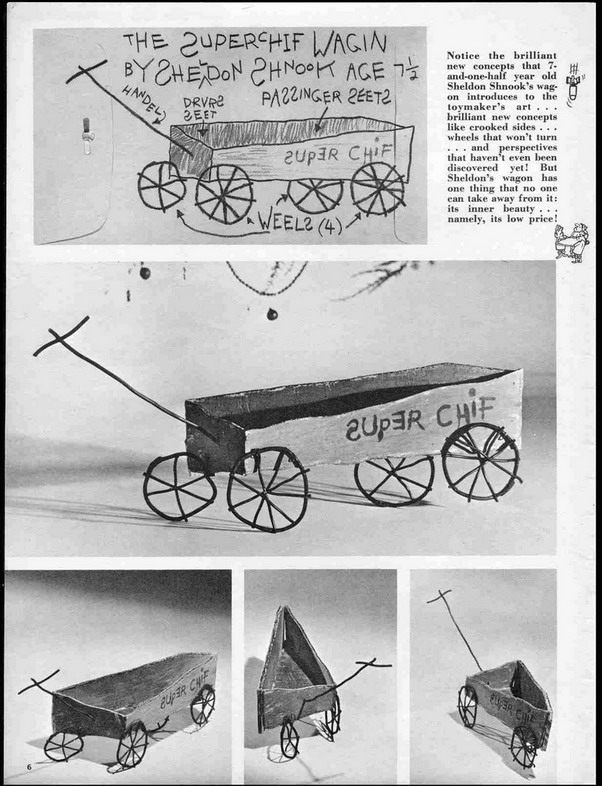
There was one piece in the moron’s tubular issue that particularly blew my mind.  It was called something like “if children designed their own Xmas toys” and it had a series of perfectly crude children’s drawings, with impossibly skewed perspective and naive, nature-defying angles.   They had created exact replicas out of these drawings, which were photographed in beautifully lit 3-D, and presented next to the kids’ designs.   It was mind-blowingly ingenious.

When my father saw how much I loved the magazine he offered to get me a year’s subscription as a Chanukah present.  That sounded great to me, but it never happened.  Boy’s Life, the scout magazine, arrived in the mail with my name on it for a while.  I remember reading an article by Cardinal’s third-baseman Ken Boyer, I think, called “How to Handle the Hot Corner”.  There was a great article by Bill Cosby called “High School Was A Load of Laughs” about how he learned to game the system by playing on the school’s varsity team and somehow qualifying for remedial gym.  It involved wearing black knee socks and acting like a spastic, to get into a gym class where he could goof off and not do anything strenuous.  This was presumably before he discovered an even bigger laugh:  drug your young classmates before feeling them up and nobody is the wiser.  

I never got a copy of MAD magazine in the mail.  There was no subscription for me.   Instead, every time MAD came on the newsstand my father bought a copy, which I’m fairly sure he read on the train home from work.  He had a very subversive sense of humor and MAD played to that big time.   My father would hand over a pristine copy of the latest MAD every month (he read it gently as could be, from the looks of it untouched by human hands).  I’d say thanks, and read it cover to cover, folding the inside back cover to see each clever Mad Fold-in.    This went on for maybe ten years.

I eventually sent a box of the years of MAD to a friend for his son. Hopefully, somewhere in these stacks here, is that original copy of the coverless magazine that the moron could not stop waving around in social studies class.  I’d love to see that feature on kids designing their own toys again.  

AH, the  internets!  

MadMagazine-076-008.0.jpg

By the great Al Jaffee, it turns out.  I also learn (not that we believe everything we read on the internets) this was supposedly in their January 1963 issue, making me, impossibly, six and a half years old at the time.  No wonder I was so literal about the moron!  

Winning the Battle, Losing the War

My sister and I had to laugh when I reminded her of our father’s familiar prediction, usually snarled ominously, “you may win this battle, but you’re going to lose the war.”

“Think about that,” she said, “what does that actually mean, ‘you’re going to lose the war’?”

Leaving aside the most obvious question– what war and why were we in the middle of it? — the most likely scenario, when you lose the war, is that you’re dead, your home destroyed, your bones scattered for hungry animals to pick over.  Or you could be locked up for life in a prison camp in some armpit of the victor’s country.  In antiquity you could be a slave.  In all cases, when you lose the war you’ve lost pretty much everything.  

As for winning the battle, where one side has its ass shot off and the other side has half its faced burnt, you’d need to find a pretty sick ref to declare either side the winner.  “You’re gonna lose the war” is kind of a funny prediction for a father to make to his two kids every night over dinner.  

“Well, look, Elie, that’s how I grew up,” said the skeleton. “Everything was a ruthless battle of the wills.  Why do you think you have such a hard time with tyrants?  The hatred of autocrats gets in your blood.  ‘I’m not going to let this bitch win….’   The desire to get revenge on the person who betrayed you is overpowering, you simply can’t resist it, no matter how civilly you might try to act.  

“Why were you and your sister in a war?  Wrong place, wrong time, bad luck, like any civilians caught in a war.   When the soldiers came out of the trenches and began dashing across battlefields following the tanks with their bayonets fixed, toward the end of the World War, casualties quickly multiplied.  Why were they advancing across scorched earth in long ragged lines, dodging machine gun fire, keeping their gas masks handy?  Why is anyone in a war?”  

I started following you– my sister and I were born in the wrong place at the wrong time, like a Jewish kid born in Vishnevitz in 1930.  No bar mitzvah for you, bubbeh, don’t worry about learning to chant your haftorah, here, put your pants over there, shirt and shoes there, very good, step up, next!  You turn thirteen when they are executing everyone in your village and— today you are a man, a dead man.  Goodnight.  

“Well, we talk about these things like there is an element of rationality to them.  While they were negotiating the armistice to end the Great War, between the German request for the armistice and the signing, during those five weeks, 500,000 soldiers were killed or wounded.  The last day of the war, when the secret deal was already done but they hadn’t had the official signing ceremony yet,  2,738 men lost their lives.  

“As a species we are, historically, very matter of fact about war, you know.  How many Iraqis lost their lives when Cheney gave those enormous truckloads of cash to Halliburton, pursuant to no-bid contracts, to set freedom on the march and liberate those innocent civilians from a modern-day Hitler?   We have no idea, and, beyond that, truly, we do not give so much as a fart.”  

Yeah, yeah.  But we are talking about a father who constantly threatens his young children with the ultimate curse:  losing the war.  After you lose the war, what do you do for an encore?   How insane do you have to be to phrase every interaction with your own children as a skirmish, a strategic battle in a war that, in the end, they are fated to lose?  

“Well, I grant you, you do have to be somewhat insane, I mean, when you put it that way.  But you see, Elie, at the time I couldn’t see it that way.  All you could do was fight me, and that perpetuated the war, not that surrender would have done you much good either.  As long as you would not surrender, and admit that you had started the war by your belligerent attitude as an enraged baby, well… I don’t know what your mother and I were supposed to do.”  

Come on, man, you’ve had more than a decade to let that one dissolve in your mouth.  I’ll let you think about it some more.  I admit, it’s a tricky one.  Go ‘head, you can get back to me on this one.

NOTE: Hanging with the skeleton of my father

I didn’t imagine, when I started to write the story of my father’s life, that his skeleton would start a conversation, or how quickly I’d be drawn into it.   It seemed only natural the first time he popped up to give me mild shit about something I’d written.  He often had a problem with things I wrote, even as he usually approved of the style.  I have to say, though, since his fairly sudden death, and our chat the last night of his life, he’s become milder than when he was alive and kicking.

The skeleton’s personality is the essence of Irv as he always was, and also, my father as he would have been, had we had more talks along the lines of that conversation the last night of his life.  The skeleton has the enhanced self-awareness that comes from thinking about his life in quiet contemplation for the eleven years since his death.  He has much more perspective than he did when he was alive.  This is only natural.

There is some irony in the changes to his personality since he became a skeleton,  He always argued that people cannot change themselves or their lives in any fundamental way.  He seemed quite changed to me that last night of his life, expressing regrets, admitting he’d been foolish, wrong, apologizing for the first time in his life.  I know I was changed, thankfully, and just in time to be mild, and patient– to hear his confession and help him make his exit from this world.

The skeleton of my father, who first popped up to  heckle me, became an equal partner in the telling of this story of his life.  He supplements, argues, clarifies, proposes alternate scenarios in ways that sometimes surprised me, even though I wrote his words for him.  He sometimes chafed at this arrangement, me writing all his lines, but he generally found it easier to just go along.  Another sign of how much he mellowed and matured since his death.  

What choice does he have, anyway, if he wants his story to be told?