Neuroplasticity

Neuroplasticity is a term that’s been getting a lot of play lately, it refers to the brain’s ability to heal and reformat itself.   Though the idea has been around for a long time, scientists, using MRI brain scans, can now confirm the brain’s power to heal itself — the scans show the changes in the brain’s chemistry and physical structure.  

Not to say it doesn’t take a lot of conscious work to heal the brain, but the soft, sensitive organ, easily harmed and scarred by abuse, is remarkably malleable, it turns out.   ‘Neuroplasticity’, if the term had been coined, wasn’t in wide use back when I was arguing with my father about the ability of a human to change painful aspects of his life.

 “Well, like a lot of science, Elie, all I can say is ‘dassum shit’,'” the skeleton said.  “You know, it’s an attractive idea, that we can heal ourselves, change the emotional functioning of our brains.  Have you known anyone who has ever done that?  I mean, seriously, to any great extent?  

“Have you seen dramatic transformations of that kind in anyone you’ve known, in yourself?  The MRI might see it, but how does that translate in a human life?   This research is based on the brains of meditating monks who acquire fantastic abilities, like elite athletes who push their bodies to do amazing things.  I think the jury is still out on ordinary people who ride the subway and grind their teeth at night, whatever their brain scans might show.  

“Not to mention that scientists still have only the most primitive idea of which part of the enormously convoluted and complicated human brain is responsible for which emotions.   I stick to my original position on that — people cannot fundamentally change their personalities, or their brains.”  

OK, although you realize that position reflects the rigidity you say you regretted as you were dying, and a refusal to evaluate evidence that can be shown on an MRI.  Those brains showing all the damage that were imaged after months or years of therapy, good diet, plentiful sleep, deliberate changes for the better, and showed reversal of the damage?   ‘Dassum shit’, you say?   Have you become a science denier now too, just to win a senseless argument?    

“You may have noticed that senseless arguments are the most hotly contested ones.   If you’re going to base an argument on what makes the most sense, it’s often possible to show that one side is much more sensible than the other.  Of course, the relative sense of positions is not the real question, most arguments are conducted for their own sake, they stand in for the primitive will not to be dominated.   Did Eli’s arguments make sense?”  

Sometimes they did, as ridiculous as they were at other times.  I recall the time he accused his son-in-law Herbie of fucking him when he bought Eli a hearing-assisted phone.  

“His hearing did get pretty bad at the end, when you were talking to him on the phone,” said the skeleton.  

Yeah, so Herbie bought him a phone with an amplifier in the handset.  He showed it to me like he was displaying a greasy, corn-encrusted turd someone left for him on his pillow.  “Can you believe this shit?” he demanded.  

I told him it was very nice of Herbie to get it for him and that we should plug it in.  He looked at me like I’d just squeezed out a turd next to Herbie’s.  

“Are you kidding me?” he fixed me with his famous scowl.  “He didn’t buy me this to be nice, that’s not in his repertoire.  He bought me this to say ‘here you go, you deaf old fuck, have a hearing aid phone!’  It was nice, all right, if you want to say he was being nice,  it was a nice ‘fuck you’.  Have it your way, then, he bought me the piece of shit phone as a nice “fuck you, Eli, you deaf bastard!”  Are you too goddamned dim to see that?  Come on!”  

“Were you too goddamned dim to see that?” said the skeleton.

 Look, we’re straying a little far from the point.  

“Oh, ‘we’ are, are ‘we’?” said the skeleton archly.  

“Look, you have to reconstruct, or let me be more precise, you have chosen to try to reconstruct, using memory, imagination and conjecture, what my interior life may have been like.   You believe, with impressive, even heroic, naiveté, that once you have shaped this into a narrative that anyone will give a rat’s camisole about the life of an unknown man, alternately a gentle idealist and a violent monster.”  

I’ll grant you the book proposal will lack some of the oozing sex appeal of the biography of some celebrity twat who, through tireless effort and cunning, parlayed a paltry ten or twenty million into a billion dollars, or sold ten million records, or could hit a baseball 450 feet, or who gave 10,000 blow jobs, or even someone who imprisoned and raped teenaged girls in his cellar, but life is primarily lived by anonymous people, sometimes invented out of whole cloth– as in famous literary characters– who read to find echoes of their own experience, and whatever little insights they can use, as often as they read to escape those experiences.  

“Ah, so you give them both.  Brilliant.  A little worrying of the soul, a little torment, a ridiculous Eli anecdote sprinkled in for fun.  Did you remember to tell them about Caesar Previti?  That’s a good one.”  

I was thinking about your friends and colleagues, or, I should say, the name Caesar Previti popped into my head the other day.  I jotted it down and texted it to my sister, asking if the name rang a bell.  It seemed to me that Previti was a co-worker at the Human Relations Unit.  My sister had the same feeling, that Previti was a friend and colleague you spoke of from time to time.  

“And you got excited, right?  Like this was a little vein of gold to be mined, maybe Previti was still around to be interviewed or something, right?”  said the skeleton.  

I’m afraid so.  Anyway, I put his name into google, and it spell- corrected it to Cesare Previti. After that, it was only a matter of seconds:

Cesare Previti (born October 21, 1934 in Reggio Calabria) is a former Italian politician and convicted criminal. He was, with Marcello Dell’Utri a close friend and right-hand of Silvio Berlusconi and founder of Forza Italia.

“Your sister was surprised too, right?  Another clue, if one was needed, about the dodgy, slippery nature of memory.  Perhaps your neuroplasticity research will take you to a place where your neurons are flexible enough to flawlessly separate fact from fiction, but then again, maybe you’re just kind of fucked, Elie,” said the skeleton, sniffing the breeze that was blowing down the hill from Oregon Road.
In praise of a dead dictator

A Castro supporter on the radio just now spoke of free medical care and higher education for all Cubans.  Typical.

Any free market American Exceptionalist will plainly see these things for what they are: shameless Communist apologist propaganda.   In a free market things like health insurance and  higher education are best left to free enterprise.  

Literacy, another of the dead dictator’s alleged legacies to the people of Cuba, also, highly overrated in the age of smart phones.

Worst from an American Exceptionalist perspective: in Castro’s Cuba, nobody born entitled to makes a dime on health care or education.   SAD.

One reason Trump is President-elect, why most Americans hate their government, and why they hate others, as well

I voted for Barack Obama twice, holding my nose the second time. “All presidents disappoint”, Bill Moyers reminded his viewers during the euphoria (for many) when Obama was elected the first time.  Moyers’ reminder was one of the most sobering, and prophetic, I can recall.  Obama, smooth, thoughtful, droll, sensitive, has disappointed more than any other president in my lifetime.  

For but one example of my disappointment, let’s have a peek at his signature achievement, The Patient Protection and Affordable Care Act, popularly known as Obamacare, the program the president-elect has vowed to repeal as soon as he’s inaugurated.  

I am the only person I know who is directly affected by the outgoing president’s masterful compromise with the massive health care corporations who need to remain as lucrative as ever.    I speak of the workings of the PPACA with bitter personal familiarity unmixed with statistical satisfaction of any kind about things like the possible long-term altering of medical care cost vectors.  

The law was a hasty compromise with what was sorely needed to prevent tens of thousands of preventable American deaths every year.  It was written, by industry insiders, to ensure, above all else, that the private insurance and drug industries would remain as healthily profitable as possible.  

Written by wealthy health industry lifer Elizabeth Fowler (check out the great five minute Bill Moyers clip at the bottom of the link) who worked, during a brief sabbatical in ‘public service’, for the most handsomely paid (by the Health Insurance and Pharmaceutical industries) man in government, Montana Senator Max Fucking Baucus.  

Baucus apparently admitted never having read the bill, stating that it would have been a “waste of time” to do so, because only an expert could understand its 2,700 pages (NOTE: the author of the linked Washington Post article, no friend of Mr. Obama’s, is a professor at the ‘Antonin Scalia Law School’ whatever the devil that infernal place is).   A somewhat less biased account of Baucus, with a passing note on his ambivalent role in the crafting and passage of the PPACA, is here.

One learns from the Grey Lady article that Baucus is the scion of a “prominent and mostly Republican” Montana ranching dynasty who always “marched to his own drummer” as he did, one assumes, when accepting Obama’s appointment as ambassador to China rather than face sure defeat in a re-election bid as Montana Senator after three and half decades on the job.  

Baucus took over the lead role shepherding through the PPACA when Ted Kennedy died.  Baucus is known (albeit not well) for these right-wing, business-pleasing votes, as well as for taking millions in campaign contributions from concerned health industry lobbyists:

In 2001 Mr. Baucus defied Tom Daschle, then the Senate Democratic leader, by co-writing President George W. Bush’s tax cuts, setting off screaming matches between the two Democrats. In 2003, Mr. Baucus broke ranks to support a Medicare prescription drug benefit that Democrats viewed as a giveaway to drug companies.  (source)

You can google either of these characters, Baucus or Fowler, to read their sordid bios.  One can admire the way Ms. Fowler danced through the revolving doors, and made millions while serving her fellow health industry executives, without applauding, or even cracking a smile about, the sickening health care law she lovingly crafted for Mr. Obama’s signature.

Anyway, I’m just worked up because I got “an important notice” from the New York State of Health in the wee hours of the morning. It arrived at 3 a.m., certainly the most effective hour to send such crucial health insurance-related news that likely impacts a patient’s immediate health insurance coverage.  It read: 

A notice has been sent to your inbox in your account. This notice tells you important information you need to know about your health coverage for you and/or your family.

You must log into your account on the NY State of Health website to read the notice.

The careless motherfuckers at New York’s Obamacare “marketplace”, The New York State of Health, contacted me last year, with an almost Josef Goebbels-like sense of mischief, on Christmas Eve and Christmas Day to inform me I would be ineligible for health insurance until March 1, 2016, at the earliest, and gave me seven (7) days to provide all tax forms and a full, written explanation of why I should be given health insurance at all.


Almost lost in my inbox, I took a moment just now to log into the accursed site and read this:

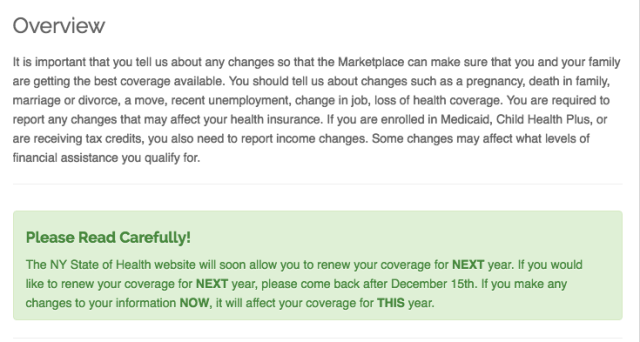
Screen shot 2016-12-04 at 3.04.34 PM.png

IMPORTANT NOTICE:   Today is December 4th, please come back AFTER December 15th to keep your insurance up-to-date and in place for 2017.  On, or just after, December 15th you will then have up to 24 hours — provided our servers, often overloaded just before our short, arbitrary registration deadlines, do not crash– to provide all required updates within that short window in those leisurely days before Christmas, or lose your insurance coverage until, the earliest, March 1, 2017.  

Or maybe not.  Nobody you speak to at New York State of Health, after a wait of no more than 25 minutes, will have the definitive word on what’s what.  The only thing you can rely on regarding the New York State of Health is not getting reliable information.  Take heed, though, and take that to the bank, bitch.

I’ll be eagerly following Barack Obama’s career as a private sector public speaker.  I am confident that my man will break all existing earning records for corporate speaking.  He’s that good.

My Brother’s Keeper

I stumbled on this wonderful definition, at google translate, of the word quijote (a variant on quixote), the name of a restaurant several of us ate at last night.  It’s perfect for a number of reasons.  

quijote:  Piece of armor that covers the thigh.

Person who has high ideals and fights and defends causes that, although noble and just, do not concern him.

“Wonderful definition,” said the skeleton, “fighting for noble and just causes that do not concern him.  Hah!  I can see why you love it.  Not only does it define you to a tee, it’s summarily judgmental, you know, the slavery of those people does not concern you, noble but misguided tilter at windmills.”  

I thought you’d like it.  Goes to that old question about being our brother’s keeper.  

“Well, things didn’t always go well for my little brother when I was his keeper.  That time I stuffed his mouth with raw chopped meat stands in for a lot of equally unkind turns as my brother’s keeper.  Still, this question of ‘what does not concern him’ is an excellent one.

“You know how we always said, on Passover, that slavery anywhere is a threat to freedom everywhere, that as long as tyranny is winked at by democracies the world is not safe for children, and putting yourself in the place of the weakest and most oppressed among us is a crucial duty of all citizens and so on, all things that, clearly, ‘do not concern him’. Funny, the right wing has succeeded in making this part of the American credo, to a seamless extent, really, if you think about it.  

“If the whole game now, the new American Dream, is being a free libertarian, the government allowing you the full exercise of your freedom without interference, it is truly not your concern that millions in your own country live in want while you enjoy heedless personal liberty, justly feeling no obligation to anyone but yourself.  If you are born with $100,000,000 you should keep all of it.  Who is the government to confiscate any part of what is rightfully yours, you dig?  

“You, why are you concerned about the poverty and hopelessness you saw when you taught third grade in Harlem?  You have bigger things, much closer to home, to worry about.   That staircase in the untended tenement on Manhattan Avenue, right out of a horror movie, with the broken glass on the landing, and that mother of the kid you walked home coming to the door at 3 pm in a flimsy nightgown, her breasts swinging freely underneath it, not understanding why this white detective was knocking on the door with her nine year old kid next to him.”

I know, twenty-five years later that scene is still vivid in my memory.  I’d just woken her from a nap, or maybe she’d just had a hit of heroin, or who the hell knows what.  She was only partially there, swaying slightly as I tried to explain I wasn’t a cop, I was the boy’s teacher.  The boy had been putting his hand up and down the front of the skirt of the little semi-retarded girl who sat next to him in class. It had upset her, to have his unwanted finger probing for her little vagina while I was at the blackboard teaching math.    I’d spoken to him sternly about it, in no uncertain terms, he kept doing it.  I told him I would speak to his mother, and so here I am.  Ma’am, are you OK?

“No, Elie, ma’am was clearly not OK.  What’s with the rhetorical questions?  Just and noble, to do what you said you would after the kid would not heed reasonable adult correction, but also, you know, matters that did not concern you.  

“That’s the beauty of what Reagan, and Margaret Thatcher and their glorious ilk sold to their gigantic flocks, what the folks your friend Tex calls economic fascists, rightists like Paul Ryan, continue to peddle.  The message resonates.  You owe only your immediate family and their circle any kind of duty.  We owe absolutely nothing to strangers.   

“The social safety net is a crutch that fosters dependence and corruption.  We owe nothing to each other as members of  a society.  It is natural to acquire as much as you possibly can, and there is nothing at all shameful about acquiring a thousand, or a million, times what you actually need to have a perfectly fine life.”   

In fact, it’s not only natural, it’s praiseworthy to seek a thousand, or a million, times what you need.   The problems of those who don’t have enough to eat?  The problems of young kids in America who get brain damage from long-term malnutrition and other poverty-related maladies?  They do not concern you.

“A food stamp recipient who buys a steak with food stamps is gaming the system.  They’re morally obliged to eat gruel, you know, like in a Dickens orphanage.  The only people who have the right to eat steak are those who earn the money to afford it, or inherit the money, or acquire it by arguably fraudulent means, but done in the employ of a corporation that is ‘too big to fail’ in a system where people who commit massive fraud are free to pay millions in bonuses to their henchmen.

“You know in 2009, right after their falsely triple A rated toxic derivative casino marketplace almost toppled the economy– cost your mother, my widow, about 40% of what we’d managed to put aside– the industry paid themselves $20,000,000,000 in compensation and bonuses. Twenty billion.”

Twelve years dead and still so bitter.

“Elie, I will feel this way about the killers and the spoilers two hundred years from now.  Even as, at the same time, I can easily see that none of this concerns me.  For one thing, I’m dead. There’s that, of course.  For another thing, even when I wasn’t dead, when I was walking around, growing my hair over my collar and my thick mutton-chop side-burns, dismissing bullshit with a curt ‘dassum shit…’ I knew how little a person can do about any of this, the stuff that ‘does not concern him.’

“The world is a place of misery and bad behavior.  The Buddha taught that the only way out is to go inside your own mind, your own soul, and find the inner tranquility to carry you through it.  I think of that Buddhist monk in the street in Saigon setting himself on fire to protest the continued war in his country.  Didn’t go that well for him, I guess.”

Sorry, dad, not my concern.  

“Go get ’em, Elie,” said the skeleton, yawning or pantomiming a scream.

The Excitable Optimism of Sekhnet

From time to time Sekhnet, who meets countless people during the course of her work gathering news for a national network, reports a fascinating conversation she had that relates to my life and plans.  She brings me a business card, or contact info written on a scrap of paper and urges me to call them.   Often things come to grief, since I am not always quick to make these potential contacts.   That most have so far been in vain is no excuse for my glass-half-empty pessimism.    

She heard a bright and funny man give a fantastic talk on becoming pitch perfect at sales meetings, during interviews of any and all kinds.  He pointed out that people have one chance to make a good first impression and clinch the deal, and that there are a hundred ways to blow it.  Read his book, aptly titled “Pitch Perfect” and you can weed out many of these ways, have a crisp phrase ready, delivered in the same winning style you see before you today, saying exactly enough to make your point crisply, and not one phrase more.  

Being pitch perfect is the difference between getting a major donation, or any kind of big yes, and getting that gassy baby smile and limp handshake at the end of a meeting too long by crucial moments.  The man’s talk and style were both excellent, she enjoyed it and found it valuable.  She bought his book, which I read cover to cover.  It was excellent.  

I took the next step and contacted his office to make an appointment for the four hour personalized master class.   It was, not surprisingly, $4,000.  I explained that I represented a small, money-strapped non-profit and was cheerfully told the tiny non-profit rate was $3,600.   My silence was met by an offer to do the half course, more than 60% as good as the full one, for only $2,000, certainly our budget could manage that.  

Well, I thought, the $2,00o, a quarter of our operating fund, could go for that or for two new animation set-ups.  I thanked her, even as a bit of bile was coming up in the back of my throat.

Sometimes helpful people, hearing my idea for the child-run interactive animation workshop, have suggested I pitch the idea on Shark Tank to get funding.   Shark Tank is a show where business owners try to strike deals to get funding from a group of wealthy sharks who evaluate the ideas looking for monster profits.

Experience has taught me the difference between what I was trying to sell and something an angel investor in the Shark Tank would salivate over. In Shark Tank the family that invented the fantastically lucrative Squatty Potty was looking for millions to take their product, a short plastic foot stool that made passing stools as easy and pleasant as operating a soft serve machine, to the next level, international super sales.   The investors were looking for a credible sign that every million they put in would have a good chance of turning into ten million for them.  It is straightforward.    

If the idea is to transform a boring public school classroom into a fun ninety minute imagination-fueled, problem-solving, peer-teaching playground where kids have the final say on every aspect of the product they are producing, a short bit of stop-motion animation, a process that leaves them collaborative, energized and engaged in learning and teaching, no angel investor worth his dorsal fin will so much as stop circling to sniff that particular patch of water for blood.  

“Sounds like a great idea, you got funding?  What’s your marketing budget?”   These are the first two questions anyone bright and practical asks when I finish my brief answer to “so, what have you been up to since last year?”  

“You have to find fellow idealists,” Sekhnet has always told me.  

I was referred to a non-profit called idealist.org, signed up.  Was invited to a mixer at a bar.   Went and met the people who worked for idealist.org.  They explained all the benefits of being a member.  I joined.  I haven’t had an email from them, or anyone else on the site, in years.  

I had an email from two guys who founded a nice outfit to introduce non-conformists with big society-improving ideas, a mutual help organization for idealistic types.  They would match people up according to their skills, interests and needs.  The first rule, when you met, was to listen to the other person’s idea and needs first and think about how you could help.  In the end, their emails stopped coming too.  It was a great idea, but I guess they didn’t have funding or an adequate marketing budget or business plan.

Having lunch with the sister of an old friend the subject of the nonprofit came up.  She thought it was a great project and then told me about a woman she’d recently met, a dynamic older woman, who was on the inside of Mayor Di Blasio’s Department of Education.  She was a great lady, and good friends with this woman’s good friend.  She shepherded many great new programs through the Education Department’s doors, knew how to get them funded and contracted as pilot programs, that was her speciality.  She was, literally the perfect person for me to meet.  In fact, we’d meet for Dim Sum, with the mutual friend, and I could run the idea by her at an informal meeting, that would be best.  

That offer turned into the old can-do idealist’s phone number being texted to me, followed by a series of supportive follow-up texts asking if I’d contacted her yet.  Presumably I was supposed to set up the informal Dim Sum meeting where the no pressure chat could unfold.  I called her a couple of times, introduced myself in short, hopefully well-pitched voice mails, I texted her this and then  this.   We never met for Dim Sum, nor did I ever hear back from her.  

It reminded me of the introduction I’d had a year earlier to the director of a large arts non-profit, with a twenty million dollar annual budget.  I was told this woman, a good friend of a close friend of mine, would love my idea and her well-funded organization could definitely help.  If our mutual friend had been present at the meeting, things might have gone better, the well-funded nonprofit could definitely have helped.  As it turned out, I was chided for my defeatist attitude before the meeting, felt dread on the way to the meeting, and the results afterwards were the opposite of helpful.    

Sekhnet remains undaunted.  Her mechanic’s daughter, it turns out, by pure whimsical chance, works at a nonprofit that features creative programs for public school children in Queens.  This friendly young woman was very excited about the student-run animation workshop, gave Sekhnet her card.  Sekhnet has learned about such things, knows that I’m currently concentrating on a book about the life and times of a man nobody’s ever heard of, and told the young idealist that it might be a while, but that I would get in touch with her.  

The same goes for the twenty-one year old idealist she spoke to in the computer department at Costco the other day.   He works at Costco and is completing a business degree at Baruch.  He and his brother love stop-motion, are idealists, think a student-run animation workshop for young kids sounds amazing and want to help.  Plus, he’s getting the business education to help with funding and marketing.  Win-win-win.  He was cautioned that it may take a while to hear from me.  

Thanksgiving I hear Sekhnet piping at me from across the room, calling me by my Christian name, if I was a Christian.  I never know what the deal is when I hear her urgently piping “Eliot!”   She’s talking with a smiling, friendly woman who it turns out works for Simon and Schuster.   She works in HR, hiring and firing like a demon, but she has found her home in publishing, after years in electronic media, and loves being around book people. She reads like a fiend since she’s been working there.  Sekhnet informs her I’ve written a book, I get a big smile.  

“It’s a manuscript, a first draft, around 700 pages.  It’s like wrestling with an anaconda at the moment, but I’m really enjoying it,” I say to the big smile.  

“I love book people,” she tells me, with that beautiful smile.  

I describe the idea that gets me out of bed every day, excited to write: a three-dimensional portrait of a great idealist who was also a monster, and how he rose from dire poverty to live the American Dream, a historian passionately involved in the historical events of his lifetime.  A dreamer and a destroyer of dreams.

I tell her that one day, as I was writing about his painful childhood, the skeleton of my father sat up in his grave to bitterly dispute something I’d just written.  I’d dismissed it at the time, went with it, had the chat, figured I could cut it later.  Then found him popping up again and again and now much of the ms. is an ongoing dialogue with the opinionated skeleton, a talk I look forward to every day.  

The smile continued as she told me it sounded cool, and that this kind of soul-searching memoir is currently a very hot genre and that if I find the right agent things could go well with this idea.  She then told us of a website where you can do a detailed search, by genre , of agents, and that no publisher will accept anything unless submitted by an agent.  Sekhnet jotted down the name of the website where I could find the highly specialized agent I will need to find.

I then told her everything I knew and felt about Jim Dale’s deightful audiobook performance of the marvelous Harry Potter books.  I promised her that she would love it, based on everything she’d told us about the books she liked best, then smiled, curtsied to Sekhnet, and went to have another muffin.  

The Fairness Doctrine is Ancient History

“Well, how bout this one, Elie– we have the votes, let’s abolish the fucking Fairness Doctrine and get the old show on the road,” said the skeleton.

For the benefit of those who have no idea what the Fairness Doctrine was, a bit of, eh, history.   Starting in 1949, when television was in its infancy, the FCC came up with a requirement for broadcasters, licensees who used the limited public airways built and maintained by We The People, when presenting public interest content, to give both sides of any contentious public controversy equal opportunity to influence public opinion.  

“If you gave air time to a spokesman for everyone’s irrefutable constitutional right to as many guns as they want and the freedom to take them everywhere they go and use them freely anywhere if they feel threatened, or even just a bit paranoid, well, a spokesman for people who are not insane had to be given a chance to present their side and rebut that opinion.  It was called The Fairness Doctrine, a quaint idea today.  

“The FCC apparently abandoned the doctrine during the Reagan Administration, when the votes lined up to begin consolidating media and getting rid of anachronistic, idealistic, safeguards against the mass media becoming a propaganda machine for one side or the other.  

“Which makes sense, since the Reagan Administration can be seen as a kind of fork in the road, making the right wing cool.  And as Yogi is reputed to have said ‘when you come to a fork in the road, take it.’  

“Under the Fairness Doctrine if a licensee down south ran segregationist programming and censored all national news about the civil rights movement, the public in its broadcast area had a right to also hear a non-racist point of view and the broadcaster was obliged to air it.   They actually yanked the license of at least one broadcasting outfit who refused to give what were then quaintly called ‘nigger-lovers’ a chance to rebut the network’s view.   You can imagine how many righteous souls that decision pissed off.  

“And, of course, if you want to influence partisans and maintain your political power, the main thing you need is a powerful echo chamber.  You don’t want the other point of view considered, or even heard, it must be vilified and ridiculed so it can be dismissed reflexively.  If you chant your slogan you don’t want the other side to get even sixty seconds to state all the reasons your slogan is pure idiocy.  

“I used to get a kick out of listening to Rush Limbaugh, as you recall, the massive, cast iron balls of that whacked out right wing drug addict used to give me a kind of kick of adrenaline.  

“Over time you have not one Rush Limbaugh, who reminded me of Father Coughlin, the old populist anti-Semite who ranted on the radio about ousting that cunning old Jew Franklin Delano Roosevelt from office, but dozens, hundreds of Rush Limbaughs.  Scroll through the radio dial, and between legal disclaimers about the views expressed, you will hear the passionate partisan stylings of countless rabid dogs.  Most of them right wing, many of them very well-paid.  Advertisers love them.  And why not, hatred has always been a winning business model.  

“Since the demise of the Fairness Doctrine, with the government no longer having any requirement over broadcasters to present any nuance at all, you get calm acceptance of things like the government proscription of showing the caskets of dead Americans returning from wars that are only explained in the most idiotically partisan terms.  ‘Freedom is on the March’ and ‘Support our Troops’ is all you need to say over and over to get people waving American flags and wearing them on their lapels.  American flags made in China, of course.  

“There need be no actual discussion of any of this, mercifully, unless you happen to listen to some fringe pirate station not owned and controlled by a giant profit-seeking corporation.  And everyone knows those people are just crackpots.  Why would you want to show a parade of American coffins coming back from anywhere anyway, you sick bastard?  

“We don’t have much conversation in the mass media, not that there ever was a long supply of that, but people talking past each other and partisan false equivalencies are the rule now, everything reduced to an over-simplified either/or.   As you say, people who wear blue hats support the charismatic guy or lady with the blue hat on, same for red hats.  It’s not about the actual issues, it’s if the person is on our team or not.  A sad day for America, but, if you look back to the beginning, it’s always been a sad day for Americans with little power over their lives.   Two sets of laws has always been the case here.  

“You heard that guy, Mike Lofgren, interviewed by Bill Moyers about the Deep State.  The permanent shadow government is not a new thing, the interests it represents go back to the Founding Fathers, but it’s entrenched and protected in ways we couldn’t have imagined generations ago.  He described it as ‘a hybrid association of key elements of government and parts of top-level finance and industry that is effectively able to govern the United States with only limited reference to the consent of the governed as normally expressed through elections.’  

“He set out the workings of our current deep state, now organized largely around, and justified by, the so-called War on Terror, that bold war against fear itself: deregulation, privatization, deindustrialization, financialization of the economy, Wall Street as the only casino in town, widening wealth disparity,  permanent war, surveillance state, etc.  It all takes on the air of the inevitable, but… well, you know, it’s by deliberate design, to maximize profits. 

“When Henry Wallace was the popular people’s choice to succeed the ailing FDR, and he had massive support at the 1944 Democratic convention, right wing business and political leaders got busy talking to the DNC.  Wallace was an anti-imperialist, anti-colonialist, non-racist, egalitarian who had been FDR’s Vice President through the war, and before that a very capable and savvy Secretary of Agriculture, to the left of FDR, throughout the New Deal.  

“When Henry Wallace gave a speech about the post-World War Two era being the Century of the Common Man, it excited millions of common men and women in America and gave hope to enslaved people worldwide.  He advocated federal regulations to guarantee equal pay for equal work, for men, women, people of all races.   He supported the right to collective bargaining and a right to arbitration for all workers in disputes with their employers. The status quo could not tolerate this sort of shit, it stood to lose trillions of dollars.   The Commies hated our freedom and, literally, wanted to take everything the rich and their grandparents had worked for generations to acquire.

“Harry Truman was a senator of limited experience and influence, perfect for the uses of the Democratic party machine and the powerful forces they represented.  Within 24 hours they’d brought support for Truman as FDR’s V.P. from around 2% up to a robust 90% or so on the third vote, and all it took was an overnight adjournment of the convention vote and the granting of a few hundred political appointments.  

“After that third ballot Truman would be the next president, Wallace was done, the Cold War started, Civil Rights legislation and Equal Pay legislation, and the rights of labor, put off for a generation.  Then, after a few fitful years of modest progress on each of these things, shoved off for another couple of generations.

 “The Fairness Doctrine would not apply to cable TV stations, or the internet, but the abolition of it, in hindsight, was just another sign of which way the wind was blowing.   Who needs Fairness when it’s Morning in America, Elie, or when we’re Making America Great Again?  You dig?”  The skeleton beamed, a slightly mad glint shining in the eye sockets.  

“Consider this, though, Elie, which one of us is the madder, the guy who is dead and buried or the one putting words in his mouth almost twelve years later?  Hmmmmmm?”

Death of A Thousand Cuts

“Well, that’s the nature of the beast, isn’t it, Elie?  It’s rarely one thing that kills you, it’s that gang of relentless demons that finally takes you down, one pulling sneakily from the direction you least expect, as another one gleefully kicks you in the throat, two others clog dancing on your lungs, a tiny one knifing you in the kidneys,” said the skeleton of my father cheerfully.  

You remember I went to see our cousin Eli toward the end, a week or so before he died, actually.  On the phone he’d told me not to bother coming up, that he wouldn’t be very good company.   I told him I was on my way anyway and when I arrived he scowled and handed me the insert from the fentanyl patch he was wearing.  The insert was a long scroll of tightly printed mouse type, a learned collaboration between medical and legal professionals, in a life-saving effort to shield the manufacturer of the drug from liability.

He had some damned, very intense pain nothing could touch (turned out to be from inoperable cancer his children decided he didn’t need to know about) and they’d given him these damn pain patches, which did a little bit to ease the pain, which had been getting worse and worse while nobody could tell him what the hell it was caused by… but he had every damned side effect on the list.  

“Black, tarry stools?” I read from the scroll.  Yop.  The answer was the same curt “yop” to literally every symptom on the list.  Blurred vision, yop, chest pain, yop, difficulty breathing, yop.  Dry mouth, yop, increased thirst, loss of appetite, yop, yop. Muscle pain, numbness and tingling, difficulty urinating.  Yop, yop, yop.   Back pain, diarrhea, yop, yop, loss of strength, yop.  Irritability.  

“What the fuck do you think?” he roared irritably.  

“Yop,” I said and we went down the rest of the list.  We fell into a cadence of symptom, yop, symptom, yop.  

When I left Eli hours later we hugged and I told him I was sorry for not giving him a good fight.   It was very rare to have a visit with him for any amount of time when he wasn’t purple faced with rage at some point.  Fighting was the favorite sport of Eli and my mother, and they never missed a chance for a good brawl.  

“That’s OK,” said Eli patting me as we let each other go.  “We’ll fight next time.”

The next time I saw him, just a few days later, he was in a  hospital bed.   He didn’t know I was there, though the nurse told me to speak to him, that he might be able to hear me.   His wrists and ankles were bound to the bed frame and he was fighting with all his might.

A day or two later he was gone and my father and I were speaking at his funeral, me reading my careful, heartfelt notes, my father improvising like John Coltrane playing over changes for a tune he loved.

                                                               ii 

I was thinking of Eli’s fentanyl side-effects because I’d wound up in the Emergency Room last week with troubling symptoms, which seemed to be getting worse, even though it had been a few days since I’d stopped taking the statin I’d been prescribed a couple of weeks earlier.  My doctor told me to go to the E.R., just to rule out a heart attack.  

I had weakness, numbness, fatigue, muscle spasms in both arms and legs, tingling in both hands, tightness in the chest, pain over the heart, pain radiating down the left arm, odd urinary symptoms and, finally, unreasoning fear at 4 a.m. as all the most ominous symptoms continued to worsen.

As I wait for my $20,000 hospital bill for the sleepless overnight stay I decided to look up the side effects for Crestor.  They include:  weakness, numbness, fatigue, muscle spasms in arms and legs, tingling in hands, tightness in the chest, pain over the heart, pain radiating down the left arm, odd urinary symptoms and unreasoning fear.  

Reading the list I recalled my surprise, in the bathroom of what was, for about eight hours, my hospital room, while urinating into a plastic jug they never collected the urine from to study, to suddenly see blood and cloudiness– two other uncommon but known side effects I hadn’t seen before.    

The thought quickly went through my mind:  Jesus Christ, doc, you might have saved me a lot of worry and thousands of dollars I don’t have if you’d told me to go upstairs, do a quick google search and check how many of these symptoms were known side effects I was advised to contact my doctor if I was experiencing.

The Patient Protection and Affordable Care Act

The New York Health Exchange, which determines the metallically designated (platinum, gold, silver, bronze)  level of PPACA insurance coverage your income qualifies you to have, has no ombudsperson.   It has no meaningful appeals process to correct things like an error that deprives a patient of health coverage for a few months.   The name of the director of the New York State of Health, if you ask, figuring you will contact that office directly, is none of the public’s business, although the enterprise is a wholly public one.  

It employs practices that fit the definition of “arbitrary and capricious” but would probably not be so deemed in a court of law.   You can hire a lawyer to bring an Article 78 proceeding, under NY State law, if you have a few thousand dollars lying around, but, there is zero chance of recovering any kind of monetary damages, so why go there?    

The Patient Protection and Affordable Care Act could, as accurately, have been called the Health Insurance and Pharmaceutical Industry Profits Preservation Act, but while the name would have been more truthful, it would have been a harder, and more embarrassing sell for the president.

But, let’s leave all that aside for now.    

Now you have health insurance assigned to you and you pay your premium. You liked the doctors you’ve been seeing for years, and were promised you could keep them, but that was not a truthful promise by the president.  No problem, and don’t get all pissy about it.  You find new doctors and you can have medical records sent to them for free by your old doctors, provided you send the proper authorizations to each previous doctor’s office.  Not really much of a problem, as anyone would agree.  

Except when you try to find out who will pay the new doctors for their services.  Then it becomes the patient’s sole responsibility– and you’d better be smart and patient as hell, preferably a trained lawyer, too — to figure out what you have to do so that you won’t be left holding the often shockingly unaffordable bill.

Although there is no requirement in the law that the patient be informed of the price of any medical service until after it is rendered (and therefore, purchased) it turns out to be possible, if not simple or straightforward, to research which services and providers are covered by insurance under the Patient Protection and Affordable Care Act.  

All you need, in the end, is the provider’s NPI number.   You call the provider (in health insurance jargon doctors and hospitals are called ‘providers’) request and write down the ten digit NPI number for that provider. Then you call your insurance company where you can usually speak to a representative within less than twenty minutes, since they are generally busy assisting other “customers”.   You give the person who answers the NPI number and then go back on hold while they connect you to someone who knows what an NPI number is.  

Do not get overwrought when the ads you are listening to while on hold are suddenly in Spanish, or in Mandarin.  You can never be sure, from a marketing point of view, which language ad will be the most ‘impactful’ even if the customer did not oprime el numero dos when given the choice of languages.  It is best to remain free of judgment while on hold.  

One must not be unduly disturbed by the thought that every health-related transaction is driven by the imperative to maximize corporate profit.  It is also important to keep in mind that any aggravation you may experience while on a long hold has nothing to do with any active desire to make things harder for patients trying to get medical treatment.  The health insurance company keeping you on hold to speak to customer service is only trying to keep costs down, for your ultimate benefit.  

“You didn’t get the provider’s NPI number?” the representative may say, throwing up her hands.  If you had the foresight, and got the NPI number, it is only a minute’s work for the insurance company representative to look up the doctor, determine if the provider is “in network”.  If you have not made a prior call to the provider to learn the provider’s NPI number you create additional work for a representative who does not get paid very much to do the patients’ work for them.  

You may learn, to your great surprise, and only 51 minutes into your customer service experience, that one provider may have multiple NPI numbers, each corresponding to a specific office location and associated telephone number.   Call the wrong office, or even the right one picked up at the wrong location, and the NPI number and provider are no longer “in network”– even though it’s the same provider, it’s a totally different NPI number, which should be obvious enough.  

From the insurer’s point of view, why would you expect to have insurance pay for a provider who you think is in network, even if the insurer itself told you so, if you do not have the correct NPI number for the specific service delivery situs you are making an appointment to see that provider at?

I understand that the bottom line in our global economy is corporate profit.  I get that, I really do.  I don’t like it, particularly when applied to health care, but I understand we live in a materialistic world and that corporations are legally constructed psychopaths the Supreme Court has us pretend are living human beings for purposes of their right to have a say in the government that makes and enforces the laws they must “live” by.  I get all that, I do.  

I get that all presidential candidates lie, that all presidents disappoint, that Mr. Obama was no worse than most in either of those areas.  He was better than some recent ones, certainly.  If you’re going to be fleeced by a predatory corporation, or killed by a drone without charges or trial, or have your phone and email records secretly collected, or be denied a Freedom of Information request, or threatened with the death penalty for being a diligent journalist, or anything else Mr. Obama or any other American president might do, you might as well get that treatment from someone who is thoughtful, funny, smooth, cool, calm, who knows how to sound like his heart is always in the right place.

I don’t begrudge B.O. the hundred million in speaking fees he will get in the next couple of years.  He’s brilliant and very talented and deserves the handsome fees much more than most of the famous and infamous speakers who get paid obscene sums to inspire corporate audiences.  God bless America and God bless his freedom to make those hundred million in the next few years.  Couldn’t happen to a nicer guy, as far as I can tell.

That said, I have limited patience for statistics-spouting, blindly partisan defenders of a deeply flawed,  perhaps fatally compromised, solution to a long-standing problem that afflicts millions of our most vulnerable, especially if that partisan defender has had no personal experience with the day to day niceties of the Patient Protection and Affordable Care Act.  

The outgoing president, taking his bows now in a last well-measured victory lap, has to get some of the blame for the many flaws of the monstrously complex, profit-driven health industry-favoring law that bears his name.  

You want to point out that he’s been surrounded from day one by detractors, many of them racists, snarling, unreasonable, petulant obstructionists who have done nothing to fix the flaws in the complicated, problematic law, outside of trying to repeal it countless times?  Fair enough. But the solution the president put on the table at the start of negotiations was designed, before anything else, to ensure that health insurance and pharmaceutical company profits were kept as healthy as possible.    It was drafted, after all, by experts who went back to work for those industries after the bill became law. 

And, as in any zero sum game, the weaker party, regrettably, wound up, inadvertently and completely unintentionally — and we’ll stipulate, out of respect, that it was done with only the best of intentions — burdened, scammed, coerced, unaffordably billed and, in many cases, simply fucked.  

But, hey, would you rather have a preexisting condition?   Or die in an E.R. with the 45,000 other Americans who died every year for lack of health insurance?   Thanks to Obamacare the number of Americans who die in Emergency Rooms for lack of decent preventive health care is certainly much lower now.   Though statistics are hard to find, I’d wager that terrible number has been cut in half.

As the president said when signing the flawed law “don’t let the perfect be the enemy of the good.”  Or, as a patient protected by the PPACA might say, “don’t let the good be the enemy of the fairly crappy.” 

Creativity as a solution to problems

Creativity is only a solution to a real-world problem, like poverty, if it generates capital.  That’s an iron law of capitalism.  Even an excellent idea that could help millions, unless it can be monetized, is worth the weight of the abstract brain cells that spawned it.

“You are one bitter motherfucker, son,” said the skeleton of my father respectfully.

The Framers’ Intent and the Electoral College

“There’s been a lot of whining about the Electoral College since, for the second time in the last five presidential elections, the winner of the popular vote, a Democrat, lost in the Electoral College to the Republican, who went on to become president according to the Constitution,” said the skeleton breezily, sitting up alertly in his grave.  

“That’s arguably by the intent of the Framers’, Elie.  American democracy was based on a series of compromises between wealthy white men whose wealth was not based on slave labor, and those whose wealth was.  Fair is fair, Elie.  In the Northern states manufacture and, to some extent, in places like New York, the slave trade (but not slavery itself, God forbid) were sources of wealth.  In the South it was labor intensive monocultures, cotton and tobacco.  To make those crops really lucrative, it was best to have a slave labor force to pick it.   So keep your cotton pickin’ hands off our slaves, son of a bitch. 

“To ensure the deal, and make sure popular opinion, that might be eventually be revolted by something as inherently repulsive as chattel slavery, did not get the final say, safeguards were put into place to make sure the wealthiest Americans did not have to resort to dirty tricks or violence to keep the populace in line.  One of these ‘compromises’ was the Three-Fifth’s Compromise that is so famous today, and rightfully so.  

“For purposes of apportionment to Congress, and to give more power to the more sparsely populated southern states, each slave counted as 3/5 of a man.   So if you owned 500 slaves, your district got a boost of 300 ‘citizens’ for purposes of apportionment and say so in the Electoral College.   In effect this manipulation of the electorate– using slaves, who were neither citizens nor voters, to increase the voting power of their masters  — equalized the playing field for the rich of the North and the genteel, slave holding Planters of the South.  

“All this to say that it’s no surprise a media-star billionaire who lost the popular vote by more than ten times the margin JFK beat Nixon by is the president-elect of the United States today.  It is as the Framers intended it, you might say, if you were the smug skeleton of, say, Antonin Scalia.  

“You want the punchline?  Alexander Hamilton was very proud of the Elector College, he thought it the most ingenious part of the Constitutional scheme, because… wait for it…. it would protect the new republic from ever being taken over by a demagogue.   You can’t make this shit up, seriously,”  the skeleton nodded, jaws clacking.

“Have a nice day, Elie,” said the skeleton, “I’ve got to sleep this one off.”