Fundamental Question Two

“You awake now, Elie?  You snooze you lose, time is money, chop chop!” said the skeleton of my father gaily.    

Yeah.  Let’s go harvest the ducats, father.

“While you were sleeping, I was thinking.  I may have your theme here.  We had a lifelong argument over whether people could change their natures in a significant way.   You’ve written about that controversy here, but how ’bout you wrap the whole story in that fundamental question?   It’s bullshit that people can change themselves in any meaningful way vs. it’s essential that tormented people change themselves.  We went hundreds of rounds on this question.”  

Yes, and I can make a vigorous case for both sides at this point.  If you’re talking on the level of our essential DNA, our genetic predispositions, our body type, our immediate reflexes to react one way or another, there is only so much we can change.  

“OK, fine, but that’s not the point.  You were talking about moral growth, something I gave a lot of lip service to while I was strafing you and your sister over flank steak and rice-a-roni and telling you, through gritted teeth, that you were going to lose the war.  I think what you were hammering at was the need to develop self-critical insight and what I was defending against was the same thing.  You can’t keep machine gunning your children once you realize what you’re doing.  I had to insist I was right, you see, because my entire personal life was defending myself against the terror of who I thought I was.   No matter how much outward security I had, no matter how much status I achieved, I was always the dumbest, and poorest, Jewish kid in Peekskill — and a physically and emotionally abused one at that.”  

Still unthinkable to me.  Poor, I get that, and I have no doubt of the deep scars poverty leaves.  The physical and emotional abuse is beyond question. But the dumbest Jewish kid in Peekskill still sounds like an insane statement.   

“I could tell you more, but do you really want to veer from the work you might be able to get a  handle on today?” said the skeleton.  

Well, just to say that my theory is that you started school behind the eight ball, a year behind at least since you had to learn English while your little classmates laughed at you.  I also think your 20/400 vision was probably not discovered until after you were placed with other slow kids who couldn’t read.   In Peekskill 1930 I think the class was probably designated “The Retards Class” and the teacher probably addressed you all as such.  But you graduated Syracuse with honors and finished graduate studies at Columbia.  Isn’t there a scale where you weigh these factors and realize you couldn’t have been the dumbest Jewish kid in Peekskill?  

“Well, that’s a fair question.  I’d say it takes some insight to connect the obvious dots like that sometimes.   That’s what our argument over change boils down to, the quest for insight and exploring possibilities vs. insistence that grim reality is immutable.  My failure was a failure of imagination and a lack of faith that anything could really change.  My life experience was that no matter how hard I worked, no matter how comfortably we lived, no matter how many people applauded me when I spoke, it made no difference.  Every night my demons were waiting for me, their pitchforks glowing red hot.   You see, that’s part of the whole pathology  of an adult who takes it out on his kids.”  

“It was easy for me to use the two of you as intellectual and emotional punching bags.  You two were always punching way above your weight class.  You remember Eli telling you about me getting angry at you one day, you must have been four or five, and I came over to menace you.  You said “Oh, big man, going to hit a little kid…” and Eli cracked up, as did mom and everyone else who heard it, and I lost my chance to smack you.”  

Well, to your credit, you were never much of a hitter.  Mom hit us more often than you did, or at least she hit me.  

“Yes, that’s true, but as we discussed, verbal violence, emotional abuse, is as damaging as a belt buckle or a fist.  Both attack your soul, your sense of personal safety, of ever feeling protected.  Abuse fundamentally alters your DNA, as that brilliant and striking pediatrician described in that TED talk you saw.  

“What causes one person to grow up and replicate that abuse and another to become a defender of the abused?   See, that’s a mysterious question, Elie.  Every abuser was once abused– you have that great George Grosz quote to that effect:  ‘to understand how a man can brutalize his fellow men you must study how he was brutalized’ or however he said it.  You can say, as I might have, that certain people are predisposed to a more heroic outlook than others, or that luck plays a role — something hard to deny, accident of birth, fortuitous meeting, wise mentor, and so forth — or you can say that each of us has the capacity to develop insight, to live more wisely, with less pain.”

Three large vultures soared over head.  The skeleton and I turned to watch them.  

“You know, as I was dying I thought what a shame it was that it would have to wait until after I was dead, if ever, to have this kind of conversation with you.  It’s easy to be a philosopher when you’re dead, Elie.  When we are alive, sometimes, it’s just one big fight, as your friend Albert King described his life of hard luck and trouble.”  

One of the vultures swung low, opened his curved beak and let out what sounded like a mocking laugh.  

“Fucking bird, what does he know?” said the skeleton.  “Carrion eating motherfucker!”

“Look, Elie, I know you have to leave momentarily or you’ll be late for your lunch date, but consider this organizing principle.   The difficult and unrecognized change you were forced to make in yourself in order to accommodate my refusal to change, even acknowledge the possibility of it.  It will take a bit of art, to avoid making this sound self-serving, how, as I was dying, I admitted you were right and I’d been a ‘horse’s ass’.  And, yeah, obviously, I also have no idea whose ass I pulled that ‘horse’s ass’ phrase out of.  I think it’s a good theme, that and well illustrated by how you were able to be so mild as I tried to make some kind of amends the best I could that last night of my life.”  

The lazily swooping vulture was now close enough that I could see his red face clearly.  It was not a good looking face in any way that I could see.   On the other hand, if I don’t get up and into the shower right now, I will be late for lunch.  

“Don’t be late for lunch, Elie, we’ll pick this thread up next time.”
 

A Fundamental Question

“Well, you know, Elie, one very important question you still need to answer remains  unaddressed.   You have to figure out why anyone would give a shit about a poor Jewish kid from Peekskill who, by pure luck is rescued by The Second World War (no combat), the GI Bill, hard work, attains American Dream.  In his comfortable suburban home he was The Dreaded Unit to his children and not very tender with his wife, so what?”  said the skeleton of my father.  

“I mean, why would a reader give a shit about my life?  I was pretty much nobody.   I was not the best man, but there were many, many worse men than me.  Statistically I was like millions of other guys of my generation, the so-called Greatest Generation.  I came of age when America was fighting a just war, the last just war, against manifest evil, actual Nazis and Japanese militarist fanatics.  Every American who fought in that war was entitled to a middle class life, if he didn’t throw away the chance.”  

“That post-war period, during the early Cold War years, was the largest growth of a middle class probably ever in human history.  When it was over, people became very, very bitter.   In the end, when the populace gets de-spirited and bitter enough, you get someone like Trump.”  

“Another way to think of it is as a monster story, and I have to admit I was a monster as a father to both you and your sister.   We discussed this right before I died, you understand I became aware of how fucked up I was when I used to machine gun you and your sister at the dinner table.  I couldn’t really see it for all the years I was desperately fighting for my life, but I saw it as I was dying, as you know.”  

“Still, it’s not your classic monster story anyway, you’d have to write it really masterfully to get the nuances of my monstrosity.   I  wielded a metaphorical machine gun, strafing in a subtle manner, leaving no dramatic physical wounds.  I could justify everything, very convincingly, and I inflicted my damage with the relentless cruelty of that.   I ground you two down, my ground game was awesome.  You and your sister were going to lose the war, that was the main thing.”  

“I was, if I might say it about myself, an eccentric monster.   My subtle monster story might fascinate a few freaks, the sophisticated, creative ways my sadism expressed itself, the entirely psychological palette I used to such great effect. But it’s not a story built for more than a small, specialty niche demographic. Nobody will be very impressed by what a monstrous dick I was to you and your sister.”  

“In the scheme of monstrous pricks, I’d hardly rate, though I know to you and your sister what I inflicted was just as bad as what the first rate monsters do.  In any random group of fathers, there are a few who commit truly horrible abuses against their kids.  I never crossed that line, I like to think, though I certainly know I did my damage, serious damage.”  

“Maybe a better way of thinking of my story is playing the angle of how almost universal this intense childhood pain you’re talking about is, my childhood, your childhood, my mother and father’s childhoods.  It’s a matter of degree, of course, but few children escape traumatic experiences altogether.   Childhood involves a certain amount of trauma for all but a few fortunate kids.”  

“There is something scary, scarring, enraging, humiliating, traumatizing, in almost every child’s life– think of all the ways a kid can be scarred for life.  They call these Adverse Childhood Experiences now, and there are quite a few such experiences on the list, with lifelong effects.   Poverty comes with its own set of them.  Hunger is one, being constantly hungry can really fuck with your mind, as well as your body.  Being beaten is certainly an adverse childhood experience, especially if the one beating you is your father or your mother.   Kids are raped, how do you recover from that one?   Others are viciously told just to shut the fuck up every time they open their mouths.   A parent who is intoxicated all the time, or two parents who are constantly at war.   The ways to traumatize a kid are limited only by your sick imagination”

“I never knew what trauma my poor father must have gone through to leave him ‘two eyes, a nose and a mouth’ as the poetic Eli described him to you.”  

Eli finally explained to me why your father was named Harry and his brother was also named Harry.  I was confused when introduced to Uncle Harry, who was my grandfather Harry’s brother.    

“They were half-brothers.  They had two different mothers.  My grandfather married a woman with two or three boys, one named Harry.  His son was also Harry.  So my father was the second wife’s step-son, and not a very welcome Harry in a family that already had a kid named Harry,” said the skeleton.  

According to Eli she was the classic evil step-mother.   She was reportedly fond of whacking her step-son Harry in the head with heavy objects.  She would slug him with a cooking utensil, a thick book, a wooden board.  He adapted, apparently, by keeping a straight face and looking straight ahead.  He rarely spoke, Eli said, and when he did, it was in a tentative, ironic manner that Eli described as drily comical, infinitely subtle.  

“Well, it was certainly infinitely subtle.   Eli must have been the only one who would describe my father as ‘drily comical’.   It makes sense, what Eli said about my father being hit in the head frequently when he was a kid.   He was completely unable to cope with this world, my father.  He was illiterate, unsophisticated, overwhelmed by the demands of the material world.   It wouldn’t surprise me to learn he’d had concussions, traumatic brain injury, something like that.  People thought he was retarded, that’s why when I went to kindergarten as a big, blind dummy who couldn’t speak to anyone everyone just figured, ‘well, his father is a retard, what do you expect?'”

“The retard doesn’t fall far from the retard tree, as they say.  I know we don’t say ‘retard’ anymore, it’s considered a pejorative term for low IQ people.  Moron used to be a word, a descriptive term for a certain range of low IQ people.  However you want to say it nowadays, my father, to all outward appearances, was a dullard.”  

I’m going to have to stop you there, dad.   I know you don’t have to get up tomorrow, dad, but I do.  I’m tired as hell, so I will bid you a good nap and, God willing,  I’ll catch you on the other side.  

“Goodnight.  Don’t let the bedbugs bite.”

Most of us never grow up, Elie

My conversation with the skeleton of my father has grown quiet lately, which is a shame in a lot of ways.   I spent the better part of the last year waking up every day excited to continue our long overdue discussion.  It was the kind of talk we rarely had, but should have had regularly.  My father blamed himself, as he was dying, for not being capable of letting his defenses down long enough not to be a ‘horse’s ass’.   He was right to blame himself.  

Poignantly, and too fucking late, he acknowledged that he’d felt me reaching out many times over the years to have the kind of back and forth we started to have on the last night of his life.  Fucking tragic, truly, and the only other person who could fully appreciate the tragedy of it was the man who had just died.

I need to point out again that the idea of conversing with my father’s skeleton was not something I dreamed up, it happened of its own accord.  In fact, he spoke first.  It was early on in writing this manuscript, trying to recall everything I could about my father in order to try to describe the full scope of his complicated life.  

“Well, I couldn’t just let you make a hash of the historical record,” said the skeleton of my father from his grave atop the hill at First Hebrew Congregation cemetery north of Peekskill.  “Whatever liberties I may have taken interpreting personal history over the years, you will admit I was kind of a stickler for accurate historical detail.”    

Granted.  The devil, of course, is in the interpretation of those bare bones of what happened.   History isn’t a recitation of chronology, it’s showing events in perspective to help us understand the present, navigate the future, in light of the heartaches of the past.  

“Yes, of course, that goes without saying,” said the skeleton.  “Howard Zinn spoke beautifully, toward the end of his life, of the ideal role of the historian.  It’s at the end of a long, rambling post, as I recall.  You can cue it up, Elie, cut and paste it, right?”

Sure thing, though it’s really an aside here, isn’t it, dad?

“Fine, make a footnote, or appendix out of it, then,” said the skeleton.    

Done. [1]  

“The past’s fugitive moments of compassion, what a beautiful phrase,” said the skeleton of my father, with that manic grin skeletons always seem to have.  

“OK, the point we’re discussing today, as you know, is that in fundamental ways adults never truly grow up.  I’m not saying this just to excuse my immature temper tantrums or to justify the way I emotionally abused you and your sister.  I’m thinking of that deep insight John Sarno expressed about how the subconscious has no sense of time.   An early traumatic experience is exactly as painful at fifty and seventy as it was at two and six.  These traumas operate on an emotional level, their pain is not lessened by the passing of years. 

“It was almost a hundred years ago now that my mother, the only one besides my uncle who escaped the massacre of their extended family, in desperation and rage, rose to her full five feet and first whipped me vehemently across my unmarked baby face.   Five hundred years from now, if anyone interviews me, the moment will be just as– for lack of a better word– fresh.  Do you think the victim of a lynching has any more vivid memory of anything in their life than those last horrible moments?”  

I never thought about it, but, it sounds true.  

“Well, you know, it’s the old ‘aside from that, Ms. Lincoln, how did you enjoy the play?’   These indigestible moments mark us, Elie.  The miracle is that anyone can move on at all.   That’s one reason leisure does not sit well with most people.  I don’t need to lecture you about this, since you seem driven to prioritize your life to have minimal security and maximum leisure…”

I think of it as productive work time and not being distracted by bullshit.  

“Well, OK, but it’s work you don’t get paid for.  Most people prefer to be working and getting paid to anything else they could do on an average day.  You work, you get paid, you buy things you want, put money aside, take a vacation, come back and work.   That’s the world, Elie.  You’ve always been a little queer that way, as if the world, from the beginning, owed you something for trying to see beyond the facade of this mysterious dung-heap of a world.”  The skeleton fixed me with an eyeless stare.  

And your point, sir?  

“No point, really, just sayin’.   When you were a kid, and you could draw like that, grandma encouraged you to believe you were already a great artist. What did George Segal tell you about grandma?   ‘Your grandmother was very good for you, and very bad for you’.”  

That’s ambition, dad, that’s a separate thing from the love of creation. George turned out to be a pretty angry guy himself, when prodded a bit.

“Well, just because you get world famous, and rich, doesn’t mean you’re not still a spoiled little baby pinched by all your original demons.  Look no further than this Whiner-in-Chief your idiot countrymen selected as their CEO — do you think he’s sick of winning yet?  That’s all well and good.  But, look, however intoxicating you find those moments of creation, without ambition, without getting paid and recognized for what you do well, love of creation eventually withers, becomes a bitter caricature of itself.”

Perhaps, but that’s another discussion for another time, dad.  

“Fine.   You know, when you were a kid and you watched mom and me interact with Russ and Arlene, I’m sure you felt you were watching four adults, finished with their maturation and enjoying adult life.   You remember going upstairs to go to sleep and the smoke from Arlene’s cigarettes wafting up the staircase to your bed, and the roars of laughter continuing downstairs until very late.   It was impossible for a kid to understand that those were also the laughs of five year-olds.  I’m not explaining this very well.”

Believe me, I get it.  It’s like the personalized demons we were talking about recently.  Things that terrify one person are blandly nonthreatening to another person and there’s no predicting who will be deeply afraid of what, who will seem brave about what.  My ultimate horror is finding myself trapped in an uncreative job I don’t particularly like, at the mercy of an employer who is free to act like an angry two year-old.  

“I can understand where you’d get that,” said the skeleton, “since you spent your childhood at the mercy of parents who were eternal two year-olds, on one level.   I was certainly that way, I think mom and you had a better relationship.  You didn’t have to confront that childish side of her as often.  Or maybe I’m rewriting history a bit, you can never tell.”  The skeleton turned to watch two turkey vultures, sweeping in long, lazy arcs in the sky toward the river.  

You know, dad, all this has made me think of other things I have to do today, to make myself feel productive.  I’m going to wrap this up and try to do some excavation on the right side of my desk, see what I can do about taming some of this horrific interior wilderness.  

“Strength to your arm, Elie,” said the skeleton, “and watch out for the natives.  They’re restless today.”


[1]    Howard Zinn:

“I wanted, in writing this book, to awaken a consciousness in my readers, of class conflict, of racial injustice, of sexual inequality and of national arrogance, and I also wanted to bring into light the hidden resistance of the People against the power of the establishment.   

“I thought that to omit these acts of resistance, to omit these victories, however limited, by the people of the United States, was to create the idea that power rests only with those who have the guns, who possess the wealth.  I wanted to point out that people who seem to have no power — working people, people of color, women– once they organize and protest and create national movements, they have a power that no government can suppress.

“I don’t want to invent victories for people’s movements, but to think that history writing must simply recapitulate the failures that dominate the past is to make historians collaborators in an endless cycle of defeat.  And if history is to be creative, if it’s to anticipate a possible future without denying the past, it should, I think, emphasize new possibilities by disclosing those hidden episodes of the past when, even if in brief flashes, people showed their ability to resist, to join together, occasionally to win.

“I am supposing, or perhaps only hoping, that our future may be found in the past’s fugitive moments of compassion rather than in the solid centuries of warfare.”

Pence as understated humorist?

Vice President Mike Pence responding, apparently without irony, to Trump’s equating white supremacist hate groups and anti-Nazis:  “We’re also praying that in America that we will not allow the few to divide the many. “

If the stakes weren’t so high, and the angry rhetoric of intolerance not turned up to ten by a man who rose to power by playing to the division of the many, that remark would be droll.   The extreme right wing Vice President, a publicly pious Christian, proponent of gay conversion therapy,  funerals for aborted fetuses, voter suppression laws in Indiana, also offered this glittering statement in defense of the president he is patiently waiting to replace, when nature takes its course. 

“The strength of the United States of America is always strongest, as the president has said so eloquently, when we are united around our shared values, and so it will always be.”

Might I squeamishly suggest that “eloquently” is probably not the best word, ironic or comedic effect aside, to describe the utterances of our increasingly peevish Winner-in-Chief. 

Tabloid Politics

In a culture that believes “time is money,” excessive time spent reading, pondering, discussing, is money wasted, I suppose.   That’s an arch way to put it.  There is nothing inherent in reading, thinking or discussing that puts any premium on the development of humanity, decency, correct action.   Humanity, decency and correct action are all matters of opinion that people of good will can discuss; things angry people, who are always certain of everything, can tell you to fuck off about.  

People read Mein Kampf, for example, ponder it, discuss its arguments, arguments that speak directly to their rage and sense of injustice, find inspiration in its author’s passion.  Humans, as a group, are famously challenged by the gentler and more difficult messages of people like Jesus and Buddha.  Killing, torture and persecution done in the name of Jesus have been, sadly, arguably as common as the merciful acts he exhorted his followers to perform.  Jesus weeps.

Let’s skip the philosophical argle-bargle, and talk about tabloids and the real world.  Back in the day, you could buy a newspaper, like the New York Times, page after page of fine print, with news and analysis of world events.   That newspaper cost a nickel, more than the other papers.  Whatever its limitations and hidden biases, reading it was a commitment of time that required some concentration.  After reading an article in the always measured New York Times you had something to think about– even if for a critical mug like me it was often about the things the otherwise nuanced article had neglected to make mention of.  

Next to the Times on the newsstand were more compact papers, only folded once, not twice like the fancier publications, with blunt, colorful headlines like Nazi Kills at Klan Rally.  These tabloids cost maybe two cents.  The headline was a teaser designed to grab your attention, make you buy the paper, there was usually a dramatic photo under the headline.  The tabloid delivered selected highlights dramatically and entertainingly.

Readers of the tabloids would get the unapologetically opinionated news delivered to them in short, digestible chunks.  There were plenty of pictures, often catching the subjects in undignified moments, many ads, comics, a word puzzle, a colorful and detailed sports section and, on good days, a picture of a pretty, scantily clad young woman on page six.  The tabloids were the newspapers of the masses, as today FaceBook and shit like that are the news sources for most Americans.  The publications eggheads read were full of complexity and nuance, the tabloids were bold and simple.  You want a complicated non-answer, or a simple, convincing, actual answer?  Hmmmm? 

During the start of the Cold War, which extended from the end of World War Two until the Age of Reagan, an angry demagogue named Joseph McCarthy, senator from Wisconsin, aided by a pugnacious, closeted gay lawyer named Roy Cohn, bullied and prosecuted suspected Communists in a Senate Committee often confused with the similarly anti-Communist House Un-American Activities Committee (HUAC).  The always-above-reproach Richard Nixon was a member of HUAC during McCarthy’s time.  

McCarthy’s ruthless tactics, often victimizing innocent people with little or no evidence, outside of suspicion and personal rancor, gave rise to the term McCarthyism.   He was eventually discredited, after pissing Eisenhower off when he turned his red-baiting on the U.S. Army and the Army fought back in nationally televised hearings.  He was censured by a large bipartisan majority of his Senate colleagues.  He died during his second term in the Senate, of liver disease at 48, in 1957.   Before his downfall Joseph McCarthy wielded enormous power, harnessing the fear and hatred of Communism to advance his own career.  

While he was the nation’s chief red-baiter, McCarthy was urged by the young Roy Cohn, his legal aid (later fierce defender of Carlo Gambino, George Steinbrenner and other notorious luminaries), to use the Court of Public Opinion to level his charges and prosecute his cases against suspected Commies.   The lesson was the same one demonstrated in previous decades by other totalitarian regimes:  the truth is what people believe is happening, not what may be actually happening.  Control the perception of the masses, you control “reality”.  If the cover of every tabloid said so-and-so denies being Red, with a picture of him looking like a guilty goddamn Commie — well, that was most of the battle right there.  Cohn later became good friends with tabloid king Rupert Murdoch, a man he could rely on for an inflammatory series of tactical headlines.

Fast forward to 1973 and Fred Trump’s legal battle to defend his good name against federal charges of racial discrimination, systematic violations of the Fair Housing Act in the rental of his apartments.   Roy Cohn was the Trumps’ lawyer, and young co-defendant Donald Trump learned a lot at his knee.   You can read about the lawsuit here.  It was brutally fought by Cohn, who countersued the government for $100,000,000, comparing their persecution of his clients to tactics used by the Nazis.  The judge threw out his countersuit but the case dragged on for twenty months.  

“Trump and his father settled the case in 1975 without admitting wrongdoing, but they were required to take out advertisements saying they welcomed renters of all races.”  (source)  

More importantly, Trump learned, from his mentor Roy Cohn (not a very nice man, by most accounts) how to use the tabloids to advance his case, his fame, his fabulous career.    Keep it short, spicy, bold, don’t fuss about if it’s true or not.  When attacked — hit back harder — brutal’s fine, make it work for you. Those lessons would come in handy, as history has brought us, truly, our first tabloid president.

Obamacare 101

You know it’s a well-designed, consumer-friendly health care program when the second item on the phone menu at your state’s private insurance health exchange is:  

“Press two if you are an in-person assister which includes navigators, brokers, certified application counselors and health plan facilitated enrollers.”

Death by American Healthcare (part 3 of 22,000,000)

I was lucky enough, after more than two months in the wilderness, to get an appointment with a nephrologist who seemed to be very well-liked by his patients.   Sekhnet located this doctor for me, by persistence and almost pure chance.  He was not listed as a participating provider in my health plan, but Sekhnet’s call to his office confirmed that he accepted my insurance.  The only bad news was that his next available appointment was September 19th, almost four months after the biopsy confirming my progressing kidney disease.   I had a call back from his office Tuesday, could I come in Thursday? On Wednesday, the next time my primary care doctor was available, I neglected to get a new nephrology referral, something that is the patient’s sole responsibility.    

Thursday I found myself at the nephrologist’s office without a referral.  My fault, though somewhat understandable, due to the last minute nature of the changed appointment.   I called my doctor’s office and spoke to his service, who informed me he was off on Thursdays.   She promised me a call back, but as I ‘d never had a call back from him, I had my doubts.  Ten minutes later I had a call back from someone in his office, offering to try to get the referral faxed over.  Problem solved, or possibly not.

The problem was, my insurance company requires an Emdeon electronic referral, according to the new doctor’s receptionist.   A faxed paper referral won’t be accepted, she told me, though it had been accepted by the prior nephrologist’s office.  There was a discussion of back-dating the referral, something I’ve been told is insurance fraud.

“Just to be safe,” the receptionist told me, “let’s have you sign this, to avoid a surprise bill.”  The form she gave me stated that the nephrologist did not participate in my plan, was out-of-network, and that therefore I was responsible for paying the full cost of the visit.  

I asked what the cost of the visit was and the receptionist told me she had no idea.  They cannot tell you the price of any medical service, under Obamacare, until after the service is rendered.   It’s a menu with no prices next to anything, the waiter just keeps smiling and tells you not to worry, that you will be billed in thirty days.  It’s fucking insane.  “Just to be safe,” I thought, and then told her I couldn’t sign a paper saying the doctor wasn’t in-network when he was.  I pointed out to Sekhnet, who assured me that she would pay for the visit, if it came down to it, that by signing this, agreeing to pay “whatever”, I was waiving any defense under the recent Surprise Bill amendment to Obamacare.  Even though the bill would, indeed, be a surprise.

The receptionist had another idea.   Call my insurance company and make the doctor my primary care doctor, he was an internist as well as a nephrologist.  This way I wouldn’t need a referral.  The call to my insurance company lasted for 29 minutes.  There were a series of hurdles and I was placed on hold several times, listening to muzak, the last patient of the day, waiting in the doctor’s empty waiting room, earphones in my ears.  Toward the end of this endless call the doctor passed by and I asked if he had any IV valium.  He smiled and told me not to worry, he was in no rush.  

There followed a discussion of his office location.  I told Karen, at the insurance company, that I was at 161 Madison Avenue.  She told me I could only see the doctor at his East 88th Street office.  I repeated this out loud and the receptionist, who by this point had already hugged Sekhnet twice, nodded emphatically that it was no problem.   “Tell her you’re at 88th Street,” she said.   I have a hard time with an outright lie, so I said “88th Street, fine.”

I was now at the last hurdle: a three question questionnaire about my reason for switching primary care doctors.   The last question was about convenience.

“Is the location of this doctor’s office more convenient for you?” Karen asked me kindly.   Not really, I told her.  I explained that the doctor I’d been seeing was half a block from my house and that this doctor was located about an hour from my home, but that I wanted to switch anyway.

“Is the location of this doctor’s office more convenient for you?” Karen asked me again, prompting me.  I repeated Karen’s question out loud for the receptionist and Sekhnet, both now actively coaching me, nodding like two mad women.  

“Yes,” I told Karen, “much, much, much more convenient.  Thank you.”  She thanked me, the transfer was done, I was able to see the nephrologist.    

When the nurse began taking my vitals I heard Sekhnet’s agitated entreaty from the waiting room.  “Don’t take his blood pressure yet, he just got off the phone with the insurance company!”  I told them both it was OK.  My pulse was 57, blood pressure 122/82.   I told them I’d become so used to being screwed around by the insurance company that it rolled off me like water off a duck’s back.

The young doctor smiled again when I apologized for being late (it was now an hour after my original appointment time).  We discussed my idiopathic membranous nephropathy and he told me candidly that the reason there is not more recent research on the disease, which is not as rare as the lack of research might suggest, is that there is no pharmaceutical in development.  The drugs used to treat the disease have been around for a long time.   When a new pharmaceutical is in development that drives research.  “Death by American Healthcare,” I thought, but nodded thoughtfully instead.

He was indeed a very likable doctor.  The upshot was roughly the same as at the previous nephrologist, my best bet was medicine’s only bet: immunosuppressive therapy.   He would refer me to the doctor he trained under, who specializes in glomerular (a word I still can’t pronounce– definition below*) diseases like mine.   There was no immediate rush to begin treatment, he said, as the disease progresses slowly, but his senior colleague was the expert and would fully inform me of everything I needed to know.  We shook hands and bid each other goodbye.   Sekhnet was beaming from ear to ear.  

“You should keep this doctor,” she told me, “even though it’s inconvenient to get to his office.”  I told her I’d think about it.  This morning at 9 a.m. he called to discuss the results of yesterday’s blood test.  We’ve been playing phone tag since, but it was impressive to hear back from him so soon.


*      glomerulus:  a cluster of capillaries around the end of a kidney tubule, where waste products are filtered from the blood.

Writing to Survive

Leaving aside my increasing need to make a few copeks from writing, somehow, I have been writing recently to survive.    I’ve been writing out, as clearly as I can,  what I need to try to digest in order to keep my frustrations from crushing me.  There is something to be said for closely studying a hideous monster, setting the monstrousness out on a page as plainly as possible.   It is preferable, in my view, to squeezing the eyes shut and groaning “no… fucking no…. arrghhh….”  

So on that theory, and to keep my writing pencil sharp, I tap out these words every day.  It feels like a psychic necessity.  I have two things I need to write, two things I’ve been too preoccupied to tend to as I worry about the long difficulty of finding a nephrologist, as I struggle against Death by American Healthcare.  I have an appointment with a nephrologist tomorrow, so I am once again thinking of the future. 

One thing I need to write is my long-planned letter to NYS Attorney General Eric Schneiderman.  He is one of the few AGs who proposes legislation and advocates for it.  I wrote an untenably long letter to him in January that  I never sent.   I need to write a short, persuasive letter, with many attachments.    It needs to proffer a kiss or two for his activism against creeps and corporate malefactors.  It needs to alert him to the need for a NYS regulatory agency to intervene in the epidemic of frauds committed by health insurance companies in NYS, corporations not presently regulated in any way in New York State, except in the most cursory regard.  

Sounds like a simple enough letter.  Its last paragraph would set out what the attachments are, as in a legal brief.   #1 sets out the useless cul de sac of helpline numbers NYS consumers currently have access to.   #2  is a series of examples of seemingly fraudulent practices I can testify to.   #3  is a description of the dysfunctional practices of the NYS of Health Marketplace.   Just writing it out this way makes me feel that the project, though important and proposing sorely needed oversight that could help thousands presently screwed, is also mad.

The other thing I need to write is a note to Jeremy Scahill, both as a letter of introduction and to have him confirm something that has been gnawing at me since the extra-judicial execution of the American Muslim Anwar al-Awlaki.   Everywhere but in Scahill’s detailed discussion in Dirty Wars, Awlaki is referred to as a top al Qu’aeda leader and the organization’s number one English-speaking recruiter.   When I say everywhere I mean: NY Times, PBS, NPR, Fox News, CNN, Washington Post, Wikipedia, any other source you can turn to for information on the first American citizen killed by the US president as an enemy that must be “killed or captured”.  

Scahill describes an initially non-political American imam targeted for blackmail by the FBI, fleeing with his family to Yemen, locked up in Yemen, at the request of America, and held in solitary for a year or more, a man increasingly outraged by the worldwide war against Islam unleashed by his own country after 9/11.  Scahill reports that there was no proof of Awlaki’s involvement with al Qua’eda and no charges against him at the time of his murder by drone launched missile.

No charges against this dangerous al Qua’eda leader?   US Government agencies involved in the killing refuse to comment on whether there were charges against him at the time of his killing.   You can read that everywhere too, right next to the claim that he was a supremely dangerous terrorist leader.   We had to kill him because he hated our freedom and inspired other terrorists to hate us, goes the official story.  No need for a showing of any kind in any court, there is no appeal once placed on the new Presidential Kill List.  Appeal denied.  End of story.  Freedom on the march, nothing to see here.

The history of the world, of American Empire, is written in the blood of people whose deaths were used to tell one story or another.   I think of the widely disseminated lie about the death of American hero Pat Tillman.  The heroic legend Bush and Cheney’s people concocted about Tillman makes anyone who learns the real story want to vomit.   Tillman was killed by Rumsfeld’s inept handling of the war in Afghanistan, a victim of an idiotic policy, shot in the face by a guy in his own platoon.  

His uniform and journals were burned before his mostly headless body was flown back to the US for a hero’s funeral. The journals were burned, presumably, to get rid of the evidence of how critical he’d become of America’s misguided and mismanaged “War on Terror”.  Tillman’s family doggedly pursued the truth, eventually got it, put it out there.   Jon Krakauer wrote a powerful book about Tillman, that’s how I know.  Most people don’t give a rat’s ass.  Something is wrong, something smells bad, better spray some Febreze.  Ah, that’s better. 

I cannot turn my eyes away, some how.   If you can kill an American citizen without trial, without charges, even — what the fuck?   Why isn’t everybody fucking angry?  An idealistic American hero, killed by the ineptitude of the Secretary of Defense, his death lied about before his burial as a martyr to American Exceptionalism?   What?  Oh, wait, America’s Got Talent just started, got to get ready to vote.  Thank God I recorded Dancing With the Stars, though, regrettably, I won’t be able to vote.   Sucks to watch the show with absolutely no say on who advances to the next round…

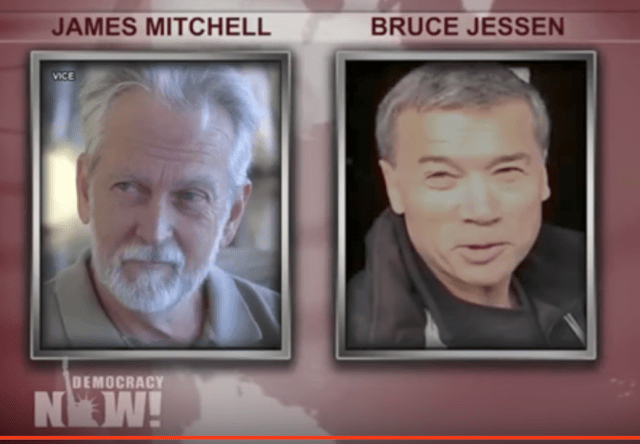
Civil Suit proceeds to trial against torture psychologists Jessen and Mitchell

The two psychologists pictured below were paid over $80,000,000 by the Bush administration to design a torture program for use against captured terrorism suspects.  The torture program was called “enhanced interrogation” to give the torture and inhumane treatment a fig leaf of legal deniability, just in case anyone later decided to follow up on the systematic violation of American and international law.   Nobody successfully did, until this ACLU lawsuit on behalf of two living and one murdered torture victim.  

Screen Shot 2017-08-08 at 2.05.39 PM.png

from a Spokane paper, Quackenbush is the District Court judge in the case:

In the last hearing, defense attorney Brian Paszamant argued that his clients only provided the CIA with a list of potential interrogation techniques.

“The problem is my clients were involved in drafting the guidelines (for the CIA) and didn’t know they were going to be applied at” CIA black-site prisons, Paszamant said. “There is a huge disconnect.”

Quackenbush asked Paszamant about the treatment of Rahman, who was placed in a diaper before he died on a cold floor. Evidence suggested that Jessen helped interrogate Rahman but it only included one slap to his face.

“I’m not sure a single slap to the face would constitute torture under international law,” Paszamant said last month.

Quackenbush replied: “He was tortured.”

Paszamant pointed out that Rahman died of exposure … “none of which my clients had anything to do with. I’m not at a position to acknowledge (Rahman) was subjected to torture.”

The judge then added: “That’s why we have juries.”

In his written findings, Quackenbush noted that the defense attorneys made “several unconvincing arguments” that there was no connection between developing the interrogation techniques and those applied to Sulieman and Ben Soud.    

source

Lawyers for these two psychologists also argued that the defendants could not be held accountable for their work because the scientists who invented Zyklon-B, the poison used in Nazi gas chambers, were not prosecuted at Nuremberg.   The judge rejected that argument as well.  He ruled yesterday that the case against these two will proceed to trial.