

(photo credit)
As we learn, words matter very much. What we call something frames the conversation and removes certain aspects completely from the discussion. Most of us recognize that there is a more truthful description of an actual incident and a less truthful one. Those who would manipulate public opinion seize the selected description that serves them best. We can see this daily in the asinine pronouncements of President Pantload and the often convoluted defense of these remarks by his loyalists. It is an old ploy: call the thing something else and we are no longer talking about the thing that concerns you the most.
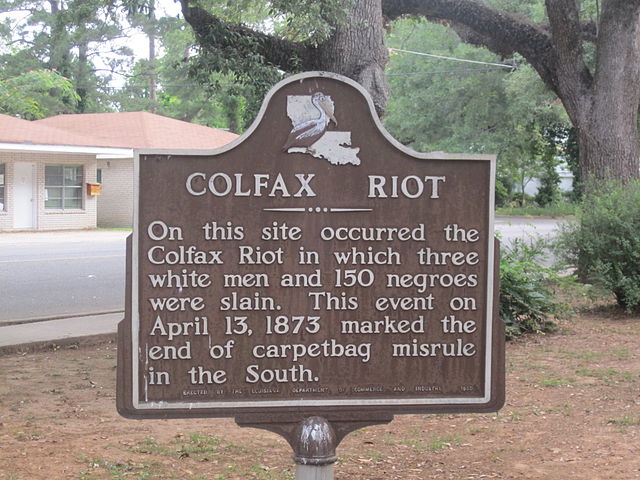
Look at the thirty-four words on this marker about an event that took place on April 13, 1873, Easter Sunday that year. A beautiful example of this.
Context: this incident took place less than a decade after the end of the Civil War, a war that grew out of a peculiar form of commerce, institutionalized racism and a region’s military defense of chattel slavery based on that racism and commerce. It is an American war that continues to rage, as a glance around today will confirm.
The side that lost America’s bloodiest war was forced by the winners to ratify constitutional amendments that would give full citizenship to a race that had until a few years earlier been mostly enslaved. The former Confederate states were not happy about being forced to do this, but they were compelled to sign so they could get Federal funds to restore the destroyed infrastructure of the South.
After the election of 1872 local whites were enraged that former slaves were again attempting to vote and, worse, were intent on trying to enforce the results of an election their candidate had won. An armed garrison of blacks guarded the courthouse at the county seat of Grant Parish, to ensure that their candidate was sworn into office. Local whites, heavily armed, most on horseback, with at least one cannon, besieged the former slaves guarding the voting box. After the surviving outnumbered blacks surrendered they were taken prisoner. Dozens of these unarmed prisoners were summarily executed by the mob over the next few hours.
Riot or massacre? You decide.
Note that three white men were killed. In a riot. Then 150 blacks were killed, probably while running amok. “You know how those people are…” is presumed here, I can almost hear the demur, lowered voice, almost apologetic.
The passive voice “were slain” is another great touch. You know, shit happens in a riot. It is so much more tasteful than “were butchered” or “shot point blank by members of a mob who also tortured many before killing them”.
Then the historical marker concludes, like an incompetent president doubling down, with the punchline, of sorts.
“This event on April 13, 1873 marked the end of carpetbag misrule in the South.”
It is amazing in its bluntness and accuracy, to cite only two ways it is amazing. Once local mobs could kill blacks with impunity there was no way the former slaves could hope to enjoy the rights of citizenship. It was probably the Supreme Court decision on the case a few years later, freeing all the white perpetrators/victims of the riot, that marked the end of so-called carpetbag rule, and the compromise that settled the 1876 presidential election, and removed federal troops, that led to the end of enforcement of the new federal laws in the South, the return of “home rule”, but that is a trifle.
The carpetbaggers were unscrupulous northerners who came down to plunder the helpless south after the war. There were a bunch of them, no doubt, and some enriched themselves in the manner of ticks gorging on the blood of a noble animal too weakened to resist. But the “carpetbag misrule” on that plaque refers to the efforts of the Federal government to enforce the constitutional amendments preventing slavery, extending full citizenship and the vote to former slaves. This “misrule”, enforced with troops and often called “bayonet rule”, included making the former Confederacy do everything it had gone to long and bloody war to prevent: treat its blacks as equal citizens. “Misrule” because it is so unfair for the victor of a war to impose its will on those who lost, no matter who fired the first shots.
The fucking issue is still being bitterly fought. The racism behind it is deeply baked into our society. Calling it by another name? Just more of the same.
Bravo, by the way, to the creators of that historical marker. Making America great again.
Dear Mr. Attorney General:
I am appealing to you for assistance, on behalf of many thousands of New Yorkers caught in a sometimes life-threatening situation regarding their healthcare. As described more fully below, citizens of our state have no government agency that intervenes in cases where patients are mistreated by the corporations we buy health insurance from. This is true even in cases of apparent fraud.
I urge you to propose legislation to correct this grave oversight. The need for state regulation of health insurance grows ever more acute in light of the current federal administration’s determination to gut all regulation.
I’ve followed your career and admire the principled and proactive steps your office has taken against the powerful perpetrators of various frauds. Leaving politics aside, as one must in a letter like this, it is gratifying to see someone in office holding powerful entities responsible for their bad acts. Your office is well-suited to fix what I believe is a healthcare emergency affecting the lives of countless New Yorkers who purchase private health insurance, particularly older citizens and those living just above the “poverty line.”
As frustrating as my healthcare-related ordeals have been, a 61 year-old currently trying to get treatment for kidney disease and skin cancer, I have the benefits of fluency in English, computer literacy, legal skills. It is hard to imagine the life-shortening stress that is inflicted on the elderly and other vulnerable New Yorkers unable to get so much as a hearing for often unappealable denials of health care.
It has been a challenge to put the many healthcare-related issues I’ve been forced to navigate into a streamlined letter. I’ve attempted to keep this letter short and dispassionate. To that end I provide some of the devilish details in a series of attachments. I have confirmed many times that my experience as a consumer who buys health insurance on the New York State of Health Marketplace (“NYSOH”) is representative of the experiences of countless others.
Attachment # 1 is a detailed description of the “consumer help” cul du sac that desperate NYS residents can spend a few hours in, looking in vain for help with health insurance-related troubles. Anyone in your office can retrace the useless steps. Creating a healthcare ombudsman position would be a good first step here.
Corporate “persons” are without conscience and motivated only by a zeal for profit. When left unregulated, it is no surprise such “persons” act as they see fit. In the case of health insurance companies, they are free, for example, to repeatedly refer patients to “in-network” doctors who are not actually in-network. They are also relatively unrestrained when refusing to provide services, under a variety of corporate rationales, in spite of what the Patient Protection and Affordable Care Act (“PPACA”) may have to say about it. There is no penalty for these common business practices and they are well aware of it. Regulations to address these things, with an enforcement arm, would be a good start. (see #2)
Those mandated by the PPACA to purchase health insurance from the New York State of Health Marketplace may find themselves with a host of new problems during the short holiday season window for purchasing insurance. A consumer advocate or ombudsperson on site at NYSOH would greatly aid in resolving problems, including simple mathematical errors, that presently can only be addressed by a lengthy appeals process. (See #3)
Billing irregularities, including improper bills, which are to be expected in a law as complicated as the PPACA, are probably the most common form of immediate stress most of us are regularly subjected to. The rep at your office’s consumer help desk offered help with billing problems, problems I suspect are legion. I offer a short overview of the larger problem and one recent snapshot as #4.
Thank you for your time. I am available to amplify anything written here and to testify anywhere you may require.
Yours sincerely,
From attachment 4:
The PPACA, whose primary drafter, Liz Fowler, went back to work in the health industry after her legislative work was done, apparently contains no provision that the cost of a medical service must be divulged to the patient before the medical service is performed.
The doctor’s office or hospital cannot tell you the fee until the insurance company sends them a statement. The insurance company cannot predict the fee until they get the provider’s bill. The insurance company then eventually sends the patient an Explanation of Benefits, (“EOB”), detailing all charges, payments made and the patient’s responsibility for whatever part of the negotiated rate insurance has not paid.
My kidney biopsy, for example, may cost the patient anywhere between zero and many thousands of dollars. Simply no way to determine the cost prior to delivery of the service, under current law. I had the procedure on May 26, I got the most recent EOB related to the procedure on September 28. In the intervening four months, I got many bills from the hospital.
Though there is probably nothing your office can do about this particular practice, I offer it as an illustration of the scope of the challenges facing New York healthcare consumers. I provide the following (obviously minus preamble, dear reader) as a snapshot of the general billing madness under our current regulatory scheme. I compare it to eating at a restaurant with no prices on the menu, and being sent a bill for the meal weeks later. Except, of course, that it is not a meal at a restaurant, it is often a matter of life or death.
An organization, seeking to foster a real conversation about our history of violent racism, lynching in particular, had the funding (from Google) to shoot me a compelling video ad on youtube that led me to explore their website. From their report:
When the era of racial terror and widespread lynching ended in the mid-twentieth century, it left behind a nation and an American South fundamentally altered by decades of systematic community-based violence against black Americans. The effects of the lynching era echoed through the latter half of the twentieth century. African Americans continued to face violent intimidation when they transgressed social boundaries or asserted their civil rights, and the criminal justice system continued to target people of color and victimize African Americans. These legacies have yet to be confronted.
The organization is called The Equal Justice Initiative. Their project is of crucial importance, in a country being made great again by people who deny our ongoing bloody history, and climate disruption, our 2500% higher rate of mass killing by gun than any other nation and many other horrors that are denied at our peril. The website is very well done. The historical section I read is clearly and beautifully written.
When I was in law school, twenty years ago, a case called U.S. v. Cruikshank was mentioned in a one sentence footnote in the casebook for Constitutional Law. As I began researching what happened to enforcement of the amendments intended to outlaw slavery, guarantee full citizenship to former slaves and give black men the right to vote, I stumbled on more details about the little known case. After reading the lower court decisions, and the Supreme Court’s final word, I came to understand that Cruikshank, as much as the aptly named Slaughterhouse cases (which gave a miserly reading of the rights of federal citizenship that would be our law for almost a century), was actually the death knell for the new rights of citizenship for black people in America.
When an organized, torch carrying crowd marched and chanted recently in Charlottesville, Virginia, protesting the proposed removal of a monument to the slaveholders’ armed rebellion against the U.S.A., the stink of an undiscussed history hung over that procession. There was the occasional shot of a screaming chap wearing a swastika, a chant about Jews, delivered by the marchers without love or irony, and also those carrying and wearing the symbols of those who enslaved and terrorized blacks. There was a near century, after the Civil War, of often public lynching that extended to twenty states, walking with these angry white men.
Most people, on many sides, many sides, have a revulsion for the symbols of racist regimes of the past, however little they might actually know about these notorious regimes. These symbols stand for a time when violent hatred ruled the day. That’s kind of the point of bringing these potent symbols to a rally. They are used to rub people’s faces in an easily recognizable worst case scenario for a minority, when the violent racists of the day ruled and the government smiled on the murderers.
Cruikshank was one of the leaders of a mob of angry whites, defeated Confederates, who swarmed into Colfax Louisiana on Easter Sunday 1873. They came heavily armed, on horseback, with at least one cannon. The whites were there to see that Negros did not get the final word on the vote, that no Negro take power over any white. They attacked the black Civil War veterans who were guarding the courthouse, defending the county seat of newly renamed Grant Parish after a bitterly contested election won, on black votes, by Republican advocates of black rights.
It was a slaughter, pure and simple. As many as fifty black men were killed hours after surrendering. The whites, who had overwhelming numbers, killed every black they came across, left their corpses rotting on the field on the day Jesus was resurrected and rose up to heaven. The failed federal prosecution of the perpetrators of what Eric Foner called the worst instance of racial violence of the Reconstruction era would, more than a century later, become a one sentence footnote in the Constitutional Law casebook. [1]
The federal prosecution over Cruikshank and his comrades was ruled unconstitutional by The Supreme Court. It said, amid pages of legal analysis that drily took the indictments apart point by point, that the Constitution protected former slaves only from government action– not from the actions of a private mob. It left enforcement of such crimes up to each individual state to deal with as they saw fit. The case quietly closed down all federal prosecution of outfits like the Ku Klux Klan.
The decision was a stinking piece of legalistic cavil, like other racially driven decisions over the years, but you can’t appeal that decision anywhere, of course, even if the Court is demonstrably sympathetic to the former enemies of the U.S. The ruling in Cruikshank led to all the defendants walking, triumphant as that iconic grinning Southern sheriff with his Red Man chewing tobacco pouch almost a century later, into a long period of unrestrained, often deadly, brutality against former slaves.
Here is a historical marker, put up by the state of Louisiana in 1950, photographed by Billy Hathorn (photo credit here).
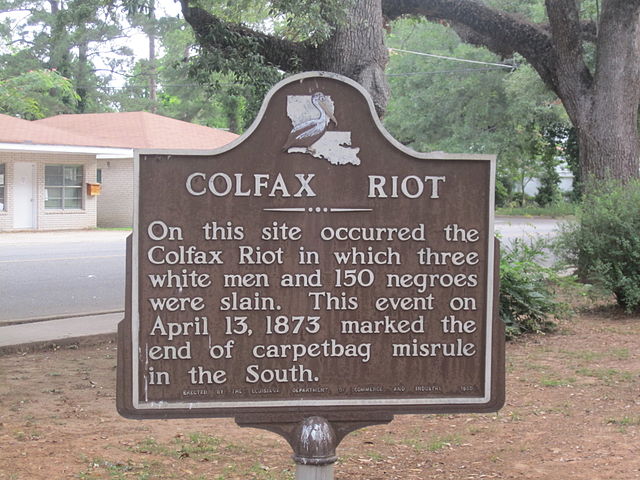
At the end of the twentieth century only an enterprising law student with an overriding interest in history could find out anything more about the case, about the then largely unknown Colfax massacre, about any of this shit. As we march along in the twenty-first century, this is the kind of history we need to be learning from together. This website is an excellent tool for learning.
As the director of the Equal Justice Initiative writes:
We cannot heal the deep wounds inflicted during the era of racial terrorism until we tell the truth about it.
True dat, as my father would say.
[1] how’s this for a footnote?
Opposition among white Democrats to suffrage for blacks resulted in 1,081 political murders from April to November 1868. Almost all of the victims were black, and some of the whites who were killed were Republicans.
The eagle eyed (or more accurately eagle eared) Sekhnet had a good comment on the letter to the A.G. I need a more dramatic, attention grabbing opening sentence. One must not bury the lede. Can’t make a sale without a good pitch, and a good windup is essential to ze nasty break on zat strikeout pitch.
The present draft begins with this bland statement (note passive voice use, it’s not like it was written by me, he said):
I am writing to give you an on-the-ground view of the stressful health care situation for hundreds of thousands of us in New York State.
Admittedly, not much there to grab you.
My more fiery, overwrought first draft, months back, opened:
I am writing to alert you to a massive consumer protection failure in New York State, regarding denials of purchased health care, and to urge your office to investigate this unchecked fraud.
There might be something there… but not enough.
I am writing to alert you to the scope of the healthcare crisis for tens of thousands of New Yorkers…
Sekhnet dictates (with some on the fly revisions):
I am appealing to you for assistance on behalf of many thousands of New Yorkers placed in an untenable position regarding their healthcare.
This also needs to get worked in early on, I suppose:
As frustrating as my medical insurance ordeals have been, I have the benefits of fluency in English, computer literacy, legal skills. I cannot imagine the life-shortening stress that is inflicted on the elderly and other vulnerable New Yorkers unable to get so much as a hearing for often unappealable denials of health care.
On the other hand, since this is the holiest day of my great-grandfather’s religion, and a fasting day, at that, I’d better wrap this up and get ready to bring these fruits I’ve been slicing and the other things we’ve been preparing up to our gathering to break the fast. Once it gets dark. That first drink of orange juice never tastes better.
For reasons too tedious to detail here, I will use this platform to compose the beginning of a draft to New York State’s activist attorney general urging him to take action. This AG is the guy who successfully sued President Winner over his fraudulent university. In NYS the AG also proposes and advocates for legislation, as it turns out. I have a plan. Relatively short, streamlined cover letter with several attachments laying out the infernal particulars. Blah blah (see #1) blah blah blah (#2) etc.
Dear Mr. Attorney General,
I am writing to give you an on-the-ground view of the stressful health care situation for hundreds of thousands of us in New York State. As described more fully below, citizens of our state have no government agency that intervenes in cases where patients are mistreated by the corporations we buy health insurance from. This is true even in cases of apparent fraud.
I urge you to propose legislation to correct this grave oversight. The need for state regulation of health insurance is even more acute in light of the current federal administration’s determination to gut all regulation.
I’ve followed your career and admire the principled and proactive steps your office has taken against the powerful perpetrators of various frauds. Leaving politics aside, as one must in a letter like this, it is gratifying to see someone in office holding powerful entities responsible for their bad acts. Your office is well-suited to fix what I believe is a health care emergency affecting the lives of countless New Yorkers, particularly older citizens and those living just above the “poverty line.”
It has been difficult to put the many healthcare-related issues I’ve been forced to navigate into a streamlined letter. I am certain that my experience as a consumer who buys health insurance on the New York State of Health Marketplace is representative of the experiences of countless others. I have confirmed this many times over the last few years.
As frustrating as my ordeals have been, I have the benefits of fluency in English, computer literacy, legal skills. I cannot imagine the life-shortening stress that is inflicted on the elderly and other vulnerable New Yorkers unable to get so much as a hearing for often unappealable denials of their health care. I’ve attempted to keep this letter short and to include the devilish details in a series of attachments.
I am therefore attaching a detailed description of the “consumer help” cul du sac that desperate NYS residents can spend a few hours in, looking in vain for help with health insurance-related troubles. Anyone in your office can retrace the useless steps. Creating a healthcare ombudsman position would be a good first step here. (see # 1).
Corporate “persons” are without conscience and motivated only by a zeal for profit. When left unregulated, it is no surprise these “persons” act as they see fit. In the case of health insurance companies, they are free, for example, to repeatedly refer patients to “in network” doctors who are not in network. They are also relatively unrestrained when refusing to provide services, in spite of what the Patient Protection and Affordable Care Act (“PPACA”) may have to say about it. There is no penalty for these common business practices and they are well aware of it. Regulations to address these things, with an enforcement arm, would be a good start. (see #2)
Those mandated by the PPACA to purchase health insurance from the New York State of Health Marketplace may find themselves with a host of new problems during the short holiday season window for purchasing insurance. A consumer advocate or ombudsperson would greatly aid in resolving problems and errors that presently can only be addressed by a lengthy appeals process. See #3
Billing irregularities, including improper bills, which are to be expected in a law as complicated as the PPACA, are probably the most common form of immediate stress most of us are regularly placed under. The rep at your office’s consumer help desk offered help with billing problems, which I suspect are legion. I offer a short overview of the larger problem and one recent snapshot as #4.
Thank you for your time. I am available to amplify anything written here and to testify anywhere you may require.
Yours sincerely,
Let us stipulate that the wealthiest citizens of this nation, as a polity, are not greatly concerned with the illness or death of masses of Americans who did not have the good sense to be born into the right social circumstances. We have a privatized health care system here that would be a cause of great national shame, in a nation where shame for such things was still possible. We are, as a nation, shameless fucks. A glance at any of President Fuckface’s recent tweets will confirm this, whatever mix of disgust and shame we may also personally feel as a result.
Here is a letter I was compelled to write today:
Pat Wang
CEO Healthfirst
100 Church Street
New York, NY 10007
Dr. Ms. Wang:
I appreciate that you allow your reps to give out your contact information to customers who can’t otherwise resolve issues with your staff. This encourages me to think that you might be helpful in resolving an aggravating billing situation that has been ongoing for months. I applaud your willingness to be contacted, it shows integrity and is in stark contrast to the policy of Donna Frescatore, director of the “New York State of Health” (NYSOH) ordering her reps not to divulge her name to callers.
I request a corrected bill and an accounting showing my remaining credit toward premium payments. The credit situation is described below.
During an August 25th call to Healthfirst to try to resolve the issue of incorrect bills being sent to me, my “case” was assigned an “escalation number” (347-79-923). I was promised an accounting, showing payment history and current credit toward future premiums. I received instead a notice, dated September 8 and signed by Christopher A. DiMarco, threatening me with cancellation of my insurance for a claimed past due balance of $28. On September 19 I called Healthfirst and was assured that credit had paid my September premium.
I was also informed during that call that “finance” had included no notes on my account. I could not be sent a simple receipt for payment or anything indicating my remaining credit. I was assured by an extremely sympathetic rep that my account was paid through October, with credit remaining toward November’s premium.
Attached is the invoice I received on September 25. It states that I must pay $482, on pain of losing my health insurance (as I begin treatments for kidney disease and skin cancer). It has been mailed to me in error. I have a credit of several hundred dollars due to overpayments made as a result of NYSOH’s error. NYSOH incorrectly denied my subsidy for 2017. It took months, and a ruling by a hearing officer, before NYSOH was ordered to restore the subsidy, about fifty percent of the premium.
As a result of NYSOH’s error, I was required to pay Healthfirst the full premium from February through June. When I got a bill for July I called Healthfirst and learned that a credit had been applied for my overpayment. After payment of July’s premium the rep calculated my remaining credit at $876.
Since then it has been a health insurance headache every month. In another context, it would be tempting to characterize the attached invoice demanding a large payment for a premium I have already paid as an attempt at fraud. I am sure it was sent to me in error. Please have somebody update my account and send me an accurate statement of my payments and remaining credit.
Thanks,
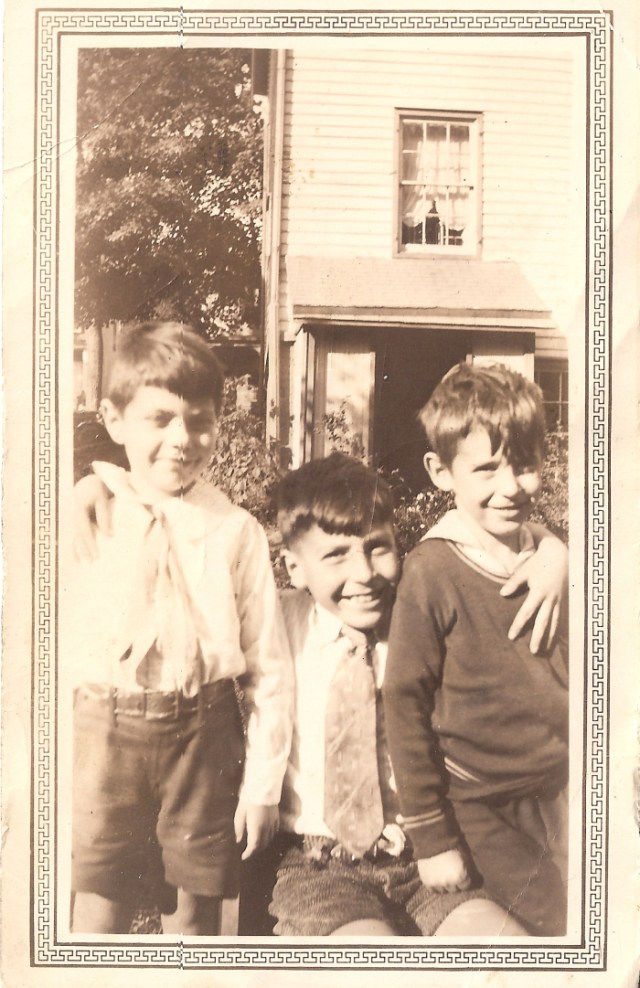
This photograph, taken at the nadir of the Depression, showed up in a box of photos we looked through after my father died. My father is in the middle, hand on the chest of his little brother Paul, the other arm draped around the shoulder of the urchin in the white shirt. They are all in short pants, and the two older boys wear ties, likely for school. I asked my uncle who the other boy was.
“That’s Herman,” my uncle said.
That was about all I learned. Herman was a friend who moved away from Peekskill not long after this picture was taken. I have no idea who took this picture, a person rich enough to own a camera, or if there was a particular reason it was taken on that sunny day. Maybe it was taken because Herman was moving and wanted a memento of his friends the Widem boys. I have no idea whose house that was behind them, it could well have been the house on Howard Street into which Uncle Aren put the impoverished family of his youngest sister.
I look at the photograph through a forensic lens, as an artifact of deep archeological interest. It is one of a small handful of photographic clues I can study. My father is clearly much bigger than his younger brother and Herman. He is sitting, or squatting, and almost the same height as they both are standing. I put my father’s age at seven or eight, based, in part, on my uncle looking five or six years-old. I’m thinking Herman must have been my uncle’s friend, though they all seem very cozy and friendly smiling for the camera.
The expressions and attitudes in photos, of course, can be grossly misleading. I think of a series of photos I found in an album of my mother’s, taken during a festive dinner at my parents’ house. I am beaming in every one of the photos on that two page spread. Grinning from ear to ear, my arm around my aunt, interacting with everyone with a huge smile on my face. The over-the-top happiness I am showing in every picture made me wonder what the hell I was so happy about. I did the math to figure out when the pictures were taken. Right in the middle of a six month period that felt to me like a profound depression, a time of personal darkness when I was monosyllabic and dreaded everything.
So I don’t put too much stock in the tender hand on my uncle’s chest, the smiles all around. My uncle flinched around my father right up until my father was on his death bed. It appears he had reason to flinch. The one story my father told, with some glee, from his unbearably awful childhood, was about the time he stuffed his brother’s mouth with raw chopped meat. Apparently well worth the ass-whupping he no doubt got for it, he chuckled about it decades later. So the tenderness for the camera, while charming, even endearing, doesn’t convince me very much.
Although, it must be said, when my father was dying, once I arrived in Florida, all he wanted to know is when his brother was getting there. I picked my uncle up at Ft. Lauderdale airport and from the time I brought him to the hospital the two Widem boys clung to each other. My sister and I were both struck by the poignance of that. After my father died, my uncle sat with his brother’s dead body, accompanied by my brother-in-law, until the hospital finally made arrangements for the body to be taken downstairs to be watched over by the Chevrai Kadisha, the Jewish burial society, eventually sent over by the Florida affiliate of the funeral home in New York.
What strikes me from the photo, outside of my father’s terrible haircut, the inexpert work of some family member, no doubt, is that my father, with his 20/400 vision, is still not wearing glasses. My father always wore glasses, he was legally blind without them. Late in his life a new laser procedure corrected his vision to virtually 20/20. For the first time in his life he didn’t need glasses to see beyond a foot or two, to drive.
“He looked so weird,” my mother told me, “that I made him get a pair of glasses with clear glass lenses and he wore those. I was so used to him with the glasses, he was almost unrecognizable without them.”
I remember the instant splitting head ache his glasses gave me the one time I tried to look through them. I have his last pair of glasses in my baritone ukulele case, where I put them when I took them off his face minutes before he died. The lenses are, indeed, clear glass.
But here’s my father, as a school kid, with no glasses. He’s looking at the camera, and the person instructing the boys to hold still and smile, and he’s seeing only a blur, benignly smiling at nothing he can see. How long would it be before the boy who grew up to become my father would get the glasses that saved him from life in the retarded class at that Peekskill elementary school?
There is nobody alive to answer most of the remaining questions I have. There are only the educated guesses of an amateur sleuth. And not a dispassionate sleuth, by any means.
I am understanding, slowly and by unsteady steps, that we don’t grasp anything important about deeply emotional things in a hurry. The pieces of the story we think we have start to come together in their own time, if enough focus is applied to them, if we are fortunate. The pieces that can never be known for certain become more or less likely after they are considered again and again, compared to other pieces that feel like they fit right.
I don’t pretend to understand how this process works, or even if it works, but it feels to me, some days, like the story of my vexing father is beginning to shape itself into a book.
I was my father’s primary adversary from before I could remember. We rarely had a conversation that wasn’t contentious, or had some element of sparring. I am told that I was born “with a hard-on against the world.” That was the phrase both of my parents always used, my father who fought me from the git-go and my mother who dearly loved me. I don’t recall my early, pre-verbal provocations, but they were famous in family lore.
“When we brought you home from the hospital the crib was on my side of the bed,” my father told me. “You’d stare at me through the bars of that crib with these giant, black accusatory eyes. You would just lie there staring at me. You’d never even blink, every time I looked over, those two black eyes would be staring at me. After a few days we had to move your crib to the other side of the bed, to mom’s side.”
It rang a bell. I remember as a new-born thinking ‘who the fuck is this asshole?’ I eventually admitted as much to my father, it seemed fitting under the circumstances. It was the way it was, the way it had always been, the way it would always be, until the last night of my father’s life.
“Well, don’t take dad’s word for it, Elie,” my mother explained. “Some babies are just born angry. You were a very angry baby. One day when you were about ten weeks old you turned bright red, and you were completely rigid, and crying, with your mouth wide open like you were trying to scream. We got very alarmed.”
“Your little fists were balled up and your arms and legs were straight out, you were stiff as a board, and red as a beet,” my father said.
“We rushed you to the pediatrician, who took one look at you and burst out laughing. He said he’d never seen it so young, but you were definitely having a temper tantrum. ‘This baby is definitely having a temper tantrum,’ he told us. He really got quite a kick out of it.”
I’m so glad he got a kick out of it. I remember him from that day, actually, and recall thinking, as he threw his head back and laughed through his donkey teeth — too bad I can’t talk yet, I’d love to register a stinging complaint with the medical ethics board against this arrogant asshole of a pediatrician.
My parents blew past all the obvious questions, relieved and vindicated by this pediatrician’s expert opinion. Did this excellent baby doctor, I wondered years later, offer a theory as to why a baby only ten weeks old could be so angry, outside of plain, native orneriness?
Was it possible I could I have been freezing, or thirsty, or had a diaper rash, or something like that? A terrible itch, a broken bone, perhaps? Could I have been trying to scream, ‘would you please feel my little feet, which are ice cold, and throw my blankie over me? I know it’s been a hot summer for you, and the cool breeze feels wonderful to you, sitting outside, chatting with your friends, but I’m skinny, just a couple of months old, don’t weigh much, and I’m freezing my ass off…’
ii
I write this account of my father’s life and times in the form of a dialogue, mostly, because that seems the best way to show him in action. My father had a certain way of expressing himself, inimitable, really, and I have tried to convey it as faithfully as I can here. He could bullshit with anybody, was adept at conversation. He enjoyed chatting, was very knowledgeable about many things and he had a quick wit and a dark sense of humor.
The fact is, he’d have very much enjoyed a lifetime of shooting the shit with me, he told me as much as he was dying. He took the blame, said he’d felt me reaching out many times over the years, but he’d been too fucked up do anything but fight. He took the blame for that, regretted it. Expressed his regret very sincerely. I had no reason to doubt him.
iii
I was writing this ms. for almost two years when I had a revelation about my father’s mother, my grandmother Chava. It became obvious to me that my father got the way he was honestly, as his violent little mother created him. I recently saw it from her point of view.
She died a few years before I was born so all I know of her is that she was barely five feet tall, had red hair (and according to Cousin Eli had been a beauty), was very religious and had a famously violent temper. I learned that she had regularly whipped her infant son, my father, across the face with a heavy cord. She also called him “Sonny”. I conclude from these things that she was an enraged psycho of some kind. But I eventually came to envision her life from another angle.
Eli told me she’d fallen in love with a Jewish post man, while living with and working for her older brother Aren and his second wife in Peekskill. According to Eli, this red haired Jewish postman was smitten with Chava, and Chava liked him. Also according to him, Aren and his wife busted up the romance. “She didn’t want to lose her slave. Chava was indentured to them, paying off her passage from Europe as their live-in maid, and she told my father to get rid of the postman. And he did.”
Years later a marriage was arranged by Aren for his little sister, now on the verge of becoming an old maid. The groom was a man without prospects, Eliyahu Widem. As the punching bag of his father’s second wife, he had learned to duck and keep all expression off his face. That was about it, from what I can tell. Chava found herself living in dire poverty, in a rented hellhole on Manhattan’s teeming, disease and crime-ridden Lower East Side, married to a cipher.
Her new husband drove a herring wagon, the horse clopping from store to store. When the horse stopped in front of a store, he’d get down and wrestle a barrel of herring inside. When the horse died he went out with a new horse. The new horse had no idea of the route, neither did my grandfather. When he returned at the end of the day with a wagon full of herring barrels, he lost that job.
At some point in the story Chava delivered a still-born girl, or perhaps the infant girl died after a few days. I can picture the dark, scary tenement, and Chava’s depression and mounting desperation. I can imagine her, a year or so later, naming the new baby boy, a huge newborn who must have been a difficult birth for the tiny, terrified Jewess. I can picture it now. “Israel, Azrael, Widem, Widaen, I don’t give a fuck. As soon as this kid can stand on his own legs I’m going to start knocking him down.”
And she did.
In our Free Market, where unfettered competition (LOL) for higher profits is the only order of business, those corporations who manipulate their customer base the best are the most successful. If sharks are in charge of all public policy, it is not surprising their only priority will be meat. If maximizing their supply of meat depends on intimate knowledge of the habits of those they eat, they will get that competitive edge, whatever it takes. Data collection and sophisticated data crunching are essential to wholesale meat-eating in our complex, digital world.
The genius of that twat who invented Facebook, for example, was to combine the essential loneliness of disconnected people, their hunger for connection, and a seamless way to harvest the essential data and psychological profiles user-expressed preferences provide. This valuable data can then be sold to shrewd data-mining operators. No wonder the fine fellow is a multi-billionaire. The valuable real-time marketing research information revealed to a company like Facebook is incredibly useful commercially and politically, as the recent American presidential election demonstrated.
Now we come to Cambridge Analytica, a company that specializes in data-driven results, commercial and political. From its inception it engaged in psyops, psychological warfare, using whatever means were necessary to win hearts and minds to persuade the persuadable towards the wishes of their clients. It is owned by reclusive billionaire and Trump savior Robert Mercer, no slouch in data analysis himself. The company began with a huge cache of psychological user profiles obtained from Facebook. As an article in the Guardian states, in connection to Cambridge Analytica’s major role in determining the outcome of the Brexit vote:
Facebook was the source of the psychological insights that enabled Cambridge Analytica to target individuals. It was also the mechanism that enabled them to be delivered on a large scale. source
From that same article, a description of the company’s mission, by an ex-employee:
“Psyops. Psychological operations – the same methods the military use to effect mass sentiment change. It’s what they mean by winning ‘hearts and minds’. We were just doing it to win elections in the kind of developing countries that don’t have many rules.”
If you want to throw up in your mouth a little, all you need to do is read this Wikipedia entry. It is not long, but it is perfectly chilling. I’ve never read a Wiki more horrifying. Then, if you want a real shiver of horror, click here. All you need to do is click “political” on the home page, right there next to “commercial” and look at the first screen that pops up. I watched the images on that screen loop for a minute, words failing me, unable to click any further. As a service to my reader(s) I revisited the site. A click-through of the CA Political menu, accessed through the three bars top right, was grimly rewarding.
Data drives all we do, yo. Persuasion vs. Manipulation– who is to really say? Isn’t it really a matter of opinion? Opinion is as American as apple pie and a bloated military budget. “Manipulate” is such a poisoned and judgmental word. Is it even against the law to manipulate people? If so, a lot of our largest, most lucrative businesses would have to close shop. LOL!
Secretive billionaire computer genius Robert Mercer bought the company a few years ago, fair enough. Oh yeah, his friend Steve Bannon partially owns Cambridge Analytica, or owned it, or at the very least was until recently vice president of the sophisticated propaganda machine– at any rate, he disclosed $125,333 in income from the firm last year. And Kellyanne Conway’s consulting firm did work for Cambridge Analytica in 2016. The company is now reportedly getting military contracts from the Department of Defense under Trump. Yeah, so what? Your point is?

