Anger Makes You Mad

Neuroscience has identified the part of the brain that lights up when we are angry — the insula, deep in the cerebral cortex.   When the insula is aglow fight or flight chemicals like adrenaline and cortisol are released and the mind is literally disabled from making fine, or even gross, distinctions.  

A truly angry parent may actually be physically incapable of seeing the harm in venting against a young kid who has provoked them to rage.  Incapable of seeing the damage done by slapping the kid, or locking the kid in a dark closet and turning the music up to drown her screams or raging wildly against the child’s sense of self. 

This shut off of the moral faculty when rage is upon us seems like an obvious point, but it really isn’t.  Angry and “mad” are synonyms, but even that is only a hint of the obvious.  

The other side of being angry is that we instantly justify our anger, even though these deeply-held justifications often don’t bear much scrutiny.  All available evidence, when we are mad, points to our being absolutely right to be angry.   The urgent reason we feel angry couldn’t be more obvious, to us.   It’s telling, and very human, that the only non-physical faculty that continues to work when we are enraged is our homo sapiens ability to justify ourselves.

This trait, rage making one resolute and incapable of seeing another person’s point of view, is what makes war possible.  It explains mob lynching and every other atrocity.   Rage makes people support deadly policies of all kinds.   We don’t see the victims of war, lynching or deadly policies as humans with souls as unique and precious as those of the people we love.   We see them as irredeemable fucking assholes who deserve what they fucking get.   If Donald Trump had a massive stroke during a nationally broadcast speech, many Americans would feel no empathy for him, some would even laugh.   Reminds me of a great line of Trump’s, from early in the presidential campaign when he was picking off his Republican opponents one after another.

 I think it was Ted Cruz, right before he was voted off the island, who introduced a woman, I think it was Carly Fiorino, as his running mate (turns out Carly introduced “our next president” Ted Cruz — ed.).   The woman turned on stage and seemed to fall into a manhole.   She stepped forward and just went down.  Trump showed the great clip to his crowd at a rally.  The crowd loved it.  He pointed out that nobody on stage had gone to help her.  “Even I would have helped her,” Trump said with a smile and a little shrug.  “Even I!”   Cracked me up.    

My grandmother, no stranger to anger, liked to calmly say, after she’d provoked me with some harsh comment about my work ethic, “I know, I know… the truth hurts, I know…”   I’d sputter on in defense of the thing she had just attacked and she’d smile, and nod, and sympathetically tell me that the truth hurts, that she knew, she knew.   I loved her, but that was some hard to come back from shit.  

There is this, though: the things that will make us most angry are things that attack us where we are most vulnerable.   A shameful secret, dangled sadistically.  Noting a particular weakness we know we have.   Bringing up something painful in a way that seems unfair.   Making an issue of our greatest fear.  

I’m no expert on anger, but I have studied it for many years, since it played a terrible role in my life going back to my earliest days.   It turns out there are ways to avoid an angry confrontation, methods to defuse anger rather than escalate it.  

The intellectual part is hard enough, recognizing the maddening principle at work, the exact, familiar thing that pisses you off, before the anger takes over, and then learning what you need to say and do next to avoid escalation.   That intellectual understanding is crucial for de-escalating the situation.  It’s hard, but over time we can get better at recognizing the signs that we are about to get mad and take the steps that have worked in the past to calm our reactions.

The emotional component of anger is the truly hard part to master.   The overwhelming feeling of injustice hits us hard out of nowhere.  Suddenly we are under attack, the stress chemicals flowing, the insula lit up, the justifications for our anger mounting aggravatingly.  That, my friends, is the fucking hard part.   Something to think about while you consider how you feel about the idea that anger, even rage, is inevitable in human affairs.   I would not concede that in my own relations.


“The Record”

For the record, I should note that generally, except for a few technical, crucial, implacable details set forth in the official record, for the general public there is really no official “going on the record”.   The exact content of the official record is something for very well-paid lawyers to argue about with the government’s lawyers.  The general public is often allowed a single participatory session to express its opinions on the matters under debate/ They speak “on the record”, but strictly speaking, their contributions to the record do not include any direct input into the debate, except through the votes of their elected officials (all of whom, in this case, appear to weaselishly favor a secretive economic development plan their constituents hate in overwhelming majorities). 

I spent a few hours today writing a statement for the record on that matter of urgent public concern, written comments had to be in within a few days of last night’s public meeting.   Good day’s work for a Friday.   In one way writing a statement for the record was a gesture of futility and, at best, a symbolic protest.  In another sense, and the way I thought of it, it was my clear duty as a citizen and neighbor to write on our mutual behalf.   I’m always happy to use my writing to try to convince someone to do the right thing.  This writing is partly sad, and partly also, writing it is a very helpful meditation exercise — feeling my way toward the connections to make this story more personal, a story to move an emotional individual toward mercy and away from a knee jerk to violence.

Anyway, I sent a copy of my previous post out to several friends and to my sister.  I wanted to let them know what I found myself up against, what I learned, how clearly I hopefully was able to describe it, and to eventually get a pat on the head or two from even one or two of them.

To my lawyer colleague and friend of almost half a century I offered the link:
Check this shit out, for a short busman’s holiday.   Anonymous frontmen for some Jareds and Donalds have their beady eyes on my neighborhood, and they spent $1,000,000 in public funds laying out a radical rezoning plan.   We’re all about to be fucked, so I went on “the record” the day after the sole “Public Hearing” into this matter of public concern the public had no other input into.

To my sister, who had recently compared me to her husband, a man she described as sitting in his easy chair and yelling at the TV, I wrote:

You can either yell at the TV or take action of some kind.  The most recent action I’m taking is to put my opposition to the planned sale of my neighborhood “on the record”.  I was encouraged that the public hearing last night was packed.  I think the facts I set out below speak for themselves, as did many of the community residents who spoke very well last night in opposition to this boondoggle for rapacious wealthy fucks.  150 neighborhood people signed up to speak, I heard about the first 40, then went home to start putting this together as my public comment.

The fucks will probably ram this corrupt rezoning plan through, because that’s what the lawyers who work for the Jareds and the Donalds get paid to do.  These types are allowed to ram rezoning plans down the throats of local opposition because their poop emits no foul odor and so forth.  The sweetness of their excretions does nothing to relieve the rest of us of our duty as democratic citizens to oppose their foul, if odorless, plans.

>Anyway, read on for the sickening/encouraging details.

To a thirty-two year old neighbor, an ecologist and an idealistic environmentalist, son of two of my oldest and dearest friends, I wrote:

Don’t know if you made it to the meeting last night about the proposed rezoning of Inwood.  To my surprise there was a raucous, standing room only crowd in the auditorium of the school across from the 9 cent store on Broadway and Academy.   150 people signed up to speak (I made it through the first 40 or so), so I contented myself with submitting this comment for the record.   You have until the end of February to submit a written comment, if you are so inspired.


Written Statement to Community Board 12M

It was gratifying to see the standing room only crowd at the public hearing at I.S. 52 last night, in spite of the opaque public notice of the hearing, to discuss various ULURP application numbers.   People turned out en masse to resist a plan that puts neighborhood residents and small businesses last as developers plan to profit off the largely unexploited northernmost section of Manhattan island.   150 people signed up to speak to a boisterous crowd, many of whom held signs that said things like “La Gente Antes de Lucro” (“People Before Profits”).  The rest of us were told we had a few days to submit a written statement for the record.  I had a chance to review a few of the hundreds of pages of dense bureaucratic documents prior to the meeting.  There are some devilish details in there.   I’m determined to write a cogent, one page statement for the Public Hearing Record today, to wit:

I submit this comment as part of the public record of the 2/22/18 Public Hearing on the Inwood Rezoning Proposal.

Inwood is a small, fairly quiet working class community, with old residential buildings and a large, beautiful, well-used park.  It is no mystery why it would be so desirable for real estate developers.   The unique charms of the NYC neighborhood I’ve called home for more than forty years are currently protected by zoning laws that have largely prevented it from being overrun by developers like the ones hatching the current plan under discussion.   

The lack of transparency of the Inwood Rezoning Proposal is striking — the meeting was called for a public hearing to discuss ULURP applications identified by number only.  No plain English/Spanish abstract of the proposal was made available for consideration before the public hearing.   The details of the ambitious rezoning plan must be gleaned from a few hundred pages of bureaucratic text, some of which I was able to ​read (CEQR No. 17DMEOO7M) at the doomed Inwood Public library prior to the public meeting.  The details that follow come from that report.

New affordable housing:  25-30% percent of the proposed construction, meaning 75% would be “market” or luxury units, radically changing the character of this stable, ​working class neighborhood.  The building of 3,804,435 sq. feet of residential space would increase the population of this small area by more than 12,000.   An additional 50 tons of solid waste per week would be generated by this increased population.  50+ passenger car equivalents per project peak hour on already crowded mass transit would be required to transport commuters.  The A train is already one of the worst running​, and most crowded, in the city, there are often no seats on the train at eleven pm.   Air quality:  “proposed actions generate vehicle traffic exceeding emissions threshold.”   

The rezoning plan would quietly make the Inwood Public Library “collateral damage” depriving us all of a valuable public resource.  The children of our community would be denied a place to get books, to do research and study, in a neighborhood whose schools have already closed their libraries.  The representative from the Economic Development Corporation spun the planned demolition of the neighborhood’s library (“the library project”) unconvincingly:  “the library project creates more than 100 affordable housing units”.   No plan for an interim library was presented.  Presumably the rebuilt library would be housed on the first floor of the large, 75% market/luxury high-rise to be placed on the library’s current footprint and that of the adjacent property.  There are provisions in the plan for the construction of a private school and a “community center”, presumably for the benefit of the some of the 12,000 new Inwood residents.

We read that because the commercial/residential mix would not “directly displace 500 or more residents” many disclosures in the application can be skipped. Shadows longer than 50 feet would be cast by new construction made possible by the rezoning, removing sunlight from streets, necessitating the inclusion of more bureaucratic language in CEQR No. 17DMEOO7M.  Proposed “sidewalk widening” is no answer to severe crowding, noise, pollution, increased sewage flowing into an old, overtaxed sewage system.   We don’t need pedestrian malls or doublewide sidewalks in Inwood, we have a beautiful park for strolling in.   We particularly don’t need this constriction of our streets if vehicle traffic is expected to become much worse under the plan.

This is a plan that puts the interests of wealthy real estate developers first, local residents and business people of Inwood last.   City Councilman Ydanis Rodriquez tried to spin the question as largely a matter of perception: fear of gentrification, perhaps fear of progress.   There is often something irrational about fear, although we have all seen such “progress” all over the city.   It benefits the rich while hurting everybody else.   This is a plan I’d expect from Bloomberg’s real estate cronies, or Trump’s.   It must not be allowed to happen in Northern Manhattan.  Please vote “No” on the Inwood Rezoning Proposal. 

NOTE:  crap, forgot to attach this document  much referred to by many of last night’s speakers!

Smiling Partisan Creep

I don’t really want to get into politics here anymore, but I read about a remark from Mitch McConnell just now that made my fists involuntarily clench.   McConnell, oddly enough, had warned Obama’s people that any action taken against Russian interference in the 2016 election would be denounced as a partisan political act. 

The president recently lashed out at his predecessor, Barack Obama, for not doing anything to stop Russian meddling in the 2016 election.  Reports came out that U.S. intelligence agencies briefed Obama on this meddling in the summer of 2016 and that he failed to adequately protect the election from it.   Trump blasted Obama with a few harsh tweets, as is his style, dating back to his Birther days.

One reason there was no bipartisan action taken to protect the 2016 election from foreign influence was that Obama was politely but firmly told to fuck himself when he asked GOP lawmakers for their support.   Mitch McConnell, a smug man with a face only his mother could resist punching, reportedly told the president no when Obama’s people asked for bipartisan support of an aggressive response to Russian interference in the 2016 election.  As the Washington Post reported:  

In a secure room in the Capitol used for briefings involving classified information, administration officials broadly laid out the evidence U.S. spy agencies had collected, showing Russia’s role in cyber-intrusions in at least two states and in hacking the emails of the Democratic organizations and individuals.

And they made a case for a united, bipartisan front in response to what one official described as “the threat posed by unprecedented meddling by a foreign power in our election process.”

The Democratic leaders in the room unanimously agreed on the need to take the threat seriously. Republicans, however, were divided, with at least two GOP lawmakers reluctant to accede to the White House requests.

According to several officials, McConnell raised doubts about the underlying intelligence and made clear to the administration that he would consider any effort by the White House to challenge the Russians publicly an act of partisan politics.

source

Hey, McConnell should know.   Just ask Supreme Court justice for life Neil Gorsuch.   Like our current president, McConnell is a man who has never been wrong, certainly not on matters of partisan politics.


Shitbox v. Loxbox

The tiny car Harold Schwartzappel pulled up in on 190th Street to rescue me from a deluge may have been a Fiat, or a Renault, or possibly a Peugeot, whichever company made a cheaper model circa 1964.  My father referred to Schwartzappel’s car as a shitbox, and compared to the well-appointed cars my father always drove, it did seem like a tin can as I got in and slammed the flimsy door.   

The engine of the shitbox had been rebuilt by Harold, if I recall correctly.   My father knew almost nothing about car engines, though he’d worked in his uncle’s garage for years.   The first car my father had was a big, bulbous orange and white Pontiac my parents called the Loxbox.  I recall sitting in the back seat of the Loxbox as a young kid.  The seat was upholstered in soft leather.   I don’t think the Shitbox was upholstered at all.

My father was happy to drive around in the American Dream, while Harold, a confident tinkerer who spoke several languages and played many musical instruments, made do with his Shitbox.

Two or Three Approaches to Dealing with Vexation

When dealing with a problem we can assemble all available information, analyze it as best we can and honestly discuss all options for solving the problem.   We can select only the information we agree to put on the table and talk about that, a more limited approach.   We can agree not to talk about controversial or embarrassing subjects and agree that the problem is not something we will ever solve.   I’ve always been in favor of the first approach, though it is no longer generally accepted as the way to solve problems.  The second and third ways are much more common.  These approaches apply to solving problems in our civic and personal lives.

As a citizenry we no longer expect disclosure from the powers that rule us, we expect spin.   We are not given access to all of the pertinent facts, we are given a few facts in the context that will cause us to hopefully buy those facts, as presented.   There is a fundamental divide in how people approach the things that vex us: we can yell at the television or we can read, analyze, discuss and write.  

For those who yell at the television I will say this: at least you’re paying attention. 

There is a divide between the open and closed approaches, a vast, deep chasm.  There is no bridging this gap, sad to say.   The advocates of a closed approach have their compelling reasons: often involving something embarrassing, shameful, illegal or otherwise painful that must be concealed.  The advocates of transparency can be said to be unaware that all the rules of human society have changed– we live in an endless, brutal global war against violent extremists and the expectations we had before Terror are no longer reasonable. Transparency is a luxury people up against Terror can no longer afford.  

This same divergence in approach applies in personal life.  Some things are just too threatening to put on the table.  So we agree not to discuss them.  It doesn’t mean the things are no longer threatening.  It means they are safely taken off the table as things we may talk about.   It depresses the hell out of me, sometimes, that information people need to make intelligent decisions about their lives is withheld from them, by deliberate policy, by an unshakable decision.   But on I march, as though the hell wasn’t depressed out of me.

Controversy in America 2018

barring gun purchases by people on the terrorist no-fly list

You would not think something like this would be controversial in a nation that girds itself against terrorist attacks and has long been ravaged by regular mass shootings, at schools, workplaces, movies, malls.   You would not think something like this would be a partisan issue, anywhere.   If the government has the right to maintain a list of people it suspects of terrorist ties, what theory ensures the right of these possible terrorists to have and to hold the most deadly guns the law allows?

Is it just me?  I know back in the day a well-regulated state militia was essential for putting down slave revolts.  I am well aware of the mythical American hero, the unblinking rugged individual putting his life on the line without a shiver, standing in the center of dusty Main Street, facing down evil with a Colt 45.   I get that one man with a gun, with no hesitation to kill, has always been the equal of several more powerful men with legitimate grievances.   I understand the outsized role the gun has played in American history, and how the gun has been romanticized and fetishized.

What is controversial about:  barring gun purchases by people on the terrorist no-fly list?   Maybe fucking Wayne LaPierre can explain that to me and my stymied countrymen.


Business As Usual (draft one)

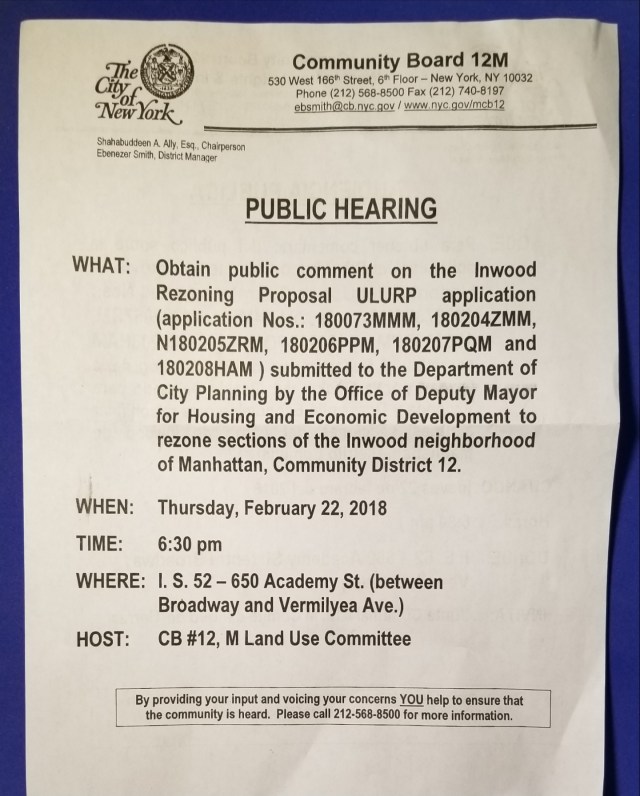
For a quick primer on how they keep the right to a public hearing as quiet as possible, check out this required legal notice of a New York City Community Board Meeting to approve a rezoning application, which I found xeroxed on the counter at my local library, to wit:

20180219_014220.jpg

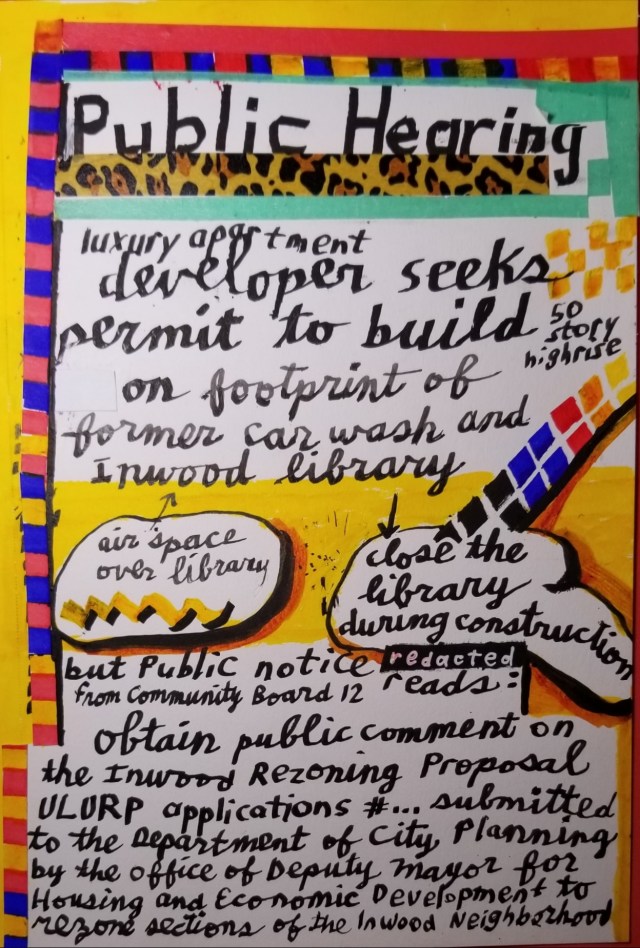
Any member of the public has access to these public records and so can easily look up those applications by number and find out that this meeting is to give approval to a real estate developer who seeks a zoning variance to build a sky scraper of luxury housing in the airspace above the local public library, in the combined footprint of the library and the adjacent property, already purchased from its owner.  

The text of the notice above complies with the letter of the law, to the letter, but to be a legally sufficient notice it should be required to read something closer to this, in the interests of basic fairness:

20180219_170406 (1).jpg

We often wonder how these motherfuckers do it.  This is a key part of how they do it.   We have the right to be heard, but only if we are very diligent, and even then, such notice gives no opportunity to prepare for the only public hearing that will ever be conducted for this decision.

This dog and pony “Public Hearing” is the only legal hurdle the wealthy developer will have in constructing luxury condos towering above the long-time working class neighborhood.  Those kids don’t read that much anyway, closing the public library for a year or two doesn’t matter in the long run… as a symbol of a dynamic New York City, this building boom looks good.

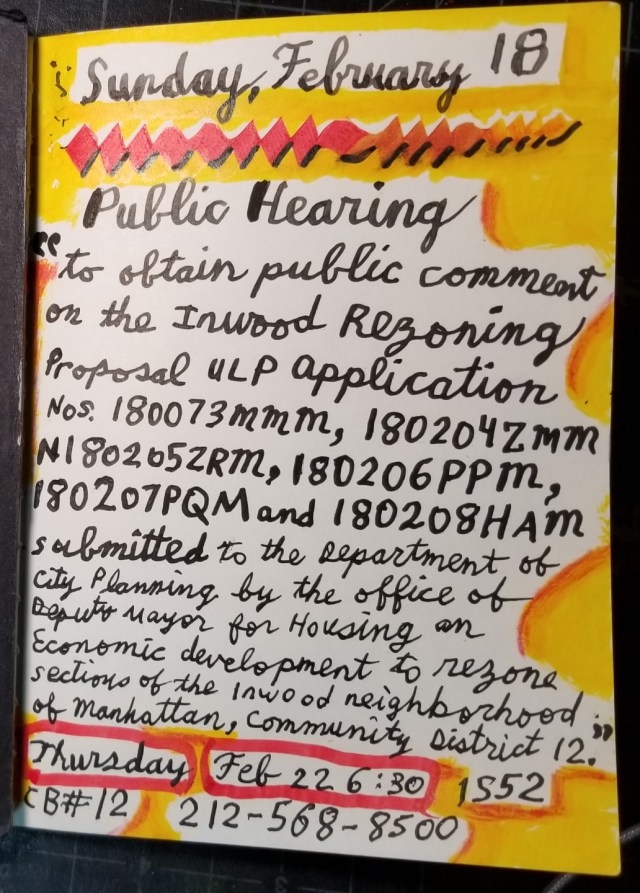
Here, in more legible bureaucratese, is the original text of that legally sufficient notice of a public hearing:

20180219_190304.jpg

Exhibit A:  

Legally sufficient notice to neighborhood citizens, in the interest of limiting attendance to necessary parties for appearance’s sake.  Nothing to see here!


Beautiful poem by Rumi

I want to see you.
Know your voice.
Recognize you when you
first come ’round the corner.
Sense your scent when I come
into a room you’ve just left.

Know the lift of your heel,
the glide of your foot.

Become familiar with the way
you purse your lips
then let them part,
just the slightest bit,
when I lean in to your space
and kiss you.

I want to know the joy
of how you whisper
“more.”

~Rumi


[with a tip of the fez to the learned old friend who posted this on his FezBook page a few days back]