The value of good feedback

Every book you have ever read was written by an author and then edited, and improved,  by a professional editor.   It is this team that produces a book worth reading, writing combed thoroughly to make it as readable and coherent as possible.  No writer can anticipate every problem a reader might encounter with her work.   Tics the writer can’t see may make an otherwise excellent piece impossible for many people to read.    I understand now how important good editorial input is for good writing.   For the best results, writer and editor must have similar sensibilities and goals.   In the scantest of published careers, I’ve experienced the horror of having whole paragraphs rendered barely coherent by an overzealous and untalented editor who swapped specific. carefully worded opening sentences for generic ones that meant something completely different.  The wrong opening sentence curses the rest of the paragraph.

We try to impose editorial oversight on ourselves as we write by imagining our reader’s reactions, with mixed results.  It is easy enough to learn to distrust and murder the overly cute darlings we may come up with from time to time.   Writing under strong emotion we might write, in an otherwise persuasive analysis of a vexing subject, that the man we are describing is the closest any of us will ever encounter to a talking piece of shit.   This is not an observation that will clinch the moral correctness of an argument.  Many readers will be repelled by a writer who stoops to scatology to portray an arguably despicable zealot; turn away and never turn back.  

An editor will immediately flag the line, something the writer may have a harder time even noticing.   The editor will demand more of the writer than a summary dismissal of a man who is, arguably, the very thing the writer has described.  Good writing requires more and a good editor asks the writer for it.

I offer this example of a paragraph I rewrote after considering my sister’s comments on the original paragraph.    After hearing her concerns, I was unable to defend the specificity of the original paragraph and I understood more clearly what I needed to write in its place, in terms of advancing the story.   Here is the rewritten paragraph about my thankless career as a lawyer:

The fees I should have earned on those two cases would have allowed me to pay off my student loans and choose a life more suitable to my personality.  I didn’t have the stomach to persevere on either case, finding both clients despicable.  I persisted unhappily in a distasteful career I’d undertaken mostly to try to please a father who nothing could have pleased.

The original paragraph, which my sister told me had an off-putting whiff of anger notably absent from the rest of the piece, read:

In one case the attorney who took over the case after I’d spent months securing a rare win at the EEOC got one-third of the half-million or more we won for the discriminated against asshole client; for reasons too sad to detail, I got $6,000.   In the other case, a frivolous but not illegal attempt at a lucrative eviction, I took in about a quarter of what I should have, put off by the client’s offhand anti-Semitic slurs. The opposing counsel was, indeed, a vile piece of shit, though “dirty Eastern European kike” proved impossible for me to swallow.  

I had already rewritten the paragraph above in response to another reader’s discomfort with the original, even more detailed paragraph.   The rewritten (now discarded) paragraph above was about half as detailed as the one before it, and, as it turns out, still many times more detailed than it needed to be.    What point was the paragraph trying to make? That I’d been unable to hold my nose as a lawyer, even on the rare occasions when there was a strong monetary incentive to do so.   No details really needed to make that point except that I turned away from a bad smell, and two excellent paydays.

You can read the original piece and see the rewritten paragraph in context.   If you are fortunate enough to get thoughtful feedback from someone whose intelligence as a reader you respect, consider it carefully.   The value of good editorial input is nothing to sneeze at.  Comments by perceptive readers help us write better.   Dismiss the considered opinions of others you respect at peril to your writing. 

Weaponizing civility

I had a falling out with a friend from my childhood over his tendency to ignore my feelings, something that seemingly got harder and harder for him to control as time went on.   It was irrelevant to him that he was making me angry about his insistence on one thing or another, my anger was my own problem, the painful truth he was driving at was too important to turn into a referendum on the propriety of putting an old friend in an aggravating position, attacking him or ignoring his clear discomfort.

My childhood friend has a troubled relation with anger, something he was taught to swallow by parents who were also taught to swallow anger, whether they had a right to feel angry or not.   His mother recently described to me how she was taught by her mother, who I knew and could believe it of, to concoct a story rather than ever confront anybody in a way that might result in anger.   Following this practice, she learned late in life, did not always have the intended result.

Every one of us has to deal with anger, a difficult, sometimes scary emotion that is often quite appropriate in an unjust world.   Most things that provoke people  are things most people would be angry about if subjected to.   The key to how you view these provocations is often whether you personally are provoked or not– it is a matter of whether or not you identify with the anger personally.  

Not everyone is taught that swallowing anger, and coming up with an anodyne story to bring a close to the underlying conflict, is the best way to deal with that harsh emotion.  It may be a widely practiced method, but that just puts it in the same category as racism, misogyny, advocating mass killing for a patriotic reason or for no reason and a lot of other widely practiced human emotional excesses.  Compared to raging outright whenever one feels aggrieved, swallowing anger is probably a better alternative, though neither approach leads to a good outcome.

Swallowing anger is a demonstrably bad long term strategy.   Anger is corrosive, comes out one way or the other and it leads to many terrible things including a tendency to irrationally fly off the handle, to lash out at people it’s safe to attack who may have nothing to do with the source of one’s anger, to be stricken by bodily pains so severe that the sufferer cannot even move.  

Maybe the worst thing about swallowing anger is that it makes any anger shown by anyone else, no matter how reasonable it might be, infuriating.  Denying another person’s right to their feelings is a common cause of anger, which must then be swallowed.   It also, sadly, makes friendship ultimately impossible with anyone not committed to pretending about fundamental things that might be absent:  like the right not to have their feelings repeatedly hurt by their closest friends, the right to swallow or not swallow anger, the right to try to make things right when a relationship is about to be lost.

The reasons this old friend was so angry at me are hard to know exactly.   I don’t seem as jittery in my own skin as he is, I’m a little more affable, more comfortable in social settings.   I play guitar better than him, I seem to stand up for myself and my beliefs in a way he can’t and I can express anger when I need to.  

I don’t know what exactly it was that made him provoke me so frequently, beyond the fact that he knew he could lash out at me without much consequence for him.   As mad as he sometimes made me, as furious as some of his attacks were, I never hit him back very hard.   There was probably nobody else in his lifetime of swallowing rage that he felt safe enough to do this with.  

Just because a person can take punches and kicks without responding in kind doesn’t mean he likes being punched and kicked.  There comes a time when even the fondest sentimental attachment frays and finally tears apart under this kind of regime.   My competitive friend’s anger, in the end, was as much about this as anything:  even though my life is manifestly a failure in every way our society uses to measure a life (beautiful home, nice car, good income, social status, quantifiable financial success), he somehow felt I have the upper hand, have the more enviable life.  My squalid rented apartment in a marginal neighborhood somehow provides me the same sense of security as his beautiful home in a wealthy suburb, which is objectively unfair.

His anger at the unfairness of this, it appears, became like a snowball rolling down an immense hill in heavy snow.  As his troubled  marriage reached a new crisis, I became the go-to guy to lash out at.   Finally, when he petulantly told me his extracted apology was apparently not good enough for a prig like me, that my stubborn demand that he actually change the way he behaved toward me was very unfair, especially considering that he was actually the victim, now and forever, we were finally done. 54 years and … poof!

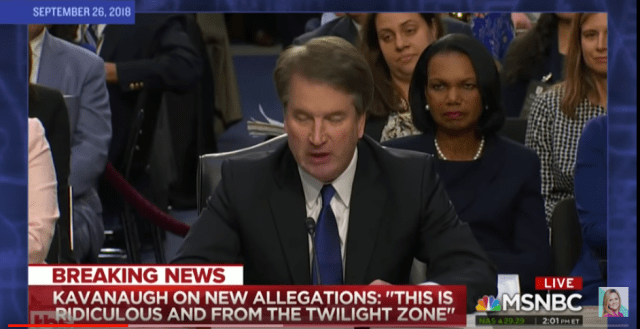
Now we come to the killing power of civility.   You can rage in a polite way, as our newest Junior Associate Supreme Court justice did at his recent hearings.   Nothing he said while raging is unprintable, he never lost control to the point that he uttered a line that could cost him his position on the nation’s highest court (like when I recently referred to him as a “piece of shit” and a “motherfucker” — the end of my Supreme Court dream).   He never cursed, never even came close to using an off-color term.   He never crossed the line into easily dismissible rage, everything he said while raging, however childish and regrettable it may also have been — every word was printable, “good enough”, anyway.  

Reading a transcript of his remarks you may not feel he acquitted himself as the brilliant, impartial jurist he presented himself as, his responses make him look like an hysterical zealot to some, and less than 100% candid and truthful, beyond question, but he clearly adhered to the rule of civility, firmly, if crudely.   It is that angrily clenched sphincter of a mouth, whenever confronted with a question he was in any way threatened by, that speaks louder than anything he actually said.

So it is with civility, being civil means never really having to say you’re sorry.

I recently saw the end of a long email correspondence with a friend who is a master of civility.    He was a mutual friend of the old friend mentioned above, the guy with the unexpressible, irrepressible anger problems.   He suffers periodically from disabling physical conditions he sees as directly related to the ongoing, inchoate rage he has to swallow daily.   He subscribes to Dr. John Sarno’s theory of Tension Myoneural Syndrome (TMS), the mind/body’s creation of crippling physical pain to mask even more terrifying psychic pain.   We’ve had many discussions over the years about this, and I’ve learned things from the exchange.  He is an excellent writer, a smart man and over the years we’ve regularly exchanged countless facts, observations and opinions that have enriched both of us.    

Recently he informed me that he’s unwilling to hear any story even tangentially related to our once mutual friend, or to be part of any conversation in any way related to any of the issues raised by that long friendship, the impasse we came to and our current estrangement.  I made a last attempt to get back on the same page with him.  

I laid out the harm of preemptively forbidding whole areas of conversation,  This ban, I pointed out, ruled out some of the most fundamental things friends should do for each other, starting with hearing what’s on your friend’s mind.   To him, his stance was simple loyalty to an old friend and a refusal to take sides.   Reasonable enough, on one level, and one might ask why I could not abide by his request to talk about anything else.   I couldn’t help but think of Switzerland during the Second World War, neutral, not taking sides, right and wrong — not our business… and my correspondent’s longtime aversion to difficult topics of conversation.  

I imagined the conversations available after the ban on any talk related in any arguable way to my falling out with my childhood friend.   Out of bounds: the corrosive nature of unacknowledged rage, the sharp brutality of denial and the nimble, desperate inventions of shameful secrecy.  The blackout would render our once frank correspondence untenable from my end since it closes the door to the things I am wrestling with daily.   I wasn’t looking for a taking of sides, though my correspondent felt that taking sides was inevitable, once the door opened, and that he would not allow himself to be placed in that position.  I took considerable pains not to offend my sometimes fussy correspondent, rewriting my email a number of times before sending it to make sure not to bruise his feelings.  I raised a handful of separate points, as tactfully as I was able.   Perhaps the most important section was:

We’re touching on a core belief about life: you explore freely and openly with those closest to you to try to get to larger truths, learn something from our own experiences and the lives and choices of those we know, trusting a good friend, in the course of a larger conversation, not to deliberately fuck you or thoughtlessly put you in an untenable position — or, out of deep loyalty or some other principle, you put up a wall, set parameters on what can be discussed against the possibility that such fucking and untenable torment is as inevitable as the next attack of TMS whenever anger is some part of the equation.

It points to the very different expectations we have of our closest friends, of our inner lives.  Also to our different relationships with anger.   I’m drawn to this kind of troubling but sometimes illuminating inquiry and the related stories, the more insight I can get the better; you appear to be drawn away from it.  Conflict, like pain, instructs us about which way to go sometimes.   Conflict is supremely uncomfortable, I know, but it’s also occasionally unavoidable if people are to grow, change, become wiser.   

It’s possible to work through conflicts if you can clearly see the part you’re playing, and there is openness to honest discussion on both sides.  There is a way of viewing conflict that is not starkly black and white, right or wrong, zero sum, winner/loser.  It is rare, and hard, but conflicts can be resolved without war (and can never be with war).  You can look squarely at what needs to be changed to resolve a conflict and, for the sake of a valued relationship, change it, sometimes.  There are general principles and a lifetime of beliefs involved in every choice a person makes, things that should be fair game for discussion, or… apparently not.

I didn’t have to wait long for his short, quick reply.  I read it to my sister.  She chuckled and said he was really smart, and agreed that he had channeled the DU (our relentless father) beautifully, it was the model wonderfully civil fuck you.   It reads, in its entirety (outside of a closing sentence wishing me luck, good health and good times in the coming weeks):

You’ve expressed your view of things here very clearly, and I truly appreciate both the re-send (with a more navigable font) and the mildness of your formulations.

We’ve had a great run with this correspondence for ten years now.  But in light of what you’ve written, and other developments over the past year or so, I think we may well have reached the point where our differences outweigh our many affinities, and that it is indeed time for a break.

Heh, can’t argue with that.   I particularly loved the lawyerly genius of  “and other developments over the past year or so”.  The DU himself could not have topped that one.   Reminiscent of the immortal line, uttered by my defeated father at the end of a desperate fight not to have an honest discussion with his adult son:  “if I ever honestly told you what I really think of you it would do such irreparable damage we’d never have any chance of ever having any kind of relationship between us.”  

Set and match.  

Nicely done, dad, we’ll revisit this on your death bed a few years from now, when I’ll have one last chance to be mild about how wrong you were, you poor bastard.  

Have a blessed day.
Psoriasis

My father was tortured by severe psoriasis that required at least one extended hospitalization during my sister’s and my childhood.  It was an unusually severe case.   Many people with psoriasis have scaly patches on their elbows, forearms, their scalp.   My father’s lifelong friend Benjie had psoriasis on his arms, and sometimes his hands, for much of the time I knew him.   My father’s psoriasis covered virtually his whole body, which was red, with white scales on it.  The itchiness of the scales caused him to scratch, and when he scratched, flakes would fall off.   It was like a biblical plague, really, and judging by the ads for psoriasis treatments I get on my phone lately (since visiting a doctor about my newly diagnosed arthritis), many Americans still suffer from it.  

The scales itched and my father scratched.   He would frequently use a stand-up vacuum cleaner to suck the scales off the floor of the living room, dining room and kitchen.   I realize now that was one reason we generally didn’t have carpeting on the first floor.   The electric broom would get hot with use and the scales, exposed to this heat, would give off a mildly sickening smell of burning flesh.   It was a particular sweet smell I can still remember very clearly decades later.

This is one terrible feature of my father’s life, a poorly understood torment of a disease he suffered from.   There was apparently a strong correlation between the severity of the disease and the stress my father was under.   After he retired and moved to warm, humid Florida the scales disappeared completely.  But from the age of thirty-two (the year I was born) on, when things got too stressful, and the weather was particularly cold in New York City, my father’s skin would crack and bleed.  When this happened he checked himself into New York Hospital where they treated him with steroids, special baths and rest.   I recall visiting him there, I was maybe 14.   The view over the East River from his hospital room, which was on a very high floor, was amazing.  

The visit to his hospital room was not without drama.   My mother, for reasons she took to her grave, insisted I wear a certain pair of blue pants to visit the hospital.  These were the kind of pants they used to call slacks, as opposed to the jeans I always wore.  I tried on the blue pants and they ballooned grotesquely in several places.   I did a turn in the living room to show this and my mother was unimpressed.   I changed out of the pants, back into jeans, and my mother had a shit fit.   My refusal to wear the hideous pants was the proof, apparently, that I did not love my father enough to wear a pair of nice slacks to visit him.   As often happened, the fight became ugly.   I don’t recall which pants I eventually wore for that visit, but I do remember my father lying in the hospital bed and the magnificent view, the nearby UN and Long Island, stretching to the horizon across the shimmering East River. 

Ironically, the hideous blue pants were later tapered by my sister, who nobody knew was a naturally gifted seamstress.   One day, without any training, she was suddenly able to do precise alterations of clothing.  In their altered form I liked them as much as any other pants I had at the time and wore them frequently.   If only the alteration had taken place before the visit to my poor father at NYU hospital!

Silence!

I learned young, in my cells, the truth that the opposite of love is not hate, it’s indifference.   Whenever something scary or painful happened to me or my sister, something that cried out for discussion in the home I grew up in, silence was imposed.   “You have to respect my right to ignore your pain,” was my father’s position.   He actually said as much to me explicitly, when we were both adults.    He had his own terrible pain, clearly, which made him very uncomfortable in these situations.    Why did I have to respect his silence?   I lived in his house, he bought me my clothes, my food and everything else.   I suppose that was how his logic worked, though it applied long after the childhood rationale was gone and he’d regret it all bitterly as he was dying.    

Silence is a prerogative of power.   If you have the power, you simply sit, lips pressed together, a silent “fuck you” the most irrefutable response to anything you don’t feel  like talking about, for any reason or no real reason.   That’s power.  Ask the powerful nominee a question he doesn’t want to answer.  He has already spent hours strategizing with the lawyers of the man who nominated him, has vast experience in this process himself as legal advisor on such nominations to a past president.   He is asked a question he doesn’t want to answer.  Clamps his lips together, stares at the questioner with undisguised hostility, knowing he can eventually run out the game clock.  “My answer, sir, is a loud, silent FUCK YOU!” he glares, mouth constricted to the size of a tightly clenched sphincter.

If a powerless person is sexually assaulted in the woods, a hand clamped over her mouth, and there is nobody there to hear her muffled protests– was there a sexual assault?   Come on.   Is this even a question?  

The Constitution was largely silent on the question of slavery.  To many of those who did not immensely profit from the “Peculiar Institution”, chattel slavery was an abomination.  For the rest a virulent racism was encouraged, so they didn’t care about the slaves.  It would not do to enshrine slavery too explicitly in the liberty-granting blueprint for republican democracy written by men who believed that all men were created equal, endowed by their creator with certain unalienable human rights and so forth.  Lawyers are geniuses of this kind of thing, inserting the devilish, controlling details between two commas, bland as all get out.   “… such persons as any of the states now existing shall think proper to admit…” [1]  yeah, there we go– the constitutional basis for the Fugitive Slave Act is authorized by an equally innocuous-sounding clause.  Read the Constitution, it’s not long.  See if you can find the three discrete, discreet phrases making slavery as lawful as anything else a landed white man had a right to.  As a law student it took me a long time to find all three.

Silence!  Those who would be tyrants must become masters of this.   Speaking with a definitive, uncontradictable voice is only possible when no contradiction is allowed.   First thing you do, silence all the investigative journalists.  Then the lawyers of the opposition.   Once these troublesome elements are dealt with, the sailing is much smoother for a tyrant.  Of course, “tyrant” is such a judgmental word.   Can’t we just say Leader?   Or Winner?  

Silence!  Your right to be heard is limited by my right not to hear you, fucker.  If you can make yourself heard, go right ahead.   Let me just put on my state-of-the-art noise canceling headphones and my sleep blinders, ah, that’s much better.  Alone with my own thoughts.   Among them, no thought of taking off my blinders and deafeners.   Scream away in your victimhood, assholes, it’s so much faint white noise to me.

Silence, while sometimes the best response when tempers are hot, more often than not benefits the powerful and the guilty.   The most important single thing required for an unjust scheme to  succeed, without adverse consequences for the hatchers, for any crime to be committed with impunity, is silence.   Silence is golden, literally.

Irrelevant Logic

Advocates for Brett Kavanaugh felt great urgency to get him on the Supreme Court as quickly as possible, for many reasons.    Delay would only allow for more and more basic and uncomfortable questions to be asked, more people willing to testify against him to come forward.   Our brazen president decided to double down [1], have the nominee brazen it out, short delay for very limited, top secret investigation — for the optics of transparency and fairness — then immediate vote and we win.

An exercise in logic for all you non-partisans out there:

Democrats and Republicans alike found Christine Blasey Ford’s testimony credible, and nobody who spoke publicly on either side said they didn’t believe her story, though Republicans were reticent about one particular detail, which was neither corroborated nor disproved by the limited FBI probe.   To a man, the men on the Senate Judiciary Committee who spoke publicly said they believed Blasey Ford’s testimony.   They would have sounded like liars, and insensitive, morally tone-deaf  cads, if they had claimed not to believe her, since she did come across as truthful.  

Keep that thought in mind — credible testimony.  

Now keep this thought in mind:  Blasey Ford’s testimony was, at the same time, part of an orchestrated political hit, a calculated partisan smear against this fine, highly qualified nominee, as the impeccable nominee himself and the indignant Republican men of the Committee all claimed .

Logic?   Truthful, yes, but a smear.  In the end: a wash.  Although, logically, she could not have been testifying truthfully and, at the same time,  been part of a vicious partisan smear against an innocent man.

Basic logic is often collateral damage in our zero-sum post-fact media spin world.  In any case, logic is irrelevant in modern political interpretive dance.

That said, it is important, as a democratic corrective, that Democrats and Independents take the House in the upcoming midterms.   Progressives on the House Judiciary Committee have already informed the president that, once they have subpoena power back, they intend to examine what appears to be Kavanaugh’s untruthfulness under oath during his recent confirmation hearings and his testimony before being confirmed for the federal bench more than a decade ago.    That is the only picture that gives me any solace in this dark moment for the silenced majority, a real investigation into the truthfulness of this smug, petulant, entitled zealot fuck.


[1] One commentator noted that he was “tripling down” in this case.   This is a characteristic move of our zero-sum winner-in-chief.

Frontier Justice

Murderous violence has often been used to settle issues.   Heretics– burn them at the stake, for the love of God!    Those who publicly oppose what they feel to be injustice– hang a few from lamp posts, the rest will get the message. Most humans are not heroic.   A few brave men who resist enslavement?  No problem, just shoot the first couple who step up, the rest of them will quickly calm down.   Violence is necessary to maintain an institution like slavery, there is simply no other way to enslave masses of people.   Thus it has always been, the status quo enforcing the irresistibility of its rights with deadly force.   In America this violence is sometimes called “frontier justice”, which conjures the image of a “necktie party” in the violent old West, or in the former Confederacy, you know, a group of men running down and stringing up some varmint for one reason or another.

My father, a man brutalized as a young boy early and often, had a dark sense of humor that sometimes bordered on the sadistic.  He smiled as he recounted the story to my young sister and me of an old time Texas judge who sometimes let murderers off the hook but always ordered horse thieves hanged by the neck until dead.   “There are some men,” the judge explained, “who need killing because they are evil.   If you kill one of these men, you are actually performing a public service by ridding the world of them.  When you kill a man who needs killing, I cannot condemn you as a murderer.  On the other hand, I never saw a horse that needed stealing.”  My father chuckled after he related the judge’s witty explanation of his folksy ways.

“Guilty!”  Bang the gavel, drop the mic, a lunger into the spittoon, pour a round of drinks, boys, and then, after lunch when it cools off a bit out there, let’s string up this Negro horse thief on the run from his rightful owner.   Yee hah!  (Unlikely as this particular scenario is, an American judge as principled as this one would not confiscate somebody’s personal property without due process of law.  The slave would be returned to the master. Hanging another man’s rightful property would be theft.  Only a free horse thief was fair game for hanging.)

In the United States today, physical violence is no longer the first response to every threat.   You can achieve a lot just by destroying a career, or using a protracted lawsuit to bankrupt somebody.  It is sometimes referred to, if done thoroughly enough, as ‘economic capital punishment’.  

When Charles Koch, still a secretive man who exercised his influence in the shadows of the many organizations he founded and/or funded, got wind of the book being written by long-time New Yorker staffer Jane Mayer (Dark Money: The Hidden History of the Billionaires Behind the Rise of the Radical Right) he hired investigators to find dirt on her.   There apparently wasn’t much to find.  Undeterred, calls were placed by Koch operatives to the editor-in-chief of the New Yorker, seeking to make enough of a stink that Mayer would be fired.  Presumably without her full-time staff salary she’d be unable to finish her book exposing the long history of the Koch’s increasingly effective influence machine.   Also, if she’d been fired in disgrace from a well-known publication, it would be much easier to discredit her clearly vindictive revelations about people who had done her personal harm.  Win-win for Koch, and of no consequence to him if it didn’t work.   Charles Koch refers to this method of exerting leverage as “upping the transactional costs” for his opponents.

I’m thinking about this today, of course, because the most unabashedly corrupt president of our lifetimes has just hastily placed a second corporatist partisan on the Supreme Court.   This one is an actual strident right wing zealot with a questionable background that should disqualify him.   More immediately,  his present day willingness to lie under oath, about things large and small, should make him ineligible for appointment. Not to mention the supremely un-judicial way he hysterically blamed a well-funded liberal conspiracy for old charges of sexual assault being credibly made against him by a reluctant victim.   During the course of reading a written partisan screed he also excoriated shameless liberals for forcing a vulnerable victim of sexual assault to come forward, against her will, thus ‘defending’ her.   If a piece of shit could talk, he’d sound like Brett.  Other Supreme Court judges may have been as nakedly partisan as Kavanugh, but all others had, at least, the skill to hide their zealotry.

I’m thinking about the $15,000,000 that we know about, in perfectly legal “dark money”, that paid for ads promoting this good Christian family man as a well qualified, impartial and independent judge.   Why bother marketing this particular highly divisive nominee of our highly divisive president to the public?   You have the votes to confirm him, why spend millions on ads to convince the public that he is not, in spite of what is easily seen, an angry partisan and clearly not an impartial and independent anything?   The public has no say in his selection, why spend the millions?

Well, the millions spent on ads probably had some effect.  Americans according to a recent poll disapprove of Kavanaugh only 50%-45%, with five percent apparently having no opinion on the matter.   This high rate of disapproval of a Supreme Court nominee is unprecedented, but think of how much worse it might be without the ads.  It would certainly be worse if there hadn’t been the fawning nationally televised interview on Fox right before the resumed hearings when Christine Blasey Ford testified and Kavanaugh repeatedly choked up about the character assassination he was being subjected to.  

That Fox interview was set up by Trump’s communications director, Bill Shine, former Fox executive, former defender of his boss Roger Ailes, Bill O’Reilly and other men at Fox who paid off women they sexually abused.   Imagine how much worse those numbers would have been if the ads hadn’t run, if Kavanaugh himself had not blandly admitted, in a self-promoting op-ed that ran in Rupert Murdoch’s Wall Street Journal on the eve of the final vote, that, sure he was emotional at the hearing, may have said things that he wouldn’t have otherwise said, but he’s committed to judicial impartiality and independence, if not to integrity.

The millions spent on ads?   That is less than a collective penny to the vastly wealthy donors who anonymously put up the money.  How are they allowed to secretly put up millions to influence the public that way?    Citizens United.   Free speech.  Liberty.  Unlimited liberty, that tree that must be watered with the blood of tyrants from time to time, according to the Author of Liberty, himself born very rich, richer still after marriage.  All the best Americans are born rich, all of them.  If God didn’t love you, why would he have granted you such a blessing?   The rest of the entitled poor people will hate you, sure, but that’s what haters do, wage hopeless class warfare against their betters.  Sticks and stones may break my bones.  Likewise, sputtering rants like this one– ow!   I see your righteousness, boy, and raise you one lynch mob.  What you say now, punk?  Huh?


Letter to Jeremy Scahill

Because I sat, utterly voiceless, like almost 300,000,000 other Americans, while the brutal farce of the preordained 51-49 Kavanaugh confirmation was grinding on like a sloppily drunk schoolboy against a girl two years younger, writing this long contemplated proposal to Jeremy Scahill is more urgent than ever.  I had to listen to the likes of David Brooks and Alan Dershowitz insisting that the credible testimony of Blasey Ford and the frustrated, emotional pouting of Kavanaugh was essentially a wash.   A handful of people read my thousands of spewed words on the subject and silently yawned.  

A person is not a writer because he or she writes for hours every day. Being able to occasionally move people with your words is touching, but ultimately, that doesn’t make you a writer.  A person is a writer only if he or she gets paid for writing and the writing is publicly disseminated.   Those are the rules and I understand that more and more clearly as the years go by.

Jeremy Scahill is a co-founding editor and the senior investigative reporter at The Intercept, a publication that describes itself this way:  

The Intercept gives its journalists the editorial freedom and legal support they need to pursue investigations that expose corruption and injustice wherever they find it and hold the powerful accountable.  source

A theme Scahill returns to again and again is historical context.  I salute him for this, and will propose writing a piece from time to time providing historical context, legal context.  Jeremy recently gave an excellent contextual introduction to a discussion of Trump’s repudiation of the Obama-era deal with Iran.   Iran’s distrust for America has direct and hideous historical roots dating back to the CIA directed coup, during the Eisenhower administration, that removed the democratically elected president of Iran and helped install a militarily backed monarchy.   The monarch, the Shah, ruled as Persian monarchs of old did, but with an infamous modern secret police force to ensure obedience to his will.  The Shah was very reasonable about sharing his oil wealth with American oil corporations, in a way that his predecessor, who planned to nationalize Iran’s oil reserves, was not.

Scahill laid this out recently and I was grateful for the primer.  The background is important, it is the only way we can ever see things in perspective, from another point of view, and we so rarely get any background on anything.   The reasons for this are fairly obvious, nuance only complicates things for most people.    The reasons for the long war in Iraq, for example, complicated, complicated!  All you need to know is that freedom is on the march and a modern day Hitler is finally being taken out. 

I’ve been intending to contact Jeremy for a long time to confirm what I recall from his book Dirty Wars— namely, that not only were no charges ever brought against American citizen Anwar al-Awlaki before his execution by drone (this I have independently confirmed), but no evidence of any connection to Al Qu’eada or any other terrorist organization was ever produced, let alone evidence that he was involved in planning terrorist attacks, as alleged by President Obama after Al-Awlaki was executed.  

This story contrasts sharply with the unanimous public knowledge and information available about Al-Awlaki.  Every reference to Al-Awlaki to be found anywhere in print or on the internet (outside of Scahill’s excellent book), including recently at the Intercept (to my surprise and shock), identifies him as connected to Islamic terrorism, a highly placed, influential Al Qu’aeda propagandist, most sources also stating that he was directly involved in planning terrorist attacks.

Truth and context matter, particularly when the execution, without trial or even charges, of an American citizen is authorized by a Democratic president.   The current president, using the identical rationale, and citing bi-partisan precedent, can, entirely at his discretion, place any person, American or otherwise, on the enemy combatants list, the kill list, authorize the secret extrajudicial execution– charges optional.  It would be as easy for him, and, one presumes, as politically inconsequential, as shooting somebody on Fifth Avenue with the added bonus of being completely legal to do, based entirely on his say so under the bipartisan rules for our borderless, timeless War on Terrorism.   The only question is why he hasn’t used this extraordinary power against Amy Goodman and Jeremy Scahill yet (or Stephen Colbert, for that matter, though Colbert’s vast popularity might be a restraining factor).  He’s probably just too busy mocking women who’ve been sexually assaulted and attacking black athletes who protest the ongoing killing of unarmed blacks by police at the moment.  There will presumably be time to take care of his more able enemies during his second term, when all squishiness has been pressed out of American democracy.

Instead of the whole truth we are subjected to a cascade of justifications and bullshit everywhere we turn.   Lying attacks from the president are now too common to and too frequent to take note of, the partisan mendacity of the party Trump leads is the new normal.  The best hope for our survival as a democracy is fearless journalism that exposes the details of the widespread corruption in our government.  It may not be a robust hope, in a nation that rarely reads anything but the screen of their phones, while being taught to chant “lying media” at Nuremberg style rallies, but it’s our best hope.  It may be a quaint and naive notion, in our day of ‘alternative fact’, but the truth of what actually happened matters, even as the untruthful version often prevails.  It would be better, of course, if integrity was a real issue in public life, but, of course, that is hoping for a lot in a superficial, celebrity culture like ours.  So we have fearless journalism.

 Scahill’s investigative journalism has taken him to places like Afghanistan, Somalia and Yemen where he did the hard, dangerous work of talking to a variety of sources, in the government and on the ground, in his search for the truth about American foreign policy.  It turns out “freedom is on the march” is only a tiny sliver of the real story.   I want to ask him if he got additional information after Dirty Wars was published that supports the contention that Al-Awlaki was a terrorist.    

His reporting on Al-Awlaki’s long ordeal at the hands of the FBI was thorough.   The FBI’s repeated interviews found nothing about terrorism, but they turned up personally compromising material they threatened to blackmail him with if he didn’t become an FBI asset.   The FBI blackmail threat was the final straw that made him decide to leave the US.  After his arrival in Yemen he was arrested and spent a long stretch in solitary in a Yemeni prison (extended at America’s behest).   In the end his transformation from moderate American Muslim imam, the go-to Muslim for American TV interviews,  to America’s deadliest enemy who required immediate extrajudicial killing was complete.   Scahill makes the case that Al-Awlaki was strenuously exercising his First Amendment rights as an outraged American citizen and was no planner of terrorist attacks, nor did he have any known connection to that or any other terrorist group.  Still, history remembers his execution as entirely right and proper, up there with the killing of Osama Bin Laden among the triumphs of Barack Obama.

History remembers, curious phrase, particularly in an increasingly distracted nation with a rapidly shrinking attention span, driven more and more by strictly partisan rage.  We are living now in the age when the preservation of human “liberty” trumps everything else.  You are free to be very, very rich and you are free to die of malnutrition based on your poor food choices, your choice.  It’s all about liberty, so choose wisely what to do with your vast inherited fortune.

And with that, I’m pretty sure I’ve exhausted your attention span, dear reader, and so, onwards and upwards!  I’ve just noticed a link at the Intercept for submissions and proposals, I’m going to read up on what I need to do to have something considered for publication there.  (Alas, it is merely an email address– on the other hand, it gives me free rein, like the FBI recently had investigating the charges against Kavanaugh, to make my pitch!)


Fairness is Justice, Justice is Fairness

Admittedly, this simple formulation must be turned on its head by those who stand to gain the most by unfairness being justice.   This is done at law all the time, rules written in coordination with lobbyists, made to preserve privilege, profit, protect the rights of the privileged, at the expense of those without privilege or power.  It happens too regularly to need to give an example of.  Call it unfair if you like, there is nothing you can do about it.  

Fairness demands, to use a quaint phrase, that a victim who comes reluctantly forward, in terror, to publicly describe a traumatic assault by a nominee for high public office she identifies with absolute certainty as the perpetrator, and does so believably, be given a real opportunity to be heard.   This would include, of course, testimony from witnesses who she says were present.   The key to finding the truth in any he said/she said is corroboration.  As long as no hint of corroboration is allowed, it’s always a draw.   Every schoolyard bully knows this at age six.   In he said/she said tie goes to the bully.

Justice, if you control the hearing, even with a one vote majority (especially with a one vote majority) demands that the other alleged perpetrator, an admitted former teenaged drunkard and self-described frustrated sex fiend NOT be allowed to testify.  What could be gained, besides making our evasive choir boy look more dishonest than he already does, by putting an alcoholic, currently in hiding, a loose cannon with shaky credibility before the American people, on worldwide TV?   Better, far better, to have that jerk’s lawyer write a sworn denial and spend millions on an ad campaign to convince the world, without ever saying the bitch accuser lied about anything– we’re very careful to say she was believable as hell — we give her full respect — we are powerful white men who always respect women, always — that our boy is of the highest moral character.  Always was, always will be.   Simple.

The same goes for the female friend who the victim says was at the gathering.  She doesn’t remember the actual insignificant early evening hang out at a friend’s house when her friend was silently traumatized.  She has no reason to recall that particular gathering.   She heard no screams, obviously, since that would have been impossible with the attacker’s sweaty hand pressed over the victim’s mouth, but she can testify about the people involved, where they each lived.  She believes her friend, as she stated, and she can tell us why.

Out of the question, obviously!   This woman, if she is as credible as her friend, could do immense damage.  Just by talking about other parties with drunk, entitled boys from Georgetown Prep, by letting any detail slip that might make her belief in her friend’s story more credible.  It would be corroboration.  No, no, a thousand times no!!!

That goes to for the FBI investigation too.  Suppose the layout of Mark Judge’s house was identical to the one described in Blasey Ford’s testimony?  The upstairs bathroom, directly across from the bedroom she was shoved into, door locked, in the moments before both drunken boys were laughing uncontrollably.   Suppose that home was a short walk from the country club where the victim had practiced diving all day?   A short walk from the club but too far from her own home to walk back.   Well, there’s a line of inquiry the FBI will not be asking anyone about, clearly!

I heard Senator Susan Collins long speech yesterday, most of it, about why she is voting for Brett Kavanaugh.   She spent a long time discussing specific cases where he appears to have ruled fairly, with integrity.  She pointed out that in more than 90% of cases that he heard with Merrick Garland, the two ruled the same way.   To me that pointed more to Obama’s attempt at fairness, nominating the conservative, yet non-ideological Garland, than to any impartiality on Kavanaugh’s part.

Collins eventually addressed the sexual assault allegations against the nominee.  She said, along with all other Republicans who spoke on the matter, that she believed Christine Blasey Ford, but that, essentially, it makes no difference, since there was no corroboration and there’s a presumption of innocence, (particularly, one supposes, when a powerful man breaks down crying over and over and is clearly angry, defensive and on the attack.)  Collins pretended, like all of her Republican colleagues, that this was a criminal trial rather than a hearing about the truthfulness and character of a nominee for one of the most powerful positions in our democracy.  Since his guilt could not be proven beyond a reasonable doubt by the single witness, he is presumed to be completely innocent, by Republicans.  End of story, for the narrow Republican majority.

Senator Collins  sounded very reasonable, very measured, as she spoke about the principles of fairness, due process, the presumption of innocence in our great democracy.  To the uninformed, to the non-critical, she sounded very principled.   She made her decision, ultimately, because her own party would destroy her if she voted the other way.    Senator Lisa Murkowski was ready to take that risk, though in the end she got to oppose the nomination without actually voting against it.  Her NO vote would have been meaningless in any case in a 50-48 vote.   Collins was not ready to risk her political career, and explained why it was actually a matter of principle,  rather lamely.   The Democratic senator from West Virginia, where Trump won so handily in 2016, was not disposed to end his senatorial career by casting a principled vote defying the president’s will.   The vacillating Jeff Flake revealed himself as the unprincipled man he is.

There you go, the Kochtopus rests its case, government is inherently corrupt, democracy is coercive and unfair to the wealthiest and most vulnerable to deprivation of liberty — don’t vote for any of these fucks, let us, the best and the brightest, take care of public policy.

Fairness is justice, except, of course, when it’s not, when higher principles than mere fairness are at stake.  Principles like power, control, liberty. The liberty of the few, born booted and spurred (in the phrase the Author of Liberty borrowed from a man about to be hanged in England a century earlier) to ride the backs of the rest of you powerless motherfuckers must not be infringed.  We, we powerless motherfuckers.  


The Five Minutes that saved the Federalist Supreme Court

If you have unlimited money there is no limit to the number of well-funded organizations you can create.   In the case of Trump’s father Fred Christ Trump, as reported recently in the NY Times, he created 295 income streams for his kids and multiple companies that did all sorts of good work getting dad’s money to his offspring without any of those punitive taxes.   In the case of Charles and David Koch, they created and/or fund institutes, societies, non-profits, think tanks, academic programs, ad campaigns, lobbyist groups, even a popular grassroots movement influential in thwarting much of Obama’s program. [1]  

That last bit, the spontaneous, instantly national Tea Party was pure genius, giving angry Americans, being ruled by a liberal leaning Negro against their will– AGAINST THEIR WILL!!!– a chance to pose as angry patriots on television, night after night.  The fury of those Americans, and a reality based feeling that most Americans are basically powerless and screwed, led to a Tea Party congress in 2010 and, in the end, a straight line to Donald Trump, the most useful imbecile the Koch network has ever had in power.

Of course, that is merely my opinion.   Do I know much about the Koch’s Institute for Humane Studies, for example, outside of its wonderful name?   I do not.  I know the Kochtopus uses ‘majoritarian’ as a pejorative term for those who believe that democracy means respect for both majority opinion and the rights of minorities.   Charles Koch is old, he has no time for that kind of mamby pamby koombaya bullshit.   He and his organizations would free us all, permanently, from majoritarian tyranny.  All it really takes is a Supreme Court with a staunch corporatist majority.  Which we are about to have.

What does any of this have to do with the five minutes that saved Brett Kavanaugh’s partisan nomination to be a dependable deciding partisan vote on the unappealable Supreme Court?   You’re right, I’m sorry for this preamble, I will get to it in less than five minutes.  First, one last bit,  just a few words about the Federalist Society, funded by the Kochs, the Mercers and other right wing billionaires [2] :

The Federalist Society for Law and Public Policy Studies, most frequently called the Federalist Society, is an organization of conservatives and libertarians seeking reform of the current American legal system in accordance with a textualist or originalist interpretation of the U.S. Constitution.   source

“Originalism” is a judicial philosophy made famous by Antonin Scalia, giving the ring of God-given truth (to his fellow true believers) to the pronouncements he made on the Supreme Court.  Under this theory he was never expressing merely his own ideas, any decision he made, he claimed, was based on uncovering the original intent of the geniuses who wrote the infallible founding document of our democracy and ruling accordingly.  Think about the incredible piousness of that quasi-religious judicial philosophy.

The Federalist Society, when it was created in 1982, at Yale Law School [3] would have been considered a fairly extremist group.  Today, thanks to movement of the Overton Window (think frog slowly being brought to a boil in a pot of warm water) their recently radical beliefs are ‘mainstream’.  There is a branch of the Federalist Society in virtually every law school in America.  They host parties, are welcoming to new members, all you have to do is believe what they do.  You can join, meet and party with a network of like-minded solidly conservative people.  It is a powerful professional network, perfect if you want to make sure to have people who think like you that you can give good jobs to.

Brett Kavanaugh is a lifelong Federalist Society member and, by all accounts, a very loyal one.  It’s not a knock, it’s what he believes in.  I find their beliefs despicable, but that’s just me.  It is the prerogative of a conservative president to pick a judicial nominee from the Federalist list of pre-approved down the line conservatives.   Kavanaugh is more than that though, more than even a hardline zealot, and for a few hours it looked like the credible testimony of a brave woman detailing an attack by a young, drunken Kavanaugh had revealed that indisputably.  

His interview on Fox, surrounded by his loving family, a few days before the Blasey Ford hearing, was unprecedented in the history of selling a Supreme Court nomination, as were the ads paid for by a conservative coalition, as was the op-ed he published in the Wall Street Journal today, on the day of the final vote, admitting he may have been overly emotional when he attacked so many people at his hearing, but assuring everyone of his perfectly impartial judicial temperament. 

The five minutes?

Kavanaugh’s nomination appeared to be over when Blasey Ford was done testifying.  The advice he got from Trump was to fight, don’t worry about how bad you might look, how transparent your lies might seem, how badly you’ve been damaged, and your family hurt, by the moving testimony of your victim, DO NOT LOSE, just keep swinging, and blustering and bullying, we have the votes and they can’t prove shit, won’t be able to corroborate shit, I CONTROL THE FBI INVESTIGATION– if it comes to that,so  be fearless, this whole thing is rigged– you win, as long as you don’t show a moment of weakness.   Kavanaugh came out raging, an innocent man outrageously attacked.  He blamed liberals seeking “revenge on behalf of the Clintons and millions of dollars in money from outside left opposition groups.” Still, after an exhausting session of dodging, evading, falsely testifying about any number of things, he was on the ropes.   He finally lashed out at Senator Amy Klobuchar and then asked for, and was given, a time out by the Chairman of the Judiciary Committee, dour octogenarian Chuck Grassely.

He was able to regroup during that five minute break.  He apologized to Amy Klobuchar, as any good choir boy would after being as rude as he had been.  Now his intemperate behavior was expunged, he said he was sorry, what more do you want?    The Republican men on the Committee, starting with a positively hissing Lindsay Graham, suddenly found their voices and got angrily to work.  His fellow partisans had his back, expressed his outrage for him, made him the victim of a vicious, orchestrated attack by the shameless Democrats, they snarled the party line for the remainder of the hearing.  Looking back, a crucial five minute break saved his ass.

If Christine Blasey Ford had testified second, after Kavanaugh, his nomination would have been over.  Preet Barara and his guest, former Attorney General of New Jersey Anne Milgram, noted this the other day on his podcast and I realized: fuck.

Back when he was a young Federalist lawyer Brett Kavanaugh advised Kenneth Starr, who was seeking grounds to impeach Clinton, to, under no circumstances, allow Slick Willie to get off the hot seat for even a minute at any point during his grilling under oath.   No breaks!  

I know I raised this detail yesterday, but those five minutes haunt me.   On a single five minute break the history of our nation turns.


[1]  This is old news, mind you, but the first thing that popped up:  In 2008, the three main Koch family foundations contributed to 34 political and policy organizations, three of which they founded, and several of which they directed.  source

[2] Donors to the Federalist Society include Google, Chevron, Charles G. and David H. Koch; the family foundation of Richard Mellon Scaife; and the Mercer family.[13]

[3] The society began at Yale Law School, Harvard Law School, and the University of Chicago Law Schoolin 1982 as a student organization that challenged what its founding members perceived as the orthodoxAmerican liberal ideology found in most law schools. The society was started by a group of some of the most prominent conservatives in the country, including Attorney General Edwin Meese, Solicitor Generaland Reagan Supreme Court nominee Robert Bork, Indiana congressman David M. McIntosh, Lee Liberman Otis, Energy Secretary and Michigan senator Spencer Abraham, and Steven Calabresi. Its membership has since included Supreme Court justices Antonin Scalia, John G. Roberts, Clarence Thomas, Samuel Alito and Neil Gorsuch.[10] The society asserts that it “is founded on the principles that the state exists to preserve freedom, that the separation of governmental powers is central to ourconstitution, and that it is emphatically the province and duty of the judiciary to say what the law is, not what it should be.”[1]

source