It would appear not all fascists are of the “left-wing” sort POTUS denounces

Granted, violently stirred emotions are stronger motivators than soundly reasoned thoughts, granted there are some very powerful people feeling dangerously desperate right now — but, take a moment to look this over.   We are at a historical moment of peril, for many reasons, including the escalating insanity of folks to whom too much is never enough.

A friend recommended Boston College American history professor Heather Cox Richardson’s daily news digest, which I’ve been getting nightly (arrives in NY around 3 a.m.) for the last few weeks.   Generally very well-done, thoughtful summaries of some of the day’s most important stories.  This one, even if you don’t read all the details, is worth reading for the full context of this bit at the end:

It is not just officials who are objecting to the administration’s authoritarian demonstrations. There was a new force on the Portland streets this weekend: moms. Dressed in yellow shirts, wearing helmets and masks, several hundred women are forming chains between the officers and the protesters. They call themselves the Wall of Moms, and are chanting: “I don’t see no riot here; take off your riot gear,” and “Feds stay clear, moms are here!” Officers tear gassed them last night, but they came back tonight in bigger numbers.

Tonight’s protest was one of the largest this month.

Literally put tears in my eyes and a waver in my voice, trying to read that paragraph aloud to Sekhnet.  Moms organized to protect peaceful protesters now protesting secret — likely illegal — federal police violence — tear gassed.    

The Times, I see, had a headline today: Vet Had a Question for the Feds in Portland.  They Beat Him in Response.   Used a little tear gas on him, and broke his fingers with their clubs, as anyone would.  
The H-word!   Oy, the H-word!!!! [1]

———- Forwarded message ———
From: Heather Cox Richardson from Letters from an American <heathercoxrichardson@substack.com>
Date: Mon, Jul 20, 2020 at 3:04 AM

July 19, 2020

Trump is shifting his reelection pitch, and it has frightening implications for the country.

Over the weekend, the federal crackdown in Portland, Oregon continued, with people in unmarked camouflage uniforms arresting peaceful protesters and taking them away in unmarked vehicles. And then, they appeared—for now—to let them go. The administration appears to be constructing a scene of violence and disorder for the news media to show to viewers.

It seems clear that the Trump campaign—which got a new director last Wednesday– is going to make its case for reelection on the idea that there is violence in America’s cities that must be addressed with federal force, and that only Trump is willing to do so.

This is an apparent attempt to overshadow the increasingly alarming news about the coronavirus, which is now burning across the country with renewed vigor. Even as Republican governors are backtracking and asking people to wear masks, Trump continues to insist—falsely– that our spiking numbers are because of increased testing and that the virus will eventually disappear.

In an interview tonight with Chris Wallace on the Fox News Channel (remember, Wallace is an actual reporter, not an entertainment personality like Tucker Carlson or Sean Hannity), Trump claimed—again, falsely—that some of the states are rolling back their reopening not because of the ravages of new coronavirus infections, but because they are trying to hurt his chances of reelection. “Many of those cases are young people that would heal in a day. They have the sniffles and we put it down as a test. Many of them — don’t forget, I guess it’s like 99.7 percent, people are going to get better and in many cases they’re going to get better very quickly,” he said.

When Wallace asked him how he would “regard your years as President of the United States,” Trump said: “I think I was very unfairly treated. From before I even won I was under investigation by a bunch of thieves, crooks. It was an illegal investigation.” Wallace tried to steer him back on track: “But what about the good—” Trump interrupted: “Russia, Russia, Russia.”

Wallace: “But what about the good parts, sir?

Trump: No, no, I want to do this. I have done more than any president in history in the first three and a half years, and I’ve done it through suffering through investigations where people have been—General Flynn, where people have been so unfairly treated….”

He went on, rehashing his grievances, until Wallace finally bade him goodbye.

From this wreckage, the campaign is trying to find a new, winning issue in law and order.

The footage from Portland shows what looks like a war zone, but the Department of Homeland Security’s own list of the actions of the “violent anarchists” in the city consists of graffiti, torn down fences, and fireworks, all situations the local police insist they can handle. The mayor, both senators, and the governor of Oregon have all asked for the federal troops to be removed, but the administration refuses. Yesterday, Portland Mayor Ted Wheeler said the protests were winding down before the federal troops came in and escalated the situation.

In an interview today on the Fox News Channel, Trump’s chief of staff, Mark Meadows, said that Trump is working with Attorney General William Barr and Acting Department of Homeland Security Chad Wolf to roll out a new plan to “go in” to make sure communities– like Chicago and Milwaukee—across the country are safe. People are assuming that means more federal troops in those– and other– cities, but Meadows did not, in fact, say that explicitly.

The Trump campaign immediately retweeted Meadows’s interview. Trump himself tweeted: “We are trying to help Portland, not hurt it. Their leadership has, for months, lost control of the anarchists and agitators. They are missing in action. We must protect Federal property, AND OUR PEOPLE. These were not merely protesters, these are the real deal!” The argument appears to be that we should not pay attention to the administration’s failure to protect us from coronavirus because it promises now to protect us from “violent anarchists.”

On Friday, The US. Attorney for the District of Oregon, Billy Williams, recognized that the administration’s tactics in Portland had gone too far. He stated: “Based on news accounts circulating that allege federal law enforcement detained two protesters without probable cause, I have requested the Department of Homeland Security Office of the Inspector General to open a separate investigation directed specifically at the actions of DHS personnel.”

Oregon Attorney General Ellen Rosenblum didn’t wait for an investigation. On Friday, she sued the Department of Homeland Security and the Marshals Service in federal court to try to get a court order to stop federal agents from arresting people in Portland. The complaint blames the federal agents for “the current escalation of fear and violence in downtown Portland.”

On Sunday, the chairs of the House Judiciary Committee, the House Homeland Security Committee, and the House Oversight Committee, wrote a letter to the inspectors general of the Department of Homeland Security and the Department of Justice asking them to investigate “the Trump Administration’s use of federal law enforcement to violate the rights of our constituents.” They tied the events in Portland to the larger story of the attack on protesters at Lafayette Square in Washington, D.C., and to the deployment of cold water cannons, pepper spray, and tear gas on those protesting the construction of the Dakota Access Pipeline across the Standing Rock Reservation.

But, they noted, they had an even broader concern. “The legal basis for this use of force has never been explained—and, frankly, it is not at all clear that the Attorney General and the Acting Secretary are authorized to deploy federal law enforcement officers in this manner. The Attorney General of the United States does not have unfettered authority to direct thousands of federal law enforcement personnel to arrest and detain American citizens exercising their First Amendment rights. The Acting Secretary appears to be relying on an ill-conceived executive order meant to protect historic statues and monuments as justification for arresting American citizens in the dead of night. The Administration’s insistence on deploying these forces over the objections of state and local authorities suggest that these tactics have little to do with public safety, but more to do with political gamesmanship.”

The letter went on: “This is a matter of utmost urgency. Citizens are concerned that the Administration has deployed a secret police force, not to investigate crimes but to intimidate individuals it views as political adversaries, and that the use of these tactics will proliferate throughout the country. Therefore, we ask that you commence your review of these issues immediately.”

It is not just officials who are objecting to the administration’s authoritarian demonstrations. There was a new force on the Portland streets this weekend: moms. Dressed in yellow shirts, wearing helmets and masks, several hundred women are forming chains between the officers and the protesters. They call themselves the Wall of Moms, and are chanting: “I don’t see no riot here; take off your riot gear,” and “Feds stay clear, moms are here!” Officers tear gassed them last night, but they came back tonight in bigger numbers.

Tonight’s protest was one of the largest this month.

—-

Notes:

https://judiciary.house.gov/uploadedfiles/2020-07-19_letter_to_doj_dhs_ig_regarding_special_deputations_portland.pdf

https://talkingpointsmemo.com/edblog/portland-mayor-feds-escalated-the-situation

https://slate.com/news-and-politics/2020/07/oregon-sues-government-detaining-protesters-unmarked.html

https://www.nytimes.com/2020/07/19/us/politics/republicans-contradict-trump-coronavirus.html

https://www.yahoo.com/lifestyle/moms-form-human-shield-front-152544392.html

protests:

https://www.nytimes.com/2020/07/17/opinion/portland-protests-federal-agents.html

I’m not linking to the FNC transcript because FNC always messes up the newsletter, but you can google: “Transcript: Fox New Sunday Interview with President Trump”

Share

You’re on the free list for Letters from an American. For the full experience, become a paying subscriber.

Subscribe

© 2020 Heather Cox Richardson Unsubsc


[1]   How the squeamish in Germany probably referred to Mr. Hitler, circa 1936.

From an article, by her, about AG Barr on Bill Moyers’s website:

HEATHER COX RICHARDSON

Heather Cox Richardson teaches American history at Boston College. She is the author of a number of books, most recently, How the South Won the Civil War: Oligarchy, Democracy, and the Continuing Fight for the Soul of America. She writes the popular nightly newsletter Letters from an American. Follow her on Twitter: @HC_Richardson.
 

1924 (part 4)

Back to that baby, my father, born on June 1, 1924.   It was a hard birth after a no doubt stressful pregnancy, the tiny mother struggled to give birth to a very large baby.   The mother had lost her previous child shortly after birth and must have been undergoing tremendous emotional turmoil.  The family was very poor, the horse that pulled the herring wagon may have already died, for all we know, and, if so, the breadwinner was winning no bread.  Crime was rampant on the crowded Lower East Side where they lived, violent criminals were organizing into a national syndicate to profit from Prohibition which was already proving to have been a massive mistake.

The second time was the charm for my grandparents, the big baby survived.   It was three of them now in the tiny, hot slum apartment during the airless summer of 1924.   What could go wrong?

My grandmother’s older brother Uncle Aren intervened, packed up the family’s belongings in his truck and they made the then long trek up to Peekskill, where Aren lived.  When this happened exactly is unknown.  My uncle, who was fifteen months younger than my father, may have also been a tiny passenger on that trip up the Hudson River, past Sing Sing prison.  Aren’s son Eli, freshly expelled from DeWitt Clinton high school shortly before graduation, helped the little family pack up and move.

Aren installed the little family on the second floor of a three story house he owned in Peekskill.  Little comes down to us about those first years in Peekskill, except that when Eli moved there around that time he had an altercation with the three Ku Klux Klan member sons of the guy who ran the local hardware store. 

“So you’re the new kyke from New York City,” Eli said they greeted him, blocking his way on the sidewalk in front of their store.  “I dropped the biggest one, stepped over him and said ‘Eli Gleiberman, nice to meet you guys’.  They didn’t bother me after that.” 

“Eli’s full of shit!  He’s a completely unreliable narrator and a notorious reviser of history” my father always insisted, particularly after I began visiting Eli regularly.   Maybe so, but many of his stories had the ring of truth.   Eli was menacing and physically formidable even at 85.

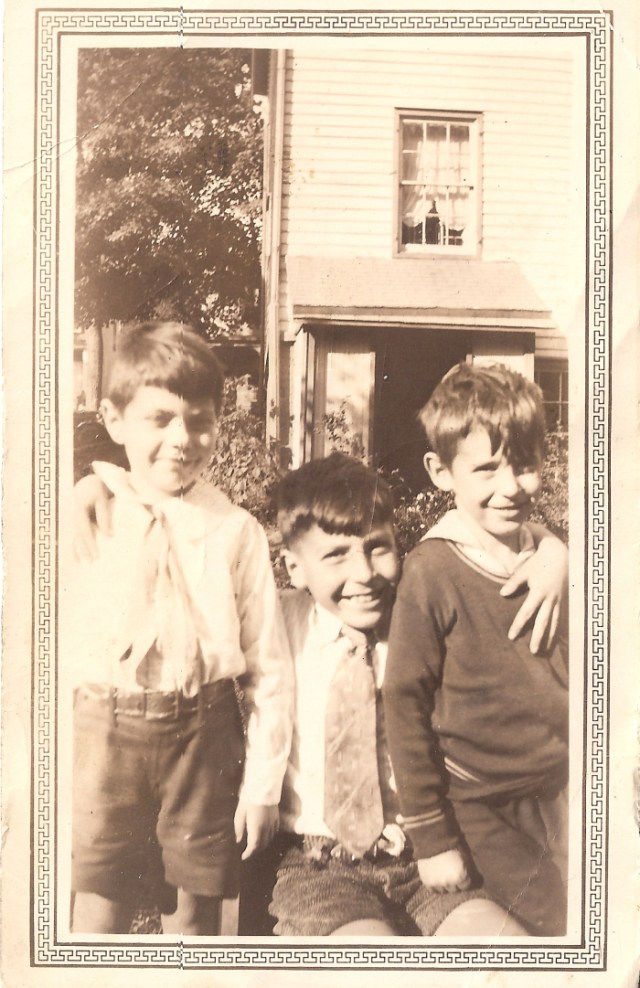
What we can establish, with simple arithmetic, is that my father started school just as the Depression was kicking off.   In September 1929 the boy was five.  His school career didn’t start off well since he didn’t speak any English and he was legally blind.  Outside of that, he probably had a pretty normal adjustment to school.  Here is a picture of him, one of very few from his childhood, that was taken during his early school years.   That’s dad in the middle.

young-irv-paul-herman

“Who’s that kid on the left?” I asked my uncle, sometime after my father’s funeral.

“That’s Henry,” he said immediately.   Henry moved away from Peekskill shortly after the picture was taken, my uncle said, and does not figure further in my father’s story.

We note that young Irv is still not wearing glasses.  He’s smiling, looking at the camera, seemingly everything is fine.   He’s affectionately draping his arms over his friend and his little brother.   All appears right in the world at that moment, during that literal snapshot of time.   It’s probably fine.

Inter-branch Dispute Court, long overdue

Congress’s right to oversee the Executive Branch by summoning its employees  with reasonable subpoenas has always been upheld by our federal courts.  Nixon was required, by a unanimous Supreme Court, to turn over the incriminating tapes that ended his presidency .  Clinton’s appeal for executive immunity from civil prosecution over sexual improprieties he engaged in while he was governor of Arkansas was also turned down by a unanimous Supreme Court.   

Our current president, the most unscrupulous one we’ve had so far, aided and abetted by the most openly unprincipled Attorney General in our history, insists on the Unitary Executive’s right to a blanket protective shield against all prosecution, all subpoenas, and investigations of every kind.

If you are litigious, and wealthy enough, you understand that you can delay almost any matter almost indefinitely, if you have an army of lawyers willing to brazenly advance arguments they know they will eventually lose.   

I couldn’t help myself, the other day I read part of the recent Vance/Mazars Supreme Court decision, and, to my amazement (but not surprise) Kavanaugh’s “concurrence” with the majority was actually an amplification of the dissent by the two farthest right  Justices, Mr. Thomas, the Black Klansman, and Samuel Alito.  Kavanaugh stressed, by agreeing with the main thrust of their narrow dissents, that the court was “unanimous” in agreeing that the president may litigate every possible legal theory to his heart’s content, ’til the cows come home, ’til American women of color walk on the moon.  Because he’s an ordinary citizen, in the eyes of the law, he may use the delaying tactics available to any ordinary citizen of great wealth.   Fair is fair.

What a slimy fellow our Mr. Kavanaugh is.  What a slimy legal system we have here under the American Rule (each side pays their own legal fees– except for poor people accused of crimes punishable by at least a year in prison).

Former federal prosecutor Glenn Kirschner gives a good account of the most recent farcical turn in this hideous — if straightforward —  case where the Court ordered Mazars to turn Trump’s tax documents over the NY County DA.   Instead of complying with the Supreme Court’s order to allow Mazars to release his tax records (why on earth would he?)  Trump sent a small army of lawyers to court to try again to block his accountants, Mazars, from turning his tax records over the Manhattan DA Cyrus Vance Jr.’s grand jury.   Their arguments were exceedingly feeble, even ridiculous, but once they lose on the merits they’ll have another appeal.   The legal process will take months, for no good reason in such an important separation of powers case.  As Nixon famously said “Americans have a right to know if their president is a crook.”

Kirshner advocates for a real and very practical solution to the problem of an unscrupulous president exploiting the delays of the courts for his own “nefarious” purposes (Kirschner used that great word a few times to describe the president’s motives and actions) — an expedited Inter-branch Dispute Court with a realistic and short time frame for resolving things like the rights of the House to have subpoenas complied with. 

The IDC, a federal court hearing only inter-branch disputes, would work on a streamlined and uniform schedule: 72 hours to present legal briefs, 72 hours to argue in court and present testimony and evidence, 72 hours for a ruling.  Resolution of the issue in nine working days.  Sounds about right to me.  It would go a long way to restoring the checks and balances intended by the Framers, the Original Intent conservatives claim to revere (except when they have the presidency).

Check it out, very well presented.


I Am SO Judgmental

It’s hard for me not to be, especially living through this deadly public denial of an out of control pandemic.  As the disease rages, and new infection records are set almost daily, we are barraged by constant public denials of the proven best ways to control the spread of this killer disease, by many of those in power here in the land of the free and the home of the brave.  If only I could stop being so darned judgmental…

I look at our floridly insane president, an incoherent man living in his own, demon-infested, world.   He cannot answer a simple question posed to him, he rambles about unrelated matters he thinks will make him look good.   He lives the life of the tormented rich man from old Yiddish curse, racing from room to room of his mansion, the Devil in hot pursuit.   

We can pretend he’s not insane, as we do, even when confronted with the latest proof of his madness, but it changes nothing.   “We must not let science stand in the way of the fact that the president wants the schools open,” says his most recent press secretary yesterday, sealing the deal, in case there was any doubt.

Donald Trump’s revered grandfather, Frederick, by the way, died of influenza in the 1918 Pandemic.   You can’t make this shit up.

What has me so judgmental today in particular?   I’m thinking about the under-reported story of how much richer the richest Americans have grown during this time of suffering and plague and judgmentally wondering why this story is not on the front pages. 

During this pandemic, between March 18 and June 17, our 614 American billionaires increased their wealth by $584,000,000,000.00.   

These are people who each already had over ONE THOUSAND million dollars, becoming richer by an average of another almost THOUSAND MILLION dollars, during a time of historically disorienting fear and mass suffering.  Take this little factoid, from the above article (which originally appeared at Common Dreams. It is licensed under a Creative Commons Attribution-Share Alike 3.0 License. Feel free to republish and share widely):

Jeff Bezos, Bill Gates, Mark Zuckerberg, Warren Buffett, and Larry Ellison—the five wealthiest billionaires in the U.S.—saw their collective riches grow by $101.7 billion between March 18 and June 17, according to the new report. A dozen other American billionaires saw their wealth more than double during that same period.

By now, a month after these figures were published, we are pushing closer to an additional trillion (A MILLION MILLION) dollars in wealth for the wealthiest and most deserving among us.  And why not?

Screen Shot 2020-07-17 at 4.15.02 PM.png

It’s not as if it would be fair to take that money, earned fair and square, and use it for the public good.   Do not wonder how many PPEs, incomprehensibly still in short supply in Jared’s America, could be immediately manufactured and distributed with a fraction of that kind of money.  Unthinkable!   That would be Marxism!  Unconscionable, sick, unAmerican!

It’s not as if a trillion dollars would be more than a drop in the bucket anyway, once you divide it by the 100,000,000 or more Americans already in increasingly desperate need.   Let’s do the math, shall we, based on last month’s $584B total.   

Shoot, that’s only $5,840 a person (or a shade under $13,000 each if we gave it only to the 45,000,000 recently unemployed Americans), how much good could that pittance actually do for anyone?   How long would that really prevent a foreclosure or eviction, anyway?  Is delaying the inevitable a good use of the hard-earned money of our most valuable, precious and productive citizens?

I keep wondering why I am so fucking judgmental.   Why does it make me so angry that someone who already has a THOUSAND million dollars has an indisputable right to have infinitely more than that?   Why does the eternal well-funded argument by the finest Americans about their right to pay as little tax as possible piss me off so much?   

Maybe it’s because I come from a once poor family and I am repelled by greed and contests of heedless vanity.   Maybe it’s because my grandmother, Yetta, living in a land of pogroms sanctioned by local aristocrats, found hope and courage in the message of international brotherhood preached by the Marxist emissaries who arrived in her hellhole part of the world, holding out a better vision for the future than endless poverty, oppression and violence.

On a louder and more immediate note:  I don’t know why the hell I am so fucking judgmental.


About Your Uncle

“What’s the single most important thing you think the country needs to know about your uncle?” George Stephanopoulos asked Donald Trump’s niece, Mary Trump on national TV the other day.

Mary Trump, daughter of the president’s older brother Fred Jr., has recently been unmuzzled by the court.   Her tell-all book is out, she’s free to talk about the sordid life of the children and grandchildren of the famously sociopathic Frederick Christ Trump, Donald’s ruthless and demanding father [1].

“My father was a wonderful man, we were very close, he was my mentor and best friend,” our compulsively lying president has insisted, as anyone would of a man who gifted him $400,000,000 in today’s money [2].  It would be hard for Donald to say that his father was brutal, unfair, incapable of love, a sadist, a man who used the law to abuse others, a “winner” who demanded that his sons be “killers.”

But I’m not thinking of that family of psychos.  I’m thinking of my own.   If my niece or nephew was asked about me, what would they be able to honestly say?

“My uncle is smart, but very fucked up.  He’s a judgmental person who holds a grudge to the grave for no reason.   He’s a weird guy, frankly.   We haven’t seen him in years, though once in a while he reaches out with some awkwardly heartfelt letters, or sends us books, or something like that.   He’s an uncomfortable subject, really, so we don’t really talk about him.   It’s weird that he keeps trying to contact us, even when we don’t get back to him.   I guess he can’t take a hint, part of his stubbornly overbearing nature.  But we love him, I guess.  He’s the only family we have, outside of our parents.”

What other view could they have after almost a decade of not seeing them?   Never having been told any of the reasons, they see no reason for this estrangement.   It’s not as if one of their parents made detailed death threats, committed multiple crimes, defaulted on multiple promises, lied over and over, raged unrepentantly, bullied, manipulated.   And, anyway, those things are all so SUBJECTIVE. 

“What if he or she was morally justified in making the detailed death threats?  What if the “crimes” were acts of necessity?   What if the promises he defaulted on were things they were unfairly forced to promise to?   What if their lies were to protect us?  How about if they were raging against someone who deserved it?  Bullying and manipulating are such vague, subjective things, we’d need proof of each one, and we’ve never seen any examples of it in our lives.

“So who is nuts here?  Our uncle’s father was a brutal and unhappy man.   It makes sense that our uncle would be a chip off the old block.   We are not the jury or the judges.   In fact, we don’t really have a strong opinion one way or another — we haven’t even seen our uncle in a decade.   There is just something off about the guy, creepy, though it’s hard to put our finger on it directly.   And, yes, he’s our uncle and we love him, so you can take that into account and picture what we might say about him if he wasn’t related to us.” 

This, to me, is a snapshot of a central tragedy of the world.  Shameful and common things that, if addressed, are part of a nuanced understanding of life; unaddressed and kept secret, compelling (but unknowable) reasons for permanent estrangement and eventually warfare.


[1]  Check out what the president’s grandfather died of!   You can’t make this shit up:

Frederick Trump – Wikipedia

en.wikipedia.org › wiki › Frederick_Trump
 

Frederick Trump was a German–American businessman and the patriarch of the Trump family. … Trump and Christ married on August 26, 1902, and moved to New York City. :95. In New York, Trump found work as a barber and a restaurant …

Died‎: ‎30 May 1918 (aged 49); ‎Woodhaven, Qu…

Cause of death‎: ‎1918 influenza pandemic

Born‎: ‎Friedrich Trump; 14 March 1869; ‎Kallstadt‎, …
Parent(s)‎: ‎Christian Johannes Trump; Katharina …


[2]  lede paragraph from Town & Country article (April 5, 2017):

President Donald Trump has referred to his father Fred as his hero, role model, and best friend.  He followed in his dad’s footsteps in many respects, joining his real-estate management company right after college and expanding on Fred’s developments in New York City.   His beloved father didn’t live to see Donald’s very successful first foray into politics; Fred passed away in 1999 at the age of 93.   “I don’t think I wanted to outdo him, but maybe psychologically I did,” Donald has said. “You’re always looking to do a little better than your parents… deep down inside, maybe I did.”

Why We Need An Expedited Judicial Process to Help Control the Occasional Unscrupulous President

Without an expedited process to bring evidence of a president’s alleged illegal conduct before a court, someone like Donald Trump can do what he has done since he learned the art from his master Roy Cohn in 1973 — run out the clock on consequences while working public opinion.   

Trump lawyers routinely file motions and appeals to tie up and almost endlessly prolong any matter under litigation, burying adversaries in papers and legal fees.  They have done this for decades and do it constantly since Trump has become president.  There is no consequence, under the American Rule (each side pays its own legal fees) for a wealthy person who uses litigation as a sword and shield this way.

The law has processes to expedite relief when the alternative is irreparable harm without adequate legal intervention.  Michael Flynn’s lawyers went to court last month to get a court to grant an emergency decree instantly dismissing his case without a hearing.  The DC Circuit Court panel did so, 2-1.   They ordered the trial judge to immediately dismiss the case without a hearing. 

There needs to be a process for expediting resolution of matters involving a manically litigious president and the public interest.  

Whenever anyone has tried to hold Donald Trump legally accountable for anything in his long, tricky, unaccountable life, his army of lawyers gets to work filing mountains of papers, making arguments that are often ridiculous (“yes, he could shoot somebody on Fifth Avenue and nobody could arrest him or investigate while he’s president”), but not technically “frivolous” (which would get them thrown out of court instantly– with ethical consequences for the lawyers). 

In 2018 the NY County DA, Cyrus Vance Jr.  subpoenaed Mr. Trump’s tax records from his accountants, Mazars, to determine whether Trump had falsified records to hide hush money payments to a porn star to keep quiet about their sexual liaison in the days before the 2016 election.   Mr. Trump’s former personal lawyer Michael Cohen is back in prison, in part for that crime.

In 2019, Trump’s personal lawyers sued the Manhattan DA, and Mazars, to prevent the disclosure of the tax fillings. Trump v. Vance (and Mazars, et al)  was one of the cases recently decided by the Supreme Court.  Trump’s lawyers brought the protective case on shaky legal grounds that John Roberts easily disposed of but the years of delay caused by bringing a lawsuit and vigorously litigating a case they knew they’d eventually lose, were years of unaccountability that Trump gained. 

The result was predictable:  the Supreme Court ruled 7-2 that Mr. Trump’s accountants will eventually have to turn over the tax records, but it could be many months, or even years, before the public sees them.  It also left open the possibility, strongly endorsed by four of the five conservatives, that Trump’s lawyers could use new delaying tactics to prolong even this straightforward case indefinitely.

In the related case of the president’s blanket refusal to allow his accountants to comply with Congressional subpoenas, Trump v. Mazars, the Court ruled the same way, also 7-2.  The second case was brought by Trump’s personal lawyers in an attempt to block his accountants, and Deutsche Bank, from turning over subpoenaed documents from before Trump was president.  One presumes these documents contain compromising information the president does not want known. 

The 7-2 majority ruled that the president has no legal grounds to issue blanket orders to everyone he has ever done business with to treat all his relationships and records as top secret.   The public has a right to know if the president is entangled, say, with shady foreign (or domestic) oligarchs (here we call them ‘philanthropists’) that he may be indebted to.  If Congress has a legitimate “legislative” need to see documents, and the subpoena passes a new four part test, the president may not block compliance with the subpoena.

The Congressional subpoena case was sent back to the lower court for Trump’s lawyers to file additional papers to delay resolution until after the 2020 election (when the subpoenas in question will evaporate anyway, as a matter of law).   It makes no difference whether Trump’s lawyers make winning or losing arguments (they mostly lose), the game is to delay resolution of issues for as long as possible.  They win by delaying.

It is the same with all of his claims about temporary presidential privilege and a ridiculous blanket immunity for him and anyone he’s ever spoken to — claims the president was encouraged to make in a letter from his new Attorney General Bill Barr.   Barr knew these claims were absurd, the Supreme Court had twice before unanimously ruled, in the cases of Nixon and Clinton, that the president must obey a lawful subpoena. 

Barr also knew how long the cases would take to get to the Supreme Court, and how the Court would likely send them back to a lower court for further legal wrangling, as happened in the case Trump’s lawyers brought to stop the production of documents that could damage the president’s reelection chances.  If all else fails, Trump’s lawyers can raise (and have) a brand new quasi-legal claim: presidential harassment.

Justice’s Kavanaugh and Gorsuch did a nice dance in voting with the majority while also siding with the two hardcore dissenters, the Black Klansman and fellow arch-conservative Samuel Alito, on the proposition they highlighted that the President may use any delaying tactics the law allows, for as long as he is able to delay the eventual resolution of matters, the interests of justice notwithstanding.  It is, after all, the American way to rule for the president’s expansive powers, when the president is a conservative Republican.  Here’s Kavanaugh:

JUSTICE KAVANAUGH, with whom JUSTICE GORSUCH joins, concurring in the judgment.

The Court today unanimously concludes that a President does not possess absolute immunity from a state criminal subpoena, but also unanimously agrees that this case should be remanded to the District Court, where the President may raise constitutional and legal objections to the subpoena as appropriate. See ante, at 21–22, and n. 6; post, at 11–12 (THOMAS, J., dissenting); post, at 16–19 (ALITO, J., dissenting). I agree with those two conclusions.

Like Solomon himself, cutting the baby in half.

“But wait,” you will say, “Solomon didn’t cut the baby.  That was the point of the story– he didn’t cut the baby.”

Yes, and this hardcore Federalist Society zealot, Mr. Kavanaugh, is no Solomon.

For an excellent analysis of these two cases, I highly recommend this recent episode of Trump Inc, entitled “Temporary Presidential Immunity is Not a  Thing.”

We need a way to have quick legal rulings on matters a criminal president can nonchalantly have an army of lawyers delay almost endlessly, as they cases work their way through the court with thousands of other cases.   Former Federal Prosecutor Glenn Kirschner advocates a special court, the Inter-branch Dispute Court,  where these matters between branches of government are decided on an expedited schedule.  72 hours for the parties to submit their papers, 72 hour for an argument, a legal ruling 72 hours later.  A criminally inclined president would no longer be able to hide evidence or corruption or criminality using the slowly grinding legal process.

What is the problem with setting up a court like this, outside of it being UNFAIR to an unethical president who is used to freely operating like a mob boss with everyone in his pocket?

As Justice Boof Kavanaugh stated was the president’s absolute right, in the unanimous opinion of the Court, the president’s lawyers exercised his right to come up with a new series of legal arguments against Mazars releasing tax documents to DA Cyrus Vance and announced their intention to start new litigation in that case, under a new legal theory that will take months to debunk.  Read all about it HERE.

Three Pieces of Terrible Psychiatric Advice and their fallout

I’m reminded, by a recent chat with a woman I’ve known since I was eight, of how destructive following bad advice from experts can sometimes be.  The cliché that the craziest people often go into psychology is borne out by the experiences of my close childhood friend whose family and mine grew close as well.   I think of the damage done to them by following three pieces of catastrophic psychological advice they were given by professionals over the years.

I had a call yesterday, out of the blue, from Caroline, the soon to be 93 year-old mother of a longtime friend I haven’t been in contact with in a few years.  She told me she’s going stir-crazy during lockdown, was tired of reading (she can’t bear to watch TV these days) saw my name in her phone book, decided to call and see how I was doing.  I was glad to hear from her.

My mother and Caroline were good friends for many years, until my father eventually took a deep dislike to her, which began to come to a head when Caroline, who busily visited everybody, particularly the sick and elderly, apparently never once stopped by to see my mother when she was recuperating from cancer surgery.  “She lived five fucking blocks away,” my father pointed out.  He later added other charges, to finalize the break with longtime friends Caroline and her husband.

I’ve always liked talking to Caroline.  She’s bright and sharp and a good listener, as well as a character with an interesting take on things and the occasional cool turn of phrase (Trump, if he loses, will remain a media force and “make borsht” out of Biden).  Like all of us, she has her faults, but they never bother me when we’re chatting, as we did for a long stretch yesterday.   At one point, after she told me of her son’s soon to be finalized divorce,  I summed up the monumentally bad advice her family had followed, in desperate moments, and she immediately agreed.

ONE

Mid-1960s:  Her daughter was always a very dramatic and often unhappy girl.  At some point dad began taking her into the city regularly for father-daughter nights on the town.  They’d go to dinner and a Broadway show.  Though she seemed to enjoy the nights out, they didn’t make the miserable girl any happier.  Her unhappiness led to a threat of suicide, maybe even an attempt.  Her alarmed parents brought her to a psychiatrist.  The shrink told them to take her threats of suicide very seriously– basically to give her whatever she asked for, because if they didn’t, they could lose her.

Second opinion, anyone?  No need.  Instead they gave the teenager a credit card.   She instantly developed a lifelong taste for the finer things in life.  The bills came, the parents paid.  What could they do?  When she needed a car, she got one.  Rent?  They paid.  The young woman did not become much happier, but she was able to live well without working, at least.   In the end, she acquired  disabling drug and alcohol addictions.  Caroline agrees, in hindsight, that it was stupid, fifty years ago, to take the advice of that psychiatrist.  At ninety-two she is still subsidizing her daughter’s lifestyle.

TWO

My childhood best friend had a series of Christian girlfriends during his college and post-college years.  The relationships would fray when he informed each one he could never marry a Christian.  At thirty, feeling desperate, he went to a shrink who told him he needed to stabilize his life by finding and marrying a Jewish girl. 

He took this advice to heart, finding a Jewish girl to date (the younger sister of a guy we knew from Hebrew School), becoming engaged to her, in spite of several brightly flashing caution signs, (including vicious fights) and marrying her soon after, in a wedding notable for its openly simmering tensions.  I didn’t understand the urgency of any of this, and told him so as he reported the latest fight while rushing toward his wedding day, but the shrink had told him it was imperative to his sanity to do it, so it was full speed ahead. 

“I knew it was a terrible mistake,” said Caroline, “everybody did.”

The decision to marry was followed by thirty years of uninterrupted warfare between the spouses.   A common early war theme involved my friend’s commitment to what he hoped would be a professional songwriting career.   For some reason these activities (working with a singer, a guy, mind you) had to be carried out in secret.  The secrecy led to occasional white lies, some of which were discovered.  There was distrust, accusations of the husband being a fucking liar, screaming matches in the kitchen, the bedroom, the bathroom.  An active war zone it horrified my friend to know he was raising his two sons in.  He couldn’t imagine the damage he was doing to them by subjecting them to these regular explosions of violence between their parents.

“Sheesh,” said Caroline “yeah, that was some bad advice.  Well, at least that long nightmare is over.  The divorce will be finalized next week.”

THREE

This piece of bad advice led directly to me, the guy’s oldest friend, and it was also something of a doozy.   I was on good terms with both my friend and his wife, felt like I performed a kind of peacemaking function when I hung out with them.  They always seemed relatively fine when I was there.   I always liked her, though I could also see she was troubled and subject to rages.  I was only once on the business end of her anger, but it passed quickly.  Later, I found out, she weaponized something I’d casually told her to beat her husband bloody with at a marriage counseling session toward the end of their marriage of a thousand atrocities.

Her husband had told me a quick story he regretted telling midway through.  The little tale was truncated, it involved his wife and a third party I didn’t care much about it, he told me to forget it, I pretty much did.  A few weeks later, his wife called to tell me the same story, which she laid out in great detail.   For the first time the odd little anecdote seemed to make sense.  

“Ah,” I said, unwittingly slipping my head into the noose.

” ‘Ah’ what?” she asked.

Here I made my fatal mistake, being unguardedly candid.

” Ah, I get it.   Now it makes sense, when he told me about it I didn’t really understand why you stormed out at the end.”

“Oh,” she said, “what did he tell you?”   

Looking back, I suppose I could have tried to sidestep the question, which would have been the discreet, if tricky, thing to do.   Instead I spoke what I thought was a bland, harmless truth.  I recounted what I recalled of the first version of the story and stressed that he’d told me the whole anecdote in about a minute and that I hadn’t asked him any follow-up questions, so he’d had no chance to clarify what I hadn’t understood about the little story.

She probably made some comment about what a fucking liar he was.  If she did, I would have pointed out that it clearly wasn’t a case of lying, it was a quick story I didn’t much care about so I hadn’t bothered getting clarification of what was incomplete about it.

A few weeks later I had a text from my friend.  He had to see me, immediately.  I called to find out what was wrong, his voicemail picked up.   He immediately texted me that he couldn’t talk on the phone, he had to see me in person.   The texting went on for a few days until we arranged a time to meet in my neighborhood.   When he arrived in his car he texted me, I texted back what corner I was standing on.  He wrote back “got it” and, a minute later, drove right past me and turned right on to Broadway.  I hobbled after his car and caught him at a red light a block away.

He was cheerful, but I noticed his eyelid was ticking.  After a few minutes of small-talk I asked him what he needed to talk to me about.  He came to the point:  he was confronting me because I had deliberately tried to destroy his marriage.

“What?” said Caroline, as though I hadn’t also told her the story in detail at the time.

His wife told their marriage counselor that her fucking husband’s oldest friend confirmed that the guy was a fucking liar.   She weaponized my remark about her husband’s “false” account of a story involving her.   The marriage counselor and the wife told my hapless friend that he was not a man who could be respected, nor any kind of husband, if he let his oldest friend sabotage their marriage this way without confronting him.   So he arrived to confront me.   

“Oh, my God,” said Caroline.

I told her the funny thing was, in spite of the tensions between us by then, I really wasn’t that upset about the accusation.   Seeing him in such turmoil, I tried my best to help him out of this impossible jam with his impossible wife in his impossible marriage.   I gave him a reasonable account to bring back to his marriage counseling session, for whatever that might have been worth. 

“Well, he’s a different person now,” Caroline said “he’s happier than he’s been in a long time.”

I told her to tell him mazel tov on his divorce and to tell him I was gratified that my attempt to destroy his marriage had finally born fruit. 

At the end of a very pleasant ninety minute chat she asked me if she should tell her son we’d talked.   I told her she certainly should.  I told her again to tell him mazel tov on his divorce and to tell him I was gratified that my attempt to destroy his marriage had finally born fruit.     

I made a note of the date of her upcoming 93rd birthday and hope to check in with her then.


1924 (part 3)

My grandfather, Eliyahu/Harry, was, I’m told, a tall, strong man.   On the Lower East Side, in the early 1920s, around the time my father was born, he had a job delivering barrels of herring to the shops.   He drove a horse drawn cart through the cobblestone streets, the horse would stop, Eliyahu would wrestle a barrel of herring off the flatbed and hump it into the store.  He’d collect the money for his boss, get back on the cart and he and the horse would go to the next stop.  He did this for some time and all went fine.  Until, one day, the horse died and they hooked up a new horse to the wagon.

Eliyahu had no idea of the route, had never paid the slightest attention, the experienced old horse had known all the stops.  Eliyahu rolled aimlessly through the streets of Lower Manhattan behind the new horse, not recognizing any landmarks, unable to read the street signs or the addresses on the invoices his boss had given him.  At the end of the day he returned to the warehouse, cart still loaded with barrels of herring.   That was his last day of work. 

I learned this tale about fifty years after my grandfather died, from my father’s first cousin Eli, who told me most of what I know about my father’s childhood.   Eli was seventeen years older than my father, and so was a young adult during my father’s early years in Peekskill.  To the end of his days my father loved and feared Eli, a rough but loving customer (if he loved you), and Eli loved and was proud of my father.  In the end, he exerted himself to try to help me understand my father.  Eli turned out to be an indispensable source of family knowledge I’d otherwise have only guesses about.  

In the last years of his long life I visited Eli regularly, in his subsidized retirement cottage in Mount Kisco.  We spent hours talking about the long ago past, many times long into the night.  He was a great storyteller and a wonderful host (if he liked you — if he didn’t, all bets were off).   He was somewhat estranged from his three adult children, kids he’d famously ruled with an iron hand.  His tyrannical child-rearing was something he told me he didn’t regret, by the way, considering the fine people they grew up to be.  In fact, he gave a speech to that effect at a family gathering, where he allowed that his treatment may have amounted to abuse, if you will, but still, he felt vindicated by how well everything turned out.   He handed me the speech he delivered to look over.   

“Not one of them accepted my fucking apology,” Eli told me indignantly.  I read him back his words, pointed out that it was hardly an apology, the way he’d phrased it, the complete lack of remorse, and we proceeded to fight it out, the way he and my mother always fought.  He was fierce when angry, short and powerful, built like a sinewy bullfrog, he jumped to his feet, his face immediately magenta, veins popping, the white hairs on his head quivered, foam formed on his lips.  He had the menacing aspect of a panther when he was angry.  After the fight, like at the end of every one of the many fights between Eli and my mother, there were no hard feelings, we hugged goodbye and I headed down the dark, twisting Sawmill River Parkway to my apartment.

I wanted to learn more about my grandparents who’d died before I was born, people my father said virtually nothing about.   I wanted to know about my grandmother, Eli’s beloved Tante Chava, who Eli loved above everyone else and, even more so, my grandfather, a mysterious, silent character whose wry smile I’d seen in the two photographs of him that exist.   In one he is in a dark interior space, probably the synagogue, with his wife and younger son, my Uncle Paul,  at that time about sixteen.   Eliyahu is in a dark suit, wearing a fedora with a wide, downturned brim, smiling a wry and utterly incomprehensible smile.

While Eli had many stories about beautiful, hot-tempered Chava, my grandmother, he struggled to describe my grandfather to me.  He used a Yiddish word, fayik, I’ve never met anybody who could translate (or had even heard of), in explaining how hard it was to describe him.  Google Translate translates fayik as “fayik”.  I have only found one reference to the word on the internet, this frustratingly short fragment:  “The root, fayikmeans. creative, skilled or …” summarizing a link that leads nowhere. 

“People say he wasn’t fayik, but it wasn’t so, he was just very quiet, very withdrawn … he had a sense of humor, he was very funny, I may have been the only person who realized how funny he was, because it was so subtle and always done with a completely deadpan face…  no expression at all… He always called me ‘big shot’ ” he struggled to describe the man’s face.  Then he came up with a kind of beautiful haiku. 

“His face was just two eyes, a nose and a mouth,” and he imitated the face, staring straight ahead, like a mask, making a zipping  motion over the straight line of his mouth, to indicate how rarely Eliyahu spoke.

I quickly got the sense that he’d kept his mouth shut to avoid getting socked in the head.  I’d always wondered how my grandfather’s English name was Harry and his brother, one of my father’s uncles on his father’s side, was also named Harry.  The two sons named Harry was like a Polish joke until Eli gave me the obvious explanation.   My grandfather’s mother died and his father remarried.  The woman he married had sons named Peter and Harry.   This evil step-mother did not tolerate the second Harry, hitting him hard in the head with whatever came to hand, including sturdy pieces of wood.   

“So, I guess he just checked out after a while, his whole life seemed to be devoted to not getting cracked in the skull, and Chava could be tough too,” Eli told me.

While many apparently considered my grandfather mentally deficient, Eli saw his dry, deadpan sense of humor, his wit — his hidden fayik nature.   He finally dug up an example.  Eli’s father, my great-uncle Aren, ran a garage in Peekskill.   He hired Eliyahu to work in the garage, he fixed cars and provided parking for others, but because Eliyahu couldn’t drive he was limited to releasing the brake and manually moving the cars around.   Eli took him out one day to teach him to drive, it had become clear it was senseless to keep him at the garage if he couldn’t drive.   

“Peekskill is hilly country,” he said, “and we’re going up a hill and the car starts losing power, and your grandfather is just looking ahead with that face and I say ‘Uncle Harry, give it gas!  Give it gas!” and a second before we start sliding backwards he turns to me and says ‘gas costs money’ and we start going backwards down the steep hill, we’re about to get killed.  I managed to get my foot in there and downshifted and pulled the car over and told him to get the hell out and that was the end of his driving lessons.”

It appears Uncle Aren (who ran my father’s little family) made the right call sending his little sister to explain to the school authorities why her son spoke no English when he started school.

1924 (part 2)

On the first day of June, 1924, Israel Irving Widaen was born in a crowded slum on the lower east side of Manhattan Island.  He was named after his mother’s father, Azrael.  According to Jewish tradition, which frowns on naming a child for someone still alive, this means that my great-grandfather Azrael was already gone by June 1924.  The baby’s last name, at birth, was Widem, shortened a few years earlier, likely by a harried attendant on Ellis Island, from Widemlansky.  It was rendered on his birth certificate as “Widaen”, a spelling my grandmother, who didn’t read English, apparently signed off on.  My father’s father also didn’t read English, and so the mistake stood when my father, who until the age of eighteen was known as Irv Widem, was drafted into the US Army as Israel Irving Widaen.

Here is a key, basic, highly determinative, never considered detail of my father’s early life that didn’t dawn on me until years after my father’s death: he was born legally blind.  For most of his life, up to a few years before he died, when laser eye surgery became common and effective, he had 20/400 vision, vision he said qualified him as legally blind without his glasses.   20/400 means that what the average person can see clearly at twenty feet looked four hundred feet away to the newborn Israel/Azrael.

His mother’s face, for example, after the tremendous exertions this tiny woman endured to give birth to a huge baby (by a husband in an arranged marriage, a man she hated), would have appeared hazy to the uncomprehending infant.   That she may have come to treat the baby as unresponsive, stubbornly, aggravatingly retarded because he was basically blind, never seems to have occurred to anyone.   The effect of this unknown blindness certainly didn’t occur to me until weeks or months into writing every day about my father.   Think of the effect on your life, on your self-image, if nobody caring for you realizes you are legally blind until you are six or seven years old.

I have a picture of my father reading on the couch before dinner, after his day job, before his night job, his thick black-rimmed glasses up on his forehead, or on a nearby surface, the New York Times held a few inches from his face.  He was nearsighted, like the famous Mr. Magoo, but unlike Magoo, he wore powerful corrective lenses that allowed him to drive on the right side of the road, serve in the U.S. military, lead a fairly standard life.   If he wanted to read something he could easily read without glasses, as long as the print was very close to his face.  He eventually settled on bifocals, which allowed him to read through his glasses, holding a book or paper like anyone else.

As he was dying he insisted he’d been the “dumbest Jewish kid” in Peekskill.  This was incomprehensible to me.  Whatever critiques could be made of this often contentious man, it is impossible to argue that he wasn’t highly intelligent, well-informed, quick witted.  In the hospital room that last night of his life I questioned his assertion that he was the dumbest Jewish kid in the small town he grew up in.  “It’s impossible for me to believe you could have possibly been the dumbest Jewish kid in Peekskill,” I said.

“By far!” he insisted, with a “humph!” hours before the end of a long life as a well-read, highly articulate intellectual.

Picture now being born in 1924, a year when the resurgent Ku Klux Klan reached its high-water mark in registered members, with 2.4 million nationwide. It was early in the ill-fated experiment in Prohibition, when murderous gangsters ran neighborhoods like the one where my father was born.  There were no federal child labor laws on the books.  A president sympathetic to the Klan and other xenophobes had signed a restrictive immigration bill into law, imposing strict quotas which effectively meant that the rest of the family in Europe was doomed to whatever Fate had in store for them.   Your little family is bitterly poor, and, try as you may, you can’t make out the details of anything in the world around you.

Infantile blindness and its lifelong effects would have been an interesting subject to follow up with the baby who grew up to be my father, an old man who still believed he’d been dumb because everyone around him, teachers and classmates whose faces he couldn’t make out, laughed at him and called him a big dummy. Another subject I never got to talk about with the man who belatedly apologized for senselessly fighting with me my whole life.

There was a glancing reference to my father’s early struggles in school in the very limited family lore about his childhood.  Like most of the details I know of my father’s difficult early life, this was humorously recounted by that great story-teller Eli Gleiberman, my father’s first cousin, Uncle Aren’s first born son. Aren had saved money and sent for his youngest sister right around the time World War One started.   Eli reported that his tiny, red-haired Tante Chava (many years younger than Aren) was the most beautiful woman he’d ever seen and that she and young Eli had experienced mutual love at first sight when he and his father went to pick her up from the boat.  Eli was a good-looking kid and, according to him, his aunt’s lifelong favorite.

The story goes that my grandmother Chava was called to school after my father, the oldest, biggest kid in his class, (in addition to being odd in his expressions, presumably) showed up for school without a word of English in his head.   The school sent for her to find out how it was possible for a child born in America to grow up to the age of five or six without learning English.  The answer was that they only spoke Yiddish at home, but that answer really answered nothing.  Eli, by then in his early twenties, probably taught Chava the line she delivered in response to the school authorities.  In a heavy Yiddish accent, when confronted by the school authorities about her son’s lack of English, she said “hee’l loin.”  Eli’s face would light up in his devilish grin when he told that story.

The boy would indeed learn, and become a voracious reader with a vast English vocabulary.  He would go on to graduate from Syracuse University and later get a Master’s Degree in American History at Columbia, one unfinished dissertation short of his Ph D. That would only happen, as it turns out, once someone at the Peekskill elementary school discovered that it was not mental deficiency, but legal blindness that made it impossible for this odd boy to learn his letters.

A related question arises, when I think things over now in the cool light of all of my detective work over the years. My father’s father, Harry, (for whom I’m named– his Hebrew name, Eliyahu, is my name) the “illiterate country bumpkin completely overwhelmed by this world,” I learned not long before Eli died, spoke English with no trace of a foreign accent.  He’d come over from Europe as a baby and picked up unaccented American English, somehow.  Go figure.  Why didn’t he go to school to talk to the authorities? Because he was an illiterate country bumpkin completely overwhelmed by this world, I suppose.  His sphinx-like presence, and his mysteriously unaccented English, would have no doubt made things even worse, Aren, the small family’s patriarch, must have reasoned.  He was probably right.

No Surprises, but still

For a “transactional” person like Donald Trump, life itself is about the necessity of “winning” every single “transaction”. Every imaginable interaction in life, by the way, can be seen a transaction — a business deal. His niece stated the obvious about the upbringing that brings about this kind of mentality in this excerpt from the book the Trump family has been in court trying to prevent the release of:

“Fred [Sr.] hated it when his oldest son [Fred Jr. –ed.] screwed up or failed to intuit what was required of him, but he hated it even more when, after being taken to task, Freddy apologized. ‘Sorry, Dad,'” Mary writes, adding that Fred Sr. would “mock” Freddy for apologizing.

“Fred wanted his oldest son to be a ‘killer.'”

Mary describes this incentive structure in the Trump household as having “destroyed” Donald Trump, with Fred Sr. leaving no room for emotions or vulnerability.

“That’s what sociopaths do: they co-opt others and use them toward their own ends — ruthlessly and efficiently, with no tolerance for dissent or resistance.”

source

Donald, the second youngest of five children of the sociopathic Fred Trump Sr., neither dissented from nor resisted his autocratic father’s demanding job description for him: win at any cost. The mythical “small million dollar loan” that Trump claims started his fabulously successful career as a billionaire businessman was calculated at $400,000,000 in today’s dollars (source: lying NY Times). Those hundreds of millions were provided by Fred Sr. over several decades to bail out his inept heir in the course of several huge business failures and bankruptcies. Who cares?

That’s why we have courts! Donald Trump is the most litigious man ever to become president of the United States. How many times has Trump been involved in litigation? Many, as plaintiff and defendant both. This no-doubt lying account claims he has been in court 4,095 times in the last three decades. When we say “he” we mean his legal team, of course.

Trump learned about the power a rich person can wield using the courts at an early age, from master of the dark art of weaponized lawsuits, the disgraced Roy Cohn. Cohn famously, and audaciously, counter-sued the US Department of Justice in 1973 when it brought a lawsuit, under the Fair Housing Act, to force the Trumps to integrate their federally subsidized apartment complexes. The outrageous accusation that this good American family was racist just because they didn’t rent to colored people was defamation! The case was tied up in court for years, by Cohn’s wrangling with the DOJ, until a settlement was worked out: the Trumps would allow federal inspectors to make sure the Trumps were following the law, but without any admission of wrongdoing from the Trumps. Trumps win!

The more than twenty lying women, with their vicious accusations right before the 2016 election that Trump was a transgressive, sexually aggressive pig — virtually every one of these liars a dog he wouldn’t rub against with Mike Pence’s putz, by the way — they would all be sued right after the election, Trump promised. Not one was. SO WHAT!?? All this senseless hatred for a man who won the election fair and square. Just jealousy.

Even many of Mr. Trump’s supporters can probably stipulate that Mr. Trump is a liar, a big one, a bad one, that he appears to have a compulsion to say whatever it is he thinks he needs to say to win a given “transaction.” It’s all just “business” these things of life are all just transactions, stories to be told persuasively to get what you need.

So if, for example, he’d been forced to fire his National Security Advisor for lying to his Vice President, and then that same man lied to the FBI and then cooperated with an illegal witch hunt started after his boss exercised his perfectly legal right to fire an FBI director who refused to be loyal and drop the case against the man… well, that’s what the law is for. To make ugly looking things like that go away.

His trust in his loyal, racist Attorney General Jeff Sessions was betrayed when Sessions followed the advice of DOJ Ethics lawyers and properly recused himself from supervising the Special Counsel’s investigation into a matter Sessions had been caught being untruthful about. There were many contacts between Russians and the Trump campaign, including by Sessions, and Russia, even the Republican Senate acknowledged, interfered in all 50 states during the election. Still — Sessions had to go for that betrayal of his boss, the transaction was completely unacceptable, left the president open for literally anything. Trump eventually found the incarnation of Roy Cohn in his current unprincipled Attorney General, Bill Barr, a man who had unscrupulously auditioned for the job, promising to protect the Unitary Executive no matter what charges were leveled against him.

If Comey had only made the “Flynn thing” go away, as Trump had asked, no need to appoint the Special Counsel, no need to document the 140 instances of coordination between Trump’s campaign and the Russians, no need to detail the ten specific acts of too close to call (if an OLC memo prevents charging a sitting president) obstruction of justice committed by the president whose lawyers insisted could neither be accused of, charged with or investigated for anything, while president.

“So are you saying the president could literally shoot somebody on Fifth Avenue and he couldn’t arrested or even investigated for the shooting?” asked an incredulous federal judge at one point during a another of the many hearings Trump’s lawyers initiated to delay resolution of relatively simple matters that their client would eventually lose on (delay is as good as victory in many lawsuits, we learn).

“Yes,” said Trump’s lawyer, with a straight face.

So, sure, the president’s assertion of a blanket immunity for everything he ever discussed with anyone, under any circumstances and all documents pertaining in any way to the president or his business affairs — not constitutional. The president’s insistence that he can’t be investigated, that nobody he knows can ever be compelled to obey a legally issued subpoena? Balderdash. And yet… he wins by dragging things out again and again, keeping things hidden.

His big idea is that once Flynn is free of charges for the crimes he committed and pleaded guilty to, crimes Barr now realizes were actually, likely, crimes committed against Flynn by Trump’s enemies, the Mueller witch hunt will be shown to be yet another piece of this criminal betrayal by his vicious, sick enemies. No Flynn guilt, no reason Comey shouldn’t have dropped the unfair, illegal case. No need to fire Comey, no special prosecutor witch hunt, no stain on his perfect presidency.

Today, big surprise, we get the sparing of longtime Trump ally Roger Stone, a man afraid of death if he was forced to report to prison for his 40 month sentence. Well, we can say this, Bill Barr, the president’s top legal advisor, has learned a few things from his own sordid history.

A pardon is an acknowledgment that the person being pardoned was guilty of what he was charged for. The pardoned person can later be compelled to come to court, or before the House or Senate, and be questioned under oath about the matters he was guilty of. All kinds of ugly, potentially dangerous details can come out. Commutation of a sentence, on the other hand, means that the details of the crimes of someone like Roger Stone are now protected by the Fifth Amendment, since without the pardon he can further incriminate himself about. Stone can never be compelled to utter a word about anything related to his crimes.

Dirty tricks committed by Stone, Wikileaks, Gucifer 2.0, Russia, on behalf of Mr. Trump’s campaign? Go jump in a lake. Tweets about the trial judge in his case featuring her face in the crosshairs of a rifle? Free speech, same as threats to witnesses against him. Parties he and his buddy attended at the sumptuous home of Jeffrey Epstein? Please…

Devils and darkness. As long as the darkness is complete, what goddamned devils are you even talking about, man? And, beyond that– so what?!