
Category Archives: personal
Blues for Sammy Worst
two and a half years of mostly iPad images presented in a semi-snappy 3:49

sorry, boys and girls, I had to take the link to the movie down. Too much personal content up there for any unscrupulous content collector to collect and pass off as original. I will put the soundtrack up for music collectors to enjoy and for the more unscrupulous to claim as their own odd composition.
We take our laughs where we can get them
There was a woman, a very good looking young woman, actually, who had a small business running after-school programs and seemed to grasp the educational and group dynamics potential of the student-run animation workshop. When I increased the price to about double what the first after-school program was paying, she barely hesitated before agreeing to pay it. Her assistant was a great and supportive fan of the workshop, she urged me to organize the little mini-animation festival I put on for the kids and their parents. One day a week or so before the festival the usually cheerful assistant came in and told me her boss had died the previous day. Cancer she never revealed to anyone she worked with had ended her life at 34. Her business winked out of existence a few months later.
Fast forward a few challenging months and, temporarily (or permanently) out of public school programming, I am conducting a four session workshop for women with chronic serious diseases. Some are in recovery from cancer, others show up straight from chemo, some show up once and not again, others make half the sessions. A core of four is there every week. These first time animators all produced very cool animation, worked beautifully together, got more and more demanding about seeing the day’s rough cut before they left, high fived each other at the end. One woman in particular, Liz, was a great innovator. She came in with brilliant and ingeniously different ideas week after week. Her animation for the four sessions is here.
She was excited about assisting at the recent Stevenson workshop, the first I’ve done since last summer. The day before the workshop she was hit by the flu and couldn’t make it, she expressed her sincere regrets. I assured her there’d be more sessions, promised she’d be at the next one, whenever I could arrange it. A few days later I sent her the clip from the Stevenson session, telling her how difficult it had been and that she hadn’t missed much fun. I didn’t hear back. I wrote again a few days later, telling her I hoped she was up and around and that I’d be sending her the new website soon.
When the website was done I sent her the link, since she had grasped the idea so well and run with the ball so enthusiastically, once she’d had her head down on the table for the first forty minutes or so of each session. I emailed her once more after not hearing back, and was beginning to fear the worst for this talented woman I barely know. I have gleaned that she is living with cancer, and that it is not easy living.
When I got a smart phone I texted her that I’d joined the 21st century, hoped she was over the flu and feeling better and added this picture.
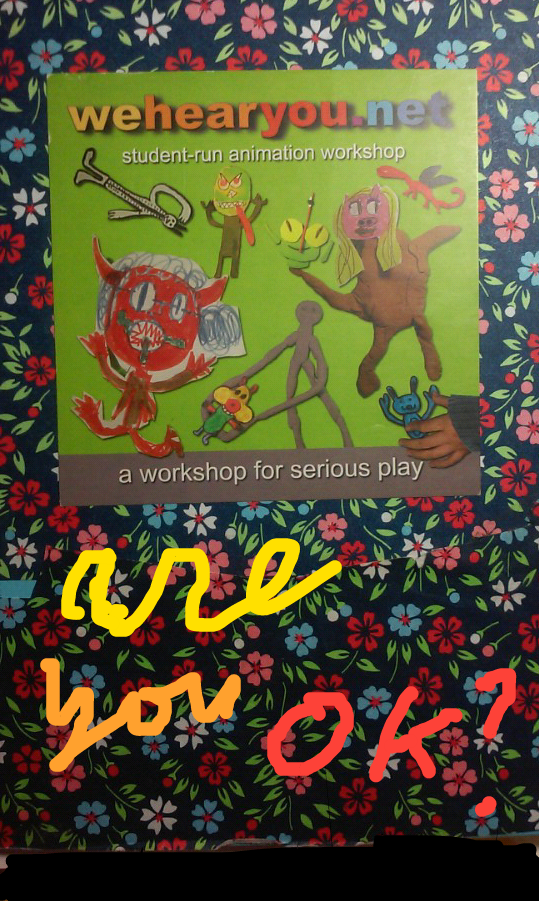
Several days passed, and hearing nothing from her, I imagined the worst. A gloomy thought twisted its way into my head: this workshop is the accursed kiss of death to the rare women who really get its potential and find it compelling.
Then tonight, at 1:35 a.m. a tiny bell in my pocket sounds, and she’s texted:
Congratulations! Sorry for the delayed reply. I’m so so happy flowers are growing (emoticon of red flower) Rain makes it happen (yellow umbrella) Happy Spring!
I wrote back:
Thanks. Good to hear from you — and happy Spring to you, too!
I hope you don’t have any objection to this wonderful bit of work being here (and I sent her the link)
3:42 a.m. I’m glad you sent this. I’m very upset and can’t sleep. Seeing this animation was uplifting. Thank you . … (emoticon of girl holding up hand)
3:45 a.m. I’d share this on my Facebook (emoticon of two people holding hands) except one thing. If it’s not too much bother, I’d like an edit…
Here I had an actual laugh. A small one, yes, but genuine (nobody here to impress with a fake laugh) and, like I said up top, I’ll take me larfs where I can get ’em.
3:49 the part with the butterflies has the cat jumping in. (Cat head emoticon) At one point its head changes to a dog. That’s not my taste (slightly disgusted looking emoticon)
3:52 I’d post your page without hesitation if that part were eliminated (a series of emoticons animating a round yellow face bursting into a laugh)
3:55 Thanks for replacing maddening thoughts with delightful ones.
She made my day with that one.
4:08 I enjoyed Jesse’s project! (gold star emoticon) The patterns in the beginning are well done. The tumbling guy has fun hair. (emoticon of a thumb up)
4:14 I will try to sleep and think of (emoticon of rowboat, I think) being inside (angel fish emoticon) animation (some kind of water emoticon). Thank you. (emoticon of little angel head with halo).
How exposure to adversity effects the developing child
I’ve known people, my mother was one, who although very intelligent, open to considering new ideas, otherwise insightful, would rather kill you than acknowledge their own anger or the harm that was done to them in childhood. Literally, repressing enough pain that they looked like they’d rather kill you than admit to being angry enough to smash someone.
“We never fucking killed anyone, asshole!” they say as a chorus now in my mind, I can see their faces, not relaxed, calm or even, in some cases, recognizable as themselves.
“‘Face twisted and contorted in hate,'” my sister quotes our father, and we both laugh. It was a phrase we heard many times over the Rice-a-roni, flank steak and salad at our formica dinner table in Queens. It was snarled, this peculiar phrase, and stated in exactly those words each time. A very curious phrase to be repeated verbatim, if you think about it.
“Twisted AND contorted,” my sister will say, and we’ll both have another chuckle. But we were not chuckling then, during those terrible battles, nor am I chuckling about it now.
My sister, working in a terrible school, is afraid to apply to move to a better one. “It’s a concentration camp but I’m used to it,” she says, “and I don’t want to leave all my friends I’ve cried with for years.” She agrees it would be better to make new friends she could celebrate with sometimes, instead of just crying and commiserating, but, in spite of being a master teacher, and someone who makes friends easily, she’s afraid to change schools.
“I’ve told your sister a thousand times what a wonderful teacher she is,” said my father on his deathbed, “but no matter how many times I tell her, it makes no difference.”
“A thousand times?” I ask him.
“Many, many times,” he says, remembering distinctly the time he told her that, at the assembly at the school where her class performed, and another one, more than one, besides. To him that was a lot. “I told her a thousand times,” seems to indicate that.
“A thousand times,” says my sister with her trademark irony. Not for nothing did she dub her father the D.U., The Dreaded Unit.
“You are a whiner,” says an observer.
“Do you hear me actually whine?” I ask the jury. On closer inspection I notice the jury is composed of a couple of weatherbeaten mannequins, a decomposing cadaver, three skeletons and a few unidentifiable animals preserved by amateurish taxidermy and propped crudely on the chairs of the jury box.
The judge, for his part, is indescribably horrible. Good thing this is a jury trial, I think to myself.
How does it work? Well, imagine you’re walking in the forest and you see a bear. Immediately, your hypothalamus sends a signal to your pituitary, which sends a signal to your adrenal gland that says, “Release stress hormones! Adrenaline! Cortisol!” And so your heart starts to pound, Your pupils dilate, your airways open up, and you are ready to either fight that bear or run from the bear. And that is wonderful if you’re in a forest and there’s a bear. (Laughter) But the problem is what happens when the bear comes home every night, and this system is activated over and over and over again, and it goes from being adaptive, or life-saving, to maladaptive, or health-damaging. Children are especially sensitive to this repeated stress activation, because their brains and bodies are just developing. High doses of adversity not only affect brain structure and function, they affect the developing immune system, developing hormonal systems, and even the way our DNA is read and transcribed.
Nadine Burke Harris, MD
Truth and Reconciliation
Got a supremely annoying phone call from a former old friend. I don’t know what the point of the call was, except to do the hideous dance one last time.
In the course of an aggravating conversation he continually justified his unreliability, made oblique references to my over-sensitivity, laughed at one point when I was sputtering slightly to finish a point he’d interrupted a couple of times for shows of peevishness. He was angry that I wouldn’t grant him it had been nervous laughter and not the passive aggressive enjoyment of a weak and angry person who had succeeded in making his antagonist mad. How dare I presume he was being passive aggressive, how dare I not let him tell me why he was laughing while I was trying to control my anger!
He told me I’d been vicious, in writing of his unreliability, characterizing it and him so uncharitably, no matter how hurt or angry I might have been. “Sometimes writing can be much more vicious than speech,” he pointed out, “and the attempts to sublimate and refine the pain and anger are more damaging than just having out with it. How hurtful do you suppose those things on the blahg were to me?”
I grant him the truth of that, as I grant him most things. One thing I don’t grant is being shouted down when I am making a point.
“The first precondition of a meaningful apology is the recognition that the person apologizing has hurt the person he is apologizing to. It is an acknowledgment of why the other person was hurt, a demonstration of empathy, followed by an admission that the behavior was wrong and some assurance of not repeating the hurtful behavior. It’s like the truth and reconciliation commission in South Africa…” suddenly I’m cut off by a loud voice.
“That was about murder and a system of brutality! Nobody was killed or brutalized here! You have this overblown tendency to make everything like that, everything is Hitler to you,” he thundered pre-emptively dismissing any point I may have been about to make.
I managed to finish my point anyway, though my lungs hurt by the time I was through, and not because I’d been shouting for more than a few seconds to break back in to finish my point.
It is a funny thing about experiences that smell similar to the childhood abuse I experienced– I feel a certain burning in my lungs whenever I’m near it.
“If you won’t acknowledge how hurtful what you did was, intentionally or not, how important the thing you promised to help me with was to me, how many hours, literally days, elapsed before you even got back to me….”
“I called you seven and a half hours later, how is it my fault you never got that missed call? Why didn’t you keep calling me when you didn’t hear back? I had bronchitis! You wrote vicious things about me on the blahg. You…”
An imaginary friend winks, tilts his long necked beer bottle to me.
“You would have been much better off forgetting the Ahimsa shit for a minute and just calling this clown and saying what you had to say originally, when he started calling you a couple of days too late, and leaving wheedling voice mails, and calling your girl friend when he couldn’t get an immediate call back from you … it’s kind of funny that he kept referring to your ‘nine days of enraged silence’ toward him, that master of enraged silence. I like when you counted off that it had actually been more like four or five days. But you should have just said what you had to say, Dude, in as few words as originally would have sufficed.”
“We’re done. You’re a cunt. Been nice.”
“Clean,” he said, and took a drink.
It’s true, that’s what this call amounted to anyway, with a residing pain in the lungs to show for my sad attempt to stay on the high road, give a stubborn former friend a chance to state his insufficient case for the hundredth time.
“You hanging up on me? You’re going to fucking hang up on me now? Hello? hello?” I can still hear the peevish fellow justifying himself, clucking about how vicious and unfair I am. “After all, you’re not the only one with problems, I’m not the only one who doesn’t help you, your constant references to Hitler, no matter the context, are inapt, and what about…’bon voyage’? ‘bon voyage’? oh, nice…. hello, hello?”
Mania
Tired, very tired today after succeeding in the frustrating prolonged struggle to get the new website up and running. That I did it all completely on my own is a source of some pride, though mainly the source of my exhaustion.
An individual must be rugged, it turns out, if he or she is to work alone over a prolonged period toward a far off goal.
Now that I can embed videos on wehearyou.net directly (see Thanks and Animation pages), I am determined to replace them all. Although there is an ether gremlin in the mix that causes two of the four to disappear, instead of playing, but only on the masked site…
Determination… hard to tell from mania today.
Listening
You have never really been listened to, granted.
I grant you everything. I grant you the pain of never really ever having been listened to. It is a primal pain, to feel that when you first spoke, until now, that you have rarely, if ever, been attentively listened to. Dig it. Many people, sadly, experience this in life. It is a trauma that puts a heavy burden on the soul.
I knew a woman who said she loved me, acted very much like she did. She did very loving things for me, was generous with her love. I could tell she hurt when I hurt. She gave me advice sometimes about my life, what she thought I should do to be in less pain. She told me she was giving me the same advice she had found useful in her life. When she was dispensing advice she told me she always talked to me the same way she spoke to herself.
I did not doubt this, even as I often resisted some of her advice. One day, when she tried to insist, I said to her “but sometimes you have talked to yourself and convinced yourself the best thing to do was to put your head in the oven.” She was quiet. She had told me of these moments of weakness, the things she had done in desperate moments. I wasn’t telling her this to make her feel bad, I was reminding her of the difference between us, and how we treat ourselves, to put her advice in perspective.
“I remind you of this to illustrate as vividly as I can, so you will have no doubt — if someone tried to put my head in an oven I would fight them to the death. I would never put my own head in an oven.” Just saying. She still offered advice from time to time, but I think this perspective stayed with her.
People who care about you will sometimes give you advice, with the best of intentions. They tell you things meaning very much to help. They may never have been really listened to themselves. Many people were not. They learned as best they could, filled their lives as best they could with the things they needed and never got in life. They took whatever wisdom they were able to find and they try to share it with you out of concern. Not all of these people can help you. In fact, few can actually help you.
Turns out the thing that probably helps the most is someone listening to you with enough care to hear what you are actually saying. This kind of listening does not assume it knows what you are about to say and does not respond to what it thinks you may have said, based on the past.
Empathy turns out to be the best thing one person can give to another, the best thing we can give ourselves. It is a question of attention– of asking questions when things are unclear, until you understand. It is a question of time, being generous with your time to hear what the other person is really concerned about. In my experience it is almost impossible for a person who is niggardly with their time or attention to be a valuable friend or even a good person to talk to.
A sufficiently mature person can tolerate being ignored, forgotten, slighted, thought of last, if at all, and can make philosophical accommodations to all these things. But when a person who claims to care for your well-being does these things, you must not tolerate it. Care does not include these things.
So, best to be direct. I have told you as clearly as I can what hurts me in your actions. I have told you again. I have explained it on a third and fourth occasion. I have given you every fair chance to do better. You have not done better, you have done worse. If you have not done worse on purpose, you did it because you were not capable of doing better. You did not care enough. I understand your limitations in friendship better than I did before.
You were not taught to care enough, nobody showed you how it should be done. That is true for many people, no doubt. It is the rare and blessed person who is shown the way to care for others. Most of us have to learn it as we go, the best we can.
I am trying hard to be a man of peace, and I succeed more often now than before in my life. I understand that self-hatred and confusion drive some people to act destructively, to themselves and others. But understanding the reason for it does not give permission to anyone to act destructively. Hitler had a horrible childhood, clearly. But fuck Hitler.
We come in the end to the point where the only question remains: hand open or hand closed when it bids you peace and go in good health?
Should go to sleep myself


excerpt from the transcript
“If you’re not insane why are you in this laughing academy?” she asked with a challenging smile.
“I’m not in a laughing academy,” I said.
“Ha!” she said. This cracked her up.
“Nothing like a girl who appreciates her own wit,” I said. “I’m glad you find this funny.” My profession of gladness snapped her right out of it, the frown returned to her face.
“This should cheer you up,” I said. “A fragment of the transcript of my intake interview. Listen to how it reads so naturally like someone speaking.”
She read:
And it was an object lesson to me about the power of apology. It was like, the feeling of hurt was dissipated instantly. And I felt much better friends with him because he empathized completely with how hurtful what he did was and he, as quickly as possible, made it go away.
I said earlier I believe in the power of apology and forgiveness and all that, and it was a sad trait in my family: my sister, my father, my father’s first cousin, my grandmother, they had a very hard time forgiving. And that’s kind of unforgivable to me. I’ve seen 30, 40, 50 year grudges in my family and so that incident with my friend was really like a light going on in a room.
“Kind of unforgivable to you,” she said handing the paper back with the most deadpan of expressions.
]
]
]
]
Does the thought of anger make you mad?
Is the subject of anger so infuriating, threatening, hideous in itself that virtually any mention of it will, sooner or later, stop conversation?
Likewise, the subjects of apology, repentance, forgiveness. Do these of necessity, except, among a small, select, wounded population, induce squeamishness and avoidance?
“May I play Devil’s Advocate?” she asks, and without waiting for so much as a nod says “Here’s another either/or. Either your intensity, self-righteousness and over-sensitivity on any subject go beyond the boundaries most people consider decent, made worse by a relentless demand for response, stated or strongly implied, put people to silence, just to make it stop. Or, if what you write is like… oh, never mind.”
What?
“You freak people out, and piss them off, when you… you know, when you act like yourself.”
Hmmmm. Good to know. I’ll try not to act like myself so much.
“That’s not what I mean,” she says.
Corporations are people, with feelings too, sniff, sniff, you judgmental, insensitive bastard. Is that what you mean?
“I don’t know what you’re talking about,” she says. “I mean that you might like to think you are not an angry person any more, that you have made great progress in that area, gained important insights you’ve had the courage and persistence to act on and are just currently frustrated, discouraged and trying not to wake up and smell the napalm, but that doesn’t mean….”
Hold it right there, girlfriend. I was in the middle of a long discussion over the roles of genetic predisposition, nurture and conscious effort to change innate personality traits one is unhappy with. The correspondence reached a certain point and then abruptly stopped on the other end. Silence as loud as the other person yelling “Silence! Enough!” [1]
I stumbled on this line in my notes last night: “the most insidious enemy of death benefits [taking positive lessons from the lives of even difficult departed loved ones–ed.] is the pervasive assumption that personality is fixed by midlife.” source
“Maybe your correspondent believes this pervasive assumption fervently, or hopelessly, as you might say, and has proven to his own satisfaction that struggling for any kind of positive personality change is futile and is just tired of your 2,000 word meditations, your opinionated self-regarding back and forth about the importance of doing things he feels are futile at best– particularly in light of your objectively depressing circumstances and lack of prospects for changing them any time soon. Maybe he’s doing you the kindness of not telling you he finds these attempts to justify your life particularly distasteful. Maybe he’s protecting you by not calling you on what bullshit virtually everything you say is.”
Dad? Is that you, you rascal?
“You will find, son, when times get tough, that I am everywhere. But let me assure you of this: you have made progress, and if I was still alive, still enlightened by the regrets I expressed on my death bed and my wishes to have lived differently, been, in fact, more like you, I’d be very proud of you. Proud that you continue to believe in what you feel is right, in spite of the difficulty of it, despite the deliberate and inadvertent deafness of virtually everyone you encounter these days.”
Must be easier for you these days, to say things like that, being a skeleton.
“Oh, I can’t tell you how much easier it is, now that I’m just bones with dirt between my smiling jaws.”
[1] Of course, another obvious reason for the gap in this particular case is the present lack of time required to thoughtfully reply in a life I know to be particularly emotionally complicated at this moment. This goes as well for each of the other several cases where the subject of anger has been unveiled and then left to languish a bit. –ed

