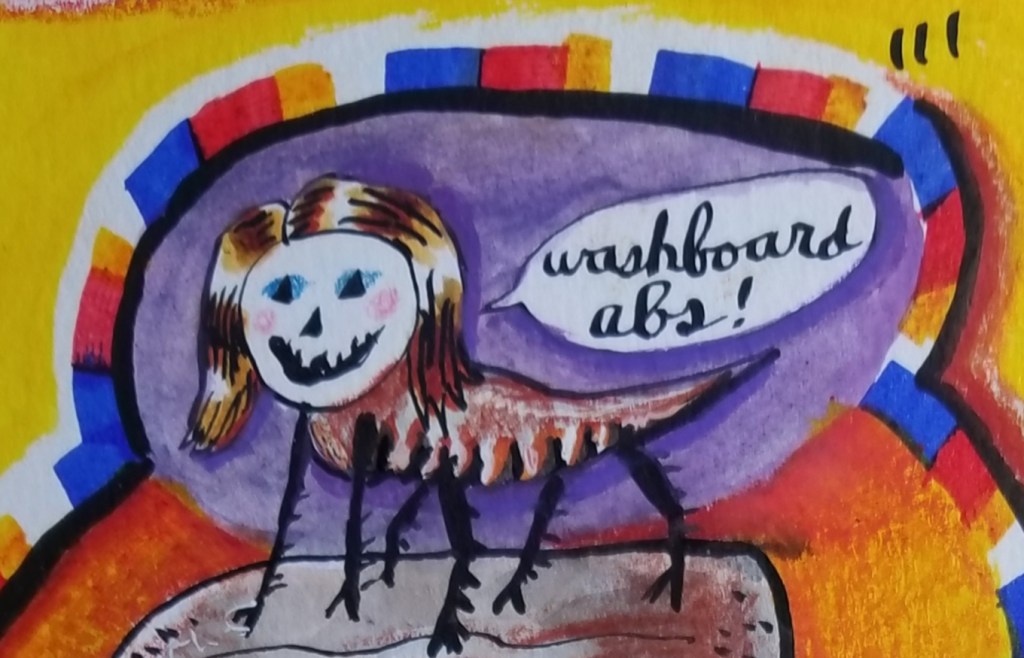
Washboard abs!
Some days the world will try to crush you, you may wake up with the weight of it solidly on your chest. It’s nothing personal, the world does it to everyone sometimes. Stay busy enough, I suppose, and you can often outrun thoughts that will otherwise stop you in your tracks: the senseless war over slowing or speeding up climate catastrophe, finally addressing racism head on, the war over public education, a propaganda machine effectively substituting grievance-stoked rage for discussion. If you stay busy enough you may never think, “Jesus, all the evidence is out there in public, has been for years, why are these dangerous, powerful criminals not being indicted?” Then, after a day of great exertion you collapse into bed, exhausted, ready for needed seep, but there is a small crew with jackhammers outside your bedroom window, waiting to energetically make sure you will make do with short sleep.
The world will crush you sometimes, it always does. What to do on those days? Do something you love, even if only for a short time. Remember, the world is a crushing machine on certain days and you are not wrong to feel squeezed by it. Moods change, the people and things you most love remain. Reminders of all the rest of this miraculous life can help lift the weight of the fucking world off of you. It won’t lift at once, or permanently, but, shoot, I’ll take less of an anvil on my heart any day. It may be tough to dance with a million tons on your shoulders, but it’s easy enough to listen to the music that makes you want to dance.
The first thing is to breathe. Breathing is the best thing to do, the first, most essential and naturally calming thing you can do. Remember to breathe, slowly, deeply, appreciating with each inhale and each exhale how much more beautiful this life giving process is than the inevitable alternative which always comes in its time. If you wake up feeling crushed, focus on breathing, first. My two cents.
Gaining insight is hard, delivering a punch in the face, when provoked, is pretty straightforward. Not to say you might not pay a price for the punch, you can break your thumb, bruise your knuckles, have the shit beat out of you, even get shot or stabbed, but the reflex to lash out when angry is pretty basic. It’s simple, primitive, sometimes effective in dealing with a real or imagined threat. Those who train to deliver a punch effectively learn to harden their hands, protect their fingers from damage, turn the fist just so right before impact for maximum effect. Everybody else is free to let fly, with real or metaphorical fists, like a hurtful series of words you can never take back.
Insight, on the other hand, is hard to come by, often painful. You need to learn to see things from a perspective not your own, feel things that may never have happened to you directly, learn to study the broken pieces calmly, detached from your ingrained reactions. Insight allows you to make connections on a more thoughtful level than our world consistently operates on.
The level our world operates on is a well-deserved punch in the face. More specifically, a punch in the smug, fucking face. Insight allows you to understand the operation of life on a less reflexive level. Gain enough insight and almost everybody may want to punch you in the face, if you’re not insightful enough to be cool about your path toward insight.
I give the example of my own attempts to not replicate what I experienced from my parents in my youth. That is, I try to follow Hillel’s formulation of the Golden Rule. I try not to do things to others that I hate being done to me. All we can do is try, but trying is a step in the right direction, every time. I hated being unfairly accused of things I hadn’t done, painted in an ugly light, I still do, as does everybody else, of course. In my parents’ house I was constantly confronted, always portrayed as coming home from the hospital two days old angry and ready to fight, usually blamed for the anger that was always exploding all around me, and always required to fight. I fought, and got pretty good at it, even as I understood how tragically ridiculous the nonsensical war I was drafted into was.
I have made it a long project to make myself less susceptible to my anger, less ready to react with rage. Reading about Gandhi’s philosophy of satyagraha (not in detail, mind you) I began trying to practice ahimsa, non-harm, as a first principle. A difficult stance, in our violent world, particularly without a religious framework and a community of fellow non-harmers, but I have found the goal very worthwhile. Trying to keep the principle of non-harm in mind has made my life better, even if I am far from serene.
If you come from a mindset of not harming others, of being straight in expressing what you need, being direct and patient, it seems to me your life will improve, particularly if you were raised in a senseless war where everybody had to fight all the time for no real reason.
It turns out even a straightforward insight like this is very shaky in the real world. Certain old friends will insist that you’re deluding yourself, that you may have become a tiny bit better at DELAYING the arrival of your famous fucking anger, but you are actually just kidding yourself, propped on a flimsy moral pedestal that with only a few hours of determined kicking I can topple, proving that your rage is very real and present, you fucking superior fucking asshole. In the end, I will make you want to punch me in the face, Ahimsa-boy, proving that I and the brutal real world are right and your ahimsa pose is just gas, self-righteous fumes, no matter how much you may think you’ve improved in overcoming your reflex to respond with anger.
To me, resisting the impulse to react with anger is a net good, no matter how incremental the improvement. If in the past you would have been angry a minute into an aggravating situation, you now find you are able to go for an hour before the anger starts sapping your will to remain peaceful. In one sense it is a huge step forward, you will find yourself doing better in many situations that would have turned to shit instantly in the past. It is a useful skill in our world, to refrain from striking others with words or fists.
On the other hand, to someone intent on proving that you, like them, are a piece of shit beyond redemption, beyond the possibility of meaningful change of any kind, well, in the end they will be able to grind you down. You are not a bodhisattva, you are just trying to do better, and in the end you will reach your limit and get that look on your face that will prove their triumphant point.
Been there, done that, showing great patience with people who demonstrated that insight was not for them, that a punch in the fucking face was much more to their taste (even if beyond the limits of their physical courage), and that I, actually, rather than being less angry and provocative with my so-called insight and ahimsa was even more of a piece of shit for trying to be better than them. Of course, and I say this just between us, I was already better than them, in terms of treating people the way I would like to be treated myself, but my goal was to be better than myself, not anybody else. I’m not in competition, in any field you can name, except to make myself better.
Insight is the only way out of pain, outside of the usual painkillers. It is not a magic door you can walk through, of course, it is a path you take, a goal you aspire to. Much easier than pausing to gather yourself and trying to develop understanding is staying on the treadmill, running until your heart gives out. Hard to blame people who recoil from introspection. People don’t like things that cause them pain, unless they are masochists.
Think of it this way, though — you can repeat the same tragedy over and over in your life, with minor variations, or you can learn from the way you play your part in the tragedy and do it a little bit less tragically next time. Or, you know, you can just punch me in the fucking face, it’ll probably feel better, at least until the adrenaline and cortisol rush wears off.
Patient (via email): The MRI results were emailed to me yesterday. I’ll be keeping my fingers crossed until I hear from you.
Doctor; Looks good!!
Patient; phew… thanks for the good news
When my father was diagnosed with prostate cancer, late in his life, his doctor told him that most men who live to be eighty will develop prostate cancer but that it grows very slowly at that age and they will generally die of causes other than prostate cancer. His doctor recommended “watchful waiting”, keeping an eye on the slow, inexorable advance of this common cancer in older men. Sure enough, something else killed my father, undiagnosed liver cancer, though saying it that way is a bit unfair to the several highly regarded specialists he saw regularly in the last two years of his life, it actually was diagnosed, in the ER, six days before he died.
A few decades later, I myself watchfully waiting, in this case for the results of an MRI on my prostate, an MRI done because my prostate specific antigen levels were quite high. The test results were quickly emailed to me, along with a bill for $162 (thank you, Medicare… the US Gold Standard…) for the short visit with my urologist to set up the MRI (bill for that to follow). I have learned that reading medical test results without knowledge can be needlessly stressful, so I am watchfully waiting for the call from my doctor to tell me what the MRI results mean for my immediate futire.
In this waiting mode you can invent stories, more or less likely, that may or may not explain the delay in hearing from the doctor — though we have no idea about any of these theories. If it was good news, the MRI showed everything nice and benign on the old prostate, the doctor would have immediately called to tell me, no? Since it’s not good news, next step biopsy to confirm cancer suspicion from MRI, he’s waiting to have a few minutes to talk to me since the discussion is longer than “good news, it was benign”. If it was bad news, another theory goes, he’d have called right away. No, wait, he’d give me a day or two in my preferred fool’s paradise before dropping the bad news that I need to have a long needle repeatedly inserted up my ass and jammed into my prostate, likely followed by cancer treatment of some kind. Or any other story I can imagine, including a list of stories involving complications in the doctor’s own life that have caused him to fall behind in updating anxious patients. Since each theory is equally plausible, and equally implausible, I put the whole theorizing out of mind now that I’ve emailed my doctor telling him I have my fingers crossed until he tells me what the MRI results mean. Figure of speech, “fingers crossed”, since I am clearly typing with uncrossed fingers.
I think, philosophically, that everybody has to die of something. I also recall the foamy urine I was seeing five years ago, foam that got so thick it looked like the head on a well-pulled pint of Guinness, foam you could piss deep holes in as you went. Ending with a smiley face in the foam was always fun. That foamy urine, with the swelling of the legs, turned out to be symptoms of a rare kidney disease that taught me a new word — “idiopathic”. What does idiopathic mean? It means we don’t know what causes it, as to the pathology of this disease we are, as they say, idiots. As to the cure? 33% of the time a short course of chemotherapy (at around $25,000 a bag) knocks it out, and I was in that lucky 33%, and lucky too that Obamacare hadn’t been repealed.
That constant itch on the inside of my left scapula? A dermatologist told me the name several years ago but I never retained it. It’s neurological, not topical, I recall that — put what you like on the skin, the itch is caused by a signal sent from a nerve, so nothing will really help with the itch, outside of a good scratch, which I was advised only makes it worse. In the Age of Surveillance Capitalism we live in, I was discussing this itch with Sekhnet, as she scratched it, and soon had videos about Notalgia Paresthetica sent to me, for my edification, or shopping pleasure.
Fucked though so much of this world is, designed by the greediest for the benefit of the greediest, with applause and hero worship for the most successfully greedy, the mass of humanity not only viciously screwed but driven mad by deliberate lies that benefit the worst people alive at any given time, spread with increasingly ridiculous ease by those paid to do it, for the enormous profits of selected far-sighted tech billionaires … we don’t want to leave it. This miraculous world is not the problem, the problem is that we must all leave it one day. The only consistently useful practice available to most of us is taking care of ourselves and our loved ones as well as we can, and watchful waiting.
The terrible thing lately about my desire to avoid having to fight over trifles is that
I’m even procrastinating about things like calls to merchants where I have credits of hundreds of dollars because I don’t want to fucking hear:
“well sir, under corporate policy you needed to redeem all credit within 90 days, which has expired by one year, as you can plainly see, so you will have to talk to corporate if you have a problem.”
And I go “I thought I was talking to fucking corporate”
And they’ll say “no, corporate is corporate and we’re customer service, there’s no direct connection. We have no authority over corporate, we can’t connect you with corporate, our system doesn’t allow it, so you have to call corporate directly because that’s corporate policy, sir.”
And the galling thought of that likely conversation with an otherwise nice, completely powerless kid makes me go fuck no, not today, you fucking corporate Nazi fucks…
Though history teaches us that in the end Nazis will lose, while they are in the ascendancy they can make life very, very bitter. As we can see with just a glance in any direction.

History, as we see in the times we’re living in, is often as much a political propaganda tool as an objective story about what happened and why it happened. That is not to say that there isn’t more insightful and less insightful history out there, but the enterprise of creating and writing history can be as fraught, prejudiced and sometimes mad as any other human endeavor.
Take the history of Ukraine in the last hundred years or so. Seventy-nine years ago, on a hot August night, the families of my grandmother and grandfather, including all the children and babies, were marched to the edge of the Ukrainian town where they had lived for generations and were not to live anymore. Under the supervision of the SS, Ukrainians killed them, along with a couple thousand other Jews, in a massacre that’s not even recorded in the annals of such atrocities. My grandmother and grandfather, who left twenty years earlier, were the only survivors of their once large families. It left me with a bad impression of Ukrainians, but there was a big piece of the story I didn’t know.
Twenty years or so earlier the Red Army, which included a young chronicler named Isaac Babel who perfectly recorded the cadences of my grandparents’ neighborhood, liberated the downtrodden of the Ukraine including its Jews. My grandmother, being an idealistic teenager, immediately embraced the international vision of workers overthrowing centuries of ignorance, superstition and hatred and working as one toward a more just future. She left for the US a few years later, and two decades later Ukrainian reactionaries killed everyone in her family.
There had always been anti-Semitism in Ukraine, as in most parts of Europe, Khmelnitsky, Ukrainian nationalist hero, was also infamous among the Jews for leading horseback slaughters of Jews. There is a town named after him, not far from the little town my grandparents lived in. But here’s the piece of the story I didn’t have until recently.
Josef Stalin, psychopath and father of socialism in one country, the Union of Soviet Republics (Russia and basically colonies of Stalin’s Russia), deliberately starved several million Ukrainians to death just a few years before the Nazi invasion of that part of the world. Ukrainian nationalists naturally took the side of the Nazi liberators over fucking Stalin, which likely accelerated their hatred and made many of them even more willing to slaughter communist dupes en masse. Jews and Communists were at that point inseparable in their minds.
After the fall of the Soviet Union, oligarchs stepped in to rule over the populations of the various new states. One of the preferred candidates of the Russian-favoring oligarchs in Ukraine, a brute named Viktor Yanukovych, was groomed by Trump’s former campaign manager Paul Manafort (who went on to work closely with an agent of Putin’s named Kilimnik to help get Trump elected). The corrupt Yanukovych was forced from power in 2014 by a spontaneous revolution of Ukrainians. He fled to Russia for the protection of his Russian oligarch sponsors. Four years later, Ukrainians elected a young Jewish comedian with a law degree, the new president Trump tried to shake down for some dirt on Biden in that perfect phone call.
How my grandmother would have laughed celebrating the inauguration of Volodymyr Zelensky, on what would have been her daughter’s 91st birthday!
So now Trump’s backer, former KGB spook and Russian oligarch, Vladimir Putin, is poised to invade Ukraine again, hopefully put his boy Yanukovych back in power. Read the recent history, if you have the stomach for it. That Mudoch’s FOX and the American right is pretty much backing Trumpie’s mentor Putin in this dispute among strangers should tell you all you need to know as you open the pages of a reputable history book.
And let us hope an old-fashioned style bloody war does not sweep across that long suffering stretch known as Europe’s Breadbasket, or anywhere else.
Bullies, because they have never felt safe, loved, or cherished, grow up supremely defensive, perpetually hurt, ashamed of their weakness and inconsolably angry. They were emotionally neglected, humiliated for ordinary human needs, bullied by someone they depended on when they were very young. These tiny victims grow up to see life through the eyes of a hurt child, a zero-sum game pitting the strong against the weak, a contest fated to end only in dominance or submission.
To berate and dismiss, or otherwise beat you, is to dominate you. To sincerely apologize to you when I see I have hurt you is to bend the knee in humiliated weakness. Bullies see a simplified black and white world, a series of grim transactions to be fought to victory or defeat. Victory feels fleetingly great, the agony of defeat is well-known and terrible to behold, particularly in a bully.
This inconsolable rage in the heart starts in the bully’s earliest life, continues year after year, making the young person harden himself against pain until finally he succumbs to sadism. The ability to dominate and bully people is not without its rewards in the world of business and politics, but it is a shit thing just the same. When a bully in control of others creates a culture of bullying, where only brutality in service to the bully is rewarded, it is a shit thing and often a deadly thing.
I just finished listening to the fascinating The Drama of the Gifted Child by Alice Miller. Though the book, in its first edition, was published in 1978, it ends with a seemingly prescient insight, though it addresses a perpetual human failing — the falling into angry mobs because the unbearable anguish of your life compels you to take out your rage on strangers, in the name of a belief system. Here is the very end of Alice Miller’s popular book:
A person who can honestly, and without self-deception, deal with his feelings has no need to disguise them with the help of ideologies. The basic similarity of the various nationalistic movements flourishing today reveals that their motives have nothing to do with the real interests of the people who are fighting and hating, but instead have very much to do with those people’s childhood histories.
The mistreatment, humiliation and exploitation of children is the same worldwide as is the means of avoiding the memory of it. Individuals who do not want to know their own truth collude in denial with society as a whole, looking for a common enemy on whom to act out their repressed rage. But as the inhabitants of this shrinking planet near the end of the twentieth century the danger inherent in self-deception is growing exponentially, and we can afford it less than ever. Fortunately, at the same time, we now have the tools we need to truly understand ourselves as we were and as we are.
For most bullies, the path away from sadism is too painful. What they have suffered as vulnerable children is too painful to seek insight into. They feel in control only when dominating others, as they were brutally dominated.
We learn, to nobody’s surprise, that as children Donald Trump and Charles Koch (born 1946 and 1935 respectively), both had driven, largely absent fathers who were brutal, intolerant and demanding, people who might fairly be called unloving pieces of shit. They were raised to believe that only the ruthless pursuit of money and power made them worthy of love (which it is unlikely either of them ever found in later life.)
Fred Koch was an admirer of the Nazis, he was introduced to Hitler before the war and Koch Industries built the oil refineries that the Luftwaffe would need for their high octane fuel to lead Hitler’s blitzkreig. Fred Trump was arrested as a young man at a Ku Klux Klan rally in Queens. Fred Koch was one of the founders of the John Birch Society, the lunatic fascist fringe of the far-right in the years after Brown v. Board of Education made public school segregation illegal in the U.S., the Birchers responded by calling for the Chief Justice’s impeachment. Fred Trump took millions in tax subsidies to build post-war working class housing, passed most of it on to his children tax-free through various frauds (read the New York Times investigative story about Frederick Christ Trump’s elaborate tax fraud and tax evasion schemes, a factual article never challenged in court [1]) and kept his housing developments racially segregated (no Puerto Ricans either, thank you) until the Fair Housing Act and the federal court forced him to stop discriminating. Characteristically, Fred Trump, and his second choice protegée. Donald [2], admitted no wrongdoing and claimed victory in the case, although “minorities” were now able to rent Trump apartments.
Charles was the second oldest of four Koch brothers (he and David beat the other two in a bitter, decades-long court battle for the right to Koch Industries), Donald was the third of four Trump children. Fred Koch believed his sons should fight it out, to see who was fit to be the boss. When they were toddlers Fred Koch, who was rarely at home, hired a strict German nanny to make sure the boys all used the toilet at the same time every day, and she raised young Charles, his older brother Fred Jr. and the babies, until the Nazis took France and she returned to the homeland to celebrate with the Fuhrer. Fred Trump openly favored his older, brighter son, a golden boy named Fred Jr., beloved of everybody. Young Donald didn’t know what to do with himself until he got a little brother to bully. It beat the hell out of his life before he had a weak baby brother to practice sadism on.
Bullies see the world as a desperate fight not to be injured and their main weapon is attack. They find people weaker than themselves to prey on, if someone shows fear, they attack. The way not to be bullied is to stand up to a bully, though few of us consistently have this ability. In the case of Donald Trump, any time he has been forcefully opposed he has backed down. We saw this at several key moments during his time in office, even at the very end, while vehemently denying his electoral loss, when he backed down from replacing the Attorney General with a man who would lie to confirm Trump’s lie about a stolen election, after a three hour shouting match, in the face of a unified threat from leaders of the Department of Justice and his loyal White House Counsel.
The bully as an individual is one thing, and sickening enough. The bully as a mob, a thousand, or a million strong, gathered to take out their limitless hurt and rage on those who can’t defend themselves, an ongoing tragedy of human history. Insight might be extremely painful for a bully to attain, but it is probably less painful than being tortured, with your neck in a noose, at the mercy of your fellow enraged bullies.

[1]
In spite of this threat, a brilliant example of the fiercest legal puffery money can buy, inserted in a very droll matter by the Grey Lady, between two paragraphs detailing the fraud with great specificity:

[2]
Freddie, Fred Trump Jr., (Mary Trump’s father) had disappointed his father with a lack of ruthlessness, demonstrated dramatically when he replaced drafty windows in freezing Trump apartments in a complex he was managing without forcing the tenants to take their powerful landlord to court. It cost Frederick Christ Trump millions to replace the windows, (for no reason!} and was the decisive blow against his chosen son, Fred Jr. as his successor.
Fred Sr. realized he’d have to train the vain little juvenile delinquent to run the Trump empire, once the kid proved that, even though he had little business smarts, he was a ruthless killer who’d do whatever was necessary to increase the family fortune. Fred Jr. ended his days drinking himself to death as a custodian in one of the Trump buildings. His family would be cheated by the other Trumps when the patriarch finally died, naturally. Donald would finally be able to defy his father by selling off all his properties, in express violation of his stated wishes. He sold his father’s real estate empire for well under its appraised value, naturally.
 gratuitousblahg