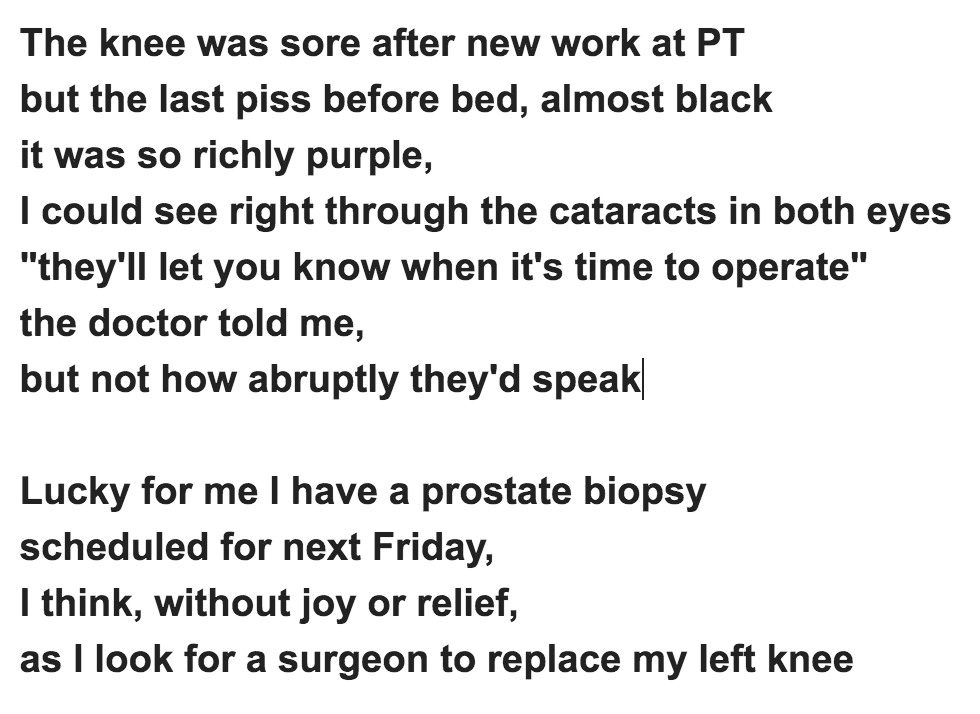

The only way forward in a conflict or problem, any troubling situation that requires thought, planning and an actual solution, is imagining, reasoning, talking and agreement. Some kind of agreement always has to come before the problem can be solved. The really scary part about human conflict is that it is often not amenable to thought, reasonable discussion or compromise. The more willful party, the one who refuses to agree to anything, will insist it has prevailed, to the harm of everyone involved.
I think of the frequent rages of my father. He couldn’t explain exactly why he was raging at any given time, but anger filled him and he needed to vomit it out regularly.
His temper was fierce and he never really forgave. He spoke and reasoned very well, so that amid his terrible curses he was able to mount an argument that was sometimes hard to overcome. Very hard to overcome, because he was adept at constantly shifting what you were actually talking about while he was angry and afterwards. Try talking something out, or calming somebody, when you can’t even agree what you’re talking about in any given moment.
We had an ongoing philosophical dispute over whether someone can change anything significant about themselves. My position was, if you are in enough pain, and motivated to be in less pain, you can change certain things that lead inevitably to more pain. For example, you can learn how to take a breath and be more patient when you are about to lose your temper. In my mind this is kind of a game changer, if your weakness is a proneness to respond to frustration with anger.
My father’s position, understandably, was that my belief in a human’s ability to change anything fundamental about himself was completely idiotic. No matter how much I may have thought that I changed he would always be able to provoke me until he proved that he was right about my fucking uncontrollably violent temper. Even after I proved to him that he couldn’t make me angry anymore, he dismissed any change in me as delusional, a superficial acting job.
It occurred to me recently, after stumbling on some literature about narcissism, and the narcissist’s need to be in control and be right no matter what the facts or the situation, that my father, speaking as a narcissist, was truly unable to change. The whole ball game for a narcissist is about winning the stark black and white conflict that is life, at any cost, no matter how small the issue causing friction. The world is either white, and everything you do is commendable and perfect, or black, and everything you do is despicable, contemptible, shameful. If those are your only two choices, you’re going to pick perfect and commendable and death to all humiliating naysayers. End of story.
What does that leave for everybody else in the narcissist’s orbit? Basically my way or the highway, asshole, you know the fucking rules of this one way road, you contemptible pile of dreck!
Look at any source of media drama and you will see narcissists, like the richest men in the world, our most powerful and greatest genius citizens, acting like petty children to assert their superiority over all of the losers in the world. Facts don’t matter when you’re a wealthy compulsive liar and there is no penalty for lying and calling everybody else a fucking liar. Would you expect a more humane rule in a world run by entitled narcissists?
Interesting how seeing this now through the eyes of narcissism, which is so prevalent in our world today, makes me finally understand that my father, for all his talents and excellent traits, actually was unable to change. The conviction that people cannot change was a core belief that went into making him what he was, because his wounds made change impossible for him. A tragedy, yes, but also very easy to understand, through the right lens.
To me, the terror of irrationality is that nothing can be agreed upon, nothing can be discussed, nothing can be resolved, no conflict can be peaceably ended, except on the terms of the more willful party. This is because all of the tools that humans have to make peace have been taken off the table in the service of one party insisting on their right to do whatever they need to do to the other party in order to control and prevail over their own helplessness in the face of their unbearable pain. So those who can’t solve their own terrible problems inflict their pain on everybody else, fair enough.
Talk about some fucked up shit, Larry...
If you are optimistic by nature, the pessimists you know will wage a long, strategic campaign to prove that they are right to expect the worst and that you are pathetic to believe that the best could still happen.
They will kill you to prove that.
Proving them right, I suppose, but in a pretty perverse way.
This turns out to be really hard to put into practice when you’re hearing something new from an old friend. It seems they must be going through some terrible crisis, that they’re not themselves, when they say things like “no matter what you say, you will never change my mind.”
The first time they say this to you, you will say to yourself, perhaps also to them, what the fuck? The second time they say this you should realize they’re being deadly serious. Every time after that, it’s on you that you don’t understand that nothing you can say will make any difference to their immovable position.
And what exactly is their immovable position? Only this: no matter what you say, I don’t care, you’re still wrong and I’m still right.
If you ask what they are right about they will simply repeat “whatever you say, you will never change my mind.”
When you are locked in a tense conversation only about frayed emotions, will and a need to be right, the only way out, since words, thoughts, appeals to friendship and mercy are of no use, is to finally believe that what your one time friend is now insisting on is his absolute truth. Now you will simply have to accept it. Nothing you can say will change it, as has been said over and over.
You don’t have to like it, of course. The point is you won’t like it, nobody likes to be told, essentially, to shut the fuck up. In the end though, you have to believe what they’re telling you, there’s no point wasting your breath in a conversation where nothing you say can will make a difference in any way.
One last metaphorical kick in the nuts, and be on your way, my friend, there’s no longer anything here for you.
A longtime friend, Mark Friedman, was the most dramatic example I ever met of someone with a repetition compulsion. Psychologists tell us that the compulsion to repeat the same painful pattern over and over is an attempt to resolve some injurious conflict that tormented us in our childhood.
In Mark’s case, as near as I could figure it, it had to do with feeling that his father never respected him, and that his mother could not love him enough to compensate for this. The primal wound he suffered is somewhat subjective and I don’t want to sound judgmental, but that he was compelled to repeat the same three act play throughout his tormented life is something I saw up close for many years.
The shape of the story was always the same, the three act tragedy identical each time.
Act one was great admiration, enthusiasm and pure enjoyment of a person who was finally able to provide everything he’d been looking for. This person was cool, smart, funny, ingenious, talented, charismatic and a great friend, the very best person he’d ever met.
During Act two cracks would predictably appear in this exaggeratedly perfect facade, which would become increasingly worrying to Mark.
Act three was the final, unforgivable betrayal of Mark, which happened every time as regularly as the sun rises and sets each day.
I don’t know of another case of repetition compulsion as dramatic as Mark’s. It was so clear to see, and so frustrating to me that as otherwise smart as he was he simply couldn’t see it. He’d get furious, in fact, if you pointed out any similarity in his crashed relationships. That, as much as anything else, was the cause of our final estrangement. Which, of course, fit the pattern, betrayal by his trusty longtime best friend was dictated by the three act structure.
While Mark’s self-destructive pattern was easy for me to see, the compulsion is much harder to recognize in oneself. Why was it that I was always attracted to smart, tormented, bitter, angry, darkly — sometimes sadistically — funny people throughout my life?
It was an attempt to work out with them what I could not work out with my own smart, tormented, bitter, angry, darkly — sometimes sadistically — funny father. In the end each of these relationships ended in a bitter falling out that I tried, sometimes for years, to prevent.
The lesson that was so hard for me to learn was that these people I cared about so much were literally poison to me because they could never give me what I was looking for, what I tried so hard to give to them — the benefit of the doubt, empathy and friendship.
Without empathy or the benefit of the doubt we don’t really have friendship. If somebody is incapable of these crucial things, out of their own injuries, we often won’t notice it until conflict arises. They say conflict reveals character, and it’s true. Under pressure things you can’t see when everything is fine will squeeze you to death. While everyone is laughing together it’s easy to feel like great friends.
And it was this laughter, this often dark, cruel humor, that bonded my father and me in between our long sessions of brutal combat. These moments of shared laughter were a great release, a relief, as well as providing the giddy hope of finding any kind of understanding with my supremely difficult father.
So these sardonic characters who were my closest friends for many years shared this bond of black humor with me and made me feel I’d found indispensable friends and was not doomed to interminable, senseless mortal combat.
It has taken decades for me to finally learn this sadly simple lesson: just because somebody smiles wickedly and laughs at your sense of humor doesn’t mean that they are your soulmate. Funny as it may seem reading these dry, serious pages I post here, I am a very funny motherfucker and make many people smile wickedly and laugh. It has taken me half a century to untangle reactions to my sense of humor from the deadly limitations of some of my onetime closest friends. Droll, eh?
I’ve had this kind of conversation before. Every time it is the saddest imaginable conversation, because at the end, in spite of great affection, both parties will be dead to each other. Alive and walking around in the world, and doing acts of kindness, and trying to be the best they can be, and dead to each other.
We don’t come to this kind of final conversation lightly. First of all, we have to care enough about the other person to extend them the final chance to avoid our mutual deaths. The average jerk who acts like a jerk and hurts us in a jerky fashion does not get this kind of final discussion. We just write them off, smile when we see them and avoid anything of consequence with them. But with people we deeply care about, who have deeply hurt us, it sometimes comes to this final conversation.
Personally, I tend to avoid starting these conversations once I’m fully aware of the hideous terrain we are both stuck in. Once the other party insists that nothing you have said changes anything, you are pretty much done. Words at that point have no ability to change the emotional reality that makes it impossible for us to continue as friends. In fact, if you express yourself clearly you are only making the wound deeper by seeming to blame the other person for being heartless, clueless, unforgiving, unyielding, rigid, needy, childish, etc.
The outline of this talk is always the same. The person calling will say they love you, that they have taken about all that they can take, that they have tried their best to be your friend and give you what you need but nothing they have done has been enough for you. They will place it on you, pronouncing the final death.
After all the aggravation, the soul searching, the health threatening stress of trying to find a mutual solution with somebody who is unable to overcome their righteous anger, their inability to forgive, words are of limited use. That said, it is good to remain honest until the end.
Trust me, you will get no acknowledgment of your honesty, and truly it means nothing in that moment. But you remain true to yourself by not pretending that all of your hard work has produced any tangible result. It is time to put down the cadaver of an old friendship you were carrying, alone, in hopes of a miracle.
I find that at the very end of these talks sometimes a last precisely calibrated insult can be very helpful in allowing your dear friend to permanently write you out of their life. At that moment, it is the least you can do by way of mercy.
Being unforgiving means you cannot let go of your hurt and anger, even after someone does their best to make amends. Even when someone expresses sincere regret for their harmful actions and humbly asks for your forgiveness, you can’t forgive.
This kind of angry person, who tends to live in a zero sum world of winners and losers, cannot forgive themselves, cannot calm themselves when they’re upset, have not learned to sit with strong, painful emotions and wait until they are calmer to try to resolve a conflict. Unregulated anger is destructive, it arises from pre-verbal fears and shame and it extends to an inability to forgive.
Holding on to anger is a maladaptive way to try to feel righteous and superior. This type, with its unhealthy bent toward indignation and rage, is clueless about how to resolve conflicts with others and within themselves.
When you think about it, it’s pretty clear that you have no obligation to forgive someone who hurts you and blames you entirely for making them hurt you. When no apology is offered, hurtful behavior is never acknowledged, your obligation to forgive disappears. That is not being unforgiving, it’s health, common sense and what’s best for yourself and other people that you love.
Those who can’t forgive, no matter what? Dangerous, wounded, supremely destructive motherfuckers. We might well feel very sorry for them, if we care about them, but not being able to forgive their eternal blaming anger does not make us unforgiving.
This type will force her mate to kill his best friends, and her mate will do it because he feels he has no choice but to become enraged at his best friends and kill them. Otherwise he will be derided forever as a contemptible weakling. The alligator he is wrestling with will point toward his more sympathetic friends and tell him that they are the vicious alligators and if he doesn’t fight them to the death he’s a pussy.
As long as he stays angry, he will never have to to be tormented by his own immature, self-harming actions, which is the greatest blessing to this eternally trapped poor bastard type.
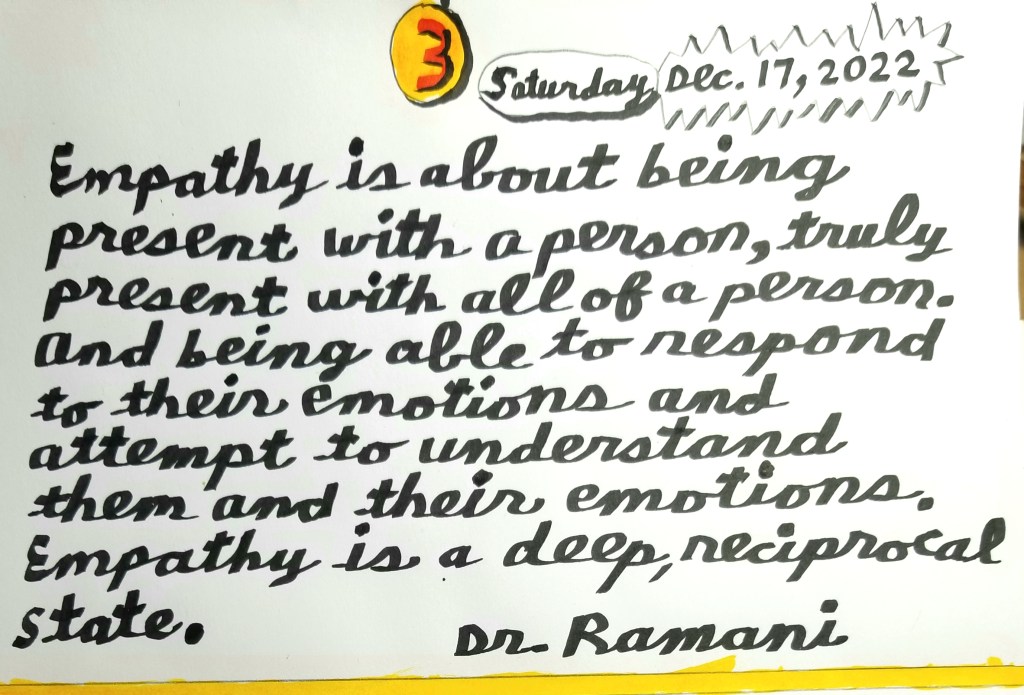
This definition comes from Dr Ramani, a psychologist and writer with a youTube channel dedicated to understanding narcissism and the harm it causes.
Empathy is about being present with a person, truly present with all of a person. And being able to respond to their emotions and attempt to understand them and their emotions… Empathy is a deep, reciprocal state.
Take away the reciprocal part and you don’t have empathy. You have a hierarchy where one person’s emotion is much more important than the other’s. Call that whatever you want, it’s not friendship. And there’s not even a whiff of empathy there.
If you’re trying to have a real conversation with somebody who lacks empathy, you might as well talk to a hungry grizzly bear.

An old friend broke his silence of a month, calling me on this rainy Friday afternoon. After a few moments of small talk about our upcoming biopsies and other medical procedures, the concomitants of living to the ripe old age we have reached, he came to the point of his call.
“I’m not going to be responsible for trying to fix this,” he said. “I’ve done everything I can. I want to be friends.”
So you’re not going to take responsibility for your own actions this last year and a half?
“Don’t put words in my mouth, that’s not what I said,” he said, saying it all. “We all did things to each other,” he began.
I haven’t lied to you once in all the years we’ve known each other. Every time you got upset in the last year and a half I behaved like your friend, heard you out and calmed you. You have never answered a single question that I’ve asked in the last 15 months.
“And I’m done with being questioned,” he said. “I guess I got my answer.”
I offered one last slightly acerbic rejoinder, which, under the circumstances, I thought was pretty good.
“I’m going to hang up now,” he said, as I disconnected the call.
When you are treated with contempt, there is no mistaking the corrosive feeling it arouses. It is dismissal on steroids. It causes a unique and terrible injury.
Contempt means nothing you say needs to be considered, your opinions and ideas are bullshit, anything you think of as insight is a bunch of stinking crap. Contempt means never having to even consider saying you’re sorry because the person acting hurt has no gripe except against her contemptible self.

Contempt doesn’t mean I disagree with you, it means you and your thoughts and your feelings are so far beneath me I don’t have to even consider them. If I have contempt for you, you are nothing to me, so far inferior that I have no need to consider anything in regard to you, except how contemptible you are.
You need understanding? It’s only because you are weak and needy. Some intimate fear you need to share with me? You are a coward. Something bothering you that you need to talk to me about? Forget it, maggot. You show me vulnerability? I show you the back of my fucking hand, asshole.
Contempt is the precursor to every act of individual and organized violence. It is not enough to simply hate the people you are about to beat, torture and murder. You have to feel contempt for them. Once you have that deep conviction of their contemptibility, you feel justified in doing whatever you have to do to the smelly, weak, pusillanimous, poisonous little pukes. Another gruesome page of human history, written in the blood of the contemptible.
 gratuitousblahg