What it means to be unforgiving

Being unforgiving means you cannot let go of your hurt and anger, even after someone does their best to make amends. Even when someone expresses sincere regret for their harmful actions and humbly asks for your forgiveness, you can’t forgive.

This kind of angry person, who tends to live in a zero sum world of winners and losers, cannot forgive themselves, cannot calm themselves when they’re upset, have not learned to sit with strong, painful emotions and wait until they are calmer to try to resolve a conflict. Unregulated anger is destructive, it arises from pre-verbal fears and shame and it extends to an inability to forgive.

Holding on to anger is a maladaptive way to try to feel righteous and superior. This type, with its unhealthy bent toward indignation and rage, is clueless about how to resolve conflicts with others and within themselves.

When you think about it, it’s pretty clear that you have no obligation to forgive someone who hurts you and blames you entirely for making them hurt you. When no apology is offered, hurtful behavior is never acknowledged, your obligation to forgive disappears. That is not being unforgiving, it’s health, common sense and what’s best for yourself and other people that you love.

Those who can’t forgive, no matter what? Dangerous, wounded, supremely destructive motherfuckers. We might well feel very sorry for them, if we care about them, but not being able to forgive their eternal blaming anger does not make us unforgiving.

This type will force her mate to kill his best friends, and her mate will do it because he feels he has no choice but to become enraged at his best friends and kill them. Otherwise he will be derided forever as a contemptible weakling. The alligator he is wrestling with will point toward his more sympathetic friends and tell him that they are the vicious alligators and if he doesn’t fight them to the death he’s a pussy.

As long as he stays angry, he will never have to to be tormented by his own immature, self-harming actions, which is the greatest blessing to this eternally trapped poor bastard type.

Good working definition of empathy

This definition comes from Dr Ramani, a psychologist and writer with a youTube channel dedicated to understanding narcissism and the harm it causes.

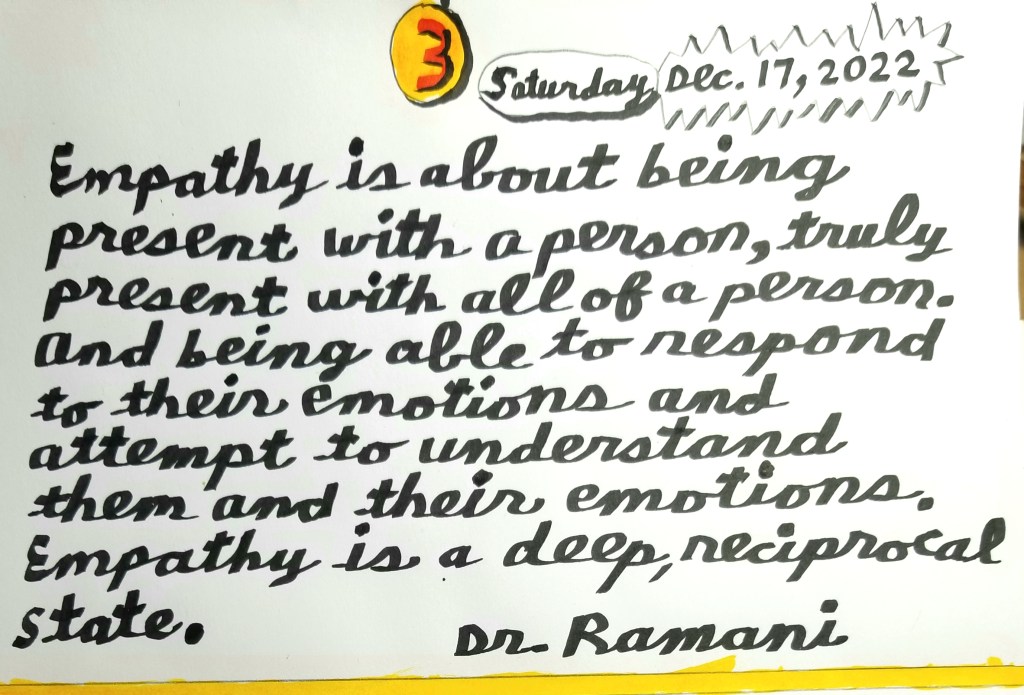
Empathy is about being present with a person, truly present with all of a person. And being able to respond to their emotions and attempt to understand them and their emotions… Empathy is a deep, reciprocal state.

Take away the reciprocal part and you don’t have empathy. You have a hierarchy where one person’s emotion is much more important than the other’s. Call that whatever you want, it’s not friendship. And there’s not even a whiff of empathy there.

If you’re trying to have a real conversation with somebody who lacks empathy, you might as well talk to a hungry grizzly bear.

A sad finale

An old friend broke his silence of a month, calling me on this rainy Friday afternoon. After a few moments of small talk about our upcoming biopsies and other medical procedures, the concomitants of living to the ripe old age we have reached, he came to the point of his call.

“I’m not going to be responsible for trying to fix this,” he said. “I’ve done everything I can. I want to be friends.”

So you’re not going to take responsibility for your own actions this last year and a half?

Don’t put words in my mouth, that’s not what I said,” he said, saying it all. “We all did things to each other,” he began.

I haven’t lied to you once in all the years we’ve known each other. Every time you got upset in the last year and a half I behaved like your friend, heard you out and calmed you. You have never answered a single question that I’ve asked in the last 15 months.

And I’m done with being questioned,” he said. “I guess I got my answer.”

I offered one last slightly acerbic rejoinder, which, under the circumstances, I thought was pretty good.

I’m going to hang up now,” he said, as I disconnected the call.

contempt

When you are treated with contempt, there is no mistaking the corrosive feeling it arouses. It is dismissal on steroids. It causes a unique and terrible injury.

Contempt means nothing you say needs to be considered, your opinions and ideas are bullshit, anything you think of as insight is a bunch of stinking crap. Contempt means never having to even consider saying you’re sorry because the person acting hurt has no gripe except against her contemptible self.

Contempt doesn’t mean I disagree with you, it means you and your thoughts and your feelings are so far beneath me I don’t have to even consider them.  If I have contempt for you, you are nothing to me, so far inferior that I have no need to consider anything in regard to you, except how contemptible you are.  

You need understanding?   It’s only because you are weak and needy.  Some intimate fear you need to share with me?  You are a coward.  Something bothering you that you need to talk to me about?   Forget it, maggot.  You show me vulnerability?  I show you the back of my fucking hand, asshole.

Contempt is the precursor to every act of individual and organized violence.  It is not enough to simply hate the people you are about to beat, torture and murder.  You have to feel contempt for them.  Once you have that deep conviction of their contemptibility, you feel justified in doing whatever you have to do to the smelly, weak, pusillanimous, poisonous little pukes.   Another gruesome page of human history, written in the blood of the contemptible.

Senseless enmity

My father’s mother, a diminutive red haired religious woman with a brutal temper, used to snarl whenever my father and his little brother fought.  “Seenas Cheenam!” she would say, Yiddish for “senseless enmity!”   They lived in poverty impressive even by the desperate standards of the Depression, their mother openly hated their father, the larger older brother was regularly whipped in the face by his mother, the sickly younger brother was always pampered by that same mother.   Add it up and you get “Seenas Cheenam!”   

My father spoke very little of his deeply scarring childhood, except to point out from time to time that he grew up in “grinding poverty.”  That was the phrase he always used when comparing his lot to my sister’s and mine.  We also heard the phrase “Seenas Cheenam” often enough growing up that it sticks in my head.  I later learned Hebrew and the word cheenam means “free,” or “gratuitous,” if you will,  seenas being the Yiddishized version of the Hebrew seenat, hatred.   

Psychological insight into human behavior is not necessarily a widespread human characteristic.  Certainty, of course, is.  We like to be sure before we whip somebody that we are doing the right thing.  And so it was with my grandmother, an uneducated woman from a family soon to be murdered en masse, prone to fits of righteous rage, a woman who died young, of cancer, a few years before I was born.  The irony of her dismissing any reason the boys might be at each other’s throats in that sadistic experiment they grew up in is not lost on me.  Blaming her boys for being at each other’s throats for no reason was her way of being certain that she was always doing what was best, exactly what God wanted her to do.  Certainty is the human genius.

Before my uncle died (in a rehab center) he told his son and me that he had framed photos of our great grandparents in the house his son was selling.   We looked everywhere, didn’t find them, and, on a last pass through, before locking up the house for the last time after it was sold, I walked into the sun room.   There behind the wicker couch my demented aunt had secreted the almost life-sized portrait heads of my grandmother’s parents, in beautiful oval frames.  I could barely stand looking at them.   These two had created a monster of their youngest child, my father’s violently unlucky mother.  

I can only imagine the household that raises their youngest to whip her infant son in the face over and over.  I look at the face of her mother, in a photo taken before 1914 when my grandmother arrived here in the US.  I shudder.   The father looks a bit more human, though as I look a moment longer I start to cringe.  People who were being photographed for the only time in their lives tend to look stiff, and rigid, and perhaps not at their most natural in the photographer’s studio, but there is something about these two that gives me the creeps.  

It is the knowledge that they raised a girl who grew up to viciously take out her misery on her first born son, a toddler who grew up to be my father.  My father, though he did much better than his mother, also was unable to resist taking out his misery and his unslakable anger on his children.  He was not one to hit, but his brutal words, as he eventually admitted, were as harmful as any regime of slaps, punches or kicks could have been.

We don’t want insight, we want to be right.  Keep it fucking simple, you merciless asshole!  I am right, as my gut is telling me, as my muscular tension tells me, as the surge of fight/flight/freeze chemicals urge me, as my every justification fucking tells me!

My sister and I had a terrible fight almost thirty years ago when my niece was a toddler.  Frustrations from years of conflict flared up and I lost my temper.  So did my sister who began screaming for me to get out of her fucking house.  My niece said, from her highchair, “mom, stop screaming at Uncle Elie!”   Sides clearly had to be drawn more decisively, as they were over the years, until my niece and nephew were convinced not to communicate with their crazy uncle any more.  Right is right when it comes to seenas cheenam, you understand. 

A nice understated invitation to exchange fisticuffs

The guy from Procol Harum who wrote the Bach-like intro to A Whiter Shade of Pale sued the other members of the group, all of whom had made millions from royalties on this universally played wedding tune, for writing credit.   A British journalist interviewed him on the eve of his lawsuit.  The guy explained how he’d written the iconic opening and had not been given songwriting credit with the others.  No credit, no royalties, on a song that is apparently among the most played tunes in history by wedding bands and other party bands.   

The reporter said: “so, you’re saying they could have been more generous with you?”

The British musician answered with beautiful British understatement “they could hardly have been less generous.”

An old friend, after fighting me for many months to establish that I’d hurt him much worse than he and his wife had ever hurt me, eventually conceded that telling me “you have to understand that I am too upset by what you did to listen to your explanation about why you were upset” was wrong, and not an act of friendship.  Though it took a long time for him to be able to admit it, I felt like an anvil had been taken off my chest when I heard that.   It was a phantom anvil removed from a phantom chest, as things turned out.

Months later, after a second ugly attempt for the four of us to discuss the original upsetting events, the long ongoing silence and discomfort, anger, denial, cover-up, blame, constant reframing and so forth, I realized the problem underlying all this hideous, insoluble tension is beyond my ability to even try to help solve.  I am, after all, in the eyes of my old friends, their threatening common enemy, therefore  my insights, such as they are, can only make things more dangerous for everybody.  I told my old friend I was not encouraged by the second angry session, even as I had largely refrained from showing anger of my own, instead literally banging my head against the wall by the end of another senseless argument over who had a right to feel more hurt.

He wrote to tell me that the second session had been difficult, but important for our friendships and a step forward.  I answered that it felt like a big step backwards to me.  He responded that he was sorry I felt that way and then offered me this marvelous bit of understatement:

Yes it’s important to have people there for you as you deal with trauma.  To use his dog bite example [parents immediately comforting a child just bitten by a dog, preventing lifelong trauma], I could have done better [when I told you I was too upset by what you did to hear why you were upset] on our walk or soon thereafter.

I could have done better.

Done better than being wrong and not showing a trace of empathy and righteously, angrily clinging to that view for eight or nine months?  You don’t say!  How petty of me to overlook how difficult it must have been for you to avoid kicking, punching or even stabbing me, in addition to not showing a hint of our long friendship, or even a casual one!

Jeez, what an unforgiving cunt I am!

Irv’s dilemma

My father was a friend of the underdog, ally of the oppressed and broken-hearted idealist turned bitter cynic in the latter years of his life.   He truly wanted to instill in me a love of independence, unwavering honesty, fearlessness in advocating for what was right, and resoluteness opposing tyranny in all forms. 

His dilemma was that his own trauma compelled him to behave tyrannically whenever he felt confronted.  He was unable to control this impulse to dominate, by any means necessary, and so he constantly offered himself as the model of the tyranny I must reject, according to the principles he taught me, while wanting more than anything my respect for his authority and my independence from it.  Damn!  Talk about a no win dilemma.

He instilled in me a lifelong quest for justice, even as he insisted on the most unjust proposition imaginable — the child who is being made to suffer is the cause of everyone’s suffering.   

This intolerable proposition had been forced down his throat, from the time he could stand.  His mother, a diminutive redhead prone to fits of uncontrollable rage, used to whip him in the face.   How does a mother whip her toddler in the face?  She truly believes the kid is viciously defying her.  She has to beat this devil out of him.

The kid, in turn, grows up to hate a bully more than anything in the world.   The only problem is that nobody is more prone to bullying others than someone who has been bullied.  The anger toward the bully is there, along with a determination never to be bullied again.  If the only way to avoid being bullied by a challenging, defiant new born baby is to bully them, how is that anybody’s fault?

So my poor devil father had a dilemma that could only be solved by difficult work that was too painful for him to do, too excruciating to even consider doingPoor bastard!

Perception management

Sometimes somebody in a disagreement will insist that everything is simply a matter of perspective.  Everyone has their own perception, and different people can see the exact same thing from very different perspectives.   There is a certain universal truth to that.  Think of any work of art that shows the same event from multiple points of view, it appears like a completely different event, depending on whose version you accept.  

It is a small step from the undeniable truth of how our perceptions shape reality to the conviction that no two people can necessarily ever agree on anything that took place, if it aroused strong emotions, since we all see things from our own point of view based on our emotional histories.  The trouble with this view is that it removes the possibility of ever agreeing about anything based on actual events or evidence of any kind that can be agreed on.  It leads to the acceptance of “alternative fact” as well as a perfectly defensible difference of opinion about those ever pliable, transactional “facts”.  It fosters the idea that since everyone’s emotions are always true to them, everyone’s perspective is equally true to them and that persuasion, learning and improving are therefore also strictly subjective matters

An easy way to refute this kind of solipsism is the punch in the face.  If I punch you in the face, I may perceive that you made me do it, you may perceive it was a vicious, unprovoked attack, but we won’t be disputing the actual punch.  If you are susceptible to self-doubt, or if you can acknowledge that you provoked the violence, I may be able to convince you that it was your own goddamned fault I had to sock you, but the fact that I socked you is not a matter of perspective, it objectively took place.  Just look at your bloody nose if you have any doubt.

Take the case of an unappeasable parent. The child finds herself locked in a war she has no insight into, turned into a combatant from before she can even speak. Nothing the child can ever do, even as an adult, can appease someone who is unappeasable.  The parent will insist the kid is the source of all the hostility, tension, anger, misunderstanding, stubbornness, refusal to be reasonable or well-behaved, a plague on the family.  A family friend will likely have a different perspective, caring for both parties and wanting to help both.  Tell the kid their parent is unappeasable and make an enemy of the parent.  Tell the parent it’s not the kid’s fault and you will face the ire of the unappeasable parent now outraged that you are blaming them for the kid’s genetic predisposition to be a provocative, angry, mean, needy little asshole.

It is a tragedy of human history that many of the most angry people in the world are the most adept at blaming their victims.   It is the true genius of homo sapiens (the “wise ape”) to justify our actions, no matter how badly we act.   We can justify them intellectually, when we have facts in our favor, or emotionally, when the facts will not so easily support our hurtful actions.   We never, with no exception I can think of, act not believing that we are right, or at least justified, in doing what we do.  Every act of violence is committed in a moment where the angry person believes 100% that what they are doing is righteous.  After cooling down, many will have regrets about the damage they did, but in the moment of attack they believed in their righteousness absolutely.   That’s what it takes to hurt people, true belief that they fucking deserve it.

A feeling can’t be right or wrong, it is what you truly feel.  The important thing is to analyze the feeling after you calm down, see what in it is reasonable, and to be heeded, and what part is purely your old pain kicking up and making you feel bad again. And if you keep reacting out of pain, and keep inflicting pain with your reactions, and learn nothing from it, you’re just an asshole I’m sorry to say.

What you can healthily accept — and what you must not

You can, and must, accept the imperfections and weaknesses of those you love.  It is easy enough to do.  We all have our faults and we all need to be accepted as the damaged souls we are.   We should also try to do better once we know that certain of our tics are hurtful to someone we love.  

Not everyone is capable of self-reflection and change, sadly, such things terrify some people.  But it’s important to the health and mutuality of intimate relationships to try to do both of those things, when needed.   Criticism from a loved one does not mean repudiation and rejection — it means you need to be aware of the hurtful effects of your actions on someone you care about.   You need to sometimes accept criticism from those you love, it may be fair or unfair, and it can be discussed, but it is brutal, and deadly, to angrily shut down any talk about it.

What you must not accept is blame for the imperfections, weaknesses and vices of those you love.  If the ultimatum below sounds familiar, and does not change no matter how calmly you manage to proceed, walk away:

“As long as you don’t ever criticize me, or show impatience, or raise your voice, or employ mean body language, as long as you accept everything I say as beyond dispute, we will remain dear friends forever.  Once you make me feel bad about myself, even one time, I will show you who the actual irredeemable asshole is in this equation.”

Rest assured that if they set those conditions, and insist on them, that they will make good on their threat, because, no matter how patient you might be able to remain most of the time, we all have our limits and will be pushed to them.  

Once you reach your limit, and start banging your head on the wall, as I found myself doing recently (actually, I picked up a small wooden stool and bopped myself in the forehead with it), the proof is now there for everyone to see — only an irredeemable asshole acts that way after only an hour or two of no-holds-barred conflict over who has a greater right to feel hurt for the last year and over what.

Somebody recently called me a saint because I’ve been trying to remain very patient with two, dear old friends in the face of this kind of ongoing ultimatum.  I told her “I am one very goddamned fucking angry saint, I can tell you for sure.”   While faintly amusing, it was also true.

If you can accept that you must remain eternally patient while those who feel criticized or challenged by you can show immediate anger whenever they feel desperate, I’m not sure what to tell you, except, perhaps, that you need to think it through again.  It is very, very hard, unthinkable, really, to leave people you love — there may be nothing harder to do.  Except, in my experience, it is even harder, and much more destructive, to cling to one-sided relationships where every conflict can only be stopped by assuming the entire fault for it and never again making the other person feel discomfort by talking about anything you need to resolve.  

The damage to yourself of accepting this kind of lack of mutuality is ongoing, and will never stop until you put a stop to it.  Once the cycle of blame, and who has a greater right to be aggrieved, sets in, you cannot change it on your end alone, no matter how sincerely you try to show love.  You must be blamed, and accept all fault, or be destroyed.  If you have friends in common, it will be necessary to destroy your good name among them as well.

It’s as hard as death itself to leave a long, loving relationship that has become corrosive, but harder still is living in a ruthless funhouse where honesty is discarded and angry desperation is turned relentlessly and implacably on you.  I grew up in a house like that, moved out when I was 17, many years ago.   The harm it did has been a long lifetime healing, as far as I have been able to heal.  The echoes of it, whenever I am made the focus of other people’s hurt and anger, extending to a tyrannical insistence that I simply stop fucking talking about what’s bothering me, have become impossible to bear.  

So I recognize now that I am in mourning, having finally, and with extreme reluctance, seen what a healthier person would probably have been able to observe a year ago, ten months ago, six months ago, last month.   It does nobody any kind of favor to carry the heavy cadaver of what was once a loving friendship around, hoping it will begin to breathe again, and smile, and thank you for having undying faith in resurrection.  

And just like physical death, or maybe even more so, the thought of a forever parting can feel unbearable, which is why we cling to things even after we’ve seen over and over they are not as they were.  Even after they have become intensely painful and impossible to stop pondering.

So, mourn I must, as I forgive my understandable slowness to take my leave from an unbearably painful situation.   The only alternative is pretending there is nothing to fix that can’t be fixed by simply not bringing up pain ever again and placidly accepting the entire fault for a deadly impasse I am at best 50% responsible for, and somehow accepting that doing those things will magically restore something, including trust, that is now irretrievably gone.

Accept all the blame and simply act like everything is fine again?   No can do.  Neither should you. 

Just just let me do my routine, Your Honor

Towards the end of Lenny Bruce’s obscenity trial a policeman read Lenny Bruce’s obscene words from a transcript he’d made at the nightclub when Mr. Bruce, during his routine, was arrested for public obscenity. The policeman read Bruce’s words “Defendant said ‘Yeah, you know how that shit works, you watch it go down and all you can say is ‘fuck!'” Continuing from his notes the detective read “defendant then cocked his head to the side. There was laughter.”

Bruce, who was by then bankrupt and defending himself, jumped up to object “Your Honor, please, he’s butchering my act, he’s delivering my lines off kilter, out of time, with no nuance, irony or any hint of humor. I’m a comedian, Your Honor, and if you would just let me do my act you’d see I’m being funny. The audience gets laughs out of my material. Please, Your Honor, let me just do my act for the court, you can hear my words in context and judge for youself, but not like this. If you find that my act is obscene, in the context of my attempt to get laughs, sentence me to prison and let me just be done with this. I’m begging you, have mercy on me and let me just show you what I do. This prosecution has bankrupted me, I’m staying in a hotel and can’t afford to pay the bill, I’d rather just go to prison, Your Honor, if you find my act obscene.”

But this American judge, at that time in history, was not going to let some little filthy-mouthed, wise ass heroin addict degenerate New York Jew subject his courtroom to words like fuck shit penis cock cum pussy and God knows what else. The judge told the pro se defendant he was out of order, denied his request, ordered him to sit and be quiet, the policeman continued to massacre Bruce’s act, which he read verbatim, words which were indeed, context and intent irrelevant, legally obscene under the law of that time and place.

After the prosecution rested, Mr. Bruce asked to be sentenced, as he was broke, tapped out defending himself while banned from earning a living. The judge told Bruce he would have to come back to court in a month for sentencing.

In the Hollywood version of this, Lenny goes back to his shabby hotel room a broken man, takes off all his clothes and overdoses on heroin, dying in a naked heap next to the toilet bowl.

And the audience who sees Dustin Hoffman’s brilliant portrayal of Lenny, understands, Jesus Christ, this guy was a popular, smart, very funny comedian and they literally crucified him for being an irreverent hipster and saying the F-word for laughs, making a mockery of eveything they held sacred.

“Your ‘work’ is obscene, you will serve time in prison, you will never work again. Your life as an adorable little piece of shit who can fucking say whatever comes into his demented little fucking heroin addict brain is now over, sir. Go ahead and style yourself a heroic martyr of the First Amendment, a persecuted icon of free expression. You are nothing. The law says ‘fuck you’ to your dream of being able to say whatever you fucking please to ‘get a laugh’. You’re dead and you’ll never work again, asshole. Death of despair? Be our fucking guest. Roll credits, bitches.”