Political Research 3 Fiscal Year & Deficit

One of the most important fiscal years for the economy is the Federal Fiscal Year, which defines the U.S. government’s budget. It runs from October 1 of the prior year through September 30 of the year being described. For example:

  • FY 2012 is from October 1 2011 through September 30 2012.
  • FY 2013 is from October 1 2012 through September 30 2013.
  • FY 2014 is from October 1 2013 through September 30 2014.

(source)

Now let’s take a look at Obama’s whopping world-record deficit in fiscal 2009, 

2009 $1416 Billion Deficit

and see how he ran up that much debt so soon after taking office.

Fiscal year 2009 began on October 1, 2008 and ran through September 30, 2009.   Barack Obama was sworn in on January 20, 2009.  

Ah, screw it, read this

Political Research 2

I really don’t have the stomach for it today (a surgeon’s scalpel yesterday is but one reason) but I would love to write a 500 word post that I could send to the Grey Skank, America’s paper of record, and see as an op-ed.   Those 500 words would lay out the numbers, in the frame of that Political Research post of the other day.  The numbers need to be laid out as simply and directly as possible, and be from a source like the nonpartisan Congressional Budget Office.

They would provide a quick view of  the last twelve years of the budget deficit.   Every year’s deficit, it appears, gets added to the national debt, a sum now over fifteen trillion dollars.  When George W. Bush became president, for example, there was a record budget surplus of  236.4 billion dollars $236,400,000,000.00.  I am relying on this website as my source, though I have no idea who Dave Maunel is, except that his site, according to him, is referenced by the NY Times, PBS, CNNMoney.com and others.  Suspiciously missing from his list are such trusted news sources as Fox News and The Onion.  The reader should take that into account.

But if we take Dave Manuel’s numbers as true, and we assume the NY Times would fact check an op-ed at least as scrupulously as they checked Judith Miller’s stories about Saddam having WMD, we see that in the first year of President George W. Bush’s administration there was a surplus of 127.3 billion or $127,300,000,000.00, more than half of the surplus of the year before.   The following year, as the War on Terror began, and the first round of The Bush Tax Cuts kicked in, there was a record budget swing of  285.1 billion dollars.  The deficit for fiscal 2002 was 157 billion dollars.

It is hard to conceptualize how much money a billion dollars is.  Take a minute to look at this wonderful animation to get an idea, on the way to a trillion, in stacks of hundreds.

The Bush administration, never running a deficit lower than 162 billion, set a record for U.S. budget deficits in 2008, 455 billion dollars.  It would seem that Bush’s $700,000,000,000.00 stimulus package (TARP) to Wall Street, to prevent its collapse after the mortgage backed derivatives scandal, was not included in that 2008 deficit.  If it had been part of the 2008 fiscal budget, it would have more than doubled the 2008 deficit, to well over a trillion dollars.

Then we have President Barack Hussein Obama, who, although unanimously opposed by Republicans, doubled down on the TARP bailout, and promptly shattered the record deficit of his predecessor by racking up an unconscionable 1.42 trillion dollar deficit for fiscal 2009.  Let’s look at that one in numbers:  $1,416,000,000,000.  Nuff said?

Till the next time, boys and girls.

(454 words)

Political Research: Who Owns the Deficit?

This post is in the process of revision, as I struggle through more conflicting facts and figures.  I wish the numbers were simpler, smaller, easier to make a point about.  The complexity, of course, is as much the problem as the sure-handed oversimplifications that are often offered instead of real discourse.  I’ll give a heads up in a later post when I’ve learned enough to make this as comprehensive and understandable as I’d like it to be.

DRAFT ONE

There are two numbers that should be part of the discussion as a TV hypnotized America goes about choosing a new president.  2.4 trillion dollars– the cost of the wars in Iraq and Afghanistan plus the Bush tax cuts to the top 5%  (see below) and 1.1 trillion dollars, the projected deficit for 2012 (see fair and balanced source).  These numbers are largely unknown while politicians negotiate over how to economize on a scaled down New Deal safety net without raising additional revenues during these hard economic times.  

Why don’t Americans know these numbers?

The amount being spent for wars in Afghanistan and Iraq, (excluding the projected cost of long term care for thousands of grievously disabled twenty and thirty year-old veterans) is $1,367,222,688,159 and counting — (source:  http://costofwar.com  )  Note that this figure excludes long term cost of caring for wounded veterans, which probably more than doubles the number.  A study at Brown University concluded the total cost of the wars will be as much as 4 trillion.

Lost revenue in tax breaks to the the top 5% of Americans during the more than decade of the Bush Tax Cuts:  $1,034,424,338,581, with 70% of that, or 700 billion dollars, going to the top 1%. (source)

This sum, wars plus tax cuts, a conservative two trillion four hundred billion dollars, must be part of any serious discussion of the deficit and how to fix it.   This 2.4 trillion should be a number every American can cite when discussing the responsibility of our current president for the grim economic backdrop to what Bill Moyers referred to as the auction for the presidency.

But further research shows how difficult it is to present the exact numbers that all Americans should know.  The 2012 deficit is different than the cumulative deficit, which is different than the national debt.   Look at this graph, if you want your head to spin, 

We talk in terms of billions, we might as well be talking in terms of gazillions or quadrillions.  These abstractions are so large that the eight or nine billion dollars that disappeared in Iraq, under the watchful nose of  L. Paul Bremmer III,  Administrator of the Coalition Provisional Authority, early in the occupation of Iraq, slips quietly under the radar while politicians seriously debate cutting the heating subsidies to just over the poverty line old people here in the US.  It would save millions of dollars, they argue.  And old people can always put on sweaters, scarves, hats, gloves, parkas, etc.  It’s easier to stay warm than to stay cool, think of it that way.

Partisans of Mr. Romney, including PAC-genius Karl Rove, the man our previous president called “The Architect” ( as well, apparently, as “Turd Blossom”) will begin waving the flag to beat the band as they speak quickly of how the Bush administration saved us all from certain destruction by Al Qaeda (there was no second catastrophic terrorist attack on their watch, after all) and rewarded the job-creators by giving them even more incentive to create jobs.  

Then they’ll quickly change the subject, since George W. Bush, for all the good he did for his constituency, is not the poster child for smaller, smarter government, nor any kind of fiscal conservative.  And, if pressed, they might be tempted to concede that Mr. Bush did drain the record surplus and run up a record deficit like a car collecting trust fund baby in a Rolls Royce dealership buying one in every color, before helicoptering off to the Porsche dealer.

As Bill Moyers pointed out, during the excitement among many after Obama’s election as president, Barack Obama will disappoint.  Every president does, he continued.  No sadder, truer words were spoken about that election.  I have often wondered about the forces that constrain the president, a great salesman and educator, from educating and selling higher goals and policies than the ones he’s shot for.

“He doesn’t want to get shot,” says one friend.

“He doesn’t want to piss off his top supporters on Wall Street, he needs their millions for the billion dollar reelection campaign he’s going to have to wage,” says another.

“He is a pragmatist,” says another.

“He doesn’t stand for real change, he stands, like anyone with the backing to become president, for the status quo,” says another.

Be assured that Karl Rove will do everything in his considerable power to make Mitt Romney the next president of the United States.  His former protegee will be left quietly on the sidelines, since discussion of his record would cloud the primary issue: that radical Barack Obama is a weak and misguided president who got us into this terrible financial mess and then had only failed ideas for how to get us out of it.

A Story About Politics

Humans are hungry for a story.  I’m not saying anything you don’t know.  A speaker who does not incorporate a few stories is a very dry speaker indeed.  When we hear even a lying politician say “let me tell you a story…” we are momentarily attentive.  Every ad we see tells a little story.  Stories are how we learn about life.

No less an expert than Adolf Hitler (no matter how we may hate the success he had, none can doubt the magnitude of that success) emphasized the importance of story in creating a community of believers.  He was constantly creating the myth, constantly reinforcing the worldview founded on that myth, a worldview that was the foundation for his actions.   That’s why he loved the work the unscrupulous fellows in the British, French and American War Departments did during the World War.  Give the folks at home, and the soldiers in the trenches, a vivid and horrible story they can sink their teeth into, digest, take to heart!  That the story is a lie makes no difference.  In fact, Hitler noted, a lie is often more powerful than the truth.

During a brief stint in a doctoral program in history I was determined to write the definitive study of how propaganda and marketing have shaped our world more than any other single force.  The professor I pitched the idea to, that the Nazis were the innovative pioneers of the modern marketing-driven use of a party controlled mass media to influence the citizenry, shook his head skeptically, scaled my project way back.  The hubris of my intended task seems obvious to me now too, as I think of it, but I believe as firmly now as I did back then that the Nazis showed how it was done, developed many of the techniques now standard for influencing public perceptions.   Events are increasingly supporting my thesis.  

The Big Lie, endlessly repeating useful untruths in the mass media, is now a familiar idea that doesn’t raise too many eyebrows.  It’s old hat.  “Yeah, yeah, Saddam bought aluminum tubes in Africa for his nuclear centrifuge.  Yeah, he had WMD.  Yeah, we don’t want ‘the smoking gun to be a mushroom cloud’.  Yeah, Saddam was a big supporter of Bin Laden, even though Bin Laden wanted him dead.  Yeah, Muhammad Atta met with agents of Saddam in Prague before the September 11 attacks.  Yeah, Saddam was behind 9/11.  Yeah, we’ll fight them over there so we don’t have to fight ’em here.  Yeah, freedom’s on the march, combat operations are over, we have prevailed over Evil.  Yeah, so what’s your point?”

At the risk of seeming partisan I will make an observation others before me have made.  The Republican party is much more successful in telling (and selling) a coherent and moving story than the Democrats are.  The Republican story goes like this:

 Once upon a time this great, innovative country was greater still.   We had values that were a light unto the world, not least of them democracy, fairness, freedom.  We are now in a crisis, caused by Americans who take freedom for granted (0r outright hate our freedom), do not want to work, want to blame others, especially successful people, for their troubles.  And Big Government, and we all know how corrupt that is, is right in the middle of the problem.

The problem is all those illegal aliens getting free medical care and free college educations, old people expecting the rest of us to subsidize their rent and heating bills, pay for their fantastically expensive health care, young lazy people who feel entitled to take our money so they don’t have to work.  (We’ll leave aside the politically explosive, nagging, unspoken question of what those people we used to call niggers actually want.  Let’s stay on the high road and focus on getting America back to greatness.)  

We need to give complete freedom to the free market.  The free market is great because it’s free.  The leaders of the free market must be free to innovate, to take great risks for potentially enormous, unregulated rewards.  To regulate these rewards would hamper job-creating entrepreneurs in their enthusiasm to take the risks that have made this country the world’s leading innovator for more than two centuries.  Besides, Big Government, who would decide on and enforce regulation, is bad, part of the problem, not part of any solution.

Democrats have no counter-narrative, none.  At best they will quibblingly point out that big government is bad, except when it enforces the rights of former slaves not to be lynched, except when it gives women the right to vote, rescues flood victims, frees hostages, builds highways, bridges, tunnels, schools, firehouses, police stations, avoids foreign wars through diplomacy, guarantees that old people who’ve worked their whole lives don’t have to eat dog food too many times a week, that people who’ve lost their jobs in a trashed economy do not also automatically have to lose their homes.  It’s no story, it’s a yawn, however true it all might be.

Democrats, if they’re feeling brave, will point out that the terms used, like “free market”, are problematic, misleading.  If the free market is free to employ the cheapest laborers to be found in a global marketplace, to pollute air, water and earth as much as needed to make maximum profit, to pay the lowest possible taxes and exercise the greatest possible political influence by buying unlimited political advertising, maybe the price for that “free” market is a bit more than the rest of us can afford.

Or the “Death Tax.”  Shoot, everyone is against death and tax.  The Republicans control that debate right there, having coined the phrase that frames and decides the debate.  I don’t recall the amount of millions that trigger the “Death Tax”, I think it’s up to eight million, but it’s many more millions than 98% of Americans will see in their lifetimes, let alone have the chance to leave tax-free to their daughter, Paris Hilton.

Paris, there’s a story.  We can all picture her face, feel the emotions this rich girl inspires, be they the envy of those who call her a “celebutard” or the love of those, like me, who observed the true tenderness she displayed giving pleasure to her lover in that short video.  But, anyway, you see how much more interesting a story is than talking about “politics”?  A story speaks for itself, politics is an unbearable swirl of depressingly complicated detail that can best be understood by oversimplifying its complexities into a good story.

I love you, Paris.

The writer recommends

A prolific writer, whose many books have moved and entertained me, periodically writes a slim book of advice, a nonfiction attempt to be part of the change he wants to see in the world.  I have one here now, called Twelve Steps Toward Political Revelation.  I have to say, he does his work much better in fiction, like in the magnificent recent novella The Gift of Fire.

Read The Gift of Fire with an open mind and you may find yourself deeply moved by the author’s vivid, animated example of the kind of world humans could have if we followed our deeper, higher natures.  A description of the story will not do the short book justice, get it from the library, read it.  Another great book by my favorite living writer.  I highly recommend it.

We turn now to his latest book of advice.  Published because he is a famous writer who has made millions for his publisher, it has little of the charm of the novels, but it moves toward the same end– showing what the world could be, if people only struggled to open their eyes and live in accord with what we all know in our hearts to be the right way to live.

One of the twelve steps the author prescribes for waking from our media-induced trance and finding out who we are and how to fix this severely broken world is to write daily.  My man is a writer, and he writes daily, and he is paid well several times a year for his new books, probably given large advances for each next one.  He’s had books made into Hollywood movies starring Denzel Washington.  He lives the life I’d like to live, if I had any idea how to start down that road.

He gets up every day and writes for three or four hours.  That’s his work day.  Then he goes out into the world, does whatever one does out there.  Returns at night to sleep.  Gets up the next day and writes for three or four hours, and so forth.  Every few months, it would appear, he has a new manuscript finished.  It goes to his editor, they work it over a bit, it’s out in print and I get a copy of it it at my local library.  A nice arrangement for everyone.

Step Six of the Twelve Steps Toward Political Revolution is called Everyday.  What we should do every day, those of us who are serious about not living as exploited zombies but doing what we are meant to do on this earth, is to write.  This should be done, the writer says, 365 days a year.  He says we don’t need to spend much time doing this, the drill is that it must be done daily.  The time of day doesn’t matter, after work, before work, the main thing is to have a regular practice that sits us alone with our thoughts daily and causes us to organize them while digging toward the deeper truths of our lives.

“Yes,” I think, “it is a good practice.  Shoot, I do it myself.  But you must realize, man who makes his living by writing what it pleases you to write, that it is easier for you to put in the recommended  ninety minutes to two hours a day searching your soul than it is for the bus driver, the cop, the campaign contribution bundler, the single mother with three kids, the school teacher, the data technician, the salesman, the career guardian ad litem.”

I don’t know where else to go with this thought, except to note that this famous writer and I were in the Creative Writing program at The City College at the same time.  His mentor was a guy named Tuten, mine was Mirsky, and our paths never crossed, that I can recall.  His imagination and drive led him to create a brooding detective character that became a franchise.  I was less productively consumed by my brooding which rumbled through the more amorphous and problematic things I produced.  I assume Tuten was a help to him, I believe I read something to that effect.

Mirsky always expressed a great belief in the importance of what I was writing, and lamented that, like much of his recent work, there was just no place in the market to sell it.  He did eventually hook me up with an editor, the grand-daughter of the Straus from Farrar, Straus and Giroux.   Somewhere I still have the accomplished young English major’s letter.  The writing was good, she said, but the pages I’d sent her indicated that the narrator had not undergone the kind of epiphany and transformation necessary for every great novel.  She closed with kind regards.

Jefferson Never Fathered Slave children footnote

I have been opining about Thomas Jefferson here fairly regularly, so a conservative friend sent me links to a debate among historians intent on debunking  “lies” about the great man.   I was struck by the conclusory claim that the DNA link between several slave children and Thomas Jefferson was retracted shortly after it was published in 1998.  It certainly wasn’t retracted by the author of a book on the DNA evidence I saw speak at the New York County Lawyers Association some time after I became a lawyer in 2000.  

The author David Barton is paraphrased on Pat Robertson’s website:

In Jefferson’s defense, David addresses some of the biggest myths about Jefferson’s reputation:

  1. Lie: He fathered a child/children by his young slave girl, Sally Hemings.

Truth:  In 1998, the journal Science released the results of a DNA inquiry as to whether Jefferson fathered any children through his slave Sally Hemings.  Eight weeks after the blockbuster DNA story was issued, it was quietly retracted, without fanfare.  The news exonerating Jefferson did not make the same splash in the headlines.  The announcement came at the beginning of President Clinton’s impeachment proceedings for lying under oath to a grand jury about his sexual activities with a young intern in the Oval Office.  They argued Thomas Jefferson had engaged in sexual tysts so therefore President Clinton should not face questions about his sexual misbehavior.

http://www.cbn.com/700club/guests/bios/David_Barton_070412.aspx

 
It would have been very easy to put a hyperlink on that website pointing to a source to argue the author’s point to a skeptic like me.  I was pretty well convinced by a variety of sources– outside of the DNA test–  that Madison Hemings, Eston Hemings and one or two others were the offspring of a decades-long affair between Jefferson and his departed wife’s half-sister (they had the same father), the slave Sally Hemings.  So was at least one distinguished French guest of Jefferson’s who marveled at the likeness between the young red haired slave pouring his wine and his host at Monticello.  Then there’s the fact that Sally’s four light skinned children were the only slaves Jefferson ever freed, among hundreds.  Sally was freed after her master’s death by her new master, who was also her niece.
 

I know of no “retraction” of the DNA evidence, which, as I recall, linked the children to either Jefferson or a close male relative of his.  The case for the relative being the father of several children over decades is weak.  The case for Jefferson being the father very strong, the beautiful 15 year-old Sally and her brother were with the widower Thomas Jefferson in Paris and each of the slave children was born exactly nine months after Jefferson’s periodic stays at Monticello.  
(break,
damn it, WordPress….)
Other flags went up while reading the short rebuttal of this “lie”.   I found the citation of Clinton’s blow job denials in the context of when the DNA link was made and supposedly retracted to be pretty ridiculous, one of those telltale signs that the author has an ax to grind.  I don’t particularly care what Jefferson thought about the bible, or Christianity– or whether Clinton stuck an unlit cigar in his love struck intern’s vagina, for that matter.  
 
It’s like arguing about whether increased greenhouse gases, gases largely the result of human activity, have anything to do with global warming– if you believe the earth is warming at an alarming rate as virtually all climate scientists tell us.  If you can find scientists who tell you definitively that there’s no connection with human activity, no warming, that it’s all some kind of left-wing conspiracy against free enterprise, well, I guess that’s good enough.  Arguing about history is even more futile than arguing about science– in science at least there are experiments that can be done and  data that can be produced to show a theory more or less likely.

OK, Forget Gratitude: Pat Tillman

Recovering from a debilitating cold yesterday I read the last two hundred pages of Jon Krakauer’s highly contextual biography of Pat Tillman,  Where Men Win Glory.   Reading Krakauer’s crisp, intelligent prose I found myself reliving some of the horrors of the eight years that unspooled after Al Gore took the high road and stepped aside after the one-off,  party-line Bush v. Gore decision stated that as the recount it stopped on December 9 could not now be concluded before the rarely observed certification deadline of December 12, that Bush, leading by 154 votes and falling, was the winner of Florida’s 25 electoral votes and the presidency.

Some may take offense at my characterizing those eight years as filled with horrors.  “Horrors,” they will say, “caused by Islamic fascists who still want to kill us.  That’s why we can’t have a president who is weak on terror, or hesitates to use torture, or wants to tax job creators, or forces people to have medical insurance.”

I was thinking about the shadowy nature of what we call history the other day.  I’d received a series of emails directing me to a debate between rival conservative historians about whether or not Jefferson believed in Christ or accepted the Gospels, or possibly even had a child by a slave.

As to the child by a slave, one wrote that this was a lie.  He cited the so-called DNA evidence of 1998 and how the dramatic claim had been trumpeted, then quietly retracted, as Bill Clinton feebly tried to use it as a defense against the serious charge that he’d lied about getting a blowjob.  I offer a footnote on dat in the next post, along with what the conservative historian himself had to say (as represented on  Pat Robertson’s website). 

The Bush administration invaded Iraq and redefined torture to make it permissible against those suspected of perpetrating evil a) out of a sincere patriotic belief it was doing God’s work; b) for cynical and miscalculated geopolitical and financial reasons; c) for brilliant and lucrative geopolitical and financial reasons; d) because they honestly despised the idea of “International Law”; e) in defense of our freedom; f) to fight them over there so we wouldn’t have to fight them here; g) to secure cheap oil so the war would pay for itself; h) to weaken Iran and intimidate the rest of the Axis of Evil; i) because we can; and so forth down the alphabet.

If people have such divergent views of the present and recent past, how can we expect history to emerge with clarity unclouded by partisanship?  Particularly as we live in a world where perception managers are paid top dollar to make sure that what we perceive is what is most helpful to their paymasters’ cause.

Pat Tillman emerges in Krakauer’s important book as a remarkable, likable, very intelligent man.  Full of passion, and ruled by loyalty, he turned down a contract worth almost ten million dollars to stay with a last place team, the only NFL team to see his potential and draft him, close to the end of the final round.   His agent (who stood to make a lot of money) was flabbergasted, telling Tillman he’d be offered the league minimum of $512,000 by Arizona.  Tillman told him he was staying with Arizona, the only professional team who showed faith in him in the draft, and signed a contract for $512,000.

When Wahabi suicide bombers killed thousands on September 11th, Pat Tillman was stunned, like most Americans.  Unlike most Americans he thought long and hard about the best way to serve his country, turned down the $3.6 million contract Arizona was now offering him, and signed up for a three year hitch as an Army Ranger.   In this elite unit he figured to be in on the hunt for Bin Laden and other fanatics.   Motivated by doing the right thing, he and his brother Kevin, who enlisted with him, soon found themselves in an untenable situation.

The Tillmans’ were among the first boots on the ground in Kuwait before the invasion of Iraq.  Pat knew at once the Iraq war was a cynically launched illegal war that would have disastrous effects.  Krakauer includes a few gloating remarks Bin Laden made about this American blunder, which clearly delighted the murderous jihadist.  It was exactly the trap Bin Laden had hoped to lure the Americans into.  

On the third day of the Iraq war, when Americans were unaccountably not welcomed with flowers and candy in a Shiite area President G.H.W. Bush had encouraged to rebel against Saddam, and then promptly abandoned to their fate, an erroneously called in air strike killed 17 Americans pinned down in Nasiriyah.  This “friendly fire” fratricide was quickly covered up by Bush Administration perception managers who recognized it for the public relations disaster it would have been.  A story was concocted about the heroism of a private named Jessica Lynch, captured earlier in the day of the fratricide, and the war machine went marching on in sure-footed spin control mode.

Tillman was among the 1,000 American soldiers mobilized for the rescue of Jessica Lynch, seriously injured in a car crash as her Humvee was fleeing a firefight after her convoy made a wrong turn into what would soon be named “Ambush Alley”.  The reality was that the injured woman had not fired her gun, which had jammed, and had been treated well by Iraqi hospital staff and doctors after her capture.  The Iraqi hospital treated her and, once her condition stabilized, sent her in an ambulance to the nearest American checkpoint to return her to American care.  The Americans at the checkpoint, fearing a trap, waved the ambulance away.

A few days later they arranged the dramatic rescue of a female soldier they claimed had valiantly shot at the enemy down to her last bullet.   She’d been seriously wounded during the firefight, stabbed, tortured and raped after her capture and had bravely stood up to all of it.   She was a hero, in the invented story, rather than a victim of a series of American fuck-ups during the first days of an ill-planned, unjustifiable war that was quickly becoming the disaster many had warned it would become.  

At the time of her rescue Private Lynch was lying in a sporadically guarded hospital in Nasiriyah, the commandos who rescued her met little resistance.  Tillman noted in his journal after the staged rescue that he thought the size of the rescue force excessive, but wished the girl, Jessica, well and was glad they had rescued her.  Several other Americans captured with Ms. Lynch (at least one later killed) were not rescued, but the rescue of Private Jessica Lynch was front page news for weeks.  The made-for-the-movies best-seller made everyone feel so much better than the truth.

A year later, having completed his Ranger training, Pat Tillman finally found himself in the mountains of Afghanistan, near the Pakistan border area where bin Laden, Haqqani and some of the worst of the bad guys were hiding out.  This was the duty the Tillmans had signed up for.  They were deployed as part of Operation Mountain Storm for just over a week, and had yet to engage the enemy, when one of the platoon’s Humvees  was disabled and needed to be removed from the rugged terrain for repairs.

The best way to do this was with a Chinook helicopter, which would lift it in a huge sling, but most helicopters were deployed in Iraq at this point.   Because of the four day wait for a transport helicopter in Afghanistan the Ranger commanders back at headquarters ordered Tillman’s platoon to transport the disabled Humvee to the nearest paved road for transport by truck.

The platoon leader was also ordered to conduct a sweep through a nearby village, a village at the end of a long, twisting canyon pass ideal for ambushes.  He was ordered to divide his men into two groups, one to tow the disabled Humvee, the other to search the village.

He urged his commanders to reconsider the orders.   His commanders consulted Rumsfeld’s orders, and an arbitrary timetable for having boots on the ground to search villages in each sector, and denied the request.  The platoon leader split the platoon, with the assurance that his half platoon (including Pat Tillman) could camp outside the village to be searched and wait for the second half of the platoon (including Kevin Tillman) to arrive the next day before actually conducting the search.

The order made no fucking sense, split the Ranger force for no reason, and wound up costing Tillman his life, but what are you going to do?  Ours is not to question why, ours is but to do or die.

The facts emerged several years after Tillman’s televised memorial service portrayed Tillman as a Silver Star recipient cut down by enemy fire while valiantly saving his fellow Rangers during an ambush, rather than a man shot three times in the forehead by a trigger-happy American spraying bullets in an adrenalized panic after the ambush was over.  

The facts only came to light after a super-heroic several year-long effort by Tillman’s family, most especially his mother and his brother Kevin.  The Army conducted several detailed investigations into the incident over the course of several years.  The initial investigation told most of the story, but it was deemed unsuitable, as it pointed the finger at the arbitrary and idiotic command to split the platoon.  Years, and thousands of pages, later the simple truth could eventually be discerned, though, for the most part only the lowest ranking men involved were assigned any blame for Tillman’s accidental death.

Tillman arrived with half the platoon at the tiny village.  No men were present, which struck everyone as odd.  It turned out the men, who’d been paid, were waiting on the ridge to fire on the second part of the split platoon, inching through the narrow pass with the disabled humvee.   When the firing started moments later Pat Tillman raced to the top of the ridge to see what he could do to help the men under fire, including his brother Kevin.

Tillman, a Ranger named Bryan O’Neal and an Afghan named  Sayed Farhad took positions on the ridge.  Twilight was coming on, the shots from the ambush behind them in the canyon had died down.  Experienced Squad Leader Greg Baker, in the first Humvee of the second half of the platoon, staring through the fog of war, saw the bearded Farhad on the hill and, even though he recognized him as wearing a uniform similar to the Rangers’ rather than the robes worn by all Taliban and al Qaeda fighters, took no chances and shot him dead.  Two others in the Humvee swung their automatic weapons around and opened fire with their squad leader.   Tillman was waving his arms, yelling out his name over the impossible racket of the machine guns.

He took three bullets in the forehead from a gunner named Trevor Alders who squeezed off two bursts from his automatic weapon from about 120 feet away.  The blast pulverized Tillman’s skull and pushed his brain out the back of his head where it fell, virtually intact, among the rocks.  His brain was collected the following day, bagged in a ziplock, put into an ammo case, and disposed of.

News of Tillman’s death reached Washington just as the administration-imposed two week media blackout on the Abu Gharib torture story was about to end.  It became necessary, therefore, to burn Tillman’s uniform and personal effects, including his last journal, order his colleagues to say nothing about the events of April 22, 2004, and ship his virtually headless body back to the US naked, decorated with a hastily stage-managed Silver Star for actions that did not actually take place, and conduct a televised service for an American hero who did not hesitate to give his life for his country.

Propaganda — short tour

soapbox, please.

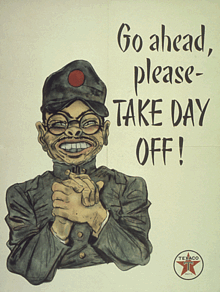
Personally, I thought this recent Texaco-sponsored Romney ad was a bit over the line.  Whether President Obama was born here or not, whatever his religion, or his extreme European Socialist views, what possible good can this sort of offensive negative ad do for our great nation?

(Full disclosure: the Texaco-sponsored bit of propaganda above was part of the war effort against Imperial Japan during World War Two and not an ad for Mitt Romney’s presidential campaign.  I am not linked with the Romney campaign, nor with any related or unrelated super-PAC or other charitable group supporting Mr. Romney, nor was the crude example of propagandistic rebranding strictly called for.  But, see paragraph below beginning “The Allies, Hitler pointed out…”)

But let us backtrack a bit and try to be a little more analytic.  What makes something propaganda?  A shameless and manipulative appeal to our emotions, brought to us via mass media.  What makes something good propaganda?  A well-paid ad agency, or government, or both, employing the most skilled people it can recruit.

1622, Pope of the Catholic Church, under attack by the so-called Reformation, creates an office to propagate the faith, sow it, let it flower.   Three hundred years later Hitler dictates the first volume of Mein Kampf, pauses to wipe the foam off his mouth and delivers a short, cogent lecture extolling the effectiveness of Allied propaganda in the recent World War.  That lecture concluded he resumes foaming at the mouth for the remainder of volume one and, presumably, in the secret, unpublished volume two.

Note: the editor of Mein Kampf was killed in “The Night of Long Knives”.

The psychopathic future dictator made several astute points in his discourse on propaganda.  One is that a lie, wielded without mercy or weakness, is almost always more useful in inspiring obedience and violent action than any sort of truth.  The Allies did not hesitate to lie about alleged atrocities committed by the Hun.  Hitler applauded this, it creates hatred of the enemy and also fear, which combined, engenders a determination to exterminate the enemy.   In contrast, the German authorities made a snobbish appeal to the superiority of their culture and troops, sneering at the contemptible unsophistication of the enemy.  

The Allies, Hitler pointed out, didn’t hesitate to make  up inflammatory captions to hideous photos– a gruesome pile of bodies waiting to be taken to morgue had not died of typhus (truth) but had been tortured to death, in a specific place and on a given date, by the Hun.  Not only that, they ran the incendiary picture in every paper for days running, with articles scrupulously documenting the invented crimes against humanity.

You starting  to get the picture?

Why did the USA get into the World War in the first place?  That is a question nobody to this day can give a very good answer to.  There’s no question American bankers had loaned many millions to the French and English war efforts, stood to lose a shitload of money if Germany won, but that alone can’t explain it.  There was a scramble for colonial possessions and a frenzy of competitive nationalism, but that wouldn’t be enough to have American farm boys, city boys and young collegians lining up to enlist.

It was the genius of George Creel and his Committee for Public Information that got them on their feet, cheering, patriotic and bursting to “make the world safe for democracy” to fight the “War to End War” and cover themselves with glory.  You can look it up.   Woodrow Wilson enlisted Creel and the Creel Committee, ingenious, tireless, unhindered by scruples of any kind, whipped up a great patriotic frenzy for war.   Lines of guys singing “Over There!” went over there to run to glory out of muddy trenches into barbed wire and machine gun fire, through mustard gas and aerial bombardment.

It begs the question of why America entered the World War. But it explains how.

Anyway, Google “propaganda”.  Look at the Wikipedia article.  I guarantee that the images you will imagine as you read will be based strictly on your political outlook, shaped by the famous confirmation bias.  Some will read the descriptions of the various techniques and see images of Cheney, Bush, Condoleeza Rice and so on.  Others will immediately see Obama, lying eloquently through wolfish teeth.

The one thing we can be sure of, effective propaganda costs a lot of money.  You have to saturate everybody, constantly, for it to work.

The Supreme Court told us recently that money is speech, the same way it once told us in the Civil Rights Cases* that biogtry against blacks had nothing to do with their status as former slaves, that nobody should get constitutionally huffy about it, and that the Fourteenth Amendment had nothing to say about it.  Go tell the Supreme Court they’re wrong.

“So, call me ‘pisher’,” the Supreme Court will shrug, “we’ll talk about this again in 90 years or so.”

As for me, I’m speechless.

*  see italic section near bottom of  post below for a full-bodied quote from that fascinating decision, it begins When a man has emerged from slavery

https://gratuitousblahg.wordpress.com/2012/08/07/my-fellow-americans-ignore-me-25-2/