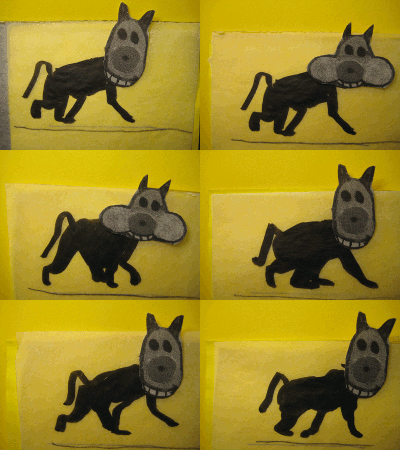
Lucky Bum

Stop me if I’ve told you this one already.

Babe Ruth was always coy about whether he actually called that famous home run in the 1932 World Series.  The pitcher, he insisted, had quick pitched him– illegal but the ump called it a strike–strike two.  Charlie Root, the pitcher, smirked, the bench jockeys screamed and howled and Ruth stepped back into the batter’s box, steaming.  Ruth points his bat over the pitcher’s head (or directly at Charlie Root’s head, depending on your POV) into the hooting Chicago crowd in the bleachers and hits a tremendous home run right there on the next pitch.  
 
There’s a great shaky 30 second film of it on youTube and an 80 year debate on whether he was pointing his bat at the pitcher or at the spot where he hit the famous called home run.  It was the last of the long-time record number of World Series homers the great Ruth hit during a mythical career.  (Consider it took Hank Aaron almost 7 full seasons of at bats to eclipse Ruth’s career total, Bonds only had an extra 1,448 at bats.  Not to mention that no great hitter ever had the brilliant pitching career [94-46 2.28 ERA] 
Ruth did before turning to hitting full time.) 
 
A sportswriter friend of his, shortly before Ruth died, said “Babe, if you won’t clear up whether you called that shot, at least tell us what you were thinking as you rounded the bases.”
 
“I was thinkin’ ‘Babe, you lucky bum, you lucky bum!'”  And one imagines the hoarse laugh of the cancer-wizened Babe at the end.

Letter to Walter (draft 2.2)

Dear Walter:

I’ve been reading your books since my mother recommended Devil in A Blue Dress to me a few decades back.  I admire the story-telling as much as the running themes of the power of imagination to change the world and the gentleness that is at the core of even your most hardened protagonists.  

Reading Twelve Steps to Political Revelation not long ago I was struck by the section calling for changes in how education needs to work to ensure a more creative, critically thinking, multi-lingual populace.  I agree that the generations coming up now are the last, best agents for the change needed to avert the looming disasters we face as a planet.  You gave a great example at the Moth recently, those two young gay strangers on Christopher Street retooling the ugly word “nigger” into a shorthand for their brotherhood.

Cheekums baboon

In the wake of Cheney and Bush I thought up my best bet for helping to bring about the kind of change we need to see.  I’ve started a not-for-profit student-run animation workshop, called wehearyou.net, to listen to young children’s concerns and help them show the creativity that is so often ignored in our testing-obsessed prison-prep factory schools.  

My hope is to have young kids produce works that will shame the more liberal of the Job Creator types (currently chafing at a theoretical 0.03% stock transaction tax) enough to fund what I envision as a grassroots movement to change the landscape of urban education, starting in the worst public schools I can find in NYC.  I worked in one in Harlem for several years, so I’m intimately familiar with the challenges kids in those schools are up against.

Cheekums1

I invite to you have a look at some of the kids’ work at wehearyou.net, along with my descriptions of the program   I hope the potential of this program, directed and produced by young kids working as teams of creative problem-solvers, lights up your imagination.   I would love to speak to you about the program.   You can send me an email or call me at (… ellipsis added…).   On my dream team of people of vision and action to work and brainstorm with, you’re very high on the list.  

Yours sincerely,
[name withheld at request of ‘author’]

Twelve Minute Drill

Going to stretch out a bit here, twelve minutes instead of ten.  You know, what the hey?  But to make things more interesting still the timer is counting down three minutes.  Then I’ll leap up, put the frozen pierogies in boiling water and then do the last nine.  I’ve wasted a minute telling you that.

I’m thinking about a friend who was a huge fan of Howard Fast’s.  So huge a fan, in fact, that she actually arranged a meeting with Fast to see if she could assist him in his work.  Fast was hostile when they met, and she left him after a short, disappointing meeting, but her admiration for him and his work was undiminished by the sobering display of misdirected anger.

Howard Fast is a name like Woody Guthrie to me, or Zero Mostel, or one of those talented people who were around and dreaming big dreams of changing the world. (The water is boiling, pardon me)   (At the risk of overboiling my pierogies I’m back for the next nine minutes)   The system we have here, Capitalism, offers freedom to anyone who can afford it.   One bi-product of Capitalism is a permanent underclass.  It is nothing we’re proud of, it’s nothing we want, but there it is.  If you speak of a more fair way to distribute work and wealth you are called a Communist and a hater of freedom.  As Fast was called, and Woody Guthrie, whose guitar was labeled a machine to kill fascists, as was Zero Mostel and countless others.  

Here’s the puzzle I’m puzzling over.  How does someone so idealistic she’d arrange to meet Howard Fast change her views so completely that, although politically independent, she defends Sarah Palin against unfair liberal attacks and recommends Glenn Beck as a reliable source for information on Woodrow Wilson, a man he apparently reviles?   Wilson did some terrible things, including his White House screening of “The Birth of A Nation”, D.W. Griffith’s rewriting of the post Civil War period that cast the Ku Klux Klan in a heroic light.   “Wilson was a member of the Klan,” more than one black person I’ve talked to about this has told me.  

The thing I’m puzzling over, as the game clock dips under 4 minutes, is how a person who believes in brotherhood, freedom, civil rights, justice, civil liberties and the perfectability of society and the individual can support things like Operation Enduring Freedom in Iraq and the torture, or at best extreme mistreatment, of those captured person’s subjected to Dick Cheney’s lawyerly-nuanced ‘enhanced interrogation’.   I suppose it is a mystery I will ponder as I go to stir the pierogies, and stop the clock with my final time-out at 1:49.

Man, those pierogies smell good.  They are filled with potato, spinach and feta cheese.  They are steaming now as I approach the one minute mark.  Soon fans will begin filing out, as the game is all but over, and I will make my way to a spot on the floor where I can stretch at full length, do a few push-ups, wipe the dust from my hands and tuck into those delicious smelling Polish raviolis.  Fifteen seconds to the buzzer and…. game time!

Peekskill USA

My father and my uncle grew up in Peekskill, NY, a once-prosperous river town on the Hudson River.   As times changed, and transport by riverboat faded from memory, the town lost its most lucrative business and its luster.  It took on the haunted quality it possesses to this day.   By the time my father and his then infant brother arrived from the slums of New York City, just in time for the Great Depression, the town was probably a pretty hopeless place.   The father and sons who ran the hardware store were, according to a cousin who punched one of them in the face on his first day in town, proud members of the Ku Klux Klan.

In August of 1949 there was a Paul Robeson concert scheduled for a picnic area just outside Peekskill.  Robeson’s likeness is on a U.S. postage stamp now, but at the time this scholar, college football star and opera singer was considered by many to be a dangerous Communist sympathizer.   Eventually he would be forced to leave the country.  A powerful, outspoken Negro at a time when black people were supposed to be content with their second-class lot and play semi-comical servant roles in movies, Robeson spoke out against wars of aggression, against Jim Crow, against racism, against police violence, against the exploitation of workers and the unbridled materialistic greed of our money worshipping culture, against so many things that patriotic men like J. Edgar Hoover stood for.  It’s small wonder there was a riot in Peekskill in August of 1949 when he came to do a show there with Pete Seeger and other idealists who, at the time, were regarded as a fifth column, fighting for Stalin under the false banner of “brotherhood”.  

It’s easy to get stressed out people to support the fight against an enemy once that enemy is properly demonized, Hitlerized, Stalinized.  Particularly if the people supporting the war don’t have to endanger themselves in any way, they will support the war effort fervently.  And if they get a chance, as they did on a summer evening in Peekskill in 1949,  to kick some mixed race Commie ass in an ambush where they outnumber the race traitor Commies twenty to one, so much the sweeter.

My father was a World War Two veteran attending Syracuse University on the GI Bill in 1949, if I have my chronology straight.  He had grown up in grinding poverty (a phrase he uttered through gritted teeth when tersely summarizing his own childhood) on Howard Street in Peekskill.   A lifelong student of history and current events, in his early years he aligned himself politically with men like Robeson and Seeger.  He was an idealist who’d been in the army fighting fascism and he was passionate about righting injustice.  He wanted to see the world become less fascistic, rather than more so.  He believed in brotherhood,  civil rights and civil liberties then and for decades after.  He also acted on these beliefs, enduring catcalls and rotten vegetables as a spokesman for the integration of NYC schools after Brown v. Board of Education and its “all deliberate speed”, among other things.  I believe he returned to Peekskill for the concert that turned into a riot when angry white mobs overran it.

My father is gone now, as is my uncle, so, unfortunately, there is no way to verify whether he was there or not.  But visiting my aunt the other day for her 85th birthday I spotted a book on her shelves called “Peekskill USA” by Howard Fast.   I recall that my mother admired Howard Fast (although she acknowledged he was probably not a great writer), and hearing from her that he’d been blacklisted by the House UnAmerican Activities Committee and also thrown in jail during the anti-Communist witch hunts of that time.

“Peekskill USA” is Fast’s eye-witness account of events in Peekskill on August 27th and September 4th, 1949.  The first one a riot, the second one an actual concert, as far as I can tell so far.  Published by the Civil Rights Congress Press in 1951, and printed in the United States of America (as it states on the copyright page) the book is a collector’s item.  My aunt was reluctant to let it go, though she certainly has not opened it in decades, if ever.  I understood her reluctance and promised to read it quickly, take good care of it and send it back to her soon.

I started reading it this morning.  The forward states that the events in Peekskill 1949 are destined to live forever in the memory of all who oppose fascism.  It was a hope, like many back then, that was swallowed whole during the so-called Cold War.   I often look around at the assumptions that underlie our singlemindedly materialistic society, like the one that says extremely wealthy criminals must be treated under a different, more forgiving, set of laws than petty criminals, and wonder about the actual winners of the Cold War.  

It seems they are the same winners as ever, the wealthiest citizens, casually united by common interests to preserve their sometimes hard-won prerogatives.  So much of the business of the 1% is amoral that it seems churlish to judge it as harshly as I do.  It’s not as though the richest among us want 45,000 Americans to die of treatable diseases every year for lack of health insurance, or want our wealthy nation to have the infant mortality rate of a third world country, or millions of hungry, malnourished, abused American children, or a permanent underclass and the largest prison population in human history.   These are surely forgivable externalities.  In order for some to have 100,000 times the wealth of others, certain sacrifices must be made.  It is only common sense, after all.

I have often thought, with that characteristic uncharitableness of mine, that Fascism prevailed at the close of the Cold War, disguised as Democracy, which, from the beginning, used phrases like “all men are created equal” with a certain puckishness.   The forces of reaction, inherently anti-humanist, amplified through the largest public megaphones, are always behind the status quo.  Why would it be otherwise?

So, if high ranking Nazi spooks were recruited after World War Two and hired by the American OSS, and their extensive anti-Communist knowledge and techniques incorporated into the CIA and used to undermine and eventually defeat the evil totalitarian system of Communism, why should I even mention this, at best, footnote coincidence, here?  If the same baldly manipulative techniques pioneered by Woodrow Wilson’s Committee for Public Information to drum up American support for unexplainable (except in terms of how it enriched certain already rich people) World War One were refined by Josef Goebbels and his Ministry of Public Enlightenment a generation later to drum up support for the war to cleanse the world of the Jewish virus and its Communist spawn, and if those techniques are still largely in use today by those who promote wars of every kind, why should I draw any negative conclusions?  Why bring Fascism into it?  After all, “collateral damage” is so much better than “murder of innocent civilians” and “Freedom is on the March” is so much better than “what are you going to do about it, asshole?”

I’ll report back on Howard Fast’s account of the Peekskill riots in Part Two.

What We Take For Granted

Quite a few things, it turns out.  A president who is clearly intelligent, thoughtful, articulate and seemingly caring must be granted certain allowances for what might be called moral or political failures.  For example, if a cleric in Yemen speaks out against Al Queda, risking his own life, and then meets with his adversaries to debate, and is accidentally killed along with the terrorists by a US drone, the cleric is collateral damage, you know?  The president’s spokesman today called the targeted killing by drone program “legal, ethical and wise.”  

If we like the president we can say “bad shit happens in war.”    Or we can all agree that collateral damage is terrible.   The last thing we’d do is call for the return of the Nobel Peace Prize he received for not being a torture-endorsing, pre-emptive war waging faith-based cowboy.  On the other hand, if we dislike the president we can say just about anything, there are a hundred things that spring to mind.

I know, I know.  The world is complex so let’s just agree that it’s OK to disagree and that we also must hunt down and kill our enemies wherever we find them, by any means necessary.  And while killing them other people will be killed and that killing also produces consequences.  OK, OK.  

How, for example, does it benefit anyone if I once more observe that Thomas Jefferson, the Author of Liberty and one of our most revered idealist presidents, a man who inherited a fortune and died deep in debt because of his love for imported luxury, was tormented as he neared death that his debts prevented him from freeing hundreds of human beings he owned?   After all, it was Mr. Jefferson who so famously stated the self-evident truth that all men are created equal.  Why carp over the fate of a few hundred he held as property in perpetuity, or their descendants, some of whom, it turned out, were his own flesh and blood?   I carp, I carp, I carp.  Carpe diem, better that than this fish mouthed carping of mine.  

Why this envious need to attack true greatness?   Sure, Jefferson had many slaves.  Sure, he went bankrupt because virtually everything on his inherited estate was imported from Europe and he had expensive tastes.   Sure, it must be admitted, almost two hundred years after his death, he did own a beautiful slave named Sally, the half-sister of his beloved wife who died young, and he had at least three children with her over a period of many years.   Why this envious need to attack true greatness?  

I don’t know, I take it for granted.  Like the fact that the rich will get richer.  Thus it has always been and thus it will ever be.  Why this foam on my lips when I read that Bank of America paid nothing to the U.S. treasury in 2010 and received an almost two billion dollar “tax rebate” that year?  What can I do about this?  Why do I take the word of an avowed Socialist on this issue when everyone knows Socialism is a short step away from Communism, a proven evil?  These people hate our freedom.  Do I hate our freedom?  

What we take for granted, I suppose, is that this is a rational world where things are done for thoughtful and sincerely debated reasons, reasons that lead to the greater common good.   If a drone is sent to kill someone thousands of miles away, or down the block, for that matter, there is a good reason for it, most likely.  It’s better than putting the lives of our young men and women at risk by placing them in war zones, right?  If Bank of America, or General Electric, pays no tax on billions in profit it is because they are creating jobs, or some equally compelling good reason.  What next, disputing the right of their executives to be paid millions of dollars a year? Just because Thomas Jefferson had a long sexual affair with a woman he owned, and treated their children kindly as preferred house slaves, that doesn’t mean he believed any the less the self-evident truth that is a beacon to the world and a keystone of human liberty and democracy.

For my part, clearly, I spend part of almost every day tormented about things I am helpless to influence.  The things I can influence for the good often remain uninfluenced as I fret about other things, as I am fretting now.  I tap the keys, glance at the screen, correct typos and other mistakes.  I reshape the sentences until they become clear and strong enough to stand on their own spindly legs.   If I march the proper sentences into a good paragraph it feels like a job well-done.   This too is an illusion.  No matter how well I put them together, make them flow one into the next, create a stream of thought and feeling a reader can paddle in, there is no job done without pay, only a hobby horse giddyapped on by a willfully blind man letting opportunity in the real world fly past him.  

I wonder if the young Thomas Jefferson, who most biographers note made a daily practice of whipping his riding horses bloody, the only outward show in his life that this thoughtful, soft-spoken patrician was not the complete master of his passions, whipped his hobby horse as a lad.  Practice makes perfect, one notes, as I rattle on here.  I suspect he may have.  Not that I judge him, mind you.  I probably would have done the same, if I’d been him.

The only alternative to this life of sour contemplation is a life of action.  After all, am I not the fellow who showed a nine year-old how to operate garageband and left her, with no further instruction, with a seven year-old to spontaneously create a music track?  And did they not, with only slight post-production help from this same adult, come up with a very neat little exuberantly improvised soundtrack within a few minutes?  

Yes, yes, I know it’s like writing that is truly nothing until monetized, but still, it should not be taken for granted.  After all, not everyone is trying to be the change they’d like to see in the world.  What we take for granted is the right to take a bow.  It is not time for any bows yet, nor is there any stage nor anyone to curtsy modestly before as the cheers descend.

Is It Just Me?

In this age of information, it’s only a matter of typing a few words and hitting ‘enter’.

US Federal Deficit $1.09 trillion

Cost of Iraq and Afghanistan wars  $1.4 trillion

Cost of Bush tax cuts over first twelve years  $1.28 trillion

Is nobody else doing the math as we argue about cutting social programs?  

I leave it to you to check the accuracy of these figures.   They explain, in part, why that speechifying wartime president has been scarce since leaving the White House, except when he nips out to earn $100,000 or more to speak English, after a fashion, to cheering corporate audiences.


Soldiering On

Being a soldier sucks in many ways.  You lose autonomy, are sent to a place where people want to kill you, watch your closest friends die awful deaths, you occasionally have to take a life, you see horrible things in war– children cut in half, old men bleeding and crying.  It gives you a chance to prove your bravery and loyalty, I suppose, but other things do too.  I wouldn’t be a soldier for all the ducats in Dick Cheney’s Halliburton portfolio.

Still, I am soldiering on.  Just because I send a request for help to a dozen people and eventually hear back from two,  that doesn’t mean I should lose hope.  I can’t lose hope, quite simply, for without it my program would die.  It’s based on hope, an admittedly fucked up thing to base anything on in a covetous world that sends soldiers to kill people, at great expense, for often very flimsy reasons.

Lebensunswertes Leben

I’m listening to a disabled woman whine on National Public Radio that she can barely live on the $1,200 a month SSD disability payment she gets now.  She complains that her parents, in their eighties and in poor health, with many medical expenses of their own, have very little to kick in from their monthly Social Security check for her upkeep.  

And the President is negotiating to lower future payments to the old and infirm for Social Security and SSD.  I’m sick to hear it, that he’s left the New Deal Social Safety net on the negotiating table in the artificial emergency hostage situation Republican phrase masters, at no small expense, have named The Fiscal Cliff.  I say they forget Fiscal Cliff– call it by what it is, when you ask the weakest to make the sacrifice for other people’s comfort, Lebensunswertes Leben (see FN below).  

This disabled caller is worried, calling Tom Ashbrook on On Point to speak for others like her, people already feeling desperately squeezed, living under the poverty line, a line that is drawn artificially low to begin with.  Do the math, $1,200 a month is less than $15,00 a year, excluding the bounty she gets in the form of the Food Stamps and Medicaid.

It seems, according to her, that the price of the transportation for the disabled where this physically and cognitively disabled woman lives  has tripled in recent years.  It now costs her ten dollars to leave her house to go shopping.   Logic would dictate she go out less often, but somehow, she seems very unhappy with the idea of how much this semblance of independence eats into her meager budget.  It’s not as if this lady is rich, strictly speaking she lives on $14,400 a year.  She doesn’t have a cleaning lady and a driver, if that’s what you’re thinking, Eric Cantor. 

She is calling Tom Ashbrook in the context of a conversation about President Obama’ s willingness to hack at the Social Saftey Net in the name, presumably, of bipartisanship — showing more of his famous willingness to concede on major principles before the horse trading actually begins– and preserving the oligarchic status quo.

Oligarchic,” a political adversary will say, raising eyebrows and hackles both.  I say, that is the proper name for the United States in 2012, there is no question of it being otherwise as the rich get richer and the poor and gullible are constantly called on to make more and more dire sacrifices.  

It’s not as if I don’t see the arguments against the position  I’m taking.  After all, why should a person making only $400,00 a year be forced to take the hit and go back to the old tax rate before the Bush Tax Cuts?  That’s why they built the Fiscal Cliff (you can be sure that well-paid right wing genius of phraseology, the coiner of  Death Tax, Collateral Damage, Friendly Fire and so forth, was well-paid to coin this hard image of looming, desperate catastrophe)  to capitalize on Bush’s deferred 2004 mandate to privatize Social Security.

How cool would that have been?   Everyone free to freely invest their retirement money on twenty thousand lottery tickets,  or getting mortgages to buy houses to flip, or on the spin of a roulette wheel that could make them fantastically rich — if they had enough to bet with.   2008 would have been a big “whoops…” for millions who would have lost all retirement income, in addition to the millions who did lose everything, (like the employees of Enron once upon a time) after the last unnatural Fiscal Disaster– the huge fraud that led to the massive losses of 2008. 

That organized effort by fantastically wealthy institutions to defraud people with limited means was perpetrated by very, very, very wealthy people, people it wouldn’t be right to prosecute, or imprison, or force to give back billions obtained by fraud and deception.  They are too big to prosecute, and besides, they are not considered a threat in the same way that an angry young black man is a threat, but, if you look at the full picture, these are some very dangerous motherfuckers.  But anyway, back to lives not worth living, those expendable millions at the bottom of the food chain.

The sickening spectacle unfolds, there goes our supposedly liberal President Barack Obama, sleeves rolled up, agreeing to pony up the Social Safety Net in favor of letting the wealthy pay as little as possible in taxes, the old rate before Bush gave them his temporary one-time tax cut gift a decade ago.  

The President seems to have agreed in principle to tie future Social Security payments to a new cost index that would gradually decrease the amount our nation’s oldest and poorest, our most helpless, receive every month.  They’ll eat cheaper meat if the market dictates it, they’ll eat less meat, they’ll live like Gandhi.  We didn’t make them losers.  If they’d made better choices in life they could have also been winners.   We didn’t make the jungle.

Still, I have to ask:  why is the New Deal being renegotiated at this particularly difficult moment for most people?  Whence this radical right wing drive to shred the Social Safety Net?   Are we still fighting the damned Civil War?   Did Germany win World War Two and nobody told me?   Why is the onus for settling an artificially engineered showdown to cut social spending placed squarely on the backs of our most vulnerable?  Why is it being  presided over by Nobel Peace Prize Winning President Change We Can Believe In?  

There must be a hundred more likely places to start to cut the deficit before we talk about cuts to a program that is solvent for at least the next twenty years without any changes.  

There are those who insist we live in the freest nation on earth.  The vast majority of children who grow up in poverty die in poverty in America.  They live shorter, more dangerous lives, their infant mortality rates are like those of Third World mothers.  American children in poverty, in the patriotic view of those who proudly call our nation the greatest nation in the history of the world, have the freedom to choose between obedience, discipline and participation or anger, rebellion and prison.  

A rational actor, the theory goes, would choose to pay close attention as the cards are dealt and gamely play the crap hand he’s being dealt every round.   He is not playing at a high stakes table anyway.  For example, if he or anyone he knew were to die and a corporation had liability for that death, their family would get a tiny wrongful death settlement.  Think World Trade Center bus boy wrongful death number ($20,000) vs. World Trade Hedge Fund guy’s (multiple millions, widows complaining about the meager pay-outs).

“Let’s see,” the lawyer for the corporation negotiating the settlement for the guy’s death from some kind of toxic product or procedure, would say, consulting charts and punching a calculator “a life expectancy of 31 years times an annual salary, interest, benefits and dividends, of…. let’s see…. zero— prisoners in the State prison system do not make very much money, would be…. we’ll give you $10,000.”

The family would take it, in sorrow and in rage.  But really, that’s the game, the way its set up, how the board is rigged, where the finger rests heavily on the scale, how the field tilts, who the refs are, how corrupt and greedy they are, and billions and billions in wealth to be taken, the wealth of the world is inexhaustible, more money than you could spend in a thousand lifetimes, but who cares?  God bless unfettered Capitalism, nobody can put a limit on an American’s right to luxury a million times over, as if he had a million lives to spend it.  

It’s Winners versus Losers, punk.  It’s a clear choice, really.  You can choose the side that wins every time– even if you personally keep losing big time you can still root for the Winners, bask in their glow.  Or, you can side with the Losers, those who will always lose, always be screwed by those who can.  Some are born with advantages, others with disadvantages.  It’s up to you— pick a side.

So this disabled woman talking to Tom Asbrook complains that if the monthly check is decreased, if she’s told to buy a cheaper cut of meat, lose some weight, don’t use so much heat in the house, wear two sweaters inside, and a scarf and a hat,  live like Gandhi, then she will suffer.  The rest of us need it all, so let’s just say, to her and the millions like her:  be quiet and have a blessed day.

FN:  Lebensunswertes Leben (from Wikipedia)

The phrase “life unworthy of life” (in German:“Lebensunwertes Leben”) was a Nazi designation for the segments of populace which had no right to live and thus were to be “euthanized“. The term included people with serious medical problems and those considered grossly inferior according to the racial policy of the Third Reich. This concept formed an important component of the ideology of  Nazism and eventually helped lead to the Holocaust.[1]  The euthanasia program was known as Action T4.

Disorder

There is a book called the DSM, Diagnostic and Statistical Manual of Mental Disorders, I think they are using version IV now, working on five.  The book lists symptoms and describes  the gradated spectrum of each diverse, specific, and sometimes subtle, mental disorder.  

Among these are the perfect statistical descriptions of each of the several distinct types that make up the editorial board of the American Psychiatric Association– brilliant and nervous,  dour and paranoid, voluble and smiling but filled with unspeakable rage, intense, taciturn but almost completely quiescent.  Those who twitch and those who smile fiercely, with one eye twitching slightly from time to time.  The trained observer may catch the occasional micro-expression showing the primal will to violence, but, for the most part, the editorial board of the DSM looks like a high-level group of accomplished professionals.

And it is.   I drop this all casually, though, of course, it’s a cliche: the crazy psychiatrist.  But the authors of the DSM, the book that categorizes every insurable mental disorder, are a select breed of psychiatrist, true experts, standing at a rare vantage point, on the defining edge, that hair’s breadth between normalcy and disorder.  

Diagnostic:  their diagnostic checklists of symptoms will decide what mental disorder you suffer from, please answer the following questions.   Are you ever sad?  Do you ever have bad dreams?  Do you become sexually aroused at odd times?   Do you like to shake your leg rhythmically for long periods of time?    A code is issued for each customized disorder and the psychiatrist  prescribes, and a pharmacist dispenses, the suggested drugs, according to the scientific recommendations of pharmaceutical industry expert psychiatrists.   Because a code number has been submitted with this claim, everyone along the line will be paid well for the patented medication to make this poor bastard function better.

Except that sometimes the poor bastard functions well, medication or no, and at other times not so well.   These mood fluctuations are a symptom of our condition here, buffeted by the pressurized demands of the world around us.  I’m just saying– a person who is freaking out might do better resting in a quiet room with soft music than strapped to a gurney, people screaming, lights flashing, men with guns, as the sedation is administered.

On the other hand, I’m no psychiatrist.

DSM-IV DSM-IV.jpg

Good Punchline in Torture Debate

Not that I often need a diversion or digression to get me following a random string, but a friend sent me an article the other day about US government use of torture, prohibited by decree of Barack Obama in one of the first acts of his presidency.   The author opined that as president Mitt Romney was likely to rescind that decree.  There was a link to an article about SERE training (see first line of yesterday’s post for link) and the US government’s perverse relationship to the torture it rightly condemns when barbaric enemies employ it.

I sent the link to that article to my friend and we shared reactions to it.   He wrote that he was aware that as soon as the acetylene torch came out he’d tell them everything.   We seemed to agree on most points.   Then, after a long and stressful day, I got an email from him with that old chestnut, the ticking time bomb scenario.   He said use of torture was not such a clear moral issue when your loved ones were on the verge of death and the prisoner in the chair likely knew how to stop it– but wasn’t talking.  In that case, he said, there is an arguable duty to use any means necessary to save your loved ones, including the worst tortures you can think of.

I reacted with a good measure of horror, and arguments, and I slapped at the hypothetical that American advocates of torture had recently used over and over to justify the torture of many innocent men, people they called “detainees” and kept in secret “black sites” or on an American military base in Cuba that they lawyered up to claim was not, therefore, subject to U.S. and International laws.  

This torture in my name, although the torture was legally redefined in a secret internal memo and defended as merely “enhanced interrogation”, and marketed as necessary to protect us from terrorists who’d planted countless ticking time bombs, has been one of the most galling aspects of the rise of the “neo-Con” partisan in American politics.  That most of the people tortured, these “worst of the worst”, had later been released as innocent is another fact that makes me wanna holler.

My friend, a skilled lawyer, hit back on each of my points, then made this point, toward the end of his gamely fighting email:

Me: Your conclusion would seem to be that if there’s a time bomb ticking, or if you believe strongly enough that there is, everyone should probably be tortured, just in case one of them knows something you would come to regret not torturing them to find out.

Him: There you go again. Screw the fucking time bomb. Why not just torture everyone and get it the fuck over with. There, I said it. Somebody had to.

I’d thought he was at least half (if not 90%) joking, so I’d ended my previous with this:

But I think you may be pulling my shackled leg in a stress position while pouring ice water on me as my balls are given a mild shock from a car battery.

 Him:  Wait your turn.

When I wrote back, my will and spirit finally broken, I told him: You win, torture away.

Him:  I am, my friend, I am.