Board of Education’s Office of Integration and Human Relations

Human relations was the term used to describe a desired state of harmony between different ethnic groups in America during the heyday of the Civil Rights movement of the 1960s.  It was in use in 1968, when I was twelve and my father was forty-four, when he was working at the New York City Board of Education’s Human Relations Unit.  Human relations and intergroup relations meant black students would be allowed to go to the same schools as white students, and that all reasonable steps would be taken to ensure that ancient and present anger and grudges did not interfere in the relations between these young humans or with their education.  The animating idea was that all children have potential and that it is a crime to waste that human potential.

Not to be an asshole about it, but the landmark 1954 Supreme Court decision that had finally done away with the hateful “separate but equal” doctrine in public education was already older than I was in 1968.  The Court had called for desegregation of public schools “with all deliberate speed” and, like many things the law solemnly proclaims, it amounted to a kind of mockery.  

The weasel words “with all deliberate speed”, well-meant, no doubt, but… as they say, you cannot legislate morality, and if local whites sincerely hated local blacks it would do more harm than good, perhaps, to send in troops with bayonets and defend the little Negroes from the wrath of the children of their fellow poor people who hated them.   How, in fact, could we police every playground, bathroom, elementary school cafeteria, even if we wanted to?    

A better approach, it seemed at the time, was to create groups to study the problem, issue reports, and form Human Relations programs.   New York City had a program, so did several other large cities including Los Angeles and St. Louis.   My father joined the Human Relations Unit as an experienced high school teacher with a proven talent for interacting with students, as he had for years as faculty liaison of the G.O. at Martin Van Buren High School.  The G.O. (“general organization”) was the student organization at Van Buren and my father was its faculty adviser.  He worked closely with student leaders, at least one of whom, Mike Levine, by name, called him at home regularly during dinner hours.  

Thinking about this now, my father’s move to the Board of Ed headquarters on Livingston Street in Brooklyn from the nearby high school in Queens, was his chance to make a difference in something he believed in.   He received the same teacher’s pay and benefits and commuted two or three times the distance to and from work every day, but was finally able to use his talents to do more than inspire the occasional high school social studies student.   He was returning to the front lines of tikkun olam, repairing the world, doing God’s work, fulfilling his potential to help bend the arc of history toward justice and fairness.

They did some good work in the world in those years.  Angry Italian kids, their high school turf forcibly invaded by unwanted Negro kids and Puerto Ricans, on top of the insult of the dark brown kids, literally rioted.   Cops were called to the school, the place was put on lockdown.  My father, his black hair spilling over his collar in the back, his thick sideburns showing a certain counter-cultural panache, strode into the school with a young, blonde WASP on one side, an Italian guy on the other side, a black man, a hispanic woman.  Into the vestibule of the Brooklyn shit-hole they went, getting dirty looks from the kids as they entered.

“Dass some shit,” one of the passersby would hear the black haired Jewish intellectual type say, and the tiny door would begin to come open.  

“You are free to express yourself freely here,” the big Jew would tell them.  “I’m not squeamish about language, but I am about dishonesty — I have no use for a fucking liar.  Use the words you need to express yourself, but please, out of respect for the rest of us, don’t try to feed us any bullshit, all right?  Our bullshit detectors all work very well. We have a problem at your school that can be fixed, mostly by learning that we have a lot more in common than we are led to think we do.  We are all going to fix a bunch of the problem together this weekend.  It’s going to be fine, but first we have to talk.”  

And they would talk, in sensitivity training sessions, in role playing sessions.  

“You want to know why the word ‘nigger’ is offensive, motherfucker?” the black kid would say to the leader of the Italian kids.  And my father and his trainers knew to hang back at that moment, I suspect.  This is a great moment between the leaders of the two gangs.  My father would make a note in his head, and at the proper time he’d begin.

“‘Motherfucker’ is one of the most fascinating and powerful words in our language.  Tony, you said it’s a fighting word, the last, irresistible, provocation before fists fly, which it certainly is.  Lamar gave us two or three other meanings for ‘motherfucker’.  The word is like holding lightning in your hand, if you think about it,” and they would talk about who the real motherfuckers were, and who just thought they was real motherfuckers, and soon every motherfucker in the room would be nodding their heads, some of them laughing.

 “Do you make the feeling behind a word more or less powerful when you forbid its use?”  I could hear my father asking.  “Lamar, would you prefer Tony call you a nigger or an ‘n-word’?  Any preference at all between those two?”

“Fuck no,” says Lamar, “let the nigger call me what he wants, but let him say it with love.”  And Tony bursts out laughing, he never realized what a funny motherfucker Lamar was.  The two had been implacable enemies, the most charismatic of their respective warring tribes, and now they were each seeing the other as a highly intelligent, witty young individual.  Like the Jew said, they actually did find out they had more in common than they thought.

“You know, as far as my people were concerned, and I mean the White Anglo Saxon Protestants who actually run this country,” said the blond folk singer, “Italians were niggers too.  I mean, no offense, Tony, but Italians were one tiny step above niggers, in the same category as garlic-eating Jews like Irv over here.   American history has not been pretty, in fact, in many ways it’s been very, very ugly, but going forward the future belongs to us.”

As they broke for lunch students who had never talked to each other began to chat.  The food was way better than school food, the setting, in a country campus somewhere, was a bit magical for these city kids, made them feel special.  Breaking bread, talking frankly, having adults who were not trying to micromanage and control everything, who let them talk the way they talked… these things were all good.  Friendships emerged.  The fighting at their school would stop.  For a year or two.  The friends would graduate and their little brothers and sisters would start attacking each other.

“Well, you’ve captured some of this, Elie, but you know who you really need to speak to if you want a primary source, don’t you?  You have to find and contact my man Phil Trombino.  Phil was there, he’d be sitting next to Tony as Evelyn was telling him Italians were actually niggers.  Tony would look at Phil and Phil would raise his eyebrows and nod.  ‘Ain’t dat some shit?’ Phil’s familiar expression would tell the Italian kid.  The Unit really was a great idea, until Nixon and that ventriloquist’s dummy Reagan and all the rest of them repackaged the narrative and made guys like us the problem, and, if you think about it, when have we not been the real problem?  Nixon had plenty of guys like us on his enemies list, the paranoid, drunken fuck.  Call Trombino, Elie, seriously.  This is a story that should be told, and who better to tell it than you?”

FDR’s Four Freedoms and Irv’s eternal horror

I can picture my teen-aged father, on January 6, 1941, huddled around someone’s radio, probably his uncle Aren’s (I assume my father’s family was too poor to own an expensive piece of furniture like a radio) listening to Franklin Delano Roosevelt’s State of the Union speech.   Radio broadcasts were new at the time, it undoubtedly still seemed like magic to hear a president’s voice, broadcast live over radio waves, somehow entering a receiver built into a large fancy box and emerging, alive, from a speaker, to be heard in its every nuance in millions of American living rooms, over speakers in the streets.  

I can imagine my young father drinking in the part of the speech about the four essential human freedoms that American democracy, indeed common decency, was built upon.   Irv would have been a senior in Peekskill High School, going on seventeen, and the president’s words about Freedom from Want would have stirred his impoverished young heart.  

“Well, you have to understand, here was a patrician, literally to the manor born, who fought against the inborn corruption of his own class to actively expand the unheard of concept of common decency for the masses, he was actually creating America’s social safety net during the New Deal,” said the skeleton. “I was aware, even then, that most of FDR’s speech was a politician’s rhetoric to help bring the skeptical nation to an acceptance of the need to fight fascism, to join the side of the European democracies against militant, hell-bent totalitarian regimes.”  

“Still, the reason FDR was so loved by so many was because he was willing to incur the hatred of those who regarded him as a class traitor.  He told them, the same merciless fucks whose adult children and grandchildren are robustly yet casually screwing us all today, he said it with that great smile of his, ‘I welcome their hatred!’*  I remember that ecstatic moment from a newsreel I saw when I was about twelve, and the crowd at that rally went absolutely wild, as many of us in that theater yelled when we saw him say it on the flickering movie screen.”

“He challenged basic assumptions held by the rich.   Why is private college still and forever the exclusive right of the children of the well-to-do?   Because we can price the children of the riff-raff out and keep it pure, pass on our ivy garlanded love of higher learning, and higher earning, to our own DNA.  It’s always been us against them, since earliest homo sapiens war parties, but FDR articulated something more.  That’s why he was elected four times, he was fighting for the basic freedoms of the common man.” 

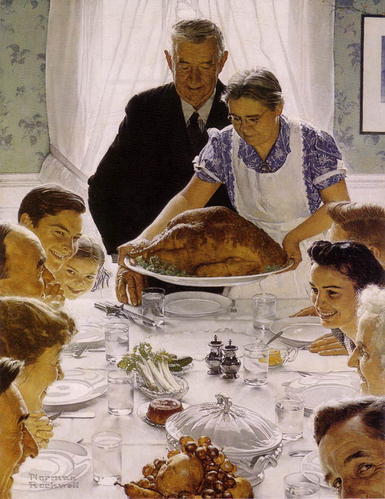
Today one has to go to google to find out exactly what these then famous Four Freedoms even were.  Sure enough, there they are, immortalized in the famous Norman Rockwell paintings, those strikingly realistic evocations of a mythical American life.  The famous one where the fat, perfectly browned turkey is being served at a big table, with the beautifully rendered greedy faces of the children at the end, one smiling lustily almost directly at the viewer, is his depiction of Freedom from Want.  One picture = a thousand words.

rockwell_freedom_from_want

“Yeah, FDR told us that the right not to go to bed hungry, in a world of abundance and super-wealth, was a basic human freedom.  Of course, any self-respecting billionaire will tell you exactly where to fuck yourself on that proposition.  Go down FDR’s list of the old enemies of peace, the first paragraph of your footnote below*,” said the skeleton. “It is now, what, eighty years later, and… hah! what do you know?!!  Same Dick Cheney types treating the government as their own piggy bank, the forces of selfishness and lust for power fucking away with insatiable, mechanized erections.  Ruthless, inhuman forces still in control of our great democracy, you say?  I don’t mean to single out Mr. Cheney, you understand, just because he’s such an unrepentantly evil motherfucker, and not even a born member of that social class FDR betrayed, still, you take my point.”

Preaching to the choir, dad.  I couldn’t have put it any better myself, self-evident as that is to say, of course.  The reality of this impossibly slippery slope of self-serving privilege and the constant rewriting of history to suit their purposes is no doubt part of what finally broke you.  

“Play the game the right way, take advantage of every bit of luck you get handed, work hard, work harder than everybody else, work as many jobs as you need to work, struggle, fight hard against ignorance and hatred, try to be a decent person and… oh, fuck, I was putting myself under so much pressure to live the American Dream that I fucked up both of my highly intelligent kids, oh, shit, and now, here comes Dick Cheney, oh, God, no…  look at that famous self-satisfied smirk…”

“And they’re not enforcing the Voting Rights Act anymore in the former Confederacy since we’re now so clearly post-racial and the f-ing ‘n-word’ is no longer tolerated, except in private among whites and among the n-words themselves, of course, and we don’t need to regulate Wall Street speculators any more, the Free Market will insure fairness, you dig, and there’s nothing wrong with a little pre-emptive ten year war on some anonymous brown bastards who hate our freedom, even with no actual causus belli, think of all the jobs we create in the lucrative war industries, and it’s so judgmental to call us ‘war profiteers’, you fucking glib, hateful class warriors, and oh, blah blah blah…  You want Hope and Change?  Vote for the charismatic black guy who will break your heart in more ways than you ever dreamed possible.  Yes, in the end, the seeming futility of it all broke me in half like a fucking dried out stick.”


*  “We had to struggle with the old enemies of peace—business and financial monopoly, speculation, reckless banking, class antagonism, sectionalism, war profiteering.

They had begun to consider the Government of the United States as a mere appendage to their own affairs.  And we know now that government by organized money is just as dangerous as government by organized mob.

Never before in all our history have these forces been so united against one candidate as they stand today.  They are unanimous in their hate for me—and I welcome their hatred.

I should like to have it said of my first Administration that in it the forces of selfishness and of lust for power met their match.  I should like to have it said, (crowd cheers begin to drown him out) wait a minute, I should like to have it said of my second Administration that in it these forces met their master.”

Reading these lines is nothing next to listening to his powerful delivery of them, hear the actual 1936 speech here.

The Actual Book

“The Book” itself, I realize now,  turns out to be something completely different than any of those three hypothetical discrete, daunting book projects I laid out the other day.  

For one thing, it has to draw all three themes together, for lack of time and because of the maddening specificity of the case it must lay out. Hatred, love, slaughter, mercy and play must be interwoven, weighed out chapter by chapter.  In the end you will have to care about it, see the work I am trying to move forward as animated by something very real and pressing, or the book is nothing.

The Book, this The Book of Irv (Book of My Father), pieces together a tricky puzzle, tells each strand of the history to lay out the unifying theory.  It is an attempt to explain the unexplainable, make clear things that are hazy at best.  

You cannot understand hate until you experience it directly, cannot love until you’ve been loved. Simple idea, though complicated to explain well.

Everything we believe has been sold to us. Everything.  

Our world is increasingly based on selling, from everything you can see with your eyes to the deepest beliefs you hold.  If I can’t package and sell I’m basically through, and the thing I must sell is, above all, a compelling story of the theory that moves me.   It’s got to move you, too.

The Book of Irv is equal parts beauty and horror; the fun and invention of play — the first and deepest mammalian bonding and learning– (and Irv was always playful with children and small animals) and the unspeakable horrors of hatred, the despicable civilities committed in the name of our American law.  The devil is, as always, in the details.  These historical strands need to be patiently, clearly set out, in order to give the reader the full context for consideration.

Irv as a unifying figure is ideally situated at the center of this explanation.   His life began in dire poverty, a Jew born in a New York City tenement who moved with his family to a shit hole in Peekskill.   He was an outsider consumed by outrageous injustice.  He fought racism in America after returning from a stint in our occupying army in post-war Germany after that modern nation showed how muscularly racism could be flexed, if insanity actually ruled.  

My father, for all his frailties, fought a fitful fight for social justice across decades, as he fought his kids, dominated his wife, quipped, raged at the inhumanity of the world.  He imparted to his children deep and important values that would influence the course of our lives, to our great detriment.   All this should be explained, the strength of this irresistible force that compels us both to work with the children of the fucked.  

The principle is straightforward:  poverty breeds despair, violence and fear.   Poverty stinks worldwide, kills millions and shortens every life it touches.   You want to heal the world?  Start by working on eliminating poverty.  Start with the kids.

In our modern world of unlimited wealth, poverty is a problem that can finally be ameliorated.  It won’t be, but that’s another story.  I suppose the thing that finally drove Irv to despair was his feeling of hopelessness.  Justice does not prevail, except sometimes incrementally, for moments in certain lifetimes, and without a community of comrades it is impossible to continue the good fight.  

Irv understood that the moral center of a society that can enslave millions solely to amass great wealth is indistinguishable from a culture that sends its believers scrabbling to cut their neighbors’ throats.    The names of the atrocities change over the centuries: impaling, shooting, lynching, drowning, whipping, but the song remains the same.

The Book of Irv must walk the line on this side of rant, unreliable narrator or no. Play must be at the center of it, because play is the only dependable relief from the oppression all around.  A tall order, friend, but while I am taking orders, why not?

“So you’re going to talk about this fascinating, all-explaining, theory unifying book you’re supposedly going to write, Dr. Bronner?  Or are you going to knuckle down and start writing it?”

I’m going to knuckle down and continue to talk about starting to write it, at the moment.  But first to get back to my long-stalled project to make some space in here.

Write the Book

So what is this book?  

It is more than one book, actually.

The subject of each has been dictated by the world, each book is needed to demonstrate my point.  These are entwined but distinct points that need to be separated out.  Let me try to disentangle and prioritize them, make them less abstract, seem less the ravings of a madman.

Book One —  to convince the reader of the obvious: how important careful listening, participating and empathetic feedback are in learning.   Make the case for why I care about these things so deeply, why others should too.

This is a fraught book, perhaps more than the others.  It is a do or die attempt to sell, more than my name or skills, a big idea I’ve already invented the machine to demonstrate and have put into  practice dozens of times in classrooms in New York City. 

The world has largely moved away from these quaint values of care and appreciation, at least on a mass level.  If I’d make a business out of helping kids learn these old-time, hand-made type skills, I have to tell the story in a way that will engage and excite.  I need to find the way to inspire a creative and caring sector of a world that values, far above everything else it also espouses, competition and the metrics of who is wining and who sucks.  

Until I find the way to tell this story compellingly enough to get it funded, or finally give it up as a bad job and find something else to do, I continue to lose the only competition everyone readily understands.   Quicksand, my friends, in which I swim in extreme slow motion.

Book one, the detailed and compelling case for wehearyou.net, (or whatever you want to call it) an interactive workshop where public school kids’ imaginations run the show as they work together to master the interlocking skills needed to produce original stop-motion animation.  This is clearly the hardest of the three books to write.

There are two easier ones that come to mind– the easiest would lay out the devilish details, fleshed out by memory and imagination where the world has wiped away all trace, of the destruction of the roots and trunk of my family tree by centuries-deep hatred that finally had the technology to carry out its ultimate goal– killing every last one of the fuckers, everyone like me.  

This had happened before, has happened many times since, has tangled roots and a million implications.  It has haunted me since I learned of it as a boy, applies over and over as we read the news today.   Who gives a shit about this story? Probably a few middle class people here and there.  It is a story that will mostly have to wait, it would appear, or show up as a long article in some journal somewhere, along with my research into the unfathomably sad, sick history of the Thirteenth, Fourteenth and Fifteenth Amendments.

The third book is the tip of the iceberg, really, the iceberg itself being the preceding book.  Or, picture, instead of the iceberg,  the fruit of the destroyed tree, if you prefer another cliché.  To understand how somebody of great intelligence, humor and charm can act like a cornered rat, lash out viciously at loved ones, you need to picture the exact circumstances that put the rat into his dreaded corner.   This would be the most interesting of the three, perhaps, and require the least by way of imagination.

But let me tell you a little story that might be the best way to set the stage for the first book, the story of my most tangible real-world quest.

In a region of Italy ravaged by World War Two, in a village called Reggio Emilia, the first thing the parents built, when peace finally returned, was a school.  This school was built in a charred landscape, for children who had known only war.  The parents wanted a better world for their children and their first priority was imbuing these poor devils with a love of life, a deep appreciation of the wonder of creativity and every hope for a beautiful future.

To that end they made the school beautiful, had the children plant and tend a garden to make the blackened earth blossom.  When the plants in the garden were cared for, green leaves magically sprouted and their fruits ripened in the sun. These delicious ingredients were harvested and lovingly cooked.  Kids and their teachers prepared and ate the things the earth produced, the things they had brought forth from the earth. 

Colors, flavors, scents, everything that could excite the senses of young kids was brought into play.  The childrens’ excitement  guided the things they studied.  Adults carefully listening to the children nurtured their creativity, childish intellectual curiosity and everything else that makes students into life long learners.

I was told of this program by a friend who’d encountered it in San Francisco.  It reminded her, she said, of my program, since it placed adults listening to children’s ideas and discoveries in the forefront of education.   She believed it was now a worldwide movement, that there was probably a Reggio Emilia school or two in New York City.  

I was delighted to find a couple in New York City. You will not be surprised to learn who the children in these Reggio Emilia schools are– they are children whose parents can afford the $35,000 a year tuition for their kindergartner.

Below is what Reggio Emilia says about itself (see ruptured appendix 1).   Here is what a writer for a major magazine has observed– a fairly obvious point about which children need this humanistic approach to education the most.

Which completely ignores the question of how these creatively engaged kids do on the life or death standardized tests designed by testing corporations to measure learning and guides us back into the crippling cul de sac that I must somehow leap out of if I am to proceed, if my long-stalled program is to go forward.  In a world of limited resources, whose children will get the rare, difficult, precious thing and whose children will get the predictable, easier, more crippling one?

If you will excuse me now, I have to go bash fucking City Hall in the face and get back to practicing so I can find my way to Carnegie Hall.

More tomorrow, when I must somehow avoid writing anything in this vein, or this vein.


ruptured appendix 1

At the heart of this system is the powerful image of the child. Reggio educators do not see children as empty vessels that require filling with facts. Rather they see children as full of potential, competent and capable of building their own theories.

Children have the right to be … active participants in the organization of their identities, abilities, and autonomy.. .  “better citizens of the world”… (this system) also credits children, and each individual child, with an extraordinary wealth of inborn abilities and potential, strength and creativity.  Irreversible suffering and impoverishment of the child is caused when this fact is not acknowledged [my emphasis– ed].

Each day and every moment, we, the teachers, follow the directions of the children and adapt ourselves, always observing, documenting, listening and interpreting their goals, theories and strategies so we can gain insight into their thinking, always ready to make changes and support the children in their discoveries.

“Tell me and I’ll forget, show me and I may remember, involve me and I’ll understand.”  Chinese Proverb

source


America’s Exceptional Exceptionalism

Other countries, other cultures, other People, may consider themselves ‘exceptional’.  This may be true —  to them — but American Exceptionalism is exceptionally exceptional, more exceptional than any other exceptionalism, as I’m sure you’ll all agree.  As I shall endeavor to demonstrate again here.

I don’t say this only to be arch– or only to avoid doing things I must do today while I tap blindly at these keys.  Those motives cannot be denied, I add in the spirit of complete transparency of the kind President Obama so forcefully advocated as a candidate.  If you don’t feel like reading my bullshit but still want a good reason to be pissed off, just click this link.

Consider this: America has been exceptionally successful selling the ideas of freedom, justice and the American way.  Selling is the American genius.  This is beyond dispute.  Nobody does it, or did it, better.  

I don’t say this only out of bitterness at not being a sales genius myself, though admittedly that’s part of it.  America has packaged and ingeniously sold any number of wonderful and terrible things.  We are the undisputed genius of that ever-growing field which now encompasses advertising, public relations, spin-doctoring, marketing, branding, market research, demographic targeting, political persuasion, fundraising, data collection for targeted marketing, political advertising to influence the outcome of democratic processes, etc.

I think everyone can agree this amazing industry, employing many millions and influencing every American deeply (not to mention billions of others worldwide) is kind of exceptional.  To have the genius and ability to sell millions of rocks as pets?  Exceptional!  To be able to expertly package and market candidates for political office, and launch devilishly targeted attack ads to torpedo enemy candidates? Truly exceptional!  No shit, really, and no wonder these experts are paid enormous sums of money for the invaluable services they provide.  

Of course, it’s mostly the bitterness speaking. And glibness, which, though I sometimes flash, I know is also a vice.  So let me stop flapping me gums and post the link to the latest illustration of American Exceptionalism that has come across my desk.  

Apparently, to avoid another threatened government shut-down by those elected government officials who are hell-bent on proving that government is the enemy, certain compromises were made here in the Land of the Free and the Home of the Brave.

Sekhnet warned me to take my blood pressure meds before reading this short article on five of the most infuriating political compromises that prostitutes, pimps and panderers struck recently in our name and in the name of preserving and funding our great democracy.  I made it to the end of number two, before going into the small room to do the same myself.  As I went I chanted “USA! USA! USA!”  If you’re feeling strong today, click here.

And God bless our exceptional United States of America.


Fun in the Sun

I had something closer to my heart to write just now, but decided to write something closer to my inflamed baboon’s asshole instead:

Dear NY State of Health:

 I had a message on the website congratulating me when I logged in recently. The green notice told me that there was nothing more I needed to do to keep my health insurance as it is for 2016. I then checked my Inbox for the message received on 12/20/25 and read that my subsidy was being removed. I called to straighten things out and two or three days later got an electronic disenrollment notice.

A confusing ninety minutes on the phone with NYS of Health on 12/22 resulted in erroneous information being inputted on my application on my behalf. The website crashed mid-conversation, which made things more difficult still.   During the first call Marlon told me he would list my income for 2016 as zero, since my income for the last three months had been quite low. I described to him why it would be inaccurate to list my 2016 income as zero and then the call was abruptly cut off.

When I called back I learned, from the next person I spoke to, Izahn, that Marlon had filed my application listing my income as “zero”.   I was unable to see my own application on-line because of the trouble with the website. Izahn assured me that he’d fixed Marlon’s mistake, submitted a new application for me and apologized for the website being down so I couldn’t see the application he’d filled out for my continued health insurance.   He advised me to send the most recent tax returns. They are enclosed.

I had two emails on Christmas Day, the first referred me to a notice that turned out to be the disenrollment notice at the bottom of this letter.     Marlon’s “zero” apparently triggered the other notice I was emailed on Christmas Day, informing me that the income information on the 12/23 application did not match income obtained from State and Federal sources.

 I’d like to maintain my insurance coverage. Your assistance is greatly appreciated,

 “Your assistance is greatly appreciated,”

He added ironically, disgustedly, clenching his face into a fist with which to smash the reader of his words to a powerless minimum wage bureaucrat working for the health insurance industry, under the guise of a program to help New Yorkers afford overpriced health insurance.

“They Can’t Do That!”

(note: this is a reimagining of a hideous courtroom encounter with an enraged young jurist who senselessly flogged a tired guardian with the unreasoning letter of the law.  No similarity to the actions of the angry hearing officer, if such a person even existed, is intended, nor should any be inferred.  Elpidio Ortega and Dave Levin, although arguably based on real persons, are also arguably not).

You don’t really understand how relentless the law is until you stand next to it for a long enough time.  Years ag0, as my dying mother was impatiently waiting for me to finish in court and get her for lunch, I had a conversation with a judge, on the record, that went like this:

Judge:  So, counselor, you’re telling you have  never even made an attempt to speak to your ward and have no intelligent action plan for the octogenarian, Mr. Ortega, a non-English speaking client of Adult Protective Services.

Me: (pause) … that’s basically what it boils down to, Judge.

The Judge asks a series of probing questions, my nods, head shakes and other body language and gestures are captured only as silence on the record, as is my detailed explanation.   Then the judge says.

So, basically, counselor, again, what you’re saying is you have never even made an attempt to speak to your ward and have no real plan of how to protect your ward, an 80 year-old man who is facing eviction.

Me:  … outside of what I have already said, Judge, that is what I’m saying.  There is only one plan now possible for Mr. Ortega.

Listen to the voice recording again, “outside of what I have already said” is a non sequitar when all I’ve said is that it boils down to me having no idea how to proceed in this guardianship matter.  

My adversary in the Housing Court that morning, Dave Levin, remembers well what I’d said, the steps I was taking, that he had already agreed to my excellent terms.  None of that is on the record.  The cunning and ambitious young judge made sure to make a clean record.

“A clean record comes in very handy when anyone questions your ethics.  If you can produce a transcript where everything that can be used against you has disappeared, you’re golden,” said his mentor Sheldon Silver.  This young judge was one of Shelly’s golden boys, had skipped over several more qualified candidates to become a Housing Court judge.  He dexterously rode the switch to edit our colloquy on the fly, delete the rest of what I’d said in the six unrecorded minutes.

But they have a clock in the courtroom, right on the bench, you will protest, surely when the judge and you speak on the record the transcript has a running time stamp that would show deletions.   

Oh, of course, absolutely — in theory.  But theory, we find, gets the snot whipped out of it by practice, almost every time.

In case a judge needs a break to make a phone call or look up a point of law on the computer, or use the bathroom, there is a switch that turns a tiny red light off and on and signals when the device is recording, when the transcript is being made.  The judge turns the recorder off between cases too, otherwise the log would be one running mess of courtroom sounds.  

Like so many things where the law is involved, keeping the system honest is on you.  If you speak without making sure that light is on, you learn to your horror too late, your remarks will leave no judicially cognizable trace.  

Once you know about the red light you can check it, point to it any time it is shut off, make a record of the light being off, correction to the record.  But, if you don’t know about the little red light, and the ease with which a concealed button can be pressed and unpressed, you are fresh meat for thirsty blood drinkers.  

“Off the record, please, your Honor,” means the tiny red light blinks off, the clock moves along, and all conversation is off the record, unless the judge decides something needs to be put on the record.  

“When we were off the record counselor for the respondent informed the Court that his client has not been seen in three weeks, cannot presently be located.   He reminds us that his client has evaded three psychiatric evaluations and a Heavy Duty Cleaning and that the last time he was in Court he spoke of having booked a reservation for a coach seat on an interstellar airline.  Respondent confirmed his flight arrangements by consulting a large, hardcover note book, and reading a long confirmation code from a blank page, aloud to the Court.” 

Outside of that kind of information germane to the case, there is almost never a reason to put something said off the record on to the record.  Everybody knows the drill.  On the other hand, an argumentative, angry judge, might prefer not to have an argument that makes him look like a cranky crybaby asshole preserved for all time. 

“Well, your Honor, I’ve already been waiting over an hour for you to look at and sign the three line stip [a stip is an agreement, stipulated to by two parties – ed.] Mr. Levin and I submitted to your Clerk.  You agree that the terms are reasonable and I have every reason to hope another Order to Show Cause will not be necessary.  In the event that the agency unaccountably does not do what it has already promised to expedite, I have almost a month before I have to make a motion.   Mr. Levin and I are in agreement about its terms and he has been generous in this negotiation.”  

Judge: this is not a bad stip, I agree, but I have a question for you, counselor, as the Guardian ad Litem.   As you know I am required to allocute this stipulation, even though your client is not in court, even though you and Mr. Levin are both attorneys.  But I have a few questions for you, and as you can see, I have not been sitting idly by as you waited for me to sign your stip, which I could not have done anyway, until I’d allocuted it.  

Me:  You will recall, Judge, that I’ve appeared before you many times as a Guardian ad Litem.  We have seen more difficult cases than this one, but the system doesn’t really have a good fix for this.  Tenant owes over $9,000 and has zero income so there is no way to get him any kind of grant.  He has to move.  He has adult children, also living with him, also with no income.  They will all have to find places to live.  The City does not have such places, outside of homeless shelters.  The best I can do is have APS get an Article 81 guardian appointed, that will stay this proceeding for up to a year, during which time they will find housing for him, hopefully.  At least then he will have a proper guardian for the person, as opposed to a Housing Court GAL.  Not many arrows in my quiver, judge.

Judge:  Did you meet with your client?  Is this what he wishes?  

Me:  Judge, the man is eighty, with no income and $9,000 behind in his rent, growing by $800 a month.  He doesn’t speak English and my Spanish is weak.   But Judge, even if he expressed to me, through a translator, his firm wish to retire to Kuai,  I could not do anything more than I am doing for him now, everything within my legal means to get him an additional six to twelve months in a rented home he can’t pay for.  It’s an imperfect system, I grant you, and we both know just how imperfect it is– and Mr. Levin’s client will be out close to $20,000 before this is over–  but I don’t see at this point what Mr. Ortega’s wishes have to do with it, I have to protect him in his place as long as I can.  

Judge:  Why would you take this case if you could not speak Spanish?  You’re telling me you never even made an attempt to contact him?  

Me:  I was in regular contact with his case manager at APS and her supervisor, Ms. White.  They both confirmed that he does not pick up the phone or come to the door.  Spanish was not an issue to your law secretary when she called to ask me to take this case.  Is there some insight I’m missing here, Judge?  

Judge (voice recorder on): So, basically, counselor, again, what you’re saying is you have never even made an attempt to speak to your ward and have no real plan of how to protect your ward, an 80 year-old man who is facing eviction.

Me:  … outside of what I have already said, Judge, that is what I’m saying.  There is only one plan now possible to protect Mr. Ortega’s interest in not being evicted into homelessness.

“They can’t do that,” you will say at this point.

I know, and dogs and cats can’t lick their genitals either. 

“You poor fucking innocent chump,” I will say.


LOG INTO THE NY STATE OF HEALTH WEBSITE TO SEE IMPORTANT INFORMATION ABOUT YOUR HEALTH COVERAGE

Two Christmas Day emails from the tireless Obamacare spambots after months without a peep from my ruthless benefactors.

Happy Christmas, sucker, (click the link to see, inter alia, the letter informing you that your health care insurance has been canceled, effective immediately, for unspecified reasons.) 

On the website, the message is a bit cheerier:

Congratulations

The email arrives, arrives again, reminding you there is a message in your INBOX.  It could be anything, it arrives on Christmas Day, should be some good news.


LOGIN to Obama's asshole

Have a nice day.  You have ten days to produce all required (if any) documentation at our Albany offices before this decision becomes final and binding.

Obamacare website


historical footnote

Footnote 7 from

A Short History of Blacks As The Special Favorites of the Law: (Revisiting the Failure of Reconstruction and America’s Persistent Race Problem)

7]   The legal foundations of the “Peculiar Institution” are buried in three discreet clauses in the Constitution. The words “slavery” and “African” are understood.

The first reference was in regard to the valuation of slave men as three-fifths of a man for purposes of apportioning representatives to Congress.    See U.S. Const. art. I, § 2, cl. 3

The second authorized the unimpeded continuation of the slave trade until 1808– “migration or importation of such persons as any of the States now existing shall think proper to admit”  

See  U.S. Const. art. I, § 9, cl. 1

The third provided the constitutional basis for the Fugitive Slave Acts,

“No Person held to Service or Labour in one State, under the Laws thereof, escaping into another, shall, in Consequence of any Law or Regulation therein, be discharged from such Service or Labour, but shall be delivered up on Claim of the Party to whom such Service or Labour may be due.”  

U.S. Const. art. IV, § 2, cl. 3.  

Excellent short piece on one of three discreet mentions of the peculiar institution in the Constitution

Not being at home, where I have a short paper I once wrote about the three slimy and well-camouflaged Constitutional foundations for American slavery, the “Peculiar Institution”, I hit the internets to find the three discreet, coded, legally binding devil-in-the fucking-detail phrases. 

I found this one first, the timeless reference to “the Migration or Importation of such Persons as any of the States now existing shall think proper to admit”; lucked on to this excellent one page discussion of the slave trade clause, well worth a read:

http://abolition.nypl.org/essays/us_constitution/3/

Glad to see there are some excellent teaching materials on-line.  My niece teaches American History in High School and I’m glad to see high quality discussions like these are easily accessible, with teaching notes.  Here’s another excellent short discussion (citing all three clauses) of one of the three legal foundations for the Peculiar Institution (I’ll leave the fucking 3/5 compromise — which apportioned representatives to Congress based on total population, including 3/5 of each slave, slaves comprising 40% of the population in the South — out of this post):

Fugitive Slave Clause — Article IV, Section 2, Clause 3
Essay by Matthew Spalding (pp. 275–276)
A model of circumlocution, the Fugitive Slave Clause comes the closest of the so called Slave Clauses (Article I, Section 2, Clause 3; Article I, Section 9, Clause 1; and Article V) to recognizing slavery as a protected institution. The Fugitive Slave Clause was one of the most controversial clauses in the Constitution because it provided that escaped slaves would be returned to those who claimed ownership. 
 
The Framers carefully drafted the clause to ensure that the Constitution did not give moral sanction to slavery. The final revision emphasized that slaves were held according to the laws of individual states and that slavery was not based on natural or common law. The language also implies that a slave owner’s property did not extend to federal territories if Congress chose to prohibit slavery there. Indeed, according to the legal requirements of the clause, an escaped slave was no longer a slave upon entering a state that did not recognize slavery under its law.
Unlike other clauses in Article IV, which vest power either in Congress directly or in the United States, this clause is written in the passive voice…

Click to access lesson-19.pdf

Matthew Spalding, author of the above, does an excellent job breaking down this “carefully drafted” clause, showing in very few words the complexities of political compromise I generally leave out of my morally indignant posts.  I frequently take a less nuanced route:

A “model of circumlocution”, “written in the passive voice”– this is how the fucking devil speaks and writes.  Just goes to show, once again, if showing again were needed (not to say it’s not): one needn’t be Hitler’s legal counsel to do excellent work, as a result of which, many millions are humiliated, maimed and killed.

467