Why the Right hates PBS

The taxpayer-funded Public Broadcasting System posted this video on youTube less than two weeks ago! Less than two weeks ago!!!! Six nasty minutes about Mr. Trump’s childhood and his time at the military academy — revolting. Watch it for yourself, and tell me it is not disgusting.

Apparently there’s even more, the rest of the full episode, of their socialist propaganda HERE.

Defund the police? Defund PBS!

The Moral (and future legal) Value of A Principled Dissent

This Channel 13 treatment of the lone dissent in an 8-1 1883 Supreme Court ruling that declared there was no further need for laws to protect freed slaves deserves its own post. It’s a public television teachers’ guide to the principled dissent, by the one Supreme Court justice who had owned slaves, to the near unanimous decision nullifying the 1875 Civil Rights Act, the so-called Civil Rights Cases.

The discussion is a great illustration of how a principled dissent (see Ruth Bader Ginsburg’s in that recent 5-4 voting restriction ruling in Wisconsin) can become the vindicated voice of the future, speaking to a grave judicial mistake being made in the present.

But first, an example of a recent partisan dissent, shamelessly written purely to support a desired political outcome, from a recent 7-4 voting decision in Arizona (a case that will be reviewed by the US Supreme Court, some time after the 2020 election):

Judge Fletcher [writing for the majority] added that “there is no evidence of any fraud in the long history of third-party ballot collection in Arizona.”

In a pair of dissenting opinions, four judges wrote that the state’s restrictions were commonplace, supported by common sense and applied neutrally to all voters [the majority points out, using evidence, that poor, urban voters– predominantly Democratic– are disproportionately affected –ed].

In one dissent, Judge Diarmuid O’Scannlain, writing for four judges, said lawmakers were entitled to try to prevent potential fraud. “Given its interest in addressing its valid concerns of voter fraud,” he wrote, “Arizona was free to enact prophylactic measures even though no evidence of actual voter fraud was before the legislature.”

source

The state legislature has a right to enact measures to restrict voting in this way, in the interest of preventing fraud, wrote the dissent,

even though no evidence of actual voter fraud was before the legislature.”

Principle: lack of actual evidence should not impede a judicial finding when the finding benefits a political party that has the votes to ignore the lack of evidence.

Back to the lone principled dissent in the Civil Rights Cases. Justice Joseph Bradley writing for the majority stated the position of the US Supreme Court:

“When a man has emerged from slavery, and, by the aid of beneficent legislation, has shaken off the inseparable concomitants of that state, there must be some stage in the progress of his elevation when he takes the rank of a mere citizen and ceases to be the special favorite of the laws, and when his rights as a citizen or a man are to be protected in the ordinary modes by which other men’s rights are protected.”

Ruling in the “Civil Rights Cases of 1883”

Here is the story of the prescient dissent, which had it been written for the majority, would have greatly improved American prospects for a just and equitable society over the next 137 years (though, arguably, less immense, selectively distributed wealth would have been created):

POWE
The opinion ends with Justice Bradley saying, “There comes a time when, after the emergence of slavery, a person must take on the role of mere citizen and cease being a special favorite of the law.” And what the Court is announcing then is, “Reconstruction is over. You’re just like anyone else.”

NARRATOR
There was only one justice who refused to join the majority. He was a starch-collared, fundamentalist Presbyterian and former slave holder from Kentucky named John Marshall Harlan. He was also the only justice who’d seen slavery and Reconstruction up close.

As attorney general of Kentucky just after the Civil War, Harlan had been a vocal opponent of the Thirteenth and Fourteenth Amendments. He’d been among the office holders who stirred white rage against freed slaves. In Harlan’s hometown of Frankfort alone, there were 64 catalogued acts of white supremacist terror against freed blacks and their political allies. When Harlan saw the bitter fruit of his politics, he’d been shamed.

PRZYBYSZEWSKI
Even though he was raised as a white supremacist, raised as a slave holder, at the same time he firmly believed that his father had been an honorable white man, that he had never abused power. That may be a myth, but that’s what he believed. And he wanted to live up to that kind of honor. And so people threw his history back in his face. And he said, “I would rather be right than consistent.”

GILLMAN
The Northern members of the Court could talk in generalities about how the freedmen had become equal in the eyes of the law, and no longer needed the special help of the federal government. But Harlan knew better. He knew the predicament that blacks faced in the South. And he knew that civil rights could not be protected simply with the abstractions of the language of equality — that civil rights required the federal government to give the aid that was necessary.

NARRATOR
Harlan determined to dissent in the Civil Rights Cases and to dissent loudly, but once he began to write, he found himself paralyzed … until his wife pulled from storage a strange memento the Harlans had bought: the inkstand Chief Justice Roger Taney had used to write his infamous Dred Scott decision, a decision in which he had observed that blacks had no rights a white man was bound to respect.

PRZYBYSZEWSKI
She cleaned it. She filled it with ink and she put it on his desk so that when he came home from church one Sunday it was sitting there. And in effect, what she was reminding her husband was that the Dred Scott case needed to be undone.

AMAR
Harlan’s dissent in the Civil Rights Cases says, we the Court protected the rights of slave masters and upheld congressional laws protecting slave masters. And now, when the Constitution has been amended to protect the rights of former slaves, we’re striking down congressional laws designed to enforce that right. We are not treating the former slaves with the same kind of generosity that we once treated slave masters, and that’s hypocrisy.

GILLMAN
Harlan is that one voice on the Court that still embodies that previous commitment that was made just a few years earlier to that goal, to the goal of racial equality. But the rest of the country, and the Court, had moved on.

KLARMAN
The country doesn’t want to continue with this experiment in coerced reform of race relations in the South. And I think the Supreme Court is basically putting its stamp of approval on that. They’re saying the national government is not going to intervene anymore in Southern race relations. We are restoring home rule on the race issue to the South. We’re gonna return to the status quo, which is: upper-class whites in the South get to decide what race relations are gonna look like.

source

Apolitical Justices

The reason the Founders created a Supreme Court whose justices are appointed for life was to insulate the justices from political pressure. Lifetime appointment meant no campaigning for office, no glad handing double-talk, no political favors to repay, no voters to please or be accountable to. In principle, it was probably a good call– though “lifetime” is a bit problematic in a democracy where the will of the populace changes from time to time.

It’s true you had former slaveholders, in the years after the Civil War, unappealably ruling things like “the day of the Negro as special favorites of the law is at an end,” [1] (effectively ending enforcement of human rights for the descendants of slaves in the U.S. for a century).

It’s also true that the constitutional amendment (the Fourteenth) that the Supreme Court placed in a judicially-induced coma for human beings, over the century after its enactment, conferred a cornucopia of expanded rights on corporations, those legally created eternal money-making entities. Our highest court has ruled that corporations are persons, just like the rest of us, with human feelings and inviolable human rights too, like the right to political expression.

And so on, there are many examples of deeply political decisions, but, the original idea of the Founders the so-called Originalists always cite was to have an apolitical court.

Of course, the reverent conservative Originalists of the Federalist Society, who go back to the intent of the Framers in the Constitutional debates while the original document was being negotiated, tend to play down the significance of the later Civil War, and the post-war Amendments that, between 1865 and 1868, gave us, essentially, a new constitution.

The original intent of the Founders, for example, was to quietly compromise with wealthy slaveholders in forming a democratic republic. The Constitution protected “the importation of other such persons” until 1807, and apportioned representation in Congress based on each of “such persons” being counted as 3/5 of a person. These discreet compromises to protect “The Peculiar Institution” were explicitly rejected as unlawful when the Constitution was amended after a bloody and protracted rebellion was finally won by the United States.

Except, as you know, that former slaveholders retained political power and got the final say on how these laws would be interpreted in their own localities for the next century or so. They are still litigating their right to do so in 2020.

The original vision of justice in our checks and balances republic, though, was an apolitical court to decide matters of what was constitutional and what was not.

In other eras, Supreme Court justices were not always nakedly partisan ideologues. An Eisenhower appointee, Earl Warren, presided over the most progressive court in our history. Warren, a lifelong Republican, was insulated from politics, though there was an outcry by some for his impeachment after his court ruled (in a unanimous decision) that segregated schools were inherently unequal. The Framers, we note, were completely silent on the matter of racial segregation at law.

The shit-storm that immediately followed the Warren Court’s 1954 Brown v. Board of Education decision to enforce equality under the law, as the amended Constitution required (albeit in tortured, somewhat ambiguous legalese [2]), was in hindsight, predictable. Over six decades, the anti-democratic lunatic fringe John Birch Society, an extremist outfit, has, with literally billions shrewdly invested to achieve this remarkable result, morphed into the present day Trump/Republican party.

This right-wing zealot that Mr. Trump is poised to force down the throats of America for a generation (the court must be expanded under president Biden if McConnell manages to ram her 51-49 nomination through, as he is expected to) is the latest in what Senator Susan Collins hoped Kavanaugh would provide — an end to partisan 5-4 decisions, (hello partisan 6-3 decisions!) .

We hear the sound bytes from a Judge Amy Coney Barrett speech, explaining what she learned at Antonin Scalia’s knee when she clerked for him — that the original intent of the wealthy white men who wrote the Constitution more than two hundred years ago is the only thing that truly matters when interpreting the document. Sounds fair enough. Except, of course, that the world has changed a bit since the end of the nineteenth century.

Here is a recent example of a non-political 5-4 party line Supreme Court ruling, to show how well the original intent of the Framers about an apolitical court has been carried on into our time. The case arose out of a partisan dispute in Wisconsin about what precautions were reasonable to accommodate voters during a surging pandemic [3].

A federal court had ruled that during a pandemic, when there was a spike in requests for mail-in ballots and ballots for many voters to mail back would not be received by voting day, it was reasonable for that the State of Wisconsin to extend by six days the postmarking and counting of mail-in ballots, to allow for fuller distribution and return of such ballots. The RNC appealed and the appeals court agreed with the lower court that the slight extension of the deadline be extended.

However, the RNC was determined, since a majority Republican Wisconsin state supreme court hung in the balance (one Republican judge was up for re-election), to have the case heard by the Supreme Court.

Remarkably, it was immediately taken up. and the quickly rendered decision stopping the extended mail-in balloting was handed down the day before voting day

As Boof “51-49” Kavanaugh, writing for the 5-4 conservative majority, frames the issue. Kavanaugh decided that the pandemic, though serious, is not an issue that may be taken into consideration, as Wisconsin’s Republican court and state senate had decreed when the governor unsuccessfully tried to postpone the state election during a surge in Covid-19 cases:

The question before the Court is a narrow, technical question about the absentee ballot process.

The sole question before the Court is whether absentee ballots now must be mailed and postmarked by election day, Tuesday, April 7, as state law would necessarily require, or instead may be mailed and
postmarked after election day, so long as they are received
by Monday, April 13.

This Court has repeatedly emphasized that lower federal courts should ordinarily not alter the election rules on the eve of an election.

The dissent is quite wrong on several points.

The Court’s decision on the narrow question before the
Court should not be viewed as expressing an opinion on the
broader question of whether to hold the election, or whether
other reforms or modifications in election procedures in
light of COVID–19 are appropriate. That point cannot be
stressed enough.

From Justice Ginsburg’s “quite wrong” dissent (worth a read, the entire dissent is only a few pages):

The District Court, acting in view of the dramatically evolving COVID–19 pandemic, entered a preliminary injunction to safeguard the availability of absentee voting in Wisconsin’s spring election. This Court now intervenes at the eleventh hour to prevent voters who have timely requested absentee ballots from casting their votes. I would not disturb the District Court’s disposition, which the Seventh Circuit allowed to stand.

A Wisconsin’s spring election is scheduled for tomorrow, Tuesday, April 7, 2020. At issue are the presidential primaries, a seat on the Wisconsin Supreme Court, three seats on the Wisconsin Court of Appeals, over 100 other judgeships, over 500 school board seats, and several thousand other positions.

As of April 2, Wisconsin had 1,550 confirmed cases of COVID–19 and 24 deaths attributable to the disease, “with evidence of increasing community spread.” On March 24, the Governor ordered Wisconsinites to stay at home until April 24 to slow the spread of the disease. Because gathering at the polling place now poses dire health risks, an unprecedented number of Wisconsin voters—at the encouragement of public officials—have turned to voting absentee. About one million more voters have requested absentee ballots in this election than in 2016. Accommodating the surge of absentee ballot requests has heavily burdened election officials, resulting in a severe backlog of ballots requested but not promptly mailed to voters.

The Court’s order requires absentee voters to postmark their ballots by election day, April 7—i.e., tomorrow—even if they did not receive their ballots by that date. That is a novel requirement. Recall that absentee ballots were originally due back to election officials on April 7, which the District Court extended to April 13. Neither of those deadlines carried a postmark-by requirement. While I do not doubt the good faith of my colleagues, the Court’s order, I fear, will result in massive disenfranchisement. A voter cannot deliver for postmarking a ballot she has not received. Yet tens of thousands of voters who timely requested ballots are unlikely to receive them by April 7, the Court’s postmark deadline. Rising concern about the COVID–19 pandemic has caused a late surge in absentee ballot requests.

The Court’s suggestion that the current situation is not “substantially different” from “an ordinary election” boggles the mind. Some 150,000 requests for absentee ballots have been processed since Thursday, state records indicate. The surge in absentee ballot requests has overwhelmed election officials, who face a huge backlog in sending ballots. As of Sunday morning, 12,000 ballots reportedly had not yet been mailed out. It takes days for a mailed ballot to reach its recipient—the postal service recommends budgeting a week—even without accounting for pandemic induced mail delays.

It is therefore likely that ballots mailed in recent days will not reach voters by tomorrow; for ballots not yet mailed, late arrival is all but certain. Under the District Court’s order, an absentee voter who receives a ballot after tomorrow could still have voted, as long as she delivered it to election officials by April 13.

… the Court’s order cites Purcell, apparently skeptical of the District Court’s intervention shortly before an election. Never mind that the District Court was reacting to a grave, rapidly developing public health crisis. If proximity to the election counseled hesitation when the District Court acted several days ago, this Court’s intervention today—even closer to the election—is all the more inappropriate.

… the Court notes that the District Court’s order allowed absentee voters to cast ballots after election day. If a voter already in line by the poll’s closing time can still vote, why should Wisconsin’s absentee voters, already in line to receive ballots, be denied the franchise?

The majority of this Court declares that this case presents a “narrow, technical question.” That is wrong. The question here is whether tens of thousands of Wisconsin citizens can vote safely in the midst of a pandemic. Under the District Court’s order, they would be able to do so. Even if they receive their absentee ballot in the days immediately following election day, they could return it. With the majority’s stay in place, that will not be possible. Either they will have to brave the polls, endangering their own and others’ safety. Or they will lose their right to vote, through no fault of their own. That is a matter of utmost importance—to the constitutional rights of Wisconsin’s citizens, the integrity of the State’s election process, and in this most extraordinary time, the health of the Nation.

You can judge for yourself whose position is more rooted in the facts of the case, the applicable law, justice, reason and common sense. Never mind any of that, 5-4!

The RNC’s Hail Mary and Kavanaugh’s lightning quick 5-4 order didn’t work, at least as far saving the seat of the Wisconsin Republican up for reelection to the Wisconsin Supreme Court. The fight continues, for certain.

[1]

Justice Joseph Bradley:

“When a man has emerged from slavery, and, by the aid of beneficent legislation, has shaken off the inseparable concomitants of that state, there must be some stage in the progress of his elevation when he takes the rank of a mere citizen and ceases to be the special favorite of the laws, and when his rights as a citizen or a man are to be protected in the ordinary modes by which other men’s rights are protected.”

Ruling in the “Civil Rights Cases of 1883″

I defamed Bradley, he was not a former slaveholder, neither were his 7 colleagues who voted to strike down a law intended to enforce the Civil War Amendments . By 1883 only one Justice on the court was. That judge wrote a powerful dissent:

POWE
The opinion ends with Justice Bradley saying, “There comes a time when, after the emergence of slavery, a person must take on the role of mere citizen and cease being a special favorite of the law.” And what the Court is announcing then is, “Reconstruction is over. You’re just like anyone else.”

NARRATOR
There was only one justice who refused to join the majority. He was a starch-collared, fundamentalist Presbyterian and former slave holder from Kentucky named John Marshall Harlan. He was also the only justice who’d seen slavery and Reconstruction up close.

As attorney general of Kentucky just after the Civil War, Harlan had been a vocal opponent of the Thirteenth and Fourteenth Amendments. He’d been among the office holders who stirred white rage against freed slaves. In Harlan’s hometown of Frankfort alone, there were 64 catalogued acts of white supremacist terror against freed blacks and their political allies. When Harlan saw the bitter fruit of his politics, he’d been shamed.

PRZYBYSZEWSKI
Even though he was raised as a white supremacist, raised as a slave holder, at the same time he firmly believed that his father had been an honorable white man, that he had never abused power. That may be a myth, but that’s what he believed. And he wanted to live up to that kind of honor. And so people threw his history back in his face. And he said, “I would rather be right than consistent.”

GILLMAN
The Northern members of the Court could talk in generalities about how the freedmen had become equal in the eyes of the law, and no longer needed the special help of the federal government. But Harlan knew better. He knew the predicament that blacks faced in the South. And he knew that civil rights could not be protected simply with the abstractions of the language of equality — that civil rights required the federal government to give the aid that was necessary.

NARRATOR
Harlan determined to dissent in the Civil Rights Cases and to dissent loudly, but once he began to write, he found himself paralyzed … until his wife pulled from storage a strange memento the Harlans had bought: the inkstand Chief Justice Roger Taney had used to write his infamous Dred Scott decision, a decision in which he had observed that blacks had no rights a white man was bound to respect.

PRZYBYSZEWSKI
She cleaned it. She filled it with ink and she put it on his desk so that when he came home from church one Sunday it was sitting there. And in effect, what she was reminding her husband was that the Dred Scott case needed to be undone.

AMAR
Harlan’s dissent in the Civil Rights Cases says, we the Court protected the rights of slave masters and upheld congressional laws protecting slave masters. And now, when the Constitution has been amended to protect the rights of former slaves, we’re striking down congressional laws designed to enforce that right. We are not treating the former slaves with the same kind of generosity that we once treated slave masters, and that’s hypocrisy.

GILLMAN
Harlan is that one voice on the Court that still embodies that previous commitment that was made just a few years earlier to that goal, to the goal of racial equality. But the rest of the country, and the Court, had moved on.

KLARMAN
The country doesn’t want to continue with this experiment in coerced reform of race relations in the South. And I think the Supreme Court is basically putting its stamp of approval on that. They’re saying the national government is not going to intervene anymore in Southern race relations. We are restoring home rule on the race issue to the South. We’re gonna return to the status quo, which is: upper-class whites in the South get to decide what race relations are gonna look like.

source

[2} the text of the 14th Amendment:

Section 1. All persons born or naturalized in the United States, and subject to the jurisdiction thereof, are citizens of the United States and of the State wherein they reside. No State shall make or enforce any law which shall abridge the privileges or immunities of citizens of the United States; nor shall any State deprive any person of life, liberty, or property, without due process of law; nor deny to any person within its jurisdiction the equal protection of the laws.

Section 2. Representatives shall be apportioned among the several States according to their respective numbers, counting the whole number of persons in each State, excluding Indians not taxed. But when the right to vote at any election for the choice of electors for President and Vice President of the United States, Representatives in Congress, the Executive and Judicial officers of a State, or the members of the Legislature thereof, is denied to any of the male inhabitants of such State, being twenty-one years of age, and citizens of the United States, or in any way abridged, except for participation in rebellion, or other crime, the basis of representation therein shall be reduced in the proportion which the number of such male citizens shall bear to the whole number of male citizens twenty-one years of age in such State.

Section 3. No person shall be a Senator or Representative in Congress, or elector of President and Vice President, or hold any office, civil or military, under the United States, or under any State, who, having previously taken an oath, as a member of Congress, or as an officer of the United States, or as a member of any State legislature, or as an executive or judicial officer of any State, to support the Constitution of the United States, shall have engaged in insurrection or rebellion against the same, or given aid or comfort to the enemies thereof. But Congress may, by a vote of two-thirds of each House, remove such disability.

Section 4. The validity of the public debt of the United States, authorized by law, including debts incurred for payment of pensions and bounties for services in suppressing insurrection or rebellion, shall not be questioned. But neither the United States nor any State shall assume or pay any debt or obligation incurred in aid of insurrection or rebellion against the United States, or any claim for the loss or emancipation of any slave; but all such debts, obligations and claims shall be held illegal and void.

Section 5. The Congress shall have power to enforce, by appropriate legislation, the provisions of this article.[1]

[3] Wikipedia:

On April 6, 2020, amid the COVID-19 pandemic, the Wisconsin Supreme Court ruled, virtually due to the pandemic, that Governor Tony Evers could not delay the state’s 2020 primary elections, despite public fears of COVID-19.[9]

On May 13, 2020, in response to a lawsuit brought by the Republican-led state legislature, the Court ruled 4-3 to strike down an order issued by Secretary-designee of the Department of Health Services Andrea Palm, which extended the stay-at-home order previously issued by Governor Tony Evers.[10] The portion of the order that kept all K-12 schools closed for the remainder of the school year remained in effect.[11] The deciding vote to strike down the Secretary-designee’s order was by Daniel Kelly, who had recently lost his bid for re-election to Jill Karofsky.[12]

Trump’s Endless War on Voting Unfairness

Donald Trump attacks the integrity of American voting because he knows his support has always been about 39% of the electorate. They love him unconditionally, there are tens of millions of them, their minds will never be changed about Trump’s greatness, but they are a clear minority of the voting populace. He knows that every one of them must vote, and that millions of others must be stopped from voting if he is to have a chance to once again squeak by in the upcoming election (via the Electoral College) and stay in power.

All quotes below (except for the last one) are from a transcript of the current episode (highly recommended) of Trump, Inc., a collaboration between WNYC and ProPublica. The episode is called Block The Vote.

Prior to the 2016 election Trump spread the same distrust of unfair, rigged elections, gamed by sneaky illegal immigrants and the corrupt denizens of crime-infested cities:

DONALD TRUMP: Illegal immigrants are voting. I mean, where are the street smarts of some of these politicians? They don’t have any is right. right. So many cities are corrupt and voter fraud is very, very common.

And, just as he feared, they stole the election from him last time. There was also the problem with the massive zombie vote, those dead voters who stole the election from him. Don’t forget the zombies!

DONALD TRUMP: You look at the dead people that are registered to vote who vote.

MEG CRAMER: Right after he was inaugurated, The Washington Post reported that in a meeting with congressional leaders Trump claimed without evidence that three to five million people had voted illegally inflating Hillary Clinton’s totals. By telling this lie, Trump could claim that maybe he had not lost the popular vote.

DONALD TRUMP: And we’re going to do an investigation on it.

He was as good as his word, and investigate they did. The Presidential Advisory Commission on Election Integrity, run by Mike Pence and Kris Koback, folded its tents after two meetings — they’d found no fraud, beyond the 1,300 cases researchers for the right-wing Heritage Foundation discovered (total cases of voter fraud, in elections going back to 1982).

Anyone who reads the news learns over and over that voter fraud is extremely rare, that reports of massive fraud are misleading, that the myth of widespread voter fraud has been debunked many times. Even using the right-wing Heritage Foundation’s numbers, the incidence of voting fraud in 2016 was less than 1 in 2,000,000 — a few hundred thousandths of 1%.

We are sometimes told the incidence of voter fraud is “less than 1%”, which is true, but misleading, it is far less than a ten-thousandth of one percent.

With constant repetition by the president and his Attorney General this baseless myth thrives, as galvanizing to millions in that solid 39% base as the one about the Satanist cannibal pedophiles who run the Democratic party.

But here’s the really creepy part. A right-wing lawyer working for the Heritage Foundation is advising a group of Republican state attorneys general on how to use disproven legal theories about electoral fraud to take control of state elections and “safeguard the integrity of the upcoming election” to support the president and his followers. This man, Hans von Spakovsky, is the Heritage Foundation’s expert on voter fraud:

HANS VON SPAKOVSKY: All we have to do is look at the many cases, proven cases of absentee ballot fraud to understand that the problem with absentee or mail-in ballots is there the ballots that are most vulnerable to fraud, to being stolen. And they also…

ANDREA BERNSTEIN: Hans von Spakovsky who is well known to ProPublica’s Jessica Huseman.

JESSICA HUSEMAN: Hans von Spakovsky is a longtime voter fraud conspiracy theorist, and he got his start like many people who are now doing strange things in the world of voting in the 2000 election.

ANDREA BERNSTEIN: After that, he went to work for the Justice Department under President George W. Bush.

He eventually wound up at the Heritage Foundation where he became their resident expert in making thinly-sourced voter fraud claims.

ANDREA BERNSTEIN: In 2018, von Spakovsky was called in to be an expert witness in a federal trial over a Kansas law that required proof of citizenship in order to vote. Von Spakovsky was there to present data on noncitizen voting.


JESSICA HUSEMAN: The judge basically dismissed all of his testimony, called it cherry picked, called it biased. Said that he was more of an activist rather than an unbiased expert witness. And her opinion basically said that she gave his testimony no real credence in her decision.


ANDREA BERNSTEIN: The judge, Julie Robinson, wrote von Spakovsky’s statements were premised on several misleading and unsupported examples and included false assertions. She said his generalized opinions about the rates of noncitizen registration were likewise based on misleading evidence and largely based on his preconceived beliefs about this issue, which has led to his aggressive public advocacy of stricter proof of citizenship laws. Von Spakovsky maintains a database of what he calls some 1,300 cases of vote fraud.

So, naturally, he is now working behind the scenes for Mr. Trump’s re-election. He has apparently been hosting Republican-only strategy meetings for state government officials involved in overseeing the 2020 election. The frequency of these meetings is increasing as the already contested election approaches, and officials of the Trump administration are involved in the strategizing.

ANDREA BERNSTEIN: Von Spakovsky’s meetings were attended by state, secretaries of state. These officials are often partisan but their job is to ensure the integrity of their state’s elections.


MIKE SPIES: The purpose of the meeting was essentially to sort of jointly strategize.


ANDREA BERNSTEIN: And, again, only Republican officials were invited to the meetings. Up until 2020, they met basically a couple of times a year in Washington. Republican congressional staffers sometimes came and on at least one occasion so did officials from the Justice Department, Trump appointees.

The participants at these meetings are encouraged not to take notes, as everyone gets on the same page. Some took notes, some failed to carefully delete all emails and phone logs, two dogged reporters found some things.

ANDREA BERNSTEIN: Mike and Jake found an example of what it looks like for elections officials to be on the same page as von Spakovsky. In July, a voting rights group in Ohio publicly advocated that more absentee ballot drop boxes be placed at schools, libraries and other public places across the state’s 88 counties so that voters could vote more easily. According to a July 15 email, one of Ohio Secretary of State Frank LaRosa’s deputies immediately called and emailed von Spakovsky asking to discuss the matter. Weeks later, LaRosa announced he did not have the authority to add more than one ballot receptacle per county. Voting rights advocates say that will make it harder for people who want to avoid the crowds of a polling place to cast a vote. They’re challenging the decision in court. Just this August, von Spakovsky invited officials to another meeting. The invitation said the convening would, quote, “gather the chief state election officials together to strategize on advancing their shared goal of ensuring the integrity of the elections they administer in their home states.” This time, a new official joined the group, a Trump appointee from the Department of Homeland Security.

It’s kind of self-evident that the Ohio Secretary of State, as a matter of law, would only be authorized to add one absentee ballot drop box per county. I mean, who could even challenge such a reasonable assertion? And if they wanted to, it would cost a lot of money and require a team of good lawyers — and an adverse ruling could be appealed past the date of the election, rendering it moot anyway.

And so on. Listen to the episode, fascinating and more than a little bit horrifying. Many of these characters need to be prosecuted and locked up, after their man is out office and out of the pardoning business.

The episode also has a nice summary of the federal case in Pennsylvania I’ve been trying to follow (Trump v. Boockvar), and a related ruling:

Another example, in Pennsylvania, a federal judge ordered the Trump campaign to provide evidence to back up its claims about the dangers of voter fraud, quote, “and if they have none state as much.” That’s the case where the campaign called the shift to mail-in voting the single greatest threat to free and fair elections. The campaign submitted a 524-page document, which according to the news site The Intercept did not include any examples of mail-in vote fraud. The federal judge put that case on pause until a similar case was decided in state court. In that case, Pennsylvania’s state Supreme Court issued a ruling in favor of several provisions that make voting by mail easier, writing that claims of heightened election fraud involving mail-in voting are unsubstantiated. The pause on the federal case has been lifted, and the case is ongoing.

There’s also Nevada where the Trump campaign filed a lawsuit challenging that state’s expansion of mail-in voting. On September 18, a judge dismissed the lawsuit calling the campaign’s claims about the dangers of vote fraud impermissibly speculative. The judge wrote not only have plaintiffs failed to allege a substantial risk of voter fraud, the state of Nevada has its own mechanisms for deterring and prosecuting voter fraud. The Trump campaign has 30 days to appeal.

Perez [Myrna Perez, director of the Voting Rights and Elections program for the Brennan Center for Justice at the NYU School of Law. –ed] pointed out that these lawsuits have consequences beyond the resulting legal decisions.

As this writer succinctly points out (emphasis mine):

Nominally, Trump and his political sycophants are trying to stop state and local officials from making voting-by-mail more accessible during a pandemic.

But, in fact, the real aim is simply to push into the public sphere the false claims that mail-in ballots are prone to fraud. Each court battle or legislative fight gives them the opportunity to keep sowing those doubts, ready to be harvested later.

source

Why can’t we read this kind of analysis in the NY Times?

I finally had to carefully transcribe Janine Jackson’s brilliant analysis of the depth of our media-aided American dilemma, from her CounterSpin podcast of September 18, 2020. I suppose the reason we can’t read something this important to our democracy in Jeff Bezos’s beacon of freedom, or in the Grey Lady, is self-evident. But, still… Janine Jackson:

Josh Cho lays it out plainly on FAIR.org:

When the president of the United States has:

Well, then the evidence threshold has been more than satisfied for journalists to declare that he is trying to steal the 2020 election. Journalists and newsrooms have an obligation to report that the most powerful person in the country is trying to subvert the democratic process, a failure to do so is journalistic malpractice.

Yet, while you can find several op-eds pointing out that Donald Trump is acting to steal the 2020 election, for serious news reporters it remains, and one suspects, will continue to remain, a theoretical possibility.

Cho searched articles in the NY Times, Washington Post, Wall Street Journal, Houston Chronicle, Chicago Tribune, Minneapolis Star-Tribune, LA Times and USA Today from July 7th to September 7th and found various scenarios of how Trump could steal the election, columns wondering what might happen if Trump refused to concede the election and reports on Democratic politicians asserting that Trump is trying to steal the election, but not a single news article treating it as something that is happening.

And along with stories on Democratic party politicians like Beato O’Rourke warning of what might happen, corporate media have made space for Trump to air his accusations that it’s Democrats who are trying to commit election theft. Encouraging any who would want to to see it all as a story of partisan dispute.

Maybe worst, while a number of stories explore scenarios, Cho found no articles calling for action, conveying a presumption that citizens are supposed to be passive spectators and not active participants.

Legal scholars note that the peaceful succession of power relies more on norms than on laws or institutions, and as we have learned norms mean nothing to Donald Trump and every time he runs roughshod over another of them corporate elite “democracy dies in darkness” news media cover for it with palaver about how he’s breaking with tradition.

The cowardice is shocking, but get ready for the hypocrisy if Trump, as one can only wish, loses and the same corporate press corps claim they’re the ones who pulled us back from the precipice.

History will look unkindly also on things like the Associated Press’s September 4th election season launch piece which multiple critics noted could stand as an emblem of elite media’s abdication of duty in the Trump era. Joe Biden and Donald Trump, AP told readers, offer “dueling versions of reality.”

Yeah.

AP chief political reporter Steve Peeples wrote: “on the campaign trail with President Donald Trump. the pandemic is largely over, the economy is roaring back and murderous mobs are infiltrating America’s suburbs. With Democrat Joe Biden. the pandemic is raging, the economy isn’t lifting the working class and systemic racism threatens black lives across America.”

Oh, those “dizzyingly different versions of reality,” laments the piece, before adding a note that should enter textbooks:

all the conflicting messages carry at least a sliver of truth, some much more than others.”

For a reporter, to find yourself translating away from the coherent like that might be a sign you should turn to a different profession. For readers, it’s a sure sign to turn the page.

And finally, the both-sideism that plagues elite journalism extends beyond partisanship per se, writer/organizer Dorothy Benz called out a Washing Post piece from late August “US Political Divide Becomes Increasingly Violent, Rattling Activists and Police.”

Her high school English teacher, Benz noted, would have taken a red pen to that title, pointing out that divides can’t be violent, only people can. So people on both sides of a divide are becoming violent is what the Post meant, and that’s the real problem. The piece describes an armed right wing attack on a voter registration rally sponsored by a Democratic Congressional candidate in Tyler, Texas.

Hundreds of armed people descended on the peaceful crowd, yelling obscenities and physically assaulting them. The piece describes the scene as “scuffling”, downplaying the level of violence and intimidation involved in the attack and suggesting that both sides contributed to it.

The article refers to a “spate of exchanges”, and a “series of disturbances” to describe what is a pattern of right-wing political violence directed directed at protests against police brutality. Later on the assault in Tyler, Texas is summed up as an incident where “brawls erupted.”

Worst of all, Benz notes, the Post manages to talk about various armed attacks on people protesting police violence without ever using the words racism, racist or white supremacy. The US is teetering on the brink of white supremacist-fueled authoritarianism. Instead of raising the alarm, the Washington Post all but shrugs, concluding this piece:

with so many people showing up armed, including growing numbers of left-wing social justice activists, police are warning people that they need to understand the risks associated with modern-day protests and political activity.”

Thus, democratic protest is treated like some kind of luxury extreme sport where you need to consider carefully whether or not to participate, and if you get hurt, it’s your own fault.

“Unsolicited ballots”

Let’s stipulate that mere facts are not as exciting as a wildly spreading rumor/movement based on Pizzagate (and The Protocols of the Elders of Zion) involving a child-sex trafficking ring run by powerful, cannibalistic Satan-worshipping pedophiles. POTUS has a brand new talking point with an impressively authentic-sounding ring to it: unsolicited ballots.

An unfair election, says the president, will result from the millions of “unsolicited ballots” being mailed, in some states, to every registered voter. The resulting “rigged election” is the only way, he insists, that the most popular president in history can be robbed of his rightful second term. Massive fraud against Trump is the only way Trump can lose an election he won last time by a total of 78,000 votes in Pennsylvania, Michigan and Wisconsin.

It hurts me every time I hear a report on the president’s lying claim (tactfully reported as “baseless” or “false”) about widespread voter fraud that fails to cite the incidence of actual voter fraud in American elections. We sometimes hear that such fraud is rare, less than 1%.

What we almost never hear that the incidence of voter fraud in America is much, much, much less than

one ten-thousandth of one percent.

Math is confusing, I know. But the available facts show that for a fraud rate of anywhere close to 1% we’d have to multiply the proven rate of fraud (committed by partisans from both sides, mind you) by 10,000 or more. That’s really, really, really less than 1%.

A separate but related question: which political party, based on recent history, their claims about voting and their votes in every voting-related case, is more likely to engage in voter fraud? One party is seeking to make voting easier during a pandemic and to have every vote counted, the other party openly relies on a strategy of making sure as many opponents (‘enemy’ voters) as possible do not get to vote.

In 2016 there were 33,000,000 mail-in ballots, of the more than 138,000,000 votes cast. If every incident of 2016 voter fraud cited by the Koch-funded Heritage Foundation (62) had happened in mail-in ballots, and was committed by Democrats, the anti-Trump fraud rate would jump to an incidence of 1 in every 532,000 votes cast. 1/532,000 is nowhere near one percent (1/100), or a tenth of one percent (1/1000), or a hundredth of one percent (1/10,000). It would be measured in thousandths of a percent.

Why is it so hard to get this infinitesimally small number into the public “discussion” about an imaginary tsunami of voter fraud committed in the name of vicious pedophile cannibals?

Here’s an intelligent short reply to Mr. Trump’s lie about a rigged election (which does not trouble listeners with the microscopic rate of proven voter fraud):

Who is openly trying to steal the 2020 election?

He who cannot be named, by the press.

This week’s CounterSpin podcast began with a concise and powerful rundown of some of Donald Trump’s numerous efforts to undermine the integrity of the 2020 election. Independent journalist Joshua Cho compiled a selection of the many well-documented efforts by Mr. Trump and his best people to rig an election the president is constantly complaining will be rigged. I’m waiting for FAIR (Fairness and Accuracy in Reporting) to post a transcript of Janine Jackson’s excellent short piece, which, like Cho’s report, takes the corporate media to task for failing to report this ongoing and energetic conspiracy to steal the election, cloaking everything in an “objectivity” that equates factual claims and false claims, but meanwhile, listen to Janine Jackson reading it.

Yes, the president does many of these things openly and notoriously, and as his lawyers have claimed (and Bill Barr ensures), he cannot be independently investigated for anything he does while president, including shooting somebody on Fifth Avenue, or for anything he did before he was president- – as long as he remains in office. Robert Mueller pointed out that a crime done in public is no different than one done secretly — that you made no effort to hide your lawlessness is no defense at trial. Though Mr. Trump and his people have also made every attempt to hide much of their doings– (see belated released CIA report below — or Volume Two of the Mueller Report documenting many of these nefarious schemes.)

Leaves you wondering how much openly corrupt abuse of power is enough for the corporate media to report that the president is (not theoretically, but actually) corruptly using his power to try to ensure his re-election (his best bet for avoiding accountability for his numerous alleged criminal acts) by stealing the election in every imaginable way.

Joshua Cho writes:

When the president of the United States has:

…then the evidence threshold has been more than satisfied for journalists to declare that he is trying to steal the 2020 election. Journalists and newsrooms have an obligation to report that the most powerful person in the country is trying to subvert the election and retain power illegitimately, and a failure to blow the whistle on a clear threat to democracy is journalistic malpractice.

Not included on Cho’s list is the Trump-directed Republican party’s refusal to hold so much as a hearing on any legislation to address the sweeping and systematic (and ongoing) Russian election interference found by Mueller, the Inspector General of the DOJ and the Republican-led Senate Committee that investigated Russian interference in our presidential elections. This year’s top divisive Russian talking point is that mail-in voting will unleash a tsunami of fraud, although actual incidence of such fraud is 4/100,000ths of one percent–

0.00004%

62 votes out of 138,846,571 cast in 2016, according to the Conservative Heritage Foundation.

But don’t take the word of some opinionated schmuck with a little-read blagh, the CIA recently weighed in on this issue:

“We assess that President Vladimir Putin and the senior most Russian officials are aware of and probably directing Russia’s influence operations aimed at denigrating the former U.S. Vice President, supporting the U.S. president and fueling public discord ahead of the U.S. election in November.”

Thus reads the first line of a top-secret CIA assessment, published on August 31 but reported today. The report details how Ukrainian lawmaker Andriy Derkach, who, according to the Office of the Director of National Intelligence and the U.S. Treasury Department is a Russian agent, is disseminating false stories about Democratic nominee Joe Biden through congress members, lobbyists, the media, and people close to the president. Trump’s lawyer Rudy Giuliani has been openly working with Derkach for several months.

The news stories that Trump denigrates as “Russia, Russia, Russia,” have been dropping steadily of late.

source

And look, to be fair, it’s not as though the Republican-led Senate report found that Trump’s campaign manager was repeatedly meeting with a GRU agent named Konstantin Kilimnik and passing on detailed polling and demographic research that could have had anything to do with the surgical 78,000 Trump votes across three states that decided the Electoral College.

I can hear the full-throated, righteous response from those who swallow the MAGA pill daily:

Paul Manafort was a VOLUNTEER, not paid a penny by Trump or his campaign to run the campaign — so how is it Trump’s fault if Manafort was meeting with (and communicating using a variety of encrypted devices) a Russian spy during a time when the Russian government was actively trying to get Trump elected, hacking the DNC and snooping in the voting machines of all fifty states? PURE CONJECTURE!!!! Besides, Manafort was never convicted for that, or even tried for his supposed crime! Free Roger Stone, Free Michael Flynn, Free BIRD! FREE BIRD!!! Fill her seat, fill her seat, lock her up, lock her up!!! USA! USA!!!!

A Few Examples of Bill Barr’s treacherous lack of truthfulness

Admittedly, I hate the guy, a pugnacious, self-righteous, lying partisan bully. But this less than three minute clip gives ten or eleven pretty vivid examples of what a lying fraud Donald Trump’s top law enforcement officer, Bill Barr, is. Based on his stellar work on behalf of George H. W. Bush, permanently covering up the remnants of the Iran-Contra scandal, it appears he’s been a duplicitous partisan for decades.

The Washington Post, currently owned by the world’s greediest man, notorious pandemic profiteer and anti-labor hardliner Jeff Bezos, still refuses to use the common and obvious word “lie” to describe false statements made by powerful men with a deliberate intent to deceive, but, of course, the rest of us can.

A man who lies as much as Bill Barr, (or Donald John Trump, for that matter,) may appropriately be described as a liar, or, if one were determined to be scrupulously polite, said to “lack candor” as federal Judge Reggie Walton wrote of Barr in March when he ordered production of the un-redacted Mueller Report because he did not believe Barr’s representations about its contents or the proffered reasons for the many redactions [1].

The short clip above presents one demonstrable and destructive lie after another by the Attorney General, the two minute tour of his characteristic mendacity. The lies are presented in the video with an almost New York Times-like delicacy, tactful, nuance-qualified understatement bordering on muteness. (Particularly in this age of conclusory five second sound bytes.)

The NYT’s circumspect, always scrupulously balanced reporting style brings to mind this great headline from the coffee table history edition of The Onion (America’s Finest News Source). The Grey Lady could not have written it better:

That said, The New York Times does some excellent, crucial reporting. It detailed specific examples of Barr’s seemingly subtle lies about the Mueller Report during the month Barr held it back. The Times analyzed Barr’s untruthfulness in detail that few others provided. I can’t knock their investigative reporting, which is often vital and important (though best taken in conjunction with other news sources). Wikipedia summarizes:

 The New York Times reported instances in which the Barr letter omitted information and quoted sentence fragments out of context in ways that significantly altered the findings in the report, including:[20]

  • Omission of language that indicated Trump could be subject to indictment after leaving office, inaccurately suggesting that Trump was “totally exonerated”.[27][28][29]
  • A sentence fragment described only one possible motive for Trump to obstruct justice, while the Mueller Report listed multiple possible motives.
  • Omission of words and a full sentence that twice suggested there was knowing and complicit behavior between the Trump campaign and Russians that stopped short of direct coordination, which may constitute conspiracy.

And, not for nothing, speaking of liars — Mr. Trump once again had the Center for Disease Control take down its guidance on controlling the spread of the pandemic, this time removing the known fact that the disease is spread by airborne particles (something Trump has known since at least February– as he told Bob Woodward on 2/7). The CDC took the guidance off its website yesterday, stating that it had been posted “in error”.

So 200,000 dead Americans, by far the most of any nation, 20% of the world’s dead from COVID-19, a death rate 500% higher than our proportion of the world’s population (4%) and NOTHING TO SEE HERE.

After all, voter fraud may DOUBLE in 2020– to 0.000008%. YOW!!!

Eight hundred-thousandths of one percent!!!

And the race is tighter than expected in every swing state!

[1] The New York Times, in an article entitled Judge Calls Barr’s Handling of Mueller Report ‘Distorted’ and ‘Misleading’ 

WASHINGTON — A federal judge on Thursday sharply criticized Attorney General William P. Barr’s handling of the report by the special counsel, Robert S. Mueller III, saying that Mr. Barr put forward a “distorted” and “misleading” account of its findings and lacked credibility on the topic.

Mr. Barr could not be trusted, Judge Reggie B. Walton said, citing “inconsistencies” between the attorney general’s statements about the report when it was secret and its actual contents that turned out to be more damaging to President Trump. Mr. Barr’s “lack of candor” called into question his “credibility and, in turn, the department’s” assurances to the court, Judge Walton said.

Naturally, like every other story involving the president or his myrmidons, there has been virtually no media follow-up on the story. The DOJ produced the un-redacted report and Judge Walton apparently read it and had questions for the DOJ about redactions seemingly made to cover up findings damaging to the president. Walton was to hold a hearing, as of a few weeks back, if the DOJ did not give him sufficient written explanation for the redactions that troubled him.

We have no attention span here in the 24/7 shit-storm we are living in, with hundred-armed media savvy shit-gibbons constantly flinging the nasty stuff to profit-driven “news” entities Perhaps Senior District Court Judge Walton, a George W. Bush appointee, was satisfied with Barr’s answers; maybe not.

It seems that, beyond citing Barr’s lack of credibility, Judge Walton will not press the DOJ any further on Barr’s calculatedly misleading spin of Mueller’s conclusions, since there appears to have been a legal rationale offered for at least some of it.

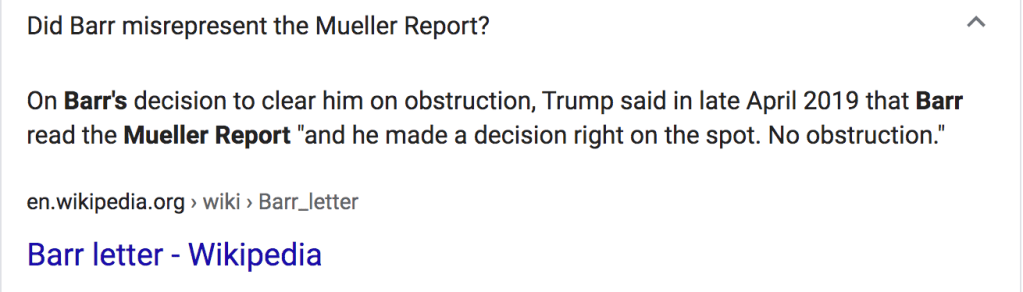
Oh, well, at least we have the internet, that fountain of immediate information:

Barr letter- Wikipedia

Trump keeps pushing Putin talking points as Russia works for Trump 2020

from historian Heather Cox Richardson. last night:

Midday, FBI Director Christopher Wray warned the House Homeland Security Committee that “the intelligence community consensus is that Russia continues to try to influence our elections” by spreading disinformation through social media, online journals, and so on. Russians are “very active” in their attempts to undermine Biden’s campaign. They are trying to “sow divisiveness and discord” and “primarily to denigrate Vice President Biden and what the Russians see as kind of an anti-Russian establishment.”

Russians are spreading the idea that mail-in ballots are insecure, and that Biden is slipping mentally—both stories Trump echoes.

Trump took to Twitter to argue with his FBI director. “But Chris, you don’t see any activity from China, even though it is a FAR greater threat than Russia, Russia, Russia. They will both, plus others, be able to interfere in our 2020 Election with our totally vulnerable Unsolicited (Counterfeit?) Ballot Scam. Check it out!”

The president’s attempt to deflect attention from Russia while putting it on China is more disinformation. Department of Homeland Security whistleblower Brian Murphy last week said that DHS acting Director Chad Wolf told him “to cease providing intelligence assessments on the threat of Russian interference in the United States, and instead start reporting on interference activities by China and Iran. Mr. Wolf stated that these instructions specifically originated from White House National Security Adviser Robert O’Brien.”

source

It bears repeating, frequency of voter-fraud in the USA, using the Heritage Foundation’s data, is less than one in 2,000,000 votes, about 4 hundred-thousandths of 1%. 0.00004%

You’d need an electron microscope to see a fraction of a percentage point so infinitesimal.

In other news:

AG Bill Barr, in a speech the other day, as he continues to “debunk” (and promise to prosecute) the “criminal” origins (oringes) of “Russiagate,” the multiple investigations into documented Russian pro-Trump interference in the 2016 election, made the inflammatory comment that Covid-19 stay-at home orders are “the greatest intrusion on our civil liberties” since slavery.

Enough said about that demented ad lib. Here’s the well-expressed objection to AG Barr as Attorney General:

The concern of Barr’s critics—ourselves included—is that Barr has exercised his undoubted supervisory powers in an improper, even corrupt, fashion, and that he has done so in a sustained effort to undermine the results of Robert Mueller’s investigation. The criticism is that he has exercised those powers to frustrate legitimate investigations and prosecutions. And it is that he has done all of this not because of legitimate concerns about the uniformity of justice or fairness to defendants generally but to protect individuals close to the president who appointed him and to serve Trump’s personal and political interests in attacking investigations of himself.

We aren’t saying Barr is deploying powers he doesn’t have or that it is wrong for attorney generals to have such powers and even to use them; we’re saying he has abused powers he certainly does have and that attorneys general need to have.

source

Of course, as we learned during the president’s impeachment “trial” (witness and evidence-free, like any good American trial should be) Abuse of Power is not a legal reason to remove somebody from office, as long as there is a one vote party-line majority to keep the person there.

Or, as any young Trump supporter, applauding Barr’s latest deranged pronouncements about justice might say “suck it, cuck!”

Why Trump/RNC is spending millions on lawsuits to stop mail-in voting — at a glance

These two graphics give you the picture of why limiting mail-in voting is such an important issue to the RNC. Look at the pictures, no need for a thousand words. Visual word to the wise.

These screenshots are from Fareed Zakaria’s recent piece on a nightmare scenario (he calls it a “deeply worrying” scenario) for November 4, 2020. The first set of numbers is from a CNN poll, the second is from a Democratic data firm called Hawkfish. (Full disclosure: I do not have Tucker Carlson’s numbers on these issues, nor Sean Hannity’s).

The rationale behind all these Republican lawsuits, of course, being the danger of massive Democratic electoral fraud in a rigged election. The RNC is trying to prevent a terrible electoral crime, like those 62 fake votes the Heritage Foundation documented in 2016 (out of 138, 846,571 votes cast.)

Danger: one out of every 2,239,460 votes is cast by a partisan fraudster!

Try saying that with a straight face. If you’re not too busy spreading the word of the well-connected and mysterious oracle Q.