My first question is, obviously, how the hell did she know about our deadly space laser? Is nothing sacred?
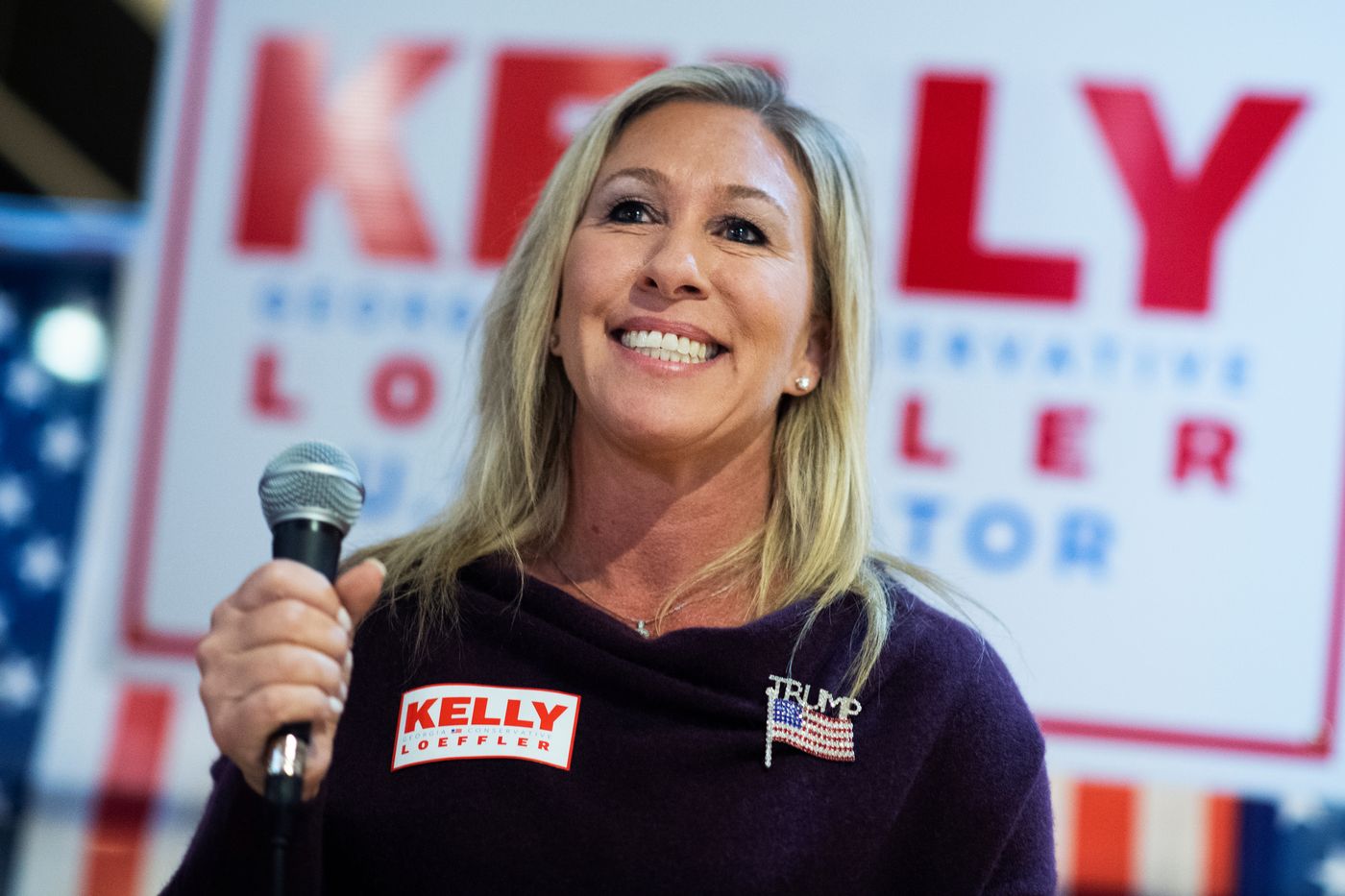
I was curious to find out more about the wide margin of victory Trump’s “future Republican star” enjoyed in becoming a Representative from Georgia’s deep red, eight year-old 14th District. She won in a landslide, it turns out, crushing her opponent by 50 points.
Greene finished in first place in the primary election and faced John Cowan in the runoff election.[21] Greene defeated Cowan to win the nomination on August 11. Greene was considered an overwhelming favorite to win the seat in the general election, as the 14th typically votes heavily Republican.[22] The 14th has a Cook Partisan Voting Index of R+27, making it the 10th most Republican district in the nation and the third most Republican district in the Eastern Time Zone. Among Georgia’s congressional districts, only the neighboring 9th district is more Republican. Since the 14th’s creation in 2012, no Democrat has won more than 30 percent of the vote.[23] Trump carried the 14th with 75 percent of the vote in 2016, his eighth-best performance in the nation.[24] On the day after Greene’s runoff victory, Trump tweeted his support for her, describing Greene as a “future Republican Star” who “is strong on everything and never gives up – a real WINNER!”[25]
Greene was expected to face Democratic IT specialist Kevin Van Ausdal, but he withdrew from the race on September 11, 2020. This left Greene unopposed for the general election, though the district is so heavily Republican that any Democratic challenger would have faced very long odds.[26][27][28]
On September 3, 2020, Greene shared a meme to her Facebook page depicting herself holding an AR-15 style rifle next to a collage of pictures of Democratic representatives Alexandria Ocasio-Cortez, Ilhan Omar and Rashida Tlaib. Greene claimed that it was time for “strong conservative Christians to go on the offense against these socialists who want to rip our country apart”. The caption underneath the images read “Squad‘s worst nightmare.”[29] House Speaker Nancy Pelosi described the meme as a “dangerous threat of violence,” and Omar demanded that the meme be deleted after claiming it had already triggered death threats.[30] In response to questions from Forbes about whether the meme was a threat, a spokesperson for the Greene campaign called the suggestion “paranoid and ridiculous” and a “conspiracy theory”.[31] Facebook deleted the meme the following day for violating its policies on inciting violence, prompting Greene to claim that Democrats were “trying to cancel me out before I’ve even taken the oath of office”.[32]
Kevin Van Ausdal, who withdrew as a candidate on September 11th (out of fear of violent extremists and horror at how ugly the campaign had become), got 25% of the vote two months later, from Georgians who simply wanted to vote against Taylor Greene.
So the future Republican star won by a whopping majority, about as large as Trump’s landslide margin in Georgia’s 14th District back in 2016.
On the other hand, she ran unopposed in a beautifully gerrymandered district that had always voted at least 70% Republican since its creation in 2012. America the beautiful, y’all.
[1]
My apologies for this link, which will probably lead to a paywall at uber-capitalist Jeff Bezos’s Washington Post. It was a fine article, but Jeff, who made $70,000,000,000 so far during the pandemic, does not leave a penny on the table, as he proved again by taking the tips of gig workers (“independent subcontractors”) hired to make deliveries for Amazon in their own vehicles, and using the confiscated tips to pay their “salaries”. Cost him $61,000,000 to settle that case, about a dime to Jeff — (plus, not to worry, not a penny came out of his pocket). Leave me a comment if you’re interested and I’ll send you a copy of the article, cut and pasted, subject to not getting a restraining order from the world’s greediest genius/predator...
Here’s a taste, from the link above:
But they all agreed that ignoring Greene was not an option, so they began drafting the statement and emailing versions to Kevin, who kept suggesting revisions that made it softer, thinking he had made it harsher.
“He needs to be ready,” Vinny told Ruth on one of their daily video calls.
“I don’t know what it’s going to take to get him to use the kind of language we need him to use,” Ruth told Vinny. “It’s a very big shift for him.”
“How’s it going?” she said to Kevin on Day 21 of the campaign, trying to sound upbeat as they began to rehearse the draft statement.
Kevin said he had been trying to stay relaxed. He had a cold.
“Okay, I know you’re not feeling well, but the good news is, sometimes when you need to push through a barrier, the best time to do that is when you’re sick, because your defenses are down,” Ruth said. “We’re not going to take you anywhere horrible.”
“We’re good,” Kevin said.
“Okay, I want you to breathe deeply,” Ruth began. “A lot of your tonality will have to go down. There will be times when you’re speaking about what Marjorie has done and you’ll be angry. You’ll need to be angry.”
More often in his life, Kevin could not afford to be angry. His voice tended to swing up, a tone he found helpful in defusing conflicts in his job at a financial services company, which had enabled his first real stability as an adult. He’d only recently bought the tan split-level where he lived with his wife and 1-year-old daughter. Now it had a “Save the American Dream” sign in the flower bed by the mailbox, one of the stories of his rise into the middle class he’d imagined telling voters about when he first started running.
The idea that it’s necessary to let go of the painful past is very big in the self-help world. “It is never too late to have a happy childhood,” we are told, among other encouragements to let go of the bad things in the past and gratefully embrace the many beautiful things about our present lives. As a general principle, letting go, not constantly reliving the hurts we’ve experienced is healthy, essential to living our best lives and to protecting our loved ones. The devil, as always, is in the details of how we actually do this.
Letting go of hurts of the past is a theme I chew on frequently, having a decent amount in the past to let go of. I feel my daily connection to history, for better or worse, and my personal stories, funny and terrible, which support my view of the world. Seeing the value of these memories, I am reluctant to simply let the past go. I feel like there are lessons in these stories, endlessly repeated; learning we need to extract and digest to move forward. It’s important to view the past in its complexity, considering the terrible things beside the inspiring ones. My once-large family was massacred back in 1943, during dark times in Ukraine and Belarus; pruned down to a very small family that lives and prospers today in the USA and in Israel. Both things are equally true.
I think of this theme of letting the past go in personal terms every time I encounter how hard it has always been for me to accept the the loss of a longtime friend. I understand that certain estrangements are inevitable, and we can see them coming most of the time, but also, a world of associations and shared memories are irretrievably lost each time. Each loss of a longtime friend is a little rehearsal for death.
Although I know the reasons for it, it bothers me each time that I could not find a way to reconcile with a couple of old friends and fond acquaintances in recent years. You could say that our lives are the stories we have lived, have told ourselves are true. People come to different conclusions about what is most important in life. Sadly, sharp differences of opinion (accompanied by drifting apart, taking friendship for granted and fading empathy) can prove insurmountable obstacles to a mutually beneficial relationship.
This leads me to once again consider how personal the political actually is, (political views are based entirely on our personal feelings about the world around us), and how political the personal can be, for the same reason. I hope to work through this “letting go” idea concisely today.
There are at least two ways of letting go of things that hurt us, as true in personal life as in political life. We can forgive and forget, using love to move forward without the need to rehash everything that hurt us in detail. This is a kind of Christian forgiveness, turning the other cheek when we are struck, as Jesus, The Prince of Peace, advised his followers to do [1]. Another way to let things go is to separate ourselves from people who hurt us repeatedly. This second way involves making hard decisions about who is accountable for what and what, realistically, is likely to happen going forward if we simply forgive and forget. Once we have done this, it is easier to let go of that troubled part of the past, though, of course, it is not as simple as that.
The difficulty of letting go of strong feelings is most easily seen in the context of physical violence against us, which is often a criminal matter best dealt with by a court of law. If someone beats us to a pulp and then asks us to please let go of our anger against them for their mistake, are we required by any moral power in the universe to agree to this? In the case of violent physical assault, there is an understandable emotional limit to a human ability to “let go of the past,” no matter how compelling a general case there is to be made for the idea.
The advice to let go of the pain and forgive can preempt the idea that you have a right not to be violently assaulted by someone who then tells you to get over it. There is a process you have to go through, once you are victimized, to first live with your rightful feelings and then separate yourself from that feeling of helplessness in the face of torment.
When a MAGA mob ransacked the Capitol recently chanting “Hang Mike Pence! Hang Mike Pence!!!” elected officials went into hiding from rioters calling for the execution of one of Trump’s most loyal sidekicks for the crime of not overturning an election he was powerless to overturn. There were also calls to shoot Nancy Pelosi in the head. During the several hours of rioting (as federal troops were told to “stand down and stand by” as Mr. Trump watched it unfold on TV) NY Representative Alexandra Ocasio-Cortez wound up taking shelter in Katie Porter’s office where they barricaded furniture in front of the door to keep the lynch mob out. Ocasio-Cortez recently revealed that she had been a victim of sexual assault in the past. Imagine how extra “triggering” a shouting mob kicking at your door might be if you had been violently assaulted in the past.
As a general principle we might all agree that nobody should ever be placed in the situation of having to barricade themselves into a room to try to protect themselves from a violent lynch mob. We might all agree to that, I think (when I say “we”, obviously I’m not talking about members of the lynch mob and those very fine people who support the mob’s right to violent anger.)
Here is a seemingly subtle thing that seems irrefutable to me now, coming back to the personal. If someone in your life is unsympathetic to your situation once in a while you can (and should) indeed let it go, overlook it, be generous, write it off to their being preoccupied with their own problems. We can’t all be empathetic all the time. It is different, and a sign of trouble, if the person is repeatedly unsympathetic and also quickly turns to blaming you for any challenging situation you find yourself in. If this happens with any regularity you will find yourself in a destructive cul du sac of contentiously conflicting perspectives. In my experience this self-perpetuating conflict can often be irreconcilable, since each party is certain that they are being mistreated by the other. If you can make no progress toward getting the other person to see the harmfulness of their stance, it is time to hop out of that deadly dead end.
It matters little what the other person’s argument is against your feelings, particularly if the argument is aggressive, angry and unyielding. Once you see that the other person will never yield, won’t concede anything to your expressed feelings … it’s time to go.Someone who is capable of empathy, and self-reflection, and who really cares about you, will find a way around their need to be right, in the interest of making a lasting peace and ensuring a mutual future.Again, true friends are very rare, especially when times are toughest. You should try not to fight about things, most things are not worth it. Once the fight takes on an abusive feeling — time to go.
As in personal life, so it is in politics. We are being told that Trump’s refusal to accept the will of the voters, his insistence that, in spite of bipartisan agreement about the fair election, and all of his lost voter-suppression and voter-fraud lawsuits, he won in a “landslide”, his raging lies about a “stolen election” that led to a rampage that could have resulted in the deaths of dozens (“only five” died directly, two Capitol Police officers took their own lives shortly after– three more dead than BENGHAZI… hmm…) including the executions of Pence, Pelosi and others, is something to “get over”. In the name of unity and healing, you understand.
As in politics, so it is in personal life. If someone beats you up, then asks forgiveness, then beats you up again, then asks forgiveness — what is the proper response? An understandably human response is to mercilessly kick the shit out of him next time he raises his hand to you, if you have the power to do so. Another, much more practical, response is walking away from the person, not letting them within punching and kicking distance. In either scenario, you accept the hard truth that this person who claims to love you is a violently angry person who can’t help taking it out on you when he feels up against it all. In no case is it a healthy response to simply get over it, until it happens next time.
Countless spouses and mates stay in these kinds of abusive relationships, being profusely apologized to by someone who will, in time, beat the shit out of them again. People stay in these kind of abusive relationships for many reasons, mostly related to fear and a feeling of not really deserving any better from their mate. Every person who stays convinces themselves of the same thing: my mate loves me, it’s just understandable human weakness that leads to the abuse. “I would be a monster not to forgive, look at those tears… ”
We can, and should, healthily let go of many things from the past that trouble us. Awareness of abuse isn’t one of them. The only thing to learn to do about abuse is to recognize it when it arises (it is not always as obvious as a fist to the face) and take steps to get far away from the perpetrator when it persists. Being out of harm’s way is the first necessary step to letting it go. The rest, friends, is much trickier, but we will never get to it while still in the cycle of endlessly replenished anger.
[1]
How often this Christian turning of the other cheek is done in reality, and how effective it may be if one manages to do it, are separate questions. For one thing, responding to mistreatment with love presumes the presence of the Divine in the person who struck your cheek.
In immigration news, a federal appeals court in Washington, D.C., is allowing the government to continue deporting unaccompanied children without a court hearing or asylum interview. The court on Friday overturned a previous ruling that had blocked a Trump-era policy which stripped asylum seekers of due process, citing public health concerns around the pandemic. Some 13,000 unaccompanied children were deported between March and November of 2020 before the practice was halted. All three judges on the court’s panel who reinstated the policy were appointed by Trump.
Hardliners like Lindsey Graham have already threatened to drag the upcoming impeachment out into an endless circus if Trump’s critics are too mean to Lindsey’s guy. He threatened to end all other legislative business while extending the unfair trial by unscrupulous means. A real credit to his race, Lindsey.
Rand Paul, who complained (without basis in fact) that all of Trump’s lawsuits (hundreds, literally) related to alleged massive election fraud were thrown out for procedural reasons, like “lack of standing” and that, therefore the merits of the election fraud cases were never reached. Of course, a few were dismissed for procedural reasons, but the bulk of the hundreds of Trump’s election-related lawsuits were dismissed based on their lack of merit as lawsuits. I loved this Trump appointee’s detailed dissection of one federal case brought by Trump’s army of lawyers.[1]
Now Paul, the well-spoken American Republican/Libertarian/Extremist, is standing by his claim that Trump’s impeachment is barred by a procedural hurdle– his colleague Mitch McConnell did not call the Senate back from its break in time after the House impeached Trump. Therefore, says Paul, the impeachment is unconstitutional. End of story, we don’t reach the merits of what Mr. Trump may or may not have done that might disqualify him from ever again abusing the power of his office to foment an anti-democratic riot, because the constitution forbids it. As James Madison and the other Framers surely intended, if you follow the reasoning, political calculation, whatever you want to call Rand Paul’s legalistic canard.
Former White House Counsel Bob Bauer wrote an excellent op-ed, The Republican Argument Against Impeaching Trump Is Dangerous, that lays out the thinness of this absurd “constitutional” argument against impeachment.Impeachment, Bauer informs us, was first and always concerned with disqualifying corrupt officeholders who perversely abused their power from ever holding power again. At one time impeachment did not include removal from office at all, it was generally used after a malefactor’s term was over to prevent them from attaining elected office again. Beyond the weak “constitutional” claim, signed on to by 45 of 50 GOP senators, signaling their readiness to let Trump slither through this high-sounding run-out-the-clock procedural loophole, Bauer underscores the danger of letting an unprincipled demagogue provoke insurrection during his last days in power and then finding that his being out of office is punishment enough.
Though this may all seem self-evident, Bauer does an excellent job illuminating the matter, and what’s at stake for our experiment in democracy.
[1] From that decision:
(After analyzing standing, which is based, in part, on having suffered, or being about to suffer, a concrete, cognizable legal injury the court has jurisdiction to address)
Second, even if Plaintiffs had standing, their claims fail on the merits.
Plaintiffs essentially ask this Court to second-guess the judgment of the Pennsylvania General Assembly and election officials, who are experts in creating and implementing an election plan. Perhaps Plaintiffs are right that guards should be placed near drop boxes, signature-analysis experts should examine every mail-in ballot, poll watchers should be able to man any poll regardless of location, and other security improvements should be made.
But the job of an unelected federal judge isn’t to suggest election improvements, especially when those improvements contradict the reasoned judgment of democratically elected officials. See Andino v. Middleton,— S. Ct. —, 2020 WL 5887393, at *1 (Oct. 5, 2020) Case 2:20-cv-00966-NR Document 574 Filed 10/10/20 =- (Kavanaugh, J. concurring) (state legislatures should not be subject to “second-guessing by an unelected federal judiciary,” which is “not accountable to the people”) (cleaned up).
Put differently, “[f]ederal judges can have a lot of power—especially when issuing injunctions. And sometimes we may even have a good idea or two. But the Constitution sets out our sphere of decision-making, and that sphere does not extend to second-guessing and interfering with a State’s reasonable, nondiscriminatory election rules.” New Georgia Project v. Raffensperger, — F.3d —, 2020 WL 5877588, at *4 (11th Cir. Oct. 2, 2020).
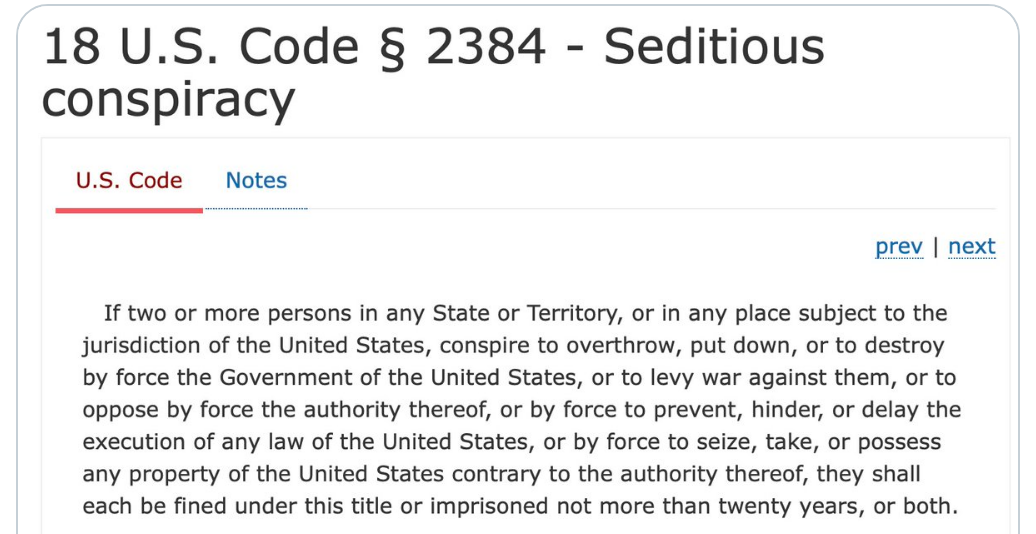
“by force to prevent, hinder or delay the execution of any law of the United States”
Of course, I can hear the crack Trump legal team dismantle this theory of the case against their persecuted client:
“We must read this law in the strict sense of the intent of its framers.This section of the federal criminal code applies to the forcible prevention, hindering or delay of the execution of any LAW. The tallying of the electoral votes is a ministerial duty, not a LAW. Likewise, the so-called peaceful transfer of power is a tradition, a norm, an aspiration, like the self-evident truth that all men are created equal — not a LAW. Where no law has been forcibly prevented, hindered, delayed… Your Honors, why is the bailiff approaching me so menacingly?”
Naturally, rightwing media, foreign and domestic, has been out in front of this story for quite some time. Check out this headline under a Der Sturmer-inspired self-created masthead:
Fake News US Mainstream Media Falls Into “Sedition Conspiracy” Trap Trump Can Now Use To Jail Them
At the site above you can find many wonderful Russian accented articles, so you know they’re true: Pompeo Oversees Capture Of UN Pedo Who Leaked Video Of Hillary Killing Child (April 18, 2018); Declassified JFK Files: Multiple Shooters, FBI Paid Oswald, CIA Makes Fake News, LBJ Was Coup Linchpin and in KKK (October 31, 2017, Happy Halloween, whackos!); Vanity Fair: Hillary threatened to “shoot the panda”, Seth Rich’s Handle was “Panda” (June 3, 2017). And so forth.
Look, there’s a lot of noise, and political barking, screeching, posturing, etc. as our nation dances around the viability of outright American fascism. The facts of the riot at the Capitol on January 6th are pretty clear to anyone who watched the well-funded “Stop the Steal” rally, a promised “wild time” advertised for weeks by the president and climaxed in Trump himself urging patriots to go down to the Capitol to fight like hell and stop the steal. When Trump was done “provoking” them (McConnell) the mob marched down Pennsylvania Avenue to take over the Capitol and disrupt the certification of the election Trump claims was rigged against him.
There is ample footage of the mob violence right after Trump’s rousing remarks about a stolen election, several deaths (including the fatal trampling of a MAGA woman holding a “Don’t Tread On Me” flag) and, oddly only about 14 arrests (less than the amount of wheelchair-bound protesters typically handcuffed during one of their non-forcible disability rights protests in the Capitol…). Trump watched the riot unfold live on TV for HOURS, including the crowd chanting for Mike Pence’s head, before federal authorities gave local authorities permission to deploy National Guard troops. Participants in the riot were allowed to leave the Capitol unmolested (rather than “kettled” and taken into custody en masse as in most far less violent protests) and many of them walked D.C. for hours after the curfew, in the afterglow. The president publicly announced that he loved them (though he privately expressed disappointment at how “low class” they looked).
Trump’s party will do its best to allow their leader to leave the scene of carnage unmolested, his influence, prestige and historical importance intact. They took a procedural vote last week during which 45 of the 50 Republican senators signed on to the controversial idea that the impeachment is “unconstitutional” since the offender is no longer in office as of the date when the “trial” is supposed to begin (never mind when the Article of Impeachment was filed or that McConnell left the Senate on vacation until the “constitutional” time to hear the case “expired”).
This procedural dodge reminds me of what a law professor told our class the first semester of law school: “give me the choice of all the facts and the law in my favor or procedure in my favor, I’ll take procedure every time.”
The crank who brought the vote on this impeachment’s constitutionality to the floor, Rand Paul, complained two days earlier (falsely) that ALL of the Trump election fraud suits were dismissed on technicalities. If this was true (it’s not) it follows that the question of whether Trump actually won the election but was illegally deprived of victory by massive electoral fraud and irregularities was never reached in court, is still an open question. Possible massive (non-white) election fraud is a question Rand Paul will be raising, he promised, all over the country during the next two years. He also complained that the interviewer (George Stephanopolous) was calling him a liar, as the Left always likes to do with all Republicans.
Then, like his kind always does, Rand made a rousing speech on the floor of the Senate and called for a vote to invoke a technicality to make the case against his leader go away.
Of the 45 who symbolically voted to invalidate the impeachment on constitutional grounds, five of these senators were part of the delegation of ten “bipartisan Republicans” that went to Biden, in a spirit of bipartisanship, to argue that the average American doesn’t need a $1,400 check, that the COVID relief bill should be a small fraction of the $1,900,000,000,000 that the Biden administration is proposing. Of course, if Biden doesn’t take their generous offer of a fractional bipartisan bill he is a liar, far from the uniter and president of all Americans he falsely promised he would be.
You see how profitably irrationality sells these days?
newest member of the House Education and Labor Committee
Under the provisions outlined in this “Seditious Conspiracy” law, this report says it’s important to note, the legal definition of the word “conspiracy” mandates it must be an agreement between two or more people to commit an illegal act, along with an intent to achieve the agreement’s goal—and was a legal standard met just hours ago when the Democrat Party shockingly announced it had barred Fox Newsfrom hosting any of its 2020 presidential candidate debates—a vile act President Trump rapidly responded to by Tweeting: “Democrats just blocked @FoxNews from holding a debate. Good, then I think I’ll do the same thing with the Fake News Networks and the Radical Left Democrats in the General Election debates!”.
Historian Heather Cox Richardson has been writing a daily newsletter called Letter from an American, since around the time Trump’s perfect call to get dirt on Biden’s son from Ukrainian president Zelensky became public. I highly recommend you subscribe to her free newsletter (there is a tab at the top of this link). It is a well-curated selection of news developments, snappily well-written and placing ongoing events in historical perspective. It comes into your email inbox, virtually every day, at some point during the wee hours of the early morning and is always worth reading.
Last night’s ended with this great analysis, and killer clinching thought, which follows a description of some of the planning that went into the insurrection at the Capitol, including the meeting, the day before the Capitol Riot, at the Trump hotel in D.C., attended by newly-elected Alabama Senator Tommy Tuberville (who, with Trump’s help, defeated disgraced traitor Jeff Sessions in the primary), Michael Flynn, Corey Lewandowski, members of the Trump family and so on [1]:
Former director of the CIA’s Counterterrorism Center Robert Grenier noted yesterday in the New York Times that the United States is facing a violent insurgency and should apply the lessons we have learned about counterinsurgency to head off political violence. Grenier notes that the nation must insist on criminal justice, tracking and trying those responsible for crimes. We must also return the nation to a fact-based debate about issues.
Crucially, Grenier noted that it is a national security imperative to convict the former president and bar him from future elective office. “I watched as enraged crowds in the streets of Algiers, as in most Arab capitals, melted away when Saddam Hussein was ignominiously defeated in the Persian Gulf war,” Grenier wrote. “Mass demonstrations in Pakistan in support of Osama bin Laden fell into dull quiescence when he was driven into hiding after Sept. 11. To blunt the extremists, Mr. Trump’s veneer of invincibility must similarly be crushed.”
In all my years of studying U.S. politics, seamy side and all, I never expected to see the name of an American president in the New York Times in a list comparing him to Saddam Hussein and Osama bin Laden. But then, I never expected to see an American president urge a mob to storm the U.S. Capitol to overturn an election, either.
News broke yesterday that extremists began planning for an attack on the Capitol in November. The Alabama Political Reporter broke the story on Tuesday that new Senator Tommy Tuberville (R-AL) met on January 5 at the Trump International Hotel in Washington, D.C., with the then-director of the Republican Attorneys General Association, an organization that backed the January 6 rally, and with members of the Trump family and the family’s advisors, including Trump’s former national security adviser Michael Flynn and 2016 campaign manager Corey Lewandowski. One of the attendees wrote on Facebook that he was standing “in the private residence of the President at Trump International with the following patriots who are joining me in a battle for justice and truth.”
Comedian Seth Meyers has emerged during the Trump decade (it seems much longer…) as a witty purveyor of reality-based respite. He employs liberal doses of comedy to serve up his frequent insights against the dark backdrop of brazen, maddening, hate-filled alternative-fact based absurdity that has become the norm for many of our public officials. The choice, when our president insists that Nazis and their victims are all “very fine people” (I just prefer the former), is laughing or raging, and laughing is better — it feels good and reminds us to remain philosophical while we figure out how to organize to make things better. Meyers, a peerless master of snark, always gets a laugh out of me, a marvelous thing during times like these. He is as disgusted as the rest of us to have become our fellow citizen of a shit-hole country and much funnier about it. He takes a closer look at some of the worst of “current events”, sets out the facts, reports them, mocks them, often while providing a serious, sensible comment you don’t hear anywhere else.
Seth’s recent A Closer Look: “Republicans Try to Dismiss Trump’s Second Impeachment Trial” concludes with the smart observation that Republicans, in their focus on maintaining power at any cost, have shown they truly don’t care whether Trump organized and incited a murderous riot against Congress or not. (It’s not like anyone actually strung up Mike Pence… get over it!!! Pelosi is alive too, so shut up!) He points out that the GOP also, by taking the position that Trump, now that his term has expired, may not be constitutionally impeached or otherwise punished for “provoking the riot” (in Mitch “this is unconstitutional” McConnell’s phrase), shows they don’t care if Trump, or anyone else on their side, does the same thing again. There is clearly no problem with planning and inciting an armed insurrection against the government, as long as it is done for their side. Here’s Seth:
The arguments of Trump’s champions in Congress — and their charges of Democrat [sic] “hypocrisy” “double standards” and “breathless hysteria” — are hard to refute — unless you look plainly at the facts of the case.
‘This impeachment is nothing more than a partisan exercise designed to further divide the country. Democrats claim to want to unify the country, but impeaching a former president, a private citizen, is the antithesis of unity.” — Libertarian Rand Paul introducing his vote on the constitutionality of Trumps’ second impeachment.
“They hate Donald J. Trump and they are engaging in an act that I think is petty, I think it is retribution, I think it is vindictive, and I think it’s a waste of time. And so, to coin a phrase, I think it’s time to move on.” — Lyin’ Ted Cruz, dismissing the whole thing as more ugly, left-wing bullshit.
“You’ve got nothing to apologize for!… this is the most unethical sham since I’ve been in politics, and if you really wanted to know the truth, you sure as hell wouldn’t have done what you have done to this guy! Are you a gang rapist? [Kavanaugh: “no”]. I cannot imagine what you and your family have gone through. Boy, y’all want power. God, I hope you never get it! I hope the American people can see through this sham… Dr. Ford is as much a victim as you are…”
Here is the mind-twisting fact about truth — it is versatile, it can be used just as righteously for good or for ill. The truth, plainly stated, will be agreed to by virtually everyone who hears it.
Here’s one: if you let somebody take over your mind and beliefs, they will be able to control you.
There is no question that this is true. The devil is in how this truth is applied to the larger discussion/argument. It depends completely on who the somebody is that is trying to control your beliefs. Are you warning against Charles Koch and his ilk controlling you by controlling the information you get and what you believe or George Soros and his?
I can find no fault with the absolute truth of the following statement by right-wing provocateur/opinion journalist Tucker Carlson, a celebrity newscaster and culture warrior I generally disagree with. In the clip below, Tucker’s statement is followed by opinion journalist Medhi Hasan, putting his finger on the larger problem — the mainstreaming of crazy beliefs across the conservative right. Hasan rightfully identifies that alarming trend as one of the big stories of our time:
Take Tucker’s comment by itself, out of context. It is hard to dispute the truth of it.Tucker is absolutely right, if a dictator takes over your mind, you are his mindless slave.When I read this to Sekhnet (omitting the reference to Q) she guessed Malcolm X had said it. I thought that was a good guess, Malcolm surely made the same point many times. Here’s Tucker:
(The real threat is a forbidden idea, it’s something called Q-Anon.) [1] Your mind belongs to you, it is yours and yours alone. Once politicians attempt to control what you believe, they are no longer politicians, they are by definition dictators, and if they succeed in controlling what you believe, you are no longer a citizen, you are not a free man, you are a slave.
Like so much in life, the entire enchilada is in the framing, the context, how the indisputable statement is used to support the argument it proves. Change just one word here — “forbidden” (the left doesn’t want you to know about this idea) to “dangerous” (if you believe this blood curdling fantasy you will do just about anything to save innocent children from these sick fucks who richly deserve death) and there is no problem at all with what Tucker said. It is 100% true. Add in some kind of indisputable right to act on your belief that you are fighting a powerful cabal of blood drinking child rapists and you have a different proposition.
But therein lies the cleverness of the skilled propagandist. Take a true premise nobody can disagree with — if your leaders control your beliefs you are their slave. Then, since that’s self-evident, and we all value our freedom — well, follow me, it’s a short step to convincing the gullible that whatever they believe, no matter how wildly improbable, no matter how demonstrably false, is their god-given right to believe and that no godless leftwing radical so-called “Truther” has the right to say anything about a fervently held belief of yours. They may not judge you! It is a matter of belief, not intellectual analysis. In many ways, belief is more powerful than mere knowledge.
This relates closely to the true concept that it is impossible to argue with a feeling. A person may be right or wrong to feel the way they do, but the feeling is real, and the feeling colors everything else in the conversation. The reality of the feeling must be dealt with first, before the facts of the cognitive matter at issue can be productively discussed.
At the risk of being tedious with a personal example I’ve offered before, here’s a scenario that illustrates this feeling/fact split to yer proverbial T. Watch how the end of this interaction with a very smart, intellectually capable friend, mirrors what Tucker stressed in that clip — the right to your belief is the thing that matters most. It is worth infinitely more than preserving your dearest lifelong friendship.
After my health insurance was illegally terminated for the first time in 2020 (the second time was during April of the pandemic), an old friend calls me to challenge me about my anger, which he says is disproportionate, out of control and which, my old friend stresses, concerns him greatly, as it’s very unhealthy for me to be so angry. He was angry about an email he got from me. He called my email snide and inaccurate, said it revealed an unfair anger directed at him, which was, in any case, totally misplaced.
After I managed to avoid a violent argument with him, declining his loud challenge to tell him to “go fuck himself” and we talked further, he conceded that my email had not actually been inaccurate, but that it was still somewhat snide, he said, particularly coming from someone who claims to be dedicated to ahimsa, non-harm. I do claim to be, and try to be, mild in my emotional reactions, to the extent I can be. There is a great value to not giving in to anger, whenever you can manage to. There is even value to the exercise when you fail.
Over the next few months we did an increasingly frustrating dance for clarity about whether I had a right to be angry about anything. It ended in him snarling at me and hanging up the phone in frustration at the implacability of my “righteous” anger. At one point he thanked me for my generosity in not blaming the blow up on him. That gratitude was soon outweighed by unbearable grievance.
In the course of our long email attempts to salvage our mortally wounded friendship, I mentioned the concept of Complementary Schismogenesis, which our impasse seemed to vividly illustrate (I know of no better illustration, actually). I wrote:
There is a dynamic called Complementary Schismogenesis — two people in an emotional cul du sac, locked in a conflict both want to solve, each of their best efforts to resolve things making the schism worse. Their conflicting styles and clashing emotional needs exacerbate the problem. One, when upset, needs a period of quiet to think, the other needs more talk, immediately.
A: “I need quiet to think, then we’ll talk” confronts B’s “I need to talk right now, then we can be quiet.” And here we go loop de loo.
Empathy should, ideally, not have to be requested, especially when a friend is up against a concrete circumstance that is both frightening and unfair, is at wits’ end, and cries out for help. A can say: but this IS me being empathetic; B will say: feels like you being defensive.
A hurt feeling does not go away because an intelligent, analytical friend says “you really shouldn’t feel that way, it isn’t healthy, cortisol’s a killer, I don’t understand why you have such a strong feeling about this thing that happened to you, you seem disproportionately angry. To make matters more upsetting, you’re not explaining it very well, I don’t know what you actually expect of me since you’re not being clear and you’re also not letting me get a word in, even as you unfairly accuse me of things I can’t even understand. Can I defend why I feel this way? Do I get a chance to defend myself against your unfair charge that I’m hurting you?”
A feeling may turn out to be unreasonable, and when it’s shown to be, after its intensity has faded a bit, hopefully the misunderstanding is over and a lesson learned — but the time to debate the validity of the feeling is not when the strong feeling is still incomprehensible to the friend who keeps demanding a rational account of why the strong feeling is not unreasonable.
In our case, the more times he told me he had no idea what my issue was and asked me to please explain again, the more pointed my explanations became as I had to tamp down more and more frustration at his inability to understand or empathize — and his repeated refusal/inability to engage with or respond to anything I wrote.
That was probably the single factor that made me more and more pessimistic about saving our long friendship — his silence on any point I raised. Though he repeatedly asked for my thoughts, and further clarification, and I’d expressed several times how hurtful silence is to me by way of response, his only response to anything I raised was silence, and telling me he still didn’t understand why I was so unforgiving. When he eventually told me he was sorry, for whatever he might have done that was hurtful, my position remained that accepting an apology for something you insist you don’t understand the hurtfulness of is a piss-poor sign for the future of a mutual friendship.
Predictably, in hindsight, my analysis fell on deaf ears, in spite of several attempts at simplifying, clarifying. I heard nothing back on any point I raised — including how hurtful I find it not to be responded to — only more genuine confusion about what I was actually talking about, what exactly had hurt me so much in his series of inadvertently hurtful acts. All this as though I do not express myself clearly. He simply would not even allow that I express myself with reasonable clarity.
My friend claimed that although he regarded me as his closest friend, loved me like a brother, he truly had no idea why I’d been upset. He expressed pessimism that anybody could truly understand what is in the heart of another person, even someone he’d been friends with for fifty years. I spent many, many hours writing and refining my replies to him, in hopes of getting through to his analytical mind. We were in the realm of feelings, though. Accordingly, he wrote that in spite of our long conversations and many words by email, I’d never given him any hint as to why I felt it necessary to be so mean to him in the end, after being so mild for many years. The long correspondence, from his point of view, was simply me trying to angrily out-lawyer this longtime successful litigator with lawyerly tactics. That was a battle the experienced litigator was not willing to lose.
In the end, for him, it all came down to me being, as originally charged, irrationally, disproportionately angry, and hurtful, and a supreme hypocrite unforgivingly insisting on the righteousness of my maddeningly superior nonviolent viciousness, directed at my innocent friend who loved me dearly, and unconditionally. He was totally justified in feeling as though I’d simply reamed him for no reason (“reaming” was the metaphor he chose, I never touched the boy, your Honor…). In the end, he wrote, I hadn’t given him a single clue as to the basis for my feelings, or convinced him of anything. He closed his final email by noting that he had searched our many emails in vain for “any clue” of what the hell had made me so insanely hurtful to him.
So, again, you can be as smart as you like and analyze things as clearly as you like. State them simply, boil them down to a point nobody can disagree with — nobody should tolerate being hurt by a thoughtless friend, even one who claims to love you. Then it is only a matter of framing and delivering your irrefutable conclusion, based on an unshakable belief: it is the fucking Jews (people like me, for example) and angry Blacks who are the real tyrants and oppressors!
Beware of people who often express hatred, suddenly bearing indisputable truths. These truths will be put to their usual uses, for better or worse.
[1]
This sentence, by itself, means little: “the real threat is a forbidden idea, it’s something called Q-Anon.” It seems to be a statement — someone, possibly Tucker (?), believes the real threat is this forbidden idea. Why is it a forbidden idea — because it is objectively bad? Because it is so ugly, inflammatory and improbable as to be unthinkable? Because, while there is no proof of any of its claims, it so easily leads to violence against the evil conspiracy set out in the idea, if you believe the forbidden theory? To forbid is to censor, to cancel, to negate someone else’s freedom of inquiry and belief.
The Q-Anon “idea” is simple enough at its root: Q is a highly placed insider of secret identity who states that Donald John Trump is the only person who can defeat an evil conspiracy of very powerful elites [top Democrats, Hollywood celebrities, wealthy liberal donors] who are pedophile sex traffickers who occasionally drink the blood of their innocent young victims. These are extremely dangerous pedophile cannibals of amazing cunning who are also, horrifyingly enough, child-murdering cannibals.
Just an idea, you dig, the details of which are constantly evolving through a kind of online crowd-sourcing. Just like Liberal Cancel Culture, you know, to “forbid it”.
Unconstitutional to impeach a president for “provoking” a riot to overturn an election, so that we can prevent him from ever holding office again? Illegal to use legal means to severely curtail his bullying political influence on the party he dragged to the very edge of open fascism, climaxing in a violent insurrection his followers argue is no big deal? We argue, you decide.
As for the glorious four year plus reign (and counting) of our greatest citizen, MAGA-man, here are some of the highlights from the lying NY Times:





 gratuitousblahg