The Last Song is Always the Same when a Friendship is Dead

One of Charles Bukowski’s swarm of trivialities, the accumulation of which send a man to the madhouse and can kill quicker than cancer, is people who insist they’re your friends.   Friendship (I’m referring to the kind of close, hopefully lifelong, friend we rely on) requires mutuality, above all else, a common desire to treat the other person’s feelings gently.  Sometimes a relationship becomes heavier on one side than on the other and after a time things become insupportable.  If both friends are not trying their best to keep things mutual, in balance, things will eventually go badly.  The end of a friendship tends to be the death of many small cuts.   The music it goes out on as it dies is always hauntingly similar, as I have noticed over the years.

Maybe because I was raised in a house of hissing rivals, the comfort of friendship has always been very important to me.     Friends, they say, are the family we choose.  A parent may be an unhappy, demanding, critical person who reflexively crushes any sign of excitement or spirit in the child, but friends, the kindred souls we find and choose to befriend, hopefully don’t act this way.   A good friend, of course, will never knowingly crush your dream or piss on your enthusiasm, never withhold sympathy when you are in a tight spot.   

When a friend sees you’re hurt, they will be quick to find out why, see what they can do to make you feel better.  Until that sad day arrives when, for reasons that are always complicated and impossible to know for certain, that is no longer the case.   Your friend, for whatever reason, may decide that nothing you say or do can change anything that is bothering you in the relationship.   This unresolvable conflict will inevitably escalate until the friendship is a shambling zombie devoid of the soul that once animated it.  Cue the end music, which is always familiar.

I’ve been through this sad cycle enough times over the years that I’ve come to consider myself something of an expert (I’ll come to that in a moment).   I can recognize the familiar signs now, and know, after a certain point, that my efforts will probably be in vain, though I always try to save a moribund friendship, apparently I can’t help myself.  Call me sentimental, I’ve tried, try still, to hold on to even very frayed friendships — a thing not always possible or desirable.  The death of good will is something I have a very hard time grasping, it seems.  It’s a sad thing to resign yourself to not being able to work things out with someone you once shared a great relationship with.  But it is far sadder to remain in a relationship that is no longer mutual, has become intolerably troubling.

I used to condemn my father for the way he cast his closest friends over the side, to the sharks.  If they hurt him, they were dead.   As a kid this struck me as typically immature behavior on my father’s part — people we loved and laughed with many times were suddenly as absent as the dead.   When I’d ask the old man about the latest casualty, he’d snarlingly describe how they’d shit on him.    He was an insecure and hard man, quick to condemn and unable to forgive, and it always struck me as just part of his weakness to cast dear friends out of his life that way.   I’ve come to realize that sometimes ending a friendship that has become toxic is the most merciful thing you can do for yourself.

The song at the end of every long, intimate relationship remains uncannily the same, the hints of the refrain in the lead up and its final statement as the last music you will hear from that particular person.   At the end of most of my long friendships that eventually had to be put out of their misery: an indignant protestation of love.   That’s the common theme in virtually every friendship I’ve watched die, in spite of my efforts to keep it alive.  The friend swears they love me, but that I am a vicious, unloving fuck.   I think about this problematic statement of love each time I pick up the hammer to solemnly drive the stake through a heart and move out of the moldy graveyard.   

“You complain that I have mistreated you,”  says your aggrieved old friend “and you go into this long description of something that, frankly, I can’t even begin to understand, let alone take responsibility for — and I also dispute it — but you can’t end our friendship, pal, because I LOVE YOU.”    This desperate trump card comes out when all else fails, and it is a tell.    “You can’t be hurt by me, as you irrationally claim you are, BECAUSE I LOVE YOU, man!”

The first of these several sad standoffs came about twenty years after high school.   A close high school friend named Tom, a young man damaged beyond repair, apparently, by his father, an uneducated man who nonetheless had no respect for his son’s educational achievements or his professional career, somehow placed me in the position of being the approving father he never had.   

We do this sometimes, place new, more sympathetic people in the roles of problematic family members who did us wrong.   There is nothing inherently unhealthy about this desire to make a painful past thing right by reenacting it in more sympathetic circumstances, except that much of the time it doesn’t work out the way we might have unconsciously planned.  

I had no idea, until very late in the game, that Tom was expecting the validation from me that he never got from his affable but ignorant, crushingly opinionated father.   I had no hint that this could remotely be the case, until it was way too late, when he revealed this was why he was so furious at me.  Tom began a series of escalating passive aggressive moves, until I could finally not miss how enraged he was.   I then learned how I had failed him.   Never ONCE did I validate him for his educational or professional achievements!  Not one fucking time!   Then, too late, I made the connection, and only after the mad idea had been stated out loud.   

When I realized the friendship was over, I told Tom the reasons why.  I immediately got a letter from Tom (this was decades ago, when we still wrote words on paper), telling me that nothing I could do could end our friendship.    He understood that I was trying to pretend we were no longer friends but that, no matter what I did, we would always be friends.  I used a photocopying machine to enlarge and print out his memorable line, decorated it with a nice, floral frame, and hung it on the wall in my kitchen:  “sorry, pal, but it’s not in your power.”

How right he was.  

Last fall I spread the ashes of the most unhappy, demanding, manipulative person I have ever known.   We’d been friends for years, close friends.  Over those years I saw Mark make and lose countless friends.   His most compatible girlfriend (the only one I knew who was funny, likable and fairly sane) was not good enough for him — something about the unworthiness of a club that would have somebody like him as a member.    When he changed his mind, years after dumping her, she considered carefully and then declined his offer of eternal love.   Another great betrayal in his life, a betrayal I played a supporting role in.   

Everyone Mark ever knew ultimately betrayed him.  I finally wrote him off years ago, after a long, doomed struggle to fix things.   One day his brother, Gary, got a call from the medical examiner, they’d found his little brother’s corpse, in a chair in his house.  Gary flew down to supervise the cremation and tie up the dead man’s business affairs.   He felt terribly guilty, having not spoken to his estranged brother in three years.   I hadn’t spoken to Mark in maybe 15 years.   Gary acknowledged that Mark had had no other friends, and that if I was willing, he’d appreciate the company as he went to spread the ashes (he also needed a guide to show him where the lake was).   He and I trudged to the guy’s favorite lake, on a gorgeous day, and spread the poor fuck’s ashes in that sparkling, clear water.  Then we had a nice lunch on the lake, exchanging illuminating stories about the unhappy departed as we ate our sandwiches.

We humans all carry pain, and anger, and grief, and other things that are hard to bear alone, like loneliness.    Many of us did not have the nurturing childhood we would wish for people we care about.   We can sometimes come to understand the limitations of our parents, the great difficulty of becoming your own nurturing parent, the necessity to move past anger about things we did not receive when we needed them as vulnerable children.  Things, by the way, that sadly our parents were incapable of doing for us any better than they did.   

Coming to grips with these painful things is very difficult.   I understand that not everybody is cut out for this kind of work.   Forgiving the unforgivable seems like an impossible task, to those who despair of the effort.   No matter how much progress you may think you’ve made, or may have actually made, there will always be pain there, and the chance that strong emotions will flare up, however profound the understandings you may have reached.   This is our fate as sentient beings.

Here’s a common mechanism I’ve seen a few times, for how the combustion of a friendship can come about, and it usually seems to be, at least in my life, centered around who has the right to be angry or hurt.  Express anger or hurt, about anything, to somebody who has learned only to swallow and repress anger, deny hurt, and you will often provoke anger in return.  This anger tends to be wild and rage out of control, since it is so threatening to the person that they spend their whole life choking it down.  The rage of somebody who almost never expresses anger is truly terrible to behold.   

The way this cycle of anger works is not hard to understand, in hindsight.  They have plenty to be angry about, much more than you do, actually, and you don’t hear them whining about it.  Yet you go on and on, self-righteously ranting about an intolerable injustice you have suffered, casting about for a remedy that doesn’t even exist, outside of the realm of creative imagination.   Even if it is a clear injustice you’ve suffered, even if you have a right to be angry about it– you have no right to tell them why you’re so angry, even if they ask.   They don’t get to tell anyone about their anger or their pain.  Never.   

So they will question whether what you’re angry about is really that bad.  They may point out that Job, in the Bible, suffered far worse than what you claim to be going through.   They will suggest that not everyone would be so mad, just because they were arguably the victim of something that could make a person angry.   Just because something happened that made you angry, that might make someone else, even most people, reasonably angry, does not give you the right to be this angry.   And just because I impatiently question your right to be angry doesn’t give you the right to be angry at me for reasonably questioning your unreasonable right to be mad!

You could see this as neglecting the first law of friendship when you see a friend upset — listen to her, hear her out,  sit with her until she’s calmer.  Friendship 101:  first do no harm. 

Recently my oldest friend, who I’ve known since Junior High School,  called to challenge me about an email I wrote him that he’d found uncharacteristically snide, and inaccurate.    What right did I have to write him a snide, inaccurate email, he wanted to know.   We argued about the extent of the snideness of my email, which he eventually conceded had been small — and the email had turned out not to be snide and inaccurate, but merely snide–  but still strikingly snide, coming from me, a person who generally refrains from snideness, at least as directed toward him. 

He told me he’d called because he was worried about how disproportionately angry I seemed to be, simply because I’d had my health insurance suddenly terminated without notice.  He argued that I was excessively, unhealthily, irrationally angry.  After an hour trying to convince me of this, and growing frustrated, I imagine at the irrational persistence of my anger, he screamed at me, challenged me to tell him he was an asshole and to go fuck himself.   I took a gentler tack and by the end of the long call we had worked things out.  He told me he loved me, apologized for making me angry.    We seemed to be on the right path.  But, of course, if I’d paid attention to the background music, I’d have known this reconciliation would turn out to be an fond illusion. 

Then his next offer to help came, in any way I specifically requested, in figuring out how to right this injustice I complained of.   Of course, if I was not 100% specific in my request for help, he kept pointing out, he couldn’t really specifically help me.  Our emails went back and forth in this way, two lawyers making distinctions, splitting hairs, seeking clarification, reframing what we were actually really discussing, and so forth.  He constantly restated his desire to help in any way he could.   

When I told him, after many annoying questions, that the greatest help I needed was not being forced to debate every point of how he could help and how he couldn’t,  He said I was being unreasonable.   When I pointed out that professions of incomprehension of my anger and his endless, cool, clarifying devil’s advocate questions had inadvertently hurt me, he said that because the harm he’d inflicted had been inadvertent, as I myself had conceded, it was wrong of me to hold him responsible, or even point it out to him.   And so forth.

Things escalated, as they do in these sorts of impasses.   He apologized in an email for accidentally hurting me and then proposed we talk on the phone again.  I called.  Within fifteen minutes he was so enraged he cut me off to yell “you think I’m an idiot, I’m a fucking moron!  I’m an asshole!”    Then, as if resting his case, he hung up on me.   He clarified by sending me a text informing me that he no would no longer tolerate being “reamed” by me. 

So be it, all clear enough now.   A few days of writing and thinking it through, I pretty much understood what had happened, that there was nothing further I could say or do to fix this broken thing.  The matter of our friendship was out of my hands.

Then, as often seems to be the case in a long friendship in this digital era, a long email.  Not mentioning his angry childishness, but defending himself a bit, telling me how important my friendship is to him, and asking me to consider this decades-long friendship and asking me to get back to him when I felt able to. 

He also pointed out, I’m not sure why, that his apology in that long, angry phone call about my snideness, had been a desperate attempt to calm me, since I was so out of control, and that he’d “abjectly capitulated” not because I’d made a strong case for why he should, but merely because I’d been so upset and he saw no other way to continue the conversation.   He’d greatly appreciate my reply he wrote, as he considered me his closest friend, and would continue to hold me in that high esteem until after he heard from me that I wasn’t his friend.

I thought of my buddy Tom. 

I waited a couple of weeks, and, goddamn my better nature, wrote him the most thoughtful analysis of our impasse I was capable of.   I spent a few days carefully combing out any formulation I thought might offend him.  In the end I was fairly proud of the piece, one of the best things I’ve ever written, I think.   

It described Complementay Schismogenesis, a dynamic that our impasse was a vivid illustration of.   Two very different types locked in a conflict, the respective efforts of each of them to resolve the conflict makes the schism deeper and wider.   It went into the infernal lawyerly habit of reframing: taking the discussion in a completely different direction so as to change the subject away from the issue at hand.   It talked about the first requirement of friendship: to listen and try to understand before responding.   I reminded him of my particular vulnerability: the hurtfulness of getting silence as response to my question or concern.   It was as deep a discussion of our particular friendship as I could have written. 

I urged him to take his time considering everything I’d written, that there was a lot to think about, a lot to consider, that our friendship was clinging to life at this point.   I reminded him that there was no need for a quick reply, that a rushed or emotional reply would not be helpful, with our badly damaged friendship on the line, as it clearly was.

Naturally, two days later, I got his thoughtful, unfailingly high-minded email.  A friend gratefully replying to his oldest friend’s attempt to get their friendship back on solid ground.    He thanked me for my thoughtful reply and the clear effort I’d made not to hurt his feelings.  He told me he appreciated how I tried to express my feelings.   I couldn’t help noting, as I read, that he’d not responded to a single point I’d raised, or even mentioned one, beyond what is embedded these two perfectly reasonable, well-written paragraphs (note the reframing, by the way):

I know you’ve tried earnestly to educate me as to the nature of the various flaws you perceive in me, and I appreciate that. I know you’re trying to help me be a better person as well as a better friend. I’d like to be able to tell you that, thanks to you giving me a good shaking, I now see the light, and painful though personal growth may be, I see the situation and see myself as you  do.  I’d like ti telk (sic) you I’m confident that I’m on my way to being the better person and friend you’d like me to be. I’d like to be able to say that I can therefore offer you assurance that you need not be concerned that I will again act in a manner that hurts your feelings in a similar way. This would indeed be a happy outcome to all of this. I value our friendship, and know that neither of us is pleased with the prospect of such a long and rich friendship coming to an end. 

At the same time, I have too much respect for you, and too little ability to knowingly try to con a friend, to feed you a line just to smooth over a rough patch. I can certainly assure you that you’ve given me much valuable food for thought, and that I take very seriously everything you’ve said to me. I can assure you that in whatever interactions we might have in the future, I will strive be more aware of how my actions might affect you, and strive to avoid causing you pain. Yet, I understand that we all will determine for ourselves the sorts of behaviors we will tolerate, and the sorts of people we want as friends. So if the person I am at this point in my life isn’t someone you feel you can trust, or my various assets and liabilities just don’t add up to someone you want as a friend, it will sadden me greatly but I’ll understand. You deserve to surround yourself with people who make you feel good. If you conclude that doesn’t include me, my best to you, and thanks for everything–is (sic) been a great ride in countless ways. I’ll hope that at some point you change your mind, and I’ll be here if you do. 

This time there was no need for further delay, my last words on this great ride of our long friendship went back to him at once:   

I understand that this patronizing gloss of a response allows you to believe you’ve acquitted yourself with fairness and integrity, subject to whatever admitted emotional/moral limitations may be in play.   I have too much respect for you to pretend otherwise.  From my point of view, silence would have been infinitely preferable to this last gust of your familiar, unerringly rational superiority, so impeccably polite and correct you can hardly smell the seething, or the fear.

Style tip: the undeniable pathos of it aside, the tell-tale, suck-my-ass bitchiness of lines like these kind of gives the emotional game away:

And, I’m aware that this pain is on top of a lot of other stresses with which you’ve had to contend over the past months–health issues, sudden loss–twice–of health insurance, the pandemic, dismay over the sorry state of our government and our predatory economic system, conflicts in other personal relationships, and so on. I can only imagine how difficult it has been for you.   

I suggest next time you feel called upon to respond to a detailed, vulnerable, emotionally nuanced attempt to save a valued friendship you have already evacuated on, from an old friend you claim to love (and who refrained from lambasting you for acting in the childishly dickish way you unapologetically did the last time we spoke) you follow this template, which works exactly as well as what you’ve written and has the advantage of brevity:     

 
Eliot,
I did appreciate what you wrote last year. I apologize for not writing sooner. I do not however wish to continue dialogue or be in a relationship with you at this time.
Please respect my feelings and refrain form further contact. I honestly wish you well. 
Noam

You have my sympathy, I suppose, for the indigestible lack of nurturing in your early life that left you this rigidly implacable.  You win — your indomitable, bullying father did a more thorough job on your psyche than poor old Irv ever could on mine.    Please tell R_____ I wish her the best of luck, and my best to your sons.   

We’ll have to allow those last words you said to me, before hanging up in rage back in April, to be the final zero-sum words on this matter — true and complete they turn out to have been.   

Then, the stake driven, I put down the hammer and noticed, to my relief, the silence, that fucking music had stopped.   Now all that was left was to digest how my accursed better nature had once again allowed me to believe it was in my power. taking somebody at his word, to carefully think things through, state them as clearly as I am able and have a positive effect on an unresolvable impasse.
The Opposite of Love

The opposite of love, it is said, is not hate — it’s indifference.   I think this states a profound reality– it is a very cruel fate to experience utter indifference to your suffering.    There is little difference, to the person suffering, between deliberately inflicted cruelty and that inflicted by nonchalant indifference to your suffering.   

Love and hate are related by a strong feeling towards another — indifference is the absence of any human connection whatsoever.  Indifference utterly erases the humanity of the subject of its neglect in a way that even hatred does not do.  Not to defend hatred, of course, but I’m trying to make this distinction between love and indifference as clear as possible.

It can be illustrated by a famous historical example.   The debate took place between former prisoners of the Nazis and former prisoners of the Soviets about which form of cruelty was worse.   The Nazis were known for expressing hatred and contempt for their captives, deliberately humiliating prisoners, subjecting them to sadistic treatment.    The Soviets were known for their utter indifference — to prisoners freezing in extreme cold, losing digits and limbs to frost bite or gangrene, to prisoners dying of disease or starvation.   The Nazi jailers made their hatred known, the Soviets made their indifference plain.   The verdict: pick your poison, both will kill you just as dead.

In comparing an administration that singles out a despised class of people for harsh treatment, as in babies ripped from their mothers’ arms at the border and sent to cages far away, with one that actually murders those babies in front of their mothers — well, obviously, the one that actually kills the children in front of the parents is worse.   

Though, of course, that’s not a thought that offers much consolation to the mother of the infant who is snatched and sent far away, never to be seen again.

Personality Conflict

If you are raised by a relentless bully there is a challenging process you must go through not to become a relentless bully yourself when you grow up.   Granted, it is not a process for everyone.

Under stress, we sometimes revert to type, in spite of what we may have learned to do better, through great effort.   Human.

I don’t want to argue with people all the time.  I try my best to avoid it, I really do. You want to argue me out of my desire not to argue, since it is a waste of a good skill set, to your way of seeing it.  I understand you can’t help the constant demand that I justify everything I say and do, but I don’t like it, can’t make you understand how much I don’t like it.

“You have an emotional blind spot,” I say, when subjected to this again, when I can see no other way out, no way to make you see my point of view.  

“I don’t see it,” you say, reflexively asserting your human right to see things as you do.  

Later, blood pressure rising as the futility becomes more and more impossible not to feel, I will make an ill-advised reference to tone-deafness that will send you into a rage, cause you to scream and slam down the phone.  

“I am neither tone-deaf nor do I have an emotional blind spot, I, in fact, love you more than just about anyone in the world,” you will write in a long, reasonable email a few days later.   “As for your ‘kryptonite’ — silence by way of response — I don’t get why your right to a response supersedes my right not to have my innocent silence misconstrued.   Further, my recent apology, which I found it unfair and unreasonable of you to demand,  was only given because you were so irrationally enraged…”

At which point my desire to continue reading fades, the stomach acid returns to my stomach and I reach for my guitar.  I play “That’s Amore”– now in the key of D, a much better key for a solo guitar version of this snappy tune, which I can’t seem to get out of my head.   Play it in D, you will like it very much.   

I later rescue from undeserved obscurity two paragraphs I wrote in closing a post I later deleted for fear of offending an old friend, my last words on the subject:

Silence, ideally, is the best remedy for unwanted silence, to demonstrate exactly how it eats at a heart that has posed an unanswered question.  To know how it actually feels, a thing difficult to explain in words.

Though here, in the odd event that my old friend who could be affected by this ever reads these words, I’d have to sacrifice the cold satisfaction of that beautifully symmetrical working of easy, elemental justice in the name of further digesting this true, hard stone — that professed love is worth little without a reflex to unconditionally empathize when your friend is in pain.  


It’s Essential to Have Words to Describe Tricky Things

Without the language to describe something, it’s hard to even conceptualize the thing we may want to talk about.   We see this everywhere.   In the absence of a good frame in language, you basically have to invent a way to talk about things that are hard to make clear.  When you have the phrase — voila! — it’s instantly much easier to have a meaningful discussion.

When I heard our scarcity-based economic system called “extractive” and the sustainable alternative called “regenerative” a light bulb went on — it’s a very clear, concise way to describe an energy policy based on burning up resources that can’t be renewed, a regime that has taken us a long way toward destroying the planet we all live on– and a saner alternative.   A fossil fuel run economy is “extractive” by it’s nature.

Yesterday I heard a great phrase that explains the forces that ensured the rise, and unchecked power, of the Mitch McConnells and the Donald Trumps — “Plutocratic Populism” — unpopular policies that benefit only the super-wealthy that are ushered in by mass popular rallies of galvanized angry have-nots funded by the plutocrats, who ride these tractable hoards, booted and spurred, as their kind was born to do, in their quest for ever more well-protected privilege.    

Same with racism.   One response to centuries of deep institutional racism in our great land, an organized movement to protest regular police shootings of unarmed minority citizens– “Black Lives Matter”– has been seized on by very fine people on both sides — an overdue demand for justice;  another example of unprovoked rage by dangerous, very angry people [1].  

I am thankful to a friend who, several years back, clipped out a little definition of an odd, ingeniously descriptive term for a tricky, but widespread, problem and called my attention to it.  The concept is called Complementary Schismogenesis, and it explained a lot about a certain kind of irreconcilable difference that only gets worse the more energetically both sides try, blindly, to resolve it.  

My every attempt to calm you down only makes you more upset, and vice versa. Seeing the other incomprehensibly more upset, instead of less, we redouble our vain efforts, to similar effect, our now mutually impatient, morally obtuse-seeming responses increasing the frustration between us.   Let me see if I can find the clipping, which was sent to me in digital form.

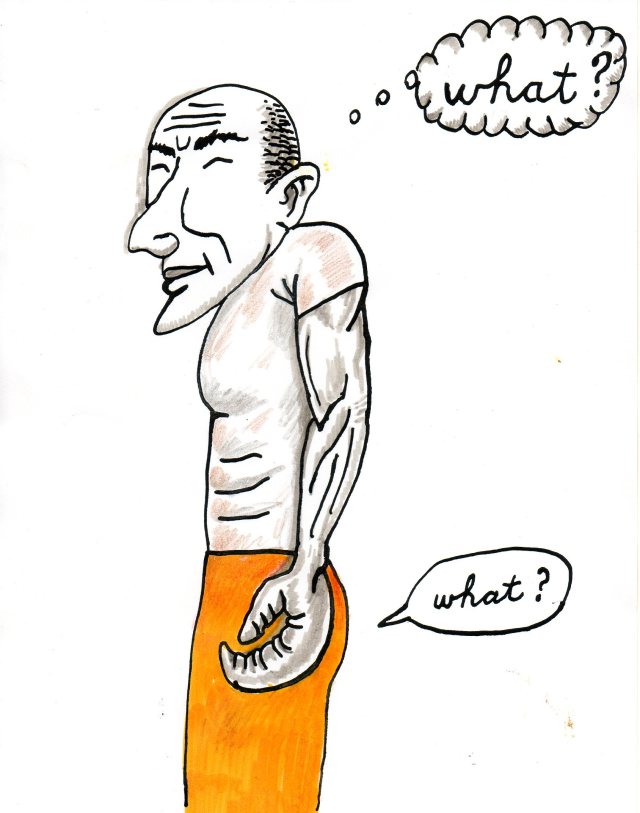
I can’t find it.  I did find this 2012 drawing, though:

what  2-19-11003


Turns out I’d written out my take on Complementary Schismogenesis pretty clearly four years ago:   

Complimentary Schismogenesis, I am told, is when two opposites are locked in some kind of conflict, neither getting what they need out of the arrangement, the attempts of each to resolve it, coming from opposite orientations, only make the problem more intractable, tighten the knot.   The schism continues to deepen as the two struggle cluelessly in opposite directions to heal the underlying fissure.

If we assume everyone is somewhat fucked up, damaged by life, laboring under certain sometimes vexing disabilities, friends are those whose asshole side we are able to overlook.  The friend has other lovable qualities we value that counterbalance the bad tendencies we all have.  We extend the benefit of the doubt to friends, a benefit we do not readily confer on random people we encounter.  

I told a friend recently that whatever other problems we may have had with each other over the years, we both are confident that neither of us would, seeing the other strapped in the electric chair, throw the switch before insisting that every single witness had a chance to speak.  He agreed.


Only one thing has changed since then, the guy who agreed that if I was strapped to the electric chair he’d let every witness for me speak before throwing the switch, may have revised that generous offer, the witness list might no longer be very extensive.  

The precipitating reason for this recent falling out — my attempt not to get angry when hurt wound up infuriating my friend who honestly had no way of knowing how upset I was since I didn’t even fucking scream at him like a normal person who claims to be so goddamned upset!   Plus, I was an aggressively self-righteous cunt about my “right” not to be “hurt,” even thoughtlessly, innocently.

My attempt to remain mild made him wild.  

If the glove don’t fit, don’t have a snit.

The Difficult to See Slow-Killing Murder of (attempted) Love (Part 2)

Love is what we all seek in life, what every living creature needs to flourish, even to survive, and I don’t mean to shit on anyone’s interpretation of love.   We all know what love feels like when we are loved, virtually every one of us has been blessed to feel this and remembers it gratefully.   I’m going to try to analyze how thwarted, frustrated or imperfect love can lead to anger, violence, lifelong hatreds and other terrible things.   Not thwarted in the sense of a hope for love that is rebuffed, most of us know how bad that kind of romantic strike-out feels, but love that is not given in a way the loved one can derive real support from.

I have to be fair.  Not everyone is always good at expressing their deep feelings for others.  I’m not.   We are all creatures of our upbringing, our genetic predispositions, society’s often unrealistic and harmful myths [1].    I’ve only recently made a habit of returning Sekhnet’s regular “I love you” greetings, and I’m glad I have, but it was something I had to learn.   My father, as he was dying, lamented that he had had no idea how to express love, never having seen it done in the miserable home he grew up in.   Made me feel great tenderness for the poor devil and even sadder about his last-hours’ struggle to make peace with a representative of the people he’d hurt by his disabilities.    It really was not his fault, in a certain very real way, as I finally came to see.

I woke up today an hour or two before I was done sleeping and couldn’t get back to sleep.  I woke up thinking about fairness, what it feels like to be the victim of unfairness.  A regular theme, of course, but as I was recently shrieked at by an outraged old friend who keeps a close watch on his emotions, I woke up wondering if I’d been unfair.   Was it really fair of me to ask for things this old friend was clearly incapable of giving?   Clearly he didn’t think so, nor would he admit he is incapable of anything– he’d always given me his best version of philia and agape (two crucial kinds of love that don’t involve romance) and I’d ungratefully, maliciously taken a greasy, prissy dump on it.   Incoherently demanding yet more of him, after all he’s struggled to give, over more than half a century, an intolerable demand that was irrational and fundamentally unfair.

I thought of a phone call I had a year or two ago.  The wife of another childhood friend I could finally not continue to negotiate the terms of a frayed adult friendship with.   She informed me that I had to remain friends with him, and her, and their two sons, because they loved me.   “We love you!” she told me, and I know she was telling me the truth, the deepest truth she knew, an undeniable truth.    I knew it myself, they clearly did love me.  Then she gave me the ultimatum:  forgive him immediately, I’m giving you this one chance, out of love, but if you don’t — you’re dead.  I told her what had become unbearably clear to me:  “forgiving” a person who can’t see he’s constantly hurting you, no matter how many times you try to make it clear, is kind of impossible.   We came to a kind of understanding, out of mutual love  — I am a dead man writing today.  

I don’t think I need to give the details of that situation beyond this restatement of what I was being asked to accept:  love is what we feel toward you, not how we may sometimes act toward you.   My husband and I, now long-since estranged and living apart, practiced our best version of love for years, fighting, making up, storing grievances, yelling at each other, hating each other, making up, storing grievances, etc.   We loved you the same way.   It was the best we could fucking do, and we fought with you MUCH LESS than we fought with each other, you judgmental fucking asshole!

I am not trying to sound morally superior to anyone (he said, unconvincingly).   It’s pointless to judge people on the basis of what they’re unable to do, just as it’s important to get away from them if it has a bad effect on you.   I guess I draw the line where someone demands the right, out of love,  to treat me in a way I can’t tolerate.   It’s a bottom line for everyone, I suppose, not accepting being treated badly, unfairly by people who claim to love you.   It may take a long time to get to that bottom line, but in the end, somebody you feel is treating you unkindly will not be able to convince you that they are treating you well.  Or that the treatment  is the best you deserve.  

Again, not to knock anyone’s life choices, many people come to accept that what they get from those closest to them is the best they deserve.   More power to them if they are comfortable in that belief.    My parents had a lot of personal demons, both of them had been ruthlessly subjugated by very angry mothers from the time they could sit up and look at the world.   In the end, I felt loved by both of my parents, nonetheless.   We fought constantly and at times I felt I hated them, but I know I was loved.   Funny how those things can all be true.   One thing I emerged from childhood convinced of:  I did not want to replicate the unhappy lives of either of my parents.

There is a subjective element of love, for sure.  When we are full of love for somebody we truly want only the best for them.   It is not always possible for us to give it, but we always intend to give it and we hope our intention outweighs our mistakes or failures.   We all have our limitations and our needs.   We have design flaws.  We can’t help being angry when someone we try to always show love and patience to is ungrateful for our best efforts.    None of this is hard to understand.

The hard part, it would appear, is not letting our disappointment show in a way that infuriates somebody who loves us, no matter how imperfect that love might feel to us.   A secret to avoiding their fury, I would guess, is never to expect more than the person who loves us is able to give.  


[1] One example: you must always forgive every hurtful thing that is ever done to you, it is primarily for yourself that you must forgive, to free yourself from the pain of what was done to you.   This sensible sounding idea is repeated in many forms, by many of our subcultures.  To forgive is divine, even if the ability to easily hurt is human.   Jeanne Safer brilliantly lays out the destructive fallacy of this A Good Person Always Forgives dictum in her book Forgiving & Not Forgiving: A New Approach to Resolving Intimate Betrayal.  

Look, it should be clear enough: you have no moral obligation to forgive the unrepentant serial rapist uncle who has only fond memories of raping you and keeps insisting you just have an irresistible ass, LOL!  Is it necessary to resolve things within yourself to close off the pain the evildoer caused, absolutely, but to forgive?   That’s some pretty divine ability to forgive right there.   Fuck that puto. Forgive him right after you forgive Hitler, or whoever else might have murdered your family in the name of bettering the world…

The Difficult to See Murder of Slow-killing Love (part one)

A few days after an unfortunate event at my sister’s wedding decades ago, my parents and I met in their living room for a violent confrontation.  There was snarling, bad language exchanged, overheated comments made on both sides, and once things became too much for me, physical violence — a single finger passed inexcusably across my father’s nose — to illustrate to him the real difference between physical violence and the emotional violence that was his specialty.

I have to back up for a moment, as I’ve tried to condense too much there.   The argument between my parents and me was over whether I had a right to be upset after an attempted beating, by the caterer of my sister’s wedding, who, by the end, had the assistance of three or four fellow off-duty cops who held me by my arms. True, he’d only thrown a dozen punches, or so, and I’d managed not to be hurt, though it was an undeniable ordeal, deserved or not, particularly while wearing a rented tuxedo I later got some of my blood on.  

My parents position was that, since I had clearly provoked the confrontation with this polite, smiling stranger, no matter how I might try to spin it to justify myself, I had only gotten what I deserved.  I found that position unfair, particularly coming from my parents, who I’d hoped would be at least partially sympathetic listening to my side of things.   Their unified, hardline attitude made it impossible for me to restrain myself from expressing my opinion at length, and with increasing conviction.

And so, because these two irreconcilable emotional positions could not be peacefully resolved, things quickly came to an ugly stalemate there in my parent’s comfortable living room.   After the illustrative pass of a single finger across my father’s nose, all hell broke loose.  It was like throwing a lit match onto a lake of gasoline.   The explosion of ugliness was not without an instant of timely, dark wit from me, but this story is not about any of that.

After enough screaming was done, I gave my parents the finger one last time as I left their home, a home I’d been told I was no longer welcome in, and rode off on my bicycle, through the rain, toward the subway for the long ride back to my apartment.   Passing the nearby home of an artist friend, a woman my parent’s age, I stopped by and rang the bell.   Florence and her husband listened to my story, troubled and sympathetic, and told me gently that time would heal this too, that these kind of mad family things have a way of blowing over and that I should not be too hard on myself.   All good to hear.  I hugged them and went on my way through the cold, dark, rainy night.

The point of this story:  the next morning I woke up to sunshine, birds singing, feeling unexpectedly light as a feather.   It was as though an immense anvil had been lifted off my chest, a tremendous weight I’d carried always, without realizing it, was suddenly gone.  I felt like leaping through the air, the relief was exhilarating. I remember the surge of energy I felt to be free of the kind of love that sadly concludes that if somebody wanted to punch you in the face over and over, they probably had a damned good reason for it.  [1]

Understand, I’m not trying to present myself as an innocent victim.   As you can probably conclude just from reading these words today, the words of a man who’d whip his own father across the nose with an outstretched finger, I am not a person who shrinks from a fight, nor any kind of angel.  When I was younger, if somebody told me I couldn’t talk to them like that I’d smile and tell them to go fuck themselves.  Cost me more than a few jobs in my day.   I have tried to learn to do better.  I’m pretty sure I do better, certainly in terms of not always giving vent to my anger, but that is not the point of this story either.  

People who insist they love you sometimes don’t really grasp what love is, and, in fairness to them, they may have come to their understanding of love honestly, never having experienced it.  The first requirement of love, it seems to me, is wishing no harm to the person, or creature, that you love.   First order of business, tend to the hurt they are expressing.   Feelings are real and can’t be dispelled by mere logic when they are enflamed.   Later order of business, once things are calm, if it will be helpful in the future, talk about the underlying issues involved, how to resolve things, etc.  But when you see a loved one crying, the first instinct must be to help them dry their tears and sit with them until they start to breathe normally again.  

That may sound kind of tender, coming from a man who’d slap his father across the nose with a finger, I know, but does it ring true to you?  

You come to me upset.  I say “before I hear your entire long story, let me quickly tell you five reasons why you really shouldn’t be upset, you need to let me finish — JUST LET ME FINISH–  before you can continue.  Try not to interrupt me, it will only take a few minutes and my calm explanations will clarify everything for you.  I have a right to tell you these things, because I love you.”  You raise a hand, extend one finger and slap me smartly across the nose.   Knowing what I know now, I really can’t blame you for that reaction.  

The thing to do, except in a situation where someone you love is about to hurt herself or somebody else, is let the person you love do what they need to do, say all they need to say, particularly when they’re upset.   The time may come, when heads are cooler, to discuss why I wasn’t actually wrong to insist on telling you the reasons you were wrong to be so upset.   But that time is not when you are upset.  

The immortal Charles Bukowski, in his immortal “The Shoelace” catalogues some of that swarm of trivialities that kill quicker than a heart attack.  On that list, and leaping off of it some days, are “people who insist they’re your friends.”   They claim to love you like family, and often they do.   It is good to remember that many assaults, most murders, and all incest, occurs in families, but that is a side note.

The main note is this — horrific as it also is, and upsetting to the stomach and disruptive to sleep as it is — if a person who tells you they love you does not treat you the way they’d want to be treated by the people they love, then that love is probably not the best kind of love for you.  

If they impatiently sit through your explanation of why you were hurt, when they meant only to help, and they insist on their right to tell you why they still believe they did nothing to hurt you, intentionally or otherwise, no matter how precisely you try to explain the hurt — and they wind up screaming at you and hanging up the phone because you have so upset them by denying their right to be just as upset as you are, in fact, more upset because your upset over an “accidental tasering” is such an irrational and unfair accusation of them… well, the best you can probably hope for is waking up the next day feeling a bit lighter.   As I can practically guarantee you will.  


[1]  This wonderful feeling of liberation would not last long, my father called a few days later to negotiate a peaceful return to the status quo, and after some wrangling over the course of several powwows, we went back to the way things had always been.  It would take until the last few hours of my father’s life, thirty years later, before he expressed his deep regrets about having been the way he’d always been.


How to Deal with Unintentional Tasering

This tricky subject is definitely a work in progress, though I have a few strong theories I’ve been testing.  I am referring to the best way to react after someone close to you, with the very best of intentions and full of love, accidentally tasers you in the genitals.  Intentional tasering is another subject for another day.

Undeniably, this unintended injury hurts like Evangelical hell, but what is the best thing to do when you have recovered the ability to speak, and breathe, and refrain from writhing on the floor in agony?

I’ve had the opportunity to ponder this from time to time during my more than six decades of the occasional tasering virtually all of us experience once in a while.   I am trying to hold myself to a difficult standard of peacefulness in my personal life, a standard I wish was more universal.   I try to live a life of non-harm, what Winston Churchill’s little brown man in the diaper taught the world is called Ahimsa.  

Ahimsa is a strong, principled stance against violence that resists violence without inflicting it.    It has its limits, as far as I can see, I certainly would drop it like a bad habit if somebody was coming to kill me or do me or a loved one bodily harm, but as a general principle of behavior that would vastly improve all life in this world, I can find no fault in it.

Violence comes in many forms, some of them devilishly sneaky.   Being acutely conscious of exactly what hurts me, in its many shades and nuances, I try my best not to do it to people I care about.  In the abstract, I care about all people.  So, since I try not to react truculently to things like an accidental application of electric current to my testicles — if I know the shock was delivered unwittingly — I should also be working on not lashing out angrily at misguided Nazi-admirers, though that will have to be a project for another decade, I think.  Certainly the subject for another essay.

Hard enough in my personal life, not to get up from a tasering and smack somebody hard across the nose, before remembering that the taser was not applied with any ill-will.   The person may not even have realized they were holding a taser.  The first things to do when you are angry, I’ve learned, at a high personal cost, are breathe, wait, and think.  Your head will clear and after some time passes you will have a better idea than your first angry response.   Hard to do, friends, but very important, if you don’t want to live in a shrinking world of constant, eternally justifiable conflict.

I’ll give you an example, if I can, of a subtle form of tasering that may be delivered inadvertently.   Each of us has been sensitized to certain mistreatment by our upbringing.  To some people, silence is a perfectly valid response to a question.   “Hmmmm… you have very much provoked my thoughts, excellent inquiry… wow… let me work this one between my silent lips for a while as I meditate on your provocative line of self-reflection.”   I can picture Shakers, or Quakers, or some silently praying sect, nodding sagely, exchanging small smiles, while they ponder something deep one of them has offered.   On the other hand, there are people, and I am one of them, who have had strategic silence deployed against them, sometimes in a cruel manner, from their earliest memory.   When I ask a friend “what do you think?” and I hear no reply, it has the effect of a hard, accidental knee to the groin.  

This is because my father, a deeply troubled man, lived his personal life with a helmet and flak jacket on, probing with his bayonet whenever he felt cornered, which was often, since he lived in a trench with an opening on only one side.  If I’d ask him for something that was impossible for him to give — like non-judgmental emotional support in a moment of fear, for example — if he couldn’t deflect my question by framing it as another instance of my sniveling emotional neediness (sadly, I began displaying this lifelong trait at a very precocious age) — he would set his jaw and say nothing.   “Dad,” I would ask, at five, or six, before I learned better, “you are seriously not going to say anything?”   Silence and a short thrust of his bayonet would be his only reply.  As a result, I became very sensitive to this kind of silent reply when I ask things of people.  

My father, a highly intelligent man who was able to present his point of view adroitly, always argued that people cannot change on a fundamental level.  I can grant him part of that point — our fundamental natures, our original impulses, are very hard to change.   We are born with certain traits, we emerge from our mother’s womb more or less emotional than others, more or less prone to fear, anger, violence, calmness, happiness, whatever.  Then, of course, how we are nurtured plays a large role in how powerful these impulses remain in us.  Then, ideally, if childhood works out, we become adults with choices, people free to learn crucial skills we realize we lack, work on improving the limitations that increase our suffering and the suffering of those we care about.  

On a fundamental DNA level, sure, one person will still feel a reflex to be angry while another, given the same stimulus, will be reflexively optimistic, or whatever. My father’s argument, if taken to the logical extreme, is ultimately a defense of the wisdom of hopelessness, a proof against our ability to learn and improve ourselves, no matter how miserable we may be in our current stinking foxhole.  We should note that my father changed his view on this, and sincerely regretted he had not examined the view more carefully, hours before he died.

So the question, after being accidentally tasered by someone close to you, comes down to this, as far as I can see: a short series of direct questions to be put simply to ensure against future accidental genital tasering, each hopefully to be answered with a clear “yes.”  [1]

Do you understand why that thing you pressed the trigger of sent an electrical current to some very sensitive nerve endings in my privates?  

Can you relate to a sensitivity in yourself that would react the same way, if I accidentally sent a small charge of electricity there?    

Do you see my “please do not taser” area clearly now?  

Will you kindly promise to refrain from sending another jolt there?  

Outside of that, I see only the potential for more shocks to what my eight year-olds in Harlem sometimes referred to as my privacy.   If what constitutes a taser to the good friend’s privacy is not made clearly understood between both friends, feel free to live your life flinching, ducking, ready to writhe.   It doesn’t seem a viable life strategy to me, though we all have our own opinions on such things, one supposes.  

If somebody cares about you, they should be able to understand your non-angry explanation of why their sincere attempt to help you hurt you so much.  They should then make an effort not to taser you in the same place, ever again.  Kind of a bottom line, I think, in what we should expect from our loved ones in this best of all possible worlds.


[1]  Practice tip:  if these questions are not asked carefully, with supreme humility, they will result in the opposite of the intended effect, if the person you are seeking peace with is prone to flying off the handle when angered.    Live and learn…

We must often make do with the best we can do

Dr. Pangloss, an absurdly optimistic character created by Voltaire, famously lived in the “best of all possible worlds” where everything happened for a preordained purpose, even the most senseless and horrific things.  As I recall he kept this belief even after half of his ass was removed by cannibals for use as a ham (and many other equally atrocious things befell him and his student).  Easy to laugh at a panglossian chap like that as we look around at a world that could certainly be better in many obvious ways, but I mention him to remind myself that sometimes doing very little is actually the best we can do in this world, and doing that little takes us, in a real sense, to the “best of all possible worlds.”   Under less than ideal circumstances, of course, but still, by far the best alternative available to us, the little we can do.

Being able to transmit complicated thoughts and difficult emotions in words is a gift of being human.    It is among the miracles of being a “wise ape.”  True, it exists along side our susceptibility to mass terror, mass murder and so forth, but our ability to speak, to read and write, is, in itself, a great blessing.   Words that literally change the world can sometimes be conceived and written.   Words can save a person from despair when she reads them, actually save a life.   Save a single human life, say the sages, and you have saved all of mankind.

Many of us write here on the internet [1].  We write for many reasons — to entertain, inform, make our opinions known, for attention, the illusion of writing for a readership, to brag, to show off our skills and our humility, to pretend to wisdom or expertise, to sing, to play, to force ourselves to write as well as we can, to drum up business, to gather an army of followers to invade and conquer other websites, to pass the time, etc.   But every one of us knows, I think, that, confronted by a sudden vexation, it is a great advantage to be able to write it out clearly.  

The ability to write clearly allows us to set things out for others to share and also, to see things more clearly ourselves.  Often this thinking-writing process is the best we can do and the time we spend here becoming better at writing with clarity is time well-spent when the last seconds are ticking away on the clock and the game is on the line.

You get screwed by a bureaucracy, say you lose your health coverage, without warning, during a deadly pandemic (to take a random example).   Frightening, disorienting, unfair, possibly illegal — just writing these words provides the beginning of relief.  Putting a scary or aggravating scenario into clear language does something to neutralize panic.  The practice of writing an aggravation down, tweaking the lines for clarity and brevity, adding helpful details, deleting distracting ones… an excellent discipline for taming thoughts and feelings that might otherwise run amok and rob you of rest in your slumbers. 

We’re living in a fucking worldwide plague, literally, with cynical, calculating, clueless cretins in charge of Federal Emergency Management and many other areas of public health, safety and liberty.   The thought that the forces of greed and death are exploiting this tragedy to gain even greater advantage over the masses of us worldwide is objectively horrifying.  There are many reasons to be concerned, afraid, magnified by disorienting loneliness during this time of “social distancing” when the closest to socializing many of us can get is the telephone or “social media” which is a shorthand for how to be in touch without actually venturing anything personal that you wouldn’t want the entire world to know about.  

Social media fosters the actual opposite of intimacy, it creates the superficial illusion of connection.  Intimacy is a rare and life-sustaining form of friendship that can only be achieved one on one, over time, with the ongoing sharing of vulnerabilities, values and trust.  You cannot, strictly (or even permissively) speaking, share real trust via social media, trust me on this.

Being old school, you reach out in your isolation to write a personal letter to an actual flesh and blood friend, knowing that she has a tendency to freak out sometimes and suffer in silence, to make sure she’s okay, extend a hand for mutual support.   “This plague is a disorienting ordeal, n’est-ce pas?  I hope you and your pup are OK” you write in a hand-written letter that sets out some of your own worries.

The answer comes directly a few days later, typed and delivered on your phone’s beautiful, glowing screen.

“Me and Bonesy are fine, old friend, thank you for asking, and, as you know, even if I was struggling and terrified, which I am not, thankfully, I wouldn’t be a whining, self-pitying wuss like you and make a squealing incoherent federal case out of bad luck that is entirely of your own making, pal.  Thanks for reaching out! Always great to hear from you.  Please keep in touch.”  

You might think, poised over the tiny keys of your phone: it appears my old friend might be in  trouble, I wonder — is there anything helpful I can do from here in my own quarantine?   Well might you wonder.   You might want to write a few hundred words, to make the wonder something you can set out in front of you, organize, study, explain a bit to yourself, mull over.   Edit, clarify and repeat.   Word to the wise.


[1] It occurs to me from time to time that I need to figure out how to collect the probably millions of words I’ve composed and posted here on this website the last few years and save them in a format I can store on various hard-drives.   If I had a mass of readers I’d ask for any ideas about how to do this, but since few stop by, I’ll keep the question to myself.  On second thought, anyone have any ideas?  Does WordPress still have something like that old RSS feed that can be copied and pasted easily?

This Plague Too Shall Pass

In the end, at the end of our widespread terror and disorientation, the vast majority of us —  at least if we are not homeless, destitute, imprisoned, illegally detained, already ill with something else, housed in nursing homes, forced to work without personal protective equipment, or foolishly expose ourselves to known risk —  will survive this deadly pandemic.  It is terrifying, it is hard to adjust to living in a plague.  Some days will be better, some days will be worse.  

It is good to remember this:  in the end, this too shall pass, as all things, and even all of us, inevitably do.

When the deadly threat has passed we may find ourselves living in a society that has made significant institutional changes for the better.  Perhaps this horror will cause Americans to finally force lawmakers to recognize everyone’s human right to have health care in this country, and an affordable home, and access to a good, healthy diet.  

Chances are equally good, of course, given the energetic organizing on, and far above, the ground to keep things as they are, we could find ourselves in the Fourth Reich, since Nazi-types are much better at mobilizing their true-believers who know exactly who they hate and blame, than are ordinary people just trying to live decent lives.   We need to stay vigilant, and organize to fight for what we must — for example, the right not to live in a failed state ruled by remorseless kleptocrats where millions starve and tens of thousands die in the name of maintaining a brutally unjust “status quo”.

When you take stock of the major stresses that we are actually up against at the moment, this may be the most stressful non-holocaust moment in recorded human history, for the most people, all at the same time.   I took a few of the top reasons for our reasonable terror and despair and put them in a paragraph.   It might help you keep some perspective — or it might just add to your nightmares.   I hope it helps you feel better, to see how much we are up against right now and how gigantic your right to feel upset really is.

Random footnote from a deleted email response whining about something or other [1].

[1] short evocation of selected horrors from previous, rejected draft:
 
We’re living in an extraordinarily fucked up moment in human history: foreseeable end of the habitable planet, fascist-type strongmen in charge of most countries, totalitarian types who rule by dividing populations along ethnic and racial fault lines, a ruthless and unrestrained global economy now in free-fall, doomsday clock set to mere seconds to midnight due to unprecedented nuclear threat, this wicked plague where asymptomatic people are infectious and immunity may or may not occur after recovery from the disease, instant mass unemployment, the potential for sudden mass starvation (even for average Americans in a nation that produces vast amounts of often uneaten food) — the weird, sudden attenuation of all social ties, nobody making eye contact in the public space, even from 20 feet, the world’s most powerful maniac lying openly and dementedly on State TV every evening to keep his zombie base jacked up to the max, a gaffe-prone, sometimes lying (though genial and nicely toothed) husk of a compromiser being proffered as the opposition’s best hope ghost candidate — this list can literally go on for another twenty lines.   The stress is palpable, unbearable some days, and people are not holding up well under it.   It certainly doesn’t always bring out the best in most of us.
 

Now Good Americans are actually happy about the deaths of Bad Americans during a plague

I don’t consider myself a particularly evil person.  I get angry, for example when I’m overpowered by somebody who grabs my arm and keeps slapping me hard in the face with my own hand, asking solicitously why I keep hitting myself.   I may have a lower threshold for being bullied than a more highly evolved earthling, but I do my best to remain as mild as I can, under circumstances that sometimes make mildness seem a very unappealing option.    Anger is a good warning system, it seems to me, not to give in the urging of righteous, enflamed feelings and do something outright evil.  And yet…

The other day I saw a piece quoting the evangelical minister of a mega-church, telling his flock, in a packed church, at a time when more reasonable people were “social distancing” all over the world, that faith protected him from COVID-19, that the Lord would protect all the faithful.  He added a nice underscore to the effect that AND YOU CAN TAKE THAT TO THE BANK, PRAISE GOD!   A couple of weeks later this man of God was dead of COVID-19.   It immediately struck me as a rare instance of justice, a wonderful “good for you” joke on a pompous, influential, ignorant jackass.   I posted the short news item here.  

So a fellow citizen, as opinionated as any of us have an absolute right to be, died a horrible death in ironic circumstances and I took in his death only as a great punchline.   Never thought about it any other way.

Served the ignorant snake-oil selling motherfucker right, was my only thought as I posted it here, thinking myself wry, for the few and the misguided to read.   Good joke, no?   “God loves and protects righteous people like me, this so-called virus is God’s message to the accursed non-believers, ignore what these people of no faith are telling you… oh, shit, I … I … can’t breathe…. what in Lord’s name?   Ahhh, get me… to … the h-h-hospital…” 

Is it really funny?  Yes, and definitely also not funny at all.  Is it funny to laugh about a death sentence someone got just for being a fool or a blowhard?   Laughing about it reminded me of what I read years ago about the officially approved humor of the Third Reich, at a time when other humor was increasingly punishable by death [1].   Nazis were not without humor, many of them loved to laugh.  What made them laugh?   A good, spicy Jew joke was surely a winner at the old brauhaus. A joke about Hitler being a little nuts?  The weakest penalty for that was referred to as the “Hitler Cut”– castration.

Hoo, boy, right away, a bee line to that dark place with the Nazis…

Am I saying it’s wrong to laugh when a bully of some kind, while berating you and brandishing a club to beat you with, slips on a banana peel and lands wrong, cracking his skull and spilling his brains out on the sidewalk?   Of course not.  I’m just saying… what have we come to as a species when we “wise apes” celebrate the actual deaths of people who espouse views repugnant to our own?     Put the shoe on the other foot, picture a death sentence for someone you agree with for expressing what you both believe, it’s easy to see the sickness of it.    

Hypocrisy is not a crime, though, in the absence of all other sports and most entertainments during this plague,  it’s become something of our national pastime here in our gruesomely divided states of America.


[1] Richard Grunberger had a chapter on Nazi humor, if I recall correctly, in his The Twelve Year Reich, A Social History of Nazi Germany 1933-45.  

About the tome, from Jeff Bezos’s ad:

“In chilling detail, this social history brilliantly demonstrates the awesome power of a brutal government to corrode the human spirit.”–Wall Street Journal
 
“Invaluable for every student of the Nazi era.”–New York Times Book Review
The 12-Year Reich, the first comprehensive social study of the Third Reich, shows what the Nazi regime proffered as the “ideal” society and how the German people responded. Along with the violence, corruption, persecution, public extravaganzas, the ever-present Party, and the cult of the Fuhrer, a ghastly imitation of ordinary life went on.
How did people talk during the Third Reich? What films could they see? What political jokes did they tell? Did Nazi ranting about the role of women (no make-up, smoking, or dieting) correspond with reality? What was the effect of the regime on family life (where fathers were encouraged to inform on sons, and children on parents)? When the country embraced National Socialism in 1933, how did that acceptance impact the churches, the civil service, farmers, housewives, businessmen, health care, sports, education, “justice,” the army, the arts, and the Jews? Using examples that range from the horrifying to the absurd, Grunberger captures vividly the nightmarish texture of the times and reveals how Nazis effectively permeated the everyday lives of German citizens. The result is a brilliant, terrifying glimpse of the people who dwelt along the edges of an abyss-often disappearing into it.