Moods come and go, and are often subject to actual events in your life. It is good to keep this transience in mind when a painful mood is oppressing you, when it feels like a particularly hard emotion will keep you in its grip forever. Moods feel irrefutable, but the ones produced by raging stress often start succumbing to reason after a good night’s sleep. It’s hard to keep this in mind while the emotion is strong, when it’s hard to even get to sleep, but I think practice may help.
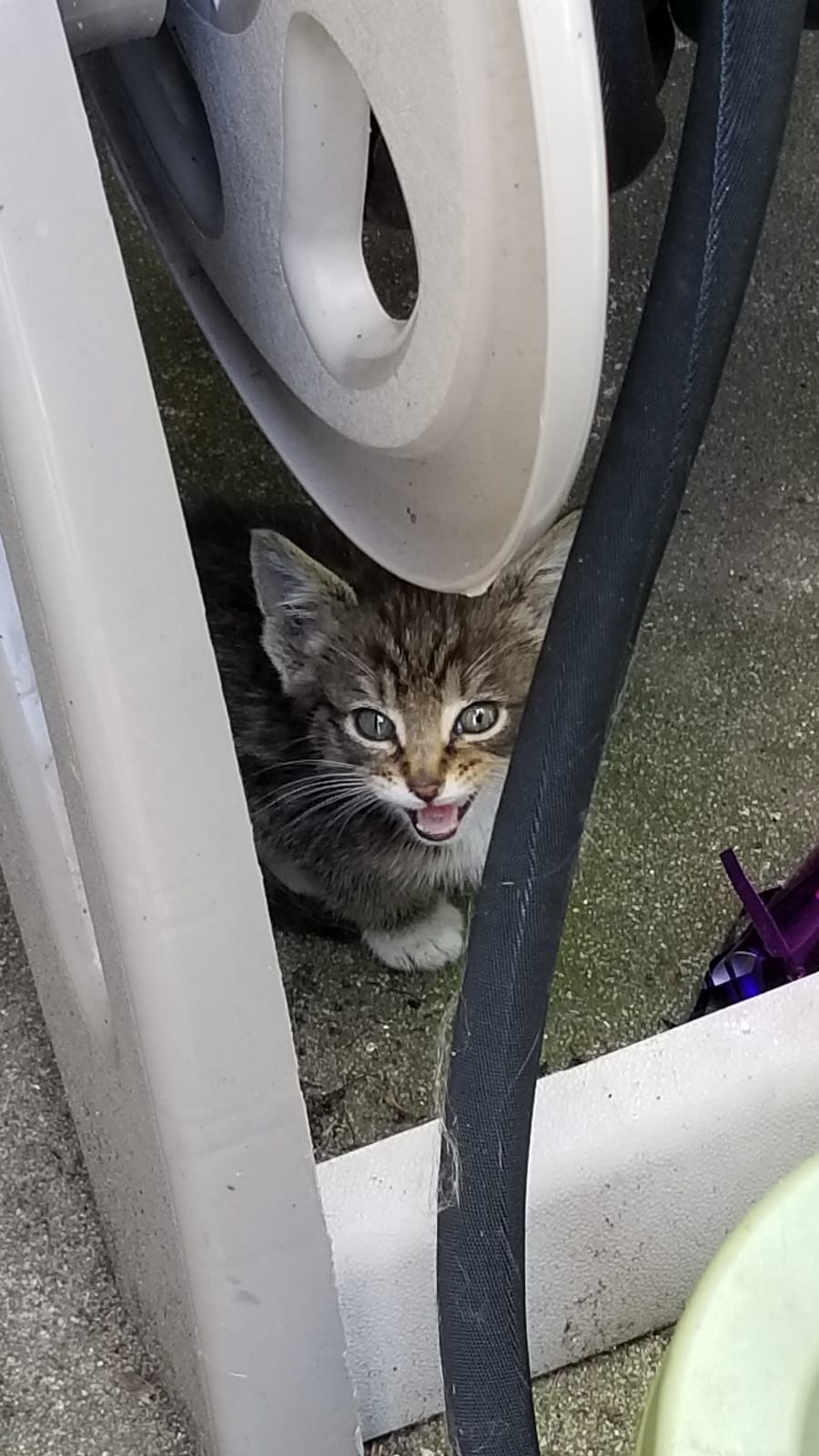
Sekhnet and I recently saved the lives of five tiny feral kittens. They’d been dropped in Sekhnet’s garden by a shrewd mother cat, a cat we didn’t know, who abandoned them to the care of the provider of the neighborhood’s best cat buffet. Once Sekhnet inadvertently allowed one of them to eat. The good looking little cat caught her eye before he left.
The next day the tiny alpha kitten was back, demanding food on behalf of himself and his four larger siblings. He simply would not take no for an answer.
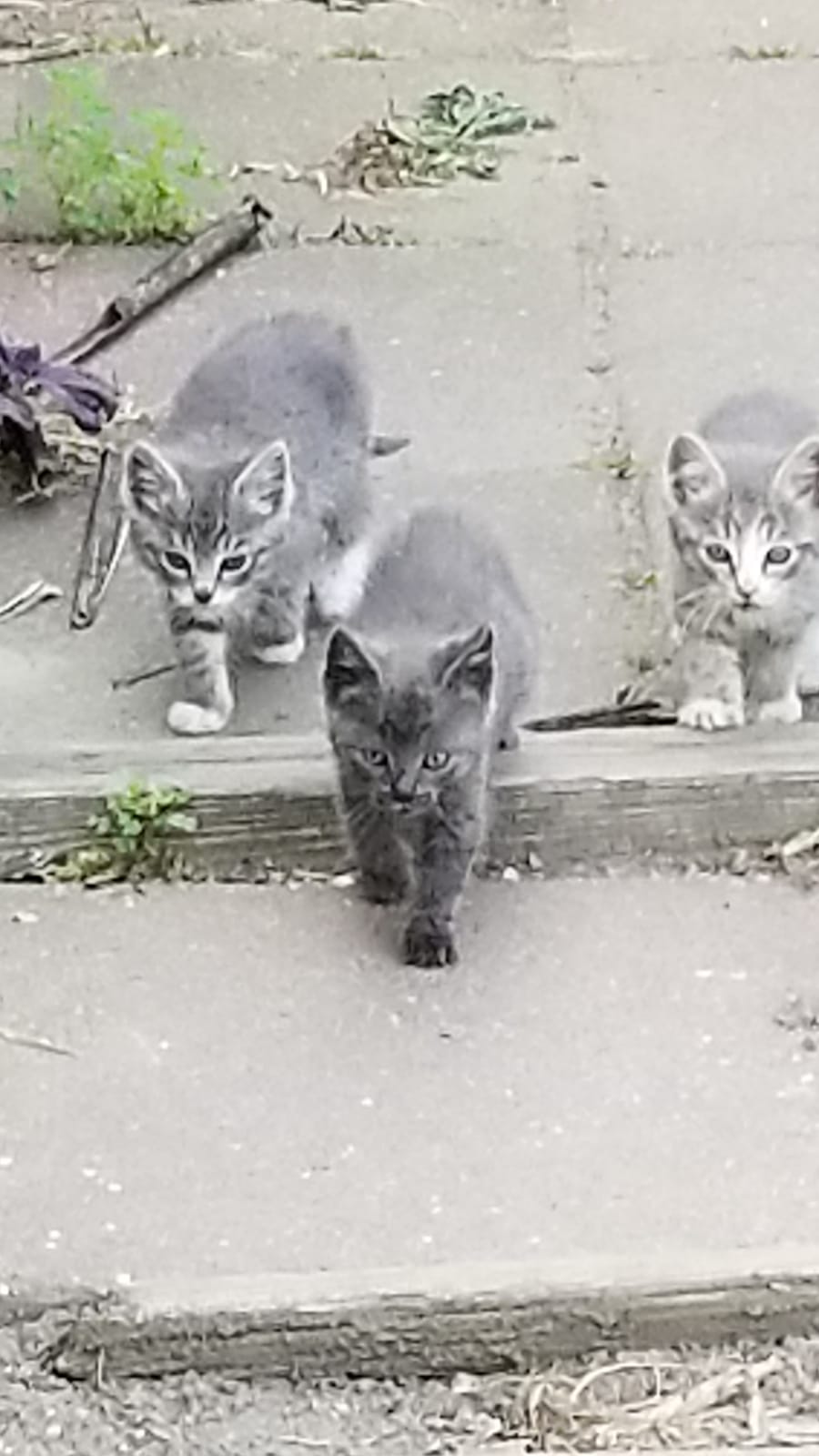
After Alpha made his successful appeal, the others followed. Sekhnet got a good shot of three of his four bothers and sisters, coming out of their hiding place and marching toward the feeding area.
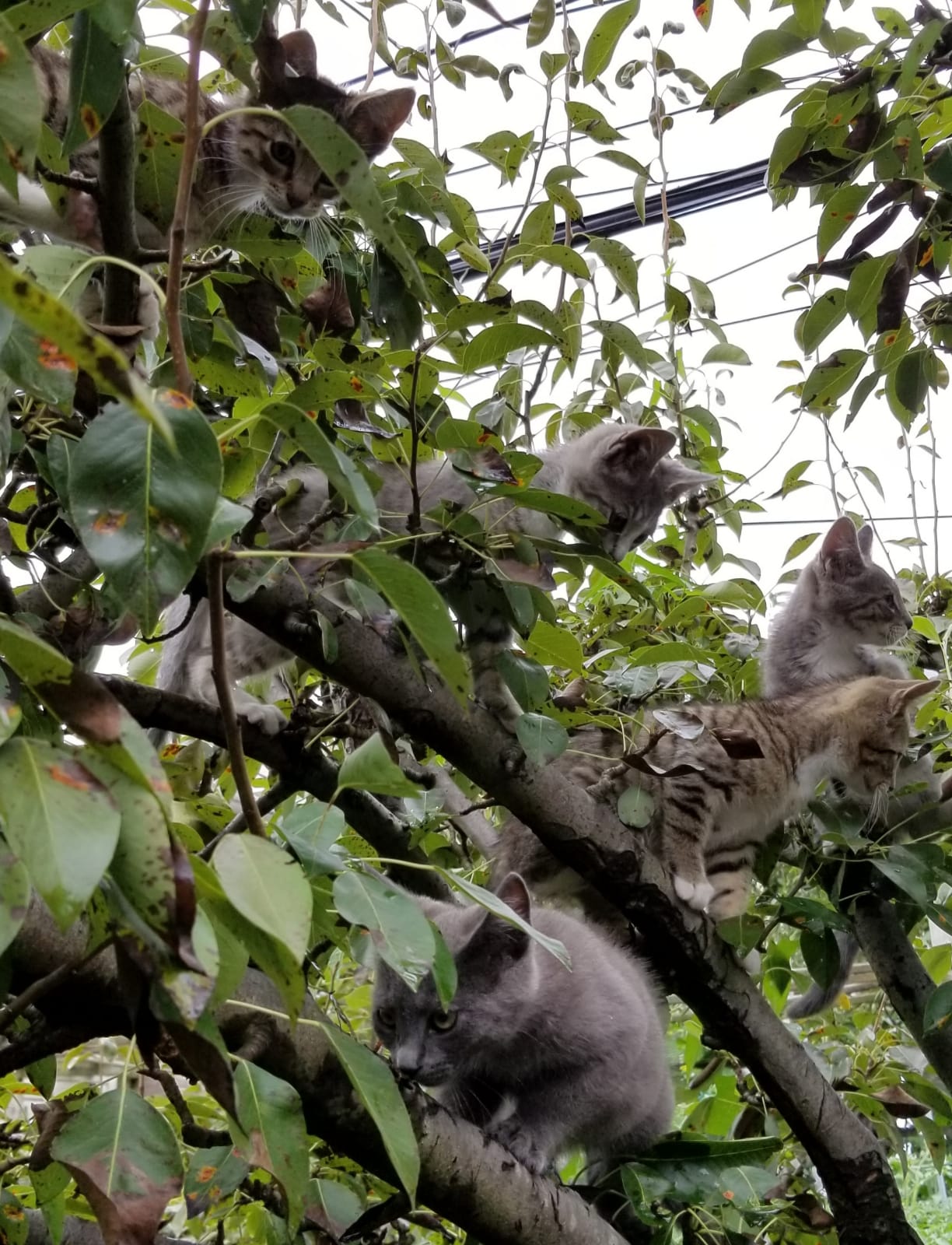
That day they all began eating two hearty meals a day in the garden, exploring and hanging out all over the place, much to the disgust of the five adult feral cats who already lived on, and had fought for control of, that turf.Here they are, led by tiny, indomitable Alpha Mouse, in the male pear tree. Naturally he was the first one up the tree.He’s looking down on them in this shot.
The disorienting pandemic lockdown was on and we took on the saving of these five tiny lives as a kind of mission. Over the years we’d watched dozens of feral cats and kittens we got to know live short, often brutal lives, many of our favorites living only a couple of months.We decided we’d try our best to save these five.
Sekhnet fed and played with them a bit in the garden every day. She took many great photos of the little beauties. I would go out and sit with them late at night, little Alpha didn’t mind being picked up, would sit calmly on my lap from the beginning. They all learned to chase the little cat cookies I’d toss them and eventually to eat them out of our hands. Once the first couple were fairly tame (Alpha’s brother Beta followed in the little leader’s footsteps) Sekhnet designed an ingenious trap, scooped them all up at once and brought them inside where they lived in a large comfortable cage she’d found online. We then set about getting the others used to being picked up and petted. They all took to it quickly.
They were surprisingly happy with the cage, which had several levels and a little workout area where they could take turns pounding a couple of light speed bags. We took them out and handled them one at a time, petted them, won them over, made them all pets. In the end we brought them to a great adoption center we finally found and every one of them was soon adopted as a pet. Naturally Alpha was the first to be adopted, after a very short stay at the shelter, his first day out of quarantine, I think. The rest were all quickly adopted in the days that followed.
We’d done a good deed, we knew we couldn’t keep them around, our plan from the start was to get them adopted to have good lives but we were emotionally devastated that first night, after our friend rented a van and helped us transport them to the shelter in Freeport. They had all come to trust us, and were affectionate and playful, and incredibly cute. We’d grown very attached to having them around. Then they were gone. The house seemed so empty. We cried looking at their many portraits and film clips that first night.
But here is the point I want to make. The pain, though intense, did not last long. By the next day it was much easier, within two days easier still. The good deed we’d done lingered, the painful goodbye to them didn’t. It is something worth remembering when you feel heartbroken sometimes. Painful feelings truly do pass, sometimes surprisingly quickly.
I think of our horror (mine and Sekhnet’s, millions of others were delighted) on election night, at how close the vote was, at the real chance that America’s long experiment in democracy was finally and definitively at an end. At least five million MORE of our countrymen had come out to vote a second time for the most deliberately divisive, untruthful, vindictive, angry, litigious president this nation has ever had. Women, it emerged, had voted for Trump in larger numbers in 2020 than 2016! Women! Hispanic (desculpe me, Latinx) votes seem to have put him over the top in Texas and Florida. The real possibility that this raging winner could win the election and triumphantly rule as lawlessly as he sees fit set Sekhnet to sobbing into her ginger beer. I felt sick too, could not get to sleep.
In the days before the election, as the pandemic continued to rage out of control in most of the country, and new records for infections and deaths were broken day after day, the president confidently (and lyingly) declared victory over the disease that was killing record numbers in the states he won. Mission Accomplished! His maskless crowds roared their approval. On election night the agitated depression we felt was impossible to refute. It was based on the unwanted truth that we are living in a nightmare where the stubbornly reinforced, aggressive stupidity of millions of our fellow citizens, proud “values voters,” impervious to evidence even if it comes up and chokes their family members to death, is unfathomable.
The day after Election Day, as the incoming vote totals were being disputed by a president who had already strongly suggested he was declaring victory, even as he announced his intention to dispute his loss in the 6-3 Supreme Court he’d created, the media (the lying media, die Lügenpresse) was quietly publishing items like these. No longer really headlines, as much as wistful reminders:
I think bitterly that if Trump’s pandemic plan had really worked, letting the pandemic kill millions of “Democrat” voters of color in “Democrat” cities, cutting off needed financial aid to the increasingly large numbers of poor to create mass desperation and massive crime sprees, riots, looting and the need for Bill Barr’s Bureau of Prisons and ICE forces to violently clamp down on “Democrat” cities, (perhaps deploying even the military itself under the Insurrection Act,) he could have proved his wildest “law and order” theory about antifa and anarchy and black rights groups, killed and locked up enough of his enemies to actually win the Electoral College, even if he again lost the “popular vote” by millions. His open conspiracy with political supporter and mega-donor Louis DeJoy, who openly sabotaged the delivery of predominantly Democratic votes, alone, could have won him the election. It could still, unlikely as it now appears.
As the vote counting continues, Trump insisting that counting in areas he leads but is in danger of losing must be halted immediately while demanding recounts in states he has already lost (fair is fair), it looks less and less likely that the president has a path to 270. As my cousin wrote me from the great state of Georgia today:
It’s too close, but I think the only way Trump gets to 270 is if he loses 50 lbs.
My point in all this — as Biden gets closer and closer to the 270 needed to win, as horrific as it is that almost 70,000,000 Americans seem to have voted for Donald Trump — and a majority of white women! (maybe the misogynists have a point…) as Trump’s path to the 6-3 Supreme Court seems more and more far-fetched — today feels much different than Tuesday evening.
Biden is far from my idea of an inspirational president, the Democratic party is not anyone’s idea of a meaningful political opposition party. One side radically employs any means necessary to maintain power and force its minority views on the majority of country — and that side is not the corporate Democrats. The Democratic party, as a party, is about as committed to the economic status quo as the Republican party always was. Still, Joe Biden is not Donald Trump — the main reason maybe 75,000,000 of us will have ended up voting for him.
Once he is sworn in, hopefully with a 50-50 Senate where Kamala Harris will be the tie-breaker (though even that modest goal of flipping four Senate seats likely won’t be achieved) we will have to set up committees of correspondence, organize, mobilize, stay in the streets, be smart in messaging, push, push, push. We will still be pushing a reluctant centrist against the dogged resistance of Mitch McConnell and Lindsey Graham — and every single elected and appointed member of their unified, radical party– as sickening as that thought is.
We need to stay positive and proactive, of course. If we push hard enough, you never know. The midterm primaries in 2022 may even feature meaningful Democratic party debates about how to avoid rapidly approaching fatal Climate Catastrophe. The escalating danger of global warming is even further down the page today than the new record COVID numbers, though the threats are equally dangerous. We don’t have much time to fix any of this, and four years have just been worse than just wasted — we need to ride President Biden like the affable, probably well-intentioned donkey he is.
My point though: it feels better today to be an American (for a bare majority of us), and much more hopeful, than it did two days ago.
My father, pursued to his deathbed by what he referred to as his demons, suffered unimaginable abuse as an infant that he was never able to heal from. He told me as much as he was dying. “My life was pretty much over by the time I was two,” he said, by way of opening our last conversation, on the last night of his life.
At that point I knew exactly what the man whose fluids were draining into a bag on the side of his hospital bed was talking about, but only because I’d spent literally decades puzzling out the painful secret he guarded to his death. His mother had been a violent, enraged, religious fanatic who literally whipped him in the face from the time he could stand. A light suddenly went on in a dark room when I learned this.
I can hear his voice now, saying what he couldn’t when he was alive and frantic to stay just ahead of the demons that drove him to act in ways he’d regret while dying. “You don’t recover from that kind of betrayal, Elie. How do you come back from a mother who treats you as a despicable enemy from your earliest memory, from before you could even talk to her?”I’m not sure I know the answer to that question, though it is worth pondering.
Whenever I raise my voice to Sekhnet, or otherwise show frustration (something I am sadly prone to), she immediately reacts with pain. She feels unfairly under attack like she did as a girl, and I understand this.
My nastiness immediately triggers painful childhood feelings from a childhood that was harsh in certain ways. All I can do is try to always be aware of this trigger and not react in a way that hits it, a great challenge in a matter of reflex. Making matters harder, my facial expression alone will pull the trigger, even if I manage to keep my mouth mostly shut. I can only apologize when I provoke this pain in her and try better to not do it the next time. My apologies, no matter how instant or sincere, only offer so much consolation, I have learned.
I don’t mean to sound like a sniveler, but disturbing issues from childhood remain for many of us, most of us, I suspect, to the end of our lives. We do our best to be aware of and overcome them for the sake of those we love, it’s the best we can do.
The subject of childhood pain is either tedious or fascinating, to be avoided or delved into, depending on your tolerance for a certain kind of discomfort and your need for a certain kind of clarity. It is tricky, emotionally fraught terrain dotted with patches of quicksand.
There is a term for constant self-punishing brooding on painful feelings from the past, rumination. There is even a psychological disorder for those addicted to this form of self-flagellation, Obsessive Rumination Disorder:
Rumination is focused on past events. It is a preoccupation with perceived mistakes, losses, slights, actions taken or not taken, opportunities forever lost. The feelings associated with obsessive rumination are guilt, regret, anger and envy.
(two second google search: what is obsessive rumination disorder?)
Here’s a short piece on the dangers of rumination and tips on how to overcome the worst of it, and lift ourselves out of it, by a guy with the incomparable name of Guy Winch.
The harm of repeatedly chewing over and reliving past hurt, churning pain you can do nothing about, is not hard to see. The difference between torturing oneself with guilt, regret, anger and envy and thinking about and learning from past pain, moving toward healthier reactions, not remaining stuck in negative cycles for reasons you can’t see or grasp, becoming a more self-aware and kind person, is not as easy to see sometimes.
Our past experience, of course, is the lens through which we view everything. More crucially, it is the filter through which we feel everything. I see this paragraph from today’s news and am struck (by the part I’ve put in bold) by an immediate painful feeling straight out of my own childhood, beyond my adult horror at the larger meaning of this news item:
Judge Amy Coney Barrett would be Trump’s third appointee to the Supreme Court and the sixth conservative justice on the bench. During her Senate hearing, she refused to state her position on abortion rights, gay marriage, the Affordable Care Act, voting rights, climate change, family separation at the U.S.-Mexico border and presidential powers in relation to the elections.
Not answering specific, troubling questions by authoritatively turning the conversation away from reasonable, concerns, was a specific technique my adversarial father deployed frequently. I found myself on the short end of this technique over and over during my childhood and well into my adult life.
This move is the complete negation of the rights of the other, a calm, unappealable pronouncement that the thing you are so concerned about is of no legitimate concern whatsoever. It dismisses your concern as the unreasonable product of your own shortcomings.
It seems clear that a Supreme Court nominee should be able to state, without hesitation, that armed people at the polls intimidating voters is against the law, is, in fact, a felony in many, if not most, states. There is no political point of view expressed in stating the black letter law in answer to a direct legal question — this behavior, though endorsed by the incumbent president, violates rights guaranteed by the Constitution, as well as federal statute. It is a crime to interfere with a fellow citizen’s right to vote, by intimidating them or in any other way (not authorized by asuperseding state law.)
This carefully vetted zealot nominee, about to become a sixth unappealable vote in the 6-3 majority to suppress anti-Trump votes (with or without legal justification [1]), refused to state her position even on this simple, important matter of voter intimidation on behalf of a president who exhorts violent resistance to “Democrat tyrrany” and vows to protect his followers from legal consequences. Instead of a straightforward answer to an uncomplicated legal question, Coney Barrett reserves all judicial options by standing on the absurd claim that she’d need, in a fact-specific situation, to consult with her interns and fellow legal scholars before deciding how to answer. She adds, in the politest possible tone, that the people asking such questions are simply partisans intent on “borking” her perfectly legal and proper nomination.
There are many reasons to be disturbed by the powerlessness many of us, a large majority of Americans, feel at the brazen and unstoppable bit of cynicism of appointing another extremist justice to cement a 6-3 right wing majority just days before an election she’ll have a vote on deciding, on behalf of democracy-averse corporations and reactionary billionaires. Add to this disturbance, in my case, a painful personal reminder of an ongoing childhood torment.
Here is the important distinction between what I always try to do and being stuck in the self-harming cycle of reliving pain from the past that psychologists call rumination. I recognize that there is a painful, personal echo in this news item for me. I can put my finger on it. I understand its harmfulness precisely. It does not send me into a spiral of negative thoughts from the past.
There is plenty negative and abusive about McConnell and company’s ugly, unprincipled move (several prominent votes in the 51-49 majority to rush Coney Barrett on to the bench took a “principled” stand, in 2016, against the very thing they are rushing to do now), days before a highly contested election, without this particular feature that strikes me so hard.
This refusal to address important concerns is one particularly personal component of this outrage for me, one I feel in my body and I understand why it strikes me that way. It’s as they say: the personal is political. It reminds me again how crucial it is for me not to do this hateful thing to people I care about.
It’s all we have when the going gets tough — the understanding of what hurts us the most, the desire not to inflict it on others and the knowledge that our concerns will not be brushed aside by the people closest to us.
We are living through historically tough times now, with the active message delivered over and over by our own government that hundreds of thousands of unnecessary American deaths, and untold deprivation, fear, hunger and other suffering, is the appropriate price of liberty, for certain powerful, unaccountable forces in our nation.
You can only look at the calculated ugliness of this and countless related daily outrages for so long, before you begin to lose hope, feeling, desire to even fight it. That is part of the deliberate design of overwhelming government-sponsored brutality like this– to emotionally dominate its victims beyond their power to resist. Resist wemust, of course.
It is understandable that few, if any of us, are at our best in this disorienting moment of multi-faced crisis. It is plain that there are different styles of coping with the present horrors as they continue to unfold with such mind-numbing monotony. We all find our own ways to remain sane and hopeful, to balance the need for information and the need for relief from the assault of deliberate misinformation.
Tolerance for our differences is more important than ever. Only by hearing and understanding each other’s concerns is there any chance of emerging from this awful moment with our full humanity intact. Patience for the foibles of others is much harder under these worst of circumstances, when we are on each others’ nerves, locked up in small, isolated groups during these fearful days, granted. For that reason patience is even more needed. The reward for patience and fortitude is proportionately greater in scary, disorienting times like these.
[1]
The emergency ruling Kavanaugh authored in April, overturning two lower courts to prevent the expansion of voting in Wisconsin during the pandemic (with Ruth Bader Ginsburg’s short, sparkling, crystal clear dissent), was one of many recent un-argued eleventh emergency rulings by the Supreme Court. Unsurprisingly:
The Trump administration has been a major contributor to the trend, Professor Vladeck wrote, having filed 36 emergency applications in its first three and a half years. By contrast, the administrations of Presidents George W. Bush and Barack Obama filed just eight such applications over 16 years.
At a time when so many are dying around the world, and around our nation, from the pandemic, from hunger, by suicide, thoughts of death are closer than usual.
Death may be the beginning of the dead person’s embrace of eternity, I suppose, but it’s a high price to pay for that union. What’s left behind is the painful absence, forever, of that loved one.In a way, our mourning for those we love and lose contains an element of rehearsal for our own death.This secret, internal rehearsal is very hard for us to do, in a society dedicated, to an impressive extent, to the eternal denial of aging, death and dying.
I thought about these little rehearsals for our own deaths recently when I reluctantly took my leave of a friend I’d known since Junior High School. Losing this old friend felt like a kind of death, partly my own. A lifetime of shared experiences, personal references, little inside jokes, good will, great favors done for each other, erased as by death. Erased, rather, by an unwillingness, or inability, to do what needed to be done to continue a mutually beneficial friendship.
I’ll take my share of blame for the final death, and though my friend angrily concluded I’d been the unreasonable, cold-hearted aggressor, I did my best to avoid the silence that eventually had to come in the absence of empathy and understanding. I spent months taking him up on his offer to grapple with how to fix what had gone wrong in our friendship. When I laid out my side for him as clearly as I could, with as much patience and lack of blame as I could muster, he was hurt and angry about it. Your choice at that point becomes stark: eternal grievance and unresolvable fight or quiet. There’s enough angry noise in this mad world without it hissing from an always virtuous person who insists he can’t be hurtful because he’s your true friend — my former good friend surely agrees with that.
When someone we love dies, the pain we feel is universal. It’s hard to imagine a person who does not share this terrible clutching in the chest, or wherever one feels it, when someone he was close to is no more.Hard to picture a human being unmoved by a selected death, unless we dehumanize them, that is. Once the despised party is no longer seen as fully human, it’s much easier to imagine the worst. That’s what rabid partisanship is all about.If you’re the malicious type, the death of someone you despise can leave you feeling “good for them… only tragedy is that it didn’t happen sooner“
I am about as far to the left on the political spectrum as I can imagine anyone being. It feels to me like the pull of liberalism, progressivism, socialism, whatever you want to call it, is toward mercy and inclusion. It aims to foster recognition of our common humanity, our unalienable equality and value as humans, the right of poor people to live with dignity. The magnetic pull of conservatism, autocracy, militarism is toward exclusion, protecting the privileges of the few, employing a punitive order that enforces divisions according to class, race, religion, nationality or, usually, a combination of those things. The right sees these divisions among people as natural and inevitable and the friction they cause as something best controlled by a well-armed police force and prison system.
Of course, someone on the political right will characterize the philosophical difference in reverse. Conservatives want to preserve freedom, decency, the value of hard work, free competition, justice, moral righteousness and so on. Liberals want to impose a kind of politically correct tyranny, giving away hard-earned money to reward lazy, corrupt people who refuse to compete on a level playing field. Liberals also don’t want to punish criminals, they want to “understand” them. And so on.
An animating belief of humanism is that our shared humanity can rise above any artificial divisions, given empathetic understanding. A very liberal writer, Jeanne Safer, gave a beautiful illustration of this in a book about seeing beyond partisan animus [1]. Her very religious, right-wing neighbor, a person with whom she shared almost no beliefs and few opinions, took her to chemotherapy every time she went, sat with her, brought her home, made sure she was comfortable, did her shopping. Her gratitude for this woman’s selfless kindness in her time of need made her appreciate the deep humanity of this undoubtedly good woman. She may vote for Trump, march in Right to Life rallies, believe homosexuals will burn in hell, but she has an undeniably generous heart on a personal level. Safer learned to cherish this wonderful heart, even as she disagreed with virtually everything else this neighbor was passionate about.
This, my friends, is a subtle fucking point well worth pondering in our troubled times.
It is a very difficult point to get a hold of during this nakedly partisan cold civil war we’re all living through. The stress acting on us daily is almost disablingly heavy, but the point is worth considering. People on the other side of every great question, people we write off as mindless partisan fucks, love their kids, take care of aged parents, would jump in front of a moving car to save a stranger’s toddler, watch videos of animals doing adorable things, to take their minds off the horrors we are all swimming in daily.
Part of the intent of keeping us all constantly at war with each other is to destroy this larger truth of our innate human connection to every other human. How many humans can kill a baby? Not many, I’d wager. Tribalism is one thing, and often a destructive one, but our common humanity, in the end, is the only thing that can save us and the planet we live on.Not easy, of course, not often seen, but urgently needed, going forward.
Looking at any history book it’s not hard to see the interests of the wealthiest (and generally most conservative) behind every war fought between average people. Poor people, young ones, from each combatant nation are indoctrinated against an enemy and sent to kill each other with the ultimate aim of making an elite group of rich, older ones, richer and more secure in their wealth. To understand war, follow the money, as they say.
And the horrible reality is that when the war sweeps through, there is no survival for the meek, no possible appeal to our higher nature. All bets are off when they come for you with machetes, guns, planes, flame throwers, mobile killing units. This is the nightmare scenario our species has lived, and perpetrated, over and over since before there was a system for recording these slaughters. In the world right now there are tens of millions displaced, people who ran from a meat-grinder that hacked up the unluckier, meeker members of their families, their community. Those who hid, cowered (not unreasonably!) and were caught are not shown mercy, not by bombs, not by men crazed with the wild adrenaline of life and death battle. They shoot first, at people who may well want to kill them, ask themselves questions later.
Extreme partisans are ready to die for their beliefs, to kill for them. This willingness to die is sometimes seen as the ultimate expression of having the “courage of your convictions” though it is just as often the “enduring brutality of your mistake”. In this country, according to the FBI, violent, deadly partisans are mostly on the far right. Far right groups have killed many Americans in the last twenty years, as part of their general operations, far left groups have killed few, if any, over that same span.
A willingness to use violence is the hallmark of terrorism — in fact, the use of violence to achieve an aim IS terrorism. We terrify you into doing what we say, because we’ve killed some innocent people, as you’ve seen, and we’ll fucking kill you. too. The threat of violent death is our calling card. Our side will beat down your side and stick those protest signs up your asses!
You wonder what has to happen to a human heart to conclude, during difficult times, that it is better to take up arms and take as many of the bastards with you as you can before they kill you than to look for a way out of war. Something the equivalent of Nazis coming to your area, rounding up local leaders and publicly executing them. If you have the ability, that moment is definitely your last chance to organize and take up weapons for self-defense against a deadly enemy.
The specter of a nation finally struggling to come to terms with a long history of racism, de jure and de facto, seems to present this endgame scenario to those ready to believe that equality among people inevitably leads to tyranny. Got to arm and kill as many of those fucks as possible before they can force us to live as slaves in a world like that! We never did anything to them, why are they coming to persecute us?! They are the violent tyrants, not us!
As I think about these little rehearsals for our own deaths, I wonder how ready I’d be, if forced into that terrible position, to die for my beliefs. Even to be beaten up, or even menaced, by armed thugs outside my polling place. Fanatics are famous for their willingness to go down in a hail of bullets, guitarists and calligraphers, not so much.
When things are put into black and white, life and death frames — if socialists are elected to Congress it will be the violent end of freedom as we know it — evil, righteous men with the money to influence mass events will eventually put death squads into motion. You can take that to the bank, the smart money will bet on it. As we all do our little, trembling, mostly unconscious, rehearsals for our own unthinkabledeaths.
[1]
I Love You, but I Hate Your Politics: How to Protect Your Intimate Relationships in a Poisonous Partisan World, 2019, All Points Books ISBN9781250200396
Bravo, again, John Fogerty. Amy Goodman reports, after a taste of the Creedence 1969 anti-war rocker:
AMY GOODMAN:“Fortunate Son” by Creedence Clearwater Revival. The song was written by member John Fogerty, who just issued an official cease-and-desist order Friday to President Trump for using it as part of his campaign’s soundtrack. The song came out in 1969 during the Vietnam War.
Fogerty said, quote:
“I wrote this song because, as a veteran, I was disgusted that some people were allowed to be excluded from serving our country because they had access to political and financial privilege. I also wrote about wealthy people not paying their fair share of taxes. Mr. Trump is a prime example of both of these issues. The fact that Mr. Trump also fans the flames of hatred, racism, and fear while rewriting recent history is even more reason to be troubled by his use of my song,”
said John Fogerty.
original post:
AMY GOODMAN: “Fortunate Son” by Creedence Clearwater Revival. The song was written by member John Fogerty, who just issued an official cease-and-desist order Friday to President Trump for using it as part of his campaign’s soundtrack. The song came out in 1969 during the Vietnam War. Fogerty said, quote, “I wrote this song because, as a veteran, I was disgusted that some people were allowed to be excluded from serving our country because they had access to political and financial privilege. I also wrote about wealthy people not paying their fair share of taxes. Mr. Trump is a prime example of both of these issues. The fact that Mr. Trump also fans the flames of hatred, racism, and fear while rewriting recent history is even more reason to be troubled by his use of my song,” said John Fogerty.
The original content of this program is licensed under a Creative Commons Attribution-Noncommercial-No Derivative Works 3.0 United States License. Please attribute legal copies of this work to democracynow.org. Some of the work(s) that this program incorporates, however, may be separately licensed. For further information or additional permissions, contact us.
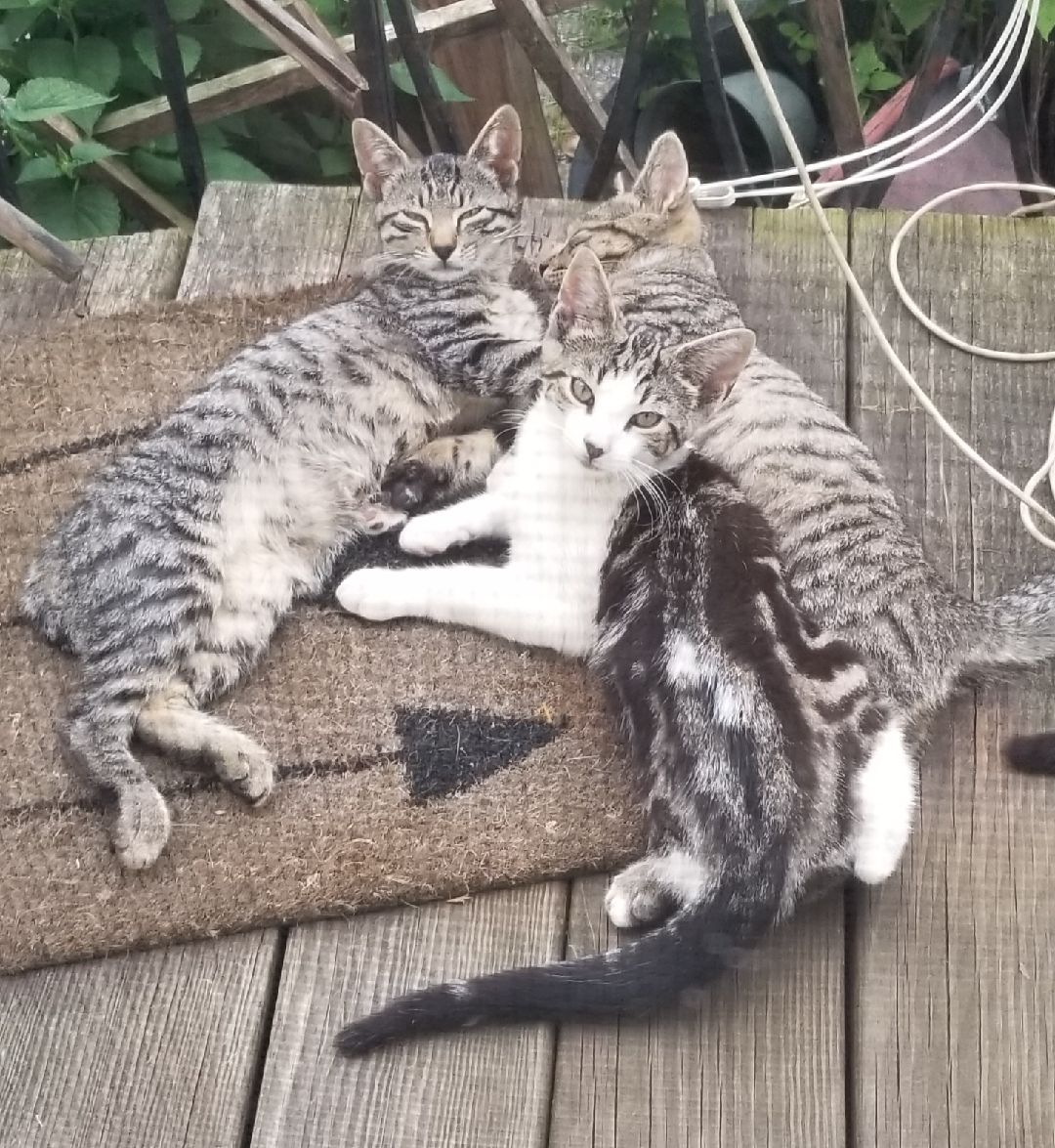
A friend who knew a lot about cats told us it was a shame the wild little beauty who was sitting at our feet, just out of reach, had been untouched by humans for the first months of her life. Once they are feral you can’t really get too close to them, she told us. This kitten came to trust us and eventually love being petted by us (when she felt like it, of course). She became our outdoor pet.
One day, in the first spring of her life, before she was even six months old, she marched her first litter of tiny lookalikes out of the bushes, to show Sekhnet to them. She will feed you when I’m done, she told them, and it came to pass.
Sekhnet was horrified when Mama Kitten chased her first kittens out of the garden. They’d been weaned, and learned to get food from humans (and to hunt a bit as well) and suddenly Mama was driving them away, quite savagely. What a bitch! said Sekhnet. We started to learn about cats in nature, nature which is as cruel as it is kind.
Mama Kitten was tough. She had to be to survive out there. She gave birth to her next litter shortly after banishing her first.
Over the next three years she gave birth to many more, producing more than twenty beautiful little kittens in her first four years of life. Few survived very long — five that we know of.
We hesitated to give them names, because it would create more attachment and make their deaths more personal, somehow. Sekhnet began giving descriptive names only, so we had a way of referring to them as they had their adventures in the garden.
Of Mama’s second to last litter of four, two daughters, Little Girl and White Back, survived. They occupy the garden to this day. The girls stood together, refusing to be intimidated by their mother, the first to do that, and both survive.
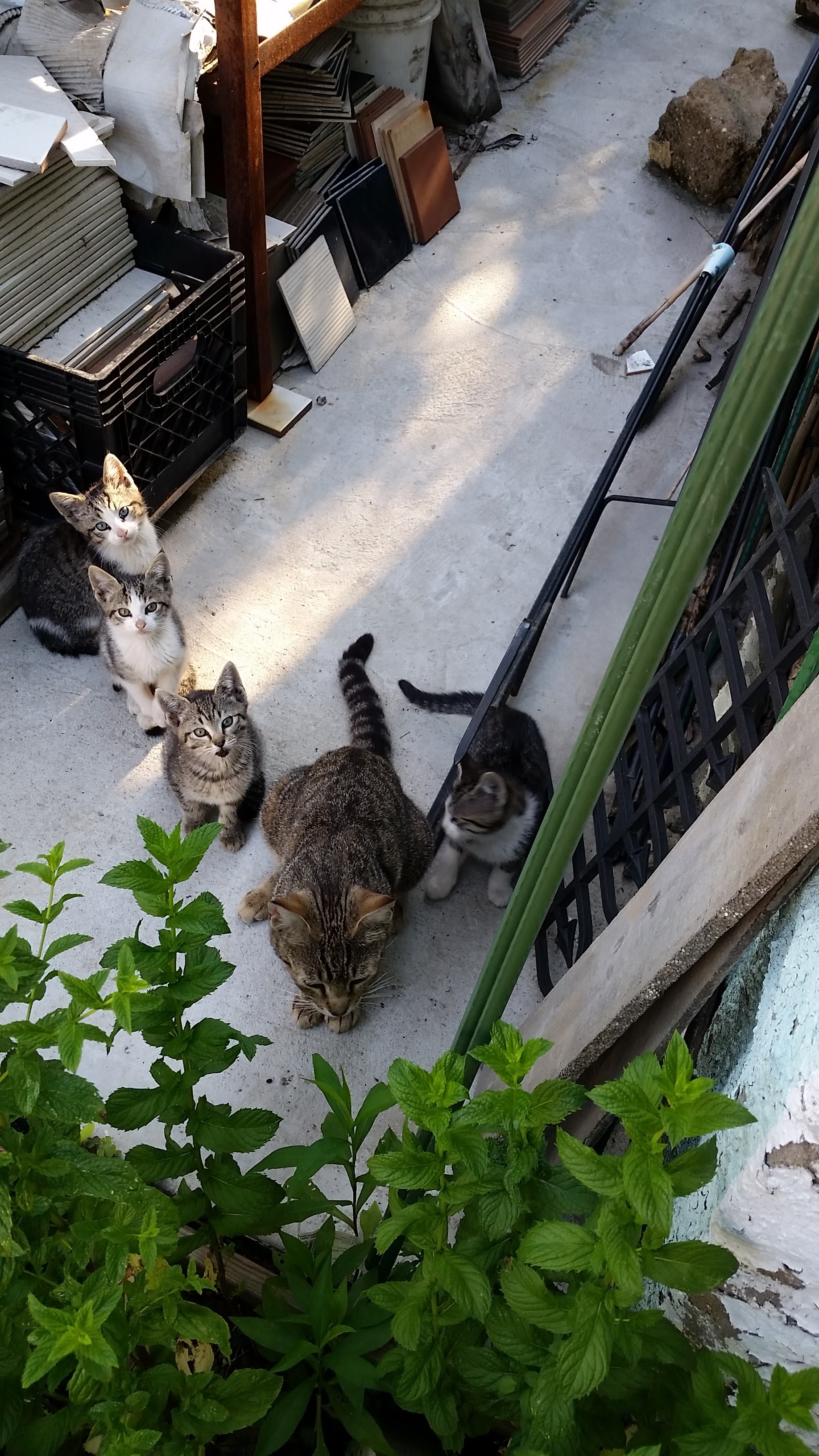
Here is the dominant one, Little Girl (left), with her two brothers, Turtleback and Whitefoot, fine little cats who had very short lives.
In the end, with the help of an almost insanely dedicated cat rescuer, we were able to trap Mama Kitten and the others and have them spayed, and the father (we assume) neutered as well. For a year and a half we’ve had a stable little colony in the garden. It was disrupted briefly a couple of months ago by five adorable little ferals whose mother abandoned them by the best cat buffet in the neighborhood. We managed to catch, domesticate and find homes for all five.
One day, not long ago, Little Girl, who always stayed close to her mother (they were known as the Driveway Bitches for their ruthless shakedowns for treats) and had always deferred to her mother in all things, snatched some food from her.I instantly intervened, and Mama finished what she was eating, but the writing was on the wall.
A day or two later a friend noticed one of Mama’s eyes looked a little funny. A few days later she lost interest in food, even the favorites Sekhnet brought to her. She took to one of the houses we made, staying warm.Then, one rainy, miserable night a couple of days ago she disappeared. Little Girl was now sleeping in her house.
We figured Mama Kitten had crawled off to die somewhere, probably in the nearby strip of wooded area across the service road. She was not yet six years old, but feral cats live much shorter lives than pampered indoor cats.
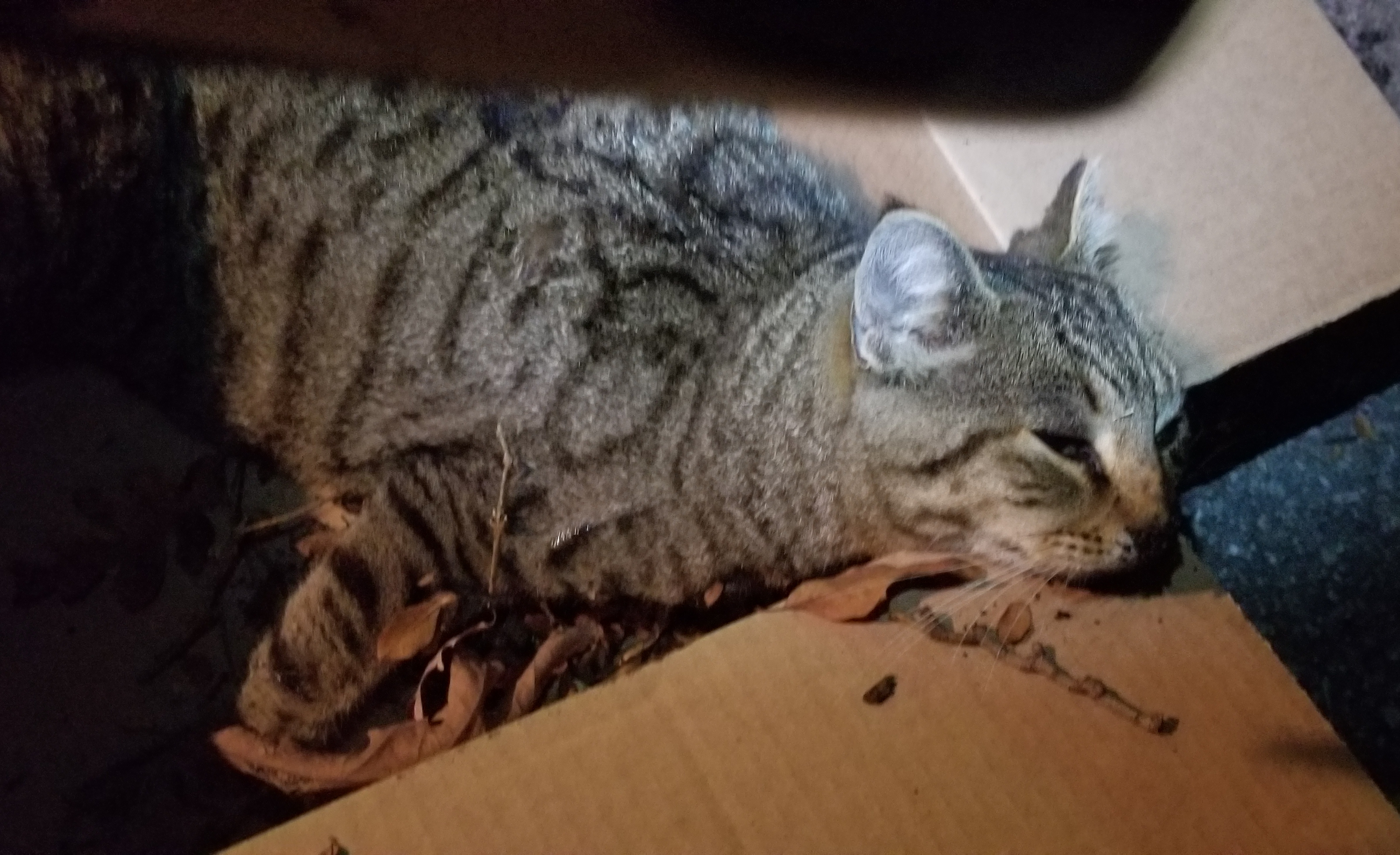
I had intended to write about her death yesterday, but somehow I didn’t get to it. Last night, after we moved the car for the firs time in a few days, to do some shopping, we found out what happened to Mama Kitten. She’d made it as far as the narrow space behind the car, before breathing her last.I put her in a box, closed the flaps carefully, and carried her a short distance to a wooded area where Sekhnet covered her coffin with branches full of dry leaves.
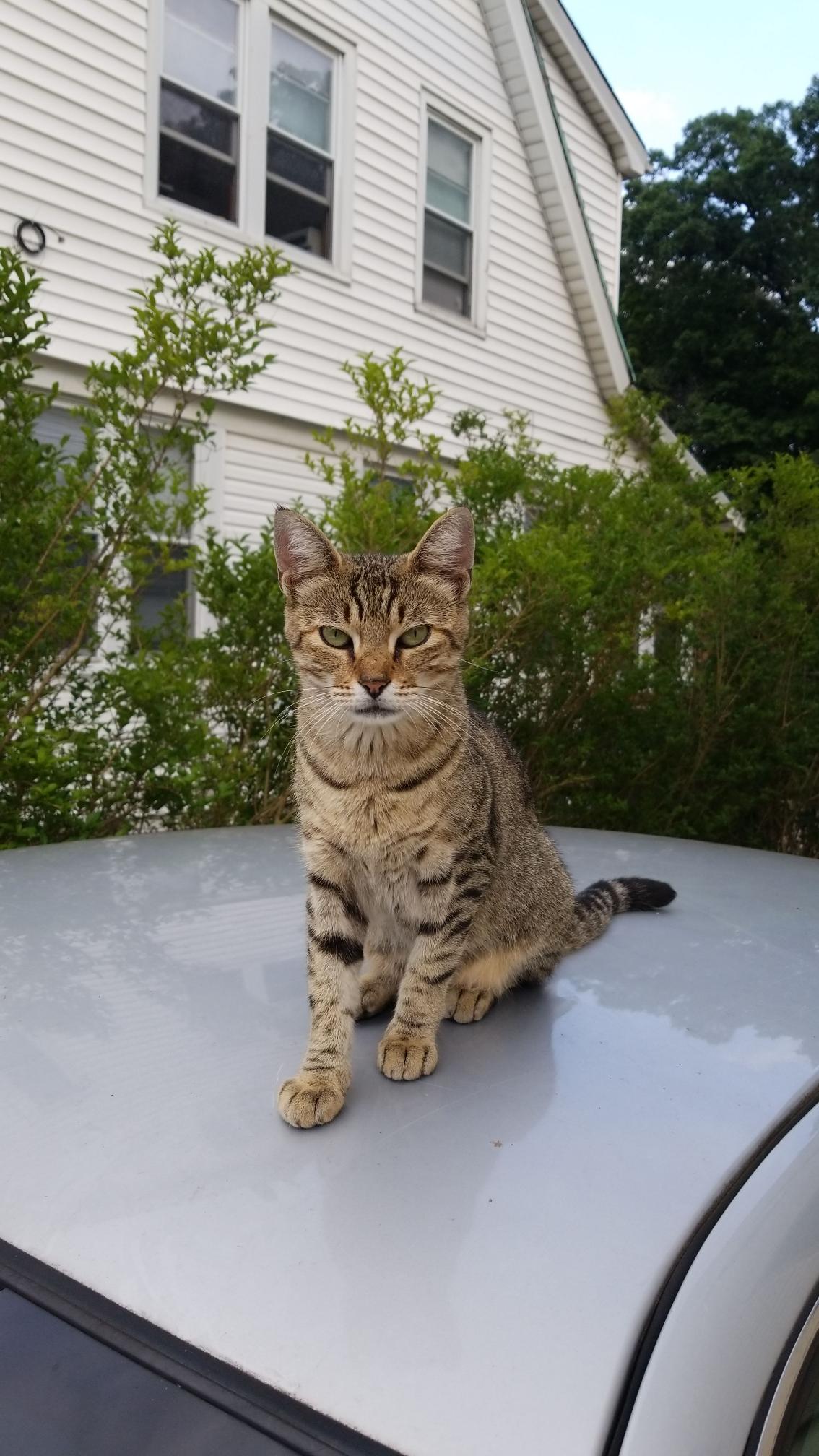
We spent the next few hours looking for photos of this beautiful cat. Here is the hero shot:
I thought at first that the lesson of Mama Kitten’s death was the simple reminder that we all must die, that it is part of nature and that a creature who showed no signs of being sick (she could jump up on to her petting table until the end) knew when to accept the approach of Death and when to go gracefully with it.
During these fearful days when the possibility of our own deaths is closer than usual, I’ve been thinking about death a lot. Mama Kitten’s death was a reminder of the pain for those left behind. I feel it clutching at my chest as I try to conclude this post with some thoughtful words. The pain is great for this stray cat we cared for, who crawled off to die, and didn’t make it to the woods.
How much more immense is our pain for a human we have known, who has touched our lives, made us laugh, held us when we were afraid?
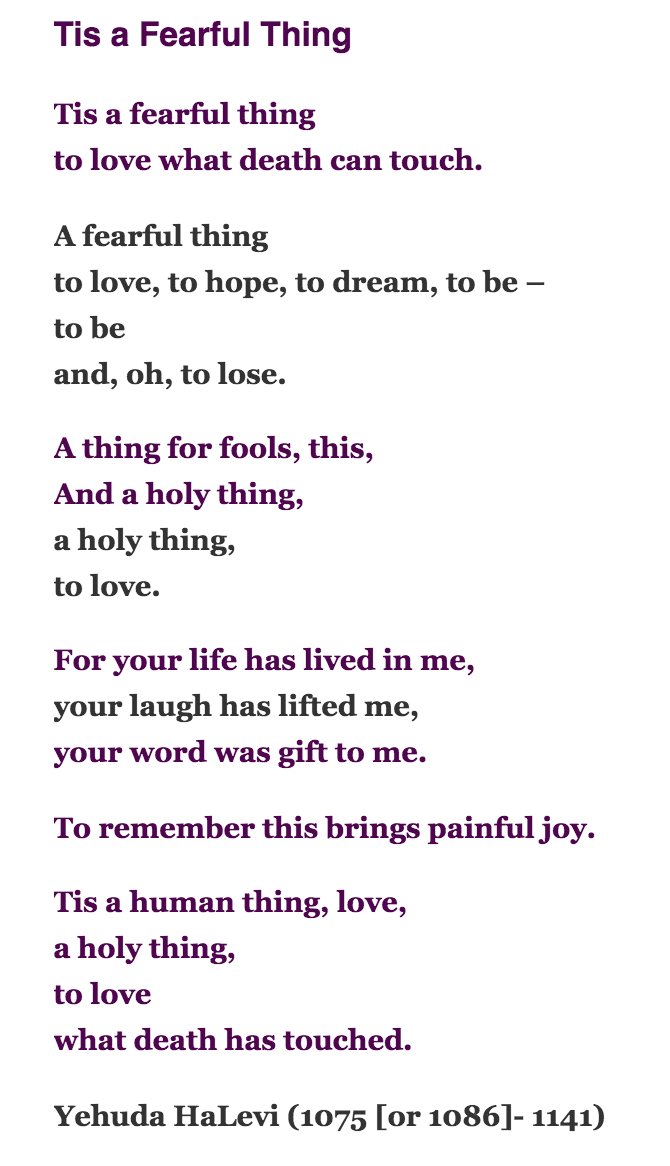
This long-dead poet says it best, as I recalled with tears when I found it among my emails last night, searching for pictures of Mama Kitten, in her prime.
We may be justifiably optimistic that change is about to come, at the last moment, before we’re all plunged irretrievably into the toxic soup. The signs are encouraging, millions lining up for hours to cast ballots instead of leaving them to the less than up-and-up Louis Dejoy to deliver for counting. These early in-person ballots will all be tabulated before Election Day, eliminating one worry about electoral hanky panky and a premature declaration of Four More Years, with an exhortation to the enraged white men in the Second Amendment brigade.
We may keep ourselves on an even keel, most of the time, remaining positive, taking care of ourselves and our loved ones, remembering to be grateful for the blessings we have. We may even make somebody laugh once in a while. But how well can any of us actually be doing at a historically stressful time like this?
A friend asked me the other night, after a few minutes of batting the latest crazed news items back and forth, how I’m doing. I thought for a moment then said “limping along, I guess” and he probed– why limping?
I told him that even without the pandemic, the stress we are all under at this point is pretty much off the charts. Just reading the headlines is now accurately called “doom scrolling.” The American carnage evoked during the president’s first inaugural address has come to pass.
The natural world is being destroyed at an alarming rate — anyone who brings up this terrible fact is labeled “an alarmist.” The norms of public life in our democracy that once provided a certain amount of civil discourse in politics, moral limits and predictable outcomes, have been flagrantly ignored, replaced by expressions of open partisan hatred.
We literally have a mad man in charge of the country, intent on turning back the clock on every form of social and political progress our nation has struggled to make since the 1950s. New episodes of the man’s florid insanity are released several times a day, day and night, weekends included.The news media is flooded by a firehouse of official misinformation spraying lies faster than they can be corrected, or even taken in.By pure coincidence, perhaps, this is a famous Soviet technique for keeping the populace off balance.
We’re on the brink of the literal end of democracy here, if this election goes the wrong way, if a 6-3 Supreme Court decides the election results all across the country were tainted by massive unverifiable fraud, even as millions were disenfranchised by open and covert means during the election itself.
Our nerves are shot, millions more of our fellow citizens have recently officially entered poverty, masses of people are starting to get evicted from their homes as winter approaches.
That’s a lot on the old plate, he agreed, after I’d stated a bit of the obvious.
Now, add, on top of that overflowing platter of hideous treats a deadly, incurable virus spreading wildly here in this country and to some extent also worldwide. “Freedom,” we are urged by our mad leader, now includes the right to infect whoever you want, here in the Home of the Brave. You walk into a room where somebody shunning the most basic personal protective equipment recently coughed, someone with no symptoms of the disease, who doesn’t even know he’s sick, and catch an incurable disease that could kill you, or mess you up very badly if you survive.
Here’s an illustrative COVID-related snapshot of the extent of the horror we’re facing:the leader of the free world is literally infecting his followers and donors with a deadly disease and it doesn’t seem to matter.
It appears likely the president knew he had COVID when he sat at that buffet with rich Republican donors, (the day after his close advisor Hope Hicks was diagnosed with the virus) glad-handing them and breathing on their food, hours before he was helicoptered to the hospital. Of course, we’ll never know if he actually knew he was infectious — although it’s virtually certain he was tested as soon as the woman who is always by his side came down with COVID — at least not until after the election.
Should we all be happy, and feeling no anxiety at all, at this moment, when we all are quite possibly living in Berlin right before the election of 1932? (Some of us more perilously than others). With an overlay of the Black Death, for good measure, just to heighten the dramatic effect? Why not? Don’t worry, be happy.
I’m happy, I suppose, with this uninterrupted shit show as the background and foreground to every waking moment, to be limping along. Forward and onward, with all deliberate speed.
For me, the answer to “how are you?” is a game “limping along, baby.”“Doing fine” is a lot to ask for right now, and less strictly honest than at most times. I hope you’re making your way forward too. Try to be of good cheer, know that everybody else you meet is on the verge of freaking out and totally losing it, and remember — this too shall pass.
There’s a point in a serious, hard to resolve conflict where nothing you can say or do will avert a terminal impasse. It is no longer possible to talk about objective things that actually happened and find any agreement, we’re in the realm of feelings – hurt feelings, at that – so, everybody gets to be right.
Everybody gets to be right.You get to have very fine people, on every side of every issue. You get to have courts rule in your favor with or without evidence, if you have the power to make them feel the way you do. You get to be right, no matter how strong the case is that you’re wrong.
Among people who care about each other, things can be done to soothe hurt feelings. The first thing we do for someone is listen, without trying to correct anything the person is feeling. Between people who despise each other, or have hurt each other beyond caring, hurt feelings are their just desert for being assholes — you know, fuck ’em.
When you argue with someone who constantly reframes what you’re talking about, so that you’re always discussing the issue they want to talk about, from their chosen perspective, it’s difficult, if not impossible, to ever reach agreement about anything. This technique is used all the time in bare knuckle politics and the partisan interpretation of law, and it can be maddening. It can also be hard to see or counter, until you learn to spot it as it’s happening.
Here is a recent example, from my life, which lays out clearly how reframing can create a false equivalency that can then be used to drop the mic, having won the argument. It’s likely you’ve experienced the same thing, possibly without being able to get a handle on what actually happened.If so, this illustration may help you see it more clearly.
An old friend questioned me about my falling out with an old jamming partner. I described how tensions had been rising and anger was being stored up by the ace harmonica player. I wasn’t aware of how much resentment this guy had stored up, since he never mentioned any of it to me. In the end, and suddenly, a spark burst into a bonfire. Hurt escalated quickly, and, had the confrontation been in person, and we were the types to resort to violence, we would have come to blows. Things were said in anger that could not be taken back. It was the end of our ability to ever get along again. My later attempt to make peace did not succeed.
The old friend who questioned me later jumped ugly during a couple of tense phone calls, yelling and angrily hanging up mid-sentence the last time we spoke. We then communicated a few times by email, trying to make things right. He felt no need to apologize until I brought it up weeks later, in taking my leave of the troubled friendship he said he was trying his best to save. He no doubt felt justified in his angry actions,under the theory, I suppose, that since I had mercilessly and infuriatingly provoked him, I was the one at fault and so he didn’t need to explain why a person would hang up on somebody like that, let alone apologize for it. Anyone with any self-respect would have done the same thing.
It became impossible to pretend to a friendship that had obviously outlived itself. I finally threw in the towel. To my mild but persistent dismay, he was determined to have the last word.
Here is his reframing of my comments about the awful final, unresolvable confrontation with the harmonica player, which he used to demonstrate that I was the unreasonable, unyielding party in our unresolvable dispute, the cruel bastard who had ended our friendshipfor no understandable reason:
You’ve said many unkind words to me, Eliot, and I’ve been deeply hurt. When we were discussing your issues with Noam about a year ago, you said something along the lines of, when you have a disagreement with a friend, you try hard to get to a meeting of hearts and minds, but once you conclude that’s not happening, you give it to them with both barrels. I feel that’s where you’re at with me. I feel you no longer value the relationship, but value articulating your grievances and causing me pain in retribution, for whatever purpose that may serve for you. If at this point you just want to be sure you’ve “given as good as you’ve gotten, and then some,” I think you have.
The beauty of this paragraph is that it makes one of us clearly wrong and the other one the victim of the wrong person’s senseless, deliberate cruelty. When I disagree with a friend, and don’t manage to persuade him I’m right, I blast him with both barrels of the old shotgun.
Note that it could not have been accomplished without reframing.
Substitute “disagreement” — a common human experience we all deal with regularly, a largely intellectual conflict — for “violent fight” — an emotional flare up, something hopefully rare, and always upsetting — et, voila! you have the proof you need of who’s being reasonable and who is undeniably at fault for the end of a long friendship. Never mind that it always takes two to Tango, Foxtrot or Waltz.
What I actually told him, in relation to Noam, was that once I recognize behavior as abuse, motivated by sustained, righteous anger, and I fail in my best attempts to defuse that abusive situation (where anger is dumped on us that we’ve done little to bring on and the other party won’t yield a millimeter in their insistence that we are exclusively at fault), I owe that person nothing but a figurative punch in the face.
Friends can do this sort of thing sometimes, argue using unfair politician’s tricks to reframe what is actually at stake and why, particularly when they feel defensive, and it is best to overlook it most of the time. We all can be assholes, our friends are people who value the best of us and don’t slam us for our weaknesses. I had a friend for many years who was a habitual liar, it never bothered me much since it rarely had a direct effect on me or my friendship with the guy.
These kinds of flaws only become dangerously contentious when good will has been otherwise lost in a friendship. When we share a problem with a friend who tells us we’re crazy, that it’s all in our head, or who won’t address our concerns at all — it’s pretty much game over. Once that happens, every technique available can come into play to pry whatever remains of friendship apart. What I think about then is trying to leave with integrity, taking my leave in a way that explains my position as clearly, and nonviolently, as I can.
Of course, not matter how gracious I may try to be, it doesn’t change the other person’s sincerely held belief that I am the violent, enraged asshole who deliberately and unilaterally blew everything up. Nothing I can do about that. Having extended courtesy and fairness to the other party makes me feel better about my difficult decision. It also supports my improved ability to make healthier choices based on an honest assessment of what actually took place, to own and try to fix damage I’ve caused and to let go of blame unfairly thrust on to me.
Of course, the injured party, reading this account, will snarl at this further proof of my pathological need to be right, and sanctimoniously unforgiving, and the lengths to which I’ll go to preserve my self-righteousness. Fortunately, that particular snarl is no longer really my problem.
No good deed goes unpunished, it is often said. Usually by people trying to be philosophical about that bitter feeling when your best attempt to make something better by doing a kindness comes around to bite you in the ass. I woke up with that cliche in mind today and find myself needing to organize some thoughts about it.
I saw a cool short discussion of why so many people want to be writers these days. The little animation makes a convincing case that the desire to write stems from existential loneliness (which is on the upswing in this era of “social media” — and heightened during the pandemic, of course) — an unfulfilled need for intimate back and forth conversation all too rare in real life. To accommodate ourselves to our relative isolation, many of us conduct internal conversations on the page that we wish we could have in life [1].
I recently attempted an extended soul-draining good deed over the course of several months and got a sharp, defensive, hurt retort by email the other day. The upshot is that I am mean, vengeful, incapable of generosity– and deluded. This is the verdict of an old friend with his own emotional limitations. Though I had no confusion about where the anger was coming from at this point in our long back and forth, it’s an argument, isn’t it?
Nonetheless, it irked me, after my patient efforts to get through were all ignored, to get this shotgun blast blaming me for being a rigid, vindictive, insensitive putz. I gave an adorably reluctant Sekhnet the two minute version last night, she was sympathetic as I read part of the email, after dismissing anything he might have written to me by telling me to consider the source and the context. She was right. Nobody else I know can reasonably be expected to listen to a few pertinent takeaways as I struggle toward them in conversation. So I’m going to give it an hour or two here, make a fuller account of why this resonates with me so much.
I’m also hopefully doing a good deed by providing a discussion that might be helpful to someone in turmoil about a relationship turned sour, and to anyone who’s had to give up on an old friendship after a long struggle not to.
First, there is the matter of the good deed itself. Most “good deeds” are done for a variety of reasons. For one thing, it makes us feel better to do something nice for a person in need. I once liberated two women, strangers, who were locked in their apartment, plaintively calling out of a window overlooking an alley. Overcoming my feeling, on that dark, deserted street, that someone might be waiting behind the door to knock me out with a baseball bat and take my wallet, I entered their lobby and went to unlock their door. The women were relieved and grateful to be saved from their predicament by a sympathetic stranger. I felt good too, and a little better about mankind in general.
One person’s good deed may be another person’s self-righteous, passive aggressive kick in the groin. Strictly a matter of perspective. Think of the difference between a terrorist and a freedom fighter. Picture outgunned, desperate Jewish partisans in the Warsaw Ghetto as the Nazis were “liquidating” the population. I suppose it’s possible to say there were very fine people on both sides, everyone believing they’re on the side of the angels, especially when fighting for their own notion of freedom. Not many would say that, perhaps, but you see what I’m driving at about our point of view being key to analyzing right and wrong.
For purposes of this exercise, let’s agree that a good deed is rarely 100% selfless and altruistic. It’s just part of the nature of good deeds. They make us feel better to do them, they help somebody else — or not. When they don’t help, they can hurt. Unwanted results in such cases are to be expected, sometimes lead to punishment, as they say.
I try to practice of my secular version of Ahimsa (non-harm) and I attempt to “first do no harm.” This doesn’t always result in a peaceful outcome, though I’m doing better now than years ago. It is much more important to me these days to avoid fights than to win them. I try my best to see things from the other person’s point of view, to listen, to be fair, to phrase things in a way I think will be heard, to eventually realize when I need to accept, with as little anger as possible, that there can be no agreement in this particular case. I try to avoid the bad feelings that can easily come from these clashes. I withdraw when I see a relationship is no longer a mutual exercise in overlooking human flaws in the other. Sometimes, in spite of my efforts, I get drawn into an existential showdown anyway.
I recognize that this strong reflex to fight back is from my childhood. I was raised by an implacably angry, very smart, adversarial father. In my conscious mind, I am now taking a nonviolent stand by being direct: laying out the causes of friction with as little anger as I can and appealing to conscience when I feel somebody is unfairly accusing me of being the aggressor. To a longtime observer, my need to take this stand probably feels like “here we go again, he really, really needs to be right…”
It’s true, it’s hard to know for certain sometimes that what we think we’re doing is what we are really doing. I had a troubled friend who dramatically and infallibly illustrated this principle. He lived the Repetition Compulsion over the decades I knew him– endlessly replaying the identical, primal three-act play in every situation. It always began with great excitement and inevitably ended in betrayal, anger, sometimes violence. No matter how often he fell into the same trap, he was never wrong. Also, he could not see the pattern, had no clue that he was performing the same idiot drama over and over. Maybe I’m the same way?
Memory is unreliable, we’re ruled as much by emotion as by Reason, we believe things that turn out to be shaky, outright mistaken. The world, if we scroll through the Doom that is today’s headlines, offers unlimited proofs of the power of irrationality and delusion. I am obsessed with this issue, as you can read here on any given day [2].
So, you may be forgiven for seeing my writing here as just so much venting, a twitchy, idiosyncratic virtue dance to make myself seem righteous. People I’ve known who thought themselves the most brilliant, the most insightful, were also, in fundamental ways, the most broken. We all virtually always believe we are doing the right thing for the right reasons. Otherwise, how could people gather to do things like burning down the home of a voting rights activist?
I’ve digressed from the story with these caveats about my own reliability.Of course, I believe I am right in this case– but, of course I do! So just two or three illustrations that I think will complete the point I’m trying to make.
A longtime friend, a lawyer by profession and personal style, called after my health insurance had been abruptly (and mistakenly, it finally emerged) cancelled last January. He was angry that I seemed to be so angry about it, had written him a couple of overwrought emails and then sent him one that he called “snide and inaccurate”. He told me he was concerned about my out of control anger, worried where it might lead me. Within a few minutes he cut me off and loudly challenged me to tell him to go fuck himself, if that’s what I felt like doing.
This guy was an old friend, one of a small handful I have left. I managed to calm him down. In the discussion that followed he admitted that my email had not been inaccurate, or even very snide. It was snide, he said, by the standard of my usual breezy communications with him, which is why the snideness struck him so hard that it also felt inaccurate, which he now allowed it was not. After the call, I felt good that I’d avoided a shouting match with an old friend who was obviously going through some stressful shit on his end.
I know, “Jesus, El, this guy sounds like… well, you described it yourself.” Sure, but we had been friends for about fifty years. He is a very smart guy, good sense of humor, we shared many beliefs about the world, a taste for blues guitar, a love for good, clear writing, we went back decades and had always been loyal friends to each other. You don’t throw all that away because the guy is having a bad day and calls to take it out on you. Or do you?
In hindsight, maybe you do. It certainly feels that way in light of the relentlessness that followed. But hindsight, you know what they say about that superpower.
The crankiness continued, on a slow boil, expressed through endless challenges to most things I said in the weeks that followed. This rigorous contestation was always part of my friend’s nature — he relates by parsing, analyzing, challenging assertions, testing the strength of claims. It served him well in his legal career, if not always in his personal life. I was very slow to grasp how much he was deploying these things to … I don’t even know, destroy our friendship?
He has a dark view of the human race, seeing people as basically flawed, unreliable, deluded, incapable of not being selfish. Perhaps it was inevitable that his closest friend had to be shown to be the same as everybody else. He said I was a better person than him, at least I was struggling against my crabbed human nature, but over the years more and more bitterness crept in.
I will spare you all the ugliness of the months that followed. I isolated for my friend the two most intolerable things in our frayed friendship. These were things I thought he’d be able to see and make adjustments for, as he told me I was his best friend and that he was determined to do everything in his power to make sure our friendship continued.
The first was the lack of response to concerns I raised. He would simply ignore them, no matter how many times I raised them. I told him this was particularly hurtful to me because it was my angry father’s favorite technique for getting under my skin. I presented him with my belief that virtually anyone, bringing a concern to a close friend, would be rightfully hurt if that concern was ignored. He had no comment about this, no matter how many times I raised it.
The other thing that was intolerable was the reflexive lawyerly reframing of every issue to shift the ground of the discussion. This was another dreadful adversarial technique I knew well from childhood. As a kid I’d try to explain why I was upset and my father would cooly counter that I was conveniently sidestepping the real issue: my vicious, uncontrollable temper. Suddenly I am struggling to defend myself, and stay calm enough not to prove my father’s provocative point, the hope to get my father to understand why I was upset long gone.
Reframing is a very easy technique to use. Even a man of limited smarts like Mike Pence can do it almost in his sleep, as he did over and over the other night while talking over his female opponent for Vice President. All you need for reframing is a perceived weakness in the person you’re talking to and a desire to dominate. They say A and you immediately pivot to X, and, HA! now they have to defend why they want to put 100,000,000 Americans out of work!
In the end, after thousands and thousands of words spoken and written, and reducing the friction between us to just these two crucial points, I had no response to anything I’d raised, except for my friend’s protestations that he still didn’t understand exactly what I was asking him for. In the end, after all my attempts had come to nothing, I sent him these thoughts, before repeating, with some anger, a few of my many unheeded attempts to make peace:
Intimate friendship is rare and can be hard to maintain, in my experience. Real mutuality takes trust, mutual vulnerability and sometimes work, including a two-way readiness to overlook a friend’s faults and to accommodate ourselves to a friend’s weaknesses and problems. We can all be assholes sometimes, the beauty of real friendship is that our asshole side is not held against us, not tallied on some kind of ledger for future use at the worst possible time — and that we repay our friend’s generosity in kind.
When our attempt to explain why we’re hurt is met with resistance, reluctant acceptance, impatience, then anger, and that anger is redoubled (as when a friend angrily cuts us off, hangs up the phone and texts us back to tell us he’s done with us violating him), then, for weeks, the friend stands on his right to be angry and unapologetic, and later, after multiple explanations, claims to still not understand the exact nature of his hurtful acts … I’m not sure how a friendship moves on from there. I haven’t figured it out in my life, anyway.
It may be that like all living things, friendships have life spans. As much as I understand from your last email that you want to somehow salvage our friendship, the idea that you’re unable to imagine, after so many years, how I feel, how I think, even what I actually mean when I try my best to be clear (let’s stipulate that I express myself with reasonable clarity), is impossible to get past.
It turns out knowing how to take care of a friend’s hurt feelings is the most essential part of being a good friend. Of having good friends, of deserving the few close friendships we’ve managed to sustain. Knowing how to take care of a friend’s hurt feelings is another way of describing intimate, mutual love, which requires a reflex to mercy above all else.
I’m not entirely sure how we’ve come to this sorry pass — this brutal contest of vanities — and, outside of this little intro, I really don’t have anything to add to what I’ve written below. Along with the sadness is a sense of disappointment at our mutual limitations, that I, in spite of exhaustive efforts, haven’t been able to figure out a way to solve this sickening moral puzzle. It feels like a failure of my ahimsa shtick, the “first do no harm” business of being a loyal friend, and a mensch.
I balance that disappointment with the knowledge that we can only work to change ourselves, not others. If you can’t overcome a reflex to act abusively when you feel righteously angry, even with someone you deeply care about, nobody but yourself can help you with that. The breaking point for me is when somebody, claiming to love me, stands on their right to act abusively — fuck that.
Anyway, no need for a reply like to the other emails. Each reply did more harm than good, in spite of the good intentions expressed in each one, each one made the hole deeper. Your good intentions were complicated by the confusion you expressed, and the lack of confidence that you knew how to interpret the past, understand the present or move productively forward. Your confusion and lack of confidence in our friendship are things it’s unproductive for me to grapple with at this point — particularly since you acknowledge that I’ve always been a good friend to you.
I understand you may want to have some kind of last word, but it’s not necessary. As I’ve sat weeks (now months) with this email ready to go I’ve wondered from time to time if there’s any real point to sending it. I’ve decided I don’t want to leave you hanging after our many years of good friendship and your last good faith attempt to salvage it. It doesn’t seem right to finish without some kind of closure that might help you understand the impossibility of my situation, of our friendship, even if only a complete explanation of why I have nothing to add to what I wrote weeks, and now months, ago.
I understand the impulse to have a last word of some kind might be strong. You may feel a reply would be your last chance for a summary, an understanding, an expression of any final regret, etc., but I urge you to consider, again, out of friendship, whether your reply will do anything to make me feel better about the end of our long friendship, or go any way toward mending what is torn. If not, just don’t do it, OK? In any case, if you need to reply, there’s absolutely no rush. At least hold on to what you may have written for long enough to repeatedly reread and refine it, if you need to make some kind of reply. On my end, there’s no need.
It’s very sad, either way you slice it — eternal silence by way of final reply or a categorical final reply like the one below. Little rehearsals for our own deaths, I suppose, these leave takings from old friends after so many decades. On the other hand, I don’t know anyone else who has a friend from Junior High School still in their life. Also, sadly, we all have to die, something I find myself thinking about more and more these days as the death count continues to rise in the greatest nation Jesus ever blessed.
I’m sad about the loss of our long friendship, but as I’ve seen in other situations like it over the years, it is best to be philosophical. The most important thing when a friend is not treating you with the mercy you’ve tried to extend (and have a right to expect in return), and when nothing you say or do makes any difference in that friend’s perceptions, is to leave.
Sad, truly, but sadder still is fragile, self-conscious, sentimental friendship, waiting for the next chance to repeat the same enraged, clueless dance and shatter into painful pieces again. There is relief at the end, to be finally out of harm’s way.
With that, my regrets and my immediate reply to your email of May 27
(in part that email offered many specific things I’d raised in previous emails that he’d never responded to– this is key to appreciating the last line of his first paragraph below).
Here he is, the final 10% of his long reply:
I understand well that I’ve hurt you, Eliot. I’ve told you I’m sorry. You apparently find my conduct unforgivable. I’ve asked myself (and others) many times what you might be looking to me for that I’ve failed to offer, that would demonstrate to you that I’m someone you still want to be friends with. I find no answers in your emails or elsewhere, and reluctantly conclude you really don’t want that.
You’ve said many unkind words to me, Eliot, and I’ve been deeply hurt. When we were discussing your issues with Noam about a year ago, you said something along the lines of, when you have a disagreement with a friend, you try hard to get to a meeting of hearts and minds, but once you conclude that’s not happening, you give it to them with both barrels. I feel that’s where you’re at with me. I feel you no longer value the relationship, but value articulating your grievances and causing me pain in retribution, for whatever purpose that may serve for you. If at this point you just want to be sure you’ve “given as good as you’ve gotten, and then some,” I think you have.
If I’m mistaken and you actually do still want to be friends with me, the door is open. If not, nothing more needs to be said. In any case, my best to you and M.
The issue with Noam, as presented by my friend, was slickly reframed, probably by the instinct to remember something in the light kindest to oneself. It is reducible to this:
If I have a disagreement with a good friend, try my best and can’t get my friend to agree with me, I give it to them with both barrels, like the brutal, self-righteous asshole I am.
The issue with Noam was not a disagreement, except in the broadest sense of the word. Noam had picked a fight with me, out of the blue, for no apparent reason, over what turned out to be a catalogue of unexpressed resentments, as he finally admitted. It was not a “disagreement” that could be worked out with Reason, it was open hostility that could not be pacified, that had become mutual.
For anyone who has made it this far, a bit of “sorbet”. Here is the footnote (written by this same articulate fellow) that I closed my last snide, if not inaccurate, email with, his own words about the end of my friendship with Repetition Compulsion Man from many moons ago:
[FN]
Not ever having really known him –I was around him at times but have no recollection of actually exchanging any words with him directly –I could only vaguely comprehend the basis for your position. His email opens a window. Very manipulative and emotionally Byzantine, the art of placing blame while trying to appear not to have done so, but rather to have made a bold and mature gesture. Very frustrating, if not infuriating, watching someone bob and weave so strenuously to evade emotional connection and basic responsibility, seeking to anticipate and counter objections and arguments rather than open a line of communication. I can only assume it’s infinitely more exhausting for him than it is for the recipient, and that’s saying something.
[1]
[2]
Just the other day, the Supreme Court ruled that lack of evidence of actual voter fraud is no obstacle to the South Carolina state legislature imposing its will in a democracy by passing laws to prevent a practice they believe could result in such fraud. We have a raving emotional basket case as our fearless leader. Tens of millions love him and regard him as their savior from a cabal of immensely powerful cannibal pedophiles. And so forth.
a gratuitous self-quoting headilne:
It’s very sad, either way you slice it — eternal silence by way of final reply or a categorical final reply like the one below. Little rehearsals for our own deaths, I suppose, these leave takings from old friends after so many decades
As my grandmother, who loved me fiercely, was on the bed in my childhood bedroom dying a painful death from colon cancer, I went down into the basement where I slept and wrote a song one night. I was in my early twenties at the time and was certain I knew a great deal more about life than I actually did. I sang quietly there in the basement, playing some nice guitar chords against a plaintive melody I can almost remember. The lyric that I recall, the chorus, was “when you have love, you never die.” The line repeated several times, and then again as the song faded out. It wasn’t true, of course, she died a few days later and remains steadfastly so.The fact is, no matter how much love we have, we always die.
My grandmother was one of seven children born to her parents in a Ukrainian town near Kremenetz, not all that far from Khmelnitsky, a city named for a Ukrainian nationalist famous in Jewish history as an enthusiastic slayer of Jews, a major pogromnik. A talented, ambitious girl and an adventurous young woman, my future grandmother embraced the vision of universalism, equality and the brotherhood of workers she learned from the idealistic young commissars of the Red Army who took over her neighborhood of the Ukraine after a bloody civil war. She brought that vision with her, along with her dreams of some kind of personal greatness, to the United States, where she arrived, after a fairly harrowing ocean crossing, at twenty-one or so, in 1921. She was the only one of her family to leave. My grandfather, also one of seven siblings, followed two years later, also the only member of his family to get out.
As I write about my grandmother, as you read these words, a small sense of her eternal soul flickers and shimmers a bit. Her soul, while I am considering it, is not truly lost. I knew and loved her well.
Then I think of her six siblings, and their spouses and children, and my grandfather’s six siblings and their families. Of all these only her adored youngest brother, Yussele, Joe, has a name that anyone alive (me) knows. I wonder how many were still around when another group of true believers took control of that inhospitable corner of the Ukraine. One airless Ukrainian night in August, 1943 the last of them officially became Lost Souls.
What I know from a small monument in the cemetery where my grandparents are buried (erected by the Vishnivetz Benevolent Society), and from transcripts of translated witness history (the only mention of the atrocity that I have found on the internet) is that the survivors of the hastily constructed ghetto in that small town, after being starved and tortured for a year or so, were marched after dark to a ravine on the north western edge of town.
They were marched to the sound of drums, the clanging of pans and the yowling of brass instruments, to drown out the cries. The ravine had been prepared in advance, the earth softened up. Layer after layer of doomed Jews were buried there, fragments of their bones skitter in the wind to this day, according to a travel piece about the town I read in the New York Times a few years ago.
What to do about these lost souls? Have they nothing to say? No right to their tiny place in the mad story of in the world? Who am I to write about these lost souls? The only one left alive who knows any of them ever lived.
When I was a boy, and learned about this mass murder of every one of my great aunts and great uncles and all of their children, the immensity of the horror was too much for my parents to discuss. My grandparents never uttered a peep about their loss, I never heard so much as a clue from either of them that anything bad had ever happened. Everyone pretended, it appears, that everyone getting a bullet in the neck and being hastily tucked into a mass grave was normal; that bad, even unthinkable, things happen, that you clutch tightly to the people you love, even as you sometimes battle them to the death.
At one point, for two years or so, I sat every day, as I am sitting now, thinking and tapping at a computer keyboard, trying to tell a story that is, at best, a puzzle with most of its pieces missing. I wrote more than a thousand pages diving into the life of my father, holding it against him, at first, as I had for decades, that he got angry when I persisted in trying to learn more about the murder of our family. True, he called me a drama queen (or whatever the equivalent of that phrase was when I was eight years old) and accused me of trying to claim some kind of victimhood I wasn’t entitled to since the people who died were mere abstractions I’d never even met. I understand now that he had no way to process this atrocity, no way to discuss it with his young child. In the context of his own life, articulate, righteous anger was the best he could summon.
When I was thirteen, by the tradition of my religion, I read part of a holy book to the community and “became a man,” I have few recollections of that day, except that a girl from Hebrew School who I liked, who had not been invited to the bar mitzvah party, showed up anyway in that catering hall on Hillside Avenue. She spirited me away from the party, down a flight of stairs, sat on my lap on an upholstered chair under the room where the festivities were going on and kissed me on the lips a few times.
I mention this to illustrate how elusive the past is. I was there, I am said to have an excellent memory, and I remember one detail. I have a few mental images of myself in the chapel, reading from the Torah (my part was read from the same xeroxed and marked up page I’d learned it from). Mostly, no memory at all of that memorable day.
As we also learn, given enough time, a life seems to go by in the wink of an eye. Thirteen years is not very long to be alive. Thirteen years passes quickly, I’ve discovered as 13 turns to 26 then to 39 and so forth.
A few months less thanthirteen years before I was born there was a terrible racket in the Ukrainian night, and then, after the ruckus was over, the silence of death. Every Jewish soul that was alive that night when the banging started — that soul was lost forever. Have we nothing to learn from this?