The human propensity for cannibalism

Given the right horrific circumstances, every human being is capable of eating another human being. We live with this hard to digest fact the same way we live with the certainty of our own death: by putting it out of mind as much as possible.

We are social creatures, human babies are more helpless than most baby animals and need the most care if they are to survive. We feel tenderness toward babies, even if they are strangers to us, and most of us have a reflex to leap to their defense if we see one toddling into traffic. At the same time, we are also programmed to survive.

In my first semester in law school we read a British case from the height of the British empire, Regina v. Dudley and Stephens. Dudley and Stephens, sailors, had survived a shipwreck with two other guys, one being the teenaged cabin boy. There were four of them, barely alive in the lifeboat in a remote area of the ocean, day after day. The kid was close to death, but hanging on. Reasoning that the boy was going to die very soon anyway, and that they’d all die if they didn’t eat him, two, Dudley and Stephens, voted to kill the boy. They killed him, over the moral objections of the third, and all three men ate and were eventually rescued. The principled cannibal gave evidence in the criminal case against Dudley and Stephens, who were sentenced to be hanged by the neck until dead.

The verdict was designed to send a message to the civilized British navy. You cannot eat the cabin boy until he is dead of natural causes. Once that lesson was imparted, the queen (Regina) quietly commuted the death sentences of Dudley and Stephens and that was that.

In real life, recently, I have seen this impulse toward cannibalism among friends I’ve had for decades. When you are under enough stress, and feel desperate enough, you will believe any lie that makes you feel alive, part of a loving group and righteous in your shared fury. It is a short trip, step by step, from angrily denouncing someone, based on an ugly lie, to hating them, to hanging them from a tree, to eating their barbecued corpse.

We are all capable of this kind of abominable group behavior, in an extreme enough situation, but some are able to do it even when there is no direct threat to their own life. I don’t want to sound judgmental, God forbid, but my best advice is to avoid this kind of grimly transactional motherfucker, once you see that hungry gleam in their beady eyes.

The Fundamental Terror/Beauty of Life

The most terrifying thing humans are up against is the erasure of our right to exist.   This is why my grandmother used the phrase “screamed bloody murder” so often, why she drank so heavily as she got older, why she got tearful when her vodka-fueled gestures of affection toward us made us uncomfortable.   She had good reason to feel this way, her entire family had no doubt screamed bloody murder, though their screams were drowned out by drums, out of tune brass and drunken catcalls, in the ravine where they all met a nightmare end.

Death is one thing.  We can be philosophical about it, since it is inevitable, but until we find ourself in unbearable, unrelievable pain it is not an option anyone finds palatable.  Life is the precious, irreplaceable thing, and feeling grateful for our place in this ongoing miracle, breathing and loving for the wink of an eye that we exist here.

The most painful thing, as far as I have experienced, is having your feelings erased, contested, fought to the death by people who claim to love you.   It is a pain I recall well from my childhood, it is a pain I revisit every time something I say is met with silence, dismissed, contested, fought to the death.  I don’t want to fight to the death, but many cannot restrain themselves, they must fight to the death, these clueless gladiator fucks.  The alternative is the humiliation of being wrong, admitting imperfection, which is unbearable to this type. 

I can fight as well as any clueless gladiator fuck who has ever come against me with a sword or ax.  I have had to fight, from my earliest memories.  My life has been a long, slow journey away from the need to fight these senseless, idiotic battles with people who profess to love me.  I spent decades learning to control my temper, with some success, although never enough sometimes.  For example, I still suffer from instant Tourettic outbursts whenever I am buggered by technology.

Having a supportive social network is one predictor of longterm health.  Sadly few people have these networks in our modern, corporate world.  There is an epidemic of loneliness in America, which expresses itself in deaths of despair.  If nobody gives a fuck about you, after a while you conclude “what the fuck?” and whatever you must do to answer that question seems legitimate, even if it kills you.

The only antidote to this life threatening isolation is talking to someone who cares.  It is a true horror that so few get this chance to be heard when they need it.

If you have a painful medical procedure and find yourself abandoned by your social network, amid recriminations and expressions of your unworthiness to be loved, your recovery will be slower than if you are visited, checked up on, wished well, sent jokes and funny videos.  As Martin Luther King, Jr. observed “in the end it is not the words of our enemies that we remember, it is the silence of our friends.”  Dig it.

An anguished soul can be a heavy burden to carry from day to day, even for people who love you.  I have to be sensitive to Sekhnet’s frayed nerves and her endless worry for me.  I isolate myself today and tap here, speaking silently to the universe of anyone who may stumble on these words, instead of troubling her.  We all need a day off.

This is where imagination and creativity come in.  I noticed at a very young age that I was closing myself in my room with the intent to set my dismissed feelings out on a page.  My drawings were often disturbing.  My writing was grandiose and rambled, trying to cover every subject in the world at once.  Sixty years on my drawings are often oddly cool, my writing focused and somewhat compressed.

The beauty of writing is that you can go back as many times as you like, comb through ambiguity and weak expression to make your writing as clear and elegant as possible.  A piece of writing is as perfectable as our delicate, malleable human souls. 

The phrase neuroplasticity is used to describe the ability of a pain damaged brain to heal itself.  It doesn’t happen without hard work, but what better work is there, during the wink of an eye we get to participate in this ongoing, if often tragic, miracle?

Morality is not theoretical, it’s practical

In talking there is always the chance of accidentally rescuing a broken friendship. In silence, only the grim certainty of continued death during life, a true shame on both of us, to share the short remainder of this brief moment when we are both alive and waste it in mutual anger.

Given the choice between redemption and condemnation always choose redemption when it is within reach.

If your parents lie to you

If your parents lie to you, you’re fucked, kid

Trust me when I tell you that your parents cannot help lying to you, if they are the kind of parents who tell their children lies.  Liars truly cannot help themselves, except by telling lies.  Whatever actually happened to make them this way is too shameful for them to talk about at all, let alone honestly.  Impossible to share this with children whose love and obedience they desperately need.  A good lie covers that painful, gaping wound, though it comes with a cost.  

The cost to the child is almost incalculable.  It is impossible for a five year-old, a nine year-old, to consider that her parents are lying.  For years the most outrageous lies are taken as true, until such time as the cognitive dissonance in your head makes it impossible not to question the more outrageous lies you’ve been told about yourself. 

When your truth-challenged parents tell you anecdotes to illustrate your terrible fear, when you were tiny, they are telling you about their powerlessness to protect you, to overcome their deep pessimism about anything beautiful coming out of life.   When they tell you that you were a fearful, untrusting, oversensitive little kid plagued by nightmares and hypochondria, that’s as close as they can come to telling you they surrendered, because they couldn’t do any better, because nobody can change, because we’re all already doomed to our fate.   We are already doomed to lie instead of confront anything painful about ourselves, and if you don’t believe it, we got some serious pain for you.

What lesson can a child healthily take from lying parents?   An understanding that nobody lies to someone they love unless they are supremely damaged and live in terror of their shame.  Shame is the motivator of all violence, and lies are a special category of violence, they damage your ability to trust, to perceive reality, to act with integrity based on simple cause and effect.  

You can learn from your lying parents’ inability to be vulnerable, to acknowledge faults in themselves, their mad need to never be wrong, their inclination to punish those who insist on “truth”, not to be like them.

You can understand that the greatest treasure in life is making loved ones comfortable enough with you that they can be vulnerable.   We are all very vulnerable.  Only an asshole can deny this, and they always do. 

Don’t be like them, don’t close your heart to everything but the need to protect yourself at all costs. 

You will be much less unhappy once you can consciously act with integrity, based on real experience in the real world, instead of conforming to a twisted universe of lies.  You never have to confront lying parents about their lies, it is almost always futile (and can expose you to desperate rage), but you have to acknowledge in yourself that you were lied to about essential matters from the time you could form memories.  Then you adjust accordingly, the work of a lifetime, boys and girls.

Superficiality is its own reward

The demons that may descend on you in moments of weakness, the worries that rob you of sleep, the doubts you may harbor about your ability to overcome these things, to ever feel better — a terribly debilitating pack of torments. I’ve known many people who adopt a simple solution for this. It doesn’t work for me, but I try not to judge those who adopt it. It is hard not to judge them, I have to say, but here we go.

Here’s the quick fix: simplify, deny and stick scrupulously to whatever is on the surface of things, the things most easily controlled. All the risk and terrors involved in vulnerability to others and honesty with yourself, swept away at once with a magnificent, unwavering commitment to the superficial. In this world of appearances you can actually, clearly win. Here’s all you have to do:

Have a beautiful home that people will admire. Have a large circle of social friends you can point to as proof that you are well-loved. Have children who willingly do what you tell them to do. Have a well-paying, high-status, job. Dress well, exercise religiously, avoid gaining an excess pound. Allow your charitable work to be publicly honored by your peers. Accept all awards graciously and with modesty. Cut anyone from your life who does not adhere to these simple rules for a good life. Make sure everybody else in your life knows these sick fucks are good and fucking dead and that communication with them will be punished harshly.

The things that torment you at night, that wake you early, in dread? Hide them from everybody, hide them from yourself. Remember, above all else: I am perfect and nobody can see these silly things that torment me and everybody else. There, under the surface of things, be dragons, here, where all is above board, be peace, security and no threat from anyone. Here on top be victory.

People of the Lie

A friend sent me a book, People of the Lie, that had greatly impressed her. It was written by a psychiatrist named M. Scott Peck, who subtitled it The Hope for Healing Human Evil.

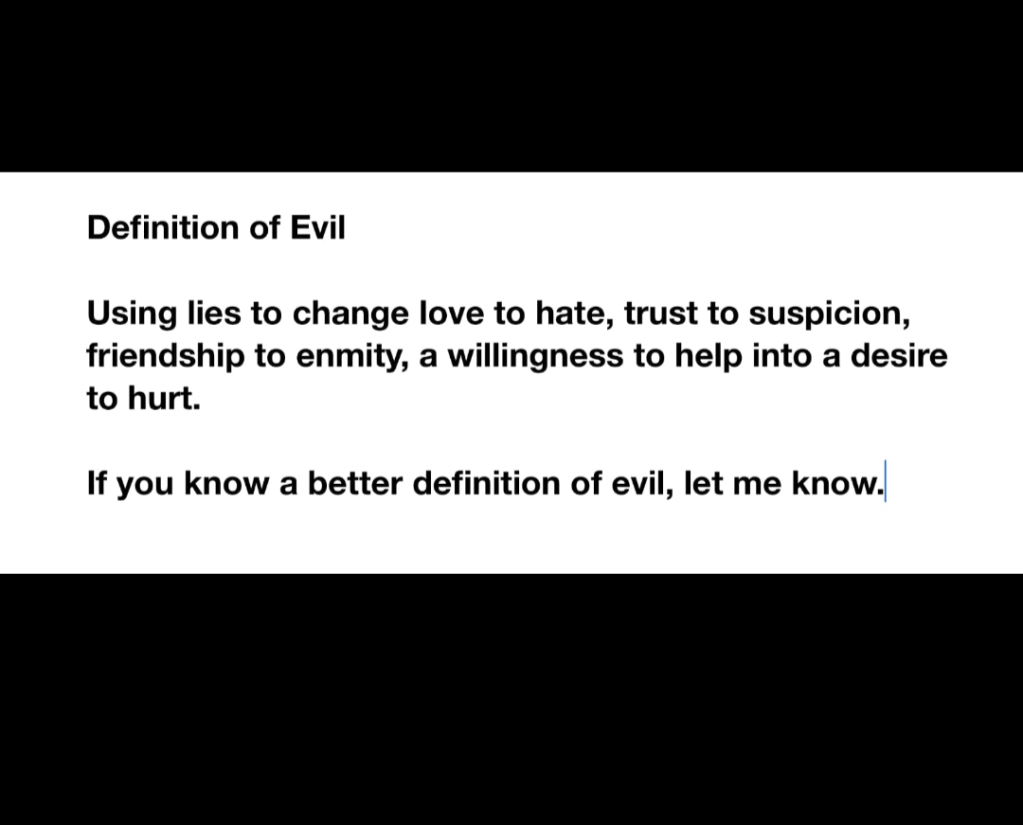
That human evil arises from unbearable pain and searing humiliation in the person who practices it is not hard to observe. Peck’s book was case study after case study of people who routinely hurt others brutally and convince their victims, themselves and everyone else of a lie that leaves the perpetrator completely blameless. He isolated human evil, describing these people of the lie, as well as I’ve ever seen it done. Evil is always based on inhuman, mercy-negating lies.

The story that stuck with me was of a suicidal young man who was brought to Peck by his concerned parents. The parents had a plausible story for the boy’s depression. Peck eventually spoke to the boy privately and learned the truth of the precipitating event — the parents had given the boy a gift, the gift rifle from them to his beloved older brother, who had recently used it to kill himself. The parents went into a rage when this story was revealed, as if it could have explained anything, and immediately terminated therapy for their depressed son. Such is the nature of the lies destructive people routinely tell to hide their rage and the shame that provokes it.

It is one thing to read about this foul trick in a book. It is much more powerful to experience it unexpectedly in your own life. It is viscerally unsettling to find yourself close to this kind of destructive desperation. It smells like death and conjures atavistic images of devils and eternal darkness. Get a good whiff of this evil and it will take a very long time to get the stench of it out of your nostrils. You are unlikely to completely recover without expert help, help I am still trying to secure.

Case study from my own life: old, beloved friend reacts with rage to what she perceives as her friend’s defiance. Leave aside the entire concept of defiance — a stubborn refusal to yield to the will of another. Just look at the display of rage — a focused, hostile glare of the kind described as ‘if looks could kill’ directed at you for long, silent minutes, as her husband tries to gently translate her glaring silence, explain why she is too upset to speak. It is not a transient moment of rage, it continues, through the end of the tense negotiation and ends with a snarled refusal to compromise in any way and a closed bedroom door.

Never go to bed angry at a loved one is very good advice. You eventually learn that these two do it all the time, the one who must never feel defied and the martyred appeaser, silently locked in an angry struggle when they go to bed and when they wake up the next day, and the day after that.

Now, granted, having an ugly side of your relationship seen this way by dear, long-time friends is objectively embarrassing. It should not be the end of friendship, or anything like that, but it is something to be talked about afterwards. If it is actually felt as humiliating, the impulse to lie, and blame the witness, becomes irresistible. The alternative is acknowledging that you have no idea how to resolve conflict, how to deal with anger, are locked in a hideous farce of a beautiful relationship that everyone must admire, an admission that you need help.

The one who must be right at all costs forces all the other family members into therapy, because she cannot be wrong, will not be challenged, will do whatever needs to be done to feel right, superior, beyond reproach or even criticism. She simply will not tolerate defiance, and she will NEVER go to therapy because she is perfect the way she is. All of her friends and colleagues tell her so.

If her son is depressed, to the extent that he must be hospitalized for it? Sadly, the young man inherited his father’s depressive DNA instead of her genetic predisposition for happiness and high achievement. She and her husband have been the ideal parents to this hypochondriacal, oversensitive, vacillating, embarrassingly unrealistic young idealist, as everyone who knows them knows. If their former closest friend, the aggressively, threateningly defiant one, is told by a mutual friend that the boy is in a mental ward, that is betrayal. It is none of his fucking business! He is DEAD to us, DEAD. What do you not understand about DEAD?

The funny thing about being dead is that if it happens to you while you’re still alive, well, you’re a dead man talking. You are right now reading the words of a dead man (which will be true enough, by and by, if you happen upon these words once I am truly gone), a dead man about to go to the kitchen and get a cold drink. Kind of funny, this kind of death, in an ironic kind of way, no?

The person who is not damaged to the point of destructiveness is always the last to understand, the game of people damaged enough to be evil is always to the death. There is no irony at play when the Nazi says “we are going to kill every last one of you, Jew.” Nazi irony is of a special kind, winking to its cohort and the world — “Work Liberates” on the gates of a slave labor/death camp, “Special Handling” stamped on the passports of those transported to such workers’ paradises and so on. Every evil must be accompanied by the lies that make it possible. With the wonderfully flawed human understanding that if you honestly believe that a lie is true — it is not a lie.
In a place where there are no mensches, strive to be a mensch

A mensch is someone who strives to be honest, to keep their word, to do what they know is right, even if there is a price to be paid for right action. Real mensches are rare, we treasure them when we meet one, and, if we are decent, we try to live by the example they set. Jews are commanded “in a place where there are no mensches, strive to be a mensch”. So this is me, on the holiest day of the Jewish year, striving to be one.

I refrain from telling two longtime dear friends, too damaged by their own childhood trauma to refrain from assassinating my good name, that they are teaching their children a vicious and wrong lesson about life. I manfully avoid writing them and their family a note to ask: are you really teaching the three children you love that your own inability to deal with your pain, humiliation and rage entitles you to decide who they may love?

I would not be wrong to write those words, but I have to first consider if they would have any practical effect, if they could possibly improve anything between me and people who have decided I am dead because I was hurt by them and refused to simply shut up and pretend everything was as it always was, or as it always seemed to be.

My words would have no effect except to make two people already too humiliated to act with decency feel even more humiliated. It would increase their rage. It would harden their resolve to make sure the lid of my coffin is hammered tight shut and I remain, for all concerned, dead and silenced forever.

So, I am reduced to thinking these dour thoughts and writing those words here, as we all fast and consider our good and bad acts of the previous year, and who we still need to make amends with. I strive to be a mensch, and they have long avoided reading anything I post here, so there is little chance of them ever reading this. Still, there’s a chance they might. If they do, call me pisher.