Impossible letter #2 — background

The impossible letter, I understand now, is any letter written to influence somebody who has unquestioning, unreasoning belief.  The greatest letter you can conceive will not change deeply held beliefs, unless the heart of the recipient is already inclined toward what you have to say.  It’s natural to suspect a nefarious motive when you receive an attempt to persuade you of something you’re not inclined to accept, coming from someone you’ve been warned against.   A charming, personal letter from Hitler, no matter how beautifully written, would have little chance of changing my mind about anything.

Impossible letter number two was written to my only two living blood relatives, my niece and nephew.   I was disappointed, but not entirely surprised, to have no response from either of them.   The back story is long and complicated, though also simple and straightforward.

The roots of this insoluble impasse to-the-death, like most things of a deadly emotional nature, are in long-ago childhood.  I have avoided writing directly about this particular tangled emotional web but at this point my need to set things out is greater than my need to be senselessly discreet.   When you’re forbidden to talk about things, and they continue to bother you, the most obvious option, for those who sit down every day to write, is to write them out.   To me clarity is a much better option than blind emotional commitment to a strong, unreasoning feeling.   If you’re like me, the impossible letter eventually begins to take shape in your head, you imagine the clear telling that will set everything straight, in a perfect world.

In the home my sister and I grew up in, our father dominated our mother.   Dad “won”, mom “lost” — she always compromised, he almost never did.  Our mother was smart, quick on her feet, funny, competent, sociable, a better driver than our father, adroit at solving mysteries, but she always deferred to her strong-willed husband during the hollering matches we had with our dinner almost every night.   She bent to whatever he needed, always took his side, out of love, loyalty, sympathy, knowing how badly he needed to be right, fear, weakness, conditioning, lack of confidence, variable self-esteem, a housewife’s expected fealty to her husband in the 1960s, some combination of all of the above.  Our father was upset almost every evening, exhausted by working two jobs and the monstrous ingratitude of his two spoiled, mean-spirited children.  He flew into a rage easily and in his rage was never without righteousness on his side.  He was rightfully known as the DU, The Dreaded Unit, my sister’s perfect name for him.

My sister paid me a great compliment once, when we were young adults.  We were sitting in a Dunkin’ Donuts in south Florida.  She asked me why I wasn’t like either one of our parents.  I told her that if those were the only two options in life, to become one of our deeply damaged parents, I’d have long ago snuffed myself.  I asked her why she thought those were the only two choices.  I had no understanding then of how inexorably our childhood had marked my sister’s life, limiting her choices to modeling herself after a winner or a loser, righteous dominance or humiliating submission.

“I’m the DU,” she told me somberly, shortly after her second child was born.   She fixed me with a terribly poignant look that shook me as much as her statement.

“No, wait, that can’t be, you can’t… you have to do something about that.  You need to talk to somebody, you need to do some work, you can’t replicate what was done to us.  You don’t want to inflict that kind of damage on your children.  You can’t do that to them, come on, they’re totally innocent.   What are you going to do?  You’ve got to nip this shit in the bud.”

“Being the DU means you can’t do anything about it,” she said. 

Decades later I understand that if you are damaged enough to see the world as black and white, win or lose, pride or crushing shame, with nothing in between (compromise is weakness) you believe, in your core, that there is nothing you can do about it but get up every day and fight anyone who makes you feel bad about yourself.  My father always argued that people cannot change on any fundamental level.  

I understand now, only very recently, that it was a true statement for him.  Being the DU means you feel utterly powerless against your dreaded nature.  If you acknowledge that others can work and change some of the worst things about themselves, how humiliating that would be.   It’s almost like you’re choosing to be too weak to face whatever makes you live in a black and white world.

(part 2 to follow)

Thoughts and prayers

Happy Birthday to Jesus from the family of Andy Ogles, the newly elected George Santos of Tennessee’s brand new gerrymandered 5th district. The place where America’s gun, the AR-15 assault rifle, killed 6 more in a Christian school the other day. Andy says we have to wait, we don’t know all the “details” of the 130th mass shooting of 2023 yet, and arm ourselves in the meantime.

Latest US gun massacre, for the moment

This murderous asshole was a female of some kind, killed three nine year-olds and three adults. Assault rifles, two of them. Number one cause of death for Americans aged 1-19, bullets.

Heather Cox Richardson, with context:

Seven people died today in a school shooting in Nashville. Three of them were nine-year-olds. Three were staffers. One was the shooter. In the aftermath of the shooting, President Joe Biden once again urged Congress to pass a ban on assault weapons, to which today’s Republican lawmakers will never agree because gun ownership has become a key element of social identity for their supporters, who resent the idea that the legal system could regulate their ownership of firearms.

In the wake of the shooting, Representative Andrew Ogles (R-TN), who represents Nashville thanks to redistricting by the Republican legislature that cut up a Democratic district, said he was “utterly heartbroken” by the shooting and offered “thoughts and prayers to the families of those lost.” 

In 2021, Ogles, his wife, and two of his three children held guns as they posed for a Christmas card with a caption that read: “The very atmosphere of firearms anywhere and everywhere restrains evil interference—they deserve a place of honor with all that’s good.”

Heather

Writing draft two of my father’s story

My father, a brilliant man with a quick wit and a dark sense of humor, did severe damage to my sister and me.  Our childhood was a minefield, a war zone, we grew up in a home of constantly shifting alliances where accusations and angry screaming accompanied dinner almost every night.   

Irv always presented a puzzle that was impossible for me to solve: a man with so many admirable qualities, capable of being such a great friend, so funny and enlightened about so many things, who was, at the same time, so maniacally determined to never be wrong that he waged total war against his own children.  He was hellbent on never losing an argument, no matter how shaky its foundation.  He insisted to the end of his life, for example, that I’d had it in for him since I came home from the hospital, a newborn with a clear rage against his father from day one.  I stared at him as a two day-old, in his account, with big, black, accusing eyes.

The last night of his life, April 28, 2005, he expressed many regrets, but until then, and I was close to fifty that night, he always fought like the devil.  His rapidly approaching death seemingly relieved him of the need to fight to the death.  He was able to be candid about the demons that pursued him, for the first time in his life.  Looming death helped him gain clarity, but there were other forces also in play, as I will describe in the pages to follow.

I sat down, daily, in 2015 and 2016, and spent a few hours writing down everything I could think of about my old man, from every angle I could imagine.  It was like trying to assemble a jigsaw puzzle with a hundred missing pieces, in a darkened room.   At the same time, the process of remembering and reconstructing his life was fascinating.  Most amazingly, writing it all out got me closer and closer to truly understanding his uncompromising point of view when it came to conflict.   I didn’t agree with him much of the time, and understood his deep regrets about having been that way, but by the end of writing that first draft, and thinking about it, I felt that I truly understood how and why he came to see things the way he did.

Early on in writing that first draft the skeleton of my father piped up one day, and figuring I could always go back and delete the adorable device, I let him speak up regularly.  Much of that first draft is a back and forth with my father’s skeleton.  Over the course of writing I had many sessions with the skeleton, a close version of my father, whose voice I could hear very clearly as the skeleton made his opinions known, only much more capable of honest self-reflection since his death.   

I found myself greatly looking forward to our almost daily conversations, which seemed to me only partly imaginary though I was transcribing both sides and had no illusions that my father’s bones were actually sitting up in his grave, as I described, speaking at length and sometimes commenting drily on the raptors flying over the Westchester graveyard where he’s buried.  In the end, 1,200 pages, and many sessions with my father’s bones later, I was able to see things through my dead father’s eyes.  It was an outcome I never imagined.

That sprawling first draft was nothing close to a book and there are many reasons for it.  For one, the conceit of an extended conversation with my father’s sardonic, philosophical skeleton struck me as a bit precious and contrived (though the skeleton would have a good argument against my hesitation.)  Two big reasons for its incompleteness I am just understanding now, and they are connected.

The first is that I only recently put together that the personality type who cannot be wrong no matter what, the kind, like my old man, who is hypersensitive to criticism, quick to insult and anger, harshly blames everyone else for all hurt and never yields in any way, is not only a tortured soul, but a narcissist.   How did I not understand, until very recently, that my dear father was a narcissist?  

A narcissist, whenever there is conflict, is the quintessential black and white thinker.   They see themselves as either superior to everyone, or as utterly, humiliatingly worthless and undeserving of love or respect.  There is no grey area, no ability to compromise between these two stark choices.  In case of conflict, no matter how minor, for the narcissist it is always an existential war that can end only in domination or unthinkably painful submission.  They must use every weapon to maintain the narcissistic identity of perfect mastery or face the horror of their crushing unworthiness to be loved.

It doesn’t mean my father wasn’t also funny, sentimental, sometimes affectionate, very smart, with good impulses toward the world and an admirable identification with the oppressed (his paranoid tyranny over wife and children aside).  It just means his desperate childhood had damaged him to the point that he could not tolerate being wrong.  His fear of the humiliation of being wrong in any way was too painful for him.  He could not forgive, he could not apologize, there was no making amends with him.  My sister named him the DU, the Dreaded Unit, and not for nothing, the name fit him like a skin.

His narcissistic solution to the terror of ever being humiliated was to create a persona that was smart, well-read, informed, authoritative, adroit in argument, disarmingly funny, moralistic, admirably idealistic and formidable.   He had a real talent for debate and was without peer in constantly and effortlessly turning the disagreement from whatever conflict his opponent needed to resolve to a moral high ground of his choosing where he was in complete control at all times. Control, recent experience has taught me, is the cardinal need of the narcissist.  If the narcissist is not in control — devils and darkness!

Seeing the whole of my father’s life in terms of narcissism helps me understand it a little better. The first draft was written in the dark, in terms of the general insights about narcissistic incapacities available to me now.  In light of his personality having been without a doubt narcissistic, there is now a small lamp in the corner, shedding more light on the whole portrait.   Even as I realize that my father may not have presented as the classic narcissist because he was very skilled in making his manipulation seem entirely reasonable, even altruistic. 

The second major reason that draft one was a missed attempt to tell my father’s tragic, triumphant story is a limitation I put on myself in writing it.   The relationship that was the greatest illustration of my father’s character, his style and his limitations, was off limits to me. It involved a family member in our immediate family of five and I decided at the outset to exclude any mention of that important supporting character, indispensable supporting character, really, in an attempt to keep the peace with my remaining  blood relatives.  Taking this imagined high road did not prevent my estrangement from that little cult anyway, so, understanding what I now do about the worldview of narcissists, I am no longer bound by that high-minded impulse to avoid a painful part of the truth. No story worth hearing omits necessary truth.

Truth was a huge thing with my father.  There was some truth he was incapable of grappling with, true, but he was a big believer in the power of honesty.   He always stressed how crucial honesty is to any relationship and I took his guidance in that matter to heart.  In battles with other narcissists you will often encounter desperate lying, the constant shuffling of a shifting set of convenient facts that can be changed on the fly.   My father, because of his skills, never needed to do that.  I am not aware of any lie ever told by my father. He didn’t need to bend the truth, he simply reframed anything he didn’t want to talk about right out of existence.  

And yet, as clear as truthfulness is, as clear as an outright lie is, there is, in our world of imperfect humans, a vast field of gradation there in the middle.  

Part of that gradation is the way we treat people who we don’t trust but still need something from.  My father gave me the example, toward the end of his life, of a compulsively lying person he despised (and he pronounced the word with almost spitting contempt) but was able to pleasantly shoot the shit with, in order to have unfettered access to other people he loved.  The guy knew my father hated him, and he’d lost every argument he’d ever had with him, been handled as easily as a foolish child, but they talked sports, and the weather, and a little politics sometimes (they had roughly similar views), and for his part the guy played along, smiling, making wisecracks.  Anyone passing the two of them chatting would have assumed they were on good terms.  Unless one was able to observe their micro-expressions, those tell tale little flashes of true feeling that constantly play across the human face.

So this guy has to be a character in the final draft of my father’s story, he’s indispensable.  I forbade myself from including perhaps the most important supporting character in the story.  Can’t tell the story without including this motherfucker and everyone in his circle.  Sorry, but finishing this long delayed book is more important to me than a little group, damaged just as I was, who no longer speak to me anyway.  Let’s give ’em something to read about, shall we?

Waco!

“Remember the Alamo!”

No dog whistle needed for Trumpie’s first 2024 campaign rally. Waco, on the anniversary of the bloody government/ armed cult standoff and deadly fire at the compound of an armed anti-government cult in Waco, Texas.

Two years later, to the day, Timothy McVeigh blew up a government building in Oklahoma City, killing over hundred Americans.

30 years later, on the day, Trumpie, choosing Waco, on the infamous anniversary, sacred to those who hate democracy, to make his Hitlerian promises of merciless retribution against those sick trairors who would enforce the law.

Makes presidential candidate Ronald Reagan’s dog whistle to Southern racists, giving a states right’s speech in Nashoba County Mississippi, at a County Fair very close to where three civil rights/election workers were murdered by the klan and buried in a dam, seem almost subtle by comparison.

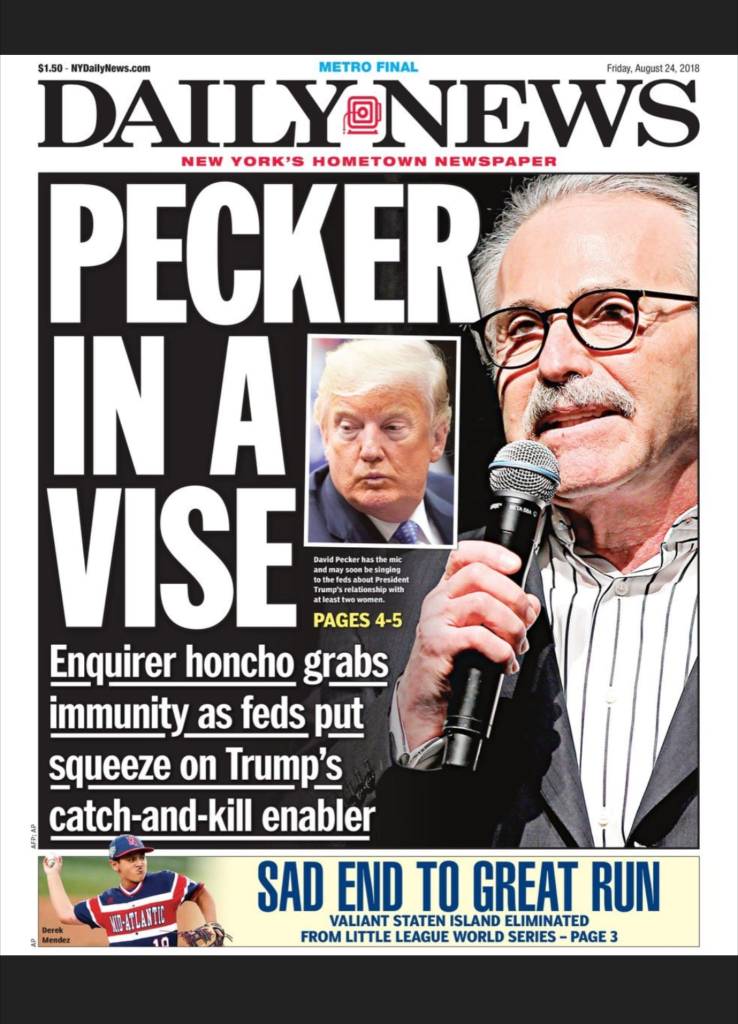
Same goddamn song, different singer. Indict Roger Stone already, for fuck’s sake

Trumpie’s ongoing obstruction of justice

Federal judge Lewis Kaplan, recognizing that a dangerous psychopath was a party to a lawsuit soon to be tried in his courtroom, took special precautions to insulate the jury from tampering, intimidation and threats of violence.

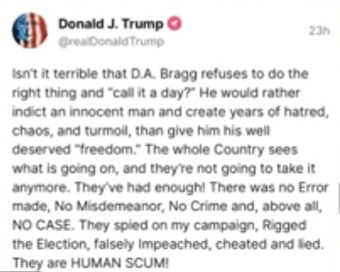
On the same day, the office of Alvin Bragg, the district attorney who Trumpie demeaned as human scum, a degenerate, psychopathic animal inserted by hateful Jew billionaire Soros, received, according to The New York Times, a package containing unidentified white powder (and a single piece of paper with the typewritten words, “ALVIN: I AM GOING TO KILL YOU!!!!!!!!!!!!!”). Can you say stochastic terrorism, taking its cues from the fearsome intimidator-in-chief?

Ben Meislas, an articulate lawyer with a nuanced understanding of the legal and political landscape of our threatened democracy, puts Trumpie’s rage tweets in context. He points out that judges are already using them as evidence of Trumpie’s lifelong penchant for intimidation, threats and inspiring violent retribution against all of his dangerous, sick, psychopathic, animal, Jew, Black, often female enemies. Ben included some of Trumpie’s recently posted overheated pronouncements against a few of his recent deadly enemies, human scum, worse than the Gestapo!

Image for a dead friendship

In hindsight, it’s often easy to see the moment when a friendship ends. The time of death can be placed pretty precisely in retrospect.

The image I had for the year I was hoping a cherished friendship was not dead was me carrying the corpse of a relationship I was desperately believing was not actually dead.

I realized just the other day that a more accurate image, in light of how relentlessly this heavy cadaver fought me to the death every time I tried to make peace, is that I was carrying a zombie who kept trying to bite me. Lovingly toting around a biting zombie. Try getting your brain around that.

Bad enough to be naive enough to carry the dead body of a beloved in hopes that maybe they’re not dead. But how much worse to carry a zombie that is actively trying to bite you the entire time?