not for profit

Reading a book I should have taken out of the library two years ago I learn the obvious:  a dedicated team of unpaid idealists is needed to share the heavy uphill burdens of starting a business based not on making money but on doing good.   “Be realistic about your capacity,” urges the author of this guide-for-idiots style book, “it is easy to find yourself burned out by taking on too much responsibility.”

“Delegate, delegate, delegate!” exhorts one chapter heading.  I opened my pocket-sized idea book and drew a bird-headed man in a contemplative pose, looking into a mirror and parroting “Delegate, delegate, delegate!”  Hell yeah.

The author writes that 75% of all nonprofits fail, in large part, because they are started by well-meaning people with no business experience.

The answer, of course, is to delegate more of the concrete tasks to myself and quit whining about how exhausted I feel all the time.  Will be starting wehearyou.netblahg, rah-rahing myself and keeping potential supporters apprised of my mad uphill dash.

As a friend and great supporter often writes “Go team go!”

Stinking Garbage Truck

I take my bike rides at night during the hottest time of the year.  The hilly streets around here are quiet, lights flash on the front and back of my bike, I wear white, and a helmet.   I can get a good aerobic, mind-clearing ride while listening to Bill Moyers, the timer in my pocket counting down an arbitrary 37 minutes.

One thing I’ve noticed this summer is a stinking garbage truck that races down the Avenue between 1 and 2 a.m., the same time I’m usually pumping up and down the hills.  Since the streets are empty, the truck rumbles along at top speed, trailing a wake of wet stink that hangs in the humid air for two blocks behind it.

I keep an eye out for the stinking truck, and smile when I manage to turn up another street to avoid breathing in its humid reek.   Last night, though, they were doing road repairs on both ends of Seaman Avenue.   The broad avenue was blocked off by trucks running their engines to keep the overtime crews inside cool.   I found alternate uphills on a much shortened route and was coming up Indian Road, a fairly steep incline, when the stinking garbage truck roared around the blind turn and came at me on the narrow street.   That I was riding a bicycle uphill and they were speeding the wrong way on a one-way street did not come into the equation for anyone but me.

“Motherfucking stink merchants,” I muttered as I managed to leap a mercifully low curb and continue up the sidewalk next to the narrow one way street.  Then I turned right, breathing hard, and headed into two blocks of the truck’s foul backwash.

Propaganda — short tour

soapbox, please.

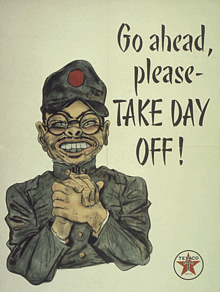
Personally, I thought this recent Texaco-sponsored Romney ad was a bit over the line.  Whether President Obama was born here or not, whatever his religion, or his extreme European Socialist views, what possible good can this sort of offensive negative ad do for our great nation?

(Full disclosure: the Texaco-sponsored bit of propaganda above was part of the war effort against Imperial Japan during World War Two and not an ad for Mitt Romney’s presidential campaign.  I am not linked with the Romney campaign, nor with any related or unrelated super-PAC or other charitable group supporting Mr. Romney, nor was the crude example of propagandistic rebranding strictly called for.  But, see paragraph below beginning “The Allies, Hitler pointed out…”)

But let us backtrack a bit and try to be a little more analytic.  What makes something propaganda?  A shameless and manipulative appeal to our emotions, brought to us via mass media.  What makes something good propaganda?  A well-paid ad agency, or government, or both, employing the most skilled people it can recruit.

1622, Pope of the Catholic Church, under attack by the so-called Reformation, creates an office to propagate the faith, sow it, let it flower.   Three hundred years later Hitler dictates the first volume of Mein Kampf, pauses to wipe the foam off his mouth and delivers a short, cogent lecture extolling the effectiveness of Allied propaganda in the recent World War.  That lecture concluded he resumes foaming at the mouth for the remainder of volume one and, presumably, in the secret, unpublished volume two.

Note: the editor of Mein Kampf was killed in “The Night of Long Knives”.

The psychopathic future dictator made several astute points in his discourse on propaganda.  One is that a lie, wielded without mercy or weakness, is almost always more useful in inspiring obedience and violent action than any sort of truth.  The Allies did not hesitate to lie about alleged atrocities committed by the Hun.  Hitler applauded this, it creates hatred of the enemy and also fear, which combined, engenders a determination to exterminate the enemy.   In contrast, the German authorities made a snobbish appeal to the superiority of their culture and troops, sneering at the contemptible unsophistication of the enemy.  

The Allies, Hitler pointed out, didn’t hesitate to make  up inflammatory captions to hideous photos– a gruesome pile of bodies waiting to be taken to morgue had not died of typhus (truth) but had been tortured to death, in a specific place and on a given date, by the Hun.  Not only that, they ran the incendiary picture in every paper for days running, with articles scrupulously documenting the invented crimes against humanity.

You starting  to get the picture?

Why did the USA get into the World War in the first place?  That is a question nobody to this day can give a very good answer to.  There’s no question American bankers had loaned many millions to the French and English war efforts, stood to lose a shitload of money if Germany won, but that alone can’t explain it.  There was a scramble for colonial possessions and a frenzy of competitive nationalism, but that wouldn’t be enough to have American farm boys, city boys and young collegians lining up to enlist.

It was the genius of George Creel and his Committee for Public Information that got them on their feet, cheering, patriotic and bursting to “make the world safe for democracy” to fight the “War to End War” and cover themselves with glory.  You can look it up.   Woodrow Wilson enlisted Creel and the Creel Committee, ingenious, tireless, unhindered by scruples of any kind, whipped up a great patriotic frenzy for war.   Lines of guys singing “Over There!” went over there to run to glory out of muddy trenches into barbed wire and machine gun fire, through mustard gas and aerial bombardment.

It begs the question of why America entered the World War. But it explains how.

Anyway, Google “propaganda”.  Look at the Wikipedia article.  I guarantee that the images you will imagine as you read will be based strictly on your political outlook, shaped by the famous confirmation bias.  Some will read the descriptions of the various techniques and see images of Cheney, Bush, Condoleeza Rice and so on.  Others will immediately see Obama, lying eloquently through wolfish teeth.

The one thing we can be sure of, effective propaganda costs a lot of money.  You have to saturate everybody, constantly, for it to work.

The Supreme Court told us recently that money is speech, the same way it once told us in the Civil Rights Cases* that biogtry against blacks had nothing to do with their status as former slaves, that nobody should get constitutionally huffy about it, and that the Fourteenth Amendment had nothing to say about it.  Go tell the Supreme Court they’re wrong.

“So, call me ‘pisher’,” the Supreme Court will shrug, “we’ll talk about this again in 90 years or so.”

As for me, I’m speechless.

*  see italic section near bottom of  post below for a full-bodied quote from that fascinating decision, it begins When a man has emerged from slavery

https://gratuitousblahg.wordpress.com/2012/08/07/my-fellow-americans-ignore-me-25-2/

The Definition of Insanity

“Sitting in a cluttered hovel, staring at a screen, writing stuff like this, waiting for nothing, ” he wrote, trying to define it succinctly.

“That is not the definition of insanity,” said his imaginary friend, breathing out loudly through large nostrils.

“Takes one to know one,” he wrote on the screen, where his hulking imaginary friend sulked.

“Enough with the imaginary friends,” said a real friend, but it caught him unawares.

“But, Howie, you’re dead,” he said.

“Sure,” Howie said, the most cheerful dead man you’d ever want to see, “but then again, what do we really know about death?  I was sitting at a traffic light in Berkeley, one minute alive as you and me… well, alive as you, anyway, and the next minute.”  He snapped his fingers.

“You recall that ragged guy you passed this afternoon lying in the grass?  Up by the Allen Pavilion?  You paused, watched to see if he was breathing.  At first he didn’t seem to be.  What did the woman getting out of the car nearby do?  She asked you if he was breathing.  You said he was.  The two of you approached him.  She touched a hand to his filthy naked shoulder and shook him when he didn’t answer.  You asked him if he needed help after he grunted.”

“Is this a Zen koan?” he asked his dead friend.

“No, it’s a bell of mindfulness.  When the woman walked back to the car, satisfied that the dead looking guy was alive and didn’t want help, another woman came up to you.  A fat woman with a smart phone in her hand and a kind expression on her round face.  She was also concerned about the dirty man in the wife-beater lying face down on the grass.  You spoke for a moment and she walked back uptown to let the hospital’s security guard know a man might be expiring a block from the Emergency Room.”

“A bell of mindfulness,” he mused.

“Yes,” Howie said. “there’s nothing to be gained by defining insanity.  Most people would qualify, by one definition or another.  You have a heart, and a conscience, and you don’t know what the hell you’re doing and you don’t know how to proceed, or how to put your head down against the wind, and you tend to lose faith.   That doesn’t add up to insane, in my book.”

“A bell of mindfulness,” he mused, smiled at his dead friend, put on a white shirt, a pair of shorts, his helmet, shouldered the Chinese-made Schwinn and headed down the stairs to the avenue to do his laps up and back in the faintly cooled summer night.  The bell of mindfulness sounded faintly as he went.

My Fellow Americans Ignore Me

The statistics don’t lie, there is only one reader in Poland who continues to click on this blahg occasionally.  I’m not grousing, mind you, we Americans pretty much ignore each other as a matter of national pride.  USA!  USA!

If I have learned one thing from this program I’m trying to launch, the one in which I put all the eggs I will ever have in one basket and balance it at the end of a long, brittle stick held by an extended, shaky arm, it is not to be so damned sensitive.  Sure it’s nice to have feedback, to feel  some appreciation from time to time, but here’s what I’ve realized:  the work is the same, whether it is commented on or not.  Also this: I am the final judge of whether I have succeeded in a given work or not.  I am the expert on my progress or lack of same.

“Oh, you are talking to yourself, trying to be brave,” you will say.  Absolutely right, but there’s more.   I am not dashing face-first into a wall, I am not collecting cobras like the little girl in India who gets bitten by one of her “best friends” 

http://www.youtube.com/watch?v=ZMz7DOcwUpg&feature=player_popout

I am no longer pissed off all the time about friends who can’t bother to lend a few seconds of moral support, even as a tic seems to force me to check the stats on this new blahg several times a day and mutter to myself “some American bastards messed up my perfect downstepping ziggurat on August 5.”  I know it was Americans because of the map.  And I know, pretty much, which Americans those probably are, since only five or six have been sent the secret link to this blahg.

But, who am I fooling?  I know why Americans ignore me, and I would ignore myself too, if it was within my power.  I don’t dream the American dream, for one thing.  A friend and I were discussing that dream the other day.  On its face a dream of “freedom” (like what was on the march in Iraq a few years ago when so many lost their lives) but it is, more precisely, the dream of being rich, of having enough money to buy whatever you want and also, with that money, the ability to tell everyone to go fuck themselves.  As dreams go it may seem a tad materialistic, maybe a little shallow, but who am I to judge a dream as big as the American Dream?

Sure, it’s easy to take potshots at a nation that used the phrase “Manifest Destiny” to commit a deliberate genocide against the people who occupied the territories it was God’s Will Americans could own and exploit.  Easy too to condemn practices carried on for more than a century, under the “inalienable truth” that “all men are created equal” (and for 150 years before that banner was raised).  

The practices of our Peculiar Institution left the once fertile soil of the American south stripped of nutrients and the soul of America stained with the kidnap, murder, subjugation and rape of millions kept in chattel slavery.  You could say that the Divine retribution Jefferson feared, even as financial considerations made it impossible for him to manumit the hundreds of chattel slaves he owned (his sole wealth, after all), is still being visited on America for the way it built its collective wealth on the exploitation of slaves.

Generations later you can see the descendants of these slaves, hardly grateful at all, most of them, for the freedom they have enjoyed since being freed in 1865, and more particularly, since the Civil Rights Acts of 1964 and 1968 guaranteed these freedoms once again.  Including the freedom to once again seek redress in a federal court, after a ninety year hiatus, if you or your family is lynched by a non-governmental outfit like the Ku Klux Klan.

I know I go on about this all the time, and I’m aware how tedious it is.  I really should take the hundreds of hours of research I did in Law School and write a concise version of that paper “The Day of Blacks as the Special Favorites of the Law is at an End”.   That was the conclusion of the Supreme Court when it decided the unintentionally aptly-named Slaughterhouse cases in 1873.  The reasoning was quintessentially American.

The slaveholding states of the former Confederacy, who, until their secession, held their slaves under inalienable Constitutional right, were devastated by the Civil War.  There was nothing civil about the Civil War, as we all know.  The infrastructure of the South was destroyed, roads, bridges, levees, crops, cities, everything.  In order to qualify for Federal funds to rebuild, the defeated rebel states were forced to ratify the 13th, 14th and 15th Amendments.

I don’t know much about the other amendments, except that the First allows me to write the word “fuck” here if I fucking feel like it, and the Second guarantees the right of private American citizens to have as many guns as they like, including assault weapons designed for spraying up to 100 bullets a minute, and as much ammo as they can afford.

But I know a lot about the 13th, 14th and 15th.  The 13th ends slavery and involuntary servitude.  Under the 13th amendment the only way the state can put you on a chain gang is if you’ve been convicted of a crime.  Private actors may or may not be subject to this restriction, but that would be fought in the courts for more than a century and is still in dispute, hinging as it does on the precise meanings of “involuntary” and “servitude”.

The 14th Amendment is a big one, it guarantees that the rights of U.S. citizenship shall not be denied or abridged by the states.  Since the angry radical Republicans in Congress who drafted and forced these Amendments down the throat of the defeated South knew lawyers and judges down there would look for loopholes, they created an enabling act as part of the Amendment.  Congress can, and did, pass any law necessary to enforce these federally guaranteed rights. 

The 15th Amendment is really not worth talking about.  It guaranteed to Negro men, whatever their previous condition of servitude, the right to vote.  Treated as a bit of dark humor from the beginning, it would wait a century for any sort of enforcement.

But the 14th Amendment was a big one, it created the Department of Justice, for one thing, and the never repealed laws passed under its enabling act virtually shut down the Ku Klux Klan for a short time.  It allowed, for a time, the election of numerous black representatives, seemed to guarantee that the former Confederacy could not continue to exploit its former slaves or, for instance, pass Black Codes that made it a crime, punishable by a lifetime of indentured servitude, to be unemployed.

The 14th Amendment protected freedom until the Slaughterhouse decision and a few others, (like the little known Cruikshank case holding that States had exclusive jurisdiction over adjudicating murder cases, even cases of organized, racially motivated mass murder), made the scope of the 14th Amendment and the law of the land crystal clear.

The Slaughterhouse cases were brought by white businessmen, slaughterers and butchers,  protesting the monopoly the State of Louisiana had granted to other white businessmen.  Their lawyers styled Louisiana’s restraint of free trade as imposing a kind of “involuntary servitude” and sought the protection of the 13th and 14th Amendments.  I don’t remember the dull procedural details, you will forgive me.

But I remember well the holdings and influential dicta of the case.  The Court said, first of all, everybody knows the 14th Amendment was passed to help Negroes, not white businessmen who were never slaves, so you slaughterers are a cynical bunch trying to invoke it.   And, second of all, the rights of Federal citizenship protected by the 14th Amendment are three:  the right to freely migrate from state to state, the right to use navigable interstate waterways and another, equally essential right, that slips my mind now.  Everything else, said the Court, is the province of the individual states as far as granting or taking away rights, inalienable or otherwise.  Law of the land for almost a hundred years after that.  In layman’s terms the Court said: “I’ve got your 14th amendment right here, bitch”.

The Court also took pains to make it clear, less than a decade after the bloody Civil War ended, that the day of former slaves “as the special favorites of the law” was at an end.  “And how!” as my idealistic grandma Yetta would have said.

Oh dear, my fact checker, Google, informs me that I am incorrect.  That last bit was not uttered by the Court until the so-called Civil Rights Cases decided ten years later, by which time former slaves had, arguably, enjoyed their freedom for almost two full decades.  Here’s what the Court wrote:

When a man has emerged from slavery, and, by the aid of beneficent legislation, has shaken off the inseparable concomitants of that state, there must be some stage in the progress of his elevation when he takes the rank of a mere citizen and ceases to be the special favorite of the laws, and when his rights as a citizen or a man are to be protected in the ordinary modes by which other men’s rights are protected. There were thousands of free colored people in this country before the abolition of slavery, enjoying all the essential rights of life, liberty and property the same as white citizens, yet no one at that time thought that it was any invasion of his personal status as a freeman because he was not admitted to all the privileges enjoyed by white citizens, or because he was subjected to discriminations in the enjoyment of accommodations in inns, public conveyances and places of amusement. Mere discriminations on account of race or color were not regarded as badges of slavery. If, since that time, the enjoyment of equal rights in all these respects has become established by constitutional enactment, it is not by force of the Thirteenth Amendment (which merely abolishes slavery), but by force of the Thirteenth and Fifteenth Amendments. blah blah blah.

I confess, I have no idea why it doesn’t come under the 14th Amendment (Slaughterhouse notwithstanding), as it would come to be almost a century later.  Oh, of course, Slaughterhouse ruled that the 14th Amendment covered virtually no rights a white man was bound to respect.

Anyway, I leave you, Polish guy, with the last part of a review of Manning Marable’s biography of my brother Malcolm X, clipped and sent to my attention by a friend  I sent the link to.  It has some bearing on the earlier part of this exercise in tedium, where I was on about the American Dream.

The real tension exists in one simple fact: Malcolm’s story is one of the great human stories, but it is not one of the great American stories. This is not Horatio Alger, Benjamin Franklin, or even John Galt. His success as a human being is not measured in terms of wealth or prestige. It is measured in moral terms. His was not a life to be evaluated within the basic assumptions of mass capitalism. He cannot be reduced to a postage stamp or a children’s book. In his final days, Malcolm recognized that this is a worldwide struggle of the people versus mass capitalism, which was out of control in 1965 and now out-Orwells Orwell. This marked him for death in our society. It also made him one of the great figures of world history.  If we ever figure out why this is true, we might have a chance at social transformation – a reinvention, as Manning Marable puts it.

full review here:  http://www.ctka.net/reviews/Manning_Marable_Malcolm_X_Green.html
A Man with Strong Opinions

I had a long wait to have blood drawn at the hospital today.  I’d gone in for a consultation to schedule out-patient surgery to fix an umbilical hernia.  Didn’t realize they’d be drawing blood today, or doing an EKG either, but I found myself waiting for both. Sitting outside the phlebotomy room I penciled optimistic notes on the back of a Statement of Patients’ Rights.  I saw the bottoms of two crutches out of the corner of my eye, heard “excuse me” and moved over on the bench without looking up.  

“Thank you,” said the man with the crutches, sitting heavily beside me.  I grunted graciously and continued to draw and make notes of the simple animations I would do when I got home.  It’s amazing how all things seem possible, easy and wonderful too, when you are optimistically making notes.

I sensed that the man with the crutches was looking for conversation, but I wasn’t.  I glanced over my shoulder at his profile and recognized him at once.  He didn’t recognize me, but he had no reason to.

I recognized him as the man who’d been crying on Broadway near 204th Street many years ago.  He was crying, he explained, unsuccessfully trying to pull himself together, because he was from Boston, or perhaps Philadelphia, and he’d just been mugged, and then roughed up by the police, which is what really hurt, but he’d managed to hold on to some money hidden in his shoe, I think it was, and only needed $12 more dollars to get on the bus and go home.   A grown man, crying in the street, begging me for $12.  I may have given him a dollar, I don’t recall, it could have been fifty cents.

The reason I recognized him was that several days later, on another section of Broadway, near 115th Street, the same man began crying to me, trying unsuccessfully to pull himself together, launching into the same story about being mugged, and roughed up by the cops, and needing a certain sum to get out of this hellish town and back to wherever it was he claimed he was trying to get back to.  I glared at him that time, snarled nasty things at him, though I’m sure I was one of a hundred people who’d done that to him that day.  Perhaps that same number also gave him a buck or two, or a sandwich, or some sympathy the same day.  A salesman knows you win some and you lose even more; no reason to catalog the losses. 

“I’m a working man,” I heard him tell the old black woman he’d managed to corral a few seats away, “I’m a bricklayer, or at least I was until the economy went into the toilet and nobody is hiring American workers anymore,” he told her, with all the sincerity in the world.  “I grew up in this town, I’m a lifetime New Yorker,” he said, right after telling her he wasn’t drunk or anything when he broke his ankle, he’d tripped over his nephew, they’d been playing, and the ER doctor had sent him home with tylenol telling him it was just a sprain.  Which he believed until the leg grew more and more painful and finally swelled up like an elephant’s leg a few days later.  He was very grateful to have a good doctor now, and that’s who he was waiting to see.

As the old woman nodded politely he began to tell the story of an honest working man who remembered a time when even criminals in the projects where he grew up respected old people.  “Old people have wisdom, and I remember many times when I was young seeing hardened gangsters go after a kid who disrespected his elders,” the woman nodded, a forced smile fixed on her face.  “It’s not like that anymore, ma’am, sad to say,” he said with great sincerity, “nobody respects anybody anymore, least of all the senior citizens.  The first thing everybody does now is reach for a weapon.”

As I drew stick figures moving animatedly across the paper and imagined, in spite of everything, that I may still be becoming the change I want to see in the world, he went on in this vein, expressing his deep convictions about America, what needed to happen in society, and what had gone wrong.  I have to say, I didn’t disagree with much of what he said.  

I’d glance over at the old woman from time to time, look at the stiff, almost convincing smile on her nodding head and wonder if it she was agreeing too, or just understanding, with the wisdom and street smarts of the old and unwealthy, that whether she wanted to listen or not, she’d better keep nodding and smiling at the large, haranguing bullshit artist who needed so badly to talk.


The Continuing Debate over Manning Marable’s Malcolm X: A Life of Reinvention

As I was too sticky to sleep last night anyway I found myself researching reactions to the Manning Marable biography of Malcolm X that had recently shaken me.  Whatever its possible deficiencies, the book presents what seems to be a three-dimensional person, flawed and admirable, decisive and contradictory, inspiring and tragic.  The portrait made organic sense to me, troubled me, inspired me.  This was not, apparently, the same reaction all readers had to the book.

There was a video debate on Democracy Now from shortly after the book was published in which Amiri Baraka and a professor named Michael Eric Dyson go at it, sometimes using hammers, other times gently plying tongs, over whether Malcolm or Marable, or the good professor or the genius Baraka, was faithful to Lenin, a Social Democrat, an apologist, a racist, etc.  I could see Malcolm’s skeleton in his grave, shuddering.  The most reasonable-sounding of the three guests did not fight to get too many words in edgewise.  When he did it was mainly to brush away as nonsense the sex-related tidbits Marable received a lot of attention for including.

The New York Times review chimed in predictably, as their editorialist did in sickening fashion immediately after Malcolm was murdered.  I went from a review that concluded the book read like it was written by a committee of grad students who’d thinly sourced it, to one that praised the book as the definitive biography of the great and problematic American icon. 

What is it about American icons that so many of them seem to get executed by shady men with guns?

The most thorough walk-through of the book I found last night was presented on a website, I noticed after reading the review, dedicated to researching and publicizing the truth about the executions of American icons JFK, MLK, RFK and Malcolm X.   I thought it was an excellent review, similar to my own reactions to much of the material, ignoring the sexual suggestions so many had focused their critiques on.   I had to confront my  own knee jerk reaction to noticing the nature and mission of the website, which says a lot about how successful the mainstream media has been in marginalizing “Conspiracy Theorists”.   It is clear to anyone who thinks about Malcolm X’s assassination for more than a moment that several forces, with different agendas, played essential roles in his execution.  The same seems to go for the other assassinations, the same goes for the series of very odd coincidences surrounding and following the catastrophe of 9/11.

It is not surprising that the author of the review for that website (see link below) praised the academic Marable for laying out, in a credible, highly footnoted mainstream book, the interlocking details of certain conspiracy.  Also not surprising that the reviewer was one of the few who did not spend more than a few lines on some of the titillating details other critics had gone ballistic over.

For example, Marable concludes, in a couple of paragraphs among 495 pages of text, that the young Malcolm himself was likely the gay hustler, his “friend” Rudy in the Autobiography, who stripped and sprinkled baby powder on the rich white man who achieved orgasm during this practice.  He supports this assertion by pointing out that the rich white man, Paul Lennon, communicated with Malcolm while Malcolm was in prison, and perhaps also sent money.   Lennon is apparently also mentioned, as a possible benefactor, in at least one letter Malcolm wrote to his family from prison.    

Numerous reviewers were incensed by this suggestion of some possible variant of mercenary homosexuality on Malcolm’s part (it is the only such mention in the book) and also by Marable’s strong suggestions of marital infidelities by Malcolm and his wife Betty in the last year of Malcolm’s life.  Another reviewer, on WordPress, a gay female reverend, from the looks of it, wrote a treatise about homophobia in the black community and offered some even more detailed allegations about young Malcolm’s supposed sexual preferences from a 1991 book.

I am now even sorrier that Marable died two days before his provocative book was published.  I’d like to have heard him defend himself and his research, amplify his call to investigate the assassination and prosecute the real murderers, all of whom he names by name in the final chapters, including the man who wielded the shotgun that ripped the first, seven inch, hole in Malcolm’s chest, one-time Newark NOI member Al-Mustafa Shabazz  (formerly Willie Bradley), still alive and well, 73, and defended by his wife and lawyer in the Newark Star-Ledger as an innocent man.  I’d like to be able to get on to the exhaustive Malcolm X Project website that Marable set up, and which seems to have followed him to the grave.  I’d like to dig deeper into all this, if only for my friend in Gaj.

If nothing else, the undisputed fact that three or four hours after Malcolm’s bloody execution, police photographers and the forensics team left the ballroom, Audubon staff mopped up the dead man’s blood, and guests danced in the regularly scheduled Washington’s Birthday party dance, makes me want to holler.  It really does.

link to the review mentioned above

http://www.ctka.net/reviews/Manning_Marable_Malcolm_X_Green.html

Downstepping Ziggurat

As part of our instant gratification culture one can sign up for a blahg (merely click the tab at the bottom of this screen), tap a few words, hit “publish” and send your thoughts, or lack of same, out into the world.  A thousand of these posts comprise a hundredth of a drop in the ocean.  Of course, it is a virtual ocean.   Debates rage, issues fester, opinions are bandied, bloggers liked, disliked, friended, unfriended– all in an electronic environment only Philip K. Dick could have imagined fifty years ago.

WordPress has a feature that allows you to view constantly updated statistics on how many are viewing, liking, disliking, commenting on, refraining from commenting on, friending and unfriending your blahg.  By clicking a tab labelled “stats” you can instantly see a bar graph of views for the previous few days and by looking at the world map on the bottom, find the geographic location of these viewers.  Today, for example, as of 2:50 pm, four people in Poland, or one person in Poland four times, had checked the blahg.

International readership, yo.  Talk about your cachet.  

But here’s the cool part, for a man who feels his creative energies at low ebb, dragged on by the need to constantly produce upbeat material for a community project for kids that is, as of now, only him.  Check out the bar graph, which I’ll hopefully be able to do a screen capture of (COM-SHFT-4) and then crop, to give you, gentle reader, the same instant gratification, and odd shiver of perverse self-schadenfreude, it gave me.