Skunkie

Walking back from the all night grocery store with a small bag (which says “be the change” on it)  I turned up Cumming, a quiet one block street that leads to the famous corner where it joins Seaman.  It was 2 a.m. and garbage was set out in black plastic bags for early morning pick up.  Looking ahead and to my left I saw an odd looking cat moving among the garbage bags.

Strange looking cat, I thought as I got closer, with that wide beige back, and the dark fur everywhere else, the pointy face is not a cat’s face, nor that stripe on his head, nor cat ears, and what an odd splayed tail.

“Skunkie,” I said casually as the wild animal eyed me momentarily.  I noticed the skunk’s back was toward me, in position, and thought for a second “please, don’t spray me, man.”   I was like that kid getting tasered because he’d worn a t-shirt insulting to a powerful politician.  Don’t tase me, bro.

The skunk, satisfied that I was not going to try to pet him or otherwise molest him, that I was staying to my side of the narrow sidewalk, walking away at a steady but not alarming clip, looked after me to make sure I was serious about avoiding a show-down, and then went back to looking for dinner in the loose collection of plastic garbage bags, very businesslike.

I thought of another gentleman skunk I’d seen in the neighborhood a few years ago.  This one stepped out between two parked cars to cross Seaman Avenue, not far in front of my bike, also long after midnight.  I slowed, and the skunk, very self-assured, paused to look at me.   His look seemed to say “you know who I am, you know what I can do.  I say you move nice and slow and I walk across the avenue to my buffet.”   I agreed at once, waited straddling my bike as he unhurriedly crossed the wide avenue and disappeared among the black plastic bags.

To this day I’m convinced that skunk was the spirit of Sekhnet’s father, Sammy.  It was just after the good-looking, dapper 92 year-old died and my first thought, seeing the good-looking intelligent face of that skunk, calculating and shrewd, was that Sammy’s  spirit was visiting me in the person of this handsome little forest creature out for some human food on a Wednesday night.  When I told the story to Sekhnet she had no doubt her father had contacted me in the person of the skunk.

I’d almost forgotten this annoying slice of NYC life

Luckily I had my notes from 9/7:

I took the C local uptown because there were plenty of seats, the A was crowded, and I could take the C, a slightly slower boat, to 168th where I could switch to the A for the short last leg of the ride to Dyckman Street.

As these things often happen, the C train inexplicably stopped in the tunnel a few hundred feet from the last stop, 168th Street, the stop where I’d catch the A for the five minute ride home.   The train sat in darkness for three or four minutes, the engines silent.  Suddenly the engines rumbled to life, the train lurched forward two or three feet, then stopped again, and went silent.  Another few minutes passed.  Though I had nowhere to be, this was annoying, since it would likely mean missing the connecting A train and waiting another ten or fifteen minutes for the next one.  For nothing.

The speaker started crackling, the conductor about to begin a belated apology for the delay.  Before he could even thank us for our patience the train rolled slowly into 168th Street.  Very slowly, but not slowly enough that I didn’t see the A train across the platform, its doors closed, poised, either just having pulled in or just about to pull out.  

It happened in slow motion.  We sat on our side of the platform, with our doors closed, looking at the immobile A train, with its doors closed.  If we were pirates we could have swung easily from one train to the other, daggers in our teeth.  

In the way of such things the doors of the C took a minute to open at that last stop and the A train, after waiting with doors closed for just long enough to give hope, pulled slowly out, towards my stop five minutes up the line.

The conductor of the C, its run now at an end, was looking out his window and I took the opportunity to vent to him a bit.  “Did you see that A train leave right as we pulled in?” I asked.

“Nah,” he said pleasantly, “I didn’t notice it.  It was odd that they had us waiting in the tunnel, you know, because we were already late.”  Clearly he worked for a messed up transit authority and didn’t get too bent out of shape when stupid things happened. 

I smiled at the conductor, who seemed like a pleasant enough fellow.  “It’s frustrating that the A didn’t wait another fifteen seconds and now I’ll wait 15 minutes for the next one,” I opined.  He nodded, thoughtfully.  Then I had another annoying thought, “and we can’t even assault you guys any more.”

I was referring to the new law of the last few years making it a felony, punishable by up to seven years in prison, to slap or punch a conductor or bus driver who closes a door in your face or otherwise dares you to be indignant or unruly.

The conductor gave me a big smile and in the same NY second retracted his head and slid his window shut.  I smirked and settled in for my wait on the broiling, airless platform.

On the A train

heading uptown

with new brushes

black ink

the entire universe

anything that cannot be said

by pausing

string bent

to lay a bit of

succulent silence

against the beat


on cue

tres payasos

in cowboy hats

clubbing a Mexican beat

to death

with upright bass

buzzing twelve string

and a squeeze box


Mama

don’t let your baby

grow up to be a payaso

with a squeeze box.

Be The Change You Want to See in The World

Gandhi is thought to have created that idea, although maybe it comes from one of his beloved texts.  (A writer skillfully straightens out the whole feel-good coffee mug aphorism industry here)

Whatever the source, or whoever coined the pithy bumper sticker, it is on a recycled nylon bag I have used dozens of times and also on the banner of my youtube channel (here) where you will find the opinion “nice work, if you can get it.”  “Be the change you want to see in the world” is a short phrase that encapsulates a lot about the work I need to be doing.

As the writer cited above wrote:   

The closest verifiable remark we have from Gandhi is this: “If we could change ourselves, the tendencies in the world would also change. As a man changes his own nature, so does the attitude of the world change towards him. … We need not wait to see what others do.”

If we would like to see less violence in the world, and are constantly in fist fights because we react to insults with fists, teaching ourselves how not to throw the first punch is a big step in the right direction.  The world isn’t going to magically change from violent to more peaceful if we stop the preemptive face-bashing, but the change in ourselves is a necessary precondition for being able to convince anyone else to stop fighting.  Plus, the violence in our own life is likely to decrease as we change our behavior.

The default settings of life are what enable complex human societies to function in a more or less automatic way in a complicated and demanding system set to default.  But if you have a dream of doing something to influence and change the status quo, the default settings will not help you accomplish it.  If that dream involves doing your part to change the world in the direction you dream of, you are going to have to transform yourself into an effective role model for what you’re talking about.

As the eminent philosopher Moms Mabley postulated “if you do what you always did, you’ll get what you always got.”  

I need to think no further than my father on his deathbed to reinforce for me the importance of being the change– becoming the kind of force you’d like to see in the world.   He died full of regrets, largely related to his fiercely held belief that people can’t change in any significant way.  “The world’s not black and white, Elie,” he told me with the great sorrow of a decades-too-late revelation, hours before he died.  “I think now how much richer my life would have been if I hadn’t seen it as a battle—good versus evil.”

Good versus Evil thinking simplifies the world in a reductive, and frankly, often stupid way.  Of course we can see the difference between good (helping someone in trouble) and evil (torturing someone in trouble) but that’s not the point I’m slogging toward.  Human motivation and behavior is famously complicated –suppose the person in trouble you’re helping or torturing is not a victim but a vicious person, a terrorist not a freedom fighter?– which is the greater good and the greater evil is a topic for endless debate.  

But, for example, if we are hurt every time we feel rejected, and never miss a chance to express that hurt, whether the rejection was actually intended or inadvertent (as much perceived rejection turns out to be), we are trapped in a syndrome caused, largely, by our own reaction.   If our goal is to create a classroom where kids learn to deal gracefully with failure and rejection, we have a good deal of work to do first on our own reactions to what feels like failure and rejection.

Otherwise, we will find ourselves building a lousy model, in a room with kids slugging away with bullies, fighting perceived rejecters on their behalf but teaching the children nothing about the proper way to respect yourself and your work and not be unduly put out by the negativity or silence of others.  The project will fail unless the teacher has first figured out how to keep negativity and fighting out of the space.   That work is on the teacher, if the teacher has a goal larger than imparting knowledge of a particular skill or subject.

That 99% of teachers, 99% of people, will not submit themselves to this difficult work, or have the kind of larger goal I give in the example, has nothing to do with it.  Most people work in default mode, protected by their rationales, encouraged by their successes and taking pleasure and pain where they find it.  This is the way of the world.  

I am talking specifically about those who wish to change the world.  It’s a job that demands upheaval.  The person who would attempt it has some hard work to do before they can even think about being the change they want to see in the world.

That’s all I’m saying.

You play the game, you takes your chances

I’d like to be an omniscient observer sometimes, omnisciently observing, instead of grunting and bleeding in the game itself.  Become a deadpan, detached narrator, paid to craft a story that makes sense and satisfies on some level.  Anything, sometimes, rather than this.

I have had an umbilical hernia probably for years.  It is one among several medical things lurking, probably one of the more benign.  The surgeon himself made no pitch for me to have surgery, pointing out that probably half of Americans have umbilical hernias.  The treatment poses problems about as often as leaving the hernia untreated does.  It seemed to be a crap shoot.  I was convinced by the noncommittal surgeon himself not to have my belly button slit open.

Two guys I know spoke highly of the surgery.  One said since the surgery he is able to walk like a man again, with his stomach sucked in.  I’ve never been able to walk that way, even when I was skinny.  The other is a man with many fears, and his fear of an incarcerated hernia, the excruciating and sudden event (and apparently very rare) when part of the intestine is forced through the torn wall of abdominal muscle, necessitating an agonized rush to the emergency room and emergency surgery, caused him to swallow his fear of doctors and have the surgery.  “It was nothing,” he said, patting his ample belly, “and I am, truly, a complete coward.”

I fancied the hernia bothering me as I sat typing recently, felt it sometimes as I strained pumping the bike up a hill, or carrying the bike up two flights of steps after a ride.  I remembered the surgeon saying “if it starts to bother you, come back and we’ll fix it.”  I became fixated on this reasonable-sounding advice, reasonably or unreasonably, and went back for the surgery.  “Well, if it’s bothering you…” said the surgeon.

Now nine days after the surgery it’s bothering me again.  But bothering me more are the words of my old friend, a long-time pediatrician.  “Why are you having a hernia operation?” she asked me the night before the surgery, the first time she heard of it. “We see kids with hernias all the time,” she said, “we almost never operate on them, unless they’re having pain from it.”

The surgeon had a glib answer for that the next day.  In children, he pointed out, hernias often heal by themselves.  Anyway, I’d already paid my $75 co-pay, was in a gown about to go into the room for surgery, my blood pressure was 140/72, it was a little late to call off the dogs.

“Most hernias in children don’t heal by themselves,” my friend told me tonight. “that’s not why we don’t operate on them.  We don’t operate because there’s usually no reason to operate on a hernia.” 

Tonight my hernia is bothering me as I sit here typing.  It could be related to the three trips I made up the flights to my apartment last night, carrying heavy bags.  It could have to do with walking around today with a briefcase that was also a little heavy.  The surgeon did tell me to take it easy after the surgery, maybe I just overdid it a little too soon.

Or maybe there was no reason to have the operation at all, and this pain I’m feeling now, although dull enough and almost mild, is a harbinger of a problem I never had.  As pleasant as my lunch and meeting with a very intelligent woman who indicated a strong desire to help with my nonprofit was today, an opaque cloud passes in front of my memory of it.  Besides, it’s been five hours and she hasn’t replied to my thank you email.  Isn’t it as likely as not that she was just humoring me?

Oh, to be an omniscient narrator.  I’d do it for a modestly discounted fee.  I’m clearly not in any of this for the money. But if you will excuse me, I have to lie down with a hand over my stomach.

Slice of NYC

The rain was pounding down this morning as I turned in bed for a few last winks at Sekhnet’s.  I was off the leash today, a friend from far away coming by to play some music as we do now for a few hours every two or three years.  He came in, bent, and whispered Polish to the cat.  The cat regarded him intelligently.  I had no idea the cat understands Polish.

The rain that had pounded down indicated the kind of barometric upheaval that sometimes left the inside of my face swollen, achy and the rest of me slightly nauseated.  I didn’t notice, while playing the host, the exact location of my general sense of unease.

As my friend made the best of my plastic piano, the guitar went in and out of tune.  I had to keep hopping up to stir the sauce I was making, make sure the pasta didn’t boil over.  Soon it was time for lunch, and a toast.  The scotch went down easily, even into my empty stomach.  Didn’t notice how much I was sweating when we went back to play.

The feeling of time slipping away.  Trying to think of songs we’d meant to play together.  A few nice moments, amid the grasping, then it was time to say goodbye.  After he left I realized how much my sinuses were bothering me.  At least then I knew why I’d felt so crappy all day.

Here’s your slice of NYC life:  

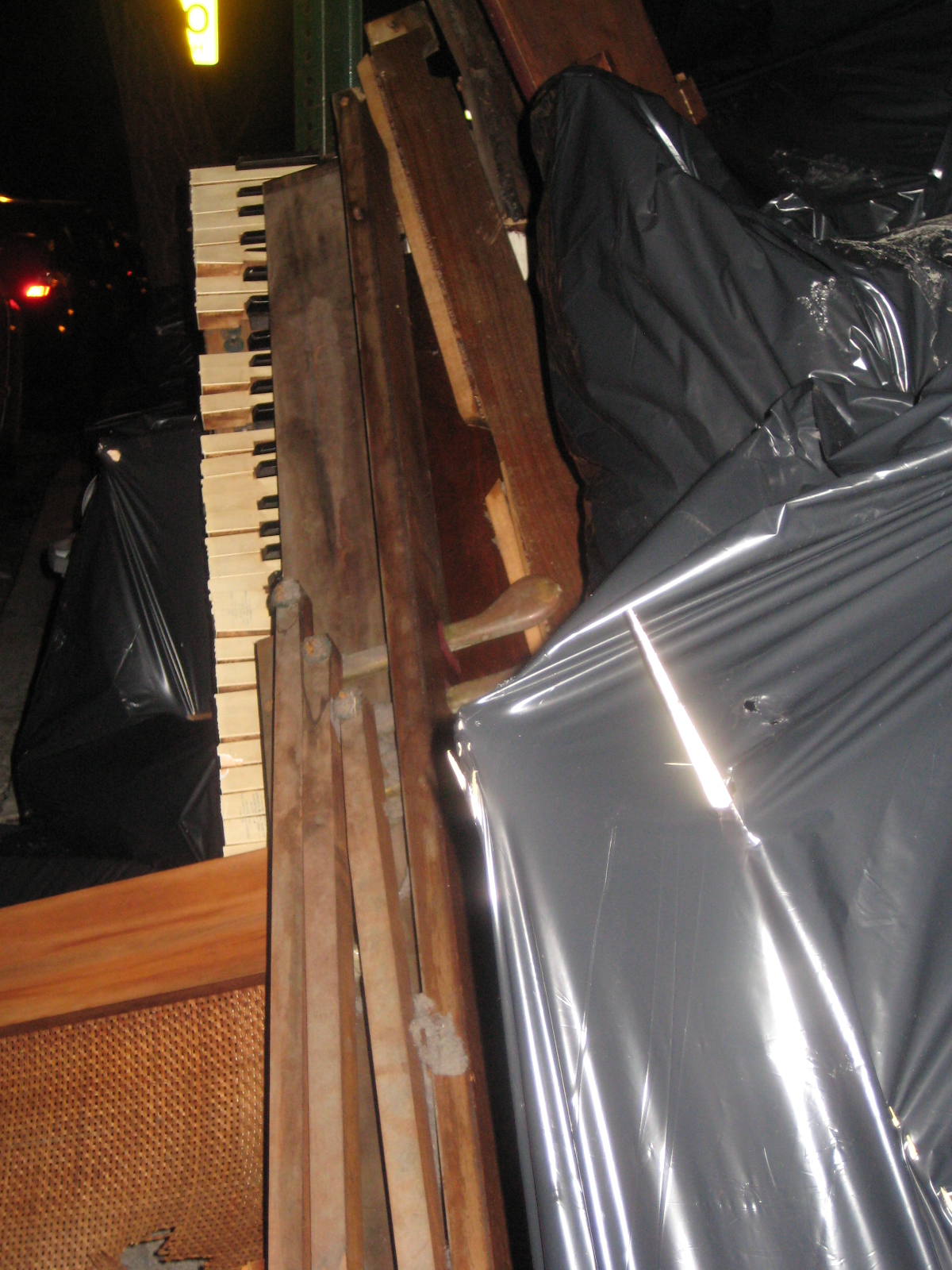
Coming back to my third floor walk-up there was a pile of black plastic contractor bags on the curb, wood sticking out of some of them.  Something about this odd collection of misshapen bags caused me to linger, look them over.  Sticking out of the bag furthest from me was a piano keyboard, mostly intact, but looking like it could use some dental work.  The several other bags held the rest of the piano, an actual piano of wood, strings, hammers.


“Damn,” I thought, and trudged up the two flights to my airless apartment.