Author Archives: oinsketta
Be The Change You Want to See in The World
Gandhi is thought to have created that idea, although maybe it comes from one of his beloved texts. (A writer skillfully straightens out the whole feel-good coffee mug aphorism industry here)
Whatever the source, or whoever coined the pithy bumper sticker, it is on a recycled nylon bag I have used dozens of times and also on the banner of my youtube channel (here) where you will find the opinion “nice work, if you can get it.” “Be the change you want to see in the world” is a short phrase that encapsulates a lot about the work I need to be doing.
As the writer cited above wrote:
The closest verifiable remark we have from Gandhi is this: “If we could change ourselves, the tendencies in the world would also change. As a man changes his own nature, so does the attitude of the world change towards him. … We need not wait to see what others do.”
If we would like to see less violence in the world, and are constantly in fist fights because we react to insults with fists, teaching ourselves how not to throw the first punch is a big step in the right direction. The world isn’t going to magically change from violent to more peaceful if we stop the preemptive face-bashing, but the change in ourselves is a necessary precondition for being able to convince anyone else to stop fighting. Plus, the violence in our own life is likely to decrease as we change our behavior.
The default settings of life are what enable complex human societies to function in a more or less automatic way in a complicated and demanding system set to default. But if you have a dream of doing something to influence and change the status quo, the default settings will not help you accomplish it. If that dream involves doing your part to change the world in the direction you dream of, you are going to have to transform yourself into an effective role model for what you’re talking about.
As the eminent philosopher Moms Mabley postulated “if you do what you always did, you’ll get what you always got.”
I need to think no further than my father on his deathbed to reinforce for me the importance of being the change– becoming the kind of force you’d like to see in the world. He died full of regrets, largely related to his fiercely held belief that people can’t change in any significant way. “The world’s not black and white, Elie,” he told me with the great sorrow of a decades-too-late revelation, hours before he died. “I think now how much richer my life would have been if I hadn’t seen it as a battle—good versus evil.”
Good versus Evil thinking simplifies the world in a reductive, and frankly, often stupid way. Of course we can see the difference between good (helping someone in trouble) and evil (torturing someone in trouble) but that’s not the point I’m slogging toward. Human motivation and behavior is famously complicated –suppose the person in trouble you’re helping or torturing is not a victim but a vicious person, a terrorist not a freedom fighter?– which is the greater good and the greater evil is a topic for endless debate.
But, for example, if we are hurt every time we feel rejected, and never miss a chance to express that hurt, whether the rejection was actually intended or inadvertent (as much perceived rejection turns out to be), we are trapped in a syndrome caused, largely, by our own reaction. If our goal is to create a classroom where kids learn to deal gracefully with failure and rejection, we have a good deal of work to do first on our own reactions to what feels like failure and rejection.
Otherwise, we will find ourselves building a lousy model, in a room with kids slugging away with bullies, fighting perceived rejecters on their behalf but teaching the children nothing about the proper way to respect yourself and your work and not be unduly put out by the negativity or silence of others. The project will fail unless the teacher has first figured out how to keep negativity and fighting out of the space. That work is on the teacher, if the teacher has a goal larger than imparting knowledge of a particular skill or subject.
That 99% of teachers, 99% of people, will not submit themselves to this difficult work, or have the kind of larger goal I give in the example, has nothing to do with it. Most people work in default mode, protected by their rationales, encouraged by their successes and taking pleasure and pain where they find it. This is the way of the world.
I am talking specifically about those who wish to change the world. It’s a job that demands upheaval. The person who would attempt it has some hard work to do before they can even think about being the change they want to see in the world.
That’s all I’m saying.
You play the game, you takes your chances
I’d like to be an omniscient observer sometimes, omnisciently observing, instead of grunting and bleeding in the game itself. Become a deadpan, detached narrator, paid to craft a story that makes sense and satisfies on some level. Anything, sometimes, rather than this.
I have had an umbilical hernia probably for years. It is one among several medical things lurking, probably one of the more benign. The surgeon himself made no pitch for me to have surgery, pointing out that probably half of Americans have umbilical hernias. The treatment poses problems about as often as leaving the hernia untreated does. It seemed to be a crap shoot. I was convinced by the noncommittal surgeon himself not to have my belly button slit open.
Two guys I know spoke highly of the surgery. One said since the surgery he is able to walk like a man again, with his stomach sucked in. I’ve never been able to walk that way, even when I was skinny. The other is a man with many fears, and his fear of an incarcerated hernia, the excruciating and sudden event (and apparently very rare) when part of the intestine is forced through the torn wall of abdominal muscle, necessitating an agonized rush to the emergency room and emergency surgery, caused him to swallow his fear of doctors and have the surgery. “It was nothing,” he said, patting his ample belly, “and I am, truly, a complete coward.”
I fancied the hernia bothering me as I sat typing recently, felt it sometimes as I strained pumping the bike up a hill, or carrying the bike up two flights of steps after a ride. I remembered the surgeon saying “if it starts to bother you, come back and we’ll fix it.” I became fixated on this reasonable-sounding advice, reasonably or unreasonably, and went back for the surgery. “Well, if it’s bothering you…” said the surgeon.
Now nine days after the surgery it’s bothering me again. But bothering me more are the words of my old friend, a long-time pediatrician. “Why are you having a hernia operation?” she asked me the night before the surgery, the first time she heard of it. “We see kids with hernias all the time,” she said, “we almost never operate on them, unless they’re having pain from it.”
The surgeon had a glib answer for that the next day. In children, he pointed out, hernias often heal by themselves. Anyway, I’d already paid my $75 co-pay, was in a gown about to go into the room for surgery, my blood pressure was 140/72, it was a little late to call off the dogs.
“Most hernias in children don’t heal by themselves,” my friend told me tonight. “that’s not why we don’t operate on them. We don’t operate because there’s usually no reason to operate on a hernia.”
Tonight my hernia is bothering me as I sit here typing. It could be related to the three trips I made up the flights to my apartment last night, carrying heavy bags. It could have to do with walking around today with a briefcase that was also a little heavy. The surgeon did tell me to take it easy after the surgery, maybe I just overdid it a little too soon.
Or maybe there was no reason to have the operation at all, and this pain I’m feeling now, although dull enough and almost mild, is a harbinger of a problem I never had. As pleasant as my lunch and meeting with a very intelligent woman who indicated a strong desire to help with my nonprofit was today, an opaque cloud passes in front of my memory of it. Besides, it’s been five hours and she hasn’t replied to my thank you email. Isn’t it as likely as not that she was just humoring me?
Oh, to be an omniscient narrator. I’d do it for a modestly discounted fee. I’m clearly not in any of this for the money. But if you will excuse me, I have to lie down with a hand over my stomach.
Oy

wot, wot?
Slice of NYC
The rain was pounding down this morning as I turned in bed for a few last winks at Sekhnet’s. I was off the leash today, a friend from far away coming by to play some music as we do now for a few hours every two or three years. He came in, bent, and whispered Polish to the cat. The cat regarded him intelligently. I had no idea the cat understands Polish.
The rain that had pounded down indicated the kind of barometric upheaval that sometimes left the inside of my face swollen, achy and the rest of me slightly nauseated. I didn’t notice, while playing the host, the exact location of my general sense of unease.
As my friend made the best of my plastic piano, the guitar went in and out of tune. I had to keep hopping up to stir the sauce I was making, make sure the pasta didn’t boil over. Soon it was time for lunch, and a toast. The scotch went down easily, even into my empty stomach. Didn’t notice how much I was sweating when we went back to play.
The feeling of time slipping away. Trying to think of songs we’d meant to play together. A few nice moments, amid the grasping, then it was time to say goodbye. After he left I realized how much my sinuses were bothering me. At least then I knew why I’d felt so crappy all day.
Here’s your slice of NYC life:
Coming back to my third floor walk-up there was a pile of black plastic contractor bags on the curb, wood sticking out of some of them. Something about this odd collection of misshapen bags caused me to linger, look them over. Sticking out of the bag furthest from me was a piano keyboard, mostly intact, but looking like it could use some dental work. The several other bags held the rest of the piano, an actual piano of wood, strings, hammers.
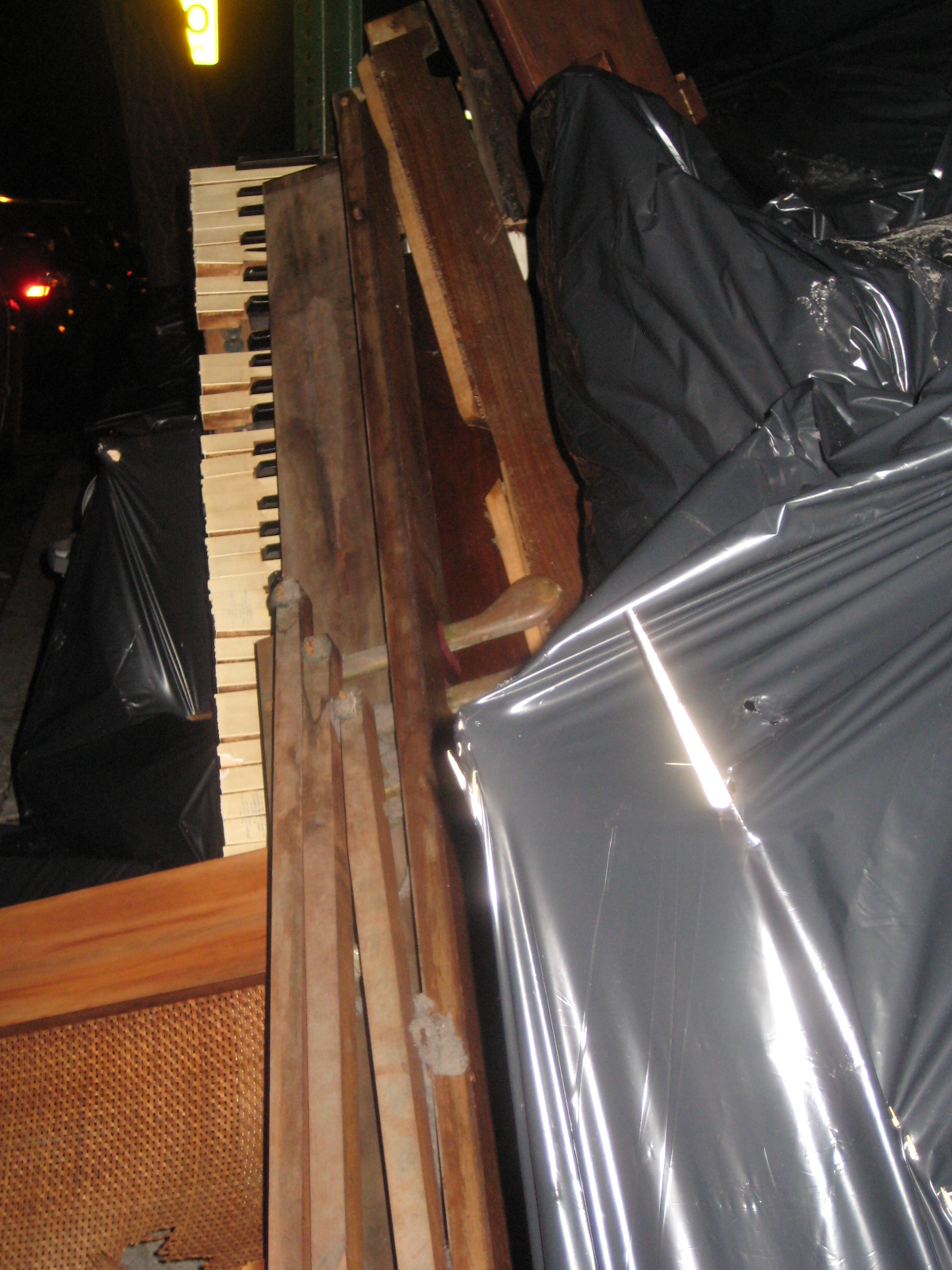
“Damn,” I thought, and trudged up the two flights to my airless apartment.
Here’s lookin’ at you, Squid
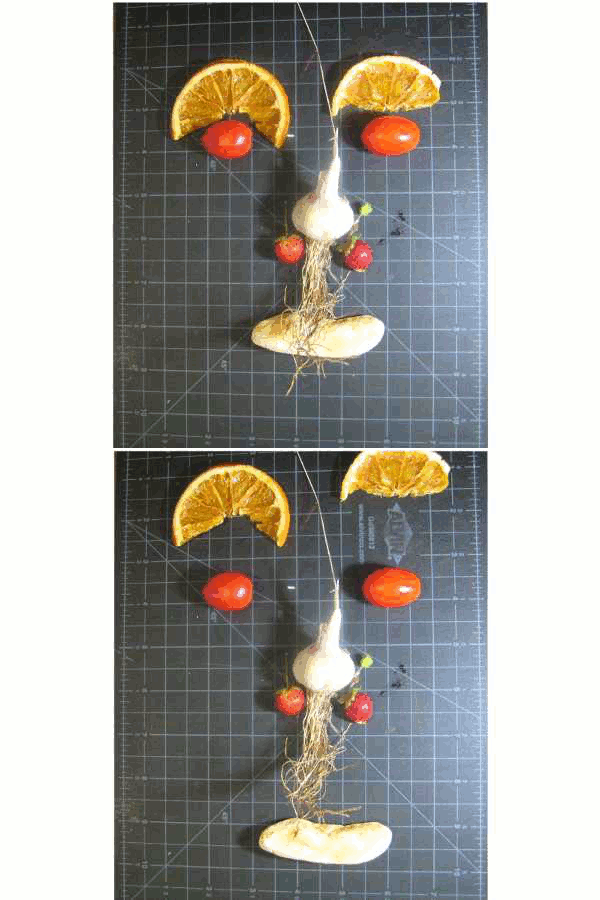
I’m afraid you may have to click me in the face before I can properly look at you, Squid.
Inspired to do the milder thing
Had a call just now from a friend who has her ups and downs. She was up today, yesterday had apparently been a great day. When she began telling the story I thought we were heading towards the delicious coldly-served revenge scenario she’d been sketching out for a while in regard to this particular person.
Instead she’d had a revelation, the person who’d hurt her was a damaged, suffering soul who was sorry for the behavior. They’d spent a surprisingly lovely day together, spoke of and laughed about the various revenge scenarios that would have been richly deserved. “I tell you, I feel light as a feather today, letting all that anger go,” she reported happily.
Inspired by our conversation I decided to call back the person who is the subject of A Puzzle for You and Psychic Role-play. The puzzle was solved– be mild, direct, no need to bring up the guy’s worst, most annoying side, even when he says, with apparent conviction, that we should stay in touch. I have nothing against staying in touch. We had a few laughs and talked for a good while. It was a most pleasant conversation.
Better to be mild than punitive, when the offense, in the larger scheme of life, harms only your perception of the other person. It’s easy to reduce someone to the sum of their annoying faults, but there’s also a baby, probably worth saving, in that stinking bathwater.
I shouldn’t really use that metaphor, though, I don’t have much use for babies.
One for the kids
recent demo of a second session animation project with kids 8-11. Make some faces, please, then a quick music track, and then we’ll shoot the video on to youTube.
wehearyou.net is now a 501(c)(3) charitable organization.
Got any old macbooks, iPads, loopers or digital cameras you’d like to donate?
Email us at wehearyou.net@gmail.com
Psychic role-play
This post should be read in conjunction with Puzzle for You, also in the Personal category.
I have a second voicemail from the fellow I described in the previous post. The first one came at noon today, this one arrived seven hours later.
In his first message he suavely introduced himself as my doctor, calling to make sure the operation had left me without any discomfort. Then smoothly he became himself, assured me that he and his wife were at my disposal and then, in the evening, he reached out again. I haven’t listened to his second message yet, but I assume the tone will be slightly less playful.
Why don’t I listen to his second message now? I don’t really want to hear it, at the moment, the same way I didn’t feel like improvising a duet with him when he called for a second time today. And, as it happens, T-Mobile, my cellphone provider, sometimes doesn’t deliver messages until several days after they’re left. I am surprised, sometimes, when missing a call from my sister, that she’s left no message. It’s not like her not to leave a message. Then, three days after I speak to her the message from earlier that week is delivered to me. It’s the damnedest thing.
So I have deniability, as well as a bit of sadistic tit-for-tat pleasure in ignoring the second call. All I have to say is that stinking T-Mobile often waits three days to deliver voicemails and I’m off the hook. What can I say? I didn’t tell him that I didn’t hear his messages, only that T-Mobile is so often bad at delivering messages. It’s like a politician’s perfect lie: the truth of it is undeniable, yet it is completely untrue and has no application to the actual facts at hand.
Another thing I understand is that he and I are playing psychic roles for each other, the dimension and scope of which are hard to define. It may be that I am very much like his father, who was droll, quick and emotionally elusive. It may be he stands in for the good friends who don’t answer emails and takes the lumps for all of them. These people, in turn, are standing in for my parents who always insisted that since I was a genius and know-it-all I really didn’t need their feedback and should stop whining about the strategic silence.
If things hold true to form, in this hideously choreographed ballet, his tone will get less and less playful, take on more and more of an edge, for every call he makes that is not returned. He’ll be hurt, the wronged party, complaining, unjustly treated badly, increasingly, with every additional message he has to leave. For my part, I already feel justified in not getting back to him right away. I act this way because I’m far from being a saint, though further along than I was when I was still doing battle with my parents. As for him? I have no idea, really.
In the moment
One thing is easy to forget, when we are not in the moment. We forget that we are always fully alive in the moment, rather than thinking abstractly about it.
As the car skids on the wet road you snap into the moment.
A second ago you may have been distracted, or tired, had no idea how slippery the sudden downpour had made the hot turnpike. In the skid, you have the wheel in your hands and the pedals at your feet. You are in the moment now and you will do what you know how to do, everything you are able to do.
Likewise, if you can sing, and weren’t made self-conscious about singing, you jump right in when the band strikes up the beat, the intro ends and others begin singing along.
That is the moment, you can be in it or out of it. The creative, effective place to be is in the moment. Whatever that moment may be. It is a challenge to stay in the moment all the time.
The moment is like the beat of a drum, announced in your blood. Bring your voice in right on the beat, or wait, a split second too quick to describe, come in perfectly off the beat.
Playing against the primary rhythm, the 2 and 4 of the beat, gives music its swing. Django Reinhardt’s mischievous, dancing notes come to mind. Playing off the beat is impossible until you can play perfectly on the beat. Playing directly on the beat is also a great and incomparable virtue.
So remember to play on the beat sometimes too, it’s good form, helps the rhythm section keep pumping steady and is always beautiful in its own right. But, most of all, be in the moment whenever you can.

