The Long Argument

My father and I had a lifelong argument over whether or not a person can change their outlook and feelings in any meaningful way.   This is a pretty fundamental question, it seems to me, and how you feel about the possibility of change, and your willingness to work toward it, is the difference between hope and resignation.

The argument apparently started when I was less than ten weeks old, which really freaked my father out and started us off on the wrong foot.   It was a big mistake, I realize now, to challenge my father at such an early age, and if I had it to do over again, I probably would have tried to have been more conciliatory.  

At ten weeks, it seems, I’d reached my limit and went into a prolonged temper tantrum.  While this immature show of red-faced, fist-clenched rage greatly frightened my parents, it also pissed both of them off.  The pediatrician laughed it off, but my parents could not.

It didn’t help things when, a few months later, my first precocious words were “go fuck yourself.”  I admit that didn’t help a bit, as it only confirmed what they were already pretty sure of.  

“Well, you’re trying to be funny about it, but some babies just are born fucking pricks; it’s medical fact,” said the skeleton of my father from his hilltop grave in Cortlandt, New York, annoyed to have to state the obvious so soon in this account.  “You were born with a fucking hard-on against the world.”

Now the only question was ‘can a person change their nature?’  I approached the subject with a certain optimism.   My father’s position was an emphatic ‘no’.  

“You can change only the most superficial things about yourself, the deeper feelings, the impulses, those things remain hard-wired,” my father always insisted.

But you yourself are living proof that people can change, dad, I told him, toward the end of our last argument.  

After I told you I would no longer tolerate abuse disguised as fatherly advice, after I told you I wouldn’t stick around to be mistreated, you changed your behavior.  Things have been much better the last fifteen years or so.  How can you discount the salubrious effect your changed behavior has had on our relationship? 

My father was old at this time, almost eighty.  He had less than two years left, though, of course, neither of us knew it as we argued that day in his den in Coconut Creek, Florida.  He was probably already well into the undiagnosed liver cancer that he’d find out about six days before his death, shortly after the E.R. doctor gave my sister that instant, meaningful look.  My old man was tired, he was desperate.  Things had not worked out for him, he was choking on disappointment, frustration, unslakable anger.  His son, already in his late forties, was still trying to make his infernal point, still senselessly hammering away at his father’s shield.   My father smiled, but it was a horrible smile.

“Hah!” he said without mirth, with the opposite of mirth, really.  “I merely changed my superficial reactions.  My deeper feelings never changed at all, they cannot change or be changed, as much as you might try to convince yourself they can be.  I always felt the same way, my feelings never changed, I just honored your request not to speak of my true feelings about you.”   He saw that he had not yet said enough, I was still standing, not even sweating, really.  

“If I ever told you how I really felt about you, it would do such irreparable harm we could never have any kind of relationship at all.  I recommend we keep our conversation to sports, and politics, and books, the kind of civil pleasantries I exchange with Roy.”  

You want to keep our conversation to the kind of civil pleasantries you exchange with somebody you just told me again how much you despise?  

He nodded, unwilling to admit the grotesqueness of his desperation to somehow win this argument.  

I took a breath, shook my head.  

OK, I guess you win, dad.  People can’t change.  I go back to my original position then.  Why don’t you go fuck yourself?  

Two years later, in spite of the fact that we cannot change our essential natures, I stood mildly in my father’s hospital room the last night of his life.  I was there to listen, to help however I could in the difficult transition he had to make.  I was like an old family priest taking a very sophisticated white collar criminal’s final confession.  

“You know,” the dying man said in an incredibly strained voice he wouldn’t be using much longer, “I felt you reaching out many times over the years… I was just too fucked up to have the kind of relationship I should have had with you.  I was always afraid it was going to be a fight.  I think now how much richer my life would have been if I hadn’t seen everything as a zero-sum battle to the death.  That’s my fault, you’re supposed to have some fucking insight…”  

I nodded, what could I say?  

“I wish we could have had this kind of talk fifteen years ago,” he said, his voice weaker still.  

We both knew he’d be gone now in a very short time, he was like a candle burned down to the very end, his light becoming dim.  

Fifteen years? I remember thinking.  A senseless, brutal war for almost thirty-five years and fifteen years of peace at the end?  It didn’t seem like a very good proportion.

Some time after he died the next day I realized, shit, fifteen years would have been pretty good.   I’d take fifteen years.

My Way or the Highway

“You’re an increasingly judgmental bastard,” observed the skeleton, as I cut and pasted some passages from Leviticus.  “I told you not to be like me.  You know that ‘my way or the highway’ shit is very bad and you recall how it tormented me on my deathbed to have lived my life in that blinded black and white mode.  And why this sudden intolerance for religion?  I mean, you have that damning portion of Leviticus all cued up, cut and ready to paste, and it certainly does not make God look like a very nice guy.  You know, especially that bit about making people literally eat their own sons and daughters.  Why this antipathy and why now?”  

I thought of the tiny, red-haired religious woman who whipped my infant father across the face with the cord from her steam iron while teaching him her strict version of Judaism.  I thought of the many religious people of every faith who are gentle, and kind, and generous– who are brought to their highest natures by religious feelings.  I thought of those true believers who, in the name of religion, put people to the sword, who put millions to every kind of sword.   Here is God Himself speaking in Leviticus 26.  

(I hadn’t realize how droll the Eternal Creator could be until I read 26:36, check out the comedic brilliance of that opening line.)

14 “‘But if you will not listen to me and carry out all these commands, 15 and if you reject my decrees and abhor my laws and fail to carry out all my commands and so violate my covenant, 16 then I will do this to you: I will bring on you sudden terror, wasting diseases and fever that will destroy your sight and sap your strength. You will plant seed in vain, because your enemies will eat it. 17 I will set my face against you so that you will be defeated by your enemies; those who hate you will rule over you, and you will flee even when no one is pursuing you.

18 “‘If after all this you will not listen to me, I will punish you for your sins seven times over. 19 I will break down your stubborn pride and make the sky above you like iron and the ground beneath you like bronze. 20 Your strength will be spent in vain, because your soil will not yield its crops, nor will the trees of your land yield their fruit.

21 “‘If you remain hostile toward me and refuse to listen to me, I will multiply your afflictions seven times over, as your sins deserve. 22 I will send wild animals against you, and they will rob you of your children, destroy your cattle and make you so few in number that your roads will be deserted.

23 “‘If in spite of these things you do not accept my correction but continue to be hostile toward me, 24 I myself will be hostile toward you and will afflict you for your sins seven times over. 25 And I will bring the sword on you to avenge the breaking of the covenant. When you withdraw into your cities, I will send a plague among you, and you will be given into enemy hands. 26 When I cut off your supply of bread, ten women will be able to bake your bread in one oven, and they will dole out the bread by weight. You will eat, but you will not be satisfied.

27 “‘If in spite of this you still do not listen to me but continue to be hostile toward me, 28 then in my anger I will be hostile toward you, and I myself will punish you for your sins seven times over. 29 You will eat the flesh of your sons and the flesh of your daughters. 30 I will destroy your high places, cut down your incense altars and pile your dead bodies[b] on the lifeless forms of your idols, and I will abhor you. 31 I will turn your cities into ruins and lay waste your sanctuaries, and I will take no delight in the pleasing aroma of your offerings. 32 I myself will lay waste the land, so that your enemies who live there will be appalled. 33 I will scatter you among the nations and will draw out my sword and pursue you. Your land will be laid waste, and your cities will lie in ruins. 34 Then the land will enjoy its sabbath years all the time that it lies desolate and you are in the country of your enemies; then the land will rest and enjoy its sabbaths. 35 All the time that it lies desolate, the land will have the rest it did not have during the sabbaths you lived in it.

36 “‘As for those of you who are left, I will make their hearts so fearful in the lands of their enemies that the sound of a windblown leaf will put them to flight. They will run as though fleeing from the sword, and they will fall, even though no one is pursuing them. 37 They will stumble over one another as though fleeing from the sword, even though no one is pursuing them. So you will not be able to stand before your enemies. 38 You will perish among the nations; the land of your enemies will devour you. 39 Those of you who are left will waste away in the lands of their enemies because of their sins; also because of their ancestors’ sins they will waste away.

“Well, I’ll grant you, that does look bad out of context,” said the skeleton.  “Don’t you think it’s only fair to cut and paste the rewards for not being hostile to God?”  

Yes, I do think it’s only fair.  He makes a very generous offer.  We also have to acknowledge that His “As for those of you who are left…” at 36 is complete genius.

1 “‘Do not make idols or set up an image or a sacred stone for yourselves, and do not place a carved stone in your land to bow down before it. I am the Lord your God.

2 “‘Observe my Sabbaths and have reverence for my sanctuary. I am the Lord.

3 “‘If you follow my decrees and are careful to obey my commands, 4 I will send you rain in its season, and the ground will yield its crops and the trees their fruit.5 Your threshing will continue until grape harvest and the grape harvest will continue until planting, and you will eat all the food you want and live in safety in your land.

6 “‘I will grant peace in the land, and you will lie down and no one will make you afraid. I will remove wild beasts from the land, and the sword will not pass through your country. 7 You will pursue your enemies, and they will fall by the sword before you. 8 Five of you will chase a hundred, and a hundred of you will chase ten thousand, and your enemies will fall by the sword before you.

9 “‘I will look on you with favor and make you fruitful and increase your numbers,and I will keep my covenant with you. 10 You will still be eating last year’s harvest when you will have to move it out to make room for the new. 11 I will put my dwelling place[a] among you, and I will not abhor you. 12 I will walk among you and be your God, and you will be my people. 13 I am the Lord your God, who brought you out of Egypt so that you would no longer be slaves to the Egyptians; I broke the bars of your yoke and enabled you to walk with heads held high.


Slow to Anger, Quick to Forgive

As promised, that great teaching, from the Sayings of the Fathers, on anger and forgiveness.  

One thing my father had great difficulty with was forgiving.  I can’t recall a single instance when he ever forgave anyone.  He never forgave himself, first and foremost, though he also defended himself relentlessly at all times.   A strange combination, but unfortunately not an uncommon one.  

Here is what Sayings of the Fathers’ has to say about anger and forgiveness, and the four kinds of dispositions.


Screen shot 2016-08-01 at 5.59.24 PM

Once you see it laid out this way, it’s very hard to see it much differently.  The type who is slow to anger, quick to forgive is also translated as “righteous” and “saintly”, the root of the word chasid being kind, benevolent, gracious.   The fourth type, quick to anger, slow to forgive, is our friend Rah-shah — the bad one.

It is clearly best to be slow to anger, for anger helps nobody solve anything, though it may get you momentarily out of the doldrums from time to time (but not as well as a good laugh, or emotions like hope and a desire to help), and one can argue that injustice should make you angry, and mobilize you to fight it. Anger at injustice certainly has its place.  Between people, however, it is best to be slow to anger.  If one is slow to anger but also slow to forgive: your gain is offset by your loss.

Of course, the alternative posed against anger in this translation is not forgiveness, but a willingness to be appeased.  לרצות  means appease, placate, to try to please.  In this scenario the person who has angered you has sought your forgiveness, tried to make amends.  

This is significant, since it is difficult for most people to forgive someone who accepts no part in having made you angry.  Someone who refuses to accept a sincere apology, a real attempt to make peace, is, indeed, as my grandmother Yetta used to say, not a bit nice.

This section of Pirkey Avot strikes me as a bit of real wisdom, hidden in the back of a prayer book that has always struck me as an exercise in blind faith and wishful thinking.  At that memorial service yesterday we read responsively, in words meant to console the mourners, that God always helps the helpless, that God is all-forgiving, that God is ever kind and merciful, that God will never abandon those in need, that God rewards the just, that God lifts up and embraces all who call to Him.

I whispered to a friend, like the Rah-shah, that I thought some of this sarcasm was a bit over the top.  She had the good sense not to snicker, snort or hiss, though I don’t think she necessarily disagreed with me.  I read this, which I loved and photographed:

20160731_190018-1

This same, gracious, quick to forgive Eternal One who told his Chosen People that He was a vengeful and jealous God who would force parents who disobeyed Him to eat the flesh of their children, torture their descendants for generations, visiting the sins of the parents on their children’s children, yea, upon their children’s children’s great-grandchildren.  Of course, that was only God speaking in anger.

I thought about my father so deeply hurt he could not find a way to forgive a life that could brutalize him from the time he was a defenseless baby.  

I thought briefly of several formerly close friends of mine I can find no reason to forgive, (not one of whom ever tried to apologize, now that I think of it) even though I believe that forgiveness is one of the great blessings of life and the best attitude to have in most situations.  

And then, since this was a memorial service for a Jewish woman who during her almost century-long life always went overboard serving a lot of food,  I went over to the buffet table to see what my next course might be.

Eesh Tam veh Yashar

One of the difficulties of having only a little context– we reach conclusions that might be out of context.  The cliche “a little knowledge is a dangerous thing” is out there for good reason. Although men like Mr. Hitler did their best to destroy the last of a long culture, and almost succeeded in my case, we continue.  I come from a very old tradition.  Evolving for centuries and followed for many generations, I know very little about the inner world of this tradition.   I speak and read a useful bit of Hebrew, (though my reading is fairly primitive), so I have some tools for understanding a little, if not a wealth of context.

Thus, as I stood in front of my grandfather Eliyahu’s grave in Cortlandt, the headstone crammed together with the markers for other paupers’ graves, I read the Hebrew words:  Eesh Tam veh Yashar, a simple, straight man.  These words stung me, knowing the abbreviated history of this sad man I am named for.  Eesh Tam veh Yashar!   Here lies a simple, straight man.  It struck me as a kind of cruelty.

“It’s an old and nonchalant form of cruelty,” said the skeleton cheerfully.  “In the shtetl you were called by your distinguishing trait, there was Chaim the Deaf Boy, Yussel Shlep-foos, you know, he dragged one leg because he’d had polio, Fat D’vorah — because in that little town also lived Skinny D’vorah and Birthmark on her face D’vorah.  My father was, no question, a simple and straight man.  Two eyes, a nose and a mouth.  Come on.”

It bothered me because I knew the word Tam, simple, from the Passover Haggadah.  Tam, the simpleton, is one of four types of people in the world, the sages have said in this venerable old book.  Teaching ethics by giving examples of contrasting types is a device the sages were fond of.  There are some excellent and useful examples of this scattered through the teachings, the one about four types in relation to Anger and Forgiveness from Pirkey Avot is my favorite (I will post that one later).

In the case of the four Passover types and their capability to understand, and what our duty is to each as far as recounting the story of the exodus from slavery to freedom, it goes like this.  There are four types:  wise, wicked, simple, and one who does not even know how to ask a question.  

What is our duty to the Wise Son, Chah-Cham?  To the Wise Son you must take pains to tell everything, down to the smallest detail.

 The Wicked Son, Rah-shah, who scoffs at everything, what is our duty to him?  You shall answer him caustically.

This teaching, of course, always bothers me, because it essentially means you dismiss the nonbeliever as wicked since he does not obediently follow God’s laws.  You do not take pains to show him the wisdom and love that is lavished upon the Wise Son whose wisdom is reflected in his eager obedience to God’s will.  You answer the Rah-shah angrily.  In the original Hebrew the way to deal with the Wicked Son is to metaphorically “blunt his teeth.”

“Well, admittedly, there is a fine line, sometimes, between the Chah-cham and the Rah-shah.  One man’s Rah-shah is another man’s Chah-cham; it’s in the degree of respect and knowledge in the challenge the person presents.  There are those who strive to understand, and question to gain insight and wisdom, and others whose only delight is mocking and feeling superior.  That’s probably what they were driving at, don’t you think?” said the skeleton.

That’s a charitable and reasonable view.  I can go with that.  Then we come to Tam, the Simple Son.  This child gets essentially the same answer as the Rah-shah, but without the bite to it.  You tell him, since he’s simple, that you are following this traditional ritual of the storytelling meal because of what the Lord did for me when He brought me out of Egypt.  

Which is very much like what you are instructed to tell Rah-shah, that God did this for ME, except in the case of the Rah-shah, you make a point of letting him know that had he been a slave in Egypt God would not have seen fit to release him from bondage because he’s the kind of despicable, unredeemable jerk who deserves the lifelong punishment of slavery.  

“Well, you paraphrase, of course,” said the skeleton.  

That’s what I almost always do, yeah.  Anyway, the only category below Tam is the child who does not even know how to form a question.  This represents the person who goes along with everything without having any intellectual tools to try to understand the world around them.   The child who does not even know how to ask is portrayed as a very young child, a baby who hasn’t learned to speak yet.  

“Well, Ben could have had them carve ‘sheh aino yodayah leeshole’ on my father’s grave, if he’d really wanted to be a prick.  Tam is an upgrade over ‘too stupid to even form a question’, no?” said the skeleton.

Much better, sure.  But here’s the surprising point of this story.  I was at a memorial service yesterday for a friend’s mother who died a few days ago at almost 98.   There was a selection of old black and white photos in a tall frame that we began looking at after the service.  One photo was of a large, impressive gravestone inscribed almost entirely in Hebrew.  We puzzled over it for a moment.  I puzzled more than Sekhnet, since I didn’t have my glasses with me. 

She turned to me, raised her eyebrows and said “eesh tam veh yashar,” pointing to the words inscribed in the large, dark stone. 

I’ll be damned, I thought.  Here’s what google translate teaches us about the phrase:  א’ש תמ וישר     “An upright man”  “perfect and upright”   “upright and just”.  

I’ll be damned.

Eliyahu

Eliyahu was the name of my father’s father.  I am named for him.  He was named after God’s favorite prophet, Eliyahu, known in English as Elijah the Prophet.  We were named for the humble, supremely loyal prophet whose name means, as Wikipedia teaches: Elijah: אֱלִיָּהוּ, Eliyahu, meaning “My God is Yahu/Jah.”  Wikipedia also teaches that it is said of that when dogs are happy for no reason, it is because Eliyahu is in the neighborhood.  Eliyahu is generally associated with reverence, hope and love.

If you go far enough back in our uprooted family tree people actually believed that righteous men like Eliyahu were so loved by the omniscient, omnipotent Creator that He chose to converse with them, have them convey His wishes to humans.  The prophet Eliyahu was apparently God’s most beloved,  although his namesake, my unlucky grandfather, a poor and meek man all his life, died at fifty-five of liver failure though he never drank alcohol.

“Well, my father was an unlucky man, no question.  In the bigger picture, though, this takes us back to Harari’s book Sapiens.  Our troubled, violent, insane species has believed any number of remarkable and awesome things to make sense of life in a terrifying world,” said the skeleton.

John Lennon called God a concept, by which we measure our pain.

“John was a clever bastard,” said the skeleton.

There is irony — and I know, I know, where is there not irony?– in your father having that name, and in my being named after that father, by a man who quickly came to regard his baby son as an implacable adversary, both named for a prophet whose mission, in preparing humanity for the coming of the Messiah, is to return the hearts of  fathers to their children and the hearts of children to their fathers, as it is written, in Malachi 4:5-6:

“Behold, I am going to send you Elijah the prophet before the coming of the great and terrible day of the LORD. He will restore the hearts of the fathers to their children and the hearts of the children to their fathers, so that I will not come and smite the land with a curse.”

“That’s our Lord,” said the skeleton, “do this so I will not have to come down there and smite the land with a fucking curse.  My favorite is when he threatens the disobedient that they will eat their own children if they continue to disobey Him.  He sticks that in the middle of a long, long list of blood curdling curses that He will bring down upon those who do not believe in His infinite love and mercy.

“But, look, this is all well and good, and ironic, sure, irony is the most plentiful element in the universe, certainly the Jewish universe, but the fact is– you were an implacable adversary.  That’s my fault, I realized about 47 years too late, but my understanding of such things was limited, unfortunately.  I was raised by an implacable enemy myself, as you know.  I’m talking about my mother, olav hashalem (may she rest in peace).  

“My father was a nonentity, a self-erasing man who just didn’t want to be beaten up any more.  I have no idea what he ever thought about anything, he was mostly silent, though when he spoke, as I recall it surprised you to learn, it was without a trace of a Yiddish accent.  

“Would he have returned the hearts of fathers to their children and the hearts of children to their fathers if he could have?  The jury will have to remain out on that one.  I will say that you, personally, seem to take this crucial mission seriously, even if it is manifestly impossible in our world of fear and hatred, and the genius moral justifications for why we are right to fear and hate.”   

Hmmmm.  Well, I can make use of all that somehow.  As Nike says, or maybe it’s Adidas: Impossible is Nothing.  Fuck impossible, dad.  I’m going for the impossible.  

“Clearly you are,” said the skeleton, “that’s my boy.  But look, Elie, everything that cannot be imagined is impossible — until it is imagined and articulated, and that previously unimaginable leap is taken.  I’m not talking about supernatural belief systems, I’m talking about all human progress.  It all starts when the unimaginably is imagined.

“We have a language that is capable of communicating virtually anything we can imagine, plus tools like drawing to show things we are unable to fully describe.   The universe inside a human imagination is virtually without limits.  But we use only a tiny fraction of our minds, only a sliver of our stunted imaginations.

“Look, by all means, use the concept of Eliyahu, friend of the poor, righteous man, servant of God’s benevolence, if it helps you.  This conversation we’re having now, much as I came to wish we could have had many like it while I was alive, look, we both realize this is all in your head now.  

“But there’s something larger here– you are moving toward understanding something most people cannot even imagine exists.  There may be a way to forgive someone who has brutalized you and draw out their deeper humanity, see beyond the pain they inflicted to their actual heart of hearts, access the great love they have hidden, even from themselves, if it is important enough to you.  

“I’m not talking about friends who cross a line and become toxic.  You just have to get away from those people.  But if your parent has poisoned part of your life, well, nobody can really help you with that but yourself.  I commend you, and by doing that, of course, you commend yourself, for grappling with this seemingly impossible thing.”

I suddenly saw my grandfather’s face, which I recognized from the two photos I have of him.  It was a mysterious, mischievous face that betrayed nothing.  It was truly, as Eli said, two eyes, a nose and a mouth.  He turned to me.  

“You’re imagining all this,” he said, with only the faintest hint of a smile.

Try to Do Better with that Elevator Pitch

The task of Elijah the Prophet, a man God loved so much he didn’t let him die but took him straight up to heaven alive, is to return the hearts of parents and children to each other.  This loving task, a precondition for the Messiah’s arrival, was conceived at a time when it was still considered pious to put an adulterer in a pit and stone her to death. The generation gap didn’t start at Woodstock, baby, read your damn Bible.  

“Now, that’s what I’d call an elevator pitch, Elie.  Bravo, now you’re cooking with Zyklon B,” said the skeleton. “Am I insulting your readers if I point out that Zyklon B was the highly toxic insecticide-derived gas the architects of the Final Solution used to expedite their important work?”

I think it would take more than that to insult my readers, pops.  

“OK, now straighten up and fly right,” said the skeleton.

There’s no school that teaches how to be a parent, or a child.  We do the best we can.  Sometimes parents and children do terrible things to each other, and then what?  We either learn to forgive and do better or we keep blaming, herding our loved ones into metaphorical fake showers with nozzles for, not water, but…

“Hitlerious, dood.  Again,” said the skeleton.  

Parents and children do the best they can with each other, without much help.   The only way to break the cycle of anger that may sometimes arise is with gentle bravery and a kind heart.  

“I’ve got your gentle bravery and kind heart right here, motherfucker,” said the skeleton, gripping what once was his crotch.  

Thanks, you’re, as always, a yoooooge help.  

My father was an idealist, lover of animals, champion of the underdog, smart, funny, endowed with a certain charisma.  My father was a pessimist, an abuser of the weak, cruel and cowardly.

“It was the best of times, it was the worst of times,” said the skeleton.  

My father’s ass was the wisest part of his body.

“It was also his most eloquent,” said the skeleton.

Parents and children hurt each other all the time.  It can be the work of a lifetime to break this cycle, if you’re lucky.  Color me Lucky.

“You wouldn’t know luck if it came up to you and ripped your balls off with its teeth.  You are lucky, you poor bastard.  Look all around you, would you trade places with anyone?”  

No, honestly, I would not trade places with anyone.  

“You poor, lucky bum,” the skeleton looked off to where a pair of red-tailed hawks rode the thermals.

“Do you remember what Babe Ruth said about that Called Shot in the 1932 World Series, when he pointed at the bleachers, after Charlie Root quick pitched him, as the Cub bench jockeys rode him mercilessly, and slammed the next pitch right where he had pointed?” asked the skeleton.  

Obviously I do.  

“Geh head, then,” said the skeleton.

Ruth was always coy about whether or not he’d called the shot, his last World Series home run.  It was the stuff of legend and I have read (in Robert Creamer’s excellent biography) Ruth always danced around whether he called the shot, had pointed menacingly at Charlie Root, or gesturing to try to shut up the screaming bench, or whatever.  There is a grainy 1932 amateur film clip of him pointing to the spot where the home run landed one pitch later.  But he never claimed anything about it one way or the other (Ruth’s voiceover on this clip notwithstanding).  

Toward the end of his life a sportswriter friend asked him what he was feeling after clouting that famous home run, as he trotted around the bases, waving derisively at the Cub bench as he rounded first.

“I was thinking, Babe, you lucky bum.  You lucky bum!”

Putting a bow on the story

The art of persuasion, selling,  winning over, converting, is the art of great storytelling.  We love good stories, live by ’em, we need stories to make sense of a largely incomprehensible universe.   I heard a master storytelling salesman at work the other night at the Democratic Convention, weaving a long, compelling story about his wife.   Former president William Jefferson “Bill” Clinton, considered by many our first black president until one with 50% African blood was elected.

“Also considered the finest Republican president of the twentieth century,” said the skeleton.  

“To hear him tell the story, he and his brilliant wife have always been humble servants of the People, selflessly doing everything they could to make sure the tide kept rising and that the rising tide lifted all boats.  He has that down home Elvis charm, calls people ‘man’ and has a deft touch with humor and pathos.  Blacks loved him when he was their president, he spoke their language to them, played the saxophone.  Shucks, he was a charming southern white boy who was completely comfortable with blacks, clearly liked and even admired ’em.

“Meantime, in the name of compromise (and in the worst sense of the word) he did the bidding of some rabidly bad people, over and over again.   Welfare ‘reform’, his 1994 crime bill*, with three strikes and mandatory sentencing, and NAFTA did more to make things harder for blacks than anything Reagan, a president who clucked at racism, had done.  Not to mention the farcical and emblematic “Don’t Ask; Don’t Tell”.

“I recall we had a chat about then governor Bill Clinton’s return to Arkansas, during his first presidential campaign, to oversee the execution of some brain damaged killer on death row, a shooter who’d turned his gun on himself and blown most of his brains out without actually dying,” said the skeleton.  “Show them the Times article to refresh their recollection, to tell it to those too young to remember.”

Well, we’ve talked about the psychopath test for president.  You don’t qualify to run for the office unless you demonstrate that, among other things, like lying convincingly, you can kill when needed, for the good of the country, of course. Plus, you have many Americans who believe in an eye for an eye, literally, death for those who kill, and they need to be satisfied that their president will unflinchingly see justice done. 

“Kill whoever you like, if you’re the president, as long as you tell the story properly, or keep the killing properly secret like your current president’s kill list.  Admittedly, sometimes the president has to be willing to kill, but much of the time it hurts more than it helps.  Framing the story of the killing is the most important part, if you do that, kill away, man.  

“You remember on TV we used to see those numbers like insanely lopsided basketball scores, the kill numbers they’d show every night during dinner?   US: 19  Viet Cong: 345.   Low score meant you won.  So piles of dead Vietnamese would be added up, and if any of the dead were males between the ages of 15 and 50, you had dead Viet Cong for the tally.  William Westmoreland and Robert MacNamara’s people came up with that body count system.  Great for morale, it told the story, every night, of our irresistibly mounting victory.  What did you guys yell when unfair teams were chosen: slaughter sides!!!

“How about Agent Orange?  You remember that amazing stuff, defoliant, highly concentrated herbicide, I think it was also called Dioxin.  They called the destruction of jungle and crops ‘Operation Ranch Hand’ — how cool is that?  Spray it from a bunch of airplanes and it dissolves all plant life underneath.  Neat.  Except that it may have killed almost half a million civilians and caused birth defects in probably many more than that, plus what it did to many American boys.   Luckily for us, about half of those Vietnamese killed were males between the age of 15 and 50, like the many terrorists we’re secretly killing today in the president’s brilliant and legally complex drone war.  

“These are the hard calls a president has to make, Elie.  Would Clinton have won that election if he couldn’t go back to Arkansas and sign the death warrant for a severely brain-damaged person’s lethal injection?  He probably would have lost his own state, like Gore would eight years later.”  The skeleton looked around, weary.  

“But, look, you started off talking about telling a story and now we’re talking about psychopath presidents.  You know what telling a good story involves?  Seeing the whole story before you start to tell it and not getting lost in digressions that detract from the story you want to tell.  

“You need to have a good beginning, to hook your listener, an interesting story-line that’s easy to follow and a satisfying pay-off at the end.   The story has to hang together as an organic whole.   People have to know why you told the story and everything you need for people to grasp and digest the story should be explained as you go.  

“You should never have to go back and add something you belatedly realize you’ll need for the punchline.   You need to see the whole picture you want to paint before you lift your brush to start painting.

“Which places you in an unenviable position here, telling my story.  What is my story even about?  I was born in poverty, had certain ideals, worked my ass off, had a certain amount of luck, accumulated enough money that when I died my son could take a year off to write my biography.  What kind of story is that?  

“Hey, I got it, here’s your story: the loser’s son, at the end of the final withered branch of a family tree rather crudely pruned by hate-filled Ukrainians, anti-Semitic Poles, Nazis and Belarusians, in his mad hubris, thinking anyone in the world actually gives a shit about another anonymous loser.  The story could actually be about you, you know, the meta-story, with the story of me kind of floating by in the background, like a hallucination.  

“We see the author sitting in an unbelievably depressing rented one-bedroom apartment, with decaying walls, etc. cracked ceiling, bathroom floor disintegrated.  All around are papers, some beautiful, most not, but a colorful jumble that defies description.  Why is he in his underwear in front of a fan at 2 pm? Is this a mental patient, tapping away as he stares at the computer screen with no expression?”

Point taken, I should put on some pants, although it’s 88.3 degrees in here at the moment.   Here’s the story in a nutshell for you, then.

The cards dealt to you were a daunting hand.  You were born poor, Jewish, at the dawn of the Great Depression, less than twenty years before the organized mass-murder of poor Jews.   The human helplessness that is the birthright of every human being who does not get help was laid heavily on you, over and over.  The small town you grew up in was anti-Semitic.  You wore a jacket with a Jewish star on it because your mother insisted, as only a few years later Hitler would insist all Jews do.  Drafted into the army’s air force in 1942…

“Blah, blah, blah, I don’t see a story here.  No hook.  Next!” said the skeleton in the manner of a distracted record company executive forced to listen to his mother’s friend’s son’s demo.

 “Ha! You remember that, don’t you, you rascal, Robbie’s big break, when Caroline got the A & R guy son of her friend to listen to his cassette.  It was like your letter from that nice girl at Farrar, Strauss and Giroux way back when:  I don’t see the hook.  Robbie learned, eventually, to put the hook way up front.  He told you about the ‘elevator pitch’, right, you’ve got to be able to put the hook into them within a short elevator ride, you have maybe fifteen seconds.”

Yep, yep.  And in fairness to the gatekeepers, everyone thinks they have a book in them, that their life should be a book.  Most books, like most lives, and particularly the imagined but unwritten books of most lives, are dull, stupid, vain, too predictably depressing to be bought and sold.   I have to package you and sell you, simple as that.

“What’s your fucking story?  Give me the angle.  What’s your fucking elevator pitch, bitch?”

I was raised by a brilliant, funny father who was full of self-hatred.   He fought me from the time I was a baby and the fight continued up until the last night of his life.  On that night he told me, for the first time, that he was sorry he’d been….

“Time’s up, bitch, we’re at my floor.  Nice meeting you.  If you want to blow me some time, set it up with my secretary.  Otherwise, have a nice day and most excellent life,” said the skeleton, his face as vacant, inscrutable and mad-looking as Andy’s.


NOTES

* Again, we’re dealing in a story element, a passing example of how Clinton was the best Republican president in recent history.  For those purposes the 1994 Crime Bill works nicely, it contains some heinous provisions that played a part in increasing American’s off-the-hook, disproportionately poor and black prison population.  But fairness dictates telling the rest of the story, a snippet of which follows, more of which can be read here:

The trend toward increased incarceration began in the early 1970s, and quadrupled in the ensuing four decades. A two-year study by the National Research Council concluded that the increase was historically unprecedented, that the U.S. far outpaced the incarceration rates elsewhere in the world, and that high incarceration rates have disproportionately affected Hispanic and black communities. The report cited policies enacted by officials at all levels that expanded the use of incarceration, largely in response to decades of rising crime.

“In the 1970s, the numbers of arrests and court caseloads increased, and prosecutors and judges became harsher in their charging and sentencing,” the report states. “In the 1980s, convicted defendants became more likely to serve prison time.”

Indeed, this trend continued with tough-on-crime policies through the 1990s as well, but to lay the blame for the incarceration trend entirely, or even mostly, at the feet of the 1994 crime bill ignores the historical trend…

…So while it may go too far to blame the 1994 crime bill for mass incarceration, it did create incentives for states to build prisons and increase sentences, and thereby contributed to increased incarceration.


History, Anyone?

History is a story.  It is woven from an infinite number of facts, fictions and pieces of stories, fervently believed and often in dispute.  Dramatic details tend to become recorded in history, though they are just as easily deleted completely, which may shock you, at first, if you participate, with two hundred thousand others, in a historical moment that is never recorded in the New York Times.

“The New York Times is the first draft of history, Elie,” said the skeleton, who read the paper cover to cover every day of his adult life.  “It also serves the masters it serves, as you know very well.”  

It struck me the other day that the Grey “Lady” is a reasonable voice for reasonable people who are reasonably comfortable.  If that’s your world, they are speaking to you, and for you, and making the objective-looking, well-written  record future historians will pick from.  

“Fair enough, but I thought you came here to correct the historical record, somehow,” said the skeleton.  

I did.  Following up with Azi, who has done a lot of research on family history, I learned that your mother came to the United States, with Gene’s mother Dinsche, on the Grosse Kurfurst, a steamship that embarked from Bremen.   Your brother found this out on Ellis Island, where he presumably saw a passenger manifest that had them leaving Europe on November 8, 1913 with 1,481 others.

According to Gene, who got the information from his mother, she and Chava left Europe on the last ship out before World War I was declared.  That ship, the Grosse Kurfurst, left Bremen again on July 11, 1914, two and a half weeks before World War I began.   The voyage was twelve days, according to Gene, so they and 357 other passengers arrived at Ellis Island (Dinsche, Chava and the other steerage passengers did, anyway)  mere days before the war kicked off in Europe.  The Grosse Kurfurst, as Gene had said, spent the remainder in the war in America, as shown by ship schedules which do not record any voyages until after November 1918.

“Which story do you like better?” asked the skeleton.  

That’s a no-brainer, dad. Then there’s the fantastical theory that Aren, Fishl and Fleishman dashed across Asia, crossed the Pacific, found their way to San Francisco and on to New York City, in 1904.   Wyatt Earp was Deputy U.S. Marshal in Tonopah, Nevada at that time.  How did these three Russian/Polish Jews hightail it 3,000 miles across the prairies and the Rocky Mountains to the slums of Lower Manhattan?  Why would they?  

“You would have recalled this detail if Eli had mentioned it to you.  You know you would,” said the skeleton.

 Azi debunked this for us.  Nehama had told him that Aren came to America on the Hamburg-Amerika line’s Patricia.   He arrived in New York (records show this ship sailed between Hamburg and New York in those years), according to Nehama, on December 25, 1904.   All she knew about his desertion from the Imperial Russian Army on the eve of the Russo-Japanese War was that “the train with the troops went in one direction, we took the train in the other direction.”  The train with troops would have been heading east, toward Japan.  Aren and his fellow deserters went west, to Hamburg.

“Interesting,” said the skeleton.

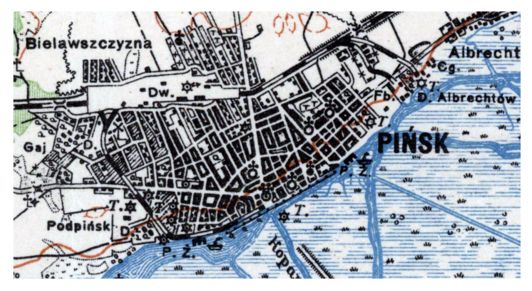
As for Truvovich, Vuvich and Misititch, this is the best clue I’ve found so far, a map of Pinsk from around 1925.  If you follow the main N-S street down to the Pina River at the bottom of this selection you will see, just on the other side, a short ferry-ride away, a spot in the marshes marked with a Jewish star and a capital T.

Truvovich maybe

“Star marks the spot of that muddy hell-hole, you say?” said the skeleton.

Death Benefits

These conversations with the skeleton of my father snuck up on me the first few times.   At first the skeleton simply interrupted, popping up to give me a detail from his point of view.   I indulged him when he had something to say and, also, when he had little to say.  

I came to look forward to our discussions, even as I was aware they were taking place in my imagination.  His answers had the ring of truth to them, he could be disarmingly honest and diabolically dishonest at the same time.  

He sometimes surprised me, like when his tone turned mid-sentence, the familiar merciless prosecutor yielding to the humble, remorseful man he became as he was dying.   The skeleton is once in a while the carping bully but more often he speaks in the voice of the man with the too-late perspective of suddenly having less than a day to live. That second voice is the one he would have preferred to have had all along.  The skeleton character speaks for both sides of my father,  what he was and what he could have been. 

By the time I got the call that he’d been rushed to the Emergency Room, yellow and unable to move his legs, I had begun to heal.   Our confrontations had made little sense to me as a child, all I knew was that the war was constant and unavoidable, except for the unpredictable ceasefires with a few hysterical laughs thrown in.    

I would come to know this hideous dance by the supremely ironic name my grandmother Chava used to describe the violence between my father and his brother: “seenas cheenam”  senseless hatred born of jealousy, pettiness, inexplicable malice.  

Seeing my father suddenly dying jarred me fully awake.  The experience in the dying man’s room is about person who is dying, not about anyone else.  He had things he needed to say.  I made it possible for him to say them.  Luckily for both of us I had attained at least that much empathy and common sense by then. 

I’d begun to see by that time, thankfully, and I was almost fifty already myself, that he had been unable to do better, would have done better if he’d been capable of it.   My father tried to explain, during that last conversation, that “on one level it was really nothing personal”.  I didn’t really get it at the time. This is a hard idea to truly grasp, but I think I’ve come to understand it.

Treating people badly is often the first reflex of people who’ve been treated badly themselves.  They will lavish the bad treatment on anyone they can safely do it to, a child is ideal.  Making the victim feel like it’s his/her own fault for the mistreatment is a satisfying two-fer my father was a master of.   He never recovered from being a two year-old, whipped in the face by his enraged mother.   How does one go about recovering from something like that?

Add to it the unutterable rages and sorrows that bubbled up from the lost souls of our murdered family in those doomed little Eastern European towns, rising like poisoned gas from the mass graves of our indecently slaughtered ancestors.  These unspeakable things can only be raged about.  The dead themselves, if they could speak, would bitterly complain it was so unfair and terrible, what they did to the powerless people who gave us life, people who only wanted to live, like everyone else.

                                                  ii

When my mother died, five years  and 22 days after my father died, I learned my sister and I were entitled to free grief counseling anywhere in the United States because our mother had been a patient at Hospice by the Sea at the end of her life.    My sister saw somebody in Florida, she went a few times.  I went every week for several months to 32nd and Broadway to sit with an Episcopalian priest named Paul who was an excellent listener and a kind man.  He recommended a book he’d found helpful — Death Benefits, by Jeanne Safer.  It was a book I marked up extensively when I read it.

The big idea of the book is that once a loved one dies their life can be seen, for the first time, as an organic whole.   There are gifts and lessons left behind when a loved one dies, from even the most miserable and ungenerous of them.  Seen in the context of one’s life and values, these gifts can be cherished and put to good use.  

Jeanne Safer had begun to see this after her own larger-than-life mother died.  Being a therapist, she had a wealth of patient stories as illustrations of death benefits large and small.  There was an overweight woman whose critical father’s death freed her to live a healthier, more satisfying life.  A frustrated accountant quit a job he hated to do what he’d always wanted to do, become a chef.  Old jury-rigged terrible things replaced by better, more refined and useful things by processing difficult lessons and seeing the gifts inside them.   

As I said, I took a pencil and bracketed sections of text that seemed particularly important or profound to me.  This is my practice when I want to mark text to find later, instead of underlining.  Underlining ruins a book, sometimes even crosses out some of the words it wants to remember.  I curse the underliners of library books, a tribe of unthinking, selfish morons.  A penciled bracket next to the text makes the section easy to find, in conjunction with a bookmark with a note and page number.  A bracket in the margin does nothing to make reading the prized section any more difficult.

I found the book very helpful.  I realized I’d learned many excellent and useful values from my parents, had inherited valuable traits.  I loaned my marked-up copy of the book to an old friend whose mother had died within weeks of my own mother’s death.  She never read it, and it was with a bit of drama, not without some ugliness, that I got it back a year or two later.  

I loaned it to another old friend who had lost her mother.  I never heard a peep about it and, in spite of her later promise to send it back to me, it vanished like the muddy little hamlets in the marsh where my grandmother’s family went into the night and fog.


Historical Revelations over shumai

Had dinner the other night with my father’s first cousin once removed, Gene, who grew up, from the age of five, in 1933, in the same Bronx apartment building on Eastburn Avenue where my mother lived with her parents.   Gene’s wife Sally grew up on the other side of the Concourse, just a few blocks away.   Sekhnet and I ate with them in a Chinese restaurant in Teaneck, where they have lived for many years.

I learned that Gene and Sally, like my parents, had little real information about their parents’ lives before they came to America, or about the families left behind. Gene’s father Morris had been one of eighteen children in a Polish town near the German border. Nine of the eighteen lived, including his father’s twin sister.  

Of these children only young Morris made it to America, having been sent for in 1909 or so by an uncle in New York.   He arrived after a two-week Atlantic crossing; was greeted by his uncle, who, three days later, died. Thirteen year-old Morris had to make his way alone in New York, learned the needle trade, became a union shop steward and a Communist.

“Stamper was a Communist,” my mother always said, without any judgment attached.  Although, it turned out, according to Gene, that after von Ribbentrop signed that pact with Stalin’s underling Molotov in 1939, the fatal non-agression deal between mass-murdering Josef Stalin and soon to be mass-murdering Adolf Hitler, Morris Stamper resigned from the party.

My grandmother Chava, Irv’s mother, had come across the Atlantic, with Gene’s mother (Morris’s future wife), on one of the last ships to leave the port at what was then probably called Danzig, now Gdansk, before the outbreak of World War I.     This was in the summer of 1914.

I was mostly listening, and filing details away, but I got the impression, from Gene’s description of his mother Dinsche as a brave, beautiful “leader” and Chava, two years younger, as a complaining, far less intrepid type, that it was due to the spirit of Dinsche that the two were able to cross the Atlantic in steerage during the summer of 1914.  

Dinsche had regarded the crossing as something of an adventure, charming the crew and getting special privileges for the two of them.  Chava, apparently, complained about the food, though the food they got was better than the food most people in steerage received, thanks to the socially adept Dinsche.   After their German-registered ship discharged its passengers in New York it was quarantined in the U.S. for the duration of The Great War.

As for the muddy hamlet the two of them came from, Truvovich, a place no longer found on any world map, it had been one of three such tiny Jewish hamlets located across the river from Pinsk, in a swampy area, as far as I can tell.  The other two doomed hamlets were Vuvich and Misitich.   Pinsk at the time was a town of about 70,000 people, about 30,000 of them Jews (of whom 37 are known to have survived the Nazi occupation).  

It was a short ferry ride from Truvovich across the Pina River (though Gene called it by a different name). It must have been after a ferry ride to that metropolis, in the earliest decade of the twentieth century, that Leah and Azriel were immortalized in a photo studio in the two large portraits Chava dragged with her to the New World in 1914.

The most amazing bit of history Gene imparted, along with descriptions of his childhood train trips up the Hudson River to visit Chava and her kids in Peekskill, was about my father’s uncle Aren’s Marco Polo-like voyage across Asia, the Pacific, the entire American continent just after the turn of the twentieth century.   If I’d heard this amazing and unlikely tale, I’d forgotten it.  

Aren had three children, Eli, by his first wife, who died of complications from Eli’s birth, and Nehama and Dave by his second wife. Aren sent for his little sister Chava in Truvovich after he remarried. Eli, I did the math just now, was about six when he went with his father to greet his beautiful, red-haired aunt in NYC and the two fell immediately into lifelong love.

Aren’s story I heard mostly from his son Eli. I spent many days, often until late at night, talking with Eli in the final years of his life.   Much of the talk was family history, the entanglements and devilish details of it.   Aren had arrived in New York City in around 1905, I had understood, where he learned to vulcanize rubber. Getting in on the ground floor of the brand new automobile industry, he would work with cars for the rest of his life.

I knew Aren had escaped from conscription in the Czar’s army around the time of the Russo-Japanese war, which history books tell us was in 1904-05. In those days a Jew drafted into the Russian army served for thirty years, absent early release via death or dismemberment in battle (partially untrue, actually, see note*).

Aren and two friends, Fischl Bobrow and Fleishman, decided not to be among the 40,000-70,000 dead Russian soldiers in that war.  They escaped the Imperial Russian Army together and arrived in the United States.  It’s possible Fleishman opted for Canada instead, which is where I think he settled.  I believe Fischl was the eventual connection to the Widems, Irv’s father’s family, from outside of Hartford, Connecticut.

According to Gene, their flight took them across Siberia, the Pacific (or perhaps the Bering Straits) and eventually to San Francisco.   San Francisco in 1904 or 1905, before the Great Fire of April 1906.  I picture Aren now, arriving in California, having crossed the massive Pacific Ocean somehow, a trip of about 6,000 miles.  Then he heads east, presumably on the transcontinental railroad, for another three thousand miles.  Next we hear from him, Aren’s in Manhattan learning to vulcanize rubber.     A few years later he sends for his little sister, who becomes my father’s mother, and the rest, as they say, is history.


* Apparently Jews, who were not allowed to serve in the Russian army until 1827, had been drafted for a twenty-five year hitch prior to the reforms of Alexander II.  Therefore Aren and his friends were likely only in for a five year military stint at the time of the Russo-Japanese War.  They were not alone in disobeying the Czar’s military orders.   From the summer of 1905 to the fall of 1906 there were apparently 400 mutinies in the Imperial Russian Army.

Things were made worse for the Jews at this time by circulation of the infamous forgery The Protocols of the Elders of Zion, published in Russian 1903,  confirming the worst about The Chosen People, in the minds of many, and unleashing a renewed flood of pogroms.