How You Do It

“What difference did it make to Azrael?” I asked him, when he told me how upset Azrael had been when an insect drowned in hot water while he was running a bath.   

“I asked him that after he came out of the bathroom,” he said.  “He’d been running hot water to rinse the tub when a bug he realized was alive a moment too late to save it died a horrible, plunging, drowning death in the pipes.    What he said to explain it to me was so simple it still strikes me.   He said ‘picture your own moment of death — would you like it instant and painless or prolonged and painful?’  I always think of that when I kill a bug, to this day.  That bug desperately swimming for his life away from the sucking drain could have instantly been put out of his mortal terror and unavoidable death by a merciful finger.  

“Azrael had been too slow to react when he saw the bug, at first he didn’t realize it was even alive.  Then he saw it struggling to swim in the hot water away from the drain.  Then he’d watched the bug get swept over Niagra Falls to die an agonizing death by drowning in the churning, unbearably hot water.  It impressed me how awful he felt about not sparing that bug such a miserable death.”  

“Instant and painless or prolonged and painful,” I said.  “I like that.  A no-brainer for a marketing/branding scheme exploiting that no-brainer:   ‘Quick/no pain or slow/maximum pain, your choice.’  It’s appealingly philosophical, too.”    

“Of course, life is not so black and white,” he said.  

“Exactly, which is why such idiotically phrased choices are so irresistible, anyone who’d choose the wrong choice is so obviously wrong.   I like the phrase, and I think we can monetize it, I think it’s a good choice phrase,” I said.  “Plenty of imagery and punch, the rubes will love it.”

“The phrase is fine, monetize away, I’m just sayin’,” he said.  

“You know, it’s not like Azrael was exactly into Ahimsa or any ascetic religious practice that would have made him so sensitive to a bug’s soul.  He ate meat, he’d curse, he was always rough breaking up a fight,” I said.   “He certainly didn’t shrink from hurting anybody.”

“He didn’t, but when you say Azrael ate meat, that’s funny, yeah, he ate meat.  He lived on meat, ate almost nothing besides meat.   He was a shoichet’s assistant, at a place down the street from the butcher’s, from shortly after his bar mitzvah, if I recall correctly, until he started working at the delicatessen,” my brother reminded me.  

“He was one tough son of a bitch,” I said.  

“Yiss,” he said.  

“And he always kept a dog.”  We both remembered Azrael’s dogs.

“Yiss,” my brother said.

Note to Eric

As predictable as it is SAD!

Dear Eric:

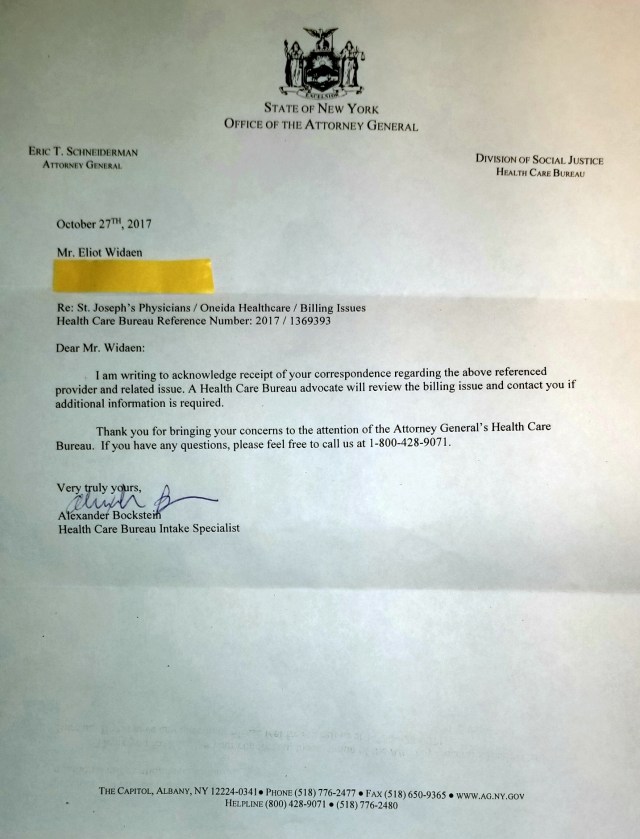
Please excuse the liberty, colleague, I’m responding to the November 6 letter from one of your Division of Social Justice assistants, Jennifer Lonergan, who incorrectly stated that I had addressed my letter of October 12 to “Eric Schneiderman”.   

I voted for you in each of your State Senate elections and for A.G.  I share many of your political views, including the belief that a primary role of government is protecting citizens from the predations of the powerful.  I applaud the proactive stances you take on many important issues.  I don’t blame you personally for the inadequate response to my long and detailed letter, though it reflects poorly on the office that acts in your name.

Ms. Lonergan begins her point by point refutation of my painfully researched assertion that the New York State regulatory help scheme for low income health insurance consumers is a cul du sac by demonstrating active listening, the dismissiveness of her tone in restating the obvious probably inadvertent:

It appears that it is difficult for health care consumers, such as yourself, to ascertain where to turn for help regarding various health care issues, and further, that you received misinformation from various entities tasked with assisting consumers with health care issues.

Ms. Lonergan, although perhaps not fully grasping the blood pressure elevating vexation that unregulated health insurance causes low income New Yorkers,  did an impressive amount of cutting and pasting in assembling a letter full of potentially helpful sources that could possibly solve some pressing healthcare-related consumer problems within only a few months.  According to her, the help desk in your office is more than a match for most of the vexing, unregulated consumer abuses detailed in my letter.   

Her response to this paragraph was noteworthy:

Essential Plan members do not have a right to file complaint appeal (sic).  If they need assistance filing a grievance or appeal, they may also contact the state independent consumer assistance program at:  Community Health Advocates, 105 E. 22nd Street, NY NY 10010 or 888-614-5400 or email at cha@cssny.org

source:  Anthem’s National Contact Center Document under NY market tab for “Essential” plan updated as of 12-14-16 at 7:56 a.m.

She informed me, presumably based on research unavailable to a consumer like myself, that the health insurance representative had been mistaken when he pretended to read corporate policy from his customer service manual.  This leaves me marveling at the rep’s inventiveness and eidetic memory,  “reading” me the identical made up wording several times, so that I could transcribe it accurately.  Adding that it was printed in red, and providing an invented source, were truly brilliant, if diabolically misleading, touches.

Ms. Lonergan also corrected my slipshod use of the legal term “fraud”; she was good enough to point out that I had not established an essential element, since doctors I’d been referred to by the insurance company who had refused me treatment had not actually taken payment from me.  I guess, arguably, the premiums I pay every month to the corporation that referred me to these doctors are beside the point for purposes of a claim of fraud.

I greatly prefer the letter from Mr. Bockstein (attached), which, while clearly sent to me in error, at least spelled my name right and did not dismiss the health-threatening concerns I’d taken pains to detail carefully for your office’s consideration, practices I offered as illustrations of the desperate need for the policy changes I suggested.  I subsequently had Mr. Bockstein’s kind assurance that my original letter was under consideration by an advocate named Jennifer Lonergan who would be getting back to me.  No point beating a dead cul du sac here.

I suppose the most honest letter I could have received in reply to mine would also have been the most depressing: low income healthcare consumers get whatever care they get, and whatever version of due process goes along with it.  And though they may address a letter to a champion fighting institutional injustice, with the power to advocate changes to grossly inadequate protections under the law, they can expect, at best, a letter like Ms. Lonergan’s.

Have a great day,
Eliot “Widaeu”

20171105_000124

For reference, the corrected file number on my original letter is 1370738.  Presumably my letter is also preserved under that file number.

Insights from a Jesuit

My sister alerted me to a recent Terry Gross interview with a Jesuit priest named Greg Boyle, Fresh Air from November 13, and said it was worth my time.  It was.  Then, as his new book “Barking To the Choir” is currently hitting the stands, Krista Tippett broadcast her chat with him.   I wrote to thank my sister, with cuttings from the transcript of Krista’s talk with Boyle, which I will provide here.

He covers some different ground with Krista Tippett, I’m reading the transcript, this just jumped out at me (and what a potent phrase that is below, which I emphasize for ye):

Ms. Tippett: One of the realizations you’ve said you made out of that is that peacemaking requires conflict. And while there’s lots of violence between gangs, there’s not conflict that you can define, like you can with a war.

Fr. Boyle: Yeah, it’s difficult, because I’m sort of the dissenting voice, I think, in the country at the moment, when it comes to this thing. And sometimes people will say to you, “Well, how can you be against peacemaking?” Well, obviously, I’m not against peacemaking. But I’m old-fashioned: I think peacemaking requires conflict, and it’s important to say that there is no conflict in gang violence. There’s violence, but there’s no conflict, so it’s not about anything.

So you want to understand what language is gang violence speaking? That’s important to me:

It’s about a lethal absence of hope.  It’s about kids who can’t imagine a future for themselves. It’s about kids who weren’t seeking anything when they joined a gang. It’s about the fact that they’re always fleeing something — always, without exception. So it shifts the way you see things.

Somebody, Bertrand Russell or somebody, said, “If you want to change the world, change the metaphor.” And that’s kind of how we want to, I think we need to proceed, in something like this. So if you think it’s the Middle East, you’re quite mistaken. If you think it’s Northern Ireland, wrong again. It’s about kids who’ve ceased to care. So you want to infuse young people with hope, when it seems that hope is foreign.

(as I wrote to my sister about this next clip)  WOW.  from the same interview with Krista Tippett:

So recently, I gave a talk, a training, an all-day training to 600 social workers, a training on gangs. I had two homies with me, and one of them was a guy named José. And he got up — he’s in his late 20s, and he now works in a substance abuse part of our team, a man in recovery and been a heroin addict and gang member and tattooed. And he gets up, and he says, very offhandedly, “You know, I guess you could say that my mom and me, we didn’t get along so good. I guess I was six when she looked at me, and she said, ‘Why don’t you just kill yourself? You’re such a burden to me.’”

Well, the whole audience did what you just did. They gasped. And then he said, “It’s sounds way worser in Spanish,” he said.

[laughter]

And everybody did what you just did. And then he said, “You know, I guess I was nine when my mom drove me down to the deepest part of Baja California, and she walked me up to an orphanage, and she said, ‘I found this kid.’” And then he said, “I was there 90 days, until my grandmother could get out of her where she had dumped me, and she came and rescued me.”

And then he tells the audience, “My mom beat me every single day. In fact, I had to wear three T-shirts to school every day.” And then he kind of loses the battle with his own tears a little bit, and he says, “I wore three T-shirts well into my adult years, because I was ashamed of my wounds. I didn’t want anybody to see them. But now my wounds are my friends. I welcome my wounds. I run my fingers over my wounds.”

And then he looks at this crowd, and he says, “How can I help the wounded if I don’t welcome my own wounds?” And awe came upon everyone, because we’re so inclined to kind of judge this kid who went to prison and is tattooed and is a gang member and homeless and a heroin addict, and the list goes on. But he was never seeking anything when he ended up in those places. He was always fleeing the story I just told you.

D.U. never had this, too bad he didn’t learn the last part:

Our motto, still, on our T-shirts is: “Nothing Stops a Bullet Like a Job,” but that does about 80 percent of what needs to be done. There’s still the other 20 percent, which is relational, and it’s about healing. And it’s about what psychologists would call “attachment repair,” because gang members come to us with this disorganized attachment. Mom was frightening, or frightened. And you can’t really soothe yourself if you’ve never been calmed down by that significant person in your life. And it’s never too late to kind of gain this, so they repair this attachment, and they learn some resilience.

Nice ending, she asks him to read the 14th century Rumi poem from his latest book.  Krista does a great job with these interviews:

Fr. Boyle: Yeah, I don’t know why I put it in my book.

[laughter]

And so now I’m living my nightmare of my interview with Krista Tippett.

[laughter]

Now proven myself shallow and uninteresting.

Anyway, it’s called “With That Moon Language.”

“Admit something: Everyone you see, you say to them, ‘Love me.’

Of course you do not do this out loud,
otherwise someone would call the cops.
Still, though, think about this,
this great pull in us to connect.

Why not become the one who lives with a full moon in each eye
that is always saying,
with that sweet moon language,
what every other eye in this world
is dying to hear?”

I’ve Got To Say This For Them… these motherfuckers are not trying to hide anything

I’ll say this for the right wing, when they are in power they march in a straight line, consistently toward making America great again, for our greatest Americans.  

How’s this for a straight line?  In the lead up to the last presidential election Facebook ran micro-targeted, personalized anti-Hillary ads that were seen by over 120,000,000 Americans.   In an election The Donald won, by about 70,000 votes in the five states that put him over the top in the Electoral College, those 120,000,000 hairy eyeballs Facebook ads provided were probably a factor.   Trump lost the popular vote by almost 3,000,000, which caused him to claim widespread national voter fraud and establish a commission to collect the voting data for every American.  Fortunately, he loses interest in shit like this almost as fast as he comes up with it.

The internet– to regulate or not to regulate?  The current rule is that no internet provider may give privileged, fast-track access to any website over any other.  This is called “Net Neutrality” and it has always been the rule and custom on the internet.   You get the bandwidth you purchase, period. 

President Trump, among his first orders of business, appointed a corporate attorney from Verizon to oversee things, and be the swing vote, at the Federal Communications Commission.  The attorney/chairman’s first order of business at the FCC is to overturn the internet’s long tradition of democratic access by creating a high speed lane in the internet toll road for the wealthiest purveyors of  internet fare to roar down, drowning out the curses of the rest of us as we slog along in the heavy traffic that is the lot of poor bastards.

Look, we get the justice we can afford to pay for, that’s just the way it is here.  Always has been, too.   After all, even our sainted founding fathers, those of Scalia’s “Original Intent of the Framers” fame, allowed that in areas where great fortunes were to be made, certain compromises, if artfully enough written into the margins of our Constitution, could ensure the continuation of such lucrative economically advantageous arrangements as could be sensibly, subtly, compromised over in penumbral yet binding clauses in otherwise unrelated paragraphs. 

It would take ninety years, in The Land of the Free and the Home of the Brave, until moral prigs (and whichever other such persons should have good cause to complain thereof) began agitating loudly enough for the abolition of one such compromise, the Peculiar Institution.  Then there was a national slaughter, and more slaughter, terrorism, lawlessness, law and some more slaughter.  You can read about it and weep, crybaby.  USA!   USA!!!!

The D.U. Reassures His Wife

I need to amplify this subject, how my father treated his wife, my mother.  We can understand a person best by how they treat those closest to them.  For now, this one regular scene from our family dinner table, when the war was not actively raging.

My mother from time to time would express concern about some possibly life-threatening turn in my father’s health.  He always had the same breezy answer ready for her expression of concern.

“Don’t worry, Ehvie,” he would say cheerfully “only the good die young.”   

My mother’s response was always the same too.  Her nostrils would instantly flare, her eyes would become wet and she’d begin to sob.  My sister and I would look at each other and shake our heads, though neither of us could have explained exactly why we were reacting like two wise, old Jews.

NOTE to self (gracias a Gaj): loo-doo

Great Summary of the Age of Obama/Clinton

Lee Carter recently unseated Jackson Miller, Republican majority whip, in the Virginia House of Delegates.   He ran as a Democratic Socialist and resisted attempts by the local Democratic party to steer his campaign.  He won by a nine percentage point margin of victory.   He spoke to Jeremy Scahill last week on Scahill’s Intercepted podcast (at 01:17:50) and summarized the current dilemma in knee-jerk red hat/blue hat American politics better than anyone I’ve heard do it.

Lee Carter:  2008 saw a massive collapse of the global economy on a scale we hadn’t seen since the Great Depression.  The fact that we never really fixed the global economy after 2008 has built up this simmering discontent with politics as usual, on both sides.   You have politicians, particularly in the Democratic party, because Barack Obama was the president at the time, who, for the last eight years have spent the entire time saying “look, we’re in a recovery, things are going great, we don’t need to change anything about us, the problem is the Republicans.”

And then the Republicans were pointing to the actual problems with the recovery, the fact that prior to 2008 we had millions of people who had a single, full-time job that was able to pay the bills, now they’re having to work two and three precarious jobs to get most of the same amount of money as they had before and they’re saying “the economy is not recovering, it’s still in the tank, and the problem is the Democrats.”   So the center of American politics in that environment is not really holding anymore.   

If you look at the polling, obviously the most unpopular thing in American politics is President Trump, but the second most unpopular thing in American politics is the Democratic Party.  So the Democratic Party,  right now, the leadership, certainly, seems to think that just by tying all elected Republicans throughout the country to Donald Trump they can see electoral success.  And in the short term that may very well work.   

But unless we actually clean our own house, and recognize that the recovery we have overseen since 2008 has been incomplete, that we never addressed the structural problems of America’s economy, that there are people who are being left behind, if we don’t address those problems and become the kind of party that fully embraces the working class and the health and welfare of 98% of people, once Donald Trump is gone we are going to go through the floor, because we won’t have that crutch anymore.  Donald Trump is not going to be around forever and once he’s gone, if we haven’t fixed our own problems, we are in a lot of trouble.   

Me:  Well said, sir.   Thank you for your service.

NOTE:  just spent a good deal of time accurately transcribing Lee Carter’s statement, since last time I checked the Intercept did not publish a transcript of its podcasts.  Now, looky here, darn it, all I had to do was cut and paste (note, the remainder of Jeremy Scahill’s interview with Lee Carter is at the bottom of this note):

JS: Now Lee, you, of course are at the beginning of your political career and it seems to me like there’s this bifurcation within the Democratic Party right now where you have the kind of more corporate, elitist, old school Democratic Party headed by the Clintons and their supporters. And then you kind of have everyone else who seems to want the Democratic Party to move in a different direction, more to the left and more in sync with the visions of the most popular political figure in the country right now, Bernie Sanders.

What’s your analysis, Lee, of the state of the Democratic Party?

LC: This is something that’s happening on both sides of the aisle. 2008 saw a massive collapse of the global economy on a scale that we hadn’t seen since the Great Depression. The fact that we never really fixed the global economy after 2008 has built up the simmering discontent with politics as usual on both sides.

You know, you have politicians particularly within the Democratic Party because Barack Obama was the president at the time, who, for the last eight years have spent the entire time saying, “Look, we’re in a recovery, things are going great, we don’t need to change anything about us, the problem is the Republicans.”

And then the Republicans were pointing to the actual problems with the recovery and the fact that prior to 2008, we had millions of people who had a single full-time job that was able to pay the bills and now they’re having to work, you know, two and three precarious jobs to get most of the same amount of money as they had before and they’re saying, you know, the economy is not recovering, it’s still in the tank and the problem is the Democrats.

So, so the center of American politics in that environment is really not holding anymore. If you look at the polling, you know, obviously that the most unpopular thing in American politics is president Trump, but the second most unpopular thing in American politics is the Democratic Party. So, the Democratic Party, right now, the leadership certainly seems to think that just by tying all acted Republicans throughout the country to Donald Trump, they can see electoral success. And in the short term that very well may work, but unless we actually clean our own house and recognize that the recovery that we have overseen since 2008 has been incomplete, that we never addressed the structural problems of America’s economy, that there are people who are being left behind, if we don’t address those problems within our own party and become the kind of party that fully embraces the working class and the health and welfare of 98 percent of people, once Donald Trump is gone, we’re going to go through the floor, because we won’t have that crutch anymore.

You know, Donald Trump is not going to be around forever, and once he’s gone, if we haven’t fixed our own problems, we are in a lot of trouble.

The interview begins:

JS: Lee Carter, first of all, congratulations on your victory.

LC: Thank you so much.

JS: You have, also, an interesting story as to how you decided to seek political office.

LC: Yeah, so, I served five years on active duty in the United States Marine Corps from 2006 to 2011, deployed twice with the 22nd Marine Expeditionary Unit, went to Haiti after the earthquake in 2010. You know I decided to run for office after an injury on the job in the summer of 2015, long after I got out of the Marine Corps, but I was installing a lighting control panel and I got shocked and I blew my back out pulling away from that panel, and I could barely walk for about two and a half, three months. You know I couldn’t walk more than about fifty feet at a stretch, and I just got shuffled around from doctor to doctor on worker’s comp and none of them really wanted to address the actual problem, they just wanted to give me pain pills and get me out the door.

But finally, I decided to pay out of pocket for a specialist to figure out what the problem was and he was able to get me back on my feet fairly quickly. And when I was able to get back to work, I called my boss and I said, “I’m ready to go, put me back to work.” And they said, “We have work, but we don’t have any for you. Because our customer is not comfortable with you on their job site.”

That’s what sort of pushed me into politics, you know? There was this rage that I put my body on the line to make this company rich and when I finally got hurt, you know, when that dangerous job caught up to me, they just threw me under the bus. So, I decided I was going to step forward and run for office and fix this. Because there’s a very common phrase in the construction industry that goes, “If you fall off a ladder you’re fired before you hit the ground.” Most construction workers have heard that and you know they’ve heard it, not as a joke, as a threat.

So, you know, I decided to step forward and run for office and make sure that what happened to me didn’t happen to thousands of other Virginians.

JS: Talk about the struggles you had in fighting both the Republicans and the institutional Democratic Party in Virginia.

LC: Yeah, we were able to put together a coalition of groups, you know we had the Democratic Socialists of America, we also had the anti-gerrymandering group, Let America Vote, which was founded by former Congressman Jason Kander. We had, you know, the support of the Sierra Club and Planned Parenthood and NARAL Pro-choice Virginia and the Virginia AFL-CIO and sister district and all these sort of women’s march type groups.

So, we had the support of the base of the Democratic Party, and also, you know, the Democratic Socialists of America and we put that coalition together sort of in defiance of Virginia’s Democratic Party leadership.

The leadership here certainly wanted a lot of minute to minute reports on exactly what was happening in the campaign that I wasn’t comfortable providing. They wanted some editorial control over my message that I wasn’t comfortable providing. So, I decided, you know what? I’ve got the manpower to do this. I’m going to go ahead and do this and I’m going to do it my way.

And the mailers that my opponent sent out, he actually sent out to 11,000 homes, a mailer that had Joseph Stalin and Mao Tse-Tung and Lee Carter’s face on them, all the text on it talked about my health care policy, because, you know, if there’s one thing that people remember Stalin for, it’s the health care.

JS: [Laughs.]

LC: But clearly that sort of 1950s, 1960s, you can’t go to the left or they’re going to call you a commie type of common knowledge in politics doesn’t hold true anymore.

U.S. Armed Forces Video: If a person defends the activities of the communist nations while consistently attacking the domestic and foreign policy of the United States, she may be a communist.

source
President Humbug

It is by now beyond question that our country is presided over by a man who can fairly be described as a crude, blustering jerk of average intelligence.  His main talent, perhaps his only one, is his unflappable ability to sell himself.   One should not sneeze at this talent.   This is an essential skill for any showman, any celebrity, anyone wishing to be president.  It is a sad day, however, when this ability, vast, inherited wealth and brand recognition are the only criteria needed to attain the world’s most powerful office.  SAD!

Phineas Taylor “P.T.” Barnum was America’s most famous unscrupulous self-promoter, until this chap Donald John Trump came along.   I thought I’d check out Barnum’s life and career a bit, and so spent a few minutes of painstaking research reading the Wikipedia article about P.T. Barnum.    I was surprised and not surprised to learn that among several books written by Barnum one was called “The Art of Money Getting”. 

It is a small step, a hundred years later, to “The Art of the Deal”, an art that Mr. Trump boasts of, without much proof of his skill at it, outside of bullying New York City officials in his early real estate deals.   Barnum, we learn, was born in modest circumstances and made and lost a vast fortune more than once.  Trump, by his own account, required only a “small million dollar loan” from his father to get started building on his father’s real estate empire.   He later legitimately acquired a fortune, and vast publicity and credence (to the credulous),  playing a fictional successful businessman in a wildly popular “reality TV show” made while he was negotiating multiple bankruptcies for some of his many failed business ventures.   

Of the two, only Barnum appears to have done anything good for anyone but himself (unless we include Trump’s appointment of wealthy, unqualified people to high government positions).  Of himself, Barnum said: “I am a showman by profession…and all the gilding shall make nothing else of me”[2] .   He also said that his personal aim was “to put money in his own coffers”.   That said, he seems to have shared his wealth with others.  Tom Thumb became a wealthy man working with Barnum and the famous impresario seems to have given a good deal of money to others over the course of his life, including Tufts University and the city of Bridgeport Connecticut.  Barnum also advocated principles, like his eventual strong opposition to slavery.

Barnum reputedly said, as Trump would later prove, “nobody ever went broke underestimating the intelligence of the American people” [1], and is remembered as America’s flamboyant, once world famous snake-oil salesman.   Still, one would have to take Barnum over Trump for frankness, originality and taste.  He probably would have made a better president, too. 

He could hardly have made a worse one, a powerless prick given to snide understatement might add.

[1] Whoops, this was an observation of H.L. Mencken’s, apparently, paraphrased into the current blunt version we all lovingly quote today


Freedom on The March — End Net Neutrality!

The far right, representing the interests of most of America’s wealthiest and greediest, is now wringing its hands in happy anticipation of the imminent repeal of more Obama regulations.   For whatever obnoxious reason, the FCC, which makes the rules about all mass media over the public air waves, including the internet, is not a bipartisan, non-political commission.  The sitting president seems to appoint the swing vote.     

The FCC, stewards of the public airwaves, has a Republican chairman now, Ajit Pai, talking about the importance of repealing a two year old Obama-FCC ruling that “regulates” the internet.  It regulates the internet by not allowing providers to selectively slow down or speed up access to selected websites and internet based services.  This “regulation” of enforced non-interference is called “Net Neutrality” and it means that it is currently illegal to allow, say Democracy Now!, to pay a provider for high speed streaming service bringing it to customers at ten or a hundred times the speed of, say,  FOX, who does not pay the premium.  It would allow a provider to slow or even block the content of any website that does not pay whatever toll it imposes on fast internet speed.  It is this kind of over-reaching government regulation, says Pai, that must be repealed in the name of Freedom.

Of course, Mr. Pai does not go into in any kind of detail arguing why killing Net Neutrality is a good thing, why should he?   The actual argument, mainly that those with the most money should enjoy the greatest influence over the previously free internet, would only cloud the picture, turn people against his position.  Neither would it help his argument to underscore the obvious: that it is fitting that the people with the most money get the greatest say in what information gets out to internet users, just like they get the greatest say in who makes rest of the laws, and what laws are made, here. 

Suffice it to say, says Pai, with a winning smile, I am a man in a red hat announcing that I am striking down job and competition killing, freedom hating regulations promulgated by OBAMA.  Now, you people in red hats, raise your fists and let’s hear a great “Huzzah!”   MAGA!   USA!  USA!!!!

You can hear three commies discuss the implications of this current threatened end to Net Neutrality here.

Here’s Ajit Pai himself, interviewed on PBS shortly after his appointment by Trump, announcing his plans to end net neutrality.  Characteristically churlish of me to mention that Pai was, until recently, a lawyer for corporate giant and internet provider Verizon.  Pai says he’s wants to end net neutrality to protect people in poor areas, to ensure that providers are not “disincentivized” from providing them decent internet service. 

If my cat’s litterbox could speak like a Harvard trained lawyer, this is what it might say.  Pai speaks for himself, and all internet giants here.   Have fun!   

Kudos to NYS Attorney General Eric Schneiderman for his principled, activist stand on this issue.  I will be back to kick the A.G.’s ass a little on an unrelated issue in a few days.  Assuming this website will even be accessible once Mr. Pai and Freedom Herself are done with their march for poor people’s rights.

This One I Truly Don’t Get, Obama

Happy Thanksgiving, first of all.

I had the usual holiday bot response from the New York State of Health Marketplace this morning at 8 a.m.   An important message in my inbox, the email advised me, which, of course, could be any message whatsoever.  Last Christmas, on the day, that important message told me, in error, that I would not be receiving the subsidy because my income, well within the range for the subsidy, well — no subsidy.   That only took five months to fix.  The year before I think it was New Year’s Day, I was informed that my health insurance was cancelled and could not be restored until March 1st, but only if I uploaded a series of demanded documents within seven days.   

The emails tell you to log on immediately to see the important message.  Presumably this is done for your privacy.  If they sent you an email saying: congratulations, your enrollment for 2018 is complete, see message in your inbox for details, anybody hacking into your email could see that you were eligible for insurance coverage in 2018.  It’s confidential, of course, and your confidentiality is very important to us, so please go to your inbox for this important message.

Your NYSOH inbox shows all these messages marked Template, with various random, inscrutable template numbers.   Even in your private inbox there is no indication of what these various messages may say, only the dates they were sent to you.   You must download these form letters, in PDF format, to read them.  OK, this is a witless bureaucracy and presumably they can save money by having a tireless, unpaid bot send you a generic email each time NYSOH communicates with you, and also, by putting Template 099 next to each message in your inbox, instead of labeling them; enrollment, immediate action required, seven day notice, health insurance in jeopardy, what have you.

Here is the part that truly confounds me.   It has nothing to do with Trump defunding Obamacare advertising, or Republican sabotage of a law they despise that happens to allow more low income people to have health insurance, or the current, most excellent president’s fanatical zeal to overturn everything his slippery, lying Kenyan-born secret Muslim predecessor managed to enact.  It has nothing to do with the flawed design of the cleverly named Patient Protection and Affordable Care Act.  It is just a puzzle, and I have no idea what is at work, outside of plain, simple human stupidity and bureaucratic rigidity.  I literally have no clue, outside of the usual shabby consideration given to people affected by any government program that serves those who are in any kind of financial need.

On October 24th I had an email from NYSOH, the only one I had since July.  In July the important notice, Template 077, told me what I already knew.  It turned out to be a condensed electronic version of the mediator’s decision that I had been entitled to a subsidy all along, and that it was restored, retroactive to the first premium payment of 2017.     Bear in mind that this October 24th notice, which I read the other day, was the only notice I will receive about deadlines for re-enrolling to be eligible for health insurance in 2018.   Page two (of ten — one blank, four related to registering to vote, in many languages) reads:   


Screen Shot 2017-11-23 at 11.19.58 AM.png

Dig this.  Not only are the IF categories forgetting one important IF– if you want health insurance for 2018 you will have a thirty day window to get it, but there is something far worse.  (OK, I have to admit, in fairness to these sloppy assholes, that page one informs me that “ACTION IS REQUIRED by December 15” so that an appropriate — or inappropriate– decision can be made on my health insurance coverage for 2018).  

Here’s the mystifying thing.  This October 24 form letter is the only notice you anyone on Obamacare will get regarding your health insurance for 2018.  On October 24 you get an important notice telling you that beginning on November 16 you will have thirty days during which to purchase your 2018 insurance plan.   Mark your calendar carefully, asshole.  Note: we changed the arbitrary deadline this year, it no longer extends to New Year’s eve.

Leave aside all the other institutional problems with a health plan that is based on private insurance companies selling you insurance.  Forget the rabid profit-crazed foxes left in charge of the henhouse.  Forget all of the gripes about the problems of the original PPACA, unaddressed by a Congress full of twitchy fundraisers, half of them fanatically focused on repeal of the popular law.

I live in New York State.  This state was one of the original adopters of the PPACA.  When it came into law the state abolished its own program for low income New Yorkers.   New York State was all-in from the beginning.   It’s not like the state is in the hands of people that have any motive to sabotage the law or deny anybody coverage.     That is the case in many states, who refused to participate fully because they opposed the conservative health insurance compromise on principle, because it was sponsored by a post-racial president.  (Post-racial, wink wink, you get what I’m sayin’?)

Does anyone have any idea what the logic, if any, of this single important notice given three weeks before the short holiday season window opens for buying the following year’s health insurance could be?  Outside of another random example of exceptional American human idiocy?

I suppose I could ask Donna Frescatore, the director of NYSOH, a political appointee who doesn’t allow reps at NYSOH to divulge her name (why should she?) — but that would seem churlish, don’t you think?

Practical Consideration

Rachel Yehuda, among many excellent points in her talk with Krista Tippett, asked a very good question:  who would you rather have with you in a war zone, an experienced fighter or a cultured philosopher who has never faced a murderous enemy?  This question was answered “fighter” by many Jews after the Hitler regime, determined never again to be quiet victims of mass violence.  Being eternally tough and ready to kill can lead to overkill, certainly, but it is an understandable enough answer when the question is survival when an entire army is determined to kill you. 

In my quiet life I may feel pacifism is the best option in human affairs, and mildness the best choice when dealing with others, but I would certainly not feel that way faced with an army of murderers intent on killing me and everyone I love.   I’d want an experienced killer next to me to show me how to kill the motherfuckers who were after us.

I was thinking of the same thing in regard to electoral politics and influencing public policy in the USA.  Would you rather have millions marching in the street in protest of evil done in our names, or legislators strategically placed in state houses and Congress to vote in blocks to pass actual laws and give the official nod to secret horrors?   

A few years back, a movement of right wing zealots, funded generously by billionaires, formed a “grass roots” organization called the Tea Party.  This rag-tag army of staunchly conservative patriots got tremendous publicity and, with a shit-ton of money, managed to move the Republican party even farther to the right.  They made the party more extremist by “primarying” moderate Republicans out of office.   The Koch brothers and their ilk looked on approvingly, funding the campaigns of these radical reactionaries, sponsoring this group of servile champions of the already powerful, making the current crop of Republican legislators move to the right or lose their jobs.  Once in office these Tea Party true believers literally held the government hostage, at one point even shutting it down by refusing to fund government programs at a budget deadline.  That’s how you make policy, if you are a ruthless motherfucker intent on changing the world to reflect your worldview, and have the monetary clout, and organization, to do it.

It turns out not to be a matter of right and wrong, who rules, even in a democracy.  The fiction is that our elected representatives act on our behalf.  In the real world of winners and losers they act on behalf of those who pay for their campaigns and keep them in office.   It is not much of a choice on election day, in most cases.  It’s Lewis Black’s two bowls of shit and you’ve got to pick one.   

Might makes right in the Darwinian jungle of electoral politics.  If your party controls Congress you can tell a popular sitting president who won in a landslide to shut the fuck up.  You can simply deny him his constitutional right to fill a Supreme Court vacancy, nothing he can do about it.  You can do everything but outright call him a nigger, even though you’re free to insist he’s a lying Kenyan Muslim and an illegitimate president and doesn’t mean shit.   That’s the power of organized lobbying and the leverage a loud-mouthed celebrity can exert if he is given a big enough public platform via the mass media. 

A stage full of Republican hopefuls in a presidential debate– not one can admit outright that humans evolved from apes, or that the climate is changing in dangerous ways, or that human activities, driven by unchecked greed, are  destroying the planet.  That’s the co-opted Jesus and fossil fuel lobbies, respectively.  The Democratic party is not quite as bad, but it is also an incorrigibly corrupt machine oiled by the money of those legally created psychopaths, corporate “persons”, and their human counterparts who expect their will to be done.    Both parties serve their masters in a society based on the bottom line, and in this case, anyway, the customer is truly, always right.

The bottom line here — was the Bernie Sanders campaign a one shot novum, never seen before in America and never to be seen again?  Or could a candidate with principles and a convincing analysis of why there is so much poverty, misery, desperation and rage in our wealthy nation, funded by small donors (Obama bragged of the same kind of support, but took the bulk of his money from corporations and wealthy folks and opted out of the campaign finance law designed to limit the influence of these forces, and outspent his opponent two to one — and he, uh, ruled accordingly) actually win an election that was not otherwise rigged? 

On one side, a slickly marketed, relentlessly publicized, opportunistic demagogue, saying whatever was necessary to keep angry people enraged, greedy people salivating about all the luxurious things they could buy with their even greater wealth, on the other side someone actually analyzing the legitimate causes for rage, despair, the logical consequences of heedless greed, our nation’s greediest protected by laws they bought and paid for.   

The second candidate never even made it on to the ballot, since his opponent in the primary was supremely qualified, wealthy, politically connected, corporately funded, anointed next in line and the party had an immense thumb on the electoral scales before the primary even started.   

All I can say is “motherfuckers”.  Makes me want to run for office, but without at least one cocksucking billionaire to fund me (not to mention politically inconvenient skeletons cavorting in my closet, and right here, openly, in the room behind me as I type), I may as well try to start a successful non-profit organization to help poor kids prove they are not disposable pieces of shit.  In the greatest, most exceptional nation the world has ever seen.