The rest of the 3,000 words, draft one

The skeleton of my father sat up abruptly in his grave at the top of the hill in the small First Hebrew Congregation cemetery just north of Peekskill.  

“Jesus, Elie, you spend forty years trying to dig up enough clues to solve an insoluble existential puzzle and you put that giant piece on the table just like that?   On page two?   You don’t think that’s kind of a spoiler?”

I never planned on my father’s skeleton being my partner in trying to tell the story of his life and times, but he made a pretty good case.   As I said, he was a very smart guy and, in spite of a lifelong twitch to defend himself at all costs, could always see the other side of what he was arguing against.  

“I love it when you talk to the reader like I’m not sitting right here,” said the skeleton, turning his head in a crackling circle to loosen his crepitating neck.  

I can feel this little intro slipping out of my hands, dad.

“Don’t mention it,” said the skeleton, with a nonchalant little flip of his hand.

High over the well-situated grave (there is a huge tree providing blessed shade) two Westchester turkey vultures made lazy circles in the air.   The skeleton looked up and nodded.

To those who loved my father, and there were many of us, including some very bright people who frequently roared at his tossed off lines, waiting with expectant smiles for the next bit of hilarity, it will cause great distress to read about his monstrous side.  

“After all, Elie, who among us has not employed relentless brutality to irreparably damage the children we raise?   Come on, Elie, be fair about that.”

I’m picturing the dinner table when Arlene and Russ Savakus were over.  Arlene with her keen appreciation, her super-sharp mind, Russ, her more low-key hipster husband, a moderately famous bass player, both of them howling.  Their explosions of laughter were a kind of music I can still hear.  My father was at his best with an audience like Arlene and Russ.

“We’re always at our best with people we love, who love us back,” said the skeleton.

Yes.  Love is all we’ve got here, really.  If you don’t have love in your life, nothing else really matters, except a ruthless lust for power I suppose.

“As your friend Napoleon, who reputedly regarded men as base coin, wrote (something to this effect) in his diary ‘As for me, I know very well I have no real friends, and you don’t suppose I care– as long as I remain what I am I will always have ‘friends’ enough.’  As you have noted before, Elie, who is the ‘you’ he is addressing this thought about not needing intimates to?”

Arlene and Russ.   I remember lying in my bed, as a kid, long after dinner, with the smoke from Arlene’s endless cigarettes wafting up to my room, along with their cackles and excited remarks.   It is hard to imagine, seeing you at your best, that you could have also…

“Well, there’s your mystery of life right there, Elie, and nothing very sweet about it, I’m afraid.”    

The potential in all of us, to be at our best, instead of pressed under the pressures we are constantly forced to fight being crushed by.  Mind boggling, how hard it is to put that best side always forward.    

“Well, some people are better at it than others.  Some people, some of our most successful people, are all show, a thin candy shell over an inner life of squirming, festering horror.  Look at this menace you have in the White House now.  Unloved bully, raised by a demanding, overbearing. loveless father and whatever the hell his gold-digging mother was, look at the cruel monster that produces.   I like to feel, although, admittedly, I verbally whipped you and your sister in the face every night over dinner, that I never humiliated either of you, that I always, somehow, let you know how much I loved you both.”  

Aye, that you did, pater, though it took me almost sixty years to see it all clearly.

“The tragedy of life, Elie,” said the skeleton.   One of the vultures suddenly veered toward earth, the other one turned to follow.  

Also the triumph of life, dad.  We couldn’t have this kind of conversation when you were alive, but now we are.  

“I’ll take it,” said the skeleton, looking off toward the rapidly descending scavengers.

First stab at 3,000 words (2172)

My father read two or three newspapers every day, starting with the New York Times.   The bending of the moral arc of history concerned him greatly and he could speak spontaneously and intelligently on many philosophical subjects without the need for notes.   He came across as something of a hipster, an ironic idealist with a dark, wicked sense of humor.   He loved soul music, particularly Sam Cooke.   For a few years, in the middle of his long career, he wound up speaking like the angry black cats on the street.  “As they say in the street,” he would say, then hit us with the latest street vernacular. “Dassum shit,” he would snap when confronted with something that struck him as bullshit.  He appreciated the subtleties of the word motherfucker.

Professionally, he hung out with the violent leaders of rival ethnic high school gangs, bullshitted frankly with them and won them over to his way of thinking.   In those days he wore mutton-chop sideburns and grew his dark hair down to his collar.   As part of a Mod Squad style team (Black guy, Jew, WASP folk singer, Italian guy, Puerto Rican woman) my father led the rap sessions, I am sure, with quick, barbed humor and irreverent, pointed honesty.   His deep identification with these discontented underdogs must have come across, along with his sincere hatred of brutal, random hierarchy and its inhuman unfairness.   He invited these young enemies to laugh, identify, curse, imagine, talk about injustice and find common ground. They all left as friends, or at least with mutual respect, at the end of these weekends, time after time.   There was a certain amount of charisma and a lot of deft, real-time improvisation involved in this alchemy.

He was born and raised in “grinding poverty”, a phrase he always spoke through gritted teeth, face like Clint Eastwood’s.   “Grinding poverty” stood in for his unspeakably brutal childhood circumstances in Peekskill, New York during the Great Depression.  My father had the good fortune after High School to be drafted into the Army Air Corps as America entered World War Two and live through a unique time in American history when hard work and determination, and a little help from the G.I. Bill, which put him through college and graduate school, could actually lift a person from humiliating intergenerational poverty to a comfortable middle class American life.   Not to say my father ever felt comfortable, not for a minute.   He paid a high price, working two jobs, to give his children an infinitely better life in a nice little house on a tree-lined street in Queens.  Naturally, his children, not knowing any different, never sufficiently appreciated the things they took for granted, the lawn, the great, small public school, the backyard with the cherry tree that gave big, black cherries. 

My father had all the appearances of a cool guy, but the pose concealed a dark, corrosive edge that was always at the ready.   He had a deep reservoir of rage that was kept under tight control most of the time.  His anger poured out almost every evening over dinner, in violent torrents over his two children, my younger sister and me.   Even as we expected it every evening, as our overwhelmed mother recited all her complaints about us for her tired husband to address before he drove out to his night job, the ferocity of his anger still surprised us, somehow.   It was a little bit insane.  

Like anyone who rages and snarls, he justified his brutality as necessary to deal with his responsibilities, in our case to educate the two viciously ungrateful little pricks he was raising.   He never hit us with physical blows but pounded us regularly with ferocious words intended to cow us and destroy unified resistance. The terrible mystery was how he could be such a tyrant while also imbuing us with important life lessons about decency, humility and kindness to animals.

The brutal battlefield of our family dinner table was a regular feature of our childhood.   It was as horrific as any war scene you can imagine.   The strafing from planes, ominously rattling machine gun nests, the rolling clouds of poison gas, the stinking trenches, rusted barbed wire, the groans of dying horses were as common to us as the steak, salad and Rice-a-roni we found on our plates in front of us virtually every night.   Eating steak was a sign of prosperity for a man who had been hungry during his entire childhood, my mother broiled steaks from Frank and Lenny’s almost every night.  The steaks were barbecued during the spring and summer months, my father or I usually turning them on the grill.  Ironically, and somewhat characteristically, my animal loving father joined PETA later in life and cut out a lot of his former meat diet.  

I was an adult, well into in my late-thirties, before I had the beginning of any insight into this confounding split in my father’s psyche.  On the one hand he was a funny, smart, sympathetic, hip guy who was very easy to talk to, when he wanted to be.  On the other hand, he was a supremely defensive man who more often used his great intelligence to keep others constantly off balance, a man who seemingly could not help trying to dominate and verbally abusing his children.  

My father had all the attributes to be a sensitive, lovable, very funny friend, yet he somehow chose to be an implacable adversary to his children most of the time.  

I’m realizing only now, as I write these words, since I am not a father, what most fathers would probably have realized a long time ago:  what a tormented father my father must have been all those years.  

I spent many years, before and since his death in 2005, trying to assemble a picture of my father as a whole person whose life made some kind of holistic sense.  I could never do it.  That’s the reason I eventually started writing this, an attempt to put together the puzzle of my father.  I work at the puzzle in a darkened room, most of the pieces missing, moving things around on a slanted, slippery table.  His unhappiness, right alongside his great capacity for laughter, was something I never had any insight into, not even a clue.   Puzzling over it as a kid must have been at the roots of my lifelong compulsion to research and write.  

Partly in search of insights into my perplexing father, I used to visit my father’s beloved first cousin Eli in his retirement cottage in Mt. Kisco, New York.  I’d drive up there every other week for a while, about an hour north of my apartment, and sit with the supremely opinionated Eli in his tidy living room, shooting the shit.   Then we’d go out for a meal somewhere.  We’d often wind up talking until well after midnight and by the time I left I had to drive the twisting, black Sawmill River Parkway steering with both hands on the wheel.    

Eli was an old man, well into his eighties, alienated from his own three kids, in a forty year blood feud to the death with his half-sister, on an every other year basis with his half-brother, he didn’t get that many visitors.   I was a fledgling writer and he was a great storyteller and it was usually a pleasure sitting around bullshitting with him about the past.  

It added to our bond that I was also the firstborn son of Eli’s favorite cousin, Irv.   Irv was the firstborn son of Eli’s favorite aunt, Chava who was the youngest sibling of Eli’s firstborn father Aren.  My father’s Uncle Aren had deserted from the Czar’s army, hopped a westbound train as the other draftees were shipped east to fight the Japanese.  Aren’s run to America, and bringing his little sister here a decade later, a few years before their hamlet was wiped off the face of the earth along with everyone they’d ever known there, is the only reason any of us were ever born.  Eli was Uncle Aren’s firstborn son, born in New York City, 1908.  

My father’s first cousin Eli was seventeen years older than my father, he had watched my father for his entire life.  The tough, American born Eli was the closest thing to a father figure my father had growing up, though his own father, a silent man from Poland overwhelmed by this world, was around until my father was in his mid-twenties.

Eli was a colorful character, no other way to put it.   A short, powerfully built, frog-bellied man of infinite charm, with a sandpaper voice, equally comfortable charming a pretty waitress with his smile or punching someone in the face with either hard hand.   I have often said of Eli that if he loved you he was the funniest, most generous, warmest and most entertaining person you could ever spend a few hours with.  If he didn’t like you, he was Hitler.  

I sometimes brought friends with me to visit with him.  I’d know in two minutes if the visit would be a fleeting ten hours of cheer, great stories and laughter or 150 endless minutes of grim, pointless discussion and occasional glaring.  Eli either loved you or hated you, there was not much in between, though he was capable of pretending, mostly, for a couple of hours.   He had his own demons, surely, but was devoted to my father, my mother, my sister and me — there was never the slightest doubt of that.  

He had a fierce temper, the “Gleiberman temper” as he called it, and would turn, in one second, from an infinitely charming raconteur into a purple faced, savage panther, white foam on his sputtering lips.  Even at eight-five he was formidable when he was angry, and my father seemed to be somewhat scared of Eli until the end.  My mother was the only person I knew of who was allowed to constantly fight with Eli.  It was great sport between them, to rage at each other wildly and end up laughing, hugging and kissing when it was time to take their leave of each other.  

Once, describing a car trip back from Florida with Eli, my father told me happily “your mother and Eli fought all the way from Boynton Beach to the end of the New Jersey Turnpike.”  I pictured my mother, turned around in the front passenger seat, slashing at Eli with a broad sword as Eli swung his at her from the back seat.  Tireless combatants locked in mortal combat, swords clanging, for more than a thousand miles, then getting out of the car, hugging and kissing with genuine, unquestionable love, laughing and saying they’ll see each other soon.

I had something of this kind of relationship with Eli, every visit he’d turn purple with rage at least once, but we always parted as friends.

It was in this spirit of friendship, and seeing me so frequently perplexed by my father’s unfathomable anger and sudden alarming rigidity, his grim determination to win an argument at any cost, that Eli finally told me something that immediately changed the way I thought and felt about my father.   The more I thought about it, the more it explained.

“You remember seeing those old electrical cords they used to make before the insulation was made out of plastic?   They were thick and heavy, not very flexible, wrapped in layers of rough cloth for insulation.  The ones you saw as a kid were frayed, like burlap — you remember those cords on the old toasters?”

I did.

“Well your grandmother, my beloved Tante Chava, had one of those cords for her steam iron that she kept in a drawer near where she sat at the head of the kitchen table.”

I pictured the kitchen grinding poverty would have provided a little family in Peekskill, New York in the 1920s.   It was like a scene out of a gothic horror movie, a shaft of light coming into the dim, barren room from a high, narrow window, dust motes dancing listlessly, menacingly.  

“When your father was little, she used to reach into that drawer every time she got mad, and she had the Gleiberman temper, you know, and she’d grab that heavy cord and whip your father across the face with it.”

Across the face?  What?  I’d never met my paternal grandmother, who died before I was born, but… what the fuck?

“Yeah, she’d give him a couple of shots in the kisser with that heavy cord and he’d stand there cowering and crying.   I saw it many times.   After a while, all she had to do was rattle the drawer and your father would stand like this,” and Eli stood and did a remarkably moving imitation of a little kid staring down at the ground, cowering in terror.

“How old was he when she started whipping him in the face?” I asked.

“From the time he could stand,” Eli told me with infinite sorrow.

(to be continued)
Placeholder

I spent the weekend, with ambitious plans, too distracted to do much, though I did do a mean version of Yer Blues for a while there downstairs.  My fault, really, being distracted, still letting petty, personal vexations twist and constrict me that way.  I am 62, it is past time to get much better at not being squeezed by extraneous emotions.  I’m not responsible for the misery of enraged, terrified, provocative people, I’m responsible for my own thoughts and actions, keeping my focus on what I need to do, in spite of all the noise all around.   

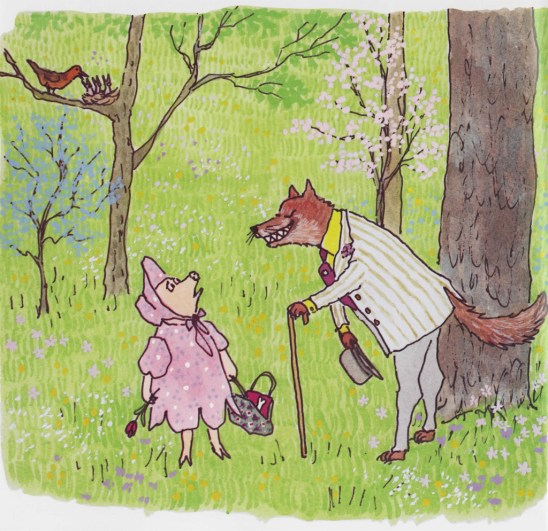
After all, the world is as the fox told Pearl in The Amazing Bone by the immortal William Steig (may he rest in peace).  

amazing bone.jpg

Pearl, the pretty little pig,  taken home by the smiling, courtly fox, is trussed and ready for the oven, flames already leaping inside the wood burning stove.   She pleads with the fox who is cutting up vegetables with gusto and whistling happily thinking of the tender, succulent pig he is about to enjoy.  Pearl pleads to the fox to spare her life.

“Why must you eat me, Mr. Fox?   I am young, I want to live.  Please!” The fox looks over at Pearl sympathetically. 

“Why are you asking me?” says the fox, “how should I know?  I didn’t make the world.”   (This isn’t the actual Steig line, the correct quote is below [1])  The fox finishes preparing his salad.   As he leads her to the door of the oven he offers further words of solace:

‘I regret having to do this to you’, said the fox. ‘It’s nothing personal’. 

It is the bone, it turns out, who says to the fox:

“You must let this beautiful young creature go on living. Have you no shame, sir!”

The fox laughed. “Why should I be ashamed? I can’t help being the way I am. I didn’t make the world.”  [2]

The wisdom of that “I didn’t make the world,” however cruel its particular use might be,  has always stayed with me. 

It’s an answer as illuminating as “because he can” to the question of why a dog licks his genitals or how a Supreme Court justice with a glaring appearance of impropriety can insist he has no legal or moral obligation to recuse himself from sitting to hear the case.  

“I didn’t make the world.”  

Truly.  I had no hand whatsoever in the making of this world.

My only work here these days is coherently setting down what I’ve seen, heard, learned, discovered, read, in an effort to understand as much as I can.  I don’t know what compels me, exactly, or why it seems so necessary to me to write down clearly as much as I can write  down in whatever time remains.  

I know it has something to do with this cosmic less than wink of an eye we each have to be alive in, this flickering miracle of consciousness we so briefly share.  How intolerable is it, therefore, to be forced to march in a column, for an insane reason, life and death decided by the worst and most violent humans on earth at any given time?   To wait a century or more for rights our Constitution provided for almost two hundred and thirty years ago?  Is it just me?  I don’t think so, my friend.

(placeholder)

 ii

A great book is like a fascinating conversation.   When you hear the voice of someone who reads a book with feeling, the author’s ideas coming out clearly in the spoken words, you’re having a conversation with those people.  The conversation of reading is as real as, and often much more substantial than, many actual conversations you may have with other living people.  Particularly conversations in these contentious, violent times, which can burst into flames quicker than you can say “wait…”.  

I have been listening to two fantastic audio books that I cannot recommend highly enough.   Eichmann in Jerusalem (Hannah Arendt) and Dark Money (Jane Mayer).   I intend to post full reviews of both here at some future time, hopefully some time this summer.  In fact, the NY Public Library is into me for two weeks of overdue fines already for the paper copy of Eichmann I have been making notes from. I have to buy a copy ASAP.  

(placeholder two)

iii 

I offer the following as an example of the kind of thing that, designed to eliminate stress, actually causes more stress, a kind of forgetful oversimplification that can lead to a fist fight.   It is the lazy mind’s approach to thinking.   Take a snapshot of the idea, and that’s the idea. The snapshot is the idea, get it?  If you hold the snapshot, the still frame from the movie, you’re holding the actual idea.   Nuance is for fucking eggheads, and, anyway, who can keep all that contradictory shit in their heads, you know what I’m sayin’?  The snapshot, on the other hand, is clear as the nose on your face.  Often the only possible response to a brilliant presentation of great nuance is “Fu-uh-uck YOU!”    That response often carries the day in the debate between a snapshot and the actual person in the photograph.

That’s just the way it is right now, when so many are angry, fearful, desperate, riled up, not going to take it anymore.   We didn’t make the world.  Consider, though, how limited the essential truth, if any, is contained in a single snapshot of anything.

There is a book called Man’s Search for Meaning, by Viktor Frankl.  I found it in the public library in Fresh Meadows back when I was in high school.  I read it and recall being very impressed by it.  An editor at Wikipedia did a wonderful job describing it:

Man’s Search for Meaning is a 1946 book by Viktor Frankl chronicling his experiences as an Auschwitz concentration camp inmate during World War II, and describing his psychotherapeutic method, which involved identifying a purpose in life to feel positively about, and then immersively imagining that outcome.

Toward the end of the book (a longtime international best-seller) Frankl writes, as I recall, that the highest form of personal purpose is one you’d be willing to die to defend.  I remember thinking as a sixteen year-old what a beautiful thing it must be to love someone or some value so much you’d die to protect her.  I also recall being a little troubled by the statement, even as a teenager.

Over the next few decades I’d come to see the danger of this statement, removed from the humanistic context of Frankl’s book.  Frankl was talking about defending decency against indecency, not endorsing some crackpot’s idea of hate and violent revenge that other enraged imbeciles would willingly die for.  But take that one statement by itself, present it as a snapshot of the book and you have the humanitarian Frankl advocating suicide bombing, killing abortion doctors, performing any of the many atrocities, undertaken for the sincerest of murderous beliefs, for which certain humans are rightfully abhorred.   These atrocities reflect badly on all of us humans, when you think about it.  Although we, none of us, made the world.

But dig how that works.  Out with the filthy bathwater, fuck the baby!    You read an entire book, enjoy and get engaging ideas from the author’s conversation, agree with virtually everything you read.  Then you find a paragraph toward the end that causes your brow to furrow.   You underline the sentence about being willing to die for your beliefs and put it next to a picture of fucking Mohammed Atta [3].   Then you take your snapshot: Frankl says Mohammed Atta is an example of the highest form of purpose and meaning in human life.   Based on that, the rest of the book can be dismissed as an intolerable incitement to fanaticism and murder.   You cast it on to the bonfire, along with Mein Kampf, The Art of the Deal, Atlas Shrugged and the rest of the worst of best-selling twentieth century dreck.

A stray thought: could this hateful principle, seemingly applauding fanaticism, have possibly come from the same book by the same Victor Frankl portrayed here?   Remove nuance from any conversation and all that’s left is simplistic folly, or worse. 

iv

When my weekend of agitated distraction was about to begin I had an ambitious, perfectly achievable, though challenging, plan.  I was optimistic about making a good start on it, with two days to myself, before my concentration was shattered by an intolerably annoying personal sideshow I was unable to put out of my mind for long.   My goal is a 3,000 word publishable abstract of my 1,200 page manuscript about my father’s life and times.  This would be published somewhere and I would send the enticing published clip out to literary agents to try to hook one to sell the book proposal, to get me some money, an advance from a publisher.   I will take the first step now:

the first draft is here  (placeholder)


[1]  I went searching for the exact quote, as I am bad at exact quotes in spite of having a better than average overall memory and spending hours daily carefully weighing words. You’d think I’d be better at quotations, but I really am quite lousy at getting them perfectly correct.   I get the sense, almost never remember the exact words.

My own copy of Steig’s masterpiece is buried somewhere in my apartment.   I found nothing on-line to enable me to give you the exact, perfect Steig quote (he was a master of language in addition to being a great artist). I provide a link to a short animated clip, an advertisement of the copyright holders for the very best of perhaps six hideous video versions of this marvelous book read aloud on the internet.   I am seriously considering plunking down my $1.99, this is a beautifully done animation and aloud reading of one of the great books of all time.

[2]   Excellent description and review of  the Steig masterpiece, complete with quotes (yay!) and selected illustrations:  HERE.

[3]  Mohammed Atta was one of the 9/11 suicide terrorists who flew two 747s  into the World Trade Center.  His face, in the single snapshot of him most people have seen, is a mask of hatred.   The nervous Sekhnet and I  were at JFK airport for a flight to Spain, around 2005.   She had some anxiety about the flight, and time pressure (due to my habit of arriving at the last moment), and asked me to arrive with her three or four hours prior to our flight time, to avoid stress, and I had agreed.  While she slept contentedly on a bench in the terminal I walked around aimlessly with our valuables, sullenly counting the wasted minutes.  Over the PA there was an announcement asking Mohammed Atta to please come to such and such a desk.  The announcement was repeated several times.   I was glad Sekhnet was asleep, and figured the name they were calling over and over must be a common one in some parts of the world.

Distraction

There are certain things that occupy the mind so clamorously that they crowd out all productive thought.   If you’re worried about something all the time to the point of preoccupation it’s hard to focus on anything else.   Your work suffers.   Eventually the boss sends in the guy with the ax, your head rolls a few feet and is booted into a basket.   If you have no boss, thoughts themselves can be your brutal master.   Certain thoughts, once they have their hooks in you, will not let go until they have sucked you dry of creativity, even the impulse to try to be creative.

Being captured by one of these thought occupying conundrums is like being caught in a loop while on a treadmill with no off switch.   Presented with a difficult, seemingly insoluble problem, one real possibility, once you’ve tried to solve the damned thing a few different ways and failed, is becoming caught in a recursive cycle.  You will continue to turn the problem, view it again from several different angles, tend to go over the same poor solutions again and again, failing each time and never being able to “think outside the box”, the only place where any possible solution exists after all other options have exhausted themselves.  In the end, incapable of the necessary leap of inspired imagination, you’ll become convinced the problem has no solution.  

Every serious problem ever faced by humans, the deadliest problem of the day, was solved by an inspired leap of creative imagination.  These leaps are not conceivable to caged animals, pacing their confinement off in a track that rubs the fur off one of their flanks.  Once the problem is solved, often by something ingeniously simple, the solution seems obvious, is eventually taken for granted.  Before we harnessed fire, what?

Take any political stalemate you like as an example of the supremely distracting, mental energy sapping thing I’m trying to bring out.  The killing on the Palestinian side of the Gaza fence.   You can turn that one several ways, and it doesn’t ever come out good.   The answer is not there, among terror advocates, human shields, political tools, protectors of democracy, dupes, zealots willing to die and snipers with orders to shoot to kill.   In the end, your mind glazes over, you pick a side and glare, or turn your eyes away in despair.  Even as you’re aware the human truth is not really there on either present merciless side: a terrorist outfit running Gaza, right wing nationalist extremists running Israel, and that no solution is possible as long as these merciless motherfuckers are running the horror show.

You get something stuck between your molars.  It is lodged so firmly that it actually makes your teeth hurt a little bit, pain now traveling along your jaw.  You can’t get it out with your fingers, your fingernails, with a toothpick, the thinnest blade of your pocket knife, the edge of your map, your tongue endlessly goes to it, you are talking, trying to do other things but distracted.  Nobody has dental floss.  You’re seven miles out on a hiking trail. Up shit’s creek, no paddle.  If only…

There are many things like this in life, particularly in a fast-paced competitive society that believes “time is money,” and “chop, chop, we’re on the clock.”   Time is obviously not money in the most basic sense.  You can have a billion dollars, but when you run out of time, the worms begin licking their lips, dirt is thrown over you (the passive voice used) and your money is no good here, sir.   Time is time, the only real possession we have while we’re here breathing, dreaming and being so often distracted.  It is, of course, difficult to see that in a land where everyone keeps chanting “time is money, chop, chop, we’re on the clock!”    The chant of a crowd is supremely distracting.  A good chant can actually produce mass mindlessness.   The examples in history and current events are so numerous and well-known that we can safely skip the example.   

I’ve often railed against the lying, attention demanding false show called advertising, also known as Public Relations (and in the political context; propaganda) which has, of course, come to rule electoral politics in modern democracy, as well as in modern dictatorship, now that I think of it.   During a brief stay in a PhD program in History (with the capital H, to be sure) I focused on the rise of the Nazis, masters of organized public lying on a mass level, the abusive fathers of the modern political advertising almost universally practiced today.  

The rise of Nazism and the functioning of their infernal state were things I’d studied long and hard as an undergraduate.  I even won a prize for my research paper The Nazis vs. Degenerate Art, which, like so many things, sounds more ominous in German: entartete kunst.  In the decades since that Joan Kelly Prize-winning paper several books have come out about the infamous Nazi campaign against modern art.  At the time, I was among the first Americans to explore the subject, with very little research material then available in English.  I was basically following somebody’s footnote about entartete kunst.  I somehow procured an original catalogue of the show that travelled through the Reich, the highest attended art show until the Metropolitan Museum put on King Tut (or maybe it was MoMA’s massive Picasso show) an art show that broke the record half a century later.  Devilish shit, that black and white glossy catalogue, with a particularly ugly African mask on the cover, staring out with dead, hollow eyes.   

Anyway, I noticed in my reading and watching that as mass media became the monolithic force it is today (and today, of course, our selected mass media is in our pocket, with a beep to notify us there is something urgently waiting for us to look at) corporations and governments took on more and more of the same tactics for influencing and dominating public opinion.  The same experts who earned the most money in commercial advertising (masters of “psychological warfare” like Edward Bernays, who coined the phrase around 1920) sold things like war (Committee for Public Information in the build up to U.S entry into WWI, much extolled by Hitler in Mein Kampf) and political candidates.   I’ve written a lot about this sickening subject over the years, there are many excellent books out there on the subject, (Noam Chomsky’s Manufacturing Consent comes to mind, there’s a great movie of that title on youtube, if I’m not mistaken;  I’m not, here you go ) and the power of advertising in our current world is hard to overstate.

DISTRACTION, on a mass level, by design.

When I sat down to write yesterday I was unable to begin the important, challenging thing I have in mind to write (a 3,000 word version of the book about my father, to sell to some publication so as to procure a literary agent to sell the book, though it will be hard enough to sell the short piece to any impressive publication without a literary agent– Catchuh-22!)  until I had written something else, cleansing the mental palette of what has been distracting me so much lately.  A long friendship dating back to when I was seven or eight years old, on the ropes, bleeding from multiple cuts, both eyes swollen shut, head carbuncled with contusions, panting piteously as the onlookers gasp, referee nowhere in sight.   I’m requested not to write anything about this, no matter how obliquely, even though writing clearly is the only way I know how to really process anything.  The only way I can set the thing clearly in front of myself is to write it coherently for someone else.   I am sternly requested not to write about it, chided with:  I would certainly never publicly write about you, or any of your troubles.  I could write it in my diary, I suppose, if I still kept one, but I don’t.  I consider the discipline of writing for “publication” essential to my writing life.

So there you go, let’s just close that annoying fucking loop and focus on the difficult work ahead.  Here we go loop de loo.  Fine.  Eyes on the prize.  Mind on spin cycle. There is no way out.   I will not be distracted, I will not be distracted, I will not be distracted, I will… OK, I suppose I will.

A true artist, I was once convinced, learns to extirpate everything from his life that distracts from making art.   Now I think this is a cynical formulation created by auto-mythologizing public relations monsters like genius and money-machine Pablo Picasso, who devoured whole women alive to obtain the raw materials for his masterworks.   On the other hand, fuck.  Some weeds just need to be rooted out, tossed into the sun to dry out, become airy puppets for the doomed feral kittens in the garden to bat around.


Basic Goddamned Fairness! How about it?!!!

People are unfair to the President of the United States of America, as they so often are to the true, unapologetic geniuses walking among us.    It is reported the U.S. president “attacked” our NATO allies, calling them cheap, demanding that they pay more into NATO’s military budget, claiming afterwards that they had agreed to his new terms.  Immediately after those remarks the French leader said there had been no such agreement.    The leader of Germany has never shown much respect for our president — he offered her some advice, told her what she needs to do for political survival, as he smoothly told one of Rupert Murdoch’s TV hosts in Britain the other day, but she, sadly, appears to be doing exactly the opposite.   He took some modest credit for the great feeling of collegiality at the recent NATO meeting, something he said never existed until recently, when, presumably, someone of his caliber finally came into the room.  

His meeting with Vladimir Putin on Monday, we learn, no surprise, will be secret, mano a mano; apparently no other witnesses, no recordings, no official record of any kind.   Just the account that will be given of the meeting by two world leaders who have never lied about anything, nor have they ever agreed to lie about anything, nor would either ever have the slightest motive to lie about anything, clearly.   No point to unfairly mention Cheney and Dubya’s controversial top secret, tandem testimony, not under oath, to the 9/11 Commission they reluctantly agreed to allow to proceed.   I’m not going to knock our current president, he’s had a very challenging life, is constantly treated very unfairly by many, many, many corrupt liars and gets so little credit for his many towering and historic achievements from our communistic mass media.  

One of the people who attacked the current president, while our leader was still a candidate, texted terrible things about him, this FBI man and one-time member of Robert Mueller’s team on the witch-hunt to find some kind of corruption to link to the highly principled POTUS.   This Peter Strzok as much as called him a “fucking asshole”.   When the defamation laws are tightened up (and truth is no longer an absolute defense to the charge of speaking words that harm another’s reputation) people like him will face justice.  For now, he was dragged into a Congressional Hearing to explain to hostile interrogators what the fuck he was fucking doing texting these vicious, personal opinions to another FBI employee he was having an extra-marital affair with.    Instead of apologizing, the adulterer Strzok was defiant.  He said this, among other inflammatory things:

Peter Strzok: “That was written late at night, off the cuff, and it was in response to a series of events that included then-candidate Trump insulting the immigrant family of a fallen war hero. And my presumption, based on that horrible, disgusting behavior, that the American population would not elect somebody demonstrating that behavior to be president of the United States. It was, in no way, unequivocally, any suggestion that me, the FBI would take any action whatsoever to improperly impact the electoral process.”

source

That dickhead’s words speak for themselves.  Traitor.

I thought the NY Times was too respectable a paper to publish outright mockery of America’s president.  Apparently I was sadly mistaken.   Not only did the fuckers splash headlines about 12 Russians indicted today for hacking the Democratic National Committee’s emails and other records, the president “trying to repair damage after criticizing British leader,”  another headline reading, with leering suggestiveness, that he “Invited the Russians to Hack Clinton.  Were They Listening?”  but they also published a disrespectful, even humiliating little video of disgusting Brits ‘taking the piss’ on the NY Times website.   The disrespect for our commander-in-chief that these fucking out of control goddamned Brits mirthfully displayed when our president came to tell their head of state she’s wrong and misguided, and that her extreme right-wing political rivals are smart and with the times?  Fuck those fucking so-called “protesters”, you know what I’m saying? Totally unfair.

If you have a morbid curiosity about the depths the failing NY Times will now sink to in their hysterical hatred of our blameless leader, click here.

Depression v. Anxiety

Depression is familiar to me and no longer holds much terror for me.   This lack of terror may be as much the result of my genetic coding as my experiences with depression.   During the worst of the times I was depressed, for example, I never considered ending my own life.   Killing myself always struck me as useless, worse than foolish, even when the world looked bleak, pointless and hopeless to me.   I understand suicide if you are faced with a painful terminal condition with no hope of cure, but outside of that, I do not understand it at all.   I can imagine other rare scenarios, about to be tortured by some powerful psychopath who has you chained up, with no way to escape or call for help, but with a cyanide pill in your false molar, OK, it might be reasonable then.   I never suffered a depression deep enough to make me feel suicide was the only way out.   I guess that’s the easiest way to describe my lack of terror about the Black Dog.  Having experienced a fairly mild form of depression makes it easier for me to be philosophical about it, for sure.   I recognize an element of pure, dumb luck in that.

All that said, the mechanism of depression, the complete loss of hope, is clear to me now, which also helps diminish the fear of it.   You get sucked down into a low energy state where not only is everything hopeless and grim, but, on a fundamental, undeniable level, it’s your own fault that everything is hopeless and grim because you are a colossal asshole.   I’ve heard, and it seems true, that depression is rage turned inward.  Your imagination, along with all the hope it contains, turns to mud, to quicksand, no productive or hopeful thoughts can bubble out of depression.  You cannot lash out at the oppression around you, which may be impossible to do in a productive way in any case, or at least unimaginably difficult, so you turn the whip on yourself.   

Learning to stop whipping myself was a major change for the better in my life.   It was a promise I made to myself about thirty years ago, during a very trying time in my life, when I faced the prospect of prison time (during the endless months before the charges were finally dismissed).   Scary fucking days, The People of New York State v. Me.   A little voice, my own, told me one night when I was quaking in my bed: whatever happens, I will be there with you, do not worry until it’s time to worry, and remember, add nothing to what the world is already doing to you right now.   We will face whatever happens together.  

I was, naturally, also filled with anxiety, biking twenty miles or more a day, up gigantic hills, lifting weights, got into the best shape of my life, against the day when I might have to fight for it in the narrow hallway outside of the exercise yard.

That little voice reassured the hell out of me.  If I was a different kind of person that voice would have been a come to Jesus type moment, the voice of God, my Creator.  In my own case, it was the voice of the best and wisest of myself, my internal parent, the voice I had nurtured every time the world made no sense to me.   The world had often made no sense to me as a child, for reasons I was only able to fully grasp starting about forty years later.

Depression is familiar, anxiety disorder (as common an affliction, I read, as depression) is alien to me.   Anxious as I was in those days when my higher voice had to reach down to pull me out of panic, constant anxiety is a different animal entirely, I think.  Just as the depressive way of life is to accept a shit situation as something impossible to change, the way of anxiety is always churning along.   Anxiety, I am pretty sure, never stops.  The ceaselessness of worry, being on the edge of panic at all times, fearing the worst and taking measures always to avoid it, makes it a full-time job just to get through the day.

The only way I can really picture anxiety disorder is to imagine as my permanent overarching feeling the moments when I felt close to panic.  Whatever else is going on, behind the scene terror is doing a mocking dance.   The person is reassuring you that everything is fine, you see a sarcastic demon behind the person doing a grotesque, leering pantomime, waving hideous fingers in “air quotes”, as the reassuring voice drones on, almost unheard.   That is my image of anxiety disorder, which I will refer to as anxiety for the remainder of this short piece.

As I recognize features of anxiety in old friends I learn new things about it.   One complaint I’ve long had about one old friend is an inability to remember many of the specific, specifically troubling, details of a difficult discussion we’ve had.  The troubling section of our conversation is erased, like an incriminating tape.   This constant partial erasure appears to be a mechanism of anxiety.   The things that make you anxious must be continually repressed, it seems.  The strategy doesn’t really help in relationships, unless the other party is willing to simply accept that any emotional difficulty will be resolved by pretending everything is fine.   Like the depressive’s neurotic willingness to accept the intolerable as the best the person deserves, the anxious person’s over-riding desire is to avoid anxiety.   Anger?   OH FUCK, NO!!!!!   ARRGGGGH!    ARRRRGGGGGHHHHHH!!!!!!!

Anger is a common and natural emotion.   It is arguably the most difficult emotion we regularly have to face.   Some unfortunate people face it by turning that supremely threatening shit on themselves.   Can you look into the barrel of your own gun and say “fuck those fucking assholes!!!” and shoot yourself in the face if you are not full of irrational, inchoate rage?  Let’s be kind, maybe the rage is neither irrational nor inchoate– does anyone but a nut shoot himself because he can’t deal with his own anger?   (And, yes, for the gender pronoun police, part of that vast force of politically correct over-reactors who helped get the cruel Trump elected, He is more prone to shoot a gun in rage than She is, at least statistically). 

Anger to a depressive is turned inward, a kind of self-torture.  Anger to an anxiety prone person… I don’t know.   I guess it’s pushed away, denied, buried under constant frenetic activity.  It’s compressed, shoved down somewhere, rationalized, stored away as fodder for future anxiety — I literally have only the foggiest idea.  It’s the same exercise to me as trying to imagine the quiet, inner life of a devout Christian, or Muslim, or Buddhist, or Jain.  I have only the faint outlines, the imagined idea of what it might be like in the quiet heart of someone truly imbued with holy beliefs and living a highly moral life in accordance with those beliefs.   

Living with anxiety is like that to me, a world I can only imagine.  The full-flight pattern my father used to complain about his old friend running, in hindsight, is the perfect indicator of anxiety disorder.  The day was divided into a highly scheduled series of tasks, each one allotted no more than the actual time it was supposed to take.  In the real world, this ideal schedule is almost impossible to carry out, so the full-flight pattern requires constant triage, cutting corners, cutting short one thing to have the time to do another– the whole planned enterprise impossible, but, nonetheless compulsory.  The anxious person is unable to be fully present because… already running late, late, got to get to those next things, shit, things are falling apart, goddamn it…

Time is all we really have here.  Elmore Leonard has his idiot criminals and smart cops alike, in every book, “taking their time.”  This shows that they are cool.   What is cool but doing things the way you want to, not the way others demand?  So a guy asks an Elmore Leonard tough guy “what the fuck?” and glares at him, waiting for an answer.   The tough guy turns his head toward the window, through which a strip of the ocean is visible, takes it in, breathes the salt air.   Reaches into his pocket, takes out a cigarette, reaches for his lighter on the table, lights the cigarette slowly, draws in the tobacco smoke, taking his time.  “You know what?” he finally says, taking his time, “fuck you.”

“Spokesreptile”

No idea where the president got this particular spokesreptile, Alex Azar (no offense to snakes and lizards) but check out this beautiful attempt at auto-fellatio yesterday in response to the nettlesome question of why the administration has been unable to comply with a federal judge’s order to reunite families: to wit, 3,000 children forcibly taken from their parents at the southern border:

Health and Human Service Secretary Alex Azar: “It is one of the great acts of American generosity and charity, what we are doing for these unaccompanied kids who are smuggled into our country or come across illegally.”

source (hear the quote for yourself, spoken yesterday to Wolf Blitzer, on TV)

Here is CNN’s own account of the conversation (you can see that, in context, it’s not quite as simple as I made it sound above, but that’s just nuance).

Azar is the administration official who told  the Senate Finance Committee recently that it would be easy to reunite children forcibly separated from their parents.  It was a matter of a couple of keystrokes, he said on June 26, to find any detained child on the government database.   He claimed “hundreds” of children had already been reunited with parents and gave the numbers to back it up:  2,047 currently in HHS custody, down from about 2,300.    These claims were soon belied by many other reports, even by HHS’s updated numbers of detained children separated from parents (up now by about 1,000 from the 2,047 figure).   This is often the case with claims made by those speaking for our compulsively untruthful commander-in-chief.   Here you go.

I am sure Mr. Azar is as highly qualified for his position as Betsey DeVos is for her position as Czar of Public Education, or Ben Carson is for his stewardship of all federally subsidized public housing in the the United States, or Jared Kushner is for solving the Opioid Epidemic and making peace between Israel and the Palestinians, or as the environment-hostile Scott Pruitt was to head the Environmental Protection Agency.   Mr. Azar is possibly even as highly qualified as the president himself, even as the cruel president doubles down to escalate a bullying, counterproductive, unwinnable trade war with America’s enemies and allies alike.   But let us parse this “great act of American generosity and charity”.

The hateful program designed to terrorize those thinking of fleeing terror and seeking refuge in the United States is blandly called Family Separation.   Reads much better than Forcible, Possibly Permanent, Removal of Children from Asylum Seeking Parents, (and you get no receipt for your fucking kid, who we will send hundreds of miles away with no records kept, s-word asshole) in Order to Deliberately Terrorize Asylum Seekers, no?  

The president and his spokespeople freely admitted that the program was designed to scare would-be asylum seekers from coming to our borders.   It was designed to inspire the greatest terror someone fleeing persecution could ever face: the loss of the little brown children whose lives they are fleeing to protect.  Make no mistake about the class and race-based animus at work here: the despicable program is directed against impoverished brown people, not Aryans, the kind of genetic material, the best people, the very best of the best, that the president wishes were clamoring to enter the United States instead of these brown, raping hordes.

The diminutive, racist Attorney General sharpens this to a finer legal point.  We are no longer allowing asylum applications based on reasonable fear of deadly violence to those fleeing domestic violence or gang violence.  

He points out, as defenders of the Ku Klux Klan did successfully for generations, that gang violence is not “state-sponsored”.   See, this is a supremely important legal distinction.   When the Klan tortured and hung a Negro who didn’t know his place it was never “state action”, the kind of thing that would have triggered the federal laws made to enforce the long-slumbering Fourteenth Amendment.   Since it was not “state action”, you understand, it was solely within the province of the individual state to convene a jury to decide, if a trial was even necessary, whether the allegedly murdered black person had crossed a goddamned line that would have made any white person justifiably enraged enough to kill him.  Nothing to see here, says Jefferson Beauregard Sessions III, as so many of his ilk pompously intoned since before he was even a glint in his racist pappy’s eye.

Peter Fonda, an actor currently promoting some project, angrily tweeted that Barron Trump, son of the president and his third wife, Melania, should be ripped from Melania’s arms, that she might wail in agony to her supremely cruel husband (I think Fonda used the less precise adjective “asshole”) as the mothers of the forcibly seized young children wail to their husbands, if their husbands have not already been killed by the forces the US now claims no longer constitute “reasonable fear of persecution” for purposes of political asylum.  Fonda was forced to retract the tweet and apologize, since he was promoting a movie that is probably already being boycotted, based on his outrageously offensive, if morally justified, tweet.     

There is only one person in the country who is immune from apologizing for anything: the birdbrain-in-chief whose tweets, while largely incoherent brain farts emanating from his constantly enraged insular cortex, are often clearer than his oral pronouncements, his oral pronouncements, his very fine pronouncements, the repeated, idiotic sounding cadence, the idiotic sounding cadence, repeated, familiar, familiar from reality TV, which is real TV, let there be no doubt, and I repeat, I repeat, because he has, like, you know, the finest words, the best words, the very best words money can buy, and when I say money, I’m talking about money, MONEY, heaven-reaching towers of golden money piled on top of more money than you can ever imagine.  I have the greatest words.  Your words suck, but my words are the greatest, the best, the finest words.  I have the finest words, the best words, and I always get the last word, the last word, the greatest word, the greatest last word.  I always get the last word!  Which is the greatest word, the greatest word.

Nuance vs. Anger

In an enraged world, where powerless people are poised, at the slightest provocation, to bite each other’s heads off, nuance disappears.   The best explanation I heard of why this happens is the neuroscience of what happens in the insula (insular cortex) when people are angry.   This important region of the brain, crucial to our emotional lives, lights up, apparently, whenever we are angry.   When the insula is glowing with anger we simply can’t process nuance, can’t make distinctions, can’t make productive comparisons, can only see our anger.   People who insist Trump is the worst president ever can quickly get mad enough to insist that fucking Trump is a better president than fucking Bernie Sanders would have been.

We attended a concert for peace at Temple Emmanuel a few months back.  A couple of musicians we like very much were performing and it was touted as a concert for peace, Palestinian musicians making music with Israeli musicians.   Outside the historic synagogue a small group of angry looking Jews were holding signs, behind a barricade, with a couple of NYC cops flanking them.   The signs said this was an anti-Semitic event held by self-hating Jews.   I crossed the street to ask what was up. Imagine my surprise to learn that I was about to be a dupe of fucking anti-Semites!   I was informed that one of the concert’s sponsors, the New Israel Fund, supported terrorism against Israel.

This claim took me by surprise.  I knew nothing about the New Israel fund, and asked how exactly these momzers [1] supported terrorism against Israel.   “BDS”, I was told, the anti-Semitic plot to squeeze Israel to death economically so that the Arabs who claim to be Palestinians can overrun it.   I felt like I was talking to Stephen Miller, the hatred coming off this one young man was palpable.   I told them I’d check out the New Israel  Fund, but that as far as I knew, from the artists in the show, I was pretty sure none of them are anti-Semites.  My friend crossed the street and took me by the arm at this point.  She led me away from the dozen or so protesters who continued to make a ruckus after we headed in to see the show.

For true believers, it suffices merely to have a rationale, a buzzword, to spit in the face of those who refuse to believe.  In the case of these protesters, BDS is a tool for modern day Nazis and should be criminalized in America, the sooner the better. Full throated support for BDS is the same, to them, as opposing the criminalization of this specific form of non-violent political coercion.   To these angry people, anyone who believes BDS should not be illegal supports BDS and intends to put a dagger through the heart of our beloved Jewish State.  Easy peasy, no need for your fucking anti-Semitic nuance you self-hating fucker!

Here is the New Israel Fund’s position on BDS (Boycott, Divest, Sanction), from their website:

What is NIF’s position on boycott, divestment and sanctions?

The New Israel Fund is committed to strengthening democracy in Israel, supports freedom of speech and promotes non-violent means of expression of belief and conscience. We oppose any attempt to criminalize the legitimate expression of support for any non-violent strategy or tactic, including the global BDS movement which we do not ourselves support.

The NIF does oppose the global (or general) BDS movement, views the use of these tactics as counterproductive, and is concerned that segments of this movement seek to undermine the existence of the state of Israel as a Jewish homeland.

NIF will not fund global BDS activities against Israel nor support organizations that have global BDS programs.

However, NIF opposes the occupation and settlement activities. NIF will thus not exclude support for organizations that lawfully discourage the purchase of goods or use of services from settlements.


[1] bastards

בצלם אלוהים

The words above are “b’tzelem Eloheem”, a biblical phrase that means “in the image of God.”  Man and woman were created b’tzelem Eloheem, in the image of God.   To those who believe in an all-powerful, all-merciful creator who watches over the world (God), the connection between the divine creator and His creations is more than a metaphor.    Sentience, the ability to feel the many miracles (and pains) of this world, is an attribute of God.  Empathy is an attribute of God.   Jealousy and rage are also attributes of God.   That’s righteous jealousy and rage, mind you.   We are, every one of us, created in God’s likeness, animated by a divine spark breathed directly from God’s soul.  Accordingly, we may never behave ruthlessly toward fellow creatures created in God’s image.

In my view we’re on our own down here, God, in whatever form we may imagine, has long ago been driven mad by the wickedness and brutal folly of those He created in His image, but that is another story. 

One should not look for consistency in religious views.   Humans are not known for the consistency of their beliefs, any of their beliefs, religious or otherwise.   If you truly believe God has created every human in God’s own image, it would call for different behavior, difficult behavior, Christ-like behavior.   You could never, for example, condone the torture of anybody.   The ripping of babies from their mothers’ arms at a border?  God simply would not tolerate this, Jesus would have his proverbial mildness tested.   Concentration camps?  No way.   Poverty going back many generations in the wealthiest country the world has ever known?   God would send a plague against that Pharaoh.

There are righteous followers of every religion, gentle men and women of peace, generosity, humility.   These humbly religious people are one of the great hopes of humanity.    There are also followers of virtually every religion who are complete, even murderous, assholes and hypocrites.   To be sure, they may pray to God for guidance in how to live with the atrocities they wink at, sometimes carry out with their own hands, but these folks have no hesitation to spit in the face of the God who urges them to treat the least of His creatures the same as the most powerful, when it suits their righteous purposes.

This is not intended as a critique of religion, though there’s one image I can’t seem to shake lately.  My parents toward the end of their lives, tutored elementary school kids in reading.  My mother worked with one little girl, a tiny beauty, who, although very sweet, was, according to my mother, the dumbest girl she ever met.  The kid simply could not grasp the first thing about reading.   My parents met the girl’s parents and struck up a friendship with them.    This couple were Born Again Evangelical Christians.   They had turned their backs on their parents, who self-righteously refused to accept Jesus as deeply as they had.   My parents became surrogates for the grandparents their kids would never know.

My mother, a woman of strong opinions, got into a dispute with them one day about the supremely simple Christian counter-myth certain believers argue: Intelligent Design.  Under this theory, used to refute another theory, Darwin’s theory of evolution (merely a theory, say the Born Again, no better than our “theory”), God created everything perfect the first time, there was never any need for improvement of any creation of the Supreme Creator.  For whatever reasons, my mother found this theory fantastically imbecilic, impossible to swallow.   A good natured argument raged between my mother and the mother of the beautiful little girl.    The husband stuck his head out of the kitchen door to chime in on his wife’s side.   He was eating a banana, half of it was in his mouth, the other half in his hand.  “You’ll never convince me that I evolved from a monkey!” said the father.   Everyone in the room laughed, because in that moment, he resembled nothing more than a monkey.  Even he laughed.

When my father was dying the couple showed up with a few other people from their church.  They formed a prayer circle around my dying father and called for him to accept the Lord Jesus Christ into his heart that he might be saved from the flames of eternal damnation that await the righteous of all nations who do not accept Jesus.   Had I been there, I’d have gone Jesus at the Money Changers on them, overturned their tables, dashed them out of the dying man’s sight.  I was not there.  They prayed over my father and left.   Then my father died.   And these righteous Born Again lovers of Jesus never contacted my mother, his grieving widow, after her husband died.   I think about this every time Evangelicals wink at some sinful thing their politicians do, when I think of how many of their leaders uncritically support our cruel, unChristian president.  “Who among us, if famous and powerful, has never grabbed a woman by the pussy in a moment of lust?”

I am thinking about this because I looked up the name of that Israeli peace group B’Tzelem, The Israeli Information Center for Human Rights in the Occupied Territories, and was reminded of that biblical phrase.  B’Tzelem’s position is that, since Jews and Palestinians of every political orientation are all created b’tzelem Eloheem, Jews must not treat others brutally in the Jewish State.  There are many current examples of the the Jewish State behaving brutally, often under the name of Ha’ Shem, God, the Supreme Ruler and Ultimate Real Estate Mogul.   God gave this land to me!  Who am I going to believe, God or some so-called “refugee”?

I was referred to an article that describes the Palestinian Refugee Issue as something of a massive fraud.   The article was not published in the Jerusalem Post, as I was told, but here.  The piece was supposed to convince me, I imagine, that since Palestinians and the surrounding Arab states are manipulating and misstating the scope of the Palestinian refugee problem, and creating this gigantic political wedge to hammer into the heart of Israel, that I should not be so quick to condemn the use of live ammunition against those who hate Israel.   I haven’t checked the facts asserted in the article, but for the sake of discussion, I’ll accept everything as true.   What does any of that have to do with using live ammunition against a massive demonstration?   This article also appeared on the website, and I think it is more to the point and provides a bit of nuance.

Of course, as any Christian preacher will tell you, the Devil is fond of quoting scripture, and good at it.  Infernally good, yo.   That motherfucker can quote the hell out of biblical wisdom.    Word.