To Feel or Not To Feel

An old friend reminded me the other night that it is better (though not easier) to feel what you’re feeling, experience the pain of it if it’s painful, than to pretend not to feel any part of what is oppressing you.   Feeling your feelings is an essential part of processing, healing, moving forward, being respectful and kind to yourself. Which seems counter-intuitive when you feel like shit.   It was good to be reminded of this pillar of humaneness.  If we practice not feeling what we’re feeling, how do we remain empathetic to difficult things our loved ones often go through?

I think of the choice to feel or not to feel as closely related to the choice between knowing and not knowing [1].   I think it’s better to feel and to know.  The choice not to feel a given feeling or consider a given fact is often simple denial.   Repressing the feelings your soul is going through, denying things that make it go through turmoil, is a one way ticket on the Miserable Asshole Express, as far as I can tell.   As they say on TV, individual exceptions may apply.   I’m not certainly not advocating no anesthesia before a painful procedure, I like a good anodyne as much as the next agony avoider, but I also see the importance of feeling my feelings and having my thinking informed with as much actual knowledge — and feedback from people I trust —  as possible.

What we feel is often closely related to what we know, or, just as often, to what we don’t know.   I’ve been feeling mostly anger since I learned of the sudden, senseless, premature death of a once very close friend.  He died alone and virtually friendless, in spite of possessing many great and rare qualities that could have made him a good friend to many.   It irked me, in large part, that his mere death, a purely random event two thousand miles away,  compelled me, involuntarily (as far as I could tell) to focus once more on his irremediably painful life of wasted potential.  To me an important piece of working out the puzzle of anger is figuring out exactly why the hell something makes me so mad.  I don’t know a better way of trying to digest things and come out the other side of anger.

I’ve been remembering viscerally, continually, the many years I tried to make the pain-filled solipsist see another perspective, how hard I banged my head against the locked door of his highly intelligent but utterly closed mind.   Part of my anger is at myself, for remaining friends with such an impossible person, expecting the clearly impossible, even after ample proof of its impossibility, not accepting the futility of this abzurd expectation years earlier, not saving myself a decade or two of stressful, energy-sapping adversarial relations with a very unhappy and demanding, yea, toxic, person.

Sometimes something we learn or realize can immediately begin to change our feelings for the better.   We can’t learn this kind of crucial thing without being open to learning, and to our feelings about what we learn.   We can’t feel any differently, can’t get relief from hurt, without additional insight.   Not that learning a better way, or discovering an objective, revealing fact that changes a story,  instantly makes bad feelings go away.   Feelings, bad and good, will always arise and often challenge us.

One insight I was blessed to be given was that sometimes much of what we suffer over is not remotely our fault or our doing.  No less an authority than the Buddha taught that the nature of life in this world involves this kind of impersonal suffering we can’t help but feel personally, from the pain of being attached to things that can vanish at any time.   I don’t know much about Buddha, but I do know that what the fox said in William Steig’s beautiful The Amazing Bone rings very true in regard to perplexing things beyond our control we sometimes agonize over:  I didn’t make the world.

All we can do is live in this world the best we can, trying to be kind, maintaining the relationships we value as well as we can, until it is our time to move on, hopefully with some grace, as a final gift to those we love.  

I’m thinking about this today in part because of what my friend said the other night about feeling his painful feelings and partly because of two very different reactions from two old friends to my last angry piece about the now recently cremated Mark.

One read the final email exchange between me and my relentlessly exasperating old friend and didn’t understand what was so provocative about his final response that I felt compelled to drive a stake through his grieving heart right after his mother died.  His question caused me to re-read Mark’s last words carefully and write a detailed explanation.   This process entailed putting my finger on exactly why it had set me off, giving him the context of my long experience that had left me with the conditioned reflex to react that way.   He wrote back that he understood now, and found my explanation quite complete and sensible.

Another old friend had a much different reaction.  He was troubled by the outpouring of rage, which struck him more as the reaction of a betrayed lover than a merely disillusioned friend.    I wrote back that we were like siblings, bound in a constant sullenly competitive rivalry (Mark really wasn’t my romantic type, I’d have to say).  I offered to send him the long email I’d already written explaining exactly where the rage came from but he declined, having read enough already.   De gustibus non disputandum est.   I don’t judge anyone about their appetite for the hideous details, we are all different that way.

I have an appetite for the hideous details.   As, to some extent, does my friend who asked me why I’d been so savage replying to what appeared to him as an inept, clumsy, odd yet sincere attempt at reconciliation, not the final provocation I took it to be.   It was a good question, I saw, rereading the awkward reply that had set me off.   Sitting down to examine my anger and setting out exactly what ignited it was an excellent use of several hours.   In the end I felt neither arbitrary nor capricious (nor unfair) in responding the way I had.  

This can also be seen as merely my take on the endlessly justifying human need to endlessly justify our behavior and the justness of the feelings that lead us to do what we do.   Sure.   I made a good case for why I was angry, cited a few persuasive examples from the text.   It is what lawyers do in our litigious society and I did it to the satisfaction of my fellow lawyer.  

It was also an examination, for me, of the more vexing question of whether I had been fair to do what I’d done.   I questioned my actions, my motives.   The whole process of unraveling Mark’s maddeningly “un-unravelable” lifelong conundrum, as reflected in his final email, was some help to me.  In the end I was satisfied that I’d behaved as I’d want to behave, as I’d will anyone else in the same situation to behave, if I had the power to make it so.   The old Kantian Moral Imperative: act in a way that the world would be a better place if everyone did likewise.

One more annoying question and I’ll be on my way.   Why write things like this and hit “publish”, why put these sometimes troubling personal musings up on the internet for anyone to find?     Aren’t these private thoughts best shared among a small handful of closest friends?  Couldn’t they potentially torment people who might have loved Mark and not shared my anger at him?

I write them for an invisible reader as a way of putting things that feel important to me in a more objective, finalized form.   I need to provide enough general background for anyone to understand what I’m talking about.   In doing this I practice sorting through everything in mind and putting it forward in a way that is most easily comprehensible.   It’s not good writing if the average reader can’t follow it.  

Writing it, and constantly re-editing it, allows me to go back and clarify whatever is left unclear, on the page and in my mind.  In combing away cluttering words (in a way I wish I could attack my desk or kitchen table) I am able to make what I am saying, what I am feeling, clearer and clearer — to the virtual reader and to myself.

When it is as clear as I can make it, there is a feeling of completeness, the satisfaction of a job well-done.   Before I hit “publish” I read it one last time, to make sure everything is in the place where it makes sense for it to be (I often continue editing an already ‘finalized’ post any time I find something confusing in it).  If somebody in Kenya reads it, and it helps her see something in her life better, my work is worth it, I suppose.


[1[  Mind you, though you surely don’t need reminding, I speak merely as one opinionated, self-appointed pontiff (the better to pontificate, I say).   Feel free to skip this entirely, reject my right to write it or mock away.  This thinking/writing business works for me, better than the alternatives, anyway, but reading it is not for everybody — it goes without saying… just sayin’…

Why They Say “The Devil is in the Details”

Many people think of our reality TV president as a boastful, dishonest huckster frequently shilling for his own brand.   He’s been called a malignant narcissist who is compelled to impulsive actions (and worse) something he instantly doubles down to refute, explaining that he is the Chosen One, the smartest person ever to occupy his office, in fact, people say, he says, that he may be the most important person the world has ever produced.

While his destructive comedy routine rages around the clock on cable news his understaffed loyalty oath-tested government continues to place little devils into every detail, either by neglecting the duties of their offices [1], not carrying out the regulatory functions their agencies are tasked to perform or by deliberately sabotaging those public service missions.      

For example, the Consumer Financial Protection Bureau that Elizabeth Warren proposed and pushed Obama to champion, as a check on the rampant, quasi-legal robbery of unwary consumers by predatory money lenders, is currently headed by a Trump appointee.   Recall that the idea of Warren being confirmed to lead the CFPB was shouted down by Mitch McConnell and his cronies so vociferously that Obama never even nominated her for the job.

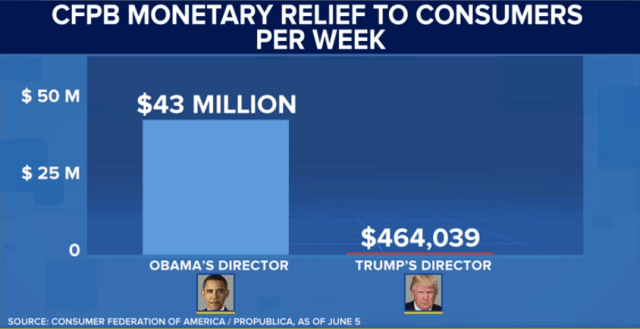
Here’s a graph of how much money the CFPB returned to defrauded Americans (mostly poor, otherwise powerless victims of predatory practices) under Obama and how much is currently being returned under Trump.   These are weekly totals:

Screen shot 2019-09-07 at 2.06.39 PM.png

This is more money, retained by corrupt financial outfits, in a week, than Republican politicians and lobbyists spend in Trump hotels and resorts in a year!

A few taps of the calculator gives us the annual, 52 week, savings to America’s most profitable predatory financial operators, outfits like the ubiquitous Payday Lenders who prey on the poor and the desperate and charge unfathomably complicated interest rates and penalties that would make a Mafia loan shark blush:    $2,211,869,972.    

No wonder these greedy, corrupt bastards are ponying up big money to party at the Trump Doral with the extremely stable genius, owner of the world’s most fabulous resorts!   They have a lot to celebrate with their fellow hungry chicken loving grifter guarding the henhouse. 

(tip of the virtual cap to Ari Melber’s excellent seven minute investigative piece HERE)


[1] in fairness to them not always out of malice, sometimes it’s mere incompetence.

Inchoate Anger and the Will to Power

Anger, what can I say about you, my old friend?   You are one upsetting, blood pressure raising, world-distorting,  bad motherfucker.   Hard, you are one hard bastard.   With you blowing stinking wind into the sails of people’s worst impulses, every atrocity ever committed appears righteous at the time.   The fucking Jews?   Fuck!  Hack them, gas ’em!  Armenians?  Drive them to drown in rivers!  Tutsis in Rwanda?   You know what to do!   Blacks all over America?   Dangerous criminals who need to be kept in their place by any means necessary!   Migrants fleeing horrors, seeking asylum in the USA?   Rip their kids away, put ’em in stinking, privatized for-profit concentration camps!   On down the list … Rohingya, let one of the poorest countries on earth take care of those raping refugees! 

Every one of these “policies” and countless others like them — and they are actual policies pursued by governments of one kind or another — is insane on the face of it.  Unless — and this is the golden, yea, platinum, “unless” that animates our bloody “wise ape” history — you are enraged.  If you are enraged it makes perfect sense to vilify people (en masse, you know, screw ’em, they all suck) humiliate them, beat them, confine them, torture them, kill them.   Fuck ’em, you know what I’m sayin’?

For the most part most of us get no say in these and other brutal policy decisions made in our names, even in a great experiment in representative democracy like ours.  When the time comes we can surge forward with the enraged mob, stand aside or run from the mob, as the case may be.  How does this unthinkable thing happen, over and over and over?

People arise, with a certain charisma, and a titanic Will to Power (in the sense of a need to control others), and act as lightning rods for the inchoate anger most people have within them.  We all have things that make us angry and often these things involve “the way things are”, a manifestly unfair system that consistently rewards the super-wealthy (often the randomly well-born dynastic inheritors of their fortunes) and more or less screws virtually everyone else, and then we die.  

A telegenic, otherwise mediocre person speaking as a “genius” directly to the bitterness in the hearts of his rightfully screwed countrymen takes the national stage.  These front men are poets of rage.   Their words galvanize the anger and sense of betrayal in their audience, they inspire bold action.   Soon armies are marching under their banners, supported by the super-wealthy beneficiaries of the cathartic distraction these organized campaigns of hatred provide.    We all know how this works.

It was generations of armed men on horseback riding in to “take care of” the Jews, responsible for every evil, in one eastern European shit-hole after another (for the benefit of the aristocratic landowners who were keeping the serfs and everyone else in misery).    White “knights” on horseback here in America, coming at night to burn down the houses of blacks who voiced discontent with the injustices they were forced to endure, torturing and killing the most vocal of them (the wealthiest county in the USA before the Civil War was in slaveholding Mississippi– most of the Klan, and all other whites, were disenfranchised “white trash”, sometimes called, to their fury “white niggers”, some things never change).

I am in a kind of rage right now, in the aftermath of thinking hard about a longtime friend’s wasted life of unexamined rage and my long campaign of trying to be better than I am capable of being.   His deeply repressed rage led him to an uncontrollable desire to dominate others.   It made him feel no better to be the boss, but it was something he had to do.   Men like him, acting on selfish compulsions to control that they have little clue into, make the policies the rest of us live and die by .    

I’m thinking about the climate catastrophe “debate” in this great nation, a prime example of the triumph of the rage to prevail over the natural needs of human beings.   You wouldn’t think this looming crisis would be the subject of much debate.   We all need clean water, air to breathe that’s not poisonous, food that’s non-toxic, shelter that’s not threatened with destruction by increasingly common killer storms.  

It’s not that hard to make the connection between the massive amounts of carbon pumped into the air by a century of accelerating extraction, refining and burning of fossil fuels and the massive increase of carbon in our atmosphere — and the rapidly and unnaturally warming of our planet, to disastrous effect.   Why haven’t earthlings organized across the globe to stop the rapid destruction of our habitat?   Our division is largely the work of organized, determined American Climate Change Skeptics.  Huh?

Enter the vampire motherfuckers and their eternal corporate avatars.   Making billions in their government subsidized industries of death there is no more determined group of individuals on earth.  The Tobacco Industry fought the families of lung cancer victims to a standstill for years, as they did what they needed to do, finding other markets and new products, diversifying, to preserve their handsome profit margin.   Until very recently Big Pharma successfully fought off all responsibility for the plague of desperate overdose deaths from the overprescription of highly addictive drugs they profited from.    The fossil fuel industry, same deal, merchants of death and deniers of death, aided by generous government policies toward them and represented by an army of talking heads posing as think tank backed scholars.  

You do what you need to keep the toxic shit pumping until every last drop in the earth and under the seas is monetized, damn the torpedos.   Charles Koch is just one of the most successful of these self-worshipping earth raping fossil fuel extracting parasites.   In every case of a corporate psychopath who places profit and domination above all else, you have a personal story of rage, as far as I can tell. Charles is a vivid case study and, thanks to the great Jane Mayer and others, we have the materials of his hideous case close at hand.

You can read the details of how the rage to prevail was instilled in Charles Koch, the unscrupulous son of a determined man who fought the government of the US, and the combined might of the other American petrol companies, to profit handsomely from the dirtiest fossil fuel refinement process ever known and who made his initial fortune working for Stalin and Hitler, men, in Randy Newman’s immortal line, “who need no introduction.”   Here’s a quick tour, with the author of the definitive book on Charles and David Koch (the Koch Brothers — the other two brothers were bought off after massive, protracted, ugly litigation) and the highly successful Koch-funded public influence machine.

You have a wealthy and ruthless father, who only wants to prevail.   In the case of little Charles this father was Fred Koch.   Fred Koch was not a hands on dad, though he was a demanding father who expected hard work and great things from his heirs.  When they were young Fred, who had made profitable deals with Stalin in the Soviet Union was over in Nazi Germany, building an important refinery for Mr. Hitler.  

The boys were raised by a nanny, a German woman, a Nazi, in fact.   Fred left the initial disciplining and toilet training to her.   She required them to defecate every morning on a strict schedule or face severe and humiliating consequences.   When France fell to Mr. Hitler, she returned to Germany to celebrate her beloved Fuhrer’s triumph.   The Koch boys grew up as best they could, I suppose, with a significant amount of rivalry and bullying.  The brilliant Charles, the Alpha Koch brother,  is known to be an unchallengeable autocrat, as all the great captains of industry style themselves.

Fred Koch was one of the founders of the John Birch Society, a group of wealthy right wing lunatics who organized in 1958 to save the country from Communism following the Brown v. Board of Education decision that held, to everyone’s shock, that American institutionalized racism was a bad thing that needed to be changed.   The John Birch Society called for the impeachment of Earl Warren, the Supreme Court justice they felt was most responsible for the reprehensible activism of striking down the “Separate But Equal” doctrine that kept everything kosher between the races.

Charles may well have hated his overbearing, unloving, demanding father, I have no sense of that.  He hewed to his politics while the old man was alive, as a member of the John Birch Society (he quit after the old man croaked).   After the old man died he fought two of his brothers in court for years for control, along with pliable younger brother David, of the father’s vast fortune and business empire.   The institutions Charles Koch and his network of fellow liberty lovers set up advanced the old man’s extreme notions about liberty above all else.   This liberty includes the unfettered right of heavily polluting industrialists to continue to profit from the extraction and refinement of fossil fuel unencumbered by any regulation or other interference from an “elected” government of liberty-hating tree hugging Negro embracing Jew bastard liberal elite social justice jackasses.

Count me among those hateful absolute liberty-hating jackasses.  

Have a very nice day.  I’m going to go play the guitar, try to calm myself down a little bit.


Mark’s last words to me

This will be my last post about my old friend Mark, who died recently.   It will contain the last exchanges we had, including the final thing he wrote to me, which was gracious, touching and something I appreciate greatly.   This long back and forth will not be for everyone.   If you want to scroll to his kind and touching lines, the last thing he ever wrote to me, they are in large print, right before the footnotes.

Mark had a unique and maddening style, in part due to his long-windedness, in part due to his intense and unwavering self-regard and his need to prevail, and these last emails between us showcase this prolix, convoluted, battling style beautifully, or horribly.   In fact, this post is almost guaranteed to extend to tedious, even excruciating, length, (Christ, I’m starting to write like him…).   I write it for those with the appetite for the fascinating, terrible details.   As well as to write the final words on this sad person I’ve been thinking about the last few days, since he was found dead in his home by a woman named Fatima.

I reconstructed our final exchanges last night (exchanges that occurred about ten years after our final falling out, mind you)  and was shocked  by the ferocity of my final words to him.  Then I reconstructed our actual email conversation to try to see why I’d been so merciless.  Once I read the back and forth, I was no longer shocked at how brutally I made sure never to hear back from him again.   I accomplished this brutality by removing all traces of sympathy from my remarks.

Reading the last few posts you may think I’m hard-hearted to speak with so little affection of a long-time friend.   This loss of my friendship was many years in the making.   In fact, I worked very hard the last few years to try to save the burdensome friendship, writing long letters, spending hours on the phone, having long talks with him whenever he was in town.   

His argumentative unhappiness was aggressive and growing, he was like an evangelist for misery.   Enduring his own demanding unhappiness required reducing everyone he knew to his level of moral agony, bending them to his view of things.   People tended not to stay around to listen to much of this, once he settled into his evangelical mode.  In his world there was only his will, his unfounded hope, unrealizable expectations and senseless betrayal by a parade of merciless false messiah putzes.

He was insistent that only he saw the world clearly, a horrible world where even his musical heroes got hideously old and let him down by aging.  It was exhausting to try to counter his grim emotional conclusions.   In the end, after a marathon conversation in a Florida diner (during the most drenching rain I’ve ever seen) I finally reduced him to silence, a process that had taken maybe five years and a million words– not to mention a law license and several years practicing law.   

He simply had no answer to what I finally said.  He sat glaring at me, arms folded across his chest, the picture of churlishness, very hurt to have been trapped that way by his old loser friend.  I found it a very satisfying moment.

I mentioned yesterday the profound similarity between Mark and Trump.   It was embodied in one quality more than any other: an unyielding need to be right, motivated by a feeling of being at a permanent disadvantage in the world.  Mark could not yield, though he’d sometimes, in an attempt to be conciliatory, refer to things like wishing he was wrong, or allowing the possibility he was seeing things badly, and things like that.  His absolute refusal to simply yield when it was called for, when he was mistaken or wrong, is what made him so hard to deal with.   My father had this quality too.   

You don’t need to have a keen mind to be unyielding, as our president shows every day, if you’re consistent in your insistence that you’re the rubber and the other person is the glue and that whatever they say will bounce off you and stick to him.  My father was by far the most skillful of the three, he almost never needed to outright bend the truth in order to prevail in an argument.   Mark was also not an untruthful person by nature, but when he felt cornered, which happened a lot,  he wouldn’t hesitate to insist, using easily disprovable assertions, that his feelings were right no matter what the facts might have to say about it. [1]   

I noticed a striking example in his final emails to me.   He mentions with hurt that I never responded to his many attempts to reconcile with me.    I reminded him of every time I responded to one of his attempts to reach out.   He agrees, when confronted, that, actually, I did almost always respond, at times beautifully.   However, he reminds me, there was that one time I didn’t respond and he’s still terribly hurt by it.   So the accusation that I never responded turned out to be an admission, when confronted, that I had actually written him back all but one time, but STILL!

Bear in mind, I had no obligation to respond at all to this overbearingly demanding former friend, outside of my promise to his mother to please not lock the door against him.  I kept my word to her as best I could.  When she died, and I got his final, completely characteristic, response, I felt released from that vow.   

Here is an email I sent somebody about my promise to Mark’s mother that I found from six months after my mother died in May of 2010:

The idiots who painted my mother’s apartment told me the enamel oil-based paint they’d have to use on all the doors was highly toxic.   The idiot in chief advised me to sleep elsewhere when they painted it.  I told him I’d be gone Tuesday and Wednesday night.  He said, “very good. we’ll paint with the oil Tuesday and Wednesday.”  When I got back to the apartment Monday night the air was so toxic, from enamel paint, my lungs began to ache after an hour in the house.

Luckily Sophie, the vampire Mark’s mother, was happy to have me drive up to her place and sleep in her guest room, which I did.  The vampire was arriving the following day.  It was somewhat ticklish.  I arrived at 11:00 pm, Sophie and I talked until 2:30 a.m., mostly about Mark.

Mark has no friends, every former friend is a ‘putz’ who betrayed him.   Sophie understands that he’s very difficult to get along with, she does everything he demands, she understands that he’s immature, and angry, and very unhappy, and bossy, and pushy, and so forth.  She wishes she could do something to help him, but he lives in a world where everybody but him is the problem.  She completely understands my point of view, why I can’t be friends with someone who, like Irv used to, views me as a rival to constantly battle.  I told her I am a good fighter but I don’t want to do it anymore, especially not with friends.

The next morning we had breakfast and I left a few hours before he arrived.  Standing by the car, leaning on her cane, this wonderful, upbeat, life-loving 94 year-old said as I started the car.

“I know all the reasons, and I wish it could be different, he doesn’t have a single male friend… and I love you so much, and I love him, it breaks my heart that you can’t be friends,” and she gave me that heartbreaking sunshine-filled smile of hers.

As I put the car into reverse she said, “maybe I shouldn’t mention this, but he’s jealous that you and I have maintained a friendship when you won’t be friends with him.”

“That’s because he lives in a black and white world,” I told her immediately.  “he can’t see the shades of grey, the gradations that make the world rich, and complicated and beautiful.”  We told each other we loved each other and I drove off, leaving her to two weeks with her loving and demanding youngest son.

His mother knows: Mark is immature and petulant, he sees himself as a victim, you’re with him or against him.  He can’t hold contradictions in his head, or see that one thing may have nothing to do with another, or that not every two different things are mutually exclusive.

I’d promised her I’d reply to his email, sent to me on the eve of his coming to Florida, since he knew from his mother that I was there too.  He sends out these feelers periodically when we are going to be in the same town for any period of time.  I was at a loss to reply to his email about which my sister’s comment was the best  “He’s completely insane and, to top it off, not a good writer,”

A few days ago I finally wrote back to him, honest and gentle as I could be, and blind cc’d it to Sophie, for whose sake I’d written it, hoping it would ease her 94 year-old mind and heart ache a bit.  She never wrote a word about it, naturally, though she’s an old fashioned kind of correspondent, almost always responsive, but when I called her tonight, with Sekhnet on the line, she told me she loves me.

Here is the last exchange with Mark, minus my  final, merciless-and-plain-as-Death words. I leave his kind final couplet as the last word on our long, tortured friendship, as I did, gratefully, in my otherwise brutal reply.

Mark wrote me this characteristic note on November 22, (JFK Conspiracy Day) 2014, after his mother died, when the brothers were arranging a memorial service for her in New York City:

Hey there — well here’s one exquisitely stanky hanky . . . . and I just want to check in with you, if there’s the slightest chance that my read of the situation is wrong, which could have very sad & profoundly tragic dimensions. You may have heard, there’s an upcoming NY memorial gathering for my mom. Several people have said to me — in light of your appropriateness to be there — “just let it go . . . . reach out.” To which I could only respond — first — that it’s never been me holding on to anything to begin with, this split was all your choice, so there’s not even anything for me to let go of . . . . and second, that I’ve already tried reaching out, repeatedly , and got no response. So I finally had to give up, as eventually it could only be taken as the very manifestation of the resoluteness of your choice, the confirmation. The art of answering without answering. Which was further seemingly confirmed by having received no personal reach-out in this, the most ultimate of moments.

But I’ve certainly had my experiences of the same reality being experienced completely differently by the two people involved (the source of so many problems & tragedies on this stinking planet), and if there’s the slightest chance whatsoever that that might be the case here, it’s too big and fraught a thing not to give you the courtesy of checking in on. And this is one situation where, contrary to how you’ve previously characterized me, I’d gladly welcome being absolutely wrong. But it’s not a thing for sugarcoating, I guess it’s a simple “yes, you’re right about the resoluteness of my decision” — or a not-so-simple (to-follow-up-on-but-I’m-willing-to-try) “no.” If it’s the first, well, then, so be it, but you’ll hopefully understand why I can’t even consider extending the invitation that you otherwise so rightfully deserve. Two of the very stankiest of hankies ever dealt me, at the very same time? Unthinkable & unbearable. There’s already more agony on this overflowing plate than it can barely hold.

Given which . . . if it is in fact the second, there’s still highly uncharted & choppy waters to immediately set forth on to see if it’d even lead to a place where, even then, the extreme existential discomfort factor could be mitigated to a level bearable enough for this most vulnerable & raw & emotional of events.

So this is me, reaching out,
Mark

I replied to his email [2] three days later:

Your note reminded me that each of us has his own terrors, his own style of terror, and there is very little one can do for another on that primitive level, even if a healthy, reciprocal friendship is there.  The end line “this is me reaching out” was particularly terrible in the context of the rest of the email.  

I’m done fighting, unless somebody comes to do me harm, even so, it’s hard to not point out that when you emailed me when my mother died, I wrote back.  I believe I wrote back to another email you sent maybe a year later when we were in Florida at the same time.  I didn’t answer the time you emailed to ask for my “most efficacious address” so you could send me a long letter and addressed me as “kind sir” or whatever it was.  It would have been very easy to get my same old address or phone number, you didn’t need me to email it to you, except as a sign that I was game to play a game I’d already told you I was done with.  I didn’t send a thank you card for your birthday CD of your newest composition in 2006, true. 

But to say I never responded when you reached out is just rewriting history to make yourself the victim and pretending you don’t recall any of the many long discussions and long letters, over an extended period, that finally led to our not being friends any more.  

I contacted Greenstein when I heard your mother died and gave him the option of contacting you again, as I’d done years back, another time you’d written him off as a putz and were planning on not visiting him while in London.  He magically called you on the eve of your trip, you may recall, just as he magically wrote you shortly after your mother died, in spite of your having written him off again.  (Not to say that he and I have remained close, sadly, though it was looking good for a while a few years ago.  I think Gill doesn’t like me.)

Very sad that your mother died, but she sounded about ready to go, I think, she died peacefully in her sleep as we’d all choose to go and she was very old, after a very long life of mostly excellent health.  Few people have their mother until they are sixty years old.  Most would be grateful for that luck, but gratitude is a tricky thing, at best. 

Your email made it clear that you’re still determined to be the blameless victim, the only one who suffers at the hands of others and seemingly always for no reason at all.   You may have the least insight into your own role in your repeated miseries (and a remarkably consistent, predictable story arc virtually every time) of anyone I’ve ever known.

I don’t know what to say about that, except that the only possibility for change is if you start to do the hard, painful fucking work of dealing with your consuming anger, developing empathy and, also, kindness to yourself.  The world is cruel, a merciless slaughterhouse, and then you age, decline and die, if you’re lucky.  Otherwise you’re sitting in your car and a drunk in an SUV kills you, or cancer does, or you die at 58 like Howie — another person you wrote off as a putz, and the closest to a saintly person I ever met– waiting for a light to change.

Since you were hurt that I didn’t write to you personally when your mother passed on, I have rewritten the email Gary forwarded to you.  Your mother was a remarkable woman and this remembrance of her was about the easiest thing I ever sat down to write.

Dear Mark:

I heard an echo of your mother’s graceful style in the way Gary broke the news:

My Mom and your buddy passed away peacefully in her sleep Wednesday am.  She got this, her final wish, a royal death.

Sekhnet cried when I read his email aloud to her.  She agreed that when we talked to your mom a month or so back, it was the first time we’d heard her voice any kind of weariness.  I guess it was her time, and a blessing that she got her royal death after a long, full, royal life. 

I realized that I am older now than she was when I first met her at 807 Edgewood Lane.   If I could live the rest of my years as well as she did those 40 plus that remained to her when we met, I would be very blessed.  

She was, as Gary said, your mom and my, and Sekhnet’s, buddy.  I realize she could be vexing at times to you kids, demanding and so forth.  All mothers cause some vexation to their children, as, sadly, we all do to our mothers.  Though I could see what could be vexing about her as a parent, I was privileged to never experience it personally.  

“I want to be Sophie when I grow up,” Sekhnet said often.  If talking to Sophie she’d say “I want to be you when I grow up!” and Sophie would laugh the easy, distinctive laugh she practiced often.  What Sekhnet meant was Sophie’s joy for life, her sense of adventure, her ready embrace of the good side of whatever else the thing might be.   Her robustness and optimism, the way she drew people to her by these qualities.

She became friendly with my parents in 1999 when they met for the first time.  You will recall that my parents came up from Florida for my law school graduation in the spring.  The graduation was in Newark.  You mom emailed my parents, inviting them to stay with her and Al.   The email was typical of Sophie — charming, well-written, mischievous.

She laid out the many advantages of staying in her home and stressed what a pleasure it was for her and Al to be able to offer this hospitality, and how small an effort it would be for them.  “If you say no, we’ll say you’re being stubborn,” she ended, closing the deal.  Our parents became friends at once.

Not long after Al died, my father was hospitalized suddenly with only days to live.  Your mom was then close to ninety and didn’t drive on the dangerous Florida speedways, but she wanted to say goodbye.  She took local streets, Military Trail, State Road 7, etc., a trip with traffic lights that took several times as long as going by the turnpike, and a journey much longer than any she’d driven in years. 

I will always remember her face as she sat by my father’s bed a few hours before he died.  It was like the sun.  She beamed a smile on him as he feebly gestured and made such small talk as he could.  She showered him with love and a huge smile in a room where everyone else was frowning and fretting.  It was about the most beautiful thing I’ve ever seen.   She stayed a short time, hugged and kissed us all, and made her way back the way she’d come, while there was plenty of sunlight to navigate by.

A few years later she and my mother booked an apartment in a residential building in the West Village, the Chelsmore, that was rented out as a cut-rate B & B.  The two of them were going to share a place for a week and then my mother would move to a studio apartment for the second week of her last visit to New York.  

I brought them to the apartment and when they opened the door my mother looked around and let out a gasp. “Oh, my God,” she said to Sophie, looking around at walls that needed painting, almost no furniture, a mattress on the floor in the living room “what a dump!”.  My mother turned her expressive face to Sophie– the expression was of someone about to throw up.  This cracked Sophie up.

“Oh, Evelyn!” she laughed “it’s an adventure!”  She immediately offered my mother the better of the bedrooms and they had a very nice little adventure together in that perfectly adequate semi-shabby apartment on West 15th Street.

Walking with them during that visit illustrated another contrast between my mother, a glass half-empty gal, and Sophie, for whom the glass was always, at the very least, half-full.  My mother walked with a cane at that point and would walk quickly until she had to stop, breathless and feeling she was about to die.  “I can’t breathe!” she’d say with some degree of panic, “I can’t breathe, I have a sharp pain…” she’d point to her heart and double over slightly as she struggled to catch her breath.   I’d calm her as she caught her breath and then she’d be fine, dash off on her next sprint.   Sekhnet and I switched walking partners after she and Sophie caught up to us.

Your mother walked slowly and deliberately at 92.  She would take your arm and cause you to walk at her pace.  She would converse, and observe, and laugh, never running short of breath, walking at a slower than average NYC pace, but steadily onward.   She made the whole process of being old and wanting to see and do everything seem effortless.

One trouble with living long and having old friends is that eventually they all die.  Your mom kept up with the children and grandchildren of old friends and continued to make new friends everywhere she went.  She was an inspiration, my life was enriched by knowing her, watching her remarkable example.  I hope very much that Sekhnet gets her wish and grows up to be her.

May her memory be a blessing,
Eliot

Mark’s well thought out email reply, sent four hours later (I have inserted some paragraph breaks where Mark should have, to make the going a little easier):

Jeez, “fighting.” that’s the last thing I want or am thinking of, my intention was the exact opposite of that.  Feeling that may be the clearest indicator of an impasse that does deserve to be honored.  It seems that that feeling came up for you because you felt I was presenting you with inaccuracies, which reveal the un-unravelable tangle, to embark upon which yet again would be soul-wearying & fruitless, plus feel like a fight.  

This has previously come up frequently, has been an intrinsic part of this impasse.  Me responding to things where the theme is “misunderstood, misinterpreted” — which feels like an argument to you, thus untenable–and a Catch-22 for me, not allowed to respond to what feels like erroneous perceptions. That is an impasse indeed.  

Do not think I reject your critical observations out of hand, I certainly have issues & difficulties  — and can be difficult, not the blameless victim at all.  You are capable of a rare degree of insight, though often so stabbing as to be painful, and vindictive-feeling, though that could very well be a self-protective misinterpretation.   And I’ve certainly had a lousy repeating pattern, that I may never unravel. Hopefully I’ve made some progress.  

Which you of course wouldn’t know about.   For what it’s worth –and please don’t construe it as “fighting”  or even arguing — just allow me to revisit the few things you mentioned to describe the view from my shoes.  Most importantly, this thing of “you not responding to my previous reach-outs” which I’m guessing is the crux of what put you off to my note — what seemed like a rewriting of history so as to maintain my fatally erroneous, eternal blamelessness.   I could have gone into detail then but didn’t feel it appropriate, possibly alienating.  But hey, I managed to alienate you anyway, so now here it is, for what it’s worth.  

You wrote me back a really nice letter to my letter following your Mom’s death.  And yes, you certainly had responded to previous “reach-outs” that had given me hope that the break might not be permanent.  That very nice & full letter was different — by far the strongest suggestion of that, possibly the first strong one — in those difficult years of struggling with this soul-blowing break & hoping it could be gotten past.  

Given that whiff of what I hoped was an open door, I wanted to eagerly go for it– for which my antipathy towards this e-medium made it feel not appropriate.  Something my Mom said had suggested that you had given up the Seaman apartment, so I simply wanted to know where to send a proper letter.  And that there is the sum total of the “no response” feeling– I asked several times & finally had to conclude the obvious, that you did not want me to write you.  

Which, by the way, I did not envision as simply taking up the rounds of this wearying wrung-out back & forth issue.  If there were to be any hope whatsoever, it’d have to be putting it behind, which I was prepared to try to do, but never got the chance.  I really did not know any other way of ascertaining your address, plus it wouldn’t have made sense to even think of ways to get it elsewhere– if you didn’t want to give it to me, that spoke for itself.  I certainly had no “game” in mind, don’t even know what that game could be, it was just the simplest of logical questions.

The way you’ve contacted Greenis on my behalf demonstrates great consideration, soul & graciousness, and I thank you for it, you have eternal respect & gratitude there.  I don’t recall ever thinking of Howie as a putz– I always think of him with love & respect — or of ever writing Greenstein off (since the recontact 20 years ago).  

No, the epicenter of my problem is being overly-sensitive to perceiving that it’s ME that’s getting written off, and having a horror-aversion to imposing myself where it seems I’m not wanted, and reacting too quickly & strongly & overly-sensitive to that perception (and to go forth trying to be a performing artist with that personality trait is downright comical & ludicrously misguided.  Plus it leads to others often getting a feeling of overly-demanding expectations, need for reassurement,  hence off-putting, hence leading to pulling back, hence the vicious cycle, the self-fulfilling prophecy).  

Perhaps in the midst of what seems to be a disengagement of that sort it’s certainly possible I could’ve uttered an untoward epithet, out of pain & self-defense, but that’s a small picture thing.  Greenstein I’m at my wits end about, it’s been a 30-year occasional dialogue-about-dialogue that he certainly hates & so do I, but I’m at a loss for what else there is to say in the face of resolute non-initiating.  His thing is “I just don’t have that communicative urge or need , but I’ll always respond” & my thing is “if someone never initiates, indicates a personal interest, lets it go for years, what does friendship even mean?” (an ironic flip-image of one of yours & mine past main issues)  

And then the next level of that, friendship consisting of encompassing & honoring this dialogue as a means of learning what bothers each other & with the basic premise that there’s caring, accommodating accordingly–well, there’s none of that, it’s his way or the highway, what to do at that point?

Finally, I don’t know how you read into my barely-mentioned reaction to my mom’s death as being “the blameless victim suffering at others’ hands,” how you made that leap.  And how as if I don’t recognize the blessing of having had her so unusually long, as if because of that blessing and her great life, it’s wrong to be extremely sad & somewhat unmoored by the loss of that constant presence, love, anchor, rock, support, orientation point?  You’re even criticizing me about my reaction to my mother’s death?  Did somebody mention anger?

There were many wonderful touching & expressive heartfelt notes we got, but your eulogy was way far above & beyond any of those, a whole other league. Which was no surprise– you are a true writer  & extremely sensitive soul, and I hope you’ve continued, and will continue, to find suitable ways & outlets to have that artistry make its deserved impact on many other souls.

MF  [3]


[1]   and, as a friend wisely pointed out to me, feelings themselves cannot be wrong or right, they are how you actually feel.  The trouble comes when your persistent feelings cannot be changed by anything, not by looking more objectively at what upset or excited you, not by realizing the importance of seriously listening to people who love you, not by working on your perceptions to avoid feelings that have little or no basis in what actually happened.   

[2]  These two friends nailed a lot of truth in their comments about the first email from Mark, which I’d forwarded them as I tried to formulate a reply:

Not ever having really known him–I was around him at times but have no recollection of actually exchanging any words with him directly–I could only vaguely comprehend the basis for your position. His email opens a window. Very manipulative and emotionally Byzantine, the art of placing blame while trying to appear not to have done so, but rather to have made a bold and mature gesture. Very frustrating, if not infuriating, watching someone bob and weave so strenuously to evade emotional connection and basic responsibility, seeking to anticipate and counter objections and arguments rather than open a line of communication.  I can only assume it’s infinitely more exhausting for him than it is for the recipient, and that’s saying something.

and

The man’s style is insufferable and unparsable.  An interesting read, I suppose, in the sense that a fatal six-car pileup is an interesting sight.  No pardone necessary, though.  I think it’s been established by now that communication ain’t always pretty, and besides, since MF (hmm, suggestive initials) has figured in your narratives from the get-go, it’s instructive for me to get some verbiage straight from the source.  Your characterization of it as a fly-covered turd strikes me as accurate, erring, if at all, on the side of charity.

[3]  I’ll leave that lovely, generous observation as Mark’s last word.   

I replied to his last email by removing all ambiguity about where I stood, in the end thanking him for his buried lede about how much he appreciated my words about his mother.

As I wrote to another correspondent at that time, still fuming over Mark’s “response”  email:

The punchline he predictably sent back stuck sideways in my craw, going on 8 hours or so now.  If I could only see him for a minute it would be enough.  [account of bar room style violence deleted]    Then, nothing but ahimsa for me going forward.
MF and the pursuit of happiness

Mark’s death a week ago (a former close friend I hadn’t seen in almost fifteen years)  has brought  up a surprising amount of emotions, varied but mostly perplexing.    I’m left, as often while he was alive, shaking my head over the unremitting and ultimately downhill tragedy of the guy’s life.  

He was a classic example of the Repetition Compulsion, the perfect illustration of doing exactly the same thing over and over firmly believing it was going to be completely different this time.  Every new relationship, or pursuit, began with unlimited excitement and optimism.  It was the greatest!   Nothing could be better, he’d found the ultimate, the secret to happiness. He’d be euphoric reporting this excitement in great detail, often in a way that made unflattering comparisons between this truly amazing, talented, nonchalant, comedic, wise, warm, amazingly cool new person and the cursed losers he already knew and had mostly written off.   Myself included, of course.

Then, as predictably as night follows day, Act Two.   Within a very short time cracks in this perfection began to appear, something was starting to smell bad.   In Act Three, every single time (with almost no exceptions), the innocuous prop left on the stage in scene one would be wielded to deadly effect by a suddenly irrationally enraged putz after some horrific betrayal by said putz.    Along the way, and invisible to himself, the common feature to every similar three act story was that Mark was only concerned with his own happiness, a tragic and hopeless version of it, as it turns out.

He was the youngest of three boys, felt disrespected by his father [1]  and never loved enough by his mother.  Very much like Trump in that way (although young Donald had a little brother to take it out on before he moved his sadism on to larger and larger stages).   In fact, Mark was very close to that zealously controlling, eternally scowling, nickel and diming archetype of the ever-victorious Artist of the Deal.  The euphoria of “winning”, judging from Mark’s unhappy life (not to mention our current national disaster’s life), appears to be an illusory thing and seems to provide little real happiness, it turns out.   

Mark had a uniquely complex style, and I will dig up some more nuggets of it to share here in the coming days, I suspect.   Few things were ever straightforward for him — other than the bottom line, that he needed to somehow prevail in everything, no matter how small or seemingly insignificant.    This applied in every facet of his life, was the price you paid to interact with him,  and was at the source of his general misery.

I was close friends with this increasingly classic energy vampire for literally decades.   We met in camp in 1970 and were in constant contact from that time until some time after 2005.   A long run for a friendship.  In the end, an exhausting run.

It is no surprise, I guess, that I am feeling a variety of emotions on learning of his sudden and untimely death.    A wealthy man, a very smart man and a talented musician;  if he’d been at all generous, a bit more empathetic,  he could have had rewarding interactions with anyone he met and shared his good fortune with friends.   Sadly, his generosity, like so much about him, was largely transactional.   He wouldn’t give without some guarantee of an even larger return.  Some would not recognize this as generosity at all.


[1]  I’m very interested in reading the correspondence between Mark and his father though it will probably be a tough read.  His brother is checking to see if the box was tossed already.    I have authorized the recycling of many dozens of long letters I sent to Mark over the years, found among his piles of possessions.  I have too much goddamned clutter here as it is.

Further thoughts on departed Mark

I called Mark’s older brother yesterday, the day after his text that Mark had been found dead of a cardiac event of some kind.   He was in New Mexico with his middle brother, at Mark’s squalid ranch house, going through the vast accumulation of things.   Signs of serious depression, he reported, the place was a garbage heap, Mark apparently never threw anything out.  On the overflowing desk the two surviving brothers collected and opened envelopes containing $30,000 worth of uncashed business checks.   Mark ran a food business, with several employees still at work to fill ongoing orders, and the brothers are trying to figure out how to keep those poorly paid green card workers employed (Mark made a little extra by paying them half by check, half in cash) while they arrange to sell the little food company.

Turns out Mark hit gold by investing, early, in an arts company called Meow Wolf, an investment that apparently paid off many times over. “He died a wealthy man,” his brother told me.  We exchanged a few short observations about Mark’s famous tightness with a dollar.   “When he was a kid he’d hide his candy bars, he was afraid we’d steal them.  At restaurants he always ate fast, to make sure we didn’t get anything off his plate.   When he was older he’d go through the bill and say ‘I didn’t order that, I’m not paying for that.'”  I reported having to top off the tip every time I split a bill with him.  His 12% on his end, calculated precisely to the penny, never amounted to anywhere near half the tip, but that was how it was.

He also mentioned that Mark hadn’t spoken to him in three years.   They’d had a fight and that was that.   His brother reported that it was his fault, that he’d blown up at Mark, wound up screaming at him, and that he felt terribly guilty now.   Natural to feel that way, I told him, but everyone has a breaking point.   Mark broke virtually everyone who ever met him, if given a chance.

They found a box of letters between Mark and his father, Al.   They’d only read one or two before they felt like voyeurs and closed the box.   In one of the letters Al, seemingly broken like everyone else by Mark’s stubborn resolve, chided him about wasting his great potential and telling him it was time to rouse himself from his lifelong solipsistic self-pity, or words to that effect.  Neither of us had any idea that Al had exchanged many letters with his unhappy youngest son.   I told his brother an iconic Mark and Al story he’d never have heard.    

Mark composed an opus for the piano on the grand piano he had in his living room. This piece was perhaps forty minutes long and had several movements, going through a gamut of styles and emotions.   Mark was nothing if not ambitious.   The piece showcased everything Mark had learned about music and playing the keyboard.   He’d probably worked on it for a year or more, learning to perform it perfectly with his gigantic, surprisingly nimble, fingers.  On a visit to his parents in New Jersey he described the piece to his father and arranged to perform it for him at the NYC apartment of a cousin who had an electric piano.   Al was an organist — the family had an organ in the den, though I don’t recall ever hearing Al play it.

They drove over to the city.   Mark sat at the piano in the small room, with his back to his father, and Al sat behind him as he played.  Within a few minutes Mark heard a clack and another clack.   Al was apparently glancing through a collection of CDs on a shelf.  Mark’s spine stiffened as he continued to play, his blood chilling in his veins.   He was instantly filled with the old rage of being dismissed by his father, and he played the entire opus to the end, with great emotion.    The incident proved to him everything he’d ever believed about not being taken seriously, not being respected, not being recognized for the great talent that he was.   

What it really illustrated, as his brother grasped at once, was that Mark was incapable of ever putting himself in anyone else’s position.  Only his needs were real.   Was Al supposed to have sat, hands folded, eyes closed, paying rapt attention to every nuance of the entire recital?   Mark and I used the “clacking of the CD cases” as a shorthand for the indifference of the world to even one’s greatest attempts.    The world, truly, and I say this almost without bitterness, generally does not give a rat’s armpit about the things we create, no matter how otherwise wondrous.

There is another Al story that is a mystery to me to this day.   The clacking of the CD cases is easy to grasp both sides of — why Al could hardly have been expected to do much differently (he could have perused the CDs silently, I guess)  and why Mark felt the way he did.   This other story remains a mystery to me almost twenty years after I played my little part in it.

Al was terrified of death when he got old.   So frightened that he’d breathlessly wake his wife several times every night out of fear that he might slip away while she slept.   Within a short time she was exhausted and at her wits’ end.   Their sons arranged to have Al taken to a nearby, nicely appointed rehab center where he was treated for depression.   Sophie was able to sleep, between daily visits to Al.  Sekhnet and I visited him there, and went out to dinner with Sophie afterwards.  I wrote Al a letter he was very grateful for.  

In hindsight, my letter was asinine, comparing the dysthymia of a healthy thirty year-old (me) to the death-inspired depression of a man almost ninety, but he told me he loved the letter.   He said it gave him hope, reminded him that depression passes, as it seemed to have in the end in his case.   He had a few good years after that and, thanatophobia apparently at bay,  stopped waking his wife every night.

They moved to Florida where he was eventually hospitalized for something serious and fell into a coma.  Mark came from New Mexico to sit by his bed.   On the wall was the Do Not Resuscitate order that Al had signed before slipping into the coma.   He was in a comatose state for a long time.  One day he woke up, and speaking to the doctor, told him urgently that he wanted to revoke his DNR, which they did.  Shortly afterwards he fell back into a coma.   Mark sat by the bed, day after day.  

He called me one day to tell me his father was awake and semi-alert and asked me if I’d like to speak to him.  He said his father was pretty incoherent, but that he’d hold the phone next to his ear for a minute or two if I wanted to say anything to him.

When Al heard my voice he practically chuckled.  “Eliot!” he said, “oh, man, it’s great to hear your voice.  How are you?   Any chance you can get down to Florida to see me?   I don’t know how much longer I’ll be around but I’d love to see you…” I told him unfortunately I’d just been to Florida a couple of weeks earlier and wouldn’t be back for a while.  He sighed philosophically and began to say something.  

Then Mark was back on the phone.  “See what I mean?” he asked, “totally incoherent… well, it was nice of you to talk to him…”

As many times as I think about this, and I have returned to it several times over the years, I barely have a theory about what the hell that was.

His brother and I spoke for a while (I didn’t bother to tell him the second Al story), both concluding that Mark’s life had been a tragedy.   A complete fucking tragedy and a waste of a brilliant and talented mind.   There was an undocumented Moroccan woman in the house, Mark’s roommate, thirty years younger than Mark. “He was her sugar daddy, apparently,” his brother said.    Very sympathetic, apparently, and expressing gratitude to Mark, saying she loved listening to his stories.  “And you remember what his stories were like, they never ended…” said his brother.   Fatima said she learned a lot of English from Mark’s stories.  

“He could certainly teach you English,” I said.  

She’d called at 5:30 when she was on her way home last Tuesday and Mark said very good, he’d see her then.   When she arrived at 6:00 she found his corpse.  The Medical Examiner had called the brother Mark hadn’t talked to in three years.  

“The Medical Examiner,” said the brother, “just like on TV.”

Dream with a message after an old friend’s death

At dinner last night I had a text from the older brother of a long-time close friend I had to finally write off not long after my father died in April, 2005.   Sudden heart attack and the guy I’d known quite well since we were teenagers was gone.  The brother and I agreed to talk today, and I’ll call him in a little while.  I remember our last chat, after their beloved mother died.  

The brother, although very aggravated by his aggravating youngest brother, was in despair for my one-time good friend.  “He’s a total mess, he’s falling apart and you’re the only friend he has,” he told me, though it had been about nine years at that time since I’d last had any contact with the now recently deceased Mark.  

I got a short (by his standards) convoluted email from Mark a few days before the memorial service for his mother.  I should dig it up to give you a taste of how his marvelous mind worked, even though one’s not supposed to speak ill of the dead.  Let’s see, ah, here it is.  You know what?  I’ll put it as a footnote [1].   I had a few laughs just now reading Mark’s oldest brother’s great deadpan reactions to his brother’s long coiling, uncoiling and recoiling emails, including this afterthought:  

One more thing,  Mark is staying with me for a week, commencing this coming Monday evening.  So,  feel free to come hang out, ought to be a barrel of laughs.  

The middle brother apparently simply hit delete whenever a long email from Mark arrived.   Scroll down to the footnote if you want a taste of Mark’s ornate writing style. 

Their mother had completely understood when I told her, more than a decade earlier, that I had finally reached the breaking point with her demanding, unhappy, angry, critical, other-blaming, eternally nickel and diming youngest son.  She thanked me for staying friends with him far longer than anyone else ever had and asked me only one favor: if he contacts you to make amends, please leave the door open to him.   I tried to hold up my end of that bargain, though, admittedly, I had little patience for the guy’s couple of characteristically odd attempts over the years.  He’d coined the phrase “idiosyncratic riffing patterns” to describe a great guitarist friend’s unique improvisational style.   It applied to nobody better than it did to Mark himself.

Anyway, I suppose it was thinking about Mark’s death, the end of his sixty-five years of mostly suffering, that led me to dream the dream I had last night:  

The wife of the California harmonica player who recently wrote me off after decades of friendship had apparently put her foot down and told her husband to stop being an asshole, that I was coming to visit and he simply had to accept that she and I were going to remain friends, whatever he thought about it.  He was obviously unhappy with the arrangement, but as the house, the expensive stereo equipment, the BMW sports car and everything else was paid for by his wife’s inheritance, he couldn’t squawk too loudly.   So he set conditions as soon as I arrived (and his wife was out of earshot):  you do everything I say, you don’t talk to me unless I talk to you first, you ask permission to do anything, etc.   He reiterated these rules a couple of times during the dream visit, anytime I presumed friendship.  I woke up realizing again that you can’t mandate somebody stop acting like an asshole.

Trying to overlook asshole behavior does not work in the long run.   I tried it for a long time with a mentally ill friend of many years.  We agreed, as a condition of our reconciliation, not to talk about his vicious wife, Hitler, who had broken up our friendship for a year or two at one point (it had a happy ending, they eventually divorced).  After we renewed our friendship (years before the divorce)  she crept into our conversations a couple of times and in the end, the brilliant but crazy bastard orchestrated some other escalating, irrefutable cause for our falling out and this time I had no choice but to go with it.

Mark was a very intelligent guy, also very talented– he was an accomplished guitarist– both finger style and flat picking — wrote many tunes, music and lyrics, and played the piano with some degree of self-taught virtuosity.   He was an excellent photographer, with a great and unusual eye, and, out of the blue, did some whimsical small paintings at one point in his adult life.  He was also, surprisingly, an excellent cook.  

At one time he had a good sense of humor, some of the best laughs of our high school years I shared with him.  There was one scene, in the home of our tormented friend Jeff (who eventually gassed himself to death in his parents’ carefully prepared garage), where we laughed longer, louder and more uncontrollably than any other time in my life that I can recall.   And you don’t forget a thing like that.   We were literally rolling on the floor laughing our asses off, ROTFLMAO!   Now I’m the only one alive who can remember that hilarious scene in Jeff’s parents’ kitchen.

Good to remember these things as I prepare to call his oldest brother, a guy with an excellent, dark, sense of humor himself.   Reading over our emails back and forth just now, the ones we exchanged prior to the memorial for their mother, I had a few laughs at his unsentimental and spot-on observations about his brother.    It was hard to have infinite patience for Mark, though that was what was required.  The only person who seemed able to do it was their mother, Sophie, a remarkable soul any way you look at her.    Oy vey.  

If you want a little taste of how Mark’s unique mind worked, and a glimpse at the complicated, endlessly compounded tragedy that was his life, read the footnote — written a few days before the memorial service for his mother, right before I sent him a personalized copy of my memories of his mother Sophie (linked above <– and here too, fine…).  Mark’s style is probably not for everyone.  And in fairness to him, you need to picture how devastated he was about his mother’s death when he wrote the sample below.

[1]  
Hey there — well here’s one exquisitely stanky hanky . . . . and I just want to check in with you, if there’s the slightest chance that my read of the situation is wrong, which could have very sad & profoundly tragic dimensions. You may have heard, there’s an upcoming NY memorial gathering for my mom. Several people have said to me — in light of your appropriateness to be there — “just let it go . . . . reach out.” To which I could only respond — first — that it’s never been me holding on to anything to begin with, this split was all your choice, so there’s not even anything for me to let go of . . . . and second, that I’ve already tried reaching out, repeatedly , and got no response. So I finally had to give up, as eventually it could only be taken as the very manifestation of the resoluteness of your choice, the confirmation. The art of answering without answering. Which was further seemingly confirmed by having received no personal reach-out in this, the most ultimate of moments.
But I’ve certainly had my experiences of the same reality being experienced completely differently by the two people involved (the source of so many problems & tragedies on this stinking planet), and if there’s the slightest chance whatsoever that that might be the case here, it’s too big and fraught a thing not to give you the courtesy of checking in on. And this is one situation where, contrary to how you’ve previously characterized me, I’d gladly welcome being absolutely wrong. But it’s not a thing for sugarcoating, I guess it’s a simple “yes, you’re right about the resoluteness of my decision” — or a not-so-simple (to-follow-up-on-but-I’m-willing-to-try) “no.” If it’s the first, well, then, so be it, but you’ll hopefully understand why I can’t even consider extending the invitation that you otherwise so rightfully deserve. Two of the very stankiest of hankies ever dealt me, at the very same time? Unthinkable & unbearable. There’s already more agony on this overflowing plate than it can barely hold.
Given which . . . if it is in fact the second, there’s still highly uncharted & choppy waters to immediately set forth on to see if it’d even lead to a place where, even then, the extreme existential discomfort factor could be mitigated to a level bearable enough for this most vulnerable & raw & emotional of events.
So this is me, reaching out . . . .
Mark

Why Trump didn’t testify for Mueller

perjury trap.

Here is Mueller’s intro to Appendix C, the complete written questions and Trump’s “insufficient, inadequate, incomplete, imprecise”  answers.  Mueller explains. quite logically, why he didn’t pursue in person testimony from our historically candid and truthful commander-in-chief:

Beginning in December 2017, this Office sought for more than a year to interview the President on topics relevant to both Russian-election interference and obstruction-of-justice.  We advised counsel that the President was a “subject” of the investigation under the definition of the Justice Manual—“a person whose conduct is within the scope of the grand jury’s investigation.” Justice Manual § 9-11.151 (2018).  We also advised counsel that “[a]n interview with the President is vital to our investigation” and that this Office had “carefully considered the constitutional and other arguments raised by … counsel, and they d[id] not provide us with reason to forgo seeking an interview.”   We additionally stated that “it is in the interest of the Presidency and the public for an interview to take place” and offered “numerous accommodations to aid the President’s preparation and avoid surprise.”  After extensive discussions with the Department of Justice about the Special Counsel’s objective of securing the President’s testimony, these accommodations included the submissions of written questions to the President on certain Russia-related topics.

We received the President’s written responses in late November 2018.   In December 2018, we informed counsel of the insufficiency of those responses in several respects.   We noted, among other things, that the President stated on more than 30 occasions that he “does not ‘recall’ or ‘remember’ or have an ‘independent recollection” of information called for by the questions.   Other answers were “incomplete or imprecise.”’  The written responses, we informed counsel, “demonstrate the inadequacy of the written format, as we have had no opportunity to ask followup questions that would ensure complete answers and potentially refresh your client’s recollection or clarify the extent or nature of his lack of recollection.”  We again requested an in-person interview, limited to certain topics, advising the President’s counsel that “[t]his is the President’s opportunity to voluntarily provide us with information for us to evaluate in the context of all of the evidence we have gathered.” The President declined. 

[entire short paragraph redacted:  “Grand Jury”]

Recognizing that the President would not be interviewed voluntarily, we considered whether to issue a subpoena for his testimony.  We viewed the written answers to be inadequate.  But at that point, our investigation had made significant progress and had produced substantial evidence for our report.  We thus weighed the costs of potentially lengthy constitutional litigation, with resulting delay in finishing our investigation, against the anticipated benefits for our investigation and report.   As explained in Volume Il, Section II.B., we determined that the substantial quantity of information we had obtained from other sources allowed us to draw relevant factual conclusions on intent and credibility, which are often inferred from circumstantial evidence and assessed without direct testimony from the subject of the investigation.

source

The best line from the deadpan Mueller:

Other answers were “incomplete or imprecise.”

Among these answers was the president’s response to the final, multi-part question about his knowledge of the actions of his associates during the transition period, two subsections of which read:

Following the Obama Administration’s imposition of sanctions on Russia in December 2016 (“Russia sanctions”), did you discuss with Lieutenant General (LTG) Michael Flynn, K.T. McFarland, Steve Bannon, Reince Priebus, Jared Kushner, Erik Prince, or anyone else associated with the transition what should be communicated to the Russian government regarding the sanctions? If yes, describe who you spoke with about this issue, when, and the substance of the discussion(s).

and

At any time between December 31, 2016, and January 20, 2017, did anyone tell you or suggest to you that Russia’s decision not to impose reciprocal sanctions was attributable in any way to LTG Flynn’s communications with Ambassador Kislyak?  If yes, identify who provided you with this information, when, and the substance of what you were told.

You have to love Trump’s answer to this one:

[No answer provided]

Incomplete, inadequate, insufficient, sure, but hardly imprecise.   As precise a “fuck you, asshole” as you can write using three other words.   Why have I never seen any reference to this colossal FUCK YOU in the media?

I’ve got to ask Preet Bharara about this one.   As a former federal prosecutor, Preet, did you ever encounter this kind of in-your-fucking-face fuck you, you fucking fuck, even from the most psychopathic mobster?    Is there no sanction for this kind of deliberate and brazen evasion?

Real Nonviolence is very fucking hard

I grew up in a violent home.  There was not much hitting, but a lot of rage.  I can hardly blame my parents — though in hindsight they could have done things better for themselves– because I learned of the violence they had endured as children.  Not that it excuses violent rage, but it explains it, makes an adult’s difficulty controlling their strong emotions at least understandable.

Finding myself frequently having to defend myself against anger that was often indefensible, I acquired an edge.   I learned to say something in a way to make you want to punch me in the face.  I can do this with the best of ’em.   All it takes, really, is anger, experience and a certain facial expression, delivered at the exact right psychological moment.  Strictly speaking, no words are needed to make an already angry person explode, though a few well-placed words are like the icing on the cake.

I got tired of fighting.   It’s tiring.  It’s a useless way to spend your life.  It makes for unhappiness.     If you’re attacked, sure, don’t tolerate it.   Be straightforward, make the hurtfulness clear, tell the attacker to stop.  If he doesn’t, walk away.  If you can’t get away, don’t let him hit you (if someone comes to kill you, don’t let it happen).   If he has a gun, just pretend he is the most reasonable person in the world and listen to what he has to say.  

About fifteen years ago I became very impressed with the idea of Ahimsa, “non harm”, which I’ve been trying to practice without any religious framework to support it.  Probably a hubristic fool’s errand, but at least I am conscious of not adding fuel to a fire, trying not to provoke people, not fighting when it is completely senseless to fight, when there’s another choice.  Better to walk away than engage in a battle of rage, a familiar horror I have walked away from many times now.

I think of my father’s old insistence that people, on a fundamental level, can never really change.  There is a problem with that formulation, because we can change ourselves greatly, but on a fundamental level the old man had a point.  Somebody who is constantly whipped in the face when he was a baby, as my father was, will be very sensitive to any perceived aggression in a way that somebody born into a warm, nurturing family will not be.   Burnt child ‘fraid of fire, as the old song goes (a title my father would quote from time to time). 

I was playing touch football with three other young guys (I was around 21, this goes back decades) on a gigantic field in the East Bay in California, near Berkeley.   It was two on two, one guy would be the quarterback and the other guy would race out to try to catch a long pass.   It was a delightfully cool early fall day.   I spent most of the game as the guy who sprinted, with a guy about my size and speed trying to either knock the ball away or intercept the pass.   We played for hours, until it got too dark to see the ball in the air.  

When we stopped playing I recall feeling an unfamiliar burning in the front of both of my thighs. We’d spent a long time running in short bursts at top speed then trotting back to the line of scrimmage then racing again.   We were all tired, but in good spirits, it had been a good game.

We were getting ready to leave, gathering up jackets from the ground, when my fellow receiver, a guy named Joey who drove a sporty convertible with a license plate that said JOE-WHEEEE, tackled me hard from behind.   He ran at me and knocked me down from the blind side, as they say.   I hit the ground hard and I recall literally seeing red.  In about a second I had Joey pinned under my forearm leaning my weight on his windpipe as he struggled to breathe.   He thrashed for a few long moments as I calculated if he’d had enough yet.  I let him up.   He was very hurt, telling me how violent I was.   I told him he was an asshole and that was that.

That was years before I’d ever even heard of Ahimsa.  I truly don’t know if I’d react any differently now, given similar circumstances.   It would go against my deeper belief that there’s no point to answering violence with violence, but, on the other hand, there is also a point, a kind of justice involved.   True, it’s the kind of justice that leaves everybody crippled, or missing an eye, but it goes deep in our human experience of what is fair and what is not.

I’m thinking about this because I had a dream last night about a friend who played the melody of Body and Soul beautifully, on harmonica, on a crowded elevated subway train in some city in Europe, while I accompanied him on, probably, a ukulele.  We played it something like this (though much less ornately).   Nobody in the train car noticed, but I was transported in the dream by the Larry Adler-like virtuosity of my friend’s harmonica playing as I focused on keeping the heartbeat of the music steady and pulsing.   The guy in the dream doesn’t play the harmonica in real life (he plays guitar).  I have only known one harmonica player, an excellent blues player with a beautiful tone, but he’s not talking to me anymore.

Sekhnet made the obvious connection between this longtime friend who jumped ugly with me recently and the harmonica of the dream.   I told her again why I am so perplexed at the permanent loss of my old friend, his wife, a gentle soul forced to take sides in an ugly dispute, who had no real choice.    He’d offered to do me a relatively easy favor, changed his mind and insisted he didn’t need to explain anything to me, no means no and that my stubborn refusal to accept this was, apparently, a “New York thang” — I was a pushy fucking New York lawyer Jew to press him in this prosecutorial way about something he had no obligation to explain to me.   Then he went on to browbeat me a bit, just for the heck of it, over a series of trifles.  He opined that perhaps our “personality conflict” was too great to overcome, though he loved me, man.

I let my hurt and anger cool down before I sent him my reply, but in a way my response was every bit as hurtful as if I’d returned the full measure of his anger at me right away, both barrels blazing.   I told him calmly, a week after his final challenge (and I’d savored making him wait), that since it was so important for him to be right, I’d agree that everything he said was correct.  He was 100% right.  

Then, in a few short, neatly manicured paragraphs, I told him I was not responsible for his low self-esteem (I’m not) and took it from there, bringing in his selfish materialistic values and his tragic misunderstanding of everything truly important in life.    My intent was to make him shut up.   It worked, there was nothing the fucker could have possibly said in response, but my email was exactly like my forearm across JOE-WHEEE’s throat.  

I never saw Joey again after that touch football game, but he was virtually a stranger to me so there was not the slightest pang attached to my arguably appropriate reaction.    This harp player and his wife have been good friends of mine for more than thirty years, almost fifty in the case of the wife, who I met when we were teenagers.   The guy styles himself a hipster, a pacifist, a laid back Californian (by way of New Jersey) who shuns anger and embraces the light.  Except on those rare occasions when he is provoked beyond endurance by someone who won’t fucking take “because I fucking said so, asshole” as the final answer.    

Like on a game show:  “is that your final answer?”   

My reaction leaves me, the type to think about these things long afterwards trying to extract some lesson, some insight, beyond ‘that person is something of a dick’, to wonder about my hard forearm to the harmonica player’s windpipe.


You don’t need information!

It is better simply to believe that those who run things know best and will tell you everything you need to know.   Once Donald Trump manages to get the WALL built, in spite of the obstruction of even people in his own party, the problems we face here in divided America will all be over.   That and locking up Hillary Clinton, and Ilhan Omar, and several other very nasty and divisive women and their “male” enablers.  Done and done, everyone will be happy, except, of course, for the haters, who are NEVER happy no matter what. 

Seriously, every oppressor, (every overbearing asshole, for that matter)  in history has first controlled the conversation by removing any “inconvenient truth” from it. This is the very first lesson in Authoritarian 101, remove anything harmful to authority from the conversation.  Look, if you can eliminate fact-based “dissent” that takes care of most of the problem.   Simple.  Just make them shut up, criminalize them, lock ’em up.   Don’t allow books like Dark Money, Democracy in Chains, Dirty Wars, The Age of Surveillance Capitalism, How Fascism Works, A People’s History of the United States, to be published.   If they already exist, take them off the shelves and burn them, quietly, secretly, just get them out of circulation.  Make examples of a few of the leaders, the more grotesque the example the better, and the rest will fall into line.  Most people are not heroes.

I once read sections of Frederick Douglass’ autobiography (Narrative of the Life of Frederick Douglass, An American Slave) to my class of third graders in Harlem.   They were shocked, had never heard any of this shit.  Couldn’t believe blacks allowed themselves to be treated that way.   They were outraged.  One tough kid, speaking for everyone, said if he’d been there in Africa he would have killed the slave kidnappers.   The class agreed.  I had him and the five other toughest kids stand up and come to the front of the room to play the Africans.  I then chose two of the smallest, most timid kids in the class and cast them as the Europeans intent on collecting slaves.   The class was relishing the confrontation that would set history straight. 

As they were about to begin I said, as if in afterthought, “oh, wait, you’ll need these,” and handed each of the frightened Europeans a rolled up piece of paper. “Those are your guns,” I told the class.   The two slavers smiled.   The Africans wanted their guns but I told them in those days Africans didn’t have guns.   Then they stood fifteen feet apart and began acting.  The hideous truth became clear as soon as the first African stepped up to tell the slavers to fuck off.   The room got very quiet as a supremely disquieting light went on overhead.

Without this obvious detail of gun vs. strength and courage alone you can build a whole story about the docility and inferiority of a people who “allow” themselves to be enslaved.  And killed, literally by the millions, during the long, cramped, stinking voyage from the life you knew to a life as a piece of property in the service of some god-fearing “white” person’s limitless wealth.   The Middle Passage, as the infamous trans-Atlantic voyage is called.

The suppression of important factual detail is essential for any narrative that justifies brutal inequality, persecution, tyranny.   In your personal life, notice how anyone who has ever sought to exploit you will always pressure you not to reveal the shameful details to anybody.  If you tell somebody, you’re some kind of rat, unmanly, a cowardly weasel who can’t simply be sodomized and take it like a choir boy.   My brother-in-law reminded me of this several times over the years.

In our neoliberal order only monetary profit has real value, increasing personal wealth is the only overarching goal.   As our recent liberal presidents have all done, you can support the civil rights of homosexuals, the rights of all minorities to be free from discrimination, the right of a woman or girl to seek an abortion if she needs one,  the right of every child to have a free, quality public education and also the right to live in a nontoxic environment and work at a safe workplace, the right not to be randomly mowed down by a maniac with a military assault rifle.   All these things are generally considered “liberal” positions and things that most Democratic (or “Democrat”) politicians support.  At the same time, as a neoliberal, you back policies and laws that make things easier for the wealthiest, and for those powerful, eternal, real-life vampires, corporations, to do what they do best: “create wealth”.

The only fly in this otherwise soothing ointment is that horrific systemic inequality flows from these practices.   If a small group owns almost everything, there is a gigantic group that will have to make do with almost nothing.    Call it the “free market” if you like, and forget the whiners who complain that those who pay the biggest price have nothing to say about the quality of the freedom they receive.    

There was a worldwide effort, started around the year 2000, the Millennial Development Goals, for the wealthy countries to greatly reduce poverty and hunger in the “underdeveloped world” by 2020 (if memory serves).   It turns out that all of the aid the wealthiest countries provide to the “Third World” (the global south) amounts to a tiny percentage of what is extracted from their governments every year just to pay the interest on the debt owed to the wealthy creditor nations for “development” loans.   Everybody wins under this global system, except for the one or two, or three, billion worldwide who live short, miserable, insecure lives of want, including unbearable hunger. 

The numbers did not look good for greatly reducing the metrics of poverty by the specified date.   So really smart people began tweaking the metrics (as American lawyers tortuously tweaked the definition of “torture” a few years back).  It turns out hunger numbers can be reduced by an impressive margin, with the stroke of a pen, if you define hunger as “severe and persistent malnutrition, less than 1,200 calories a day, that persists for more than a year.”   Heh, you see what we did?   If you get a good meal every ten or eleven months, problem solved.  We have now lifted a billion people out of hunger!  Have a blessed day and please continue your charitable giving.

The devilish details of this worldwide anti-poverty program are set out in an early chapter of a troubling book (sent to me by a friend)  called The Divide: Global Inequality from Conquest to Free Markets, by Jason Hickel.   I don’t have the book with me at the moment, so that quote about hunger, although true in essence, was pulled out of the memory hole.   The caloric number may be off, but the money shot is that hunger, as defined by these do-gooders and for purposes of creating a more uplifting narrative of success, must be persistent and last for at least a year to make the cut as something wealthier people need to feel any urgency to do anything about.  

Hickel states that the amount of food discarded daily in wealthy countries would, if somehow put into the hands of the starving, immediately solve the world hunger problem.   World food scarcity is not the result of actual scarcity, but of institutionalized not really giving a fuck about literally billions of starving people you will never see.   Go figure.

I am constantly reminded of this suppression of information needed to make informed, moral decisions, having grown up in a family where certain truths were never mentioned.   Thirteen years before I was born, in the region the family came from, everyone was murdered.  Our entire family, outside of five or six who came to the United States before the restrictive immigration law of 1924, slaughtered.   Not something that could ever be discussed because… oh, just shut up!   A father who was always angry, it turns out, had good reason to be disturbed, he’d been despised and whipped in the face since infancy by the violent little mother who called him “Sonny”.    He should have sought help, but he didn’t need to whine to some shrink like he predicted his children would.  End of fucking story.

Do you want to live in a world where you’re not allowed to know any unsettling background on anything that ever happened, anything that is happening now, anything that will happen in the future?   If you do, rejoice, there is nothing to think about!