1924 (part 2)

On the first day of June, 1924, Israel Irving Widaen was born in a crowded slum on the lower east side of Manhattan Island.  He was named after his mother’s father, Azrael.  According to Jewish tradition, which frowns on naming a child for someone still alive, this means that my great-grandfather Azrael was already gone by June 1924.  The baby’s last name, at birth, was Widem, shortened a few years earlier, likely by a harried attendant on Ellis Island, from Widemlansky.  It was rendered on his birth certificate as “Widaen”, a spelling my grandmother, who didn’t read English, apparently signed off on.  My father’s father also didn’t read English, and so the mistake stood when my father, who until the age of eighteen was known as Irv Widem, was drafted into the US Army as Israel Irving Widaen.

Here is a key, basic, highly determinative, never considered detail of my father’s early life that didn’t dawn on me until years after my father’s death: he was born legally blind.  For most of his life, up to a few years before he died, when laser eye surgery became common and effective, he had 20/400 vision, vision he said qualified him as legally blind without his glasses.   20/400 means that what the average person can see clearly at twenty feet looked four hundred feet away to the newborn Israel/Azrael.

His mother’s face, for example, after the tremendous exertions this tiny woman endured to give birth to a huge baby (by a husband in an arranged marriage, a man she hated), would have appeared hazy to the uncomprehending infant.   That she may have come to treat the baby as unresponsive, stubbornly, aggravatingly retarded because he was basically blind, never seems to have occurred to anyone.   The effect of this unknown blindness certainly didn’t occur to me until weeks or months into writing every day about my father.   Think of the effect on your life, on your self-image, if nobody caring for you realizes you are legally blind until you are six or seven years old.

I have a picture of my father reading on the couch before dinner, after his day job, before his night job, his thick black-rimmed glasses up on his forehead, or on a nearby surface, the New York Times held a few inches from his face.  He was nearsighted, like the famous Mr. Magoo, but unlike Magoo, he wore powerful corrective lenses that allowed him to drive on the right side of the road, serve in the U.S. military, lead a fairly standard life.   If he wanted to read something he could easily read without glasses, as long as the print was very close to his face.  He eventually settled on bifocals, which allowed him to read through his glasses, holding a book or paper like anyone else.

As he was dying he insisted he’d been the “dumbest Jewish kid” in Peekskill.  This was incomprehensible to me.  Whatever critiques could be made of this often contentious man, it is impossible to argue that he wasn’t highly intelligent, well-informed, quick witted.  In the hospital room that last night of his life I questioned his assertion that he was the dumbest Jewish kid in the small town he grew up in.  “It’s impossible for me to believe you could have possibly been the dumbest Jewish kid in Peekskill,” I said.

“By far!” he insisted, with a “humph!” hours before the end of a long life as a well-read, highly articulate intellectual.

Picture now being born in 1924, a year when the resurgent Ku Klux Klan reached its high-water mark in registered members, with 2.4 million nationwide. It was early in the ill-fated experiment in Prohibition, when murderous gangsters ran neighborhoods like the one where my father was born.  There were no federal child labor laws on the books.  A president sympathetic to the Klan and other xenophobes had signed a restrictive immigration bill into law, imposing strict quotas which effectively meant that the rest of the family in Europe was doomed to whatever Fate had in store for them.   Your little family is bitterly poor, and, try as you may, you can’t make out the details of anything in the world around you.

Infantile blindness and its lifelong effects would have been an interesting subject to follow up with the baby who grew up to be my father, an old man who still believed he’d been dumb because everyone around him, teachers and classmates whose faces he couldn’t make out, laughed at him and called him a big dummy. Another subject I never got to talk about with the man who belatedly apologized for senselessly fighting with me my whole life.

There was a glancing reference to my father’s early struggles in school in the very limited family lore about his childhood.  Like most of the details I know of my father’s difficult early life, this was humorously recounted by that great story-teller Eli Gleiberman, my father’s first cousin, Uncle Aren’s first born son. Aren had saved money and sent for his youngest sister right around the time World War One started.   Eli reported that his tiny, red-haired Tante Chava (many years younger than Aren) was the most beautiful woman he’d ever seen and that she and young Eli had experienced mutual love at first sight when he and his father went to pick her up from the boat.  Eli was a good-looking kid and, according to him, his aunt’s lifelong favorite.

The story goes that my grandmother Chava was called to school after my father, the oldest, biggest kid in his class, (in addition to being odd in his expressions, presumably) showed up for school without a word of English in his head.   The school sent for her to find out how it was possible for a child born in America to grow up to the age of five or six without learning English.  The answer was that they only spoke Yiddish at home, but that answer really answered nothing.  Eli, by then in his early twenties, probably taught Chava the line she delivered in response to the school authorities.  In a heavy Yiddish accent, when confronted by the school authorities about her son’s lack of English, she said “hee’l loin.”  Eli’s face would light up in his devilish grin when he told that story.

The boy would indeed learn, and become a voracious reader with a vast English vocabulary.  He would go on to graduate from Syracuse University and later get a Master’s Degree in American History at Columbia, one unfinished dissertation short of his Ph D. That would only happen, as it turns out, once someone at the Peekskill elementary school discovered that it was not mental deficiency, but legal blindness that made it impossible for this odd boy to learn his letters.

A related question arises, when I think things over now in the cool light of all of my detective work over the years. My father’s father, Harry, (for whom I’m named– his Hebrew name, Eliyahu, is my name) the “illiterate country bumpkin completely overwhelmed by this world,” I learned not long before Eli died, spoke English with no trace of a foreign accent.  He’d come over from Europe as a baby and picked up unaccented American English, somehow.  Go figure.  Why didn’t he go to school to talk to the authorities? Because he was an illiterate country bumpkin completely overwhelmed by this world, I suppose.  His sphinx-like presence, and his mysteriously unaccented English, would have no doubt made things even worse, Aren, the small family’s patriarch, must have reasoned.  He was probably right.
No Surprises, but still

For a “transactional” person like Donald Trump, life itself is about the necessity of “winning” every single “transaction”. Every imaginable interaction in life, by the way, can be seen a transaction — a business deal. His niece stated the obvious about the upbringing that brings about this kind of mentality in this excerpt from the book the Trump family has been in court trying to prevent the release of:

“Fred [Sr.] hated it when his oldest son [Fred Jr. –ed.] screwed up or failed to intuit what was required of him, but he hated it even more when, after being taken to task, Freddy apologized. ‘Sorry, Dad,'” Mary writes, adding that Fred Sr. would “mock” Freddy for apologizing.

“Fred wanted his oldest son to be a ‘killer.'”

Mary describes this incentive structure in the Trump household as having “destroyed” Donald Trump, with Fred Sr. leaving no room for emotions or vulnerability.

“That’s what sociopaths do: they co-opt others and use them toward their own ends — ruthlessly and efficiently, with no tolerance for dissent or resistance.”

source

Donald, the second youngest of five children of the sociopathic Fred Trump Sr., neither dissented from nor resisted his autocratic father’s demanding job description for him: win at any cost. The mythical “small million dollar loan” that Trump claims started his fabulously successful career as a billionaire businessman was calculated at $400,000,000 in today’s dollars (source: lying NY Times). Those hundreds of millions were provided by Fred Sr. over several decades to bail out his inept heir in the course of several huge business failures and bankruptcies. Who cares?

That’s why we have courts! Donald Trump is the most litigious man ever to become president of the United States. How many times has Trump been involved in litigation? Many, as plaintiff and defendant both. This no-doubt lying account claims he has been in court 4,095 times in the last three decades. When we say “he” we mean his legal team, of course.

Trump learned about the power a rich person can wield using the courts at an early age, from master of the dark art of weaponized lawsuits, the disgraced Roy Cohn. Cohn famously, and audaciously, counter-sued the US Department of Justice in 1973 when it brought a lawsuit, under the Fair Housing Act, to force the Trumps to integrate their federally subsidized apartment complexes. The outrageous accusation that this good American family was racist just because they didn’t rent to colored people was defamation! The case was tied up in court for years, by Cohn’s wrangling with the DOJ, until a settlement was worked out: the Trumps would allow federal inspectors to make sure the Trumps were following the law, but without any admission of wrongdoing from the Trumps. Trumps win!

The more than twenty lying women, with their vicious accusations right before the 2016 election that Trump was a transgressive, sexually aggressive pig — virtually every one of these liars a dog he wouldn’t rub against with Mike Pence’s putz, by the way — they would all be sued right after the election, Trump promised. Not one was. SO WHAT!?? All this senseless hatred for a man who won the election fair and square. Just jealousy.

Even many of Mr. Trump’s supporters can probably stipulate that Mr. Trump is a liar, a big one, a bad one, that he appears to have a compulsion to say whatever it is he thinks he needs to say to win a given “transaction.” It’s all just “business” these things of life are all just transactions, stories to be told persuasively to get what you need.

So if, for example, he’d been forced to fire his National Security Advisor for lying to his Vice President, and then that same man lied to the FBI and then cooperated with an illegal witch hunt started after his boss exercised his perfectly legal right to fire an FBI director who refused to be loyal and drop the case against the man… well, that’s what the law is for. To make ugly looking things like that go away.

His trust in his loyal, racist Attorney General Jeff Sessions was betrayed when Sessions followed the advice of DOJ Ethics lawyers and properly recused himself from supervising the Special Counsel’s investigation into a matter Sessions had been caught being untruthful about. There were many contacts between Russians and the Trump campaign, including by Sessions, and Russia, even the Republican Senate acknowledged, interfered in all 50 states during the election. Still — Sessions had to go for that betrayal of his boss, the transaction was completely unacceptable, left the president open for literally anything. Trump eventually found the incarnation of Roy Cohn in his current unprincipled Attorney General, Bill Barr, a man who had unscrupulously auditioned for the job, promising to protect the Unitary Executive no matter what charges were leveled against him.

If Comey had only made the “Flynn thing” go away, as Trump had asked, no need to appoint the Special Counsel, no need to document the 140 instances of coordination between Trump’s campaign and the Russians, no need to detail the ten specific acts of too close to call (if an OLC memo prevents charging a sitting president) obstruction of justice committed by the president whose lawyers insisted could neither be accused of, charged with or investigated for anything, while president.

“So are you saying the president could literally shoot somebody on Fifth Avenue and he couldn’t arrested or even investigated for the shooting?” asked an incredulous federal judge at one point during a another of the many hearings Trump’s lawyers initiated to delay resolution of relatively simple matters that their client would eventually lose on (delay is as good as victory in many lawsuits, we learn).

“Yes,” said Trump’s lawyer, with a straight face.

So, sure, the president’s assertion of a blanket immunity for everything he ever discussed with anyone, under any circumstances and all documents pertaining in any way to the president or his business affairs — not constitutional. The president’s insistence that he can’t be investigated, that nobody he knows can ever be compelled to obey a legally issued subpoena? Balderdash. And yet… he wins by dragging things out again and again, keeping things hidden.

His big idea is that once Flynn is free of charges for the crimes he committed and pleaded guilty to, crimes Barr now realizes were actually, likely, crimes committed against Flynn by Trump’s enemies, the Mueller witch hunt will be shown to be yet another piece of this criminal betrayal by his vicious, sick enemies. No Flynn guilt, no reason Comey shouldn’t have dropped the unfair, illegal case. No need to fire Comey, no special prosecutor witch hunt, no stain on his perfect presidency.

Today, big surprise, we get the sparing of longtime Trump ally Roger Stone, a man afraid of death if he was forced to report to prison for his 40 month sentence. Well, we can say this, Bill Barr, the president’s top legal advisor, has learned a few things from his own sordid history.

A pardon is an acknowledgment that the person being pardoned was guilty of what he was charged for. The pardoned person can later be compelled to come to court, or before the House or Senate, and be questioned under oath about the matters he was guilty of. All kinds of ugly, potentially dangerous details can come out. Commutation of a sentence, on the other hand, means that the details of the crimes of someone like Roger Stone are now protected by the Fifth Amendment, since without the pardon he can further incriminate himself about. Stone can never be compelled to utter a word about anything related to his crimes.

Dirty tricks committed by Stone, Wikileaks, Gucifer 2.0, Russia, on behalf of Mr. Trump’s campaign? Go jump in a lake. Tweets about the trial judge in his case featuring her face in the crosshairs of a rifle? Free speech, same as threats to witnesses against him. Parties he and his buddy attended at the sumptuous home of Jeffrey Epstein? Please…

Devils and darkness. As long as the darkness is complete, what goddamned devils are you even talking about, man? And, beyond that– so what?!

1924 (part 1)

Some time around 1922 or 1923, a year before the Immigration Act restricted the entry of people like my grandparents, in the crowded, polyglot slum of New York City’s Lower East Side, my father’s mother gave birth to her first child, a girl. The baby did not live long and the whereabouts of her tiny corpse are unknown. In fact, I’m not sure how I even heard about this poor child, born of two desperately poor immigrant parents. Probably from my father’s first cousin Eli, source of much of what I know about my father’s early life. History records that on June 1, 1924, my father was born in that same slum, moved to Peekskill as a toddler (in his Uncle Aren’s truck) and later lived, as a middle class homeowner, to be almost 81. I was there to close his eyelids after he took his last breath.

My father never went into the details of his years of grinding poverty. He always used that term, “grinding poverty,” spoken through gritted teeth, to evoke the circumstances of his hard life before the army. Of his mother, who turns out to have been a savagely unhappy little woman, all he ever said, in Yiddishized Hebrew, was “may she rest in peace.” He said the same about his father, about whom even less was ever revealed. A few hours before his death, my father described his father, in his breathy dying man’s voice, as “an illiterate country bumpkin, completely overwhelmed by this world.” He did not speak of his mother. I knew by then pretty much why.

The rest of my father’s large family, outside of his mother’s brother, Uncle Aren, the American patriarch who’d fled the Czar’s army in 1904, disappeared into the fog of war, literally. Their muddy hamlet in the Belarusian marsh, somewhere between Pinsk and Stolin, was erased from history, wiped off the maps, if it ever was on any map. That little town met the fate of hundreds of other little Jewish towns in those dark years when Hitler was restoring Aryan honor to Germany. After the German occupation of those areas the towns and their inhabitants simply ceased to exist.

The family in Europe was disappeared while my father was training to fight in what would become the Air Force. The immensity of this loss was something my father never spoke about, outside of dismissing it as talk of “abstractions” when I got old enough to know and be deeply disturbed by it.

The arc of my father’s life is almost unimaginable today, an impoverished boy from the slums growing into a well-educated, solidly middle class burgher. He worked hard, two jobs, followed the rules, took advantage of the GI Bill (which worked wonders for white vets, not so much for other vets) and a rare moment in history when the American Dream of a life of financial comfort could actually be lived by children born in extreme poverty. He made this transformation along with tens of thousands of the generation who fought World War Two.

My father, according to my sister, never had a happy day in his life. It’s an interesting question, because, though he had all the tools for happiness, she might be right. He found the humor in things, he was quick, he had a dark take on things (though he loved animals and small children), was beloved by his few close friends, was an avid reader with a deep interest in history and justice. He made his friends laugh and often his family as well. He could also be cold, hard, unbending. He died with terrible regrets, he’d learned basic lessons too late to put them to good use. At the very end all he hoped for was one actual conversation before he died, one that wasn’t a death match. We managed to have that talk, and then he was dead.

Years later I took many months, a couple of years back, writing an unwieldy first draft of “The Book of Irv,” an attempt to fully think his life through. My idea was to put a tricky story into perspective, letting nobody off the hook, but at the same time, taking pains to also not vilify or punish anyone. To my amazement, this long exercise in trying to see the whole picture left me with the ability to see my father’s life and sometimes troubling attitudes and actions completely from his point of view. Seeing his viewpoint clearly doesn’t make me agree with the worst things he decided, but I can understand them, even empathize. A few years earlier, before my long exploration of his troubling life, the thought of reaching that understanding was unthinkable.

Because my father was often harsh to me and my sister, I was usually harsh in my judgments of him.  There are certain things I took him to task for that I understand now were completely reasonable and within his rights.  This understanding emerged only after I became able to see the position from his viewpoint. As a boy and a young man, I was hard on him for the way he permanently banished good friends who hurt him. People we once enjoyed the company of, laughed long and loud with, were suddenly dead, simply dead.

He was famously unable to forgive, in the end unable to forgive himself for the rigidly black and white way he’d seen the world, for how that worldview often made him act toward the people closest to him. I see now that those two traits, cutting friends dead and being unforgiving, don’t necessarily add up to an unreasonable position; although a fault may come into play it doesn’t always negate a perfectly understandable motive.

I’ve learned about that terrible moment when it becomes clear that friendship is returned grudgingly (if at all) and looking away only prolongs the estrangement that is already well underway. This is not merely a matter of being unforgiving, sometimes it is simply the way it is between humans who have long been close but who have stored up grievances against each other. As I observed in my own life, and learned from my father’s steady example, there is sometimes a point of no return, even in once close relationships.

To tolerate painful treatment from someone you trust is being a party to your own abuse and there is no healthy reason to do it. Abuse is where you have to draw the line, in every case where you have choice in the matter. If you point out to a friend that they are hurting you and your friend says “I am not, you have a problem and your vicious accusation is yet another example of it” it is probably time to use the door. The old man was not wrong about that, however quick he might have been to slam that door, to shut friends into eternal darkness when they hurt him.  The timing of this inevitable moment, one you see it, now seems to me a matter of pulling the bandaid off quickly or slowly.

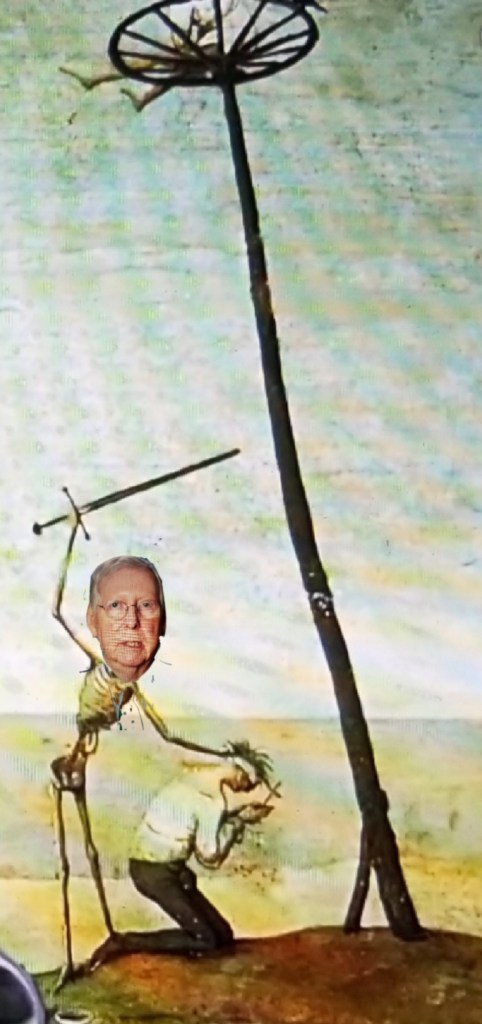
My father’s skeleton has been quiet, outside of remarks he made over the course of a few months, a couple of years ago. Those unexpected conversations with my father’s skeleton often had moments of real surprise for me, as if I really was hearing things for the first time, things my father would have said if that conversation the last night of his life had continued. Somehow I knew that it wasn’t merely my imagination conjuring these responses, they made organic sense to be coming from my father’s now wiser skeleton.

If the voices of my father’s parents, the ancestors he never saw, ever spoke to him, or cried out to him, I cannot say. He rarely spoke of either of his parents, and if he did, it was only to comment that they should rest in peace. If the murdered souls in that unlocatable marsh near Pinsk could call out to me, it would be in a language I can’t understand. The closest I can come to imagining them is the few of them I knew, and the lessons of those lives are the stories I am interested in telling now, before the clock runs out on my time to tell them — before the next personal extinction arrives.


Pandemic Learning

This worldwide outbreak of an incurable disease is disorienting. Nobody alive has any living experience with the last one, which was over a hundred years ago. You’d have to be 110 to remember much, and little was known back then, except, in hindsight, that a deliberate lack of good information increased the spread of the deadly plague. So today we are are trying to learn, slowly, how to operate during this hellish time of social isolation against the backdrop of a disease that has killed over 130,000 of us here in the United States of America so far. Here is something I learned yesterday that seems useful.

Get up every so often and move for five or ten minutes, throughout the day. It actually makes you feel better than sitting around for hours at a stretch.

I have a fitbit pedometer clipped to my shirt. I try to get my 10,000 steps a day and come pretty close most days. I walk after the sun goes down, since I’ve had numerous skin cancers scalpeled off my nose. I walk my five miles during the coolest time of the summer day. This little pedometer keeps track of another stat: active minutes and when you are logging them. Here is what I learned.

One of the bits of data you get at the end of the week is how many hours, during the average person’s 9 active hours per day, you have moved at least 250 steps. That’s a walk of three or four minutes. I consistently score 2 of 9 hours daily, correlating with my evening walks. That means for 7 hours of the day, I am sedentary, for no real reason except inertia.

I have been feeling a lack of energy lately, a certain resignation to everything stagnant in my life, powerless against every powerfully destructive force we are up against, a wave of futility kept washing over me. I write, read and watched news clips but I am constantly distracted, seeking distraction during my distractions. I took no joy in drawing, practicing calligraphy, playing the guitar, hadn’t picked up a ukulele in days. Yesterday it hit me: take a little walk.

I went around the block, then down the street, strolled for ten minutes or so. Came back up to the computer and continued to brood. An hour later, back down, around the block, sat on a bench. I’m in an area where there are few people on the street, so I carry a mask that I slip on to avoid infecting anybody I see approaching, though it is unlikely I have this sneaky disease that can be spread by people with no symptoms.

These little bursts of light exercise really seem to help, even just a little. A little bit of help is nothing to sneeze at when you’re feeling helpless.

I’m going to put my shoes on and walk for a few minutes now, if you will please excuse me. I highly recommend it (walking and excusing me, both).

Why Isn’t Every Democrat in America Saying These Things now?

contrast these humane views of our history, our present and our future with these wildly applauded, incoherent phrases:


We have to cherish our past. We have to cherish good or bad. We have to understand our past. We have to understand our history. Because if we don’t know our history, it could all happen again. We have to know our history.

— President Donald J. Trump June 23, 2020

source

Book of Friedman (8)

Friedman once accused me of using my friends as lab rats, making them unwitting participants in my lifelong psychological experiments. All of us here are lab rats, to some extent, as we can see by looking around at the peculiar setup we find ourselves in. Most of us, as we live and learn, calibrate the amount of grief we are prepared to accept from those closest to us in this ongoing, partially voluntary, experiment.

Since this giant and supremely predictable lab mouse Mark is no longer with us, I am drafting him to stand in for all those who, by their often self-destructive actions, give the rest of us clues and insights into why we act the way we do. In the end I can see that Mark’s tragedy was set in motion by the emotional challenge we all face: the eternal mammalian need for love in a world where everyone dies in the end. Mark’s painful life was ruled by his inability to find and return the love he needed to thrive. It’s a kind way to put it, perhaps, in the case of a supremely self-centered rodent who could never accept the love he needed (none was ever perfect enough, sadly), but I can now see clearly that his doomed quest to love and be loved shaped his painful life nonetheless.

After I told a friend part of a long, sad story of a badly frayed old friendship, languishing on a ventilator, she sent me one of her longtime psychiatrist’s rules. Rule Twelve reads:

A lesson is repeated until it is learned.  A lesson will be presented to you in various forms until you have learned it.  When you have learned it, you can then go on to the next lesson.

I can see quite clearly now, in light of this rule, that I spent my early teens into my thirties (and sometimes much later– as the recent case of my old friend X illustrates) facing the same unlearned lesson. I repeated the same primal scenes over and over with a cast of characters, dear friends all, who were uncannily like my difficult, defensive father in psychological make-up. In the individual cases, I was eventually able to see the ongoing harm these relationships caused. The pattern was much harder to see, and only became clear when I found myself with my back against the wall. Like Dr. House says: the lesson will be repeated until learned..

X is about the last of these stand-in for my father left in my life, and our friendship is literally hanging by a thread, there may well not be any way to salvage it (we’ll see how strong his expressed desire to fix this comatose friendship really is — see rule 13 anecdote, below) but at one time there were quite a few of these Irv stand-ins among my closest friends. A kind of intimate fifth column, undermining my progress by repeating that an angry person like me is incapable of overcoming the reflex to act out of temper, no matter what we might think. No matter how many times we may have believed we’ve demonstrated our progress.   

The lesson I needed to learn, and kept having to repeat until I began to learn it, was that somebody who is smart, and funny, and sometimes kind, but who often doesn’t listen and insists on blaming you for any conflict, is an unhealthy person to be around.  Amazing how many times I had to live through the identical storyline until I started learning to recognize the signs and take action earlier and earlier. In case after case I learned where the line was when things became intolerable and how to protect myself by acting contrary to how my programming (and I was programmed by this very type, mind you) had taught me to react.   Each time I was unable to see the mechanism, until some flare-up made it painful enough to see, bad enough for me to cut ties.   

Over the years I began to see the actual mechanism at work, always very, very similar in its operation, yet I couldn’t figure out how to get past the constant traps set by this brilliantly insane type.   Manipulative, able to convince you they really cared about you — inwardly angry and able to express it as well-camouflaged, perfectly deniable hostility (virtually all of these people were very smart, like my father was, and most also witty, in a sardonic way that could be used as a weapon, or to disarm). Part of the genius of this type is their ability to make you believe that you must be crazy, oversensitive, at fault for any ugliness that might crop up. 

The gradual learning I had with these types (virtually all of them gone from my life now) may have culminated in this one last lesson with my longtime friend now.  I say that knowing that no progress is permanent, that we always take steps backwards and forwards. In the case of X, a guy I’ve known since we were kids, I have been able to lay out the syndrome in granular detail — not only for him, but for his girlfriend, who heroically tried to make peace, for Sekhnet and for myself.  X continues to express bewilderment that I seem to have been so hurt by his mistreatment, but the two women and I can now view things with clarity.  

The things that killed our friendship, step by step, are literally there on the table, in black and white, for anybody with the ability to read to follow.   I now know the workings of the incredibly subtle (at the same time incredibly crude)  game I am up against better than I know almost anything.  In every case of a “last straw”, the final proof is only the latest example of a long list of things.  

I had a poignant email from his girlfriend, sentimental, kind, intelligent, asking me to please explain why I cannot accept that X is really trying, that he truly loves me, values our friendship, etc.   Her letter moved me, and I wrote her a long letter back, illuminating exactly how each skillfully veiled, arguably unintended, “fuck you” was constructed, made to look like a gracious statement, or a generous offer.   When I was done writing the letter explaining things to her I felt a surge of energy, of completeness.   

I felt like I’d finally mastered that particular difficult decades-in-the learning lesson.   It was gratifying to know I had set so much of it out so clearly, at last, like I was reciting the lesson, finally learned.   Like I’d completed my Masters Thesis and it had been accepted. When I read Sekh the letter I wrote to X’s mate, the would-be peacemaker,  she understood for the first time that I was not being merely being a “man”, petty, mean, proud, venting anger, manfully exacting revenge for perceived mistreatment, trying to teach him a lesson– I was only making clear exactly what was intolerable to me, the kind of no-quarter argumentativeness I would no longer accept.   

I’d laid out for his girlfriend (as I had previously for him) everything that was toxic in the relationship and recounted his defensive attempts to place his increasing callousness in the context of eternal friendship, his own bewilderment and my constant misunderstanding.  I provided everything needed for her to understand our respective roles in the conflict, how patronizing his ostensibly peacemaking emails had been, couched in polite, seemingly conciliatory language containing repeated instances of clear, snarling, yet subtle “drop deads” (arguably even unconscious on his part).   Felt like I’d graduated, being able to explain it so precisely, and also, never losing my temper while having endured more than a little abuse from X over the course of the last few months.

Mark Friedman was the poster boy for repetition compulsion, for living and reliving the unlearned lessons of his life.  I understand now, thanks to this 12th Rule (A lesson is repeated until it is learned.  A lesson will be presented to you in various forms until you have learned it.  When you have learned it, you can then go on to the next lesson.) that Mark kept trying to learn something by this repetition that he was never able to get any insight into. In the end, I believe, it was his lack of insight into his misery that did him in.

How many years can one perform the same sickeningly familiar three act tragedy over and over and over, new cast each time, identical, infernal dramatic arc?   Act one: great excitement!  amazing new person, or idea, or program, nothing like it — thrilling, life changing!   Act two; ominous cracks begin to appear, imperfections, warning signs.   Act three: violent reprisal against Mark, anger, betrayal, repudiation.   

It depressed me to hear this same story a hundred times over the years.  Finally could take it no more — plus, our friendship was the same airless drama, only the longest running version of it and Act Two was being endlessly drawn out.   In the end, he never learned any lesson from his predictable misery, died a wealthy man, completely alone, having alienated virtually everyone he ever knew.

Which brings us to Rule 13, a reminder that even an asshole, if he is motivated, is not doomed to be an asshole. It also reminds us to be kind, whenever we can:

People always do the best they can.  If they are doing poorly, it is because they have not learned the lessons that will enable them to do better.

This was a big lesson I was fortunate to learn shortly before I got the sudden news that my father was dying.   A parent is a different case than a friend — my close relationships with all those friends who stood in for my father were attempts to learn the lessons I needed to be able to work out with my father without it being total war (my dad generally insisted on total war).  I had a breakthrough in psychoanalysis maybe two months before Irv suddenly found himself on his death bed with a few days left to live.   

The timing of my psychological breakthrough was very lucky.  I’d come to realize, truly, that he had not been able to do any better than he did — the truly horrible abuse he’d suffered as a baby and throughout his childhood had given him a lifelong emotional disability that prevented him from being able to do the painful work necessary to not be that way.  He did not believe anything he did or might do could change anything for him — or for anybody else, for that matter.   What he did as a father, while often not what a child might wish for, was the best he was capable of. 

That revelation– that he was sadly, truly unable to do better — allowed me to let go of a lot of the anger I had toward him.  I came to this when I digested how atrociously he’d been abused as a young person.  As he was dying he was full of regrets, I was able to keep sincerely reassuring him that he’d done the best he knew how, that he could not have done better.  It was a small reassurance for him — his main efforts before he died were expressing his many painful regrets. Without the insight that he’d truly done the best he was capable of, I could not have been as open with him as I was. He would not have been able to unburden himself the way he did if I hadn’t been hearing him with so little judgment in that hospital room.   

That is speaking of my father, the rare relationship where it is almost always worth the exertion to try to heal.   A friend, X for example, who does the best he can but simply can’t hear — because of lack of a role model for how it’s done, or out of an excess of myopic self-regard, or competitive mania, or whatever reason  — I won’t be around to comfort him on his deathbed as he expresses his regrets.   I don’t owe it to X, as I didn’t owe it to Mark, though I felt I should try to give it to my father, to make his passing easier.   It was a wonderful gift to both of us that I was in a position to hear him, and he to feel heard. These, rules 12 and 13, are two excellent, important life lessons to digest and put to use.   

Here they are again, for your consideration:

12: A lesson is repeated until it is learned.  A lesson will be presented to you in various forms until you have learned it.  When you have learned it, you can then go on to the next lesson.

13: People always do the best they can.  If they are doing poorly, it is because they have not learned the lessons that will enable them to do better.

Here is her doctor’s Rule 8, always well-worth recalling, if we are to be as merciful to ourselves (and others) as possible:

There are no mistakes, only lessons.  Growth is a process of trial and error, of experimentation.  The “failed” experiments are as much a part of the process as the experiment that ultimately “works.”

He always shows his true colors!

One thing you have to say for our compulsively lying president, he manages to always show what he really believes, even when he tries not to. It’s a kind of involuntarily brutal honesty, if you will.

Right after he had Bill Barr viciously clear out peaceful protesters so he could walk to a nearby church to glare and hold up a Bible, the mayor of DC had workers paint BLACK LIVES MATTER in giant yellow letters on the street where he staged his religious tableau. Mayor Muriel Bowser also renamed the street Trump had walked on “Black Lives Matter Plaza”.

The other day NYC mayor Bill de Blasio announced that NYC would be painting a gigantic BLACK LIVES MATTER on Fifth Avenue in front of Trump Tower. The president was quick to respond with this clever, soul-revealing line, delivered by tweet:

(the mayor) … is going to paint a big, expensive, yellow Black Lives Matter sign on Fifth Avenue, denigrating this luxury Avenue.

You get that word choice, right, from the man with the vocabulary of the average fifth grader (this is the guy with the “best words” — the one who parsed a legal requirement recently as “hortatory rather than mandatory” as someone told him to do) deNIGrating, you get it? de-NIG-grating. Clever, eh?

Just in case you missed how he really feels, he added:

Maybe our GREAT Police, who have been neutralized and scorned by a mayor who hates & disrespects them, won’t let this symbol of hate be affixed to New York’s greatest street.

BLACK LIVES MATTER– symbol of hate. Statue of generals who took up arms in the bloody insurrection against our nation — symbol of our glorious history. After all, as the president said (in the lead up to his death cult vigil in front of Mount Rushmore tomorrow, to celebrate the signing of the Declaration of Independence):

We have to cherish our past. We have to cherish good or bad. We have to understand our past. We have to understand our history. Because if we don’t know our history, it could all happen again. We have to know our history.

Greatest president EVER, yo. Certainly the most very stable genius ever to rule from the Oval Office.

Follow the Judicial Logic, if you can

A few last words on Judge Rao’s ideologically-driven decision on Flynn’s emergency application for immediate dismissal of the case against him. I can’t let this one go, because, as Federalist Society spokesman and former Boeing lawyer Judge J. Michael Luttig wrote in the NY Times the other day, this case is “the most consequential political constitutional case in recent memory.” True dat.

Judge Rao’s legally legless 2-1 decision takes a historically destructive position, like the most notorious of our cases. In this “not unusual” case she rules that the requirements of the law must yield to even the most seemingly irrational, partisan demands of a powerful president.

See if you can follow the logic of former law professor Noemi Rao (appointed by the current president to fill the seat left vacant when B. Kavanuagh was promoted):

Whatever the precise scope of Rule 48’s “leave of court” requirement [court decides when and how to dismiss case — ed.], this is plainly not the rare case where further judicial inquiry is warranted.

Nothing rare here, “plainly not”? Defendant admits guilt and then DOJ, two years later decides that what he pleaded guilty to was not actually a crime? Is there one other case in this category in anyone’s memory?

Because legal errors ordinarily may be corrected on appeal, a writ of mandamus is proper only if there is “no other adequate means to attain … relief.” Cheney, 542 U.S. at 380. Although “an abstract concern with the separation of powers,” does not rise to the level of an irreparable injury, In re Al Nashiri, 791 F.3d 71, 79–81 (D.C. Cir. 2015), we have found the requisite harm as a matter of course when a party alleges the district court’s action usurps a specific executive power. See In re Cheney, 406 F.3d 723, 731 (D.C. Cir. 2005) (en banc); Fokker Servs., 818 F.3d at 749; Cobell v. Norton,
334 F.3d 1128, 1139–40 (D.C. Cir. 2003); In re Sealed Case No. 98-3077, 151 F.3d 1059, 1065–66 (D.C. Cir. 1998).

In this case, the district court’s actions will result in specific harms to the exercise of the Executive Branch’s exclusive prosecutorial power. The contemplated proceedings would likely require the Executive to reveal the internal deliberative process behind its exercise of prosecutorial discretion, interfering with the Article II charging authority. Newman, 382 F.2d at 481 (citing United States v. Cox, 342 F.2d 167, 171 (5th Cir. 1965)). Thus, the district court’s appointment of the amicus and demonstrated intent to
scrutinize the reasoning and motives of the Department of Justice constitute irreparable harms that cannot be remedied on appeal.

So because Flynn’s lawyer, in asking for this rare, emergency relief, alleges that harm to the Executive Branch will be grievous and irredeemable, we must grant a no appeal decision to Flynn, no matter what the other facts of this highly unusual case?

We must also assure ourselves that issuance of the writ “is appropriate under the circumstances.” Cheney, 542 U.S. at 381. The circumstances of this case demonstrate that mandamus is appropriate to prevent the judicial usurpation of executive power.

Here the harm alleged, “usurpation of executive power,” is to the government, not to Flynn, the party making the emergency application for extraordinary relief. Flynn, the one seeking the emergency decree (with the legal support of Mitch McConnell, Lindsey Graham, Ted Cruz, et al) has an appeal available, if the trial judge tries to do something beyond the scope of the court. That fact alone rules out the extraordinary relief Judge Rao grants to Flynn.

Finally, each of our three coequal branches should be encouraged to self-correct when it errs. If evidence comes to light calling into question the integrity or purpose of an underlying criminal investigation, the Executive Branch must have the authority to decide that further prosecution is not in
the interest of justice.

This president, in particular, has demonstrated his readiness to self-correct. Obviously. He does this by doubling down, attacking critics, firing whistleblowers and watchdogs, vilifying them as disloyal traitors, stupid idiots, sick, dangerous, crooked, little, insane, smelly, “dumb as a bag of rocks,” while obstructing all investigations and so forth. Like any self-correcting branch of government will do.

Because this is not the unusual case where a more searching inquiry is justified, and because there is no adequate remedy for the intrusion on “the Executive’s long-settled primacy over charging decisions,” Fokker Servs., 818 F.3d at 743, we grant the petition for mandamus in part and order the
district court to grant the government’s Rule 48(a) motion to dismiss the charges against Flynn.

Not the unusual case? Judge Rao rules for the benefit of a party not in court, the Executive Branch — that alone is kind of unusual. Flynn has the usual right of appeal, which, again, means he is not eligible for the extraordinary legal remedy of mandamus. So what, reasons Judge Rao, if the moving party has no right to what the court seeks to grant, what about POOR UNFAIRLY PERSECUTED MR. TRUMP?!!! Poor Mr. Barr!!!

Not the unusual case, you dig. Nothing to see here! Fokker! Fokker!!!

I really wanted to end there, but this bit from her response to the excellent and legally impeccable dissent is worth reading:

First, the dissent glosses over the presumption of regularity to which the Executive is entitled in the exercise of its prosecutorial discretion. While the district court is not a “rubber stamp” when considering whether to grant “leave of court” under Rule 48, Ammidown, 497 F.2d at 622, any judicial inquiry is strictly bounded by the presumption of regularity, and the presumption is overcome only in extraordinary cases and by “clear evidence to the contrary,” Armstrong, 517 U.S. at 464.

Here, while forcing a judge to “rubber stamp” a motion he doesn’t like the smell of, there will be, pursuant to the writ of mandamus, no clear evidence of anything, outside of the government’s sudden, irrefutable insistence that a guilty man committed no triable crime, will be permitted. Just like in Trump’s impeachment– no evidence allowed! No hearing whatsoever will be allowed prior to “leave of the court” to dismiss the case as ordered by a superior court. How you like that Catch-22?

Not the unusual case, you dig. Nothing to see here! Fokker! Fokker!!!