The Obligation to Lie

The obligation to not contest a lie, or more usually a series of lies, is a tough proposition for somebody who prefers a frank back and forth to dishonesty or silence. Speak honestly, listen openly, let the conversation go where it goes, sometimes learn something important; that has always been my attitude. Given the choice between believing something that can be confirmed by fact and life experience and another thing that can only be confirmed by lying, I’ll always choose the first.

Sometimes in this life you will be obliged, in order to keep the peace, or to keep a troubled relationship alive, to agree that certain touchy subjects, including lying, will never be discussed in any detail. An agreement to disagree (sad phrase) about what is real and what is an invention is a resolve to leave things unresolved and not touch anything that may help solve a problem and strengthen a relationship. It is a mutual dishonesty pact.

Families are famous for entering into these kinds of understandings, often to protect someone from shame. Factions arise, those who defend a liar’s right not to be shamed and those who feel everyone would be better served by honesty, a thing once called “the best policy”. There are both practical and moral stances taken by each faction.

For the defenders of the liar’s right to be protected from the shame that caused the lie, the idea is that concealing the shame behind a lie protects everyone. The moral stance is that it is always wrong, no matter what, to expose someone to possible shame.

The other faction believes that shame can never be overcome by allowing an endless lie to prevail, in the name of covering the shame. Also, crucially, a lie serves nobody’s interest but the liar’s. The moral position is that it’s wrong to oblige someone else to lie, requiring a choice between dishonesty and silence, even to cover someone else’s shame.

Yes, it’s wrong to shame someone, even if they lie compulsively. Shaming someone for lying to conceal their shame only compounds the problem. Yes, it’s wrong to allow a series of lies to obliterate the truth. I’m not even thinking of our politics in the morally divided USA at the moment, but the constant doubling, tripling and quadrupling down on proven falsehoods offers a good snapshot of the problem with repeated lies that become the truth.

Your family member’s husband has abused his first wife, and cheated on her, prior to their ugly divorce. Shameful. Unspeakable. The simplest answer for his adult kids of the second marriage: he was not even married before, you fucking liar!

A lie can always be concocted to cover shame, even if it is a ridiculous lie, even if its revelation as a lie is inevitable. I pretend to go to work every day and every Friday I bring my paycheck, in cash, back to the wife. Who would imagine my wife would find the bill for my dead father’s credit cards I maxed out to bring her my fake paychecks every week when I was too depressed and desperate to work for a year? I rented a PO Box so those bills would never come to the house, I had no intention of ever paying them, why did I leave one in my pants pocket for the wife to find when she did the laundry? Pure bad fucking luck in a life that never gave me a fucking chance. Nothing that a strong agreement never to mention it again won’t fix.

We have the most prolific and litigious liar in American history, our recently defeated president, with his eternal 39% who love him unconditionally, find him a charismatic, daring, no bullshit teller of truth the rest of the politicians are too cowardly and hypocritical to say out loud. You will never change their firm belief that he constantly lies to defend a much higher truth than the one eggheads feebly claim exists. That truth is (insert truth here) and if you don’t like it why don’t we let the guns in the street decide who is right and who is fucking dead?

If you don’t want to argue with a liar, or contest the compulsive liar’s right to lie whenever he feels cornered, you can agree not to talk about the lies. That agreement will only get you so far, though — and it usually comes with a cost. It is not the kind of satisfying agreement one comes to with somebody after an honest exchange of views, after you actually understand more about the other person’s perspective. It is, at best, a kind of 39% agreement, like the “historically unpopular” Joe Biden’s media-touted rapidly slipping poll numbers, which are now about the same as Trump’s average approval numbers across four years of his glorious reign.
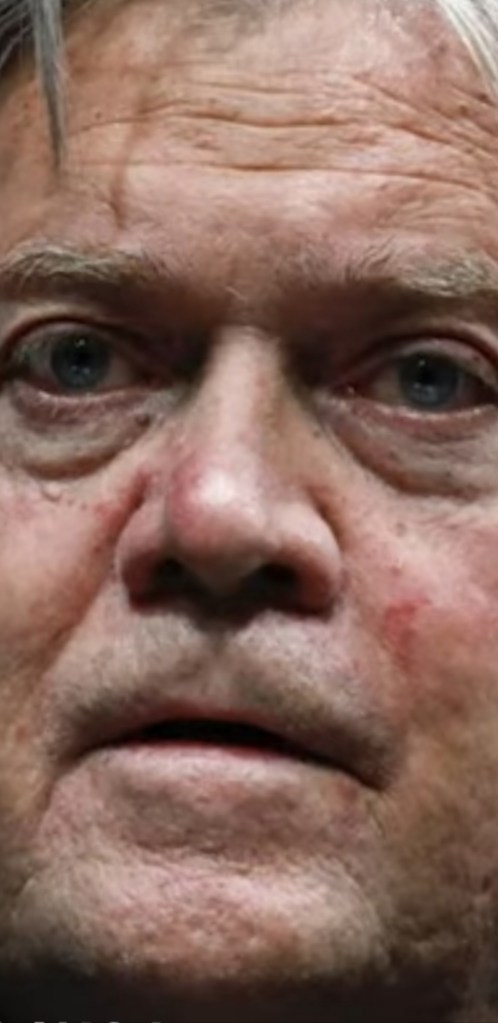
Trump’s lizard brain

Sadly this brain of his, the former chief strategist for the former president, worked for his billionaire patron Robert Mercer’s first and second choices in 2016, before throwing his support behind Lyin’ Ted and finally the last right-winger standing, Honest Donnie. Mercer also provided the GOP nominee with Kelleyanne Conway. The rest, as they say, is history.

The former president, always determined to be the smartest man in the room (he described this as part of his business genius while campaigning at wild rallies — surround yourself with loyal idiots to look smart) soon got sick of people giving Bannon credit for Trump’s victories. Trumplethinskin [1] fired Sloppy Steve a few months into his administration.

When it came time to overturn his election loss, Trump turned to a true strategist of chaos, anarchy and autocracy. You need a ruthless pragmatist like that in your War Room at the Willard Hotel as you implement your audacious plan and unleash your enraged mob.

Clearly, an insatiably ravenous reptile needs a cagey brain.

[1] tip of the cap to Stephanie Miller

You Are the Object of a Secret Extraction Operation

The brilliant Shoshana Zuboff wrote an essay published by the New York Times the other day, You Are the Object of A Secret Extraction Operation. It is worth reading and hopefully my “gift” link will allow you to read it on the NY Times website without being blocked by a pay wall. The essay begins:

Facebook is not just any corporation. It reached trillion-dollar status in a single decade by applying the logic of what I call surveillance capitalism — an economic system built on the secret extraction and manipulation of human data — to its vision of connecting the entire world. Facebook and other leading surveillance capitalist corporations now control information flows and communication infrastructures across the world.

These infrastructures are critical to the possibility of a democratic society, yet our democracies have allowed these companies to own, operate and mediate our information spaces unconstrained by public law. The result has been a hidden revolution in how information is produced, circulated and acted upon. A parade of revelations since 2016, amplified by the whistle-blower Frances Haugen’s documentation and personal testimony, bears witness to the consequences of this revolution.

The world’s liberal democracies now confront a tragedy of the “un-commons.” Information spaces that people assume to be public are strictly ruled by private commercial interests for maximum profit. The internet as a self-regulating market has been revealed as a failed experiment. Surveillance capitalism leaves a trail of social wreckage in its wake: the wholesale destruction of privacy, the intensification of social inequality, the poisoning of social discourse with defactualized information, the demolition of social norms and the weakening of democratic institutions.

These social harms are not random. They are tightly coupled effects of evolving economic operations. Each harm paves the way for the next and is dependent on what went before.

There is no way to escape the machine systems that surveil us, whether we are shopping, driving or walking in the park. All roads to economic and social participation now lead through surveillance capitalism’s profit-maximizing institutional terrain, a condition that has intensified during nearly two years of global plague.

Will Facebook’s digital violence finally trigger our commitment to take back the “un-commons”? Will we confront the fundamental but long ignored questions of an information civilization: How should we organize and govern the information and communication spaces of the digital century in ways that sustain and advance democratic values and principles?

source

Corporate lawyers like John Roberts (in his previous corporate gig) made formerly voidable one-sided “contracts of adhesion” (take it or leave it, chump) as good as gold in all contracts between individuals and the corporations who require our agreement to their terms of service before we may use those services. It works even for expensive products we buy, like $1,000 smart phones, our use of our own property is dictated by terms that advantage only the corporations providing these miraculous services. As Roberts clairvoyantly saw in crafting his innovative, popular, now standard arbitration clause (by clicking this button you agree to waive the right to sue us in court, no matter what, and consent to pay 50% of the cost of binding arbitration) in the contest for profits, every bit of deference must go to the canny corporation and let the unsophisticated, dumb-ass buyer beware.

As Zuboff shows, in her groundbreaking The Age of Surveillance Capitalism; The Fight for a Human Future At the New Frontier of Power, and again in this essay, the escalating worldwide harm done by the new keepers of the public commons, social media giants, must be mitigated and regulated by democratic lawmakers to protect democracy from the wild, self-regulated pursuit of vast personal fortunes at the expense of all non-market based values.

Mark Zuckerberg and Sheryl Sandberg, two poster children for profit over everything (profit uber alles) constantly defend their right to regulate themselves and make as much money as possible while doing so. It is not their job to judge the credulous stupidity of the public when making business decisions. After all, who in their right mind would turn down a fifty million dollar ad buy, even if it was an ad to spread an incendiary lie about a stolen election, a calculated lie debunked in dozens of lawsuits, and one that would predictably lead to outrage and possibly violence? That’s strictly a business decision, something to which the Court has always granted great deference, it’s simply The Business Judgement Rule — courts won’t interfere in corporate business decisions if there is any theoretically plausible money making rationale for them.

Zuckerberg told his executives, prior to the 2016 election (when Hillary was making noises about regulating giants like Facebook) that any government attempt to regulate Facebook would be such an “existential threat” that you have to stand on principle, you “go to the mat”, you go to the fucking mat to defend your right to double and triple your hundred billion dollar personal fortune, sue the government, do whatever needs to be done. The principle? Nothing wrong with greed, you judgmental fucking losers.

Perhaps Zuckerberg is right. 99% of the world is a bunch of crying, bitter, jealous, judgmental fucking losers, doomed to die inglorious asshole deaths after wasted lives spent envying people like him. It’s people like him, the true outliers, visionaries, men of the future, who should, by force of meritocracy and the will of the Free Market, decide what is best for the world. Who would know better than a maladjusted nerd who had become, at a precocious age, one of the richest men in human history?


Fascist-style Populism

Populism is a political appeal to what is popular among the population, and can be of the left or the right. It seems, most usually, and especially here in the US of A, it is harnessed by the right, as in the Koch-funded “spontaneous” “grass roots” Populist Tea Party, a national movement that appeared to spring up over night across the country, in a phenomenon gawked at by mass media as strong proof of a massive popular uprising against the self-proclaimed Hope and Change president, and swept a host of unapologetically angry Tea Party radicals into Congress to transform the Republican party and the US government. What we see on TV, and via social media, becomes our reality.

Just off hand, you might think that populism is good for democracy, the will of the people expressed through a mass movement. It can go either way. Most often populist movements are taken over by demagogues. The ideas are already popular — the government is a bunch of clueless elitist eggheads who don’t share our values. deciding, against our will, what we actually want! Harness this anger and you are a populist. When times are tough, populism swings right, toward authoritarianism. Here is an insightful bit from a discussion with David Sirota on a recent Deconstructed podcast:

So, in other words, human beings being thrown out of their homes, were the foam on the runway for the banks, which really tells you what you need to know about what the overall policy goal of the Obama administration was. They made a decision that they had to save Wall Street which, not incidentally, had given the most amount of money to Barack Obama’s campaign in the history of presidential politics. They made the decision that to save the economy, they had to first and foremost save Wall Street.

Now, maybe you could say it’s not corruption. Maybe you say it’s ideology. Maybe you just say it’s a principled disagreement or a principled belief. And there’s one phrase that that Geithner, I believe it was Geithner, who said: That’s how we saved the economy, but lost the country.

And what’s important to know is how historically anomalous that is from the Democratic Party itself. FDR, not that he was a perfect president, but he came in during an economic crisis. And there’s a lot of evidence — a lot of his quotes, a lot of the things he said — that he understood that if there was going to be a bailout or investments, it had to be bottom up. And he understood that it had to be bottom up for three reasons: It was morally right, people were starving; it was economically a better policy; and then he also made all sorts of statements, saying that this is the way to stop the rise of fascism — that if you do not help the working class in a crisis, then you are creating the conditions for authoritarians and fascists to take advantage of the desperation. And fascism was on the rise in the Great Depression here in the United States!

And so what 2009-2010 leading into the Trump-era suggests is that FDR was right, because the Democrats, the modern version of the Democrats, didn’t do what FDR did. And it ended up creating the conditions for Trump.

source

FDR, not that he was a perfect president, but he came in during an economic crisis. And there’s a lot of evidence — a lot of his quotes, a lot of the things he said — that he understood that if there was going to be a bailout or investments, it had to be bottom up. And he understood that it had to be bottom up for three reasons: It was morally right, people were starving; it was economically a better policy; and then he also made all sorts of statements, saying that this is the way to stop the rise of fascism — that if you do not help the working class in a crisis, then you are creating the conditions for authoritarians and fascists to take advantage of the desperation. And fascism was on the rise in the Great Depression here in the United States!

Think of the enraged army of MAGA populists across the country who now routinely call to violently threaten Republican legislators who “disloyally” voted for an uncontroversial bipartisan infrastructure bill they negotiated, a bill that will benefit their communities, a long overdue allocation of resources for the mutual good — and the good of US big business, by the way — that Trump touted when he was president (though he was too busy with other things to do anything about it). According to our right-wing populists, all we really need are strictly constitutional gun laws that respect our sacred Second Amendment right to bring our non-regulated guns wherever we want, as part of goddamned political speech. If you think that’s a problem, cucks, suck lead.

This kind of enraged populism is the necessary precondition for mob rule and autocracy.

Mr. Biden? Mr. Garland? Congress? Senate supporters of the sacred filibuster over the right to vote?

It’s Common Sense

There’s a real reason that Trump and people like him consider journalists the enemy of the people. Everything we know about the planning, funding and execution of the Stop the Steal riot at the Capitol comes from journalists. You can stonewall Congress without consequence because the courts can be used that way in this country by wealthy, powerful people. But the fucking press … the lying media… der lugenpresse! … enemy of the people!

In a new tape recording of an interview with Trump, released by journalist Johnathan Karl, the mad former president says it’s “common sense” that people who believe there was massive election fraud and Pence refused to do anything about it would rightfully want to lynch the motherfucker.

Shades of Christian Dominionist provocateur William Pelham “Bagpiper Bill” Barr with his sneering “it’s obvious!” when asked for proof that mail-in voting would lead to massive electoral fraud by antifa, enraged colored people and others who unaccountably hate authoritarianism.

What is truly common sense is that when dealing with a bully who has always backed down whenever confronted with a real counterthreat (elevating Jeffrey Clark to AG, quitting GOP, etc.), to not confront him is to empower a sadist without boundaries to take a shit in your mouth and tell you to swallow.

Bon appétit, hesitant Democrats.

Spoiler from Bezos

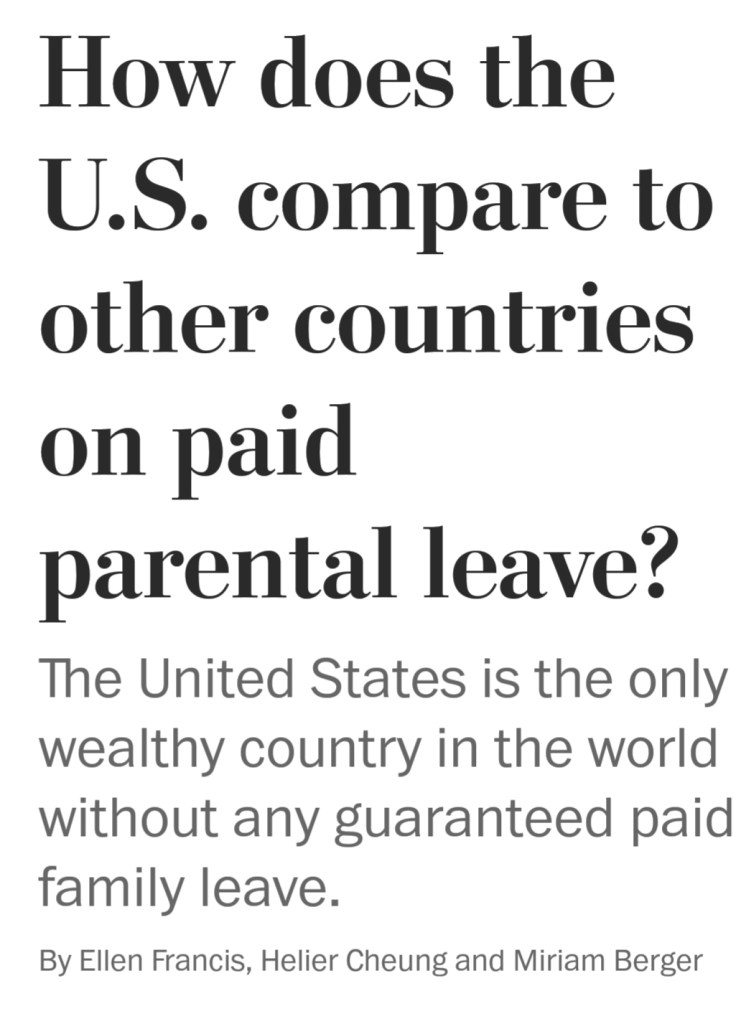
You’ve got to love the frankness of this headline question curtly answered in the short blurb below:

Just one more reason certain corporate donors love, honor and host fundraisers for unlovable, dishonorable cartoon coal tycoon/obstructionist Joe Manchin III.

Fair and balanced bipartisanship

Trumpists must not allow anyone in their Congressional cohort to break ranks to vote for ANY bipartisan bill that could politically help the illegitimate, lying, wildly unpopular anti-bipartisan Joe Biden. Purge and punish, it’s the Trump way.

Here is an expert on those things, with an unapologetically opinionated entertainment editorial.

Here’s a version of the same story by the Enemy of the People, the New York Times:

WASHINGTON — One caller instructed Representative Adam Kinzinger of Illinois to slit his wrists and “rot in hell.” Another hoped Representative Don Bacon of Nebraska would slip and fall down a staircase. The office of Representative Nicole Malliotakis of New York has been inundated with angry messages tagging her as a “traitor.”

Investing in the nation’s roads and bridges was once considered one of the last realms of bipartisanship in Congress, and President Biden’s infrastructure bill drew ample support over the summer from Republicans in the Senate. But in the days since 13 House Republicans broke with their party leaders and voted for the $1 trillion legislation last week, they have been flooded by menacing messages from voters — and even some of their own colleagues — who regard their votes as a betrayal.

The vicious reaction to the passage of the bill, which was negotiated by a group of Republicans and Democrats determined to deliver on a bipartisan priority, reflects how deeply polarization has seeped into the political discourse within the Republican Party, making even the most uncontroversial legislation a potentially toxic vote.

https://www.nytimes.com/2021/11/10/us/politics/republicans-backlash-infrastructure-bill.html