A Ticklish Personal Matter

When attacked we can fight, take flight or do any number of other things.  I have been trying in recent years to follow the principle of non-harm, Ahimsa, approaching others openly and directly, and without violence.    I don’t mean to whine, but this is sometimes a tricky road in a culture where every rugged manjack among us is expected to compete and a shove, a knee or sharp elbow is perfectly permissible in this contact sport not intended for sissies, weaklings or peaceniks.   It is a particularly hard road when, in a moment of misguided bonhomie or extreme peevishness, a friend feels free to get some blindside shots in.

In my hubris, holding my vow of peacefulness in absurdly high regard, I made a mistake, I realize to my great misery today, expecting that one kind of animal, given the chance to be heard, to listen, to reflect, could turn into another kind of animal, somehow.  I was hoping, in the face of escalating bad experiences with a troubled, reflexively defensive old friend (and we all have our troubles) that we could somehow work out the worst of our conflict and have a more honest, mutual relationship going forward.  I was actually hoping for a miracle, rare as those things are.  It was a foolish hope, no matter how laudable and high-minded the attempt to save a badly damaged old friendship might have seemed.

Writing is the only tool I’ve developed for thinking and working through this kind of painful situation — being hurt, receiving an extracted, pro forma apology  (my friend insisted there was an implied apology already given when he said, after my long explanation, that he now understood how I felt) and then having the ante immediately raised by more of the same mistreatment that was already apologized for, ad nauseam.  The hurtful behavior comes down to an uncontrollable reflex to ignore, disregard or minimize the feelings of others, seeing only your own feelings. The raw feelings in others often aroused by your own words and deeds, you truly feel have nothing to do with you or anything you might have done.

Some people seem wired to be incapable of not doubling down when they feel they’ve lost a poker hand.  Admitting fault, apologizing, being humble, really listening to another person’s point of view — all losing hands in the eyes of the winners of our culture.   Being on the other end of things, a loser, I need to finish rinsing the fecal matter out of the Hawaiian shirt I was wearing yesterday (bad accidental spraying of projectile diarrhea) and try to get on with my regularly scheduled unpaid work, progressing well, in spite of the odds.    (here)

“I apologized to you, but that apparently wasn’t enough for you” he said chidingly to begin our reconciliation talks.   He appeared sincerely irked that his apology, sincere as he could make it, did not seem to have been enough for his unreasonably demanding old friend.   All he’d really done was accuse me of malice or extreme stupidity and hold me personally responsible for a catastrophe in his life (he later allowed that he’d been wrong to do that, but I have to understand the stress he was under at the time), put me in an unfair situation no friend should ever put another person in, and vent angrily at me after I’d done my best to be a supportive friend. He seemed genuinely aggrieved that his apology had seemingly made no difference to me at all.  Not the  conversational opening, or attitude, I’d hoped for, but I’d try to make the best of it, somehow.   

I pointed out quietly that after that apology the same hurtful behavior has been repeated in each of our recent exchanges.  I told him it appeared he was unable to stop doubling down, seemed poised to keep his streak of controversy going.   I said we should refocus our chat, talk about  the changes that would be needed going forward, in light of the multiple times recently my feelings—

“You want to talk about feelings?  I feel disrespected, traffic jam or no traffic jam, after being very easygoing about our meeting time, you have to admit, I was extremely laid back about our changed meeting time, which you’ll recall was originally 2:00, and which you later agreed would be three pm, and then we didn’t get together until 3:34 pm.   That’s very disrespectful, that long a delay is simply disrespectful on its face, especially on a day when we’re supposed to be having this important conversation you requested.  Of course, things happen, none of us can control a traffic jam, but it was very disrespectful nonetheless.”

Ten minutes later, the same feeling of being disrespected about our delayed meeting time, explained and expressed again, this time half a mile from where we started our walk.  My disrespect of him was becoming a leitmotif.   Shortly after that, maybe a block and a half later, he expressed his feeling of being disrespected again.   The boy can’t help it.   The third time was the charm.    I snarled that he was perfectly right to feel disrespected, I don’t fucking respect him.  I recited the top five reasons why.  Starting with his unfathomable difficulty understanding the emotions raised in others by his need to argue every point, the smaller the better; his indefensible, dependable tone-deafness to the feelings of others.  

A very nervous fellow (he insisted his baseline nervousness is no more than a three, four at most, on a scale of one to ten), he was remarkably calm yesterday, as he pressed on, constantly turning the conversation toward minute, arguably disputable details and away from the larger point:  his reflex to provoke and then wildly defend himself, a tic that needs to be controlled if he expects us, against all odds, to remain friends.  

He was calm and collected and I was on the verge of exploding in anger as he calmly explained, for example, why he is more of an expert on depression and anxiety than I can ever be (and by the way, he definitely does not suffer from anxiety disorder, he told me that categorically)  he had been trying to spare me this.  You see, as an undergraduate forty years ago he worked in a mental hospital, for a year and a half, and had regular briefings from a famous doctor, and therefore, sorry old bean, I didn’t want to pull rank on you and rub your nose in it, but since you brought it up… 

It went on this way for almost an hour.   Note for note, tit for tat, making an equivalence at every turn, true or false as needed, distinguishing, reframing, focusing on a tiny, irrelevant detail at great length, contradicting, insisting, qualifying, comparing, rephrasing, using the passive voice, digressing slightly, sticking a few convoluted points that would have impressed a professional contortionist.  At one point he told me, point blank, when we disagreed about the timing of an unfortunately dashed off email he’d sent — “you’re lying”.   On that issue it turned out, looking at the gmail time stamps later, I was approximately as close to a true recollection as he was.    When I could bear no more of this ceaseless counterproductive cavil I snapped, pointed in the direction of his car and told him to take a walk, get in his fucking car and go home.  We were done, I told him, I was done.  Direct and nonviolent, but direct, and done.  I truly had nothing else to say.   I’d started with nothing to say and now had less than nothing to say.

My display of anger, which I’d managed to resist for almost forty minutes, seemed to give him a lift, odd to say, maybe it was the small moral victory he’d been craving — he became as conciliatory as he knows how to be.  He was relieved to see that I was finally calming down.   He assured me that he was capable of change, was going to change himself, fully intending to, and soon, he was back in therapy again.  He told me he would try to do better at recognizing the signs that he was making me angry, and promised to try to back off when he saw me getting very upset.   I told him it was a bit late to consider a friend’s feelings at that point, once he was already provoking his friend to anger.   He was undaunted, optimistic. “People can change,” he assured me, after his tour de force of immutability and well-fortified neurotic constancy.  

He implied that I was being hard-hearted to insist that an apology must contain a promise about future actions.   There I cannot yield.   It is a crucial component of a healing apology, real ownership of the hurtful thing done, acknowledgement of how that hurtful thing feels, sealed with a credible assurance that the behavior will not be repeated.   He would stand by his apology, although he couldn’t guarantee all of that, since so much of his hostility, if any (he wasn’t going to fall into the trap of stipulating to that) is apparently unconscious and therefore beyond his control, nonetheless I should believe his promise that he is sincerely working on changing himself, to become a better listener, not always provoking, being much less provocative, not that he was admitting he did provoke anyone, it was surely something he was completely unaware of about himself, if I even was right about it, which he had his doubts about, but since I seemed to believe that he was…

We spent a few senseless hours after that, talking in a more or less relaxed manner about a number of more mundane things, and then, as it was close to his bed time, he headed off  shortly after the sun went down.   As we parted, he played the love card, going for a hug.  I gave him one arm and told him that love is more than a word or a feeling, it’s the way you actually treat the people you love.

I am done being a lawyer, and trying to be patient in the face of reflexively defensive, often inept would-be amateur lawyers who insist on their right to keep arguing no matter what.  At least lawyers with the training and experience know, most of the time, when to fucking shut up.

A prayer, then:

Strive to be humble, never haughty,
Seek understanding, not strife    

Attack not, nor shall you counterattack, except to save a life.

When in the wrong, be remorseful, not aggrieved
Be not proud, but meek
Modest, not brazen
seek insight, not vindication,
Listen with your heart, become wise.

talk to your rebbe
friend
he will tell you the same thing

(please rise) 

Betrayal of Confidence

Kind of hard to forgive, I think you’d agree, someone who’d deliberately betray a friend’s confidence in a public forum.  Two weeks ago I wrote, in the context of comparing depression and anxiety, a few sentences that were, unbeknownst to me, exactly this kind of unthinkable betrayal of trust.   My friend wrote:

One thing I would ask of you is to, in the future, keep our conversation to ourselves.   I would certainly never publicly write about you, or any of your troubles.

Today I learned that these are the words he complained of:   

One complaint I’ve long had about one old friend is an inability to remember many of the specific, specifically troubling, details of a difficult discussion we’ve had.  The troubling section of our conversation is erased, like an incriminating tape.   This constant partial erasure appears to be a mechanism of anxiety.

How awful I feel, and how petty.   I wonder if I’m being over-sensitive.


for the curious

I have incorporated several notes I got from two discerning readers in the rewriting of the 3,000 word abstract of my long manuscript about the life and times of my father.  Each note contained a bit of painful truth, and mingled with my own dissatisfaction with the shorter piece.    Kept me up last night, forcing me out of bed to write the first few paragraphs which now begin the rewrite.

Here is the near 4,000 word version, which I believe is somewhat improved.  

clickez ici

A Bit of homemade Fake News

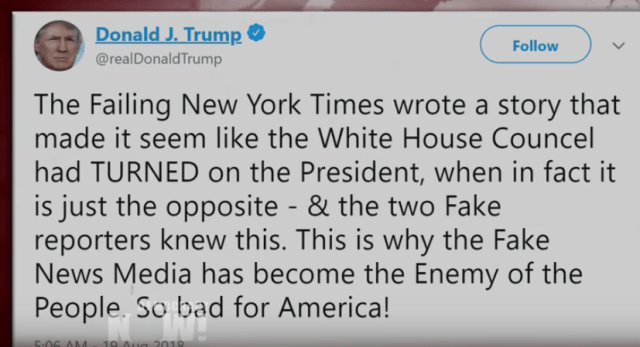
The president recently imposed tariffs on various countries as part of his plan to Make America Great Again.    The jury is still out about whether these trade wars he started will have a disastrous effect or not.   One small bit of news:  after retaliatory tariffs by China caused the price American farmers get for soybeans to plummet, the president vowed to bail out farmers with a $12,000,000,000 emergency government grant like the type used during the Depression to prevent foreclosures on small family farms. [1]  

On the surface, there is a lot of heedless idiocy here, as in many of the president’s angry, hastily implemented policies, which are promulgated largely to stoke the anger and resentment of his angry base.   To fix a problem directly caused by his policy, the president now offers to pay twelve billion dollars of taxpayer money, right after radically slashing taxes for the largest taxpayers — and driving the national deficit steeply toward an even trillion dollars.   Way to make a deal, buddy.

On a level just below the surface, this is business as usual.   Welfare for individuals struggling to survive a poverty lifestyle is frowned on by the radical right (current custodians of the GOP) as socialism, Marxism, a hated vestige of the hated New Deal, a reflection of liberal hatred of American values.   Make them work, make them take urine tests, make them pull themselves up by their own Adidas, let them miss one arbitrary, last-minute face-to-face meeting and –goodbye government tit!   “Welfare” for the wealthiest… well, that’s a little more complicated.

It’s true that “farmer” evokes the image of salt of the earth people working hard to bring forth the bounty of the land.   The farmers who will reap most, if not all, of the $12,000,000,000 the president proposes to give them, probably do not fit this image.  Most American farms today are owned by large corporations.  It is hard to find out who will be the main beneficiaries of this bailout, though I suspect not all of it will go to salt of the earth families battling the earth itself for their livelihood.  

The people who owned slaves and lived in genteel antebellum luxury were invariably called  “Planters”.   They planted nothing themselves, except perhaps the occasional seed in the womb of a good looking chattel they owned.   They were, in one way of looking at them, parasites and monsters, even if everything they did was perfectly legal and morally correct at the time.   After all, the Bible said so, as did the Supreme Court, did they not?

I haven’t spent the additional two minutes to research this, but you are welcome to. [2]   I would wager that the recipients of the bulk of this twelve billion dollar giveaway are the kind of farmers known as “agribusiness”.   Huge tracts of land, owned by corporations, worked by hired hands who are not going to be buying private planes in this lifetime.   Farmers.   Absolutely.   Nothing to see here.

But let’s assume they are all small farmers struggling to keep up with mortgage payments and laying out great sums to grow their crops, their hogs, what have you. [3]  I like what Republican senator Nebraska Ben Sasse had to say about the administration’s trade war: “cutting the legs out from under farmers and White House’s ‘plan’ is to spend $12 billion on gold crutches.”   (source)

Sasse added, gratuitously and unfairly:  “this administration’s tariffs and bailouts aren’t going to make America great again, they’re just going to make it 1929 again.” (The Great Depression began in the U.S. that year.)   (ibid)

Taxpayers for Common Sense, a group that has all the earmarks of a Koch Brother’s front group, was also dismayed, calling the president’s bailout plan “a recipe for disaster that would undo decades of progress toward weaning agriculture from financial dependence on federal subsidies.” (op cit)

Way to go, fellow stable genius from Queens!  Pay no attention to fake news.  Those enemies of the people suck!


[1] The plan will rely in large part on a 1933 program called the Commodity Credit Corporation (CCC), a division of the Agriculture Department created during the Great Depression to provide financial backup for farmers.          source

[2]  This is as close as I came in one minute trying to find out who the main beneficiaries of this complicated bit of presidential generosity will actually be:  

While such efforts are widely popular in rural states, some anti-spending Republicans and urban Democrats have said they unfairly prop up agribusinesses at taxpayers’ expense. Trump’s proposed 2019 budget also would have slashed funding for the CCC.    

(same source)

Note that until the other day the president was all for slashing funding for this program, Commodity Credit Corporation (CCC), that he now uses to pay $12,000,000,000 to some of our greatest citizens, our greatest citizens.  He even made green hats for them, saying “Make Our Farmers Great Again.”   Way to go, buddy!

[3] Perhaps you’ll have more patience for this complex article than I did.

The need for accurate information as the basis for reasonable actions

It is impossible to make a good decision if you don’t have all the facts you need to consider.  Information, it seems absurd to point out, is necessary for making informed decisions.  The partisan oversimplification of complex problems, while good for marketing on hats and bumper stickers, and winning partisan elections (of course) is a big part of the problem of trying to be an effective citizen in a democracy.   “Who are you going to believe, me or your lying eyes?” is no longer the punchline of a joke, we are up against it daily from the highest levels of our contentious, embattled government.  Nowhere was it more explicitly stated than in the president’s remarks to a Veterans of Foreign Wars convention in Kansas City the other day:

President Donald Trump: “Just stick with us. Don’t believe the crap you see from these people, the fake news. … Just remember, what you’re seeing and what you’re reading is not what’s happening.”   [1]  

I heard a great conversation between Jeremy Scahill and a historian named Nikhail Pal Singh on the podcast Schahill hosts in which the idiotic, ahistorical oversimplification in American politics, which leads to the destruction of political intelligence, was very productively kicked around between them.  The conversation was part of Scahill’s admirable ongoing effort to provide critical historical context. I have transcribed the section of the recent Intercepted podcast that caught my ear (the interview begins at 40:30).

After noting that “POTUS” sees the world in starkly competitive, transactional terms, and has simplistically externalized evil on to the Other, the historian and Scahill discuss the need to have a realistic conversation about solving world problems now, while we have the resources and ability to do it.  The historian, Nikhail Pal Singh, nails a lot of important insights in a row.

Nikhail Pal Singh:  A lot of the ways Americans like to talk about what’s wrong really have the most fanciful aspects to them, they’re almost completely abstract.   The idea that somehow the problem is the porous border, or the problem is Russia, and Russian interference, these don’t connect really to any concrete analysis of what is actually going on in the world, or what is actually going on in the country.    

As long as that’s true we’re always going to be flailing about and casting about for explanations for what ails us that don’t really match up with reality. 

Jeremy Scahill:  (Asks Pal Singh what he thinks about the loose political use of of highly charged words like “treason”.   Scahill then plays clips of Nancy Pelosi and Chuck Schumer and others solemnly comparing Trump’s recent performance with Putin at Helsinki to “Pearl Harbor” and “9/11”, overwrought hyperbole that strips events of their historical meaning and context.)

Scahill asks how this kind of historically tone-deaf rhetoric will “impact our political intelligence going forward, and also our ability to actually keep a grasp on historical context?”

Nikhail Pal Singh:   These kind of remarks just illustrate the lack of knowledge of U.S. history and how profound that is among many of these commentators.  How do we attain political intelligence?   How do we attain the kind of understanding and ability to make assessments in an information environment that’s filled with uncertainty and that’s always going to have dimensions of uncertainty in it?  

How do we create the basis for common action in a period in which many of the most powerful forces in the world are actually invested in the fragmentation of communities, in the fragmentation of people’s ability to think clearly and act collectively? 

How do we build up, or rebuild, collective capacities, because I think the best information comes from people being able to reason in common in a context in which they can inform each other and seek out new information, if they don’t have adequate information. And I think the time frame of a lot of what happens, also makes that very, very difficult to do.

As a historian, you know, when I read those kinds of comments I try not to despair, because I look at it and I think it’s just silly to compare this summit [with Putin] to the worst moments in American history in a country that essentially committed genocide against an indigenous people, dropped atomic bombs on Asia, killed three million people in Southeast Asia,  has barely been a liberal democracy for fifty years, having lived its entire career as a country built on white supremacy.  I mean, these are the broad, basic facts of American history.

I think a lot of people understand now, a lot more people understand, a lot more people, I think, are thinking about what it might mean to try to make the United States into a decent place.  But, obviously, the forces that are arrayed against us in doing this, most of all the Trumpists and white supremacists, but then, also, the centrist Democrats who really would like all of this to go away so they could to get back to business as usual, are kind of in the way of that broader, popular recognition of the need to look at our own country and to think about what it means to heal ourselves, to really correct the course we’ve taken in foreign affairs, and domestically, at the same time.

Jeremy Scahill:  OK “comrade” Nikhail Pal Singh, how much is Putin paying you for that “whataboutism” that you’re pretending is actually history? 

Nikhail Pal Singh:   I’ve said this before, and I don’t think it’s whataboutism to say that the biggest threats in the United States come from decisions that have been taken, legally, in full transparency, within our own system.   Citizens United, Shelby v. Holder [2], one unleashes the power of corporate money and dark money into our politics with no limit and the other guts the Voting Rights Act in a country that has been built on racial segregation and racial violence.    How both those things happen in this moment, I think, is very,  very significant in understanding where we found ourselves in 2016. 

And you didn’t need the Russian intervention for those things to happen.  Those things were driven internally, they were driven by the plutocratic insurgency on the one hand, that equates money and speech, and they were driven by the longer legacy of divisive, racial, white supremacy politics which has never been content with the idea of the United States actually being a democracy that included the diverse people who have been part of building this country for over two hundred years, many of whom were brought here involuntarily.  So we haven’t made our peace, as a country, with that history.

At the end of his life Martin Luther King Jr. outlined the problems we face in becoming what he called a beloved community, a community that could act in concert and think of itself as such.  And he called them the interrelated evils of Racism, Materialism and Militarism.

Racism, Materialism and Militarism are still really what bedevil us.  Neither the Republican party, which is certainly more culpable for the situation we find ourselves in, nor the Democratic party which is certainly equally beholden to materialism and militarism, at the very least, want to deal with these issues.  Neither really wants to address how we’ve lost the ability to function in some way as a polity, addressing the things that are most urgently at stake for most people. 

source

Rarely, if ever, have I heard the issue of America’s historical ignorance, and how it affects electoral politics and policy,  put more cogently or concisely.  These questions make a thoughtful citizen think hard about the predictable price those who never bother to even glance at the lessons of history must pay, along with the rest of us. 

Without information, and a working knowledge of the worst mistakes desperate people have made in the past, various deals struck with various devils in different ages (often weak, tortured, cruel men posing as “strongmen”) you and me, my friend, might as well stick a fucking fork in ourselves.  

As no less an authority than America’s foremost authority points out:

“Just stick with us. Don’t believe the crap you see from these people, the fake news. … Just remember, what you’re seeing and what you’re reading is not what’s happening.”

Ignorance is bliss, fellow citizens, until they send guys with guns to force you to come with them.


[1]  source

 [2]  This disastrous, democracy-slashing 2013 Supreme Court decision, another 5-4 partisan decision, hangs on the vote of “swing vote” Justice “My Legacy!  Mr. Trump, my legacy!!” Kennedy who voted with the conservative corporatist block in this stunning, unappealable decision.   The conservative justices decided that in a post-racial society that had already elected a Negro as president there was no longer any need to scrutinize the voting practices in formerly overtly racist states, states that had long histories of unconstitutionally disenfranchising voters based on race and party affiliation (hence the Voting Rights Act of 1965).    The truth of this post-racial state of affairs was “affirmed” by many of the states in question immediately passing new restrictions on minority voting.  

USA!   USA!!!!

3,000 words — second shot (3,825 words)

I was born into an endless fight, a kind of blood feud, initiated by me, the story goes, as soon as I got home from the hospital.  “You really were an enraged baby,” both of my parents always assured me.  It was true, they insisted, a pediatrician confirmed it for them when I was ten weeks old.   A lifetime later, as my father was dying, he told me with regret almost as painful to hear as it must have been for him to speak, that he had been in the wrong.   “It was my fault,” he said in the choked, faltering voice of a man who would be dead within a few hours. “I felt you reaching out to me many times over the years, I always fought you but you were essentially right all along,” he said, “and I was a horse’s ass who resisted all insight into how fucked up I was.”  A good start, I thought, and good to hear.  

“I wish we could have had this kind of talk fifteen years ago,” he said in that strained dead man’s voice, on what turned out to be the last night of his life.  I remember thinking what a modest wish that was.  I was almost 49 at the time.  34 years of senseless war, then fifteen of peace?  I realized later I would have signed on for that too, even fifteen days.   The next evening I was closing his dead eyes as the south Florida sun set behind the palm trees outside the hospital window.  So much for the conversations we never got to have.

I began writing about my father’s life and times in earnest two and a half years ago.  I imagined I could cover a lot in three or four hundred pages.  So far I’ve written almost 1,200.  Early on the skeleton of my father piped up to give me grief about a description of the childhood he never talked about.   I thought the device of the opinionated skeleton stagey and ridiculous and figured I’d cut it in the next rewrite.  The skeleton persisted, wound up waiting for me every day, eager to get to work.   Over time, the skeleton provided a lot of assistance writing the story of the man he once was, what he stood for, how he felt about the history that was unfolding around us.  The daily talks with the skeleton of my father were a great help.  

It’s daunting to try to cover the panorama of a perplexing lifetime of almost eighty-one years, even with an imaginary partner urging you on.   Add to this that my protagonist was an average man, a nobody.   I can’t see his life outside of the context of our larger family tragedy, a context he always denied.  A life, in death, as anonymous now as any of his aunts and uncles in that hamlet in the marshes, across the Pina River from Pinsk, forced to die terrible, unknown deaths, every trace of them, and the doomed little hellhole they called home, wiped away forever.  This book is an attempt to reclaim his life.

My father’s life, though full of the highest potential, and animated by a keen sense of humor and idealism, was essentially a tragedy.   I will give the gist of it to you, along with the seeds of wisdom he was able to impart, in a condensed form now.   

Irv Widaen, was commonly known among us by my sister’s name for him, “The Dreaded Unit” (or the D.U.), a name he embraced.  He read two or three newspapers every day, starting with the New York Times.  He was a lifelong student of history.  The bending of the moral arc of history concerned him greatly and he could speak intelligently on many philosophical subjects without the need for notes.  He was a great humanist who was also, when he couldn’t help himself, capable of great brutality toward his children.  

When my sister was upset at something I’d said or done when we were kids, he’d remind her impatiently “I’ve told you a thousand times, if you play with a fucking cobra you’re going to get bit.”  This image of a deadly scaly brother was made extra potent by my sister’s phobia about snakes.  He didn’t like the expression on my nine year-old face at such moments, not at all.   “A fucking rattlesnake,” he’d say, closing his case, “look at his face, twisted and contorted in hate.”   I’d hiss, rattle my tail, and hastily leave the kitchen.

Few people, outside of my sister, mother and I, ever saw this dreaded side of him.  He came across as something of a hipster, an ironic idealist with a dark, wicked sense of humor.   He loved Lenny Bruce, and later Richard Pryor.  He loved soul music, particularly Sam Cooke.   For a few years, in the middle of his long career, he wound up speaking like the angry black cats on the street.  “As they say in the street,” he would say, then hit us with the latest street vernacular. “Dassum shit!” he would snap when confronted with something that struck him as bullshit.  He appreciated the nuances of the word motherfucker.

Professionally, he hung out with the violent leaders of rival ethnic high school gangs, bullshitted frankly with them and won them over to his way of thinking.   In those days he wore mutton-chop sideburns and grew his dark hair down to his collar.   As part of a Mod Squad style team (Black guy, Jew, blond WASP folk singer, Italian guy, Puerto Rican woman) my father led the rap sessions, I’m sure, with quick, barbed humor and irreverent, pointed honesty.  

His deep identification with these discontented underdogs must have come across, along with his sincere hatred of brutal, random hierarchy and its inhuman unfairness.   He invited these young enemies to laugh, identify, curse, imagine, talk about injustice and find common ground. They all left as friends, or at least with mutual respect, at the end of these weekends, time after time.   There was a certain amount of charisma and a lot of deft, real-time improvisation involved in this alchemy.

He’d been born and raised in “grinding poverty”, a phrase he always spoke through gritted teeth, face constricted like Clint Eastwood’s.   “Grinding poverty” stood in for his unspeakably brutal childhood circumstances in Peekskill, New York during the Great Depression.  To be sure, as was confirmed by a cousin his age whose family was very poor, my father had grown up in unspeakably painful poverty, making the cousin’s desperate childhood circumstances look somewhat comfortable by comparison.    

Young Irv had the good fortune after high school to be drafted into the Army Air Corps as America entered World War Two.  In the army he ate well every day for the first time in his life. He never looks happier than in those black and white army photos, after he’d put some meat and muscle on those bones.  He went on to live through a unique time in American history when hard work and determination, and a little help from the G.I. Bill, which put him through college and graduate school, could actually lift a person from humiliating intergenerational poverty to a comfortable middle class American life.  

Not to say he ever felt comfortable, not for a minute.   He paid a high price, working two jobs, to give his family an infinitely better life in a nice little house on a tree-lined street in Queens.  Naturally, his children, not knowing any different, never expressed the slightest appreciation for the many things they took for granted, the lawn, the great, small public school, the backyard with the cherry tree that gave big, black cherries. 

Irv had all the appearances of a cool guy, but the nonchalant pose concealed a dark, corrosive edge that was always at the ready.   He had a deep reservoir of rage that was kept under tight control most of the time. His anger poured out almost every evening over dinner, in violent torrents over his two children, my younger sister and me.   Even as we expected it every evening, as our overwhelmed mother recited all her complaints about us for her tired husband to address before he drove out to his night job, the ferocity of his anger still surprised us, somehow.   His rage was not understandable to his young children, it always struck us as cruel and insane, though, naturally, we blamed ourselves for it.

Like anyone who rages and snarls, the D.U. justified his brutality as necessary to do what needed to be done, in our case to educate the two viciously ungrateful little pricks he was raising.   He never hit us with physical blows but pounded us regularly with ferocious words intended to cow us and destroy unified resistance. The terrible mystery was how he could be such a tyrant while also imbuing us with important life lessons about decency, humility and kindness to animals.  There is no doubt that my sister and I try our best to live by the moral truths we learned from the D.U.

The brutal battlefield of our family dinner table was a regular feature of our childhood.   Screaming fights, insane threats, vicious personal attacks were as common to us as the steak, salad and Rice-a-roni we found on our plates virtually every night.   Eating steak was a palpable sign of prosperity for a man who’d been hungry during his entire childhood.  Ironically, and somewhat characteristically, my animal loving father joined PETA later in life and cut most of the meat out of his diet.  

I was an adult, well into in my mid-thirties, before I had the beginning of any insight into this confounding split in my father’s psyche.  On the one hand he was a funny, smart, sympathetic, hip guy who was very easy to talk to, when he wanted to be.  On the other hand, he was a supremely defensive man who more often used his great intelligence to keep others constantly off balance, a man who seemingly could not help trying to dominate and verbally abusing his children.  

My father had all the attributes to be a sensitive, lovable, very funny friend, yet he somehow chose to be an implacable adversary to his children most of the time.  That he may have shared this troubling split-personality feature with many men of his generation made little difference to my sister and me.  We couldn’t help but take it personally.

I’m realizing only now, as I write these words, since I am not a father, what most fathers would probably have realized about my father a long time ago:  what a tormented father my father must have been all those years.  

I spent many years, before and since his death in 2005, trying to assemble a picture of my father as a whole person whose life made some kind of holistic sense.  I could never do it.  That’s the reason I eventually started writing this, an attempt to put together the challenging puzzle of my father.  I work at the puzzle in a darkened room, most of the pieces missing, moving things around on a slanted, slippery table.  His profound unhappiness, right alongside his great capacity for laughter, was something I never had any insight into, not even a clue.   Puzzling over it as a kid is probably at the roots of my lifelong compulsion to research and write, to try to make sense of things that perplex me.  

Partly in search of insights into my perplexing father, I used to visit my father’s beloved first cousin Eli in his retirement cottage in Mt. Kisco, New York.  I’d drive up there every other weekend for a while, about an hour north of my apartment, and sit with the supremely opinionated Eli in his tidy living room, shooting the shit.   Then we’d go out for a meal somewhere.  We’d often wind up talking until well after midnight and by the time I left I had to be alert driving the twisting, black Sawmill River Parkway, steering with both hands on the wheel.    

Eli was an old man, well into his eighties, alienated from his own three kids, in a forty year blood feud to the death with his half-sister, on an every other year basis with his half-brother; he didn’t get many visitors.   I was a fledgling writer and he was a great storyteller and it was usually a pleasure sitting around bullshitting with him about the past.  His stories about the family, the few survivors of a group ruthlessly culled by a rabid movement to rid the world of their type, were fascinating.

It added to our bond that I was also the firstborn son of Eli’s favorite cousin, Irv.   Irv was the firstborn son of Eli’s favorite aunt, Chava, who was the youngest sibling of Eli’s firstborn father Aren.  Irv’s Uncle Aren had deserted from the Czar’s army, hopped a westbound train as the other draftees were shipped east to fight the Japanese.  Aren’s run to America, and bringing his youngest sister here a decade later, a generation before their hamlet was wiped off the face of the earth along with everyone they’d ever known, is the only reason any of us were ever born.  Eli was Uncle Aren’s firstborn son, born in New York City, 1908.  

Eli was seventeen years older than my father, he had watched my father for his entire life.  The tough, American born Eli was the closest thing to a father figure my father had growing up, though his own father, a silent man from Poland “completely overwhelmed by this world” (Irv, on his deathbed), was around until my father was in his mid-twenties.

Eli was a colorful character, no other way to put it.   A short, powerfully built, frog-bellied man of infinite charm, with a sandpaper voice, equally comfortable charming a pretty waitress with his smile or punching someone in the face with either hard hand.   I have often said of Eli that if he loved you he was the funniest, most generous, warmest and most entertaining person you could ever spend a few hours with.  If he didn’t like you, he was Hitler.  He had his own demons, surely, but was devoted to my father, my mother, my sister and me — there was never the slightest doubt of that.  

Eli had a fierce temper, “the Gleiberman temper” as he called it, and would turn, in one second, from an infinitely charming raconteur into a purple faced, savage panther, white foam on his sputtering lips.  Even at eighty-five he was formidable when he was angry, and Irv seemed to be occasionally scared of Eli until the end.  My mother was the only person I knew of who was allowed to constantly fight with Eli.  It was great sport between them, to rage at each other wildly and end up laughing, hugging and kissing when it was time to take their leave of each other.  

Once, describing a car trip back from Florida with Eli, my father told me happily “your mother and Eli fought all the way from Boynton Beach to the end of the New Jersey Turnpike.”  I pictured my mother, turned around in the front passenger seat, slashing at Eli with a broad sword as Eli swung his at her from the back seat.  Tireless combatants locked in mortal combat, swords clanging, for more than a thousand miles, then getting out of the car, hugging and kissing with genuine, unquestionable love, laughing and saying they’ll see each other soon.

I had something of this kind of relationship with Eli, every visit he’d turn purple with rage at least once, but we always parted as friends.

It was in this spirit of friendship, and seeing me so frequently perplexed by my father’s unfathomable anger and sudden alarming rigidity, his grim determination to win an argument at any cost, that Eli finally told me something, a truly terrible thing, that immediately changed the way I thought and felt about my father.   The more I thought about the brutal scenes in the kitchen, the more it explained.

I pictured the kitchen grinding poverty would have provided a little family in Peekskill, New York in the 1920s.   It was like a scene out of a gothic horror movie, a shaft of light coming into the dim, barren room from a high, narrow window, dust motes dancing listlessly, menacingly.  

The skeleton of my father sat up abruptly in his grave at the top of the hill in the small First Hebrew Congregation cemetery just north of Peekskill.  

“Oh yeah, listen to fucking Eli, Eli the wise oracle, the great historian… yeah, a fountain of reliability, that raging fucking maniac.  Ask his kids what kind of loving father Eli was, why none of them talk to him.  Nothing in his life was ever his fault, that’s why he’s so angry all the time, he’s always the innocent victim, from the day he was born.   Did he tell you how many times he was about to become a millionaire before he was screwed by some asshole, how his whole life was one long fucking, how his violent temper got him into big trouble time after time?  Yeah, go ahead, listen to Eli.  He’ll tell you the real story, sure, he’s ultra-reliable… Jesus Christ, Elie, when you build a story on a foundation of bullshit, what do you expect of the finished structure?   You’re going to give credence to fucking Eli?”

I never planned on my father’s skeleton being my partner in trying to tell the story of his life and times, but he made a pretty good case since popping up during an early writing session.   As I said, he was a very smart guy and, in spite of a lifelong twitch to defend himself at all costs, could always see the other side of whatever he was arguing against.  

“I love it when you talk to the reader like I’m not sitting right here,” said the skeleton, turning his head in a crackling circle to loosen his crepitating neck.  

That’s very helpful, dad.

“Don’t mention it,” said the skeleton, with a nonchalant little flip of his boney hand.

This skeleton is a different entity from the man who was my father during his lifetime. That man regarded me as a deadly adversary starting a few days after my birth.  He fought me at every turn, until the last night of his life, when he took the blame for our long, senseless war.  One of our long-running disputes was about whether people can fundamentally change themselves.  He insisted it was impossible.  In his case, he believed it 100% of himself, which blinded him to the possibility that anyone else could change anything about their life.  Then he had a dramatic change as he was dying.

“Hmmpf,” said the skeleton.

What were the first words you said to me when I came into your hospital room that last night of your life?

“I asked if you brought that little digital recorder,” he said.  

Right, and right after that?

“I said ‘You know those stories Eli told you about my childhood?   He hit the nail right on the head, though I’m sure he spared you the worst of it.   My life was pretty much over by the time I was two years old…'”

The skeleton’s consciousness starts at that moment, just before that last conversation of my father’s life, when he finally came to the understanding that had always eluded him.

“If you say so,” said the skeleton.

High over the well-situated grave (there is a huge tree over his hilltop grave providing blessed shade) two Westchester turkey vultures made lazy circles in the air.   The skeleton looked up and nodded absently.

To those who loved my father, and there were many of us, including some very bright people who frequently roared at his tossed off lines, waiting with expectant smiles for his next bit of irreverence, it will cause great distress to read about his monstrous side.  

“After all, Elie, who among us has not employed relentless brutality to irreparably damage the children we raise?   Come on, Elie, be fair about that.”

I’m picturing the dinner table when Arlene and Russ Savakus were over.  Arlene with her keen appreciation, her super-sharp mind, Russ, her more low-key hipster husband, a moderately famous bass player, both of them howling.  Their explosions of laughter were a kind of music I can still hear.  My father was at his best with an audience like Arlene and Russ.

“We’re always at our best with people we love, who love us back,” said the skeleton.

Yes.  Love is all we’ve got here, really.  If you don’t have love in your life, nothing else really matters, except a ruthless lust for power I suppose. 

“As your friend Napoleon, who reputedly regarded men as base coin, wrote in his diary  ‘As for me, I know very well I have no real friends, and you don’t suppose I care– as long as I remain what I am I will always have ‘friends’ enough.’  As you’ve noted before, Elie, who is the ‘you’ he is addressing this thought about not needing intimates to?”

Arlene and Russ.   I remember lying in my bed, as a kid, long after dinner, with the smoke from Arlene’s endless cigarettes wafting up to my room, along with their cackles and excited remarks.   It is hard to imagine, seeing you at your best, that you could have also…

“Well, there’s your mystery of life right there, Elie, and nothing very sweet about it, I’m afraid.”    

The potential in all of us, to be at our best, instead of pressed under the pressures we’re constantly forced to fight being crushed by.  Mind boggling, how hard it is to always put that best side forward.    

“Well, some people are better at it than others.  I think you’re probably right that a willingness not to be eternally aggrieved is important.  Some people, some of our most successful people, are all show, a thin candy shell over an inner life of squirming, festering horror and rage.”

Overhead the two turkey vultures continued to circle.

“I like to feel, although, admittedly, I verbally whipped you and your sister in the face every night over dinner, that I never humiliated either of you, that I always, somehow, let you know how much I loved you both.”  

Aye, that you did, pater, though it took me almost sixty years to see it all clearly.

“The tragedy of life, Elie,” said the skeleton.   One of the vultures suddenly veered toward earth, the other one turned to follow.  

Also the triumph of life, dad.  We couldn’t have this kind of conversation when you were alive, but now we are.  

“I’ll take it,” said the skeleton, looking off toward the rapidly descending scavengers.

Nice quotes from Grover Norquist

Let me not understate the role that right wing mass media, Rupert Murdoch’s Fox news, Rush Limbaugh and company, played in red America’s angry rebellion against “liberal values.”   These right wing “pundents” (can you motherfuckers not pronounce the word ‘pundit’? — forget about its actual definition calling for expertise of some kind) [1] played a huge role, often working directly with Koch-funded groups like their foundation Americans for Prosperity and the spin-off of Citizens for a Sound Economy, Citizens for the Environment a group that declared acid rain and other pollution related concerns a “myth”.

As for how the Koch’s unpopular views overcame Obama’s great popularity to hamstring him for virtually all of his two term presidency, there was a distinct strategy involved.  Grover Norquist, a well-known conservative anti-government activist, spoke to Jane Mayer for her 2010 piece on the radical right influence machine.   He said the following mouthful:

Grover Norquist, who holds a weekly meeting for conservative leaders in Washington, including representatives from Americans for Prosperity, told me that last summer’s raucous rallies were pivotal in undermining Obama’s agenda. The Republican leadership in Congress, he said, “couldn’t have done it without August, when people went out on the streets. It discouraged deal-makers”—Republicans who might otherwise have worked constructively with Obama. Moreover, the appearance of growing public opposition to Obama affected corporate donors on K Street. “K Street is a three-billion-dollar weathervane,” Norquist said. “When Obama was strong, the Chamber of Commerce said, ‘We can work with the Obama Administration.’ But that changed when thousands of people went into the street and ‘terrorized’ congressmen. August is what changed it. Now that Obama is weak, people are getting tough.”

I’m no great fan of Obama’s, his obvious intelligence, dignity and excellent comedic timing aside, but still, the way this lynch mob of right wing extremists succeeded in hog-tying him was a disgraceful time in America.  The disgrace has continued, escalated, as the inmates have taken direct control of the asylum.   The most influential inmates, highly placed destructive incompetents like billionaire Secretary of Education Betsey DeVos, are very, very rich, but, somehow, no less insane.

Here is a digest of their political philosophy:

Many of the ideas propounded in the 1980 campaign presaged the Tea Party movement. Ed Clark told The Nation that libertarians were getting ready to stage “a very big tea party,” because people were “sick to death” of taxes. The Libertarian Party platform called for the abolition of the F.B.I. and the C.I.A., as well as of federal regulatory agencies, such as the Securities and Exchange Commission and the Department of Energy. The Party wanted to end Social Security, minimum-wage laws, gun control, and all personal and corporate income taxes; it proposed the legalization of prostitution, recreational drugs, and suicide. Government should be reduced to only one function: the protection of individual rights. William F. Buckley, Jr., a more traditional conservative, called the movement “Anarcho-Totalitarianism.”

source


[1]   pun·dit:   an expert in a particular subject or field who is frequently called on to give opinions about it to the public.

“a globe-trotting financial pundit”

synonyms:  expert, authority, specialist, doyen(ne), master, guru, sage, savant, maven

American Democracy in Action

I was on youtube just now and clicked on a video clip from Trevor Noah’s The Daily Show.   The clip was entitled: 

The Putin Plot Thickens with an Alleged Russian Spy 

There was an ad before the clip.  It was paid for by an outfit called DonaldJTrump.com, apparently the president’s 2020 presidential campaign. The ad urges viewers to sign an online “SCOTUS petition” for federal appellate Judge Brett Kavanaugh, POTUS’s pick for the Supreme Court, a man the ad praises lavishly.  

As any red-blooded American knows, this is the way Supreme Court justices are picked: by on-line petition.   The power of our great democracy at work.  It’s not as if the Republicans don’t have the votes for the newly slimmed down simple 51 to 49 majority needed to confirm this radical conservative, but, as our man of the people president has been saying all along: let the people speak.  Here’s one of the best bits of recent American speech.

God bless these United States of America.

A few more words about Jane Mayer

This is an addition to my previous review of Jane Mayer’s impressive 2016 Dark Money: The Hidden History of the Billionaires Behind the Rise of the Radical Right.

The shit hit the fan in America when Barack Obama was elected president in 2008. The Democratic president had both houses of Congress and the Supreme Court still had a “swing vote” [1]. Hope and Change were in the air after two terms of bungling, warring, tiny minority-enriching right wing rule that culminated in a massive fraud-driven economic crash. It was a bleak time for the radical right, and their best and brightest got busy strategizing and putting their strategies into action.

After their victory in Citizens United, the cleverly argued case that legalized unlimited campaign-related spending as the protected speech of legal fictions now considered “persons”, Charles Koch and his network went into overdrive. The secretive billionaire group funded the “grassroots” Tea Party making it possible for Americans to see continual, locally organized anti-Obama protests on television every evening from every corner of this gigantic nation. There appeared to be a groundswell of spontaneous, united opposition to Obama, who was otherwise enjoying a 60% approval rating, but no matter. The optics are key.

After putting Scott Brown into office, with a huge infusion of cash right before the interim election in Massachusetts to fill Ted Kennedy’s Senate seat, ending the Democrats ability to overcome a filibuster, Koch’s network got busy nationwide in the lead-up to the 2010 midterms. In that election they spent over $137,000,000, gaining 63 seats in the House of Representatives and wresting control from the Democrats. The massive spending also allowed Republicans to further eat into the Democrat’s Senate majority, where a bunch of the contested seats were flipped. Crucially, Republicans also picked up massive influence in state elections across the country, taking over a majority of state governments. This last bit was crucial as electoral district lines were about to be redrawn after the 2010 Census.

Democracy was not necessarily going to be the long-term solution for the Koch network and their unpopular ideas, but this kind of unprecedented national electoral victory was intoxicating. Unlimited “dark money” changed the game. Few candidates could survive being massively outspent by an opponent who could constantly air effective attack ads right up to election day.

Not much was known about the roots of powerful advocacy groups like Americans for Prosperity and many other interlocking right wing foundations, think tanks and non-profits set up by the Kochtopus until investigative journalist Jane Mayer and her colleagues began researching the players and their connections. She wrote a long 2010 piece in the New Yorker that infuriated Charles and David Koch and their friends. Mayer had previously written about the billionaire funder of liberal causes George Soros, whose foundation, the Open Society Institute, spends up to a hundred million dollars a year on its causes. Soros, unlike the Kochs, had agreed to be interviewed for Mayer’s article. He accepted the unflattering things about about him and his influence machine in the piece without protest. David Koch went wild when he read Mayer’s article about his family business.

Koch complained in a four page letter to the New Yorker about the unfair portrayal of his “covert operations,” insisting there was nothing secret about his well-funded and extensive network of political influence, without citing any factual inaccuracies in the article. Koch then gave an interview during which he called Mayer’s New Yorker piece “hateful, ludicrous and just plain wrong”. [2] Not long after Koch made those comments, a smear campaign was underway to discredit Jane Mayer, featuring e-mailed threats and ultimatums, private investigators and an opposition research staff.

They didn’t find much they could use, but trumped up a “plagiarism” case against her that was posted briefly on-line, before it was taken off-line, probably to avoid litigation over the attempted libel. The plagiarism case was extremely thin, with four insubstantial paragraphs cited (from a long career at the New Yorker.) Two of the four citations contained attributions to the people she was allegedly plagiarizing. The Kochtopus, not directly implicated in the smear campaign because — why would they be? — didn’t succeed in destroying Jane Mayer or her reputation, but not for lack of trying. Fortunately, they also didn’t succeed in shutting her up.

In January 2016 her book Dark Money: The Hidden History of the Billionaires Behind the Rise of the Radical Right came out. It is a hell of a book, an important story that should be widely discussed as we are locked in this vicious zero-sum fight between the facts (and truth) and endless spin (and powerful lies). Who are you going to believe, a bunch of hysterical climate scientists claiming that our escalating global climate catastrophes are somehow related to man’s heedless pollution of earth, sky and water, or two of the richest men in America who make their money dirtily extracting a highly toxic, and very lucrative, natural resource, while defending liberty?

Integral to the radical right’s position in the “post-factual” fight is sowing skepticism, doubt, outrage about things that are otherwise indisputable. We see this in the right’s pre-emptive dismissal of the mainstream media, well-researched, carefully vetted work of honest American journalists is now reduced, for the simple minded, to traitorous “fake news,” the hateful spewing of “enemies of the American people.” Bizzarro world, my friends.

Take a look at how the two sides of this debate are stacked up, and how unlimited money (“speech”) among a tiny group of super-wealthy anti-government radicals makes for slaughter sides. Tell me which side is the more deadly enemy of the American people.

[1] albeit a swing vote who voted with the right in Citizens United, actually writing the partisan majority opinion.

[2] David Koch, a world-class philanthropist, is not always so self-righteously pissed off. As Jane Mayer writes in her 2010 article, and in Dark Money, he is also capable of world-class self-deprecation:

David Koch joked about his good fortune in a 2003 speech to alumni at Deerfield, where, after pledging twenty-five million dollars, he was made the school’s sole “lifetime trustee.” He said, “You might ask: How does David Koch happen to have the wealth to be so generous? Well, let me tell you a story. It all started when I was a little boy. One day, my father gave me an apple. I soon sold it for five dollars and bought two apples and sold them for ten. Then I bought four apples and sold them for twenty. Well, this went on day after day, week after week, month after month, year after year, until my father died and left me three hundred million dollars!”

The value of good, specific, feedback

Good, specific feedback on our writing is very valuable to anyone working to be a better writer.   It’s easy to become too close to something that was satisfying to write, so close you are blind to its defects.  The great Philip Roth had a small group of smart, discerning readers he sent his first draft of every new book to.   These readers would carefully read his new work and send him their notes, notes he always took seriously when sitting down to write subsequent drafts.   I believe he went so far as calling this small group of readers essential to his work.    Most of us don’t have a circle of generous critics, we make do with a thumbs up for a post here, for all the good that does us.  The best feedback pushes us to be the best we are capable of being.

Jimi Hendrix, a lovely soul and musical genius, recorded the live album Band of Gypsies at Bill Graham’s Fillmore East on New Year’s Eve, 1970.    Jimi played his ass off during the first set as the audience went wild.  He played with his teeth, behind his back, between his legs, flipped on to his back like a super-agile break dancer, never missing a note as he played his wild, electric blues with infinite nonchalance. He came off the stage beaming and asked  Bill Graham what he thought of the show.  

Graham said “well… it was very good, it’s too bad none of those acrobatics and tricks you did will be on the album…”   Jimi, Graham reported, glared daggers at him and went back to his dressing room.   He came out for the second set and played the entire set standing stock still.   Barely moved a muscle, other than his fingers, as he played his new soulful set.   That second dhow contains much of the amazing live improvization that would wind up comprising the album.  

 When he was done Jimi glowered at Graham at the side of the stage.  Graham was clearly blown away.  Jimi mouthed something to the effect of  “go fuck yourself!” and proceeded to scream and go completely insane during the encore, doing all his Chitlin Circuit tricks before humping his guitar, which sent the late show crowd into a frenzy.   That superb live album reflects the power of excellent, fearless feedback.   I’ve never heard a live recording of any guitarist as consistently brilliant as Jimi’s playing, goaded by Bill Graham’s hard, undeniable truth, on Band of Gypsies.

I recently exerted myself to write a 3,000 word abstract of a long manuscript about my father’s life and times, much of it in the form of a conversation my father would have loved to have had, but was unable to, about the nature and substance of history, what happens to idealism during savagely hard times, the curse of unexamined anger,  the great blessing of forgiveness, the overarching tragedy of deathbed regrets, which cast such terrible shadows over a life.    

The 3,000 word piece was intended as bait, an advertisement to catch the interest of an ambitious literary agent.  It originally began with an expository paragraph, describing my father, his eyes the color of a slightly sickened green-grey sea on a cloudy day, and so forth.  Not the way I usually write, not particularly well-written, but I was off and flying and in a hurry to write the other parts and I never really looked back.  

In two or three rewrites of the whole piece I tried to rescue that first unaccountably sluggish first paragraph, which seemed to drag the whole thing backwards. I never succeeded in making it flow, dance, sing, intrigue, engage, beguile, seduce, all the rest of the things a good opening paragraph should do.

I got an email from a writer friend who tentatively suggested, for the reasons mentioned above, that I might want to cut back that first graf, or lose it entirely, even.   I blocked out the whole paragraph and hit “delete”.  

The piece immediately read better, no longer dragged backwards by that false-note opening.   Addition by subtraction, a marvelous thing.  Tip of the cap to him, over there in our new enemy, Europe.

Sent the piece to another old friend, this guy also an excellent writer.  He makes fine distinctions and argues for a living, and understandably decided it wasn’t worth the job of thinking it all through and writing it all out, and being overdue for a check-in,  he  invited me to call him for his feedback.   We spoke for a long time, about many things.  In the course of a long chat he gave me a couple of excellent insights about the piece.  

He prefaced his comments by asking for my elevator pitch, a short statement of the exact nature of the product I’m proposing to sell.   It’s a hard one, because the project is quite complicated, even as I always strive for clarity.   I made a few halting attempts, probably none as concise as what I wrote above, to wit (and which I will edit now):

The book you’re holding is the story of my complicated father’s life and times, spanning much of the tumultuous twenty-first century.    The story is largely told by the skeleton of my dead father during, a chat he would have loved to have had while alive, but was unable to.   We wrangle over the nature and substance of history, what happens to idealism during savage times, the curse of unexamined anger, the great blessing of forgiveness, the overarching tragedy of deathbed regrets, which cast a terrible shadow over a life, even as the unburdening of those regrets is also a great blessing. [1]   

His first insightful, specific comment (and I cannot over-emphasize the usefulness of the specific) was that the skeleton of my father, a man he interacted with quite a few times during the early years of our friendship, (years before my father died and grew into the philosophical skeleton we know today), sounded nothing like my father.  

He reminded me that my father always had an edge, menace in one form or another always at the ready.   In marked contrast, and out of character, his skeleton in this sample is a reasonable, wise and anodyne fellow, truly, nothing like Irv Widaen at his dreaded best.

I realized almost at once that my friend was right and then immediately understood why what I’d written for the skeleton had fallen flat: the skeleton I’d imagined for the 3,000 word piece was the skeleton of my father at the very end of our long journey together in the writing of his book.   In that satisfied skeleton there is no trace of the brooding, superior, caustic, irascible eternally stewing deployer of barbed humor and spewer of threatening ad hominem throwaways.

So there is that error of voice and tone to be fixed, the skeleton needs to be much more contentious, much more like the elegantly brutal bastard my father was in life.  

And then there is the matter of the remarkable deathbed scene, that last conversation between my father and me on the very last night of his life.  My friend pointed out how rare a scene like this scene is, and how dramatic.  After a lifetime of blaming his children and being an adamant, prosecutorial adversary, my father, as he was dying, told me that I’d been right all along and that he, to his irremediable regret, had been the immature, pugnacious, flailing asshole the whole time.  

“I never said  ‘immature, pugnacious, flailing asshole’, you pugnacious, flailing asshole,” said the skeleton of my father, with the best approximation of a scowl a skeleton can muster.  He still looked manically cheerful, as skeletons always do, but his tone was unmistakably sour.  “And who, by the way, even talks like that, you writerly fuck, you?”

Fine, but the deathbed scene certainly needs to be mentioned in the opening section, it’s the dramatic centerpiece of the whole exercise.   It does the intended job, once sketched out, of interesting the reader in knowing the rest of the story.  

Leaving out the revelation about the face-whipping in this 3,000 word sampler may also be a very intelligent note.   That stunning, sickening detail really is a kind of spoiler that shouldn’t be set out so quickly, as the anodyne skeleton suggested in his reasonable, sugary remarks.

I thanked my friend for these helpful notes.   Important to know that these kinds of fundamental deficiencies are hiding in an otherwise pretty good first draft of a piece.  I thanked him and told him to go fuck himself for giving me so much more work to do on something I’d considered pretty much done.   He didn’t even bother, in the manner of the harmless version of the skeleton of my father, to say “don’t mention it.”  It went without saying, clearly.


[1] Fuck those chatty, rambling 99 words.  I need to do it in about thirty-five, I figure, but next time.  Good night.