Veterans Day Efforts in Vain

It was raining today in New York City, on and off, and grey and chilly all day.    Since Veterans Day, November 11, falls on a Sunday in 2018, retailers begin their special Veterans Day Sales on Monday, November 5, the day the holiday is celebrated by banks and other institutions in such years.  I could have that wrong, I’m now told the reason there has been no talk about Veterans Day, or the awful plight of many veterans, is that it is celebrated on November 12th this year.   

Whatever, this Monday fell on the last day of all out tribal warfare before the midterm elections which will decide whether the almost 40% who love Trump will continue to control both houses of Congress as well as the Executive and Judiciary branches of our great democracy.   The House of Representatives is in play, and if Democrats recapture a majority, by swinging about thirty seats, they will gain subpoena and investigatory powers.   These powers will help keep the president and his people honest, restore our federal republic’s checks and balances closer to what the framers of the constitution intended.

In July 2014 a man was killed on a street corner in Staten Island.  He was a big, easy-going man, well-known in the area.  He put in long hours on his feet every day selling illegal cigarettes, evading the New York State taxes and effectively putting those tax dollars in his pocket by selling contraband cigarettes he had driven up from the South where the legal price of cigarettes is apparently much lower due to a much lower “sin” tax there.  He did this black market business for years, at the same place, and the cops had arrested him numerous times.  He served at least one hitch in prison, but he was not a hard man.   He was known as a peace maker in that section of Staten Island.  Sometimes he was arrested, sat in jail overnight, was issued a summons, and went home.  

One particularly hot summer day he told the cops to please not fuck with him, that it was too hot to go to jail, to come back another time.   The police left.   A few days later, when cops came to arrest him, one got him in a chokehold and continued to choke while the man, Eric Garner, gasped “I can’t breathe” over and over until the officer choked him to death. 

The Staten Island grand jury that heard the charges brought by District Attorney Dan Donovan on behalf of the family of the dead man and the community of Staten Island was unlikely to indict the cop for murder or even manslaughter.  The dead man had a long criminal history, was an imposing man, with a prison record, much bigger than the officer, Officer Pantaleo, and so it was hard to argue that the case was murder or even manslaughter.   No white blue collar community in America is going to indict a cop for killing a lowlife of any race, especially not a black ex-con.  It doesn’t seem fair to them to try an officer for murder in a situation like that.  The coroner ruled the death a homicide, but that doesn’t mean a grand jury had to indict the killer.

There was a strong case to made that Officer Pantaleo had been reckless, or careless, or negligent, in using excessive and ultimately deadly force on an unarmed man he was arresting.  The DA of Staten Island never brought the criminal charge of reckless endangerment before the grand jury and so Officer Pantaleo was never indicted or prosecuted for anything in connection with Garner’s killing.  

The DA was a Republican party stalwart who once ran unsuccessfully for New York State Attorney General.   He was elected to Congress from New York’s Eleventh District in a special election in May 2015, after Republican congressman Michael Grimm resigned following his indictment for felony tax evasion.   He got 56.8% of the vote when he was re-elected in 2016, in a district Trump won by over 20%, the only district in New York City Trump won.   He is running for reelection after overcoming a challenge from Michael Grimm, now out of prison, in which he “out-Trumped” the former representative.[1]   He is being opposed by a thirty-one year old Afghanistan war veteran named Max Rose.  Over a million dollars has come into the Rose campaign chest from outside the district, though none of it from corporations, who are major donors to Donovan.  If I was rich, I’d probably give Rose a generous donation.  

Instead, I headed to Staten Island to canvass for him on this final day.  I wanted to speak face to face with as many registered Democrats and the over 100,000 Independents on Staten Island as I could, convince as many as possible to vote for Rose the following day.  The margin of victory is likely to be in the low thousands, or even closer, if the predictions of a tight race are right.  It will be an uphill battle for Rose and truly every last vote counts in these district elections.  

If you are dealing with brutal forces in a contest where brutality is winked at, signaled to each other, it is best to come right out and express your political views in the most direct possible way.  I wanted to talk to voters face to face, let them see this old man who’d made a long trip to talk to them about why this race, the only race where a Republican and a Democrat are vying for a Congressional seat in New York City (all the rest are solidly Democratic), is so important.

Max Rose is for gun control, Dan Donovan supports the Second Amendment, though he would also support background checks.  Max Rose will vote for legislation to curb climate change, Dan Donovan is not sure, since he’s not a scientist, how much human pollution really affects the escalating climate catastrophe we are all seeing.   “You have to ask the scientists,” he says, in a very confident, politic way.  He tends to vote with the rest of his party, and to go along with the wishes of our strongman-type president.  He fended off a primary challenge from Michael Grimm by veering further toward the extreme right, swearing his allegiance to the president.   He is a politician I would like to see out of office.

A friend was kind enough to give me a ride to South Ferry in his car, which saved me a lot of time and hassle getting down to the ferry.   After being casually sniffed by a beautiful golden retriever, a working dog with a security handler, I waited for the next ferry to Staten Island.    I was lucky enough to board one of the old ferries with the outside deck for my cruise to Staten Island.  These old ferries had been taken out of service for years after a maniac hacked a bunch of people with a machete.  It is much easier to safeguard a ferry where everyone is in one large compartment.   This is the first ferry I’ve been on since that maniac’s attack, decades ago, that had the outdoor deck.  We passed Ellis Island in the distance, the place where poor people from Europe and beyond came seeking to be admitted as immigrants or refugees.  


20181105_140648.jpg

All four of my grandparents had checked in there in the years before the immigration restrictions for poor people, strict national quotas, were put into place the year my father was born, 1924.    People crowded along the railing to get photos of the Statue of Liberty.   We all did.  There was a group of Indians or perhaps Pakistanis (the women wore head scarves, and sandals, though it was chilly and rainy) and they were delightedly taking and posing for pictures, along with everyone else who was traveling with someone.   People lined up along the railing, took turns smiling for the cellphone camera, with the dramatic statue behind them. The woman next to me on the bench and I smiled at each other as we approached the Statue of Liberty.    You have a camera and you pass that beautiful statue, a symbol so full of promise for a better life to millions over the years, millions who have contributed richly to American life and history, you do this:

20181105_141104.jpg

On ramps right outside the Saint George ferry terminal in Staten Island there are dozen of bus stops.   I was informed by google maps that I could take the S-46 or the S-48 buses to Max Rose headquarters at 629 Forest Avenue.   It was chilly on that bench by the water.  I put on my extra layer and turned to the other old fart on the bench at the S-46 bus stop with me.   He was wearing a baseball hat with a huge American flag on it.  I asked him if the 46 would take me to Forest Avenue.   He told me the 48 was better, because it went along Forest itself, and I could watch the numbers, it would be hard for me to get lost.  The 46 went on a street parallel to Forest, but you really had to know your way around or things would get bad fast.  I thanked him and went over to sit on the bench at the 48 stop.

(I witnessed, and was a second too slow to help out on, a surprising and poignant scene between high schools kids on that 48 bus– but that will have to wait for another post).

When I got to the office, about fifteen minutes before my required training for canvassing was to begin, the young woman at the door informed me that if I was here for canvassing, they were turfed out.  She explained that meant that all of the names and addresses they had to canvass had been covered already by volunteers.  She told me that I could join the phone bank, and motioned to a room full of young people, shoulder to shoulder, consulting lists and talking on their phones.  They were reading some kind of script, I suppose, it was noisy in there.   I used the bathroom and headed back to the front door.  

“You want to join the phone bank?” she asked me as I approached the door. It wasn’t what I’d come for, I wanted to show some Staten Island Democrats my old face, talk to them in person for a few moments, impress on them the importance of going to vote the next day.   The Democrats need to flip about 30 seats in the Congress and this race, expected to be an easy win for the Republican, appears to be running neck and neck.  Making calls from the makeshift call center did not have the same appeal to me that speaking to people face to face did.   I told her I was going to walk around the block and think about it.

I stepped out into pissing rain.   It was raining hard enough now that ten minutes out in it were enough to soak your pants.   I decided to look for something to eat, to sit inside and stay warm and dry while I decided what to do.  I saw two young women with a pile of Max Rose brochures in front of them, sitting in a coffee shop.  I thought about going in to speak with them, then felt self-conscious about approaching them.  They would probably have been happy to talk to me about Max Rose, I’m sure, maybe even convince me how important it was for us all to be making phone calls.   They never got the chance.  I bought a hot pretzel a few doors away and caught the next bus back to the St. George Ferry Station.  

Right before I went to sit down at the sheltered bus stop I snapped a photo of Max Rose’s Staten Island campaign office (the eleventh district extends into Brooklyn where Max Rose already has an 80 to 20 lead).  It was then that I noticed that his campaign headquarters was in the same small building as Mandolin Brothers.   Mandolin Brothers was a famous purveyor of excellent new and vintage stringed instruments.   You could play and buy beautiful guitars, mandolins, banjos, ukuleles there.   I was only there once, years ago, and pretty close to closing time, but it was a great place I always intended to return to.  I smiled to think they’d loaned their space to Max Rose for his campaign.  Not only great musical instruments, I thought but good political impulses.  (I later learned from my smartphone that the store is long gone).

20181105_151543.jpg

The ferry back was one of the now typical ferries that have no external decks along the sides for good, open air views.  The ferry was entirely closed, which was fine with me, it was shitty out, and cold, I was disappointed, and tired, and I sat on a bench hardly noticing that we were traveling over a vast stretch of ocean water.   In a little over twenty minutes we were docking at the foot of Manhattan Island.  I passed a black lab with a working dog collar on and also the golden lab, who was now barking continuously.  It must have been close to quitting time for the golden lab, and her patience was just about done.

A short walk north and west from the ferry station in lower Manhattan, you come to this museum:

20181105_165030.jpg

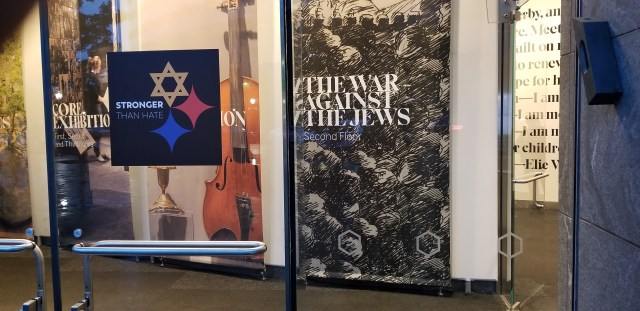
On the front door is this sign:

20181105_165121.jpg

We are stronger than hate, until hate actually murders us.  It happens.  It has not stopped happening for many years now, though the names of those being murdered by hate keep changing.   Genocide continues with horrific consistency, on massive scales and on more limited scales.    Four years ago, for example, a few thousand Yazidi men were slaughtered in the Sinjar Massacre, too few for a proper genocide, perhaps, but still very, very horrible.  The Rohingya were recently the subjects of persecution and genocide in Myanmar, the nation formerly known as Burma.   Everyone in Yemen is catching hell, children are being killed every day, casualties of  the brutal Saudi war there, which rages with American support.  Protesters and rock throwers are being shot to death in more than one country, threatened with being shot to death here, by the American president.   So-called strongmen appear here and there to enforce their will by organized mob violence and with their armies.   They use the military to intimidate citizens and perceived enemies, as our president is doing now, having soldiers install concertina wire along the border fence at a cost CBS news reported tonight is perhaps $200,000,000.

Many people feel the world is overdue for its next, and final, world war.  Look at the world, it’s in chaos, violent storms and other natural disasters are regularly destroying homes and killing people all over the planet, species are disappearing, violent ideologies are waging ruthless wars against unarmed civilians in many places.  Some historians claim that we are living in the most peaceful moment of human history.   I think that’s a wonderful thought, probably backed by some kind of very convincing statistical evidence.   I also don’t think it’s true.   The world is waiting to explode into the next mass murder, many people everywhere are desperate, snarling angrily, we are one big bomb away, and violence is in the air.

So I say, to myself and to people of all faiths and original nationalities who vote in American elections: vote today for the party that is less racist, less xenophobic, less nationalist, less extreme in its divisive rhetoric.  Changing one-party control of our democracy is not the answer to all of America’s problems, but it is the start.   The other way lies madness.


[1] Wikipedia:

In 2018, Donovan faced a primary challenge from former Rep. Michael Grimm.[27] During the primary campaign, Grimm accused Donovan of having tried to entice Grimm to drop out of the race by offering to lobby Trump to pardon Grimm.[27] Grimm pleaded guilty to federal tax evasion charges in 2014 and spent several months in prison.[27] During the primary, both candidates emphasized their loyalty to Trump, seeking to “out-Trump each other,” according to the Washington Post.[28] In the 2018 general election Donovan is facing Max Rose.[29]


I’ve Waited Long

I am typing in the room where my mother’s ashes sit in a box in a beautiful paper bag.   The elegant bag is in the corner, out of my view, and I haven’t looked at it in a long time, but it is a distinctive bag.   The bag is brown paper on the outside, a pure slate gray on the inside.   My mother would like the bag.   She has no worries now, nor any wishes, either.  I decided years ago that I’d scatter her ashes in the Long Island Sound at the public beach at Wading River, but we haven’t done it so far, in eight and a half years.   I haven’t been to that beach in more than fifty years, who knows if you can even get on the beach now without a resident pass?   When I was there last there were swings, seesaws and a sliding pond on the sand, and a small parking lot with maybe eight spots painted on the once black shore road.

The idea of scattering my mother’s ashes in the water at Wading River was a sentimental one.  I  think of those months in that rented green and white bungalow a hundred yards from the lapping water as the happiest summers of her life, but who knows?   She always said she wanted to live near the water, and for a couple of summers we did.   I don’t know if she was happy there or not, hearing the waves breaking at night.  What I do know is that at the moment she truly doesn’t care.   Her concern at the end was about not being eaten by worms and bugs, the thought terrified her.  I assured her it would never happen and it will never happen.  

The scattering of her ashes is more a poetic matter, really.   Every so often it gives me a pang, that I haven’t managed to scatter her ashes into the gently lapping Long Island Sound,  that her ashes are sitting there in that elegant paper bag.  On the other hand, I am positive she doesn’t mind, even if she would chide me about my long failure to do it, if she were somehow able to.

That I can sit here, a few feet from her ashes, writing thoughtfully about it in words almost nobody will ever see, is a blessing and my form of daily meditation.   Thinking these thoughts, molding them into sections that I then comb carefully for readability, focuses my spirit, clarifies my beliefs, sharpens my sense of purpose.   That I have little clue about the only thing the world understands — attaining financial success — does not distract me while I work.  The hard work of vainly striving is not a remote consideration while I concentrate on making my words express my thoughts, my heart, as clearly as I can.

                                                                           ii 

I had a call just now from a one-time good friend of my mother’s, a woman a year older than my mother.   My mother would have been ninety last May, this woman was ninety-one last month, and still going strong.  God bless her, as we say.  Her mind is sharp, her language is crisp, she is upright and walking and driving great distances– still a force at ninety-one.   In the course of narrating a lot of horrors she asked me to keep to myself, while assuring me that she is up to the challenges, taking them one day at a time, she mentioned something that gave her a glimmer of hope in these dark times.

She attended an interfaith vigil the other day, the great throng of several faiths who had gathered was inspiring to her.   The hall was very crowded, with a big crowd outside also.   Somebody came through the mass of people outside and ushered her inside to a seat she didn’t want.  “I can stand, I’m perfectly fine,” she insisted, “give the seat to someone who needs it.”   In the end, she took the seat, though she felt bad about it.   Her ninety-two year-old friend, who had declined the seat in another part of the crowded hall, regretted it afterwards as her lower back tightened up painfully after standing on the concrete floor for a couple of hours.   Better to be seated than aching, I say more and more often now.

Small mercies take on a bigger and bigger significance as life goes on.   We see few enough of them in the world now, as so many nations stand on the brink of merciless horrors many of us believed were a barbaric relic of a bygone, insane age.  I’m talking about a small mercy like finding a vacant bench at the point of a walk when your arthritic knees are barking.   The relief you feel, taking the weight off your troubled bones, a gift you give yourself, provided by a merciful side of the universe and gratefully accepted.

There was a lot on this woman’s mind, and much of it I agreed not to share with anyone, so there’s that.   At one point, God bless her, she couldn’t resist giving me just a little shit about not calling her lately, after I’d spent hours on the phone last month advising her about some very vexing things– and sent her several more pages about my father’s life that she was too vexed to really take in.   

                                                                  iii

After the Saudis murdered a journalist in their consulate in Turkey last month there was a period of several weeks during which the vicious, smiling thirty-four year-old Crown Prince had his advisors and marketing folks make up and spin multiple lies about what happened to the disappeared critic of the regime.  Our president, also born to great wealth that made him feel truly exceptional since childhood, stalled along with the Crown fucking Prince of Saudi Arabia, a fundamentalist Islamic monarchy.   “We have to wait until  the Saudis finish investigating whether they murdered this vicious, lying journalist, which they strongly deny, look, they strongly deny it, like Justice Kavanaugh denied all those lies against him  — whatever happened to the presumption of innocence that liberals used to talk about?  Here they go, rushing to call MBS a murderer, which we don’t know, we may never know, certainly not until he’s done investigating whether he is or not, look, this kid is a gem, a great, great future king– no presumption of innocence for him?   Typical of the lying haters and hypocrites, funders and defenders of the raping, leprosy and smallpox infected terrorist hoards advancing on us …”

All we have, any of us, is the impression we leave behind on those who knew us. We are whispers, after our death, not even ghosts.   The example of how we lived is the only thing we leave to the world of people who knew us.   The power we may have wielded over others is nothing, it is how we used that power that is remembered, that lessons for the living can be drawn from.

I had an old friend who lives the frenetic, embattled life of a successful suburban citizen.   His many stresses and frustrations have few, if any, safe outlets.  It appears that I became his best option for relief.   More and more, particularly since I’ve devoted myself, from before my mother’s death, to restraining my angry reactions as much as I can, he took to provoking me.    I pointed this out to him each time he did it, but he always argued that he was not provoking me, that I just get mad unfairly, that maybe I was the one with the provocation problem, not him.    I had more than one opportunity to throw him on the ground and kick him, but I breathed and fought my way to remaining as peaceful as I could.   This restraint apparently goaded him to ever greater provocations.

In the end, he provoked me into detailing the many things I don’t respect about him.  I don’t know if I mentioned his lack of basic courage, which I think is probably encompassed in the unfortunate phrase I do recall using “moral retard”.   In the wake of this his wife called me, basically offering me an ultimatum.   You have to forgive him, she told me, because he loves you, we all love you.  

I explained why it’s impossible to forgive someone who takes no responsibility for hurtful things they repeatedly do.   Futile, really, since those hurtful things continue on and on into the future if they are not acknowledged and corrected.   The only option, to pretend everything is fine because people tell you that they love you, is not one I’m willing to take, even for the high moral cause of professed love.

Besides, I told her, love is the way you treat people, what you reflexively do when you see a loved one in pain.   Love is action, not a word.  I told her to let her husband know that I’ll be happy to hear from him once he gets some insight in the therapy he assures me he is working hard at.  “That’s not going to happen,” his wife told me, and it had the ring of truth.   He would rather lose his oldest friend than admit that the annoyingly superior fuck might have been even partially right.  Zero sum, baby, he can’t help himself.  If you don’t win, you lose.  What could be worse than that?  Ask the president.

It began to bug me more and more that because I’d taken a principled stance in regard to an old friendship I’d lost the longtime friendship of his wife and his two sons, as well as the friendship of a close mutual friend, apparently enraged at how badly I’ve hurt his troubled old friend.   I called the guy on Halloween (spooky, I know), to ask him three questions that had formed in my head.   I left a voicemail.   I heard nothing back from him, though I’d spontaneously left him the option of doing nothing, saying I’d email him the questions if I didn’t hear back.

A few hours later I rethought my offer.  What was the point of sending questions to someone who could not even reply to a voicemail?  It would only increase my aggravation if I never heard back, give him an easy, an effortless, final provocation.  I called again, left a second message, asking him to text, email or call me if he was willing to help me by answering three questions.  

Two days later, having heard nothing, I texted him, asking if he was out of town or too weak and unJewish to respond.   “Weak and unJewish”, an admittedly provocative formulation (especially to a Jew who fervently prays every morning), but, in context, restrained, I thought, particularly after two days of silence by way of reply.

I soon got the texts one would expect, explaining how he’d heard the first message and thought he’d be getting an email, and then no email came, and then, belatedly, he saw the other voicemail from me but didn’t actually hear it until after my recent text a few hours earlier and so on and so forth and so, you see, there was a rationale to all the delay, a hazard of digital communication (which is what I’d called to avoid in the first place) and, yes, please send him the three questions.

I sent this:

It depresses me that people I was friendly with and had no quarrel with, your wife, your sons, R___, have all vanished from my life as a result of our falling out.  Not to mention you.   I understand your wife and kids have to take your side, whatever it is, but still.   And you can’t even pick up the phone and return a missed call? (rhetorical question)

What was my final, unforgivable act against you?

What did you tell R____ that made him cut off communication with me?   When he left the US we were seemingly the best of friends, he was apologizing that we’d only managed to squeeze in one quick visit when he first arrived.  Then, as a prelude to complete radio silence,  I got a reference to “other developments over the last year or so” that presumably magnified the differences between us beyond the point of possible friendship.

Did you talk to your rabbi in the days before Yom Kippur and, if so, what did he tell you?    I don’t think it’s possible that a rabbi would advise someone to make no further attempt at reconciliation with his oldest friend during the Ten Days of Repentance.   I conclude you didn’t discuss it with your spiritual adviser.   I think you should consider this seven minute discussion on apology, forgiveness and atonement: 

https://www.wnycstudios.org/story/metoo-men-repent

I heard back quickly by email.  He’d received my questions, but I’d have to give him a few days to answer them.

I took a breath and typed back: OK.

The Sins of the Fathers

The Holy One, Blessed Be He, in Leviticus 26, makes it clear that He will punish the children, grandchildren, yea, the great-grandchildren of sinners seven times over. OK, actually, I’m lying, He only implies it, merely hints at it in his final threat.   There will be no children or grandchildren left alive when the All Merciful is done with you, disobedient sinners.   As it is written:

27 “‘If in spite of this you still do not listen to me but continue to be hostile toward me, 28 then in my anger I will be hostile toward you, and I myself will punish you for your sins seven times over. 29 You will eat the flesh of your sons and the flesh of your daughters.'”  [1]

As it is written (by me):

The father’s weakness
anger, vanity
visited as a curse
on the lives
of his children

It does not, of course, need to be written this way, though frequently it is.   Your parents are your first role models for how to act.  Sometimes they are the worst possible role models, in which case, you will have to take your lumps for having originally learned how to treat others from teachers who had a poor idea of how to do it.

It makes me very sad, because, though you can learn these things over the course of many years, given the time and inclination and the luck of finding people to support you in this difficult endeavor, the odds of ever doing so are greatly stacked against you if you’re raised by senselessly enraged parents, or terrified ones.  They can’t be expected to offer meaningful support because they don’t even understand what you’re trying to do.    Your parents’ poor teaching will, as Ha Shem threatens the willfully disobedient, eat your flesh. 


[1] The Lord’s truly divine punchline (you really should read the entire five or six paragraphs of unimaginable horror the Holy One threatens will befall the disobedient, if you want the full effect of the punchline):

36 “‘As for those of you who are left, I will make their hearts so fearful in the lands of their enemies that the sound of a windblown leaf will put them to flight. They will run as though fleeing from the sword, and they will fall, even though no one is pursuing them. 37 They will stumble over one another as though fleeing from the sword, even though no one is pursuing them. So you will not be able to stand before your enemies. 38 You will perish among the nations; the land of your enemies will devour you. 39 Those of you who are left will waste away in the lands of their enemies because of their sins; also because of their ancestors’ sins they will waste away.'”

Happy Halloween!

In honor of this great pagan holiday, a few snippets from the life of our grotesque pumpkin-colored leader, a man who is always dressed, and coiffed, for Halloween.

The president is always poised to counterpunch, as he was taught to do by belatedly disgraced, too-late disbarred gay homophobe Roy Cohn [1].   Cohn impressed on the young Trump that the best thing to do when accused or attacked is to hit back much, much harder.   The Department of Justice accuses you of violating the Fair Housing Act by not renting government subsidized apartments to blacks, hispanics and other lowlifes?    You countersue the DOJ for defamation:  $100,000,000, fuckers! Now watch those sweaty weasels at the DOJ start backpedaling.  

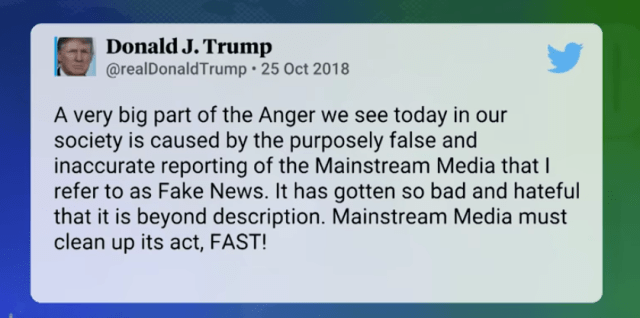
Here is the president’s reaction to the pipe bomb sent to CNN:

Screen shot 2018-10-31 at 1.04.47 PM.png

Who is really to blame for this bomb?  The fucks at lying fake news deserved it, earned it, and if they don’t stop reporting my lies, FAST! they’re going to get more of what they deserve.  

In the blitzkrieg of bullshit that marks the insane Trump/Cohn counterattack strategy, it is quickly on to the next controversy to erase the previous ones — poor families fleeing poverty and death in Honduras constitute a deadly invasion force that must be repelled by the U.S. military!!!   His son-in-law is a Jew, his daughter converted, his most loyal and rabid anti-immigration assistant Stephen Miller is a Jew, so how can anyone hold him, an unabashed nationalist, responsible for the murder of Jewish globalists in that synagogue where they didn’t have the good sense to post armed guards as the Second Amendment clearly allows?

The shit bombs fall so prolifically from the president’s mouth that much of it goes unremarked on.   His assessment of the brutal Saudi torture and execution of a journalist in their consulate: bad concept, bad execution, terrible cover-up, should have earned him at least a bloody nose.   Nothing, as always for this supremely untruthful entitled man made a multi-millionaire as a child by his foolish-risk enabling dad.

I didn’t get a chance to comment on this wonderful bit of drollery from the normally reserved New York Times.  The Times exploded Trump’s self-made billionaire lie by showing, in excruciating detail, the long pattern of his father Fred’s lawless manipulations to avoid tax laws and the lifetime gifts totaling about $400,000,000 to his idiotic, preening, serially failing son.  

Nobody cares, those who dislike him already now have the facts about his perhaps most massive lie and his base knows he lies, but so does the NY TIMES!   The failing, lying New York Times!!!   The Times report is the result of massive research, based on 100,000 documents, every detail examined, vetted and every claim, no doubt, combed through by a careful legal team.   

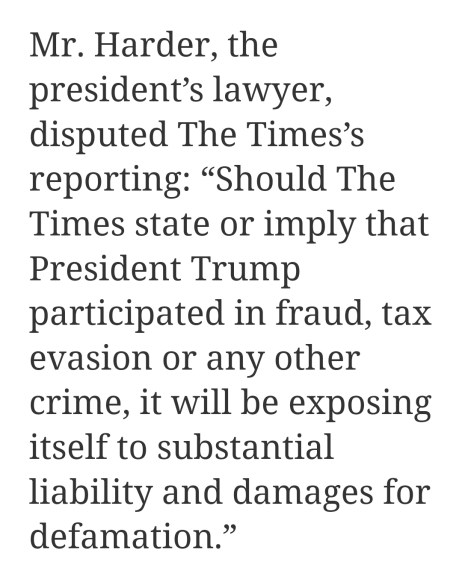
The Times describes a company the Trumps set up, one of many, to pass Fred’s fortune on to his children tax free.   This particular company was created to grossly inflate Fred Trump’s expenses for building supplies and pass the “profits” on to his children.   It was a relatively simple scam, if a boiler cost Fred Trump $5,000, this company would charge Fred’s company twice that and his kids would keep the difference.   In the middle of the section describing this fraudulent business, the Grey Lady drops this:

20181029_184055.jpg

Then the article simply continues describing the fraudulent company, without any comment on this bullshit threat by one of the president’s army of aggressive lawyers.   To those who love the president this threat vindicates them, like the strong denials by Saudi murderers or the president’s problematic extremist Supreme Court nominee.   See — the lying NY Times is lying!!!   To those with even the slightest critical ability, the failure of the president to sue the Lying New York Times (also known by many of his staunchest supporters as the Jew York Times) means the lawyer’s threat was as empty as many of the threats and promises the lawyer’s supremely litigious client has made over the years.

Happy Halloween, y’all!


[1]  Because when I have any doubt about a factual assertion I make here I do a quick and easy fact check, I asked google “was Roy Cohn a homophobe?”  He was, many sources agree.   Here is one of the results that came up in about one second, a marvelous little summary of the career of this malevolent creature, a career I highlighted in a footnote scroll to the bottom of this one for two excellent treatments of this evil fuck:

Roy Cohn – RationalWiki

Sep 5, 2018 – Roy Marcus Cohn (1927–1986) was a lawyer, a rabid anti-communist, a closeted homosexual and homophobe, a Jewish anti-Semite, …


How A Consistent Asshole Responds

At the risk of stirring a simmering caldron of shit among the handful who will read these words, I must quote part of our president’s reaction to a maniac with a gun killing eleven of the people who had gathered for a religious service in Pittsburgh.

President Donald Trump: “If they had protection inside, the results would have been far better. This is a dispute that will always exist, I suspect, but if they had some kind of a protection inside the temple, maybe it could have been a very much different situation, but they didn’t.”   source

If you have one answer to every question, and only one thought every time you open your mouth (winning, I need to win, I cannot lose, I will not lose!), you will utter NRA talking point drivel like this when the country needs a steadying hand after another explosion of murderous racist hatred.   The president did call for the death penalty for the mass shooter.   That’s consistent.   You kill killers, that’s just common sense for a guy like Trump.  He advocated the same for the guys eventually exonerated in the brutal attack and rape of that jogger in Central Park.

If you support the president he’s absolutely right.   He said kill the killer, which is right.  He said if those Jews had armed guards in the temple they could have only lost a few before their guards shot this guy to death.   Presumably that would have been fine, you know, or, if not fine, a far better result.  Unfortunately, you know, these liberals didn’t have armed guards, because they’re against the Second Amendment, so they died.  SAD!  

Also, of course, this latest outburst of prejudice-fueled deadly violence by another one of his more fevered supporters has nothing to do with the president’s steady stream of vile hatred enflaming rhetoric.   The uncle of presidential advisor Stephen Miler, the nephew being the suspected author of much of the president’s most virulent anti-immigrant rhetoric, (I’ll get to this Nazi another time), had this to say about the president’s steady incitement of hatred against the “other”:

Mr. Trump has made it his policy to vilify and dehumanize Hispanics, Muslims, nonwhites, calling them subhuman animals that are infesting our country like so many insects or rats. Make no mistake about it: This is the same kind of propaganda that is identical to the racist rants at Nazi Party rallies in Germany in the 1930s. Now Trump spews the same poisonous messages to his supporters and claims innocence when this inflammatory vitriol is sprayed over society. He claims innocence now that this political gasoline catches fire and people get hurt and killed. [1]   source   

Trump, a self-made millionaire by the age of nine, has cunningly branded himself a man of the common people, a man of the finest people, the very best of America. Make no mistake about it.

With such a steady and powerful fire hose of bullshit pumping out emotionally charged distraction 24/7 it’s easy enough not to dwell on the president’s cold-bloodedly evil assessment of the Saudi torture and dismemberment of the still complaining (even as they worked on him with the bone saw) journalist Jamal Khashoggi.   The president’s eventual conclusion about the murder, after weeks of publicly weighing Saudi billions for American munitions against their right to dismember political opponents, was that “they had a very bad original concept, it was carried out poorly and the cover-up was the worst in the history of cover-ups.”  

Bad original concept, carried out poorly, the cover-up sucked.    Now they have to quickly try and execute a bunch of people to prove they are innocent, you know, a better concept, to actually execute those responsible, though not, of course, themselves — they strongly denied responsibility so we have to presume they are completely innocent and the people they execute are guilty — PRESUMPTION OF INNOCENCE, you vicious bastards!   We’ll never know who came up with the original bad concept, carried it out so poorly, were so stupid about the cover-up. We can never know, which is SAD! At least the killers can be killed, so there’s some justice for the accidentally killed journalist’s family.

One of the few truthful things this man has said since rearing his artfully concealed bald head as a presidential candidate was that his followers are so angry, so easily manipulated in their rage, so unconcerned with their candidate’s transparent lying, that he could go out on Fifth Avenue and shoot somebody and they wouldn’t care.   They wouldn’t care.  Am I right?  Am I right?


[1] Jewish SS man Stephen Miller’s uncle also said this:   

I regard Mr. Trump as a hopeless moral imbecile, indifferent to the deadly consequences of his inflammatory conduct.

and this:

So, I am particularly horrified and angry about the cynical political exploitation of poor people trying to escape from oppression. We can’t solve all the problems in the world, but we can certainly—the United States is a large, powerful, wealthy country, very good at absorbing immigrants, as you can determine just by going out in the street and asking anybody you see, where did their family come from originally. We’re great at absorbing immigrants. And we need to do our duty to help people who are desperately fleeing from horrible conditions, as my family did a hundred years ago.

Schematic of the previous post

A complicated, difficult dynamic can be reduced to simple terms.   This process is sometimes referred to as reductionism, which has come far from its original scientific/philosophical meaning of breaking a complex issue into its simplest component parts to understand its workings.  

In our modern political version of reductionism a long, complex history can be summarized in an easily understandable, if simplistic, concept:  liberty, or betrayal, or treason. Traitors have long been executed in front of cheering crowds, their heads set on pikes as a warning to anyone who might be thinking of challenging power.   The individual guilt or innocence of the decapitated party is far less important than the effect on the rest when a traitor meets a grisly end.

For most purposes in the larger world, the party with the loudest megaphone will define what is going on.   For example, Americans angry about a recent national disgrace involving a controversial Supreme Court appointment can be called an angry mob.   An angry mob can be dismissed, they are clearly irrational assholes.   The underlying events that made millions so angry?   Wah, wah, wah.

My old friend who felt disrespected by my late arrival has his story about the end of our long friendship, confirmed in its harshest detail.   Widaen told me he disrespects me!    

Widaen, for his part, had another story, my old friend simply doesn’t seem able to stop provoking me.  He seems intent on making me angry.   He surely sees that he’s aggravating me, or placing me in a brutally unfair position, and when I protest, he doubles down.  Gives a meaningless apology, to end the conflict, and then continues on the same way as if we’ve never discussed things.

There are facts, actual events, underlying this dispute, but those facts are in dispute.   If they are in dispute, they’re not really facts, are they?   

This is the self-justifying idiocy of the world.   If you find any mental construct to support your position (if there is a dispute, can there actually be “facts”?), you’re golden, just keep doubling your bet.   In the case of my once good friend, he was able to justify his own actions, become the victim of my brutality and get the sympathy of those who know us both.  

I think a lot of conflict between people who are close (and tribes and nations, for that matter) can be traced to lack of insight, a lack of actually listening to what the other party needs.    

My friend’s refusal to empathize with the feelings I expressed became impossible for me to tolerate. Ultimately it’s impossible to respect someone who lives in denial about how his actions affect others.   His years of constant fights with his wife?   Nothing to do with my disrespect for him!    

The good news, as far as I can make it out, is that insight can be developed.   There are things baked into us that are hard to change, but change is the nature of the universe, us included.   If you develop just a bit of insight, we can continue to talk. You need to have just a little insight, to have a good friend like me.

“You arrogant, pretentious fuck,” I can hear the words foaming on my once good friend’s lips.   My point is no less true.

Provoking vs. Disrespecting: anatomy of a fatal falling out

I will use a personal story to flesh out a mechanism that commonly leads to violence and sometimes death.  It is a mechanism that is particularly ubiquitous in this black and white zero-sum society we are living in at the moment.  It is the reduction of a complicated story to a simple, primary concept, like betrayal, or loyalty.   One party wins all, the other loses all, or it’s mutual destruction — fine, everybody loses and everybody wins, sort of.

In this particular personal anecdote no punches, kicks or bullets were exchanged, though both sides wound up feeling hurt and completely justified in their final anger at the other.  Every person who knows my once good friend, including two who claimed recently to love me, has cut me dead, which is as bad as the underlying impasse with a guy I’ve known since fourth grade.   In some ways it’s worse, more painful, this tribal closing of ranks after an ultimatum to forgive without condition or forever be seen as the vicious loveless party persecuting a weaker man. 

This is an aggravating story Sekhnet, who tries her best to take care of me, urges me to somehow put out of my mind every time I mention anything connected to it.   I don’t know how that’s done, until I am done working through it to my satisfaction.   A gnawing, vexing story untold is just a fucking tumor in waiting, as far as I can see. There is nothing I can do about a lying sociopath president or a lockstep political party who seems to have, with alarming speed, acquired a taste for the inside of their new leader’s ass, but this situation with an old friend I can wrestle with directly.  I believe it also sheds light on our larger problem as a culture, which comes largely from partisan oversimplification and a mass failure of empathy.

The common response to a fight is to take sides, be loyal to your people.  They call this tribalism now, reminding all of us homo sapiens that when it comes to war, we jump with those closest to us.  Loyalty has been elevated to the highest value, they used to call this kind of reflexive patriotism “my country– right or wrong” — you defend whatever America does because you’re American.   Somewhere far down the list of civic virtues, after loyalty, are being analytical, and fair-minded, and trying to find the causes of friction and the best solutions for difficult problems, including interpersonal troubles like I had with an old friend recently.

My mother always expressed frustration, even anger, at her daughters’ children’s seeming ingratitude.   My sister (my mother’s daughter) always expressed frustration, even anger, that her mother could not just give with grandmotherly generosity without demanding a “thank you”.    I always thought that a skilled mediator could convince my sister to teach her kids to say “thank you, grandma” when grandma gave them something.   This simple act would have gone a long way toward reducing tensions, but they were both too angry, and too stubbornly committed to being right, to ever go to a mediator.   Each one dismissed the idea of mediation as something the other would never agree to do.

Sekhnet reminds me of all the other things I should be worrying about, instead of this intransigent former friend who is too hurt and angry to make peace.   I have worry enough to cover these other things, and have made appointments, or at least calls, about all but one of them. [1]   Seems funny, in light of these other immediate worries, that I’m returning over and over to the sad and now sickening falling out with a friend of more than fifty years, but here we go.   On the other hand, this is the only vexation I have any chance of getting closer to solving today.

Much violence among armed teenagers is over the issue of perceived disrespect.  “He dissed me,” more than one violent young man will say in complete justification of why the person he shot needed to get shot.   Disrespect is a fundamental blow that we are taught not to tolerate.   For purposes of my friend’s case against me, I explicitly told him I don’t respect him and I gave several specific reasons why I don’t.   It would seem to be case closed for our friendship.  

I disrespected my friend, first by my actions and then by explicit words, and that’s all she wrote.  If you don’t respect someone it’s impossible to be friends with them.   End of story.   There is no coming back from this.   It’s as bad as lack of trust, lack of mutuality, lack of empathy, lack of affection.   There is nothing else to tell, many would say, closing the case, though I will tell the rest, as is my way.  The details may be useful in seeing how this sort of irrefutable tribal conclusion is often reached.   

What I was seeking from my friend, by the way, was that when he saw me getting aggravated as he pressed ahead in some conversation — the reddening of my face, the clenching of my arms and hands, the gritted teeth, the labored breathing, the other universal signs of approaching anger, plus my words to that effect — that he could take his foot off the accelerator, apply the brakes a little and change direction.   He was increasingly unable to do this in recent years, as his own life got more and more stressful.

During our last discussion my friend told me, three separate times in the course of about twenty minutes, that he felt disrespected by me.  He felt this because I had been ninety minutes late to meet him for an important discussion to try to save our failing friendship.  He told me at once, and slightly sheepishly, that he knew the feeling was irrational, since we’d been loose about the time, and he’d declined to accompany me on the errands that took longer than planned so that we could meet at the original time.  This talk was important to him and he’d saved the entire day for it, from two pm on.  

He told me we could meet at any point, true, but still, I didn’t show up until almost 3:30 and ninety minutes is past the border line for disrespect.  It was even worse when you start the clock at 1 pm, which was my initial suggestion, making me a full one hundred and fifty minutes late.   It was true, he said, that I’d called as soon as I knew I was going to be late, spoke to him from the middle of a traffic jam on the Grand Central, and that each time I called he’d reassured me that he wasn’t, for once, under any particular time pressure. He’d told me not to worry, in fact.   All this was true, he said, and so it might seem irrational to me that he felt disrespected, but there it was.  Ninety minutes.  It’s hard to ignore ninety minutes.

The second time he told me how disrespectful I’d been to him, about ten minutes later, he was in the middle of denying that he had provoked me again recently, intentionally or unintentionally.  He told me that he’d only apologized to me in the most egregious previous instance because I seemed so peeved.   He had actually been in the right, he told me, to insist in the face of my rising aggravation, on the annoying thing he’d been insisting on me hearing, for a second time in a week, as it turned out.   In fact, he added, he’d do the same thing again, if it came to it.  

I was just wrong, he said, to see what he’d done as provocation.  He is not provocative, he is actually a lifelong peacemaker by nature, and besides, I was the one who’d behaved disrespectfully toward him and was now not accepting his most recent apology.  Ninety minutes, he reminded me, more than enough time for my disrespect, intended or not, to sink deep inside of him.

This line of counter-attack is familiar from my childhood.  My father liked to reframe everything away from whatever I was concerned about to a discussion of my terrible temper, how angry I always was.  When I was young, this used to piss me off pretty quickly, the abrupt pivot from what I needed to talk about with my father to the general subject of my crazy anger.  Once I got mad, I lost any chance to talk about anything.  “You see,” he’d say with a smug smile, “this is exactly what I’m talking about.  The People rest, you’re irrationally angry again.  You really have a fucking problem with your violent fucking temper.”    

My father did me a favor, in a roundabout way, since by the time I was a middle aged man this kryptonite became a weaker and weaker weapon against me.   It took years of work, but years well-spent, in my opinion.

My disrespected friend, on the other hand, had been actively taught never to show anger.   Anger is a threatening emotion, particularly to someone raised never to express it by word or conscious deed.  “I was taught to swallow it,” his mother told me recently, “avoiding conflict at all costs is how I was raised.   My mother used to tell me to use any means necessary, including creatively altering any details of what happened that could possibly make anyone mad.  The only supremely important thing, according to my mother, was avoiding confrontation.”  

I experienced a few untruths from this now very old woman over the more than fifty years I’ve known her, but I never held that personality quirk against her.  She’s a lovely woman, outside of that.   I spent hours on the phone with her last month advising her about a very aggravating and frightening situation I must keep secret.   That’s the other piece about her approach to anger, fear, shame — really emotionally explosive things must always be kept secret.

The son is like her in some fundamental ways.   His occasional bending of the truth was something I just accepted as a regrettable feature.   I always felt I could trust him about the big things, in spite of his tendency to be less than truthful at times about small things.   Funny that this equivocation was never a terrible issue in my friendship with him, I guess because our affection went back to childhood and since I always felt I could trust him in the larger sense, I never worried when he did that dance he sometimes does to try to make sure everybody is happy.   I suppose I never questioned his motivations when he was being less than honest, it was for the sake of avoiding what he saw as an inevitable confrontation, I could always see that.  

Now here we were in a real confrontation, and his dance was not at all endearing nor did it give me any reason for optimism.   He simply could not admit, beyond saying the words “I’m sorry”, that he’d been wrong to blame me, based on a casual remark made to his wife in passing, for willfully, or recklessly trying to destroy his long-troubled marriage.   I was his oldest friend, and I tried my best to help him get the full context to that particular, unfortunately weaponized remark.  

I was not at all angry at the pointed accusation, odd to say.  I was on the spot, I was concerned, there was a slight tightness in my gut, I felt under pressure, but I wasn’t angry.  Seeing him in such distress I did what I could to try to help him.  It took an hour or more to get things to a reasonable place that he could offer to his wife and their therapist in explanation of his oldest, closest friend’s alleged treachery.

When I was finally done with that he asked me if I harbored anger at him, conscious or unconscious, and told me I’d never once in our long relationship ever admitted I was wrong, had never apologized to him about anything.   These are faults I work on not having, when I become aware I’ve hurt a friend I do my best to make amends as soon as I can.  He brought up a thoughtless thing I’d apparently done to him years ago and I told him I was wrong and apologized, for what it was worth.

As soon as I was done telling him how sorry I was he accused me, based on something “someone in his family” had disclosed to him, of insultingly treating him like a helpless child.   The vexing information he complained of being spilled by a family member (there are only three possible candidates) was something I later realized that I myself had told him months earlier.   It was quite an emotional trifecta in his car that afternoon.  It took a few days before it began to strike me as an unfriendly, and unfair, assault on my character and my friendship.   My friend kept telling me how impossible his life was, worse than ever, the pressure on him was unbearable.  I told him we needed to talk face to face, that things between us were very bad.

Now I was in a suddenly aggravating conversation, doing what I could to try to save a friendship that was hanging by a thin, fraying thread.   The conversation was hard work, because he’s very smart and quite capable of putting up a strenuous emotional and intellectual fight.   His position was that he’d apologized to me already, about everything, including that “thing in the car”, and that it appeared to him that I was unforgiving, unreasonably demanding more than an apology.   “I apologized to you already, but my apology apparently wasn’t enough for you,” was his opening line to this conversation we needed to have to better respect each other’s feelings if our friendship was going to survive.  

In his defense, I’m pretty sure he honestly does not see himself as capable of expressing vehement hostility.   That, he likely believes, is my area of expertise.  I am the one who expresses anger, after all.    All of his efforts in interpersonal relations are intended to keep the peace, make peace, be a mediator between angry people.  In the short term, his efforts sometimes work, two angry people kiss and make up.   Long term, his record is not as good — as nobody’s can be when “peace” is based on persuading everyone to let bygones be bygones and a polite agreement that everybody loves each other.  That’s not how love, or anger, actually works.  In any event, the impasse between him and me is a special case and he really couldn’t be expected to make peace with someone as angry and unforgiving as I apparently am.   Plus, of course, the disrespect, how do you get past that?

In the end, the third time he brought up the disrespect, about five minutes after the second time, I finally lost it.  Outside of provoking me, I have no other theory for why he kept mentioning this perceived feeling of being disrespected.  I snapped.  I told him he was right to feel disrespected, that I don’t respect him, not the way he treats people, not many of the choices he’s made in his life, not his inability to empathize, to be honest about his feelings, to have any insight into his anger, to make a meaningful apology.   If you apologize for hurting somebody, I said, and you continue to do the same hurtful thing over and over, your apology is a shit apology.   A lie.   A meaningless fucking lie, dude.    

It may be worth mentioning here that we spoke for another four or five hours after that.   We talked quietly, but in circles, each trying our best to somehow rescue our deeply wounded friendship.   Oddly enough, he seemed to calm down and fight much less after making me explode at him.

 My childhood friend now spends a lot of time studying the ancient wisdom of Judaism with an orthodox rabbi, though he chose not to contact me during the Ten Days of Repentance, a time when Jews are supposed to make amends with people they know they’ve hurt.   Feeling the aggrieved party (victimhood is one of the most frequently and potently weaponized feelings in Trump’s America) I am sure he contented himself praying for his soul and the souls of his loved ones.   I thought about this falling out, blamed entirely on me for my inability not to be provoked by what I falsely claim is provocation, extensively during those ten days and beyond.  

I heard a rabbi talking about apology, atonement and forgiveness.   A fascinating seven minute segment on On The Media (click here for the excellent conversation) .  The rabbis apparently require someone seeking forgiveness to apologize at least three times before they can give up with the human and atone before God.   Element number one of an apology is empathy– I know you’re hurt, if someone had done to me what I did to you I’d be hurt too, just like you are, I’m sorry I hurt you, I’ll try my best not to ever do it again.   Remove empathy and you have only the empty form of an apology:  I see you’re hurt and waiting for an apology, so I’m sorry, can we just move on now?

Can we just move on, you merciless fucking irrationally hurt self-righteously enraged prick?

Think about any member of his family who might want to keep in touch with me– impossible.   There is a huge cost to taking sides against your own family, going against the current of your tribe’s strong feelings, even in a small way.  This conflict in the soul when a person opposes the will of the tribe has been the stuff of drama forever.  First, it is seen by those who trust you as disloyal.   Second, if you are critical of the accepted tribal story your head can be next on the chopping block, you see how upset everyone is.   Best to say nothing.  

I have a friend fond of quoting his grandfather’s aphorisms, gleaned from the teachings of the rabbis.  One of our favorites is “yaffa shteeka leh cha-chameem”   beautiful is silence to the wise.   Dig it.

 That said, the only hope we humans have, if we truly seek to change things for the better, is looking as deeply and dispassionately as we can into things that are sometimes, frankly, terrifying.  It is easy to resolve conflict in your own mind by reducing something to a simple scenario.   Few scenarios are actually as simple as we easily convince ourselves they are.


[1]  I have a CAT scan of my kidneys, bladder and ureters early next week, then a camera on a long stick up the penis into the urethra to look for the source of a large blood clot, gross hematuria, some emergency dental work I need to set up and a bit of fancy footwork to do playing the insurance odds, by the December 15 deadline to buy health insurance for 2019, trying to learn before then if I’ll need another $88,000 infusion of chemotherapy for my eventually life ending kidney disease.  

Facts Actually Exist

For example, these reasonable questions from the autocratic leader of Turkey all reference facts, things that actually exist or don’t exist.  These questions seek important details about things that happened in the real world, things that can be examined, things that will determine which story about the events is more true than the others:

“Why did 15 people gather in Istanbul the day of the murder? Who did these people receive orders from?” he asked. “Why was the consulate opened not immediately, but days later, for investigation? When the murder was obvious, why were inconsistent explanations given?” 

“Why is the body still not found?”    source

These are all things that can be investigated and verified — did fifteen security men arrive in Turkey at 3 a.m. and leave for Saudi Arabia again at the end of the same day, after the murder?  Who gave the order to kill a prominent Saudi citizen who had been critical of the young Crown Prince, to kill him in the consulate?  Why was the consulate closed for days after the hit?   Were inconsistent stories told by the Saudis?   Where is the body of the man accidentally and tragically killed after he allegedly started a fist fight against the fifteen security men in the consulate?

Not surprisingly, our leader had a different spin on the apparent guilt of the Saudi Crown Prince.   In a curiously framed paragraph in the Washington Post (where Khashoggi worked for the last year) he is quoted as describing the Saudi hit as a bungled job:

Speaking in the Oval Office, Trump skewered the Saudis, saying, “They had a very bad original concept, it was carried out poorly, and the coverup was the worst in the history of coverups.” He added, “In terms of what we ultimately do, I’m going to leave it very much — in conjunction with me — I’m going to leave it up to Congress.”  source

Nice skewer job, sir.   Now we are led to a series of alternative thoughts, taking us away from what appears to be a brutal premeditated murder ordered from on high and into the realm of pure imagination.   A very bad original concept– they should never have killed that traitor in the consulate, that was just stupid, an ill-conceived idea.   You kill him elsewhere, any mobster’s preschool grandson could tell you that you don’t kill him in your own house!   Carried out poorly — you don’t leave a blood spattered consulate that takes days to clean before investigators can be let in, you don’t saw up the body there, for Christ’s sake!   You drive a car in and secretly take the body out intact, wrapped in plastic, in the trunk, even if you have to wait until dark.   You certainly cut him up somewhere else.   Sheesh…   The coverup was the worst, the worst!  You don’t wait weeks to make up a story that is not a bit credible, you do that immediately and you tell it over and over and over, as many times as necessary.   Then you say “I’ve told you this a hundred times, that’s it.  Now you treacherous fake news vampires are just being deliberately disrespectful.  You want what that Saudi big mouth got?  LOL!”

I don’t know what happened in Istanbul, outside of the fact that a man from the wealthy and powerful elite of Saudi society, banned from writing in Saudi Arabia by the new Crown Prince, was killed in the Saudi consulate in Istanbul.  I also know that his body has not been found.   Bad concept, bad execution (bad pun intended), bad coverup.

I also don’t know what happened in a house in a wealthy Washington D.C. suburb more than thirty years ago, between a drunk prep school junior and a freshman girl, out of her depth at that little impromptu gathering nobody else even recalls.   I believe the sickening detail of the laughter of the drunken preppies after one of them held her down and the other later piled on.  It makes sense that this moment would be indelibly imprinted on the hippocampus of the traumatized young woman.

Applying Judge Martha Kavanaugh’s famous rule for judges– ‘use your common sense, what has the ring of truth?  what rings false?’  it appears that a premeditated murder of a critical journalist was committed on behalf of the young medieval crown prince of Saudi Arabia and that the trauma the woman remembers happened pretty much as she told it.   Her explanation of why she was certain of the identity of her attacker rang true.

Of course, the president is excellent at answering these questions, he does it effortlessly.  The Saudis did a full investigation of their badly planned, terribly covered up murder of a very disloyal guy who had it coming.   The Supreme Court justice gave a very strong denial, very strong, and it turns out nobody could confirm anything that woman said, which proves she was lying.    

In each case, one question remains above all others when trying to discern the ring of truth from the ring of falsity.    Who stands to gain the most from the story being told the way it is?   Who has the weightier motive to tell the particular story they tell?   Who has the more convincing concept, execution and cover-up, to put it in the president’s purely transactional terms?