Excellent Legal Analysis, then a blandly partisan political conclusion

The New York Times published an op-ed by J. Michael Luttig, a former federal judge, headlined How The Court Bungled the Michael Flynn Case. It provides an excellent legal analysis of the egregious flaws in Judge Rao’s legal analysis in a controversial 2-1 opinion that reaches none of the required legal points in ordering immediate dismissal of the Flynn case without a hearing. The op-ed also provides a prime example of the importance of knowing who is writing what you are reading. In the internet age, you don’t have to dig far to find out that Luttig, wealthy longtime Boeing lawyer, is a lifelong right-wing idealist [1].

Luttig concludes, after his precise legal analysis, while purporting to weigh the benefits of reversing this clearly wrong opinion in “perhaps the most consequential political constitutional case in recent memory,” that there is really no harm/no foul in letting the ruling stand, since the incorrectly decided opinion, ordering immediate dismissal of a case the Court “bungled” (in dismissing the case) will never be a precedent since it was idiotically decided. Fair is fair, concludes Luttig, in assessing whether the Court should rehear and reverse the clearly wrong decision. Rehearing and reversing, he writes:

… would only further politicize the already politicized case and the federal judiciary along with it. Prolonging what would then be a three-ring judicial circus would exact an almost unconscionable price from the integrity of the judicial process...

… The government’s facially [sic] and unrebutted reasons for wanting to dismiss the prosecution — namely that the government itself wrongly investigated and prosecuted Mr. Flynn in the first place and then withheld exculpatory evidence from him in the second place — are constitutionally compelling.

The Times, as you know, is dedicated to presenting a diversity of opinion. This is a fine example of a diverse opinion blandly affirming Bill Barr’s unassailable point of view (Barr was Luttig’s immediate predecessor at H.W. Bush’s Office of Legal Counsel), dangerously contextualized by an intelligent and fair critique of a grievously erroneous Court of Appeals decision, rehearing of which would:

unavoidably be perceived by many as the court’s positioning itself to rule for the losing side in last week’s case, evening the political score in this pitched partisan battle. This would only further politicize the already politicized case and the federal judiciary along with it.

God forbid the federal judiciary ever be politicized!

We should also note that the “losing side” is entirely, indisputably correct, from a legal point of view, which Luttig silently acknowledges. Only a Trump appointee could have written the ruling Judge Rao did, contorting herself to support the Unitary Executive above all other legal considerations.

As a threshold matter– yes, in the end Judge Sullivan will have to dismiss the case against Flynn if the DOJ belatedly decides its prosecution was “not in the interests of justice.” The DC Court of Appeals ruled 2-1 (incorrectly, in Luttig’s and virtually every other lawyer’s analysis) that Sullivan must immediately dismiss the case without a hearing. The ruling offered no legal reason for this extraordinary remedy except for “irreparable harm” to the prerogatives of the Executive Branch if the judge was allowed to “usurp” its powers by holding any kind of hearing prior to dismissing the case the DOJ now seeks to immediately end, with prejudice, “in the interests of justice”.

Luttig analyzes the fatal flaws of Judge Rao’s opinion:

In considering Mr. Flynn’s request, the appeals court had before it three simple questions: Does Mr. Flynn have a clear and indisputable right to have his case dismissed — before Judge Sullivan rules? Does he have any other remedy for the harm he may suffer if the case is not dismissed immediately? And last, is ending Mr. Flynn’s prosecution now, before Judge Sullivan rules, “appropriate under the circumstances”?

As it turns out, the Court of Appeals panel decided none of these three questions.

And, spoiler alert, the answer to the first is no, the answer to the second is yes, the answer to the third is no. The law requires: yes, no and yes in answer to these three simple questions before a writ of mandamus may be granted. Luttig:

Take the first question. Though it purports to have done so, the court did not decide that Mr. Flynn had a clear and indisputable right to immediate dismissal. Rather, the divided court decided the entirely different question of whether the government would have had a clear and indisputable right to have its prosecution dismissed immediately. “The circumstances of this case demonstrate,” Judge Neomi Rao wrote, that immediate dismissal “is appropriate to prevent the judicial usurpation of executive power.” However, it was not the government that asked the appeals court to dismiss Mr. Flynn’s prosecution before Judge Sullivan ruled. It was Mr. Flynn.

Luttig analyzes how consideration of the other two issues the court must weigh are also absent from Judge Rao’s decision, which ultimately rules in favor of a party (the Executive Branch) that was not even in court seeking the extraordinary legal relief she ordered for Michael Flynn.

Luttig then goes on to weigh the compelling reasons to rehear and not to rehear arguments in a wrongly decided case. As turns out, Luttig concludes there is really no compelling reason to allow a judge to hold a hearing when Bill Barr says everything was done on the up and up and that Flynn’s plea to the charges brought by Mueller is now a nullity under the law since Barr recently concluded Flynn’s actions did not constitute “material” lies or omissions made with any intent to obstruct Mueller’s unfair witch hunt, which began in Obama’s “spying.” Things that Barr has ordered criminal investigation into the “oringes” of.

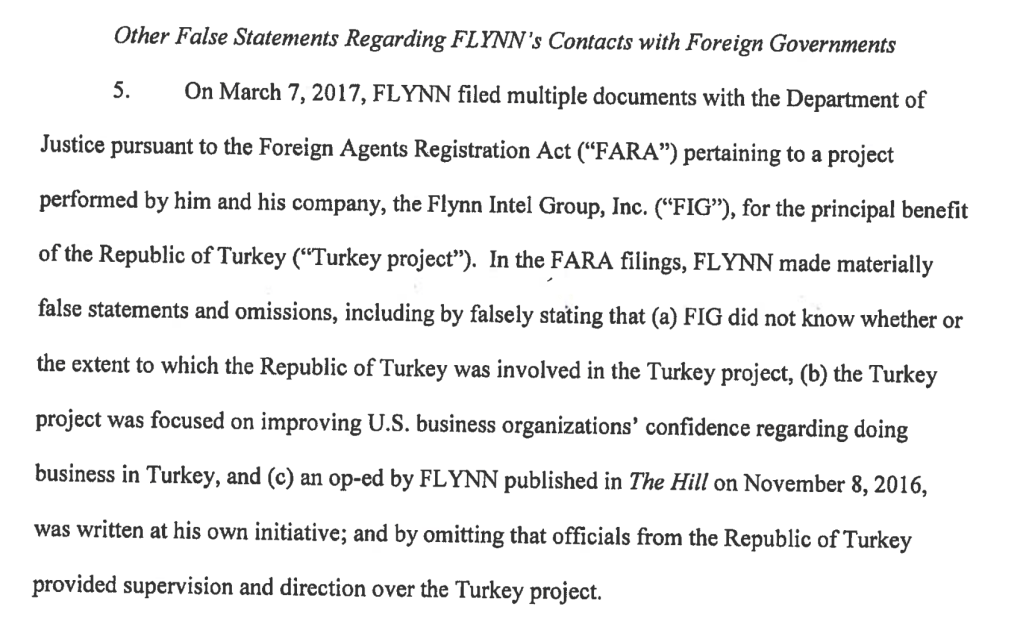
It is fair to say, whatever your political views, that dismissal of Flynn’s guilty plea without a hearing confers an advantage on those who stand to gain by a dismissal in the dark without evidence of why the government suddenly dropped a case against a man who pleaded guilty to multiple felonies involving the Trump campaign’s well-documented Russian help in the 2016 election. Flynn, Trump’s senior campaign advisor (led “Lock her Up!” chants at the RNC) and the shortest serving National Security Advisor in history, recall, was fired for lying to Vice President Pence about Flynn’s illegal contacts with Russian officials during the transition period. Flynn pleaded guilty to lying to the FBI — in covering up connections between the Trump campaign and Russia — as well as to lies and omissions on his security clearance registration forms where he did not disclose a major conflict of interest: his work for the Turkish government [2].

Luttig:

Knowingly or not, the Court of Appeals simply appears to have bungled perhaps the most consequential political constitutional case in recent memory.

Every day, courts err and often even grievously. That said, the question now is whether the entire Court of Appeals will or should rehear this significant constitutional case.

A difficult decision for the DC Court of Appeals, he writes, one that, if decided with political bias (or not), could only make Bill Barr’s life much harder than it already is, not to mention the life of the occasionally mendacious (but not materially so) General Flynn and those many supporters of the Unitary Executive who support him.


[1] Reading Luttig’s CV afterwards I understood why the then youngest man ever appointed to the federal bench (37) and former Executive Vice President, Counselor and Advisor to the Board of Directors at Boeing (who made $3,463,793 in 2019) would likely come to this conclusion:

Though each judge receives hundreds of applications, a few conservative judges seek out Federalists. Judge Michael Luttig on the Court of Appeals for the Fourth Circuit, for example, hires only students with membership in the Federalist Society or comparable credentials on their resumes. And almost all of Judge Luttig’s clerks go on to clerkships at the Supreme Court. His unheard-of batting average is sustained because Judge Luttig diverts clerks who don’t land a clerkship with other Justices to Justice Scalia (whom Luttig himself clerked for) and Justice Clarence Thomas. Justice Kennedy interviews applicants based on recommendations from a group of Federalist-friendly professors and Judge Kozinski, himself a former Kennedy clerk. Judge Kozinski stresses, however, that Federalist Society membership is only one factor. “If you are suggesting that it gets people jobs it’s simply not true,” Judge Kozinski says. “It’s like saying you’re in the Boy Scouts.”

[although, coincidentally, they only hire Boy Scouts.]

source (excellent article about the Federalist Society)

Wikipedia:

On April 23, 1991, President George H. W. Bush nominated Luttig to fill a newly created seat on the United States Court of Appeals for the Fourth Circuit. Confirmed by the United States Senate on July 26, 1991 and receiving his commission on August 2, 1991, he became the youngest judge (at age 37) on a federal appeals court at the time of his appointment.[7]

[2]

Shameless Bagpiper Bill Barr Needs to Go Home

Full disclosure, I personally hate this pugnacious, lawless, lying, culture war prosecuting handmaiden to the infallible Unitary Executive, the current exemplar of which is, demonstrably, the worst president in American history. I will, therefore, turn this post over to more cool-headed sources, that you might see the seriousness of what we’re up against having an essentially lawless man in charge of “Law and Order”, unaccountably carrying out the vindictive will of a thin-skinned idiot who has never taken responsibility for any of his many serious errors, omissions, frauds, crimes, etc.

Here is a nice snapshot of some of Barr’s more egregious abuses of power (though it omits, for example, Barr’s inappropriate military command of the violent clearing of peaceful protesters for the president’s Bible holding stunt in front of the church):

Congress must continue to pursue this matter [the recent whistleblower revelations about coercive political interference in Roger Stone sentencing revisions — ed]. It could start by subpoenaing the supervisors that Zelinsky named during his testimony and it could continue when Barr testifies in July. As Zelinsky noted in his opening statement, the deliberative process privilege, which the White House has long used to shield the president’s allies from testifying, does not apply if it is being used to cover up government misconduct or if the government selectively releases information in a misleading fashion. The House Judiciary Committee should not permit Barr to skirt its subpoena, and should ask him pointed questions about his conduct in the Stone sentencing, the Michael Flynn dismissal, and the teargassing of protesters outside the White House.

source

As a typically irrefutable-sounding New York Times editorial confidently laid out when Barr was authoritatively spreading a false narrative about the findings of the Mueller Report, a lying mischaracterization Mueller himself immediately objected to: Why Barr Can’t Whitewash the Mueller Report.

Sorry, Grey Lady, it appears he could, and did. So much for your precious norms.

Upon taking office in February 2019, Barr refused to recuse himself from Russia/Mueller Investigation, notwithstanding that in June of 2018 he had sent a 20 page unsolicited legal memorandum to the Department of Justice — which he separately sent to and discussed with the president’s legal team — in which he perversely claimed that Mueller had no authority to investigate the Trump for obstruction of justice. When Mueller filed the report of his investigative findings with Barr, the latter summarized them in a letter to Congress that can only be characterized — charitably — as a whitewashing of much of the wrongdoing that the former had uncovered. In fact, when a redacted version of the report was released in April of 2019, fact-checkers and news outlets reported that Barr had deliberately mischaracterized the Mueller report and its conclusions.

source

The recent, unexplained promotion, resignation, er, “presidential firing” of US Attorney Geoffrey Berman:

The only plausible reason for Berman’s sacking would appear to be his record as U.S. Attorney including: his prosecution of Michael Cohen, Trump’s prior attorney/fixer; his prosecution of two associates of the president’s private lawyer Rudy Giuliani, who were said by prosecutors to have been involved in the effort to recall the United States ambassador to Ukraine, Marie Yovanovitch; his investigation of Giuliani himself, in connection with allegations stemming from his lobbying practice; and his indictment, against Trump’s personal wishes, of Halkbank, a Turkish state-owned bank, on charges that it conspired to undermine the United States Iran sanctions regime.

There is much else one can say about Barr and about how he has perverted the administration of justice during his most recent tenure as attorney general. But the instances set forth above are noteworthy because they are part of a clear pattern. The findings of the Mueller report showed there was massive Russian interference in the 2016 presidential election, almost all of it on behalf of Trump. Those findings were an embarrassment to Barr’s boss and, more importantly, a huge blow to his boss’s incredibly fragile ego. In response, Barr, doing Trump’s bidding, set out upon a course to do all he could to discredit the Mueller investigation. He misrepresented its findings, is still pursuing a vengeful and baseless investigation into Mueller’s investigators, and has sought to undermine two of Mueller’s most important prosecutions. His firing of Berman is of a piece with his treatment of the Mueller investigation. Berman went after Trump associates, and so Berman had to go. And he had to go before he could do any more damage to Trump’s reputation.

source

Barr has to go, before he can do any more damage to the administration of justice in the USA, to our shaken experiment in democracy itself. It won’t happen voluntarily for this shameless political bully, and not by the operation of law either. Not while Mr. Trump is the president and The Grim Reaper, Mitch McConnell, is a gleeful and all-powerful party to the president’s ongoing obstruction of justice.

The House still ought to initiate impeachment of Barr — let the American people hear a clear presentation of the many reasons he needs to vacate his office and then watch as Mitch vows to do everything possible to work closely with Barr’s defense team and let Barr off the hook in another quick party-line Senate trial without witnesses or evidence. With all the legal niceties of an old-time Southern trial for a black man accused of a capital offense, only in reverse — Barr style! — with the greatest of deference extended to friends of the right people– in the “interests of justice” as Barr likes to phrase it.

Time for another nationally televised (only one camera, no reaction shots!) demonstration of what the Republican Party has become under its greatest leader. The time is right for it now, if Nancy Pelosi gets out of the way.

Applying the Martha Kavanaugh Judicial Sniff Test to the Flynn case

Let us look at a recent 2-1 pro-Trump decision (ordering immediate dismissal of all charges against Mike “Lock Her Up!” Flynn), written by a recent Trump appointee, and apply what Martha Kavanaugh, the Supreme Court justice’s mother, a judge, famously taught her son:  use common sense.  Does it smell right or does it smell bad?   Who stands to gain?   Who has the motive to break the law or lie?

In ordering an immediate end to any inquiry into why the DOJ made a sudden motion to dismiss a case against a man who admitted to multiple felonies in a plea deal, Judge Noemi Rao concluded that the highly unusual judicial intervention called mandamus (a court ordering a powerful entity to do something immediately) was required in a case that she wrote was “not unusual”.

The reasons she gave for this extraordinary step being necessary were based on a “separation of powers” argument , following the ideological Federalist Society position favoring a powerful Unitary Executive (as long as he is faithful to an extreme conservative agenda). All decisions by the Executive Branch, she wrote (like an abrupt about-face in a prosecution where it secured a guilty plea), are entitled to deference from the courts under the Presumption of Regularity (the presumption that the law is being faithfully carried out). To allow a federal judge to hold a hearing into the reasons for the government’s sudden determination to drop all charges against a defendant who has already pleaded guilty, twice, is, according to Judge Rao’s ruling, an impermissible usurpation of the president’s power. Of the three co-equal branches of government, under this theory, the Executive Branch is the most powerful.

How does that legal reasoning smell to you?

Then we have the dissent, artfully argued by Judge Robert Wilkins. He points out that the extraordinary, emergency measure of ordering a judge to immediately cancel a hearing and rule in favor of one party may only be done under rare, specific circumstances. He sets out the three part legal test that must be evaluated before a court may grant an application for a writ of mandamus. He points out that all three factors must be met in order to grant this rare form of legal relief. Then he shows that none of these three conditions have been met in the Flynn case.

The most obvious of the three is the requirement that the person requesting this rare, emergency intervention must have no other legal option. In this case, if the judge (Emmet Sullivan) holds a hearing and rules against defendant Flynn, a standard appeal is available to Mr. Flynn. Just like in every other”not unusual” case of this kind.

So on the one hand we have an ideologically pure judge loyally ruling that in this “not unusual” case the extraordinary legal remedy of mandamus is required. On the other hand, we have a presumption that the law requires what the law actually requires and that exceptions must only be made if they pass a stringent legal test. Judge Rao’s answer to why Flynn’s motion passed this stringent test is, by the looks of her learned legal reasoning, “2-1, yo. Boss wins.”

Judge Sullivan, hauled into the Court of Appeals on an “emergency” motion by Flynn’s lawyer and a large group of prominent Republican “friends of the court” in an attempt to stop a scheduled hearing and force him to sign off on the sudden dismissal without a hearing, is not following this “emergency” order. He is within his rights to have the order reviewed by the entire DC Court of Appeals, a legal remedy he immediately sought. It is unlikely that Judge Rao’s order will be upheld by the entire group of DC Court of Appeals judges.

When her decision is overturned, Flynn and this large group of prominent Republican “friends of the court” [1] will use the same legal remedy currently available to Mr. Flynn in this not unusual case, appeal this ruling to Martha Kavanaugh’s son and his eight unappealable lifetime colleagues on the Supreme Court.

We will not hear the end of this Flynn case until well after the 2020 election. My prediction is that, particularly if Trump meets H.W. Bush’s fate in his reelection attempt, Barr will make the Flynn case moot by orchestrating another premature pardon (a la Caspar Weinberger of Iran-Contragate fame) of Mr. Trump’s dear friend, the loyal Mr. Flynn who also, mind-bogglingly, cooperated with the rat Robert Mueller III during Mueller’s notorious witch hunt, a partisan hoax which, incidentally, according to Bill Barr, completely exonerated the illegally spied upon, criminally persecuted president.

How does this all smell to y’all?

Let us not even consider the odor of the recent abrupt no-cause firing of Geoffrey Berman, the until recently sitting US Attorney for the Southern District of New York. Trump appointee Berman had prosecuted Trump allies unfairly singled out by Mueller and was heading several investigations into Trump and his family that could be very embarrassing to the very private Mr. Trump, particularly as he is fighting to be elected to a second term. Barr offered Berman a promotion, to head of the entire DOJ Civil Division, if Berman would step aside to allow Mr. Trump’s new pick, Jay Clayton, currently Trump appointee overseeing regulation of the financial industry, to take over as head prosecutor in the Southern District of New York. The proposed new head prosecutor has no prosecutorial experience, but, as the president says “talent is more important than experience”. There is one talent alone that Mr. Trump prizes. Mr. Barr has agreed to display this talent before the House Judiciary Committee on July 28th.

So, Berman is offered a promotion by Barr, he declines, he is terminated with no cause given, Barr claiming in a Friday evening news release that Berman resigned. Berman responds with a written statement saying that he has not resigned and has no intention of resigning. He points out that as a judicial appointment (Trump put him in office as acting US Attorney and made no move to have him confirmed in the legal timeframe, leading to the judicial appointment) only the president may fire him. Barr says, fine, Trump says you’re fired, asshole. Trump: I wasn’t involved.

I, for one, am looking forward to the religious, fervently monarchist bully Bagpiper Bill Barr’s sworn testimony/tapdance on July 28 — and, anyway, what’s the rush to clear his good name of the further stink of this Berman kerfuffle, in context of his many, ongoing, dodgy dealings and untruthful pronouncements as the nation’s top law enforcement official as he demonstrates his fervent devotion to the most infallible and important man in America?

How does this all smell to you, boys and girls? All cool under the sacred “presumption of regularity?” If so, (and you have a law degree) you might be ready for the federal bench!


[1] These prominent Republicans include, among others, the Solicitor General of the United States and the Attorneys General of Ohio, Alabama, Alaska, Arkansas, Florida, Georgia, Louisiana, Mississippi, Missouri, Montana, Oklahoma, South Carolina, Texas, Utah and West Virginia. Also on the side of petitioner Flynn were former United States Attorney General Edwin Meese III and Conservative Legal Defense and Education Fund and eleven Republican members of the House. Also heard from for petitioner Flynn on immediate, extraordinary court-enforced dismissal of this “not unusual case” were Majority Leader Mitch McConnell and Senators Tom Cotton, Mike Braun, Kevin Cramer, Ted Cruz, Charles E. Grassley, and Rick Scott.

American Racism 101

Yesterday the racist-in-chief deployed 400 National Guard troops to protect Washington D.C. area monuments to white supremacy, statues of men who led a violent insurrection against the United States. Most of these “beautiful monuments” were erected decades after the end of the Civil War, honoring the leaders of the heroic fight to save a cherished and genteel way of life based on race-based human bondage. Many were put up as memorials to the “Lost Cause” by the United Daughters of the Confederacy, during decades of unpunished terrorism against blacks. These monuments to the Confederacy were put up to underscore the brutal fact that no mere Constitutional Amendments, after the deadliest war in U.S. history, were going to change the glorious ways of the former Confederacy.

A friend sent me this excellent video recently. It sets out, in 17 fast-paced minutes, the history of some of the highlights of American racism at law. It is smart and well-presented. It does not dwell on, or even really mention, the massive, deadly violence against minorities that accompanied much of this racism at law. I highly recommend it as a primer on racial inequality.


Here is just one striking fact presented. The GI bill helped lift countless veterans out of poverty in post World War Two America. My father and literally tens of thousands of other WWII veterans in New York State and New Jersey, took advantage of the GI Bill to get (in addition to college degrees) subsidized mortgages to buy homes, an investment that turned out to be the bulk of their family’s wealth. 67,000 such GI bill mortgages were granted to veterans in those two states in the post WWII years, fewer than 100 went to non-white veterans [1]. Trump’s father wasn’t the only one profiting handsomely from openly racist housing policies in those years .

As the argument over how racist is too racist rages on the streets of our nation, in Congress, many white people are examining their assumptions for the first time. White Privilege, for example, is much harder for whites to see than for everyone else. This is the best evocation I’ve ever seen of the benefit conferred by “white” skin, even if you are poor and homeless. As I wrote to the author “you go, girl!”

Let’s be clear. Racism, although deep in the heart of some of America’s wealthiest and most powerful psychopaths (Charles Koch, for example) is used primarily to keep poor people divided. This goes back to our earliest days, when Virginia, before 1700, passed laws to divide poor whites– indentured servants, many of whom made common cause with rebellious slaves and wary local natives– and their natural allies. Whites were given superior rights. They got to keep their clothes on while being whipped, got monetary compensation when they were released from bondage (if they survived it) and so forth. Poor whites hating poor blacks has a long history in this country and the “superiority” of poor whites has always been upheld by law and encouraged by custom.

As for the long-accepted deadly violence against “non-whites,” (and in particular “blacks”), “whites” are just starting to learn about some of the most shameful and atrocious racist pogroms in our history. Have you ever heard of the Red Summer of 1919? I just learned about it yesterday, and surprisingly, it had nothing to do with J. Edgar Hoover’s crippling terror of Communism (which was also on the rise back then). The Red Summer of 1919 refers to the many unpunished outbreaks of murderous violence against blacks that season.

After the senseless slaughter of World War I, the War to Make the World Safe for Democracy, there were outbreaks of deadly white on black violence across the country (just as the deadly pandemic of 1918-19 was coming to an end, incidentally), murderous pogroms in more than three dozen cities and towns across the USA. White people just went nuts and somebody had to pay. In the years that followed, Ku Klux Klan membership soared (reaching 2.4 million paid memberships in 1924), harsh anti-immigration laws were passed, monuments to the heroes of the former Confederacy were placed on pedestals in prominent places.

History is boring shit, I know. What do long ago outbreaks of deadly mass insanity have to do with anything we are experiencing today? I don’t know, probably nothing… We’ll be back at the malls soon, America will be great again, everything will eventually be fine. No worries!

Unless you’re not “white”, I guess.


[1] here are some notes on the rest of the video (with some additional editorial flourishes from me):

1970  70% of blacks had decent paying blue collar jobs, 1987 28% (as union membership was under attack, of course).  Massive unemployment —-> spike in drug addiction (as in white rural opiate areas now).   The “War on Drugs…” our new Prohibition (since the first was so successful) cracks down on “lawless” blacks.    “First black president” Clinton cuts public housing budget by billions while increasing prison budget by even more.   1980  41,000 locked up for drug crimes, today 500,000 (mostly for possession alone).   Why do cops need grenade launchers?   No-knock warrants? Total prison population 1980:  350,000.  2005: 2,300,000.   Higher percentage of imprisoned blacks in USA than in South Africa at the height of apartheid.    Prison record = no job prospects after prison, ban from public housing and other programs.Georgia drug law allowing life imprisonment for second drug offense, used on 1% of white defendants, 16% of black ones —  98% of life imprisonments under this law were for black drug users.  Nothing racist about that!Average black household has 1/10 the wealth of the average white household.   Criminalize the problem of unemployment, as under the old Black Codes when black “vagrancy” “idleness” and “mischief” were punishable by forced labor, et, voila: President Trump! 

Book of Friedman (7)

It feels like time to take a break from this project, which, in my mildly depressed state, in this disorienting time, I am starting to see as another proof that I’m right to feel depressed. Before I give this instructive tale of the doomed Friedman a little rest, I’ll ladle out that Zen koan of a story I promised yesterday.

It can be hard to forgive someone who did you wrong if they never apologize to you. I had learned to be much less angry at my father by the time he was dying, for example, but until he explicitly asked for my forgiveness for the first time, hours before he died (better late that never) the thought of forgiving him was remote. I know that Mark never forgave his father for whatever Al’s real or perceived offenses were, though nobody will ever know if Al ever asked his troubled youngest son for forgiveness. That might have been answered in one of the letters between them that wound up in one of dozens of contractor bags, but nobody will ever know.

The facts I know for certain are these:

Al Friedman was terrified of dying. I don’t blame him at all, death is terrifying to most of us. None of us know how we’ll react when we get close to the end. He’d been treated for depression caused by fear of death, spent some time in a rehab facility for it. A couple of years later, when Al was hospitalized toward the end of his long life, he signed a Do Not Resuscitate Order. This DNR meant that if he went into a coma, no heroic measures would be taken to bring him out of it.

Mark went to Florida when his father was hospitalized. He wound up staying in Florida for weeks, if memory serves. Most of his days were spent by his father’s bedside. He reported acting as a nurse to his father, including doing some disgustingly intimate cleaning. He told me this with some resentment, intimating he’d had to do worse things than clean his father’s butt. I didn’t understand, and I didn’t question him about this odd detail. I never asked about why an actual nurse or hospital aid was not doing this sort of thing.

Al went into a coma in the hospital and remained in a coma for several long days, perhaps weeks. When he emerged from the coma he was alarmed by the DNR he signed, called for his doctor and rescinded it. He indicated the next time he lapsed into a coma, and it seemed likely he was slipping away, he wanted to be brought out of it at once. Shortly thereafter he fell into another coma, which he again awoke from, this time only a couple of days later.

I spoke to Mark one day as he sat by his father’s bed in the hospital. He told me Al had been in and out of consciousness all day, and that he was currently alert. “He’s pretty out of it though, it’s super hard to understand him, I don’t even know if he knows where he is. If you want to talk to him, I’ll hold the phone next to his ear for a minute or two.” I told him to do that.

As soon as Al heard my voice he greeted me enthusiastically, as befitted a fellow collector of off-color parrot jokes (Al did a superb parrot). “Eliot! Oh, man, it’s so good to hear your voice. How the hell are you? I guess Mark told you how I’m doing…”

I told him he had, and that I was very sorry to hear it.

“Any chance I’ll get to see you? I don’t know how much longer I’ll be around, but it would be great if you could stop by…”

I explained that I’d very recently been in Florida (during the time he was in a coma, I think, otherwise I’d have visited him and his wonderful wife) and that it was unlikely that I’d be back in the near future. He expressed sadness about this, saying he probably wouldn’t be around by the time I got down to Florida again, and then, suddenly, Mark was on the phone again.

“You see what I mean? Totally out of it,” Mark said.

I said nothing then, I don’t remember why. Maybe Mark indicated that he had to go. perhaps the doctor walked in. I have nothing to say now about it, no insight or inkling, beyond what I’ve said above. Except to describe this, the only thing in my experience I have to compare it to:

My sister has a phobia about snakes. I find them a little scary, particularly when chanced on unexpectedly, and have declined invitations to hold tame snakes when they were offered (it may have happened once), but my sister goes into full-blown panic at the thought of a snake. She doesn’t even like to use the word “snake”, she refers to them as “my friends” to avoid having to say the s-word.

One hot summer day, decades back, we headed toward the Delaware River to take a dip. My sister walked down the path first, I was behind her and my brother-in-law was behind me. We were about to head down the embankment. As my sister stepped past a clump of tall grass a large black snake reared up, like a cobra, and hissed as loudly as anything I’ve ever heard. It reared back, ready to strike, mouth wide open, its large head three or four feet off the ground. It was a truly terrifying sight, and, to my later shock, I reacted instantly and with some reflexive courage. If I’d had a split second more to think, I’d have surely hesitated.

I jumped between my sister and the rearing snake and pushed her back and away from the alarmed reptile as decisively as I could. As I altered her path and pushed her away from the snake and the river she asked “what?” and I told her the river looked too muddy today and that it would probably be disgusting to go in. Meantime, my brother-in-law, who had seen the big, black snake uncoil and make it’s get away, behind my sister’s back silently indicated the serpent’s huge size with his hands.

When we got back to the cabin where our parents stayed, my sister went into the bathroom. While she was in there my brother-in-law and I quickly told my father the story. When my sister came out her father said to her “Gee, Abby, you see an eight foot rat snake and you don’t even flinch? You’re getting much better!”

My sister turned with fury on me and her husband, as though we had somehow put her friend there. She was upset, I suppose, that we’d lied to her when she’d asked afterwards if there had been a snake back there and we both reassuringly told her there hadn’t been.

She corrected one element of the story I told about her near brush with the huge, alarmed snake. I apparently hadn’t pushed her out of the snake’s way, as I’d claimed, I had lifted her off the ground, bodily (in the manner of a panicked old lady lifting her new refrigerator and carrying it out of the house on fire) and carried her several steps back up the path. “I was, literally, a foot off the ground,” she assured me.

The point of the story though: she never saw the snake.

That’s as close as I come to understanding how Mark, arm’s length from his father during our brief chat, had heard his father’s remarks as further proof that the old man was completely incoherent towards the end.

Writ Of Mandamus– extraordinary legal remedy, ordered in Flynn Case, 2-1

Federal Judge Noemi Rao, confirmed by party-line Senate vote in 2017 to work for the Trump White House, appointed to the D.C. Circuit Court of Appeals by Mr. Trump (to fill the seat vacated by Kavanaugh, when he was promoted), wrote a clear and learned-sounding opinion granting a rare legal remedy, a writ of mandamus, in this case ordering federal judge Emmett Sullivan to dismiss charges against Mike Flynn without a hearing on the merits of the DOJ’s motion to dismiss.

Writing for the 2-1 majority, Judge Rao set out why the extraordinary legal relief sought by Trump’s first (of four, so far) National Security Advisor, the man who led the “Lock her up!” chants before pleading guilty to charges including lying on his sworn security application about being on the payroll of the Turkish government. Judge Rao explained the legal necessity to immediately dismiss the case against Mike Flynn, without arguments on the merits.

The case involves the Barr Department of Justice seeking to nullify the sworn confession of a confederate of the president. Barr’s DOJ worked in concert with Flynn’s lawyers, who filed a motion in the Court of Appeals to force dismissal of the case pursuant to the DOJ’s unprecedented motion to withdraw criminal charges after guilty pleas. Judge Rao wrote, in granting the unusual remedy of mandamus that this was a not unusual case and that the unusual government request to dismiss a case in which they’d secured guilty pleas must be granted under this unusual set of facts.

As cramped in its legal reasoning as Kavanaugh’s recent 5-4 Supreme Court decision ruling in favor of the petitioning Republican National Committee that Wisconsin citizens had to vote in person if they wanted to cast ballots in an election that could neither be constitutionally postponed nor extended, it is better written. (Kavanaugh, Rao’s predecessor, now has the luxury of never being appealed, so that, rather than a lack of Judge Rao’s seeming legal sophistication, may account for his nonchalance and judicial sloppiness.)

Judge Rao’s argument rests heavily on the purported irreparable harm a hearing prior to dismissal would have on the discretionary powers of the Executive Branch and on the presumption of “regularity” it is entitled to — the presumption that it is acting legally, fairly and without prejudice or favor.

Her argument relies even more heavily on the same fundamental legal principle that Kavanaugh’s Wisconsin voting decision does: we have a one vote majority, so suck it, loser cucks!

I will spare you reading her legal prose. In a nutshell, she finds in this case the extraordinary situation in which no hearing may be held before the judge grants the motion the law says is granted “by his leave.” The reason she gives is that such a hearing would be an unconstitutional usurpation of Executive Branch prerogatives.

(the decision is here — click on the In Re Flynn link or download your own copy)

I don’t necessarily recommend it for non-lawyers, although the dissent is beautifully presented, one former prosecutor said it sings. Well worth reading, and crisply written, skip down to it. I have selected some pertinent sections to give you the gist of both arguments [1]:

Flynn petitioned for a writ of mandamus before this court
pursuant to the All Writs Act,28 U.S.C.§ 1651, seeking three
forms of relief: (1) an order directing the district court to grant
the motion to dismiss; (2) an order vacating the amicus
appointment; and (3) an order reassigning the case to a different
district judge.

For this court to grant a writ of mandamus, “the right to relief must be ‘clear and indisputable’; there must be ‘no other adequate means to attain the relief’; and ‘the issuing court, in the exercise of its discretion, must be satisfied that the writ is appropriate under the circumstances.’” In re Cheney, 544 F.3d 311, 312–13 (D.C. Cir. 2008) (quoting Cheney v. U.S. Dist. Court, 542 U.S. 367, 380–81 (2004)). Applying these standards, we grant Flynn’s petition in part.

Let us pause for a telltale footnote:

2 See U.S. Dep’t of Justice, Justice Manual § 9-27.200 cmt. (2020)
(“[A]s a matter of fundamental fairness and in the interest of the
efficient administration of justice, no prosecution should be initiated against any person unless the attorney for the government believes that the admissible evidence is sufficient to obtain and sustain a guilty verdict by an unbiased trier of fact.”).

We note here (all of us) that this DOJ directive refers to “initiating” a prosecution, not dismissing it after the admissible evidence actually results in a guilty plea. In Flynn’s case the defendant has signed a detailed plea deal admitting to numerous criminal offenses, offenses he later sought to plead innocent to in a changed plea. He stood by his guilty plea twice, under oath. In Flynn’s case the DOJ’s after-the-fact motion to dismiss requires actually vacating a sworn statement acknowledging guilt. In granting the extraordinary remedy of a writ of mandamus to dismiss the charges, under these highly unusual circumstances, Judge Rao writes:

Because this is not the unusual case where a more
searching inquiry is justified, and because there is no adequate
remedy for the intrusion on “the Executive’s long-settled
primacy over charging decisions,” Fokker Servs., 818 F.3d at
743, we grant the petition for mandamus in part and order the
district court to grant the government’s Rule 48(a) motion to
dismiss the charges against Flynn.

Fokker, of course. Naturally the judge would cite a case called Fokker, over and over. Fokker, by the way, is not a controlling precedent, it turns out, since the judges in that case made related observations and recommendations (dicta) but no holding that created a binding precedent for the DC Circuit Court. The dissent pithily points out that Judge Rao’s ruling converts dicta (non-binding) to dogma (violations of which traditionally punishable by excommunication and death).

Were Judge Rao and her colleague right to rule in favor of this extraordinary remedy in the Flynn case, which as the judge blandly and authoritatively (2-1, fair is fair) opines is “not the unusual case where a more searching inquiry is justified”? Let’s hear a bit from Robert Wilkins, the dissenting judge on the three judge panel:

WILKINS, Circuit Judge, dissenting in part: It is a great
irony that, in finding the District Court to have exceeded its
jurisdiction, this Court so grievously oversteps its own. This
appears to be the first time that we have issued a writ of
mandamus to compel a district court to rule in a particular
manner on a motion without first giving the lower court a
reasonable opportunity to issue its own ruling; the first time
any court has held that a district court must grant “leave of
court” pursuant to Federal Rule of Criminal Procedure 48(a)
without even holding a hearing on the merits of the motion; and
the first time we have issued the writ even though the petitioner
has an adequate alternative remedy, on the theory that another
party would not have had an adequate alternate remedy if it had
filed a petition as well. Any one of these is sufficient reason to
exercise our discretion to deny the petition; together, they
compel its rejection. I therefore respectfully dissent from the
majority’s grant of the writ.

Mandamus is a “drastic and extraordinary remedy,”
Cheney v. U.S. Dist. Court for D.C., 542 U.S. 367, 380 (2004)
(quoting Ex parte Fahey, 332 U.S. 258, 259–60 (1947)), and
its “three threshold requirements are jurisdictional,” such that
the absence of any one compels denial of the writ and dismissal
of the petition for want of jurisdiction, Am. Hosp. Ass’n v.
Burwell, 812 F.3d 183, 189 (D.C. Cir. 2016); see also In re
Kellogg Brown & Root, Inc., 756 F.3d 754, 760 (D.C. Cir.
2014) (“[T]hree conditions must be satisfied before a court
grants a writ of mandamus: (1) the mandamus petitioner must
have ‘no other adequate means to attain the relief he desires,’
(2) the mandamus petitioner must show that his right to the
issuance of the writ is ‘clear and indisputable,’ and (3) the
court, ‘in the exercise of its discretion, must be satisfied that
the writ is appropriate under the circumstances.’” (quoting
Cheney, 542 U.S. at 380–81)). In issuing a writ of mandamus
compelling the District Court to immediately grant the Government’s motion to dismiss the information against
Flynn, the majority concludes that each of these prerequisites
is satisfied. The majority is in each respect mistaken.

Judge Wilkins also, persuasively, writes:

In considering whether Flynn’s right to relief is “clear and
indisputable,” it serves to remember that the question at hand
is not whether or under what circumstances a district court may
deny a Rule 48(a) motion, but whether it may give
consideration to such a motion before ruling on it. It should
come as no surprise that, before today, neither we nor any other
Court of Appeals has ever read Rule 48(a)’s “leave of court”
provision to mean that a district court may not even consider
such a motion before giving its “leave.” Cf. United States v.
Ammidown, 497 F.2d 615, 622 (D.C. Cir. 1973) (“[W]e do not
think Rule 48(a) intends the trial court to serve merely as a
rubber stamp for the prosecutor’s decision.”). In fact, some of
our case law clearly points in the opposite direction: “The
requirement of judicial approval entitles the judge to obtain and
evaluate the prosecutor’s reasons.” Id.(emphasis added).

The dissenting judge makes this impossible to refute (but easy to simply ignore, if you are writing for the majority) point about why the extraordinary remedy of forcing a court to dismiss the case (before a hearing) of a man who has already pleaded guilty is not allowable in this case. A writ of mandamus is available only in the rare situation where petitioner has no other legal avenue to attain the legal result petitioner seeks. Here:

The inconvenient reality is that the petitioner— Flynn— has an adequate means, via a traditional appeal, to attain relief should the District Court deny the Government’s Rule 48(a) motion. See In re al-Nashiri,791F.3d 71, 78 (D.C. Cir. 2015) (“Mandamus is inappropriate in the presence of an obvious means of review: direct appeal from final judgment.”); Cheney, 542 U.S. at 380–81 (noting that the requirement of absence of adequate alternative remedies is “designed to ensure that the writ will not be used as a substitute for the regular appeals process”). This fact alone defeats our jurisdiction and requires the Court to dismiss Flynn’s petition for a writ of mandamus.

Judge Wilkins adds:

In issuing the writ compelling the District Court to grant the
pending motion without considering it, the majority shuts its
eyes to the unsettled state of the law on the relevant questions:
the import of Rule 48(a)’s “leave of court” provision, the size
and shape of a district court’s discretion in considering an
unopposed Rule 48(a) motion, and the interplay between the
Executive’s prosecutorial discretion and the Judiciary’s
adjudicative power in these circumstances. Flynn has adequate
means to attain the relief he seeks, and he has pointed to no
authority mandating his preferred outcome here. As such,
Flynn fails to carry his burden, and especially given that the
District Court has yet to rule on the motion to dismiss, the writ
should not issue to compel the District Court to grant the
motion.

Judge Wilkins makes another compelling point, also unaddressed by Judge Rao, about Flynn’s attempt to retract a sworn guilty plea:

The majority also concludes that the writ should issue to
compel the vacation of the District Court’s order appointing
amicus (1) to address whether Flynn should be held in criminal
contempt for perjury, and (2) to present arguments in
opposition to the Government’s otherwise-unopposed Rule
48(a) motion. In neither respect has Flynn carried his burden
to establish that his right to relief is “clear and indisputable.”

We should also note the numerous amicus briefs filed on behalf of Mike Flynn’s urgent emergency application to have the trial judge barred from considering anything before dismissing the case against him (see list of big shots who weighed in for Flynn at bottom of this post).

Wilkins continues, regarding Flynn’s possible contempt of court:

“The power to punish for contempts is inherent in all
courts; its existence is essential . . . to the due administration of
justice.” Ex parte Robinson, 86 U.S. 505, 510 (1873); accord
Michaelson v. United States, 266 U.S. 42, 65 (1924) (referring
to this premise as “settled law”). Federal Rule of Criminal
Procedure 42 provides a procedure by which a district court
may appoint an attorney to prosecute contempt, should the
government decline to do so. FED. R.CRIM. P. 42(a)(2). This
Rule reflects the fact that “it is long settled that courts possess
inherent authority to initiate contempt proceedings for
disobedience to their orders, authority which necessarily
encompasses the ability to appoint a private attorney to
prosecute the contempt.” Young v. UnitedStates ex rel. Vuitton
et FilsS.A., 481U.S. 787, 793 (1987). “Moreover, a court has
the power to conduct an independent investigation in order to
determine whether it has been the victim of fraud.” Chambers
v. NASCO, Inc., 501U.S. 32, 44 (1991). Far from establishing
his clear and indisputable right to relief, neither Flynn, nor the
majority in his stead, engages this precedent or forwards any
legal arguments as to why a district court that may undeniably
appoint a private attorney to prosecute contempt lacks the
lesser power to appoint amicus to advise it regarding whether
it ought to do so. Nor does the majority explain why directing the District Court to grant the motion to dismiss renders moot
the District Court’s appointment of amicus to advise it on the
legally separate issue of contempt.

Wilkins reaches the heart of the DOJ’s dodgy legal rationale for suddenly dismissing the case against Flynn as he wraps up his dissent:

The majority opinion effectively transforms the
presumption of regularity into an impenetrable shield. In 2017,
the then-Acting Attorney General told the Vice President that
Flynn’s false statements “posed a potential compromise
situation for Flynn” with the Russians, Gov’t Mot. Dismiss
Crim. Info. Ex. 3 at 8, No. 1:17-cr-232, ECF No. 198-4 (May
7, 2020), and just a few months ago, the prosecution said that
Flynn’s false statements to the FBI “went to the heart” of a
valid counterintelligence inquiry and “were absolutely
material,” Gov’t Surreply Mot. Compel Produc. Brady Mat. at
10–11, No. 1:17-cr-232, ECF No. 132 (Nov. 1,2019). Now, in
a complete reversal, the Government says none of this is true. Gov’t Mot. Dismiss Crim. Info. at 13–16, No. 1:17-cr- 232, ECF No. 198. The Government doubles down by asserting in its motion to dismiss that Flynn’s statements could not have been “material” within the meaning of 18 U.S.C. § 1001 because the FBI had no grounds for any “viable” investigation of Flynn at the time he made those statements, id. at 13, even though that contention appears squarely belied by our precedent, see United States v. Moore, 612 F.3d 698, 701 (D.C. Cir. 2010) (“We . . . hold[] a statement is material if it
has a natural tendency to influence, or is capable of influencing,
either a discrete decision or any other function of the agency to
which it was addressed.”) (emphasis added); United States v.
Hansen,772 F.2d 940, 949 (D.C.Cir. 1985) (Scalia, J.) (“A lie
influencing the possibility that an investigation might
commence stands in no better posture under § 1001 than a lie
distorting an investigation already in progress.”). This is no
mere about-face; it is more akin to turning around an aircraft
carrier.

The Government asserted to us that it has no duty to inform
the court in a motion to dismiss pursuant to Rule 48(a) of all of
its reasons for seeking dismissal. Oral Arg. Tr. 33. Today the
majority declares that nevertheless—in spite of the
Government’s abrupt reversal on the facts and the law, and
although the Government declares itself entitled not to be
forthcoming with the District Court—these circumstances
merit no further examination to determine whether there may
be additional reasons for the prosecutor’s actions, and if so, if
any such reasons are impermissible. Under the majority’s
interpretation of Rule 48(a), so long as the defendant consents
to the dismissal, “leave of court” is a dead letter.


The Government may be entitled to “leave of court” under
Rule 48(a) to dismiss the criminal information to which Flynn
pled guilty, but that is not for us, as a Court of Appeals, to
decide in the first instance. Rather, the District Court must be
given a reasonable opportunity to consider and hold a hearing on the Government’s request to ensure that it is not clearly
contrary to the public interest. I therefore dissent.

Of course, as we see over and over, a simple majority decides such cases. As even a litigant as legally unsophisticated as Mr. Trump can easily see, on a three judge panel, two beats one every time!

D.C. District Court Judge Emmet Sullivan, the presiding judge brought to court for emergency intervention by Flynn’s lawyers (supported by a veritable Who’s Who of prominent government Republicans and related “outside groups”) to stop the hearing Sullivan had scheduled to hear evidence before deciding whether to dismiss the case, can appeal this highly unusual partisan ruling (allowing the DOJ to immediately dismiss the case against a presidential favorite, “with prejudice” — “forever”– without a hearing) to the full Appeals Court. In fact, he did so immediately.

Not surprisingly, Flynn’s lawyer’s Hail Mary emergency move to stop a hearing on the motion to dismiss was supported by amicus briefs from, among others, the Solicitor General of the United States and the Attorneys General of Ohio, Alabama, Alaska, Arkansas, Florida, Georgia, Louisiana, Mississippi, Missouri, Montana, Oklahoma, South Carolina, Texas, Utah and West Virginia. Also on the side of petitioner Flynn were former United States Attorney General Edwin Meese III and Conservative Legal Defense and Education Fund and eleven Republican members of the House. Also heard from for petitioner Flynn on immediate, extraordinary court-enforced dismissal of this “not unusual case” were Majority Leader Mitch McConnell and Senators Tom Cotton, Mike Braun, Kevin Cramer, Ted Cruz, Charles E. Grassley, and Rick Scott.

Even if Judge Sullivan had not appealed, the Appeals Court, on its own initiative, can review the case and decide whether the two judges followed the controlling law in ruling as they did for this extraordinary remedy in a “not unusual case”. It is important that the review take place, particularly in light of several other recent highly partisan DOJ irregularities and bold-faced abuses of discretion. Unless Barr recommends a Casper Weinberger-style presidential pardon of Flynn to make the case moot, this matter should wind up in the Supreme Court some time in 2021.

Here is an opinion that contrasts sharply with my own (unlike mine it is “fair and balanced TM”), by someone who may or may not have read Judge Rao’s remarkable ruling and the brilliant dissent. No need to read so much technical material when you know the TRUTH! This is from FOX:

The U.S. Court of Appeals for the District of Columbia Circuit on Wednesday ordered the controversial lower court judge, Emmet Sullivan, to follow the law by dismissing the false statements case wrongfully brought by the original federal prosecutors who were either incompetent or corrupt — maybe both.

As evidence emerged that Gen. Flynn was set up and framed by malevolent actors at the FBI —fired Director James Comey, fired Assistant Director Andrew McCabe and fired counterintelligence agent Peter Strzok — the Department of Justice (DOJ) moved to dismiss charges against Flynn a month ago.

GREGG JARRETT: MICHAEL FLYNN’S PROSECUTION IS A SHAMEFUL INJUSTICE – CHARGES AGAINST HIM SHOULD BE DROPPED

If the retired three-star general can be faulted for anything, he is guilty of being human. Under threats and duress (as well as bad advice from his prior conflicted counsel), Flynn pleaded guilty.

He caved in to the tactics of intimidation, coercion and bullying. He should never have done so. Flynn began to regret it, as evidence of his innocence materialized. He then sought to withdraw his plea. He had the absolute right to do so under the law [although only under certain circumstances — ed.].

Judge Sullivan inexplicably balked. This precipitated a skilled legal effort by Flynn’s new and better attorney, Sidney Powell, to uncover the exculpatory evidence proving that her client should never have been charged with anything at all.

Notes concealed by the FBI and prosecutors showed that Flynn did not lie to bureau agents.  Instead, he was the victim of a politicized campaign by Comey, McCabe and Strzok to falsely accuse and wrongfully convict him of a crime he never committed. The bureau never had a legitimate reason to even interview Flynn because he had done nothing wrong and the FBI well knew it.

This is important because whatever Flynn said during his FBI interview was “material” to nothing. In a false statements case (18 U.S.C. 1001), “materiality” is an essential element of the crime. Hence, the new prosecutors in the Flynn case soon realized they could not possibly have won the case. Not only did Flynn tell the truth, according to the only witnesses involved, but his remarks were immaterial to an illegitimate investigation. [2]…

…Again, Sullivan balked. Something was amiss. At this point, it became clear that Sullivan was not a neutral or objective jurist dedicated to following the law. He was a rogue judge with an agenda. His decisions reeked of dead fish…  

Judge Sullivan had no authority under the Constitution to usurp the power of a separate branch of government.

about the author:

Gregg Jarrett is a Fox News legal analyst and commentator, and formerly worked as a defense attorney and adjunct law professor. He is the author of the No. 1 New York Times best-selling book “The Russia Hoax: The Illicit Scheme to Clear Hillary Clinton and Frame Donald Trump. ” His latest book is the New York Times bestseller “Witch Hunt: The Story of the Greatest Mass Delusion in American Political History”

source


[1] I tried to omit most of the crucial legal citations, for your ease of reading, but the formatting troubles were formidable– just skip over the citations, if you can.

[2] Naturally, it is now “immaterial” that Flynn was fired by Trump for lying to Mike Pence about contacts with the Russian ambassador during the transition period, that he repeated the same lie to the FBI who gave him numerous chances to correct his lie, that he pleaded guilty to lying as well as being on the payroll of Turkey as he took the National Security job, without disclosing this clear conflict of interest on his sworn security screening application. Under Barr’s new theory: NO MORE LIE!
Book of Friedman (6)

Years later, as Al Friedman lay dying in a Florida hospital, the oddest Mark Friedman story of all would take place. I cannot really begin to explain it, even all these years later, though I will tell it in as much detail as I can.

First I need to point out a subtle element of this story. The harmful nature of very smart, deeply damaged, people we become attached to can be very hard to see. They are able to intelligently explain why any problem you may perceive is not a problem they have any part in creating. They can often convince you, as is routinely done with children, that the problem is all in your own confused, less than perfectly rational, head.

Exactly how my father inflicted great damage on my sister and me, the lifelong actions he apologized for so miserably right before he died, took decades for me to understand. I fought against the clear unfairness and sometimes irrationality of his abuse as it was happening, but I had no real grasp of the full scope of the harm this otherwise reasonable, peaceable, politically sensitive, philosophical man was doing. The subtle nature of it, the way our father’s anger was always hidden behind some greater principle, made it a very slippery form of abuse. Much harder to understand than a sharp smack in the face. You want subtle? How about simply deploying silence when an answer to a perplexed question was requested?

In the case of my father, once I understood the unforgivable abuse he’d suffered from his mother, the face whippings, the furious demands that he have no will of his own, I could explain his desperation to myself. It made sense that he’d be filled with rage, anyone would. After enough time I came to see that, in a real sense, he couldn’t help acting the way he did, and further, that it was actually a kind of victory over his horrific childhood that he didn’t beat or humiliate his children. He merely raged at us, and made us feel it was always our fault. Bad, yes, abuse, certainly, but, at the same time, a great improvement over what he’d experienced. Silence may hurt when you are a child hoping for an answer, but a good whipping for no reason, when you are two, leaves no room for interpretation.

It was a matter of great, wonderfully-timed luck that I’d reached these understandings, digested the idea that he’d done the best he could and that anger toward him was unproductive, at best, when I got the call from my sister that he was suddenly on his deathbed. When I got to the hospital room where he’d die two or three days later I asked if he was in pain.

“Only psychic pain…” he said, his weary voice trailing off. He told me he wanted to talk to me, but that he was still putting his thoughts together.

The last night of his life we talked for hours. He talked, mostly, I asked a few clarifying questions and refilled his cup of water. He had certainly put his thoughts together. He put his impressive mind through its paces one last time, this time trying to get it all right. The organization of his thoughts struck me, obviously he spoke without notes, but he could have been reading from a thoughtfully edited essay. He had this great ability to speak off the cuff, always had. Finally he was using it to make amends. It was, as I’ve said, a blessing to us both, him making this attempt at peace, me finally in a position to hear it with sympathy instead of anger.

The day after my father died I walked around the circle in the retirement community where my parents lived. In my memory it was dawn. I’d been getting a steady stream of calls from Friedman who wanted to know how it was going, wanted to offer his support. By that time I’d begun to dread his calls. I called him back as I walked.

I was stunned by his first question after I mentioned the long talk the last night of my father’s life: “did you tell him to go fuck himself?”

I explained that there was no need, that we’d had a very productive conversation. Then, for the next forty minutes or so, as I completed the two mile circle and started around again, I heard the story of his oldest brothers’ new sports car, a beauty from the sound of it, and the beautiful, young girlfriend he had now, how things were really looking up for him, just as things had been looking pretty bad for him recently. Mark’s stories were always fantastically detailed. When he was done telling me these fabulous developments in his brother’s life I said “well, here, my father is still dead.”

I finally came to realize the difference between a struggle to come to peace with your father, or another family member and the constant vying with a friend who is a surrogate for these same people, who, while like the troubling family member in essential ways, was once a stranger and can easily be one again. We owe ourselves a certain psychic debt to figure out how to make peace with those in our family, if we can. We owe nothing to friends who insist on their right to be as vexing as the troubling intimates we are born into a family with.

Book of Friedman (5)

Writing in detail about so resolutely unhappy and demanding a character as Friedman brings up an obvious question: why would anybody care? I’m not sure. In the case of an equally perplexing character, my father, I found it important to highlight his many virtues, his humor, intelligence, sensitivity, sense of fairness — qualities that made him a person people regularly sought out for friendship. Otherwise, I thought, why would the one-note story of someone who regularly behaved monstrously be a compelling tragedy?

In the case of Mark, the slowly dawning realization that there was no way to influence his stubborn determination to be justifiably miserable eventually eclipsed all the things that made us friends in the first place. His great qualities were all erased for me in the end. After years of his grim determination to be right at any cost, I can’t even picture the laughs we had as teenagers. I literally can’t imagine him smiling. I see him glaring churlishly, arms crossed over his chest, implacable in his demand that you acknowledge the righteousness of his pain.

The trajectory of our long descent into estrangement was the opposite of the arc of my relationship with my father. Though it came tragically late, on the last night of his life, my father in the end came to see how wrong he’d been to be so reflexively, aggressively defensive. His regrets were terrible, but it was a blessing to us both that he had the chance to express them. That deathbed confession changed his story from a tale of senseless brutality to a tragedy that offered the hope of redemption at the very end.

Thinking about that lost correspondence between Al Friedman and his youngest son, my mind always goes to the classic example of Mark proving himself right. His belief that his father didn’t respect him had irrefutable confirmation during an exchange Mark never forgot or forgave his father for. Although I understood why it would have been painful for Mark, I could never help seeing the incident from Al’s even more understandable point of view.

First, to help you picture the full pathos of the scene, I should convey an aspect of how Mark looked. He was a giant. His hands were large and his fingers thick. Those blunt, sledge-hammer fingers made his manual dexterity all the more surprising to watch. He didn’t have a piano player’s long fingers, his hands were more like your proverbial meathooks. Yet he developed impressive technique on guitar and piano, largely self-taught on both.

At some point Mark’s retired parents offered each of their three sons an expensive gift of their choosing. Mark chose a baby grand piano, and he found a very a nice one. He also found a piano teacher in Santa Fe, a very spiritual man to whom music was a sacred calling. Meditation and centering was necessary before one could play a note properly, a period of reverent silence was required to prepare. The mindful way you struck the note, and the moments of divine silence between the notes, Mark was taught, were the most essential parts of the practice of playing from the soul. This appealed to Mark’s esthetic. He sent me the guy’s book, it was called something like The Art of Listening, or perhaps The Lessons of Silence. An interesting, even inspiring, read, I’m sure I still have it somewhere.

Mark was nothing if not artistically ambitious. He practiced piano for hours a day and composed a perhaps forty minute long opus for solo piano that he mastered over the course of many weeks, even months. He visited his parents’ home in Fort Lee, New Jersey and proposed to his father, an organ player, that they go to the home of a cousin (who had a piano) and he would play his new masterpiece for his father. They went across the river to an apartment on the Upper West Side where Mark sat at the piano, his back to his father in the small music alcove. I can’t imagine how Mark’s mother managed not to be part of the audience, but it was only father and son in that narrow room.

Mark began the long piece with silence, followed by a stately presentation of the first theme. I can only imagine that stately opening, since I don’t think I ever heard the whole piece, though I heard others. Al was going to hear the entire masterpiece, after which, Mark probably believed, the father was going to have a moment of revelation that would change his entire dismissive view of his youngest son. You can probably imagine where this is going.

After a few minutes, history does not record if it was five minutes or twenty-five minutes, Al began to get distracted, to fidget. There was a rack of CDs behind the piano, and Al apparently began browsing through them. Clack. Clack. Mark’s spine stiffened as he played. Clack. He continued playing to the end, though in a cold rage. His deepest horror was being confirmed with every click of the CD cases. The clicking of the CD cases would come to encapsulate the cool indifference of the world toward the artist.

This is what I was referring to about nobody really caring about somebody else’s talent, unless it touches you directly. Al may well have felt pride that his son had reached this level of mastery of the piano, but unless he was moved by the actual music, he was being placed in a very tight spot as the sole audience and ultimate validator of his needy son’s genius. That’s what Mark was demanding– the long denied recognition that he was an true artist of a very high caliber. I always relate to Al’s dilemma, though, having always pursued artistic projects, I could relate to Mark’s hopes too. But, shit, Al was really placed in an impossible position. And it’s not like Mark was twelve, or twenty, he was well into his thirties by then. It turns out it’s never too late to be an eternally disappointed child.

But, look, of course, on a certain level, we are all babies at times. There are moments when many of us lapse into a childish reaction, triggered by some sensitivity that was implanted long before we had any say in the matter. The adult in us, hopefully, can see this afterwards and make amends to anyone we might have hurt by acting like a giant baby. Mark seemingly never fully developed this insight. He was like the baby who could not be satisfied until he was the universally respected king of the world, then grew enraged that people laughed at a tiny king in diapers.

The thing that amazes me now is that there was probably an exchange of letters, during the long correspondence between father and son, over the clicking of the CD cases. How does that square with Mark’s often expressed feeling that his father had no respect for him? Maybe Al’s letters were a study in stubborn paternal superiority, I have no idea. But it is intriguing to imagine the letters following the deadly clicking of the CD cases, is it not?

Book of Friedman (4)

Live and learn, I say. What did I re-live while reading the “most important letter” of Friedman’s life, what did I learn in the years since I wrote it?

The same vital lesson I eventually had confirmed for me, as my father apologized right before he died, years too late you could say, for his absurdly black and white view of the world, his reduction of everything to “winning” or “losing” and his desperate determination to win at all costs against his adversarial son, no matter what the fight. The lesson: sometimes people who are wrong will fight to the death, with great skill, and preying on your particular vulnerabilities, to prove that you are wrong. If the world is black and white, one is either right or wrong — there is no middle ground available.

“The world’s not like that, Elie,” my father finally said to me, in that ragged dying man’s voice he had at the end, full of remorse. “I think now how much richer my life would have been had I been able to see all the gradations and nuances of life, instead of constantly fighting to be right.”

Reading that old letter to Friedman I saw, unmistakably, that I’d been forced to fight that identical, senseless, zero-sum fight. One side wins, the other side loses, simple as that. In Mark’s case, he felt he’d always lost every essential fight he’d ever undertaken. He was certainly the least appreciated of the three Friedman boys, if also the most remarkable, to hear him tell it. Could I possibly understand how painful it was to find yourself born into that unwinnable position? Nothing I had been up against could compare to the anguish of that.

“What was in that letter?” Sekhnet wanted to know. Fair enough.

I was apparently reacting to a lambasting in Mark’s previous letter for being uncool, violating some ill-defined but fundamental precept of being a cool guy. Over the years, in spite of his real respect for me in many ways, Friedman would level this same accusation. I was a fake, as elementally, irredeemably pathetic, as he was.

The essence of his denunciation was that cool people were truly cool, and that while I appeared cool in certain ways, he had endless proofs that I was actually uncool, only pretending to be cool, posing to pass, which was truly pathetic and the polar opposite of cool. Even as I write these words, I have no idea what “cool” means, only that it could be used as the ultimate whip against an adolescent who very much wanted to be seen as “cool”. A guy who never felt cool could use it to lash somebody he once fleetingly thought was cool, who he could prove, systematically and irrefutably, was actually as uncool as he was.

So in the letter I quickly read and destroyed, I admitted that I could see why he’d accuse me of being uncool, granted him a few particulars of his case against me. Then it’s as if I’m suddenly seized by a rage at the sick and unfair ridiculousness of a friend putting me in the impossible situation of having to justify my essential worth as a human being. I snarl for a few lines, then calm myself, try to see it from his point of view, make another concession, then get worked up again.

From the vantage point of decades later, I can clearly see why a fifteen year-old would react with that kind of confused mix of self-recrimination and anger. I was writing to someone I believed understood me better than just about anyone, and yet, here I was in a sickeningly familiar emotional trap, fighting for my life against a broad charge of unworthiness. It would be years before I saw this existential death match for what it was: an existential death match. Seriously, not only did my closest friend not have my back in any real way, he could only feel worthy at the expense of my feelings of self-worth. It’s like we were on a psychic seesaw.

I find myself thinking of this in the context of a family with more than two kids, something I didn’t experience. I have only a sister, twenty-two months younger than me. As the first born, though I was forced to fight daily, I received a certain kind of grudging respect, if only the backhanded respect of being treated as a dangerous adversary from an absurdly precocious age. I understand now that birth order can play a profound role in a person’s development and lifelong view of her/himself.

For example, if your father is grooming your oldest brother to take over the family business, and everybody admires your older brother, if he’s popular and good-looking and a great athlete, and has many good friends, it is natural, as much as you might admire him, to also feel disparaged, disrespected, belittled, neglected, or simply jealous. If only you’d been born ten years earlier, you’d be the next in line for all that glory. Instead, the youngest of four, you are forced to wait, and finally, when, with luck, a little brother comes along, you have somebody to take out all of your hurt feelings on.

His father never respected him was the story I always got from Mark. Sad story, sure, but I found it to be largely bullshit. I mean, I didn’t particularly respect Mark, a selfish prick for his entire life, the master of nickel and diming, both with real money and in emotional terms. He had musical talent, sure, but he didn’t write the kind of music anyone I knew really loved. There was one guy, a former tennis pro and good drummer, who considered him a genius, but that guy was a bit of whack job. More than a bit. And, anyway, de gustibus non disputandum est, as they say. We might be the best of friends and I might recognize your musical talent, and your music might still leave me unmoved.

That’s a fundamental thing. Nobody gives a shit about your talent. It is a baby’s shitty diapered view of the world to think that anyone should care about the expressions of your innermost soul. The only reason anybody would care is if you touch their life directly.

I love this story about Jimi Hendrix, my original musical hero. Somebody ripped off the book where Jimi made notes of songs he was working on. He became emotional about it at a party where a friend of his told him to shut the hell up, that he had a million ideas and the loss of this notebook was nothing, stop whining about it. Jimi jumped up and grabbed the guy by the shirt. The guy screamed “don’t fucking touch me!” Jimi released him saying, softly, “I’ll always touch you.”

Can you play guitar like Jimi? Nobody cares. Here and there you may find somebody to impress, because they wish they could play like that, or they are moved by it, or whatever, but as life goes, outside of how good it feels to play something you love (no small thing, actually) it’s meaningless. This is something Mark could never grasp and his bitterness about not being appreciated was without bottom. That’s one reason I’d have been so interested in reading his father’s letters to him. A stack of letters from a man who never appreciated him — wow. I knew Al, his father, pretty well and yet I cannot imagine one sentence of those letters.

In the end, all of this kind of work is an exercise in imagination. Does it feel true to you, and important in some way? That’s the only mark of how you will take it in. The rest is just an angry baby, inconsolable that the world treats its poop like so much crap.

Book of Friedman (3)

At the end of the movie, all becomes clear. As the credits roll you unconsciously start processing how the story was unfolded– what techniques were used to fairly or unfairly manipulate your expectations, stretch the old credulity — that willing suspension of disbelief needed to go where the story is taking you. If the story is told right, you feel satisfied that you were in good hands the whole time. If the plot has some giant holes, or the dialogue is unrealistic, if the acting rings hollow, or the direction is dumb, you will sometimes feel disgust– somebody wrote this shit, got paid a ton of money, millions were spent to make this dead dog of a movie, what the fuck. The world itself is like that sometimes, you find yourself thinking: what the fuck?

This is also true in the case of an individual human life, while it is being lived, and even more so when it is over and complete to the extent it ever will be. At the end, all of the pieces are now in place, what the person did, how they treated those they loved, how they were loved, what they said and how they acted under pressure, the demands they made, what they gave freely to others, if they ever made amends with people they hurt. We can also put together the larger story they told themselves as they proceeded and how well it matched the beliefs they held themselves to.

Put it like this, once you have the conclusive answer to a complicated puzzle, that answer seems inevitable. It was hard to discover, and you may have beaten your head against the wall in solving it, but once you have the solution it seems so obvious. That’s why “hindsight is 20/20” is such a well-worn cliche. A tune you couldn’t play a year ago, lacking the skill, that you can easily play now? In hindsight, all it took was diligence and an unflagging desire to learn it.

Understanding a complicated situation rarely comes easily, if it comes at all. The clues in this life that give real insight often come slowly, a pattern may take years to see, for many reasons. Many things keep us from seeing what later becomes blindingly obvious.

Your desire to see the best in someone, the need to feel connected to a person you seem to share many things with, will prevent you from seeing the larger, darker picture many times. If we believe in friendship, which most of us do, and bask in the wonderful, rare, intimacy of closeness, we have a great ability to be generous, and a need not to be distracted by faults that, after all, we all have.

In the case of Friedman, though his fatal flaws actually killed him in the end, in the beginning I was bothered by none of them. There were many reasons to cherish the bond we had, as teenagers. By the time we were in our forties I could not escape the fact that he was a terminally miserable bastard destined to die the kind of death any of us could have predicted for him, but that was years later.

In the beginning of my friendship with Friedman there were a lot of laughs, a mutual discovery of guitar, a remarkable meeting of two minds that were constantly reading, actively struggling to make sense of a brutal world, even if the conflict between us was also there from the start. I saw, belatedly, that in a real sense I was the cool younger brother he’d never had, somebody he felt he should be able to control. From my point of view, just out of Junior High School, there were also tangible benefits to our friendship. For one thing, the guy could drive! He also had a two track reel to reel tape recorder — unimaginably cool in 1970! We improvised our first (unreleased) album “Two Minds Working As One” in the first few weeks of our struggles to learn guitar.

The initial recognition that you are not alone in your floundering, at an awkward time in life when everyone is sometimes flapping like a fish on the floor of a rowboat, comes as a great relief. I am not alone! At the family dinner table, yes, I am alone, hunkered down as the chlorine rolls across the ground, the flashes among the barbed wire flare, the whine of projectiles mixes with the snarling arguments. In school, where I am forced to go, there are a couple of fellow misfits I can talk to. But finding a friend who really gets it, is engaged in a struggle very close to your own, comes as an incomparable relief. The kind of person you will take to as a friend is largely dictated by your life experience up to that point.

I mentioned that Mark was an unredeemable version of the worst in my father. This, I see now, was not by chance. It’s a common psychic mechanism we often use to try to resolve difficult things in our lives– acting them out with surrogates, trying to get them right. It’s not that I was not also vigorously fighting with my father, that bloody bout went on uninterrupted for most of the time my father and I were both alive and kicking. I was attempting, (it’s clear to me now) by wrangling with people like Mark, to gain skills I hadn’t sufficiently mastered, skills I needed to make peace with a tragically bellicose old man.

What was the tragic essence of my father? His need to defend himself, no matter what. I learned very late in the game that the childhood he never spoke of, beyond a few standard, snarled remarks about “grinding poverty” — and the way his little brother, my grandiose uncle, cringed around him– was a childhood of extreme physical and emotional abuse. From the time he could stand, his mother, who affectionately called him “Sonny”, would whip him in the face with the heavy, burlap- wrapped chord from her steam iron. She demanded his unquestioning submission and her absolute right to rage at him, with or without cause.

This kind of brutality, from your own mother, explains a lot about why as an adult my father could not tolerate even the slightest criticism from his ungrateful children, two entitled middle-class fuckers who had virtually never been hit, certainly never violently humiliated as he was. I was forty before I learned of the trauma my father had been forced to endure, almost fifty when I stood by my father’s deathbed calmly hearing his belated regrets, more than sixty when I finally was able to see the whole thing from my father’s point of view, after a prolonged conversation with my father’s posthumously wiser skeleton.

Granted, I’ve always been a philosophical cuss, always sat alone writing for long stretches, piecing the few things I knew together, trying to clarify things I have trouble grasping. It is a question of my nature, I suppose. I need to do this. Most people don’t, I get that, they are busy working, striving, going on vacations, returning to work, providing for others. I don’t do these things, preferring to live a materially modest life in return for having the thing I value most: the time to ponder. I try not to talk about it with others, makes me seem like some kind of scorpion, I think. But it is something I feel I should set out here, in the interest of full disclosure: I have always felt that understanding things that perplex or inspire me is about my deepest need.

Friedman, when I first met him, appeared exactly the same way. He was clearly in pain, something of an odd duck, quirky, off-kilter, trying to explain his condition to himself, to someone who would listen. We quickly developed a shorthand language, as teenagers do. In our language things that were impossible to communicate to others suddenly were capable of expression. Or so it seemed to me at 14, 15, 16. Mark was two years older, had had more time to ossify into the unhappy teenager he was. We did many of our initial drug experiments together. We showed each other things we learned on guitar, as soon as we got them. Since for most of our long friendship we lived in different towns, we wrote letters, long letters, back and forth, for years.

“We found a box of your letters to Mark,” his older brother told me, asking me if I wanted them. I told him to toss them, the thought of reading the origins of our fatal falling out seemed unbearable and unnecessary. One of the great moments of my life was reducing the endlessly caviling, insanely lawyerly Friedman to sullen silence, in a Florida diner, as the hardest rain I’ve ever seen pelted the world outside. He sat, glaring at me, hurt, finally unable to say a word in his own futile defense. That moment was the culmination of thousands of words I’d written him in recent years trying, in vain, to save a zombie friendship.

“I couldn’t throw this one out,” his brother told me, after we hiked up to the lake on a perfect October day to spread the last of the poor devil’s ashes over the lake he loved. He handed me an envelope, addressed in my long-ago handwriting, awkward, self-conscious, not quite the way I’ve come to write as an adult. On the envelope I’d scrawled “This is the most important letter of your life” or words to that effect.

“See what I mean?” he said as I tucked the envelope in my pocket. When I read the letter later I was consumed with actual horror. I was angrily apologizing for some unknown offense Friedman had accused me of, defending myself, admitting fault, alternately attacking and groveling. It was hard to even finish reading it, and when I did, I tossed it into the recycling bin, after passing it through the shredder.

A better example of live and learn I have not seen, in my own hand.