Now Good Americans are actually happy about the deaths of Bad Americans during a plague

I don’t consider myself a particularly evil person.  I get angry, for example when I’m overpowered by somebody who grabs my arm and keeps slapping me hard in the face with my own hand, asking solicitously why I keep hitting myself.   I may have a lower threshold for being bullied than a more highly evolved earthling, but I do my best to remain as mild as I can, under circumstances that sometimes make mildness seem a very unappealing option.    Anger is a good warning system, it seems to me, not to give in the urging of righteous, enflamed feelings and do something outright evil.  And yet…

The other day I saw a piece quoting the evangelical minister of a mega-church, telling his flock, in a packed church, at a time when more reasonable people were “social distancing” all over the world, that faith protected him from COVID-19, that the Lord would protect all the faithful.  He added a nice underscore to the effect that AND YOU CAN TAKE THAT TO THE BANK, PRAISE GOD!   A couple of weeks later this man of God was dead of COVID-19.   It immediately struck me as a rare instance of justice, a wonderful “good for you” joke on a pompous, influential, ignorant jackass.   I posted the short news item here.  

So a fellow citizen, as opinionated as any of us have an absolute right to be, died a horrible death in ironic circumstances and I took in his death only as a great punchline.   Never thought about it any other way.

Served the ignorant snake-oil selling motherfucker right, was my only thought as I posted it here, thinking myself wry, for the few and the misguided to read.   Good joke, no?   “God loves and protects righteous people like me, this so-called virus is God’s message to the accursed non-believers, ignore what these people of no faith are telling you… oh, shit, I … I … can’t breathe…. what in Lord’s name?   Ahhh, get me… to … the h-h-hospital…” 

Is it really funny?  Yes, and definitely also not funny at all.  Is it funny to laugh about a death sentence someone got just for being a fool or a blowhard?   Laughing about it reminded me of what I read years ago about the officially approved humor of the Third Reich, at a time when other humor was increasingly punishable by death [1].   Nazis were not without humor, many of them loved to laugh.  What made them laugh?   A good, spicy Jew joke was surely a winner at the old brauhaus. A joke about Hitler being a little nuts?  The weakest penalty for that was referred to as the “Hitler Cut”– castration.

Hoo, boy, right away, a bee line to that dark place with the Nazis…

Am I saying it’s wrong to laugh when a bully of some kind, while berating you and brandishing a club to beat you with, slips on a banana peel and lands wrong, cracking his skull and spilling his brains out on the sidewalk?   Of course not.  I’m just saying… what have we come to as a species when we “wise apes” celebrate the actual deaths of people who espouse views repugnant to our own?     Put the shoe on the other foot, picture a death sentence for someone you agree with for expressing what you both believe, it’s easy to see the sickness of it.    

Hypocrisy is not a crime, though, in the absence of all other sports and most entertainments during this plague,  it’s become something of our national pastime here in our gruesomely divided states of America.


[1] Richard Grunberger had a chapter on Nazi humor, if I recall correctly, in his The Twelve Year Reich, A Social History of Nazi Germany 1933-45.  

About the tome, from Jeff Bezos’s ad:

“In chilling detail, this social history brilliantly demonstrates the awesome power of a brutal government to corrode the human spirit.”–Wall Street Journal
 
“Invaluable for every student of the Nazi era.”–New York Times Book Review
The 12-Year Reich, the first comprehensive social study of the Third Reich, shows what the Nazi regime proffered as the “ideal” society and how the German people responded. Along with the violence, corruption, persecution, public extravaganzas, the ever-present Party, and the cult of the Fuhrer, a ghastly imitation of ordinary life went on.
How did people talk during the Third Reich? What films could they see? What political jokes did they tell? Did Nazi ranting about the role of women (no make-up, smoking, or dieting) correspond with reality? What was the effect of the regime on family life (where fathers were encouraged to inform on sons, and children on parents)? When the country embraced National Socialism in 1933, how did that acceptance impact the churches, the civil service, farmers, housewives, businessmen, health care, sports, education, “justice,” the army, the arts, and the Jews? Using examples that range from the horrifying to the absurd, Grunberger captures vividly the nightmarish texture of the times and reveals how Nazis effectively permeated the everyday lives of German citizens. The result is a brilliant, terrifying glimpse of the people who dwelt along the edges of an abyss-often disappearing into it.

A Vision of Heaven

As a child I had a picture of heaven as a place of eternal peace.   I’m sure this came from my father, who, though angry and embattled while he was on this earth with the rest of us,  is living in such a place now.   My child’s image of heaven was of old enemies meeting on a cloud, embracing and laughing off their old, earthbound enmity.  Their old reasons for hating each other now delicious jokes to be shared and laughed about together in the ever-after.

I was reminded of this today, when I had a wake up call from Elaine at Healthfirst, the health insurance company that has done so much to impersonally fuck me over lately.  Apparently my DFS complaint, which I had attempted to revoke by email on Tuesday, had been quickly assigned to an investigator who contacted Healthfirst.  Good to know that process still works so quickly, anyway.

The last time Elaine and I spoke, things had not gone well.  I had asked her pointedly several times if she was drunk.  I eventually hung up on her after one too many incoherent, drunk-sounding answers from the Resolution Specialist.  That was back on March 7, I think, the last, and ugliest, of several long conversations we had.

She began our conversation cautiously, as you might imagine.   I immediately informed her that I’d contacted DFS to retract the complaint (I believed I had finally successfully done that last night on their website).   I told her that this time Healthfirst was not to blame for the termination of my health insurance.   I told her I wished Healthfirst had contacted me on March 11, when they were informed that they needed to terminate my insurance effective March 31. I could have prevented the cancellation of my health insurance if I’d had a heads up from them in time to stay insured.

She explained that the March 11 notice Healthfirst got contained the same claim my on-line, inbox-posted version had — that I’d received two notices to remedy my easily fixable error, one the day after I re-enrolled and the March 11 notice I was never notified of.   Healthfirst was in the same boat as I was, it seemed.   No other notice had been sent to anyone, I never got the March 11 notice in any form, until after my insurance was terminated and it was too late to do anything about it.  Unlike Healthfirst, only I had had my health insurance interrupted for a month during a plague, but that wasn’t Healthfirst’s fault.  

The odd thing is how gentle our conversation was.  I had no animus toward poor Elaine, a native Russian speaker doing her best in a difficult language.   Her promised written summaries had been the best she could do, subject to redactions from “regulatory”, I grasped that now.   It was not her fault that NYS does not provide consumers with the laws that protect them from, for example, termination of health insurance without notice.  

“Did you call the New York State of Health?” Elaine asked sympathetically.  I explained to her that on a good day one cannot easily get through on the phone, during the pandemic wait times are much longer.  The reps one eventually speaks to there are as limited in their knowledge and their power to help as the ones at Healthfirst, they cannot see the entire picture or explain difficult things that are difficult, or even impossible, to explain.  She seemed to understand this.   I told her I’d found and fixed the mistake easily on-line.  If only I’d had notice to do it sooner!

Thinking about the surprisingly pleasant call afterwards (she’d been palpably relived to get no fight from me), and how we wished each other well, and spoke for the first time without defensiveness or anger on either side, two humans in very similar little boats, I was reminded of my childish view of heaven.   From the minds of children…


Inner Dialogue, Pandemic installment #1

I used to have frequent conversations with the skeleton of my long-dead father.  I did this for about two years, almost every day, sitting at the computer, taking dictation to the steady beat of my tapping fingers, thumb adding off-beats on the space bar.  Once in a while I read one of these chats, often out of curiosity after I see someone has clicked on one (as somebody did yesterday) and realize I miss talking to my witty lifelong enemy, now that he is dead and full of self-knowledge and empathy.

“Who are you talking to, motherfucker?”  

You’re a droll one, doll-face.  You know goddamned well who I’m talking to.  I’m having what you might call an inner dialogue, something that becomes necessary from time to time to straighten out my unruly thoughts, if you know what I’m saying.  

“Talking to yourself…”    

I’m going to ignore these interruptions.   The nagging, niggling voice of the reflexive interrupter is not something to be interrupted by, if you seek clarity of any kind.  

“If you say so, Chief.”  

You can be 100% correct in your analysis, based on specific past experience and outside knowledge, your overall analysis can be dead on, and you can still, in an individual case, be wrong.  For example, you can be dealing with an inhuman bureaucracy, bent on saving money by cutting the eligibility of anyone it can, in a system brutally skewed toward protecting the privileges of the privileged; that bureaucracy can have twice or more arbitrarily fucked you, in excruciating detail, for reasons they later reverse — and in “the instant case”, as we are taught to say by law professors,  you may have simply been fucked by your own inaction or error, the inhuman bureaucracy in that particular case virtually, or at least legally, blameless.

“Seriously, man, who are you talking to?”

That is a disgusting and fake question.  You have a sickening smell.   You’re a disgraceful excuse for an interrupter!  

“Apologies, SIR!”  

As you were.  Now men, it is very important, and I say this to you as a role model and the steward of your morality, that you not be confused by these competing truths.   Both things can be true at the same time, even if one is more true at the moment than the other.  Do not doubt your essential analytical skills because you find yourself mistaken in one instance.   Yes, the enemy is brutal and sneaky.   Yes, sometimes you fall asleep at your post with your hand on your dick, mouth open, vulnerable to even the kindest, most considerate attack.  

“Sir, yes Sir!”

The exploitation of your vulnerability, even if done by the enemy in the most considerate possible way AT THAT TIME, does not mean that at any other time your ruthless enemy will not revert to character, not revert to the supremely inconsiderate beast it also is.  

Your faith in your fact-based analysis, men, should be as clear to you as a glass of pure water.  Be the water, not the glass.

“Bruce Lee, Jeet Kun Do, the Way of the Intercepting Fist.”  

Just so.

You can live on a low income, by choice, and not really be entitled to call yourself low-income, though why you would want to do that  is another question entirely.  You can be protected by someone who loves you, who has the means to protect you financially from the worst, and still be vulnerable to the same institutional cruelties that routinely kill many other people in your situation.   

Be self-effacing at your own risk, men.  Remember, the boy who cries “poison gas!” in a coal mine filled with odorless gas will still be killed by the poison gas he can’t smell.

It’s may be easy to view someone you feel has not worked as hard as you, at least not for pay, as a whiner complaining about the brand new rope being used to hang him.  

To consider me a pampered stuck pig screaming in pain from a self-inflicted wound I imagine is another of the thousand cuts freely given to anybody who speaks up, or stays silent, howling at unbearable, over-amped length, tediously advertising myself as the most learned and righteous of victims, giving pompous, imagined voice to the other, voiceless, real victims, is to paint only a corner of the larger picture.  I am also, potentially, with the right marinade and glaze, and slow-cooked to a turn, a very tasty rack of ribs.

“Sir, yes SIR!  Oh, yum! SIR!”


The Boy Who Cried “Poison Gas in the Coal Mine!”

Things are bad right now, we all know it.  If it was only this relentless pathogen we were up against, we’d be up against it.   Of course, it’s much worse than that.  The inhabitable earth, our natural world, is also in immediate and irreparable jeopardy, as demagogic strong men around the world ignore the approaching catastrophe, appealing to unifying ethnic and racial hatreds instead.

My mother, when I was a hyperbolic young boy (I got that poetic trait from her) used to warn me about being The Boy Who Cried Wolf.  She told me the story of the scaredy-cat shepherd boy who would yell “WOLF!” whenever he was scared.  The men from the village would come running with axes.  After a while the village just started ignoring his cries and, of course, one night, real wolves came and ate him and all of the sheep.

Then there is Kurt Vonnegut’s “canary in the coal mine,” a bird that (in human form) can also cry wolf, I suppose.    Vonnegut said that artistic types, being more attuned to and easily distracted by odd smells than most people, were society’s canaries in the coal mine. Miners used to carry these small birds into the mine shafts in cages.   The birds have tiny lungs, which would quickly fill with any odorless poisonous gas the miners might have accidentally tapped into.   When the canary fell off its perch, dead, it was time for the miners to quickly get out of the mine.   Writers and sensitive types, according to Vonnegut, serve this same warning purpose for society at large.

I felt like one of these tiny-lunged bastards the last few days, not that I am a writer or a sensitive type, officially.   If I hadn’t had the call from the doctor, I’d have never learned my health insurance had been cancelled weeks earlier.   Apparently no law requires more than… nothing.   Once my immediate problem (no health insurance during a pandemic) was solved, I found I could breathe again.  I now only need to hold my breath until May 1, assuming no other hidden hassle lies in wait for me.

AND I AM ONE OF THE VERY LUCKY ONES.  I know this very well.   My feet never touch the ground, I am carried gently from place to place and set down carefully on soft, clean pillows.   I am loved and cared for, like a beloved pet.   I realize this and am very thankful for it.   I don’t know why I keep thinking about the millions and millions who are perpetually doomed to unthinkably grim fates.  

What about those millions of Americans who lost jobs recently — along with employer-based health insurance —  with no chance for affordable health insurance during a public health emergency?   Some, with savings,  can rely on the expensive, aptly named COBRA, but, seriously, your best hope for comfort, while unemployed in America during a world-wide plague, is COBRA?

The chaotic federal administration’s bungled response to this massive public health crisis illustrates the need for strong laws to protect programs that protect lives.   The human right to health care, for example, because it’s a human right, should be guaranteed by the government of the richest nation in human history to all of its citizens, so that none need fear death due to insufficient income.   And so forth.  

Instead, taking this crisis in the sense of the Chinese ideogram that also, famously (and probably falsely) means “opportunity,” long-sought radical right-wing programs that benefit the very wealthiest and most unprincipled are jammed through the moment the time is right — while we are all in terror for our lives.  No need for the EPA regulations, fuck Nixon and the Commie horse he rode in on! Protecting the “environment” like a bunch of tree hugging pansies!  Drop dead, job killers!   And so on, and so on, and scooby-dooby-doo-yeah.

Being summarily thrown off health insurance, particularly during a plague, is objectively terrifying and infuriating.  It should not happen to anyone.   Odd to say, my overheated, anguished screams of the last few days, before I heeded sensible advice and checked the website of the public agency that provides my health insurance, are as alien to me now as the last chirp of countless dead canaries who, having served, are forgotten, as all flesh must eventually be.   I feel a bit abashed to have been the canary boy who cried “DEATH!!!” during the plague when it was his own easily fixable error (even if he got no reminder to fix it) that tried to come back and kill him.  What a cry baby!


You Have the Right Not To Be Angry

If you are not wealthy in this country, you have a very limited right to express anger publicly.   Anger, like health care, is a privilege in America, not a right.

A wealthy person who feels aggrieved may hire a team of lawyers to legally bludgeon the person who inflicted the injury.   An angry wealthy person may take out a full-page ad in the newspaper of record, calling for vengeance against someone he hates.   Our current president did this, as a private citizen, when he purchased a full-page of the New York Times to call for the death of five boys locked up for, and eventually exonerated of, a heinous crime.    Anger is all the rage among the rich and powerful.  It is a luxury not permitted to the weak.

I was told in no uncertain terms in January, mistakenly it turns out, that my Affordable Care Act health insurance had been properly terminated without notice, for my failure to do something I had no notice of.   I’d been told by the insurance company that everything I needed to do to have 2020 health coverage had been done.  Then they informed me I had no health insurance because I’d failed to pay a “binder” during a once-a-year ten day grace period that nobody told me about.  The invoice made no mention of a do-or-die grace period.

I had no warning, no chance to fix what they told me was fatally broken in our contract.   This lack of a heads-up struck me as fundamentally unfair, as it probably is, except in a world where superhuman corporate “persons” rule over regular puny earthling persons who proceed at our own peril.

I was angry about this, even after the multiple complaints I submitted resulted in the reversal of this irreversible decision.   Within a very short time I had my insurance restored;  in fact, I had a call from the insurance company apologizing and telling me that my insurance had never actually been terminated.   I rescheduled a canceled cardiologist appointment and had an expensive treatment paid for by the insurance company, at about 30% of the uninsured sticker price, with only my co-pay required from me.

Still, I was irked about the lack of accountability for a health insurance company that had made me suffer agonizing anxiety as I exerted myself mightily to find the hidden legal remedy (hint: NYS Department of Financial Services).  I am pretty sure that the “mistaken” termination had been unlawful, this seems clear by how quickly the final determination against me was changed.  

To my dismay, nobody I spoke to in the city, state or federal bureaucracy could tell me what that violated law was, not its name, its existence, what exact patient protections it contained.  I wanted to see the text of the law, to read the precise patient protections my health insurance provider had ignored, to such unfair and frightening effect.  It is apparently not the right of a powerless citizen to have this kind of information.

I began lashing out in letters and emails, and on the phone.  A Resolution Specialist from Healthfirst called and promised me a written apology and a record of the many calls I’d had with the insurance company, which would allow me to trace exactly what had been done to me and how it had been corrected.   I wanted a roadmap of how the unknowable law had been violated.  I feel a strong need to inform others in my situation of their rights and legal remedies.   None of what I was promised by Healthfirst was delivered.  

I became increasingly unsettled, as my case was repeatedly “escalated” and never resolved.  I included some inflammatory remarks in letters and phone calls and asked pointed questions about some very obvious things.  

For example: due process is guaranteed in our constitution.  It is fundamental to a free society that people have the right to some kind of hearing, some process, before they can be deprived of something they legally own.  In my case, I’d re-enrolled for coverage in time and subsequently paid for my health insurance through June.  How was it legal to void our contract without notice to the consumer?

As if in answer to this question, I was informed on Good Friday, during this pandemic (not a very good Friday for me) that my insurance had been terminated again, without so much as an email to inform me of this sobering fact, and without any reason given, effective March 31, 2020.

I learned this when I had a call from a doctor I was scheduled to see (over the phone) on Wednesday telling me my insurance came back “inactive.”  When I called Healthfirst to snarlingly enquire, the rep confirmed that they had been instructed to terminate my insurance by the New York State of Health Marketplace, the state’s sole purveyor of Patient Protection and Affordable Care Act health insurance policies.

In the absence of law, those with the power to do so can freely oppress those who are powerless.   If you have no power, you must not be angry about this.  Anger is so bad for your health, your immune system, all of your relationships!

I was told the New York State of Health contacted Healthfirst on March 11, instructing the private corporation to terminate its contract with the patient.  No reason was given.   Any day between March 11 and March 25 would have been an ideal time for either or these entities to inform the patient of the jeopardy he was about to face (no health insurance during a worldwide plague) and the need for immediate action on his part to prevent the loss of the insurance he’d already paid for.  

There was no email, phone call or letter — none from Healthfirst, none from the so-called New York State of Health.   Healthfirst sent me a notice that my ongoing cardiac treatment had been approved through July, an invoice showing that my premiums were paid through June, and numerous instant email reminders that I’d not taken the voluntary customer satisfaction survey after each call.   Not a peep about the insurance cancelled ten days before I found out about it when a doctor’s office alerted me to it.

Had the doctor’s office not called, I’d still be blissfully unaware that my health insurance has been quietly null and void for thirteen days and counting.  Seems there should have been some legal process due before a patient is deprived of healthcare during a pandemic, no?

The well-paid CEO of Healthfirst would be perfectly within her rights to be furious at me, after being subjected to provocative lines like these, no matter how otherwise accurate they might be:

A corporate “person” is an appetitive psychopath, without conscience or remorse, driven to devour and only constrained by the rare regulation in place to restrain the gnawing impulse to maximize profits, a corporation’s only legal imperative.

The removal of health insurance during a plague is arguably an excessive punishment for an impolitic expression of something that is well-known: private health insurance corporations have every incentive to cull from their rolls older, low-income patients who cost them far more in medical care than they pay in premiums.   That’s just good business sense, however else one might feel about it.  

Why the New York State of Health intervened a month ago, as I was told by Healthfirst the other day, with no reason given, to terminate the ACA insurance of a customer who had re-enrolled and completed his end of the contract with a private insurance company is a question I will not be able to get an answer to any time soon.   During this terrible plague, everyone is overwhelmed, many mistakes are made, lines for help are very long and it is best to stay calm, even when provoked to great fear and anger.  Particularly if you are powerless in a state ruled by the bottom line.

That said, it would be a wonderful thing for citizens to actually be allowed to know the laws that protect them from arbitrary and capricious decisions with terrifying consequences.  It’s kind of maddening that we are not, if I might be so bold.


Laddie Boy, and bullying for no reason

There was a popular dog food, when I was a kid, called Laddie Boy.   For all I know it’s still around, I’m seldom in that aisle in the supermarket these days.  I think our brilliant dog Patches may have eaten Laddie Boy.  I recall the stink of it when the can was opened — in later years on an electric can opener that sounded like George Harrison’s electric guitar on Revolution (White Album version).  

I had a classmate, for a couple of years, named Fred Ladner.  I liked Fred, we stood at the back of the sized place line in fourth or fifth grade and he was always pleasant.   One day, for reasons– or more likely simple, brutish reflexes — I can’t recall, I menaced Fred in the school yard.   I remember how he recoiled, confused and hurt and I recall the vitriol with which I called him “Laddie Boy” as I glared at his sudden fear.  I may have grabbed his shirt, but I don’t think I even did that.  He didn’t make a move to get away, just stared at me wide-eyed, his sense of my senseless betrayal clear in his wet, scared eyes.   I don’t know how it happened, I don’t know what, if anything, may have precipitated it.   What I remember was his fear and confusion, and that I was the direct cause of it.  

I don’t remember any other incident of myself being a bully in childhood.   I sometimes expressed a bit of malevolence here and there, as any boy sometimes does, like after a friend’s mother drove him and his sister into a concrete stanchion and the guy wore a maroon wool hat, a la Mike Naismith of the Monkees (not sure what color Mike’s wool hat was) all day long in school.  One day somebody snatched the kid’s hat off and we saw that it covered a white circle shaved into the dark curly hair of his head, where he had been probed, or stitched or whatever.   He was very unhappy to be exposed this way and I was in the circle of boys, his friends and classmates, who sadistically kept the hat away from him in a game we used to call Saluji, for some reason.  He desperately tried to get the hat back, only to see it flicked away at the last second by the mercilessly grinning little boy he rushed.

It was a momentary thing, and this kid was probably my best friend at the time, something I quickly forgot about.   I had no recollection of it until, to my surprise, I learned that he was still very bitter about it more than fifty years later, when he brought it up one day with great feeling.  

It is easy enough for me to see these behaviors, and if there were two instances I can recall there were surely more, as me acting out what I experienced at home.  Where my sister was sly, passive aggressive, darkly, sadistically funny, I fought back directly whenever our parents took a verbal swing at me.  My father was, I can see now, often tormented by demons that caused him to act contrary to the way he taught my sister and me to behave, contrary to his ideals and highest beliefs.  He bullied my sister and me, often goaded by my mother’s demand, after a long day at work, as he was trying to rest up a bit before going to his second job,  that he do something about the two disobedient, disrespectful little pricks she had been dealing with all day.

We are aggressive and sometimes irrationally hostile, we smart apes, and, in crowds, we are capable of doing things that are the stuff of nightmares.   We have always been this way.   We don’t always know why we are screaming and pumping our fists into the air as someone we hate is being publicly tortured to death.   It’s a homo sapiens thing.   You don’t see cats and dogs doing this kind of thing.   Pigs raised for slaughter in Auschwitz-like conditions don’t act this way.   Only humans form lynch mobs, send armed men into villages to rape and burn, build vast state-of-the-art machines to kill as many as possible in the shortest amount of time.

As I state the obvious I’m also thinking about what makes a reliable narrator.  Is somebody trying to get to the bottom of his or her pain a reliable narrator?   For example, I wrote hundreds of pages, posted here, in a first draft trying to get to my father’s point of view as he was inflicting terrible damage on his children.  This process caused me to swing wildly at times, in an attempt to vividly describe the damage and also understand it from a bully’s point of view.  

Although he generally bullied us, is that really what my father was at his essence?   Surely there were many other things at work in his nature, more salient features that those who knew him would see him as before “bully”.   Describing my father’s angry glare as “psychotic,” for example, was a wild swing and a clear miss.   In the second draft, should I live long enough to produce it, these missteps will be corrected as I convince the reader, and, more importantly, the publisher, that I knew what I was doing all along when I stumbled through the first draft.   (Tip of the yarmulke to Neil Gaiman who hipped me to this in his Mahster-clahss youTube ad).

I don’t think it requires a Sigmund Freud to convince anyone that the indigestible traumas of our childhoods live on in us many years later.   The pain we can’t understand or process has nowhere to go except various, mostly unconscious, survival strategies: a rigorous daily exercise regime, sarcasm, constant busy-ness, “recreational” drug use, etc.   We make vows to do better, as I have with my attempt to apply an “if I can’t help, I don’t hurt” ahimsa-based approach to my own life.   Knowing that I am as capable as the next little Hitler of cruelty to my fellow creatures, I try to be aware of my hurtful actions as I keep my own interactions with violent or provocative assholes at a minimum.   A neutral straight face shown to a vicious person one encounters by chance, I’ve learned, is usually better than a sneer, a comment, a middle finger raised.  As is getting away from them as smartly as possible.

Still, most of us get to understand so little about what makes us act the way we do. Of course, we’re all masters of justifying it, to ourselves and anyone who might be offended by it.   I realized a few weeks ago, to my great surprise [1], that after writing everything I could think of about my father, in the course of a daily practice over two years, that I am now able to clearly see things from my father’s point of view.   I imagined his voice, informed by the regrets he had while dying and the lifetime of progress he made in the last few days of his life, expressing what he wished we could have talked about when he was alive.  

Talking to his skeleton regularly explained things to me I could never understand before.   I don’t pretend to understand exactly how this happened, but imaging the conversations I know he wished we’d had revealed things I never had a conscious clue about.   I finally understood this perplexing character, in a way I cannot presently understand the little boy who suddenly turned on his friend Laddie Boy and made his eyes grow wide in betrayal and fear.    Very much like my father’s eyes when, one day during a verbal beating he was dishing out, I stood, a skinny fifteen year old, with such violence that the old man in his chair was suddenly afraid.  


[1]   As I learned, to my great surprise, one day during law school while I was transcribing words of a legal decision into a paper I was writing, that I wasn’t looking at the keys as I typed.  I was amazed to realize that I’d taught myself to touch type, completely unconsciously, simply by typing countless pages during my dreamy creative writing days and as a rat-like law student. 

The Urge to Say It All

Time is the only irreplaceable thing we have, while we have it.  It is like breath.   You cannot live without it and it goes on without you, time and the need to draw breath.  We take our time here for granted, turn over in bed and … those who knew you are suddenly speaking of you in the past tense.   One question that gnaws most of us — how to be productive in the time we are given?   The closest I come is trying to learn and understand the reasons for things and setting them out as clearly as I can, in the unknowable interval that remains.

I’ve been writing here for years now, one among countless millions who keep this kind of public journal.   Why put these thoughts out there?   Looking for company, monkey face?   Heh?  Is that it, you’re looking for company in your existential isolation in Death’s well-appointed anteroom?   Why don’t you take a class or something, stop wasting everyone’s time?   

I am driven forward by the need to dig toward some deeper truth, I suppose, to reach some fuller, more nuanced, understanding of the nature of this complicated arrangement.   I feel especially driven now, in an age when the value of all facts and every truth, such as we can grasp them, so often yields to short-term monetary/power calculations.  

It’s an old story.  The new pharaoh, would-be founder of an upstart dynasty, always sent his minions into the tombs of the former dynasty, to scrape their faces off the walls of history, erase them from the afterlife.  History written in the blood of the passive and powerless, the helpless dead, by the supremely ambitious, the aggressively ambitious, the insane:  fratricides, matricides, genocides, the movers and shakers.  Oy.

I suppose part of this writing I do is a mourning process.   The difficulty of accepting that certain cherished things of value, long friendships and loving relations, are actually already dead and need to be buried, their sad passing grieved.   Permanent estrangements, which can be meticulously detailed and flawlessly justified — on both sides.  “He feels like you don’t respect him,” says the wife of a man I finally find it impossible to respect.  Just because he has an uncontrollable reflex to kick you in the balls from time to time doesn’t mean you shouldn’t otherwise respect him!   Peace making conversations are futile, once the line is crossed, implacable certainty sets in like death itself, on both sides.   There is no convincing the other that he would hate being kicked in the nuts as much as you do — after all, by trying to explain this to him, in your superior fucking way,  you are kicking him in the same sensitive place.  Plus, you don’t respect him anyway, that much is clear to everybody.

This other fellow here cannot help but lie (I’m not talking about the president now).  His need to change reality to make it less shameful leads him to do things like maxing out all of his dead father’s credit cards, having the bills sent to a secret post office box, presenting the cash advances to his wife every week as commissions from his steady sales from the job he pretends to go to everyday.  His wife may get mad at him sometimes, as when she discovers the real reason he is declaring a crushing surprise bankruptcy, but he knows just what to do.  Threaten a bloody death to everyone.    His loyal wife will later get angry at anyone who brings any of this up.  Why wouldn’t she?   As for the man, he is right to hate anyone who makes his wife upset.    Fuck them!

People pretend for the sake of peace.  Peace is wonderful, but pretend peace doesn’t last long, unless everyone agrees to keep pretending no matter what.   The impossibility of being objective enough to know when you are in the right or when you’re being brutal and harsh —  in its way as troubling as the sudden end of all joy, pondering and trouble.   All we have is our good will toward others, until that good will is returned badly, for the unknowable stretch of time each of us has left.

Periodic Digest # 1

I often have a hard time finding things I’ve written about on this website, even when searching by remembered key words.  I write virtually every day, on several different subjects, and pieces get mixed together and buried quickly.   I will try to post a digest from time to time to help readers, and myself, find some of the better things I’ve written lately.   Here are a few from the past week, click the title to read on:

PERSONAL

Take Your Inspiration Wherever You Find It

Here is a bit of inspiration for those who can take it. Admittedly, I’m not the typical hero of an inspirational story, I haven’t had that great heartwarming moment of underdog triumph we are used to seeing in movies, hearing about in author interviews on Fresh Air.  I have achieved little in the outside world, though my inner world, where I live most of the time, is a place I can recommend highly.  I offer this encouragement to follow your impulse to delve, imagine and create, and to go boldly where it leads.


A thought about my father’s talent for empathy

I was thinking about the mild, kind, nurturing side of my complicated father recently.   It was not his default setting, he was usually guarded and ready to attack if he felt in any way threatened, but it was a memorable side of him that needs to be brought out in describing him to you.  He was capable of great sensitivity and supportiveness, in the right emotionally threatening situation.   Anybody who ever found themselves in a tough spot, and was calmed by my father’s talent for using his great intelligence and warm humanism to relieve worry, will remember him gratefully.


Five Elements Soup

We discovered this delicious soup a few weeks back in a vegetarian Chinese joint called Zen Garden.  DEEE-licious broth, truly the most flavorful broth I’ve ever tasted.   It is also supposed to be very healthy.  This is how it’s described on the menu:

20191108_185133.jpg

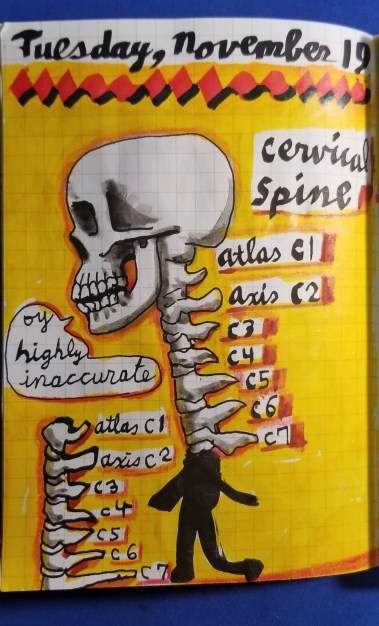
Scientific drawing:

In the spirit of Leonardo Da Vinci 


20191119_213130


POLITICS


Cutting through Mueller’s legalese to draft articles of impeachment

The problem for the Trump impeachment is not a shortage of impeachable behavior, it’s an overwhelming ongoing pattern of high crimes and misdemeanors.  The challenge is putting the worst of it into a few easy to understand sentences, strong articles of impeachment subject to proof based on irrefutable evidence.


Bill Barr defends the Unitary Executive

In Bill Barr, president Trump has found his long sought Roy Cohn, the fiercest, most powerful attorney a president could have — Trump appointed him  head of the Department of Justice.  Barr has been tireless in protecting his boss.   He is currently traveling the world to assemble evidence that the Independent Counsel’s report, which according to Barr exonerated the president of all wrongdoing, was a partisan witch hunt– the six convicted close presidential aids charged pursuant to the investigation notwithstanding.

One more treasure from Bill Barr’s 11/15 speech to the Federalist Society

I can’t help it.   Just read the remainder of Barr’s recent remarks in detail  (looking for his apparent, and telling, ad lib about Secularists — not found in the original text) and this gem was too beautiful to ignore.  In arguing about how wrong it is for courts to second-guess the actions of a conservative president, he offers this:


Take Your Inspiration Wherever You Find It

Here is a bit of inspiration for those who can take it. Admittedly, I’m not the typical hero of an inspirational story, I haven’t had that great heartwarming moment of underdog triumph we are used to seeing in movies, hearing about in author interviews on Fresh Air.  I have achieved little in the outside world, though my inner world, where I live most of the time, is a place I can recommend highly.  I offer this encouragement to follow your impulse to delve, imagine and create, and to go boldly where it leads.

The world will grind you down, constantly, it is a machine that seems designed to do that to most of us.  It doesn’t give a rat’s cuisse about you, your thoughts, desires, what you love, what you need, what you think you deserve. It is run, down to the smallest subdivision, by the most desperately misguided, almost by definition. The most driven, entitled, selfish, forceful, corrupt and violent will often decide matters for everybody else. Look around the world, it is largely run by vicious motherfuckers who did not get to rule everybody else by chance.

At the same time, the natural world is an infinitely beautiful place – a miracle. Plants, animals, the sky, the oceans, rivers, mountains, the ground you walk on, what is under the ground you walk on, its colors, tastes, sounds and smells. Human imagination is a miracle. Unimaginable things are routinely accomplished by our puny fellow earthlings. Our ability to communicate using combinations of symbols, as you and I are doing right now– no less miraculous for being also somehow explainable. Empathy and kindness from strangers, another characteristic of the species, another kind of miracle. Is there a miracle greater than the intimacy we share with those we love?

Leave aside the destructive myths of the cultures we live in, the false values that cause untold suffering to the vast majority of us, the vain, heedless leaders hellbent on destroying the marvelous planet we all live on. Human creativity, that eternally surprising source of inspiration and hope, and the unshakeable will to do something new and amazing, are among the best parts of being human.

I’m typing quickly, I’m excited, following this thought. I’m in a hurry now, hastening to urge you, and myself, to take inspiration at every opportunity, from wherever you find it.

I’ve been listening to the remarkable Robert Caro reading his book Working. In it he collects a few thoughts about how he goes about his work, gives a few choice illustrations, assembles some notes for an intended longer memoir he hopes to write one day. He is now in his eighties, and working on the last volume of a vast biography of LBJ.  Before he embarked on that work of several decades he wrote his first, now famous, ground-breaking study of power, his tome on Robert Moses, The Power Broker.

Caro has a great, down-to-earth New York accent and he speaks and reads his writing beautifully.  He is a kind of genius. When he was broke, and feeling desperate, five years into his work on his first book, the study of all-powerful New York City colossus Robert Moses, he found himself, several times, almost at the end of his faith in himself as an author.

Each time he felt about to give up and go back to working for New York Newsday, at the time a crusading liberal newspaper on Long Island, he managed to catch a break.  At one point it was a literary agent who got a sum of money for him and his family to live on as he continued to work on the book. Beyond that, she told him the New York literary world was already abuzz, very excited about his upcoming book and she found him the perfect editor. Later, when his faith was beginning to falter again, the stroke of good fortune was a key to a research and writing room at the New York Public Library.

This is the inspirational bit I am getting at. He was in a kind of despair that he might never be able to finish the massive book he was working on. Originally, naively, he’d envisioned taking a year to research and write it. Then it was two years, soon it stretched to five years and a million words.  He was trying to get at how power works in the world, using the person of the most powerful man in New York City, an unelected public builder who ruled for half a century and inexorably shaped the city forever.  He was writing a biography of Moses as a way of laying out the workings of political power.

Understanding how power works entailed learning and telling the stories of the many anonymous people screwed by the exercise of power, to get at power’s effects in the real world, on the daily lives of millions affected by it.  These anonymous people were hard to find, it took a lot of work to locate them.   The more research he did, the more interviews he conducted, the more he wrote, the more questions emerged and the further he seemed to be from the end of the gigantic project he’d devised for himself.

His wife had sold the family home she’d inherited, that money was gone, after some desperate days the additional advance from the literary agent was allowing them to rent an apartment as he continued to work in a tiny rented space, but his isolation as he worked was taking its toll. At the newspaper he’d been surrounded by colleagues, worked closely with an editor, got support from seasoned investigative journalists, had constant feedback and tight deadlines. Working in the tiny Bronx office he rented he was alone with his massive assignment.

He began to realize how much he missed the company of other writers, people who understood and could relate to the lonely work he was driven to undertake. He started thinking he might never finish the book, five years seemed an eternity and he was nowhere near done.

Off of the large research room at the main branch of the New York Public Library, there was a smaller room for several authors with book contracts who were doing research at the library.   Caro was given a key and a desk where he could write and keep the books and other files he was working with.  There were several other writers working at other desks in the room. Everyone worked in silence and for a few days he didn’t talk to anybody.

One day in the grubby library cafeteria (“grubby” I believe is the word Caro used) a writer he admired asked him about his project and how long he’d been at it. It turned out five years was not unreasonable, this writer had taken longer to research and write a book Caro had prized. Another impressive writer told him a similar story.  Suddenly he was not an outlier indulging a fantasy that could never be realized, he was a working writer trying to see an ambitious project to completion.

He reports how the simple revelation of these facts by two writers he greatly respected made him feel like kissing each of these men. You can feel his relief in the way he tells the story.  I take inspiration from his relief.

I don’t have Caro’s elite education, I went to public schools all the way through graduate school. I don’t have his background as an award-winning investigative journalist who spent years honing his craft under the watchful eyes of skilled editors and seasoned reporters he admired.  I don’t have Caro’s prodigious work ethic, if I’m being totally honest.   I work in my own imagination, in almost complete silence. Once in a while I write something that moves someone I know and they send me a quick email or text to tell me so. That is as close as I come to the world seeing me as a writer.

I write every day, as I have for many years. I’ve become good at setting things out clearly and I have a short shelf of books in mind to write. The tools are sharp, and waiting for me every time I sit down to write.  I write with a great appetite to set things out as plainly as I can and I rarely hesitate to write what’s on my mind to tell.

I had a remarkable conversation with my father the last night of his life. In that confession, which I heard with the mildness of a good priest, a whole life was encapsulated, sorrows expressed with terrible regret. My father candidly said things that night that he’d fought tirelessly to deny for all the years I knew him. A nurse friend later told me this happens sometimes to people close to death, Death hovering nearby can have this truth-encouraging effect.

Searching for a way to make some money, I learned from a writer friend about a website that pays $250 for short pieces about the experiences of Baby Boomers. I’d told this guy many stories over the years, including the story of my father’s deathbed conversion.   He told me to write some up and send them to the editor, that these family stories were just the kind of thing this website buys.

I sent the highly condensed story of a combative childhood, the constant war around the dinner table, the screaming every night, the verbal abuse. The call from Florida, decades later, father admitted to the hospital, time running out, rushing to Ft. Lauderdale airport. That final deathbed conversation, where my father, with almost no time left on the clock, told me he should have been mature enough to have had real conversations with his children, that the eternal, absurd black and white combat had been his fault. “You’re supposed to have some fucking insight…” he said in that raspy dying man’s voice. I told him it was OK. He died the next evening as the orange and pink Florida sunset outside the hospital windows turned the palm trees into silhouettes.

After a few back and forths during which I cut the piece from 1,500 to 1,000 words, it was published on the website and I had my first $250 check.  I had a bracing moment reading it on-line.  The editor had changed a few lines, swapping in a cliché here and there for a well-chosen, precise description, and in one egregious case, rewriting an entire sentence to make my narrator an insight-challenged idiot who could not understand how his mother could have loved his father, something I understood very well.

He left the next piece I sent him virtually intact, and sent me another $250, and he also loved the third, which he promised to publish soon. When I got no check for the third I inquired and he told me he thought he’d sent me an email about changing his mind. The piece was great, he wrote again, but maybe a bit too edgy for his audience. I sent one or two more but got tired of having this ham-fisted editor as the arbiter of whether my work was worth the fee. I should have begun flinging these pieces, and others, over the transoms of every magazine out there, but I didn’t.

Instead, I set out to write the book of my father’s life and times.  Every day I’d make a cup of coffee and sit down to recall what I could of my complicated, difficult father.  It was work I greatly looked forward to every day.   A man of charm, great intelligence, dark humor, idealism, sensitivity, my father was, at the same time, a broken soul who generally acted like a merciless, prosecutorial dick to my sister and me.

I proceeded on the theory, initially, that I had to show the traits that endeared him to so many, his wit, his empathy, his championing of the underdog, his intelligent counsel, and then dramatically contrast them to the dreaded monster he turned into in private during the ruthless nightly battles over dinner.  A monster! Jekyll and Hyde, something dramatic that the kids would want to buy.

After the intervention of my father, in the form of his talkative skeleton, and more than a thousand pages written over the next two years, and a year thinking more about the book I was trying to write, I came to realize that my initial theory had been crap.   Irv was an ordinary, even typical, man of his generation, of many generations. His story was not about a monster but about the crushed dreams of a little boy who’d grown into a man, doing his best, but always fearing the worst. A man, like all men, who wrestled with terrifying demons, not always elegantly, not always without damaging those closest to him.

My life was basically over before I was two,” he said with infinite sadness, yet without self-pity, that last night of his life.  By then I knew exactly what he was referring to, and he knew that I knew.

The story of a life is an elusive thing, it changes radically depending on your point of view, your proximity to it, how that life affects your life. Your life, my life, how do you summarize it?

Robert Moses was very unhappy with the detailed portrait Robert Caro painted of his life in The Power Broker. He wrote a seething 3,500 word refutation of Caro’s book, based on the excerpts of it he’d read in The New Yorker. He wrote like a haughty, angry child who’d gone to the finest schools. Larded with obscure literary quotations and references to the classics, defensive and pretending not to be, from beginning to end it was the wounded cry of a man who felt he’d done great things, for millions, without a bit of gratitude.  A master chef who had made the world’s most beautiful omelets, admittedly having broken a few eggs in the process, a thing impossible to avoid, and whose artistry was so unappreciated.

The half million people Robert Moses had summarily evicted from their longtime homes, destroying their neighborhoods (like my mother’s) to build his dream projects that allowed cars to drive quickly through what he regarded as former slums?  “You can’t make an omelet without breaking a few eggs” was how he summarily  refuted that assertion by the scurrilous Mr. Caro.   You can read his 3.500 words here

In trying to fairly assess my father’s life, the valuable ideals he instilled and the terrible harm he inflicted on my sister and me, I found it necessary to talk things out with my dead father. There was no trove of documents to read through, no witnesses to interview, no writings left behind to ponder. There were only my memories, my intimate knowledge of the man, and the hints of a final conversation between us that should have started decades earlier.

That last chat was a good starting point for a relationship, then he was dead. I was glad to hear that I was no longer being blamed for the whole long series, senseless skirmishes, relieved to finally be let off the hook as the instigator of all the ugliness between my father and me, but then… poof! the suddenly reasonable man was gone. All that was left was the image of his skeleton, sitting up in his grave outside of Peekskill, piping up from time to time, giving me someone to discuss these perplexing mysteries with.

I started writing the manuscript daily in 2016. I worked on it every day through the end of 2017. Then, overwhelmed by a rambling 1,200 page draft that had not yet captured a real likeness of my complicated old man, had only touched on the damage he’d done, the deeper lessons of his life and the inspiration he left behind, I found myself sucked into the swirling toilet bowl of the ever-distracting, attention craving Donald J. Trump and his destructively transactional worldview.

Trump, for his part, was fond of saying that his father, the ruthless Fred Christ Trump, was his teacher, his mentor and his best friend.  In more honest moments, the second youngest of the five Fred and Mary Trump children acknowledged that Fred was a hard man, ambitious, demanding and impossible to please. Young Trump, paid $200,000 a year from birth for undisclosed work he did for his father as a baby– his life was basically over by the time he was two.

Inspired by the example of historian Robert Caro, I feel like I’m ready to get back to work on the book of my father. Take your inspiration wherever you find it. Here is Robert Caro on the time-consuming search to get as close as we humans can come to historical truth:

The part of me that, now that I was writing books, kept leading me, after I’d got every question answered, to think, in spite of myself, of new questions that in the instant of thinking them I felt must be answered for my book to be complete. The part of me that kept leading me to think of new avenues of research that, even as I thought of them, I felt it was crucial to head down, it wasn’t something about which, I had learned the hard way, I had a choice – in reality I had no choice at all.

In my defense, while I am aware that there is no truth, no objective truth, no single truth, no truth simple or unsimple either, no verity eternal or otherwise, no truth about anything, there are facts, objective facts, discernible and verifiable, and the more facts you accumulate, the closer you come to whatever truth there is. And finding facts, through reading documents or through interviewing and re-interviewing, can’t be rushed, it takes time. You could say that truth takes time.

But that’s a logical way of justifying that quality in me and I know it wasn’t only logic that made me think I’m never going to write about a crucial election, a pivotal moment in my subject’s life, and say that no-one’s ever going to know if it was really stolen or not until I’ve done everything I can think of to find out if it was stolen or not.

I could not track down the character who had falsely counted the votes for LBJ in that long ago local election, and perjured himself in a court proceeding decades earlier, and interviewed the now regretful old man, as Caro managed to do.  All I can do is imagine and re-imagine my dead father’s life, in light of the discussions his skeleton and I have had, taking into account every fingerprint he left on my own life and on my sister’s.

Come to think of it, I haven’t heard a peep from the voluble skeleton in many moons. Probably time to wake him up, we have a lot more work to do if I’m going to get to the bottom of this challenging puzzle I’ve been assembling in this dark room.

Take inspiration from my determination, if you can, as I will also try to.