My Mother Reads

Driving back to New York from the outskirts of DC, where my once difficult aunt and still problematic uncle live in a well-kept, depressing home for unwanted old people, my dead mother is reading a story by Grace Paley.   The sun is fading behind the car like a world disappearing into the past as my mother reads the story like she’s one of the little girls, later women, arguing on that Bronx stoop.

“But Edie!” my mother pleads as Ruth, the perfect Bronx six year-old.   I used to buy my mother journals, try to get her to write, but she always complained that she couldn’t.  To hear her read a story, you’d never believe she couldn’t write one, she reads the stories exactly the way she would have told them.  Plus, toward the end she often spoke happily about how much she loved to lie.  She was pretty creative with some of those lies, too, and sneaky fast.

Eventually tears came to my eyes, driving as the daylight died, my dead mother’s voice coming through the car speaker, reading with such feeling, such understanding.   I used to urge her to write, she’d get defensive, then mad, but it wasn’t like I was writing.   I mean, I was writing, but I wasn’t out wrestling with other writers, proving my prose could kick their prose’s ass.  I wasn’t promoting myself, fighting the brutal fight to get recognized and paid, though my mother would once in a while read some pages I’d give her and smile and sometimes say “this is wonderful”.

“So your dead mother was a fan of your writing, how nice that must be for you,” says the guy standing on my head to get where I thought I was going.

The emotions I felt listening to my mother read, I’ll spare you.   How did I get the cassette?  It was found, by chance, in a box of tapes by my first cousin, my only cousin, really, as he was preparing to put the torch to his childhood home.  His older sister died young and I’ve tried to be more or less the brother he never had, he’s been the brother I grew up lacking.  We come from a very small family, most of the rest murdered en masse or dead of cancer.  Our two mutual grandparents, cancer.  His sister, cancer.  My mother and father and both of my mother’s parents, cancer.

“That’s impressive,” says the writer, eating my sandwich, drinking my single malt Scotch, dainty feet up on my hand tooled Corinthian leather divan.  He has all my stuff neatly arrayed in his condo.

But it’s not the cancer I’m thinking about, though on the same trip we visited a brilliant, patient, gentle man with a wise, slightly reptilian smile always at the ready, with stage four lung cancer, it turns out.  Explains a lot about how he looks.  He looked bad right after the radiation, but, even with his hair grown back, he looks bad now.  But he’s cheerful, taking every moment as a gift and planning on hanging around.  The new chemo is holding the tumors at bay, and he’s thankful for that, even with all the terrible side effects.

As I drove north, musing, I was unaware that a large library had fallen out of my pants pocket, onto the ground somewhere, probably at a Maryland gas station, with a tiny plink I didn’t notice.   My mother would not believe it, all the things that were on three tiny drives on a loop of black cord that together were no larger than a finger.  Maybe 2,000 pages, probably 1,000 tunes I’d recorded over the last few years, 200 short animations, maybe 500 drawings.   I have no idea what was on those flash drives, how to reconstruct them, back them up again.

Sekhnet was all solicitude, too much, really.  Her cousin reassured me that I could recreate the flash drives from my computer, probably.

It was almost like the gift of the found tape, recorded in 1986 when my mother was Sekhnet’s age, was cancelled out by the lost back up copies of my life’s work.   Why I was carrying my life’s work around in my pants pocket is a bitter little puzzle, at the moment.  As for the tape my mother recorded and sent to my aunt, another mystery.  

My mother once offered me $2,000, then quickly $3,000, to reschedule my court appearances and come to Florida for the week my aunt and uncle would be there visiting her, not long after my father died.

“You can’t leave me alone with them,” she pleaded, “I’ll jump out of my skin, just the thought of it.  If you love me, you’ll take the money and come down here when they come.  Please, Elie, there’ll be bloodshed.   Six days!   I’ll pay you!”  There was nothing phony about her desperation.  

The funny thing is, twenty years earlier she’d sent the tape of her reading Grace Paley stories (probably from the book of them I’d given her) to her only sister-in-law, the same woman she probably would have paid 5 Gs to be protected from.   By the way, I earned every penny of that $2,000.

“Your parents both look good,” I told my cousin at breakfast that last morning.   

“Way to kick me in the nuts!” he said, alarmed, echoing my mother’s tone as she bribed me to protect her from them.  “Why don’t you just take this fork and stab me in my right testicle?” he said, offering me the fork.

My uncle is 86, and except for the fact that he’s in a wheelchair after a stroke a year and a half ago, he looks like he could live another ten or fifteen years.  My aunt, a few years younger, also looks good.  Whatever serious health worries she’s had seem well in the past.  She’s steady on her feet, eats with a good appetite, the mild dementia agrees with her.

“I’d trade both of them for your parents, in a heartbeat,” my cousin said.  I nodded and chewed my breakfast, and thought of that ledger on which all our deeds are tallied.
Intentions

bulletin 

Intentional kicks may actually hurt more than accidental ones, least hurtful being accidental, followed by a quick, sincere apology, a new study suggests.   A thought experiment, actually.

There are thoughts that hurt, like words, and thoughts that can heal, like proper words at the needed time.   Thoughts can freeze right action in its tracks, lead directly to tissue death, heart failure, horror.  

Thoughts can also open a window high on the wall, gracefully fly up through that window to wherever you want to go.   Words discourage and disable, words encourage and enable.   Deeds, same, same.   Silence, same.  What you think the world is– it is.

For example: there are, it is said, a thousand reasons for the thing to fail, but only one needed for it to flourish.  

Smiling faces may smile for different reasons, but a real smile strikes a certain beautiful harmonic note.

There are people who look good, have winning personalities, charm and talent, who assure you, through proxies, of their affection.   You want to believe them, whether they mean any of it or not, because they are such appealing people.  And it is shame on you if you let a mistaken belief in friendship shake you up.  

 Take off the fairy glasses, man, yer old to be so naive.

Some kindness is done with great intention.   Some is done with no thought attached to it at all.  This unintended kindness may be the greatest kindness of all.  The same holds true for unkindness.

The Return of the Bad Karma Kid

Like bad breath that lingers in a closed room forever, bad karma, the lack of faith in other people’s goodness, stinking in a cloud around him.  

“I had to fire him,” he said defensively, talking to someone he considered a moralist,  or at least a person of high morals,  “his replacement was so much better than he was, it was a no-brainer.”

“I took him to court and I beat him.  I win every time I have to take someone to court– an unblemished winning percentage.”

“I made more money last year than you made in your entire life, and I’m making 40% more this year,” he put his cigar out in the kid’s hand.

The kid, I knew, didn’t need my help.   He made no sound when the cigar tip hit his hand, only a quick downward movement and the burning cigar was on the ground.  A half second later Mr. Bad Karma had a terrible expression on his face, and the next second he was on the ground, wincing.

“Violence is not the only answer,” I said to the kid, while at the same time, I couldn’t help but admire how quickly he’d resolved the karmic quandary.

http://www.youtube.com/watch?v=yL0YBXwXNIg

The Unkindest Cut

I’d be hard-pressed in this world of pain, this world of pleasure and pain, to call one cut the unkindest.  I recall a teacher describing his worst terror, the moment he might have to take his clothes off to make a point about teaching, or character, or life.  Not a far leap from that to being forced to strip and then machine-gunned into a ditch, that’s a terrible one, unkind and also a deep cut.  A sister whose rage will never be soothed in this lifetime, or a brother who will never forgive the rage, in spite of his sacred vow.  Nation who will always lift up sword against nation.

There’s the image of being on the outside of a space craft, alone in black silence, the smug robot inside, reading out your remaining oxygen levels in that robot singsong.  Friends bailing with both hands, all their servants also there, bailing hard, all the possessions in the world under that water and no time to sing harmony or even think about music.  There are massages that will never be had, laughs never laughed, debts that can never be repaid and gifts squandered ungratefully, mercilessly.   Cancer.    There are terrors more real than the hand that is on you trying to calm you down.

There are many unkind cuts, and they all hurt.  There are cuts so unkind we can only describe them by crying.   Or bending an Eb note up to E, over and over against the vamp, another way to weep, as in this example:

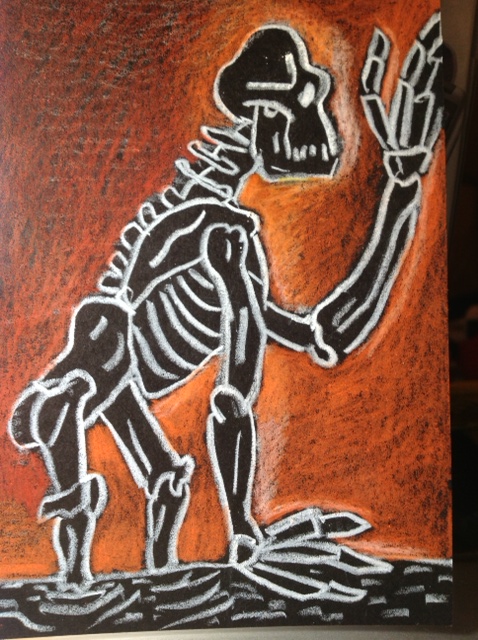
Image

see you in the boneyard


Experience

Deeply experienced things remain, even years later.  The moment, the light, how things smelled, facial expressions, every tiny unverifiable detail is contained in the memory.

I remember sitting on a stone bench on a cool evening, watching a gangly puppy’s uncontrollable excitement as he discovered the delights of eating deer shit.  “Let’s not mention this to her,” my friend says, laughing, raising a shot of excellent scotch.

Painful experiences are also in there, no doubt.  The blessing is that the beautiful experiences, though sometimes more subtle, more elusive, are just as strong as the other kind.


My Father’s Wit

My Father’s Wit


My father, may he rest in peace, was one of the fastest people on his feet I ever knew.  At least as far as a clever rejoinder, he was very quick on the draw.  He wasn’t always good at responding to other situations in real time, few are.  Those quick on their feet in every situation are the stuff of Hollywood movies, there aren’t many of them.  But in conversation my father was as quick as anyone in the witty comeback department.

I’m reminded of this because I was just lamenting to myself that I need to get more chores done, crucial unpleasant appointments made, business taken care of, in addition to daydreaming and planning all the time.  Granted, my daydreams and plans seem to be budding and I can almost see the flowers that will be the fruits of this long labor of dreaming and planning, but still, I need to do chores.  I also recognize that I’m fortunate, at the moment, that I am not lashed to the wheel of having to work to pay my rent  today, or tomorrow, although that day is looming.  So while I was bothered by my reluctance to take care of needed chores, and reflecting on my good fortune not to have to report to some hideous job every day, my father’s voice came into my head.

“You’d complain if you were hanged with a new rope,” said the old man.

What Would Gandhi Do?

Let’s say someone made multiple derogatory comments about your religious group, asked you to do favors under a tight deadline that you delivered and that they then ignored, made a promise to you they then violated and informed you of in a cc in an unrelated email?  Let’s say the success of your fledgling nonprofit organization was in some way dependent on this person and that the broken promise related to the very existence of that outfit.

Few would probably blame you for being upset, hurt, angry or all of the above.  The question is, what would Gandhi do?  The other question is: what would Bruce Lee do?

I wrestled with these questions for almost a week.  It was not an easy wrestling match.  In the end I decided that Gandhi and Bruce Lee would do the same thing.  Take a minimalist approach that deflects action back on the other party.  Responding to the cc’d email that informed me he had no intention of keeping his promise to the organization I wrote: don’t worry about it.

It didn’t take long for him to put on his clown costume and begin capering.  But I’m not worried about it.

Styles of Rage

As a child I was treated to several styles of rage as part of my regular diet.  I’m just thinking about a few of them now and thought I’d try to make a concise list.

There was screaming, of course, that loud venting that would leap into flame after the aggravations had mounted sufficiently.   What must the neighbors have thought of this pleasant, bright young family who went into their house to scream at each other?

There’s physical violence, of course.  My parents were both survivors of it and had inhibitions about inflicting it on their own children.   As a result my sister and I saw little of this in our house.  My mother hit me two or three times, a remarkable feat of restraint if you consider all the provocation she had.   Each time she had cause to weep afterwards.  

Once she swung at me wildly, knocked a hanging lamp off the wall over my bed, where I was ducking, and sent the rickety appliance flying, hot light-bulb down, to burn my cheek and the corner of an eye lid.   You can bet she cried after that.   The only other time I remember her lashing out with her hands her wedding ring turned the wrong way on her hand and the diamond wound up cutting me right next to an eye.  Oh, boy, was she upset after that.  You know, it’s funny til someone loses an eye.

My father, who my sister accurately dubbed the Dreaded Unit, was not much of a hitter either.  The DU’d grab you, sometimes, reach back from the driver’s seat to squeeze a wrist with anaconda-like force, but he didn’t hit much.   He didn’t need to, really, his verbal violence, while probably embarrassing to him if he’d ever heard it played back later, was exceptionally powerful.

Of course, the most eloquent of all is perfectly placed silence.

To a fellow blogger and my cousin J

There are two ways people go after being abused as children.  Both are difficult, but one is much better than the other.

Some people grow up to abuse others, become nightmare spouses, parents, friends, colleagues, bosses and leaders.  They feel they have the right to act like pricks, since life was cruel to them.

Others grow up to defend their loved ones from abuse.  They feel obliged to model caring behavior, to protect others.   They become beacons of hope in an often indifferent world.  

Deep feelings can change our hearts, for better or for worse.  But better is better.

I Did It, I Can’t Believe It

I saw a well-done Hollywood biography of the Notorious B.I.G., Biggie Smalls, the talented fat kid from Brooklyn.  I saw this movie on TV not long before my mother finished dying her long, lonely death.  I was often sad in those days but I couldn’t cry, even though my mother was in the last weeks of her life  — this movie made the tears flow.  I sobbed because this kid had seen the light, and was, in the screenwriter’s convincing story, making peace when he was shot in revenge for a killing he tried to stop.

I must have cried for ten minutes after the credits rolled, as Angela Bassett wipes her eyes as half of Brooklyn comes out to line the streets where Biggie lived, larger than life, rapping, rhyming, styling like TJ, the Master and mf.

In the Hollywood version he was played by a charming, charismatic actor, a quick witted mostly jovial young man, also quite fat.  He’s mean to his women, breaks his mother Angela Bassett’s heart, and he is a criminal and a thug.   A friend takes the rap for him and goes to prison telling Biggie “if I do this for you you can’t waste your talent, you’ve got to succeed– for all of us”.   By the time the friend gets out of prison  Biggie is a huge star, has an accident and is recuperating in the hospital.   The friend goes straight to the hospital bed and is disappointed in Biggie.   Biggie realizes he’s gained fame, and success, but he’s still  an unredeemed asshole.

And, in the movie, he’s moved by this realization and  he begins to change.  He wants to make amends, seeks forgiveness.  He doesn’t want to hate anybody anymore, and he doesn’t want anybody to hate him.  He makes peace with his ex-wife, his ex girlfriend, starts spending time with his daughter.  He wants to be a positive model for the people he loves.

When he goes back to the studio he doesn’t want to record another  violent, incendiary album, what his fans are hungry for.  He regrets the bad influence he’s had on millions.  He wants to make a tender album, rapping from the heart instead of his killer persona, but he’s afraid people will think he’s weak.

He’s terrified, as he begins to record, with no street bluster to hide behind.  He’s scared  of how weak he must look and afraid to listen to the playback.  But when he hears it a smile comes across his face as soon as the first vamp comes up in the headphones and he starts to shake his head slowly from side to side.

“I can’t believe it,” he says, shaking his head to the slow beat, “I did it…  I did it!” and he laughs, and keeps the beat with his head, and his friends around him at the console all smile too.  The actor who plays Biggie keeps smiling, closes his eyes and floats away on the music.  

In the movie’s next scene he’s shot dead from a passing car.  Then all of Brooklyn is mourning him on the streets as his body comes back for one last ride through the streets, and Angela Bassett looks on weeping, and I’m sobbing long after I turn off the TV.

And then, tonight, after I mixed this clip of the first two animation workshops  I started to laugh.  I said to myself  “I can’t believe it, I did it.. . I did it!”  I pumped my fist in the air as I jumped out of my chair, then I watched it again and again, with and without the headphones on.  I’m smiling as I type this, and I’m laughing too, to think about it.

(animation clip here)