The lesson of my father’s life

The painful regrets and too late apologies my father recited the night before he died dramatically illuminated mistakes to try to avoid in my own life.    My father had a quick wit, was sensitive, well-read, thoughtful, well-spoken.    He also saw the world as black and white, a zero-sum game that had only winners and losers.

“That’s not really how it is, Elie,” he told me in that weak dead man’s voice the last night of his life.  “I wish I’d been able to see the many gradations and colors of the world,  I think now how much richer my life would have been…”

As he was leaving the world he regretted his maniacal focus on being a “winner”, a silly abstraction in a game that everyone, in the end, must lose by giving up life, consciousness, all possessions.  Being a winner to my father meant never tolerating disrespect, and, more precisely, never losing an argument.   He was a strong, confident debater, even if he reflexively exerted this well-exercised power on his young children.   He deeply regretted this lifelong mistake and the merciless burdens it placed on his children, expressing his sorrow in a weak voice about sixteen hours before he breathed his last breath.

He came by his obsession with winning honestly, early in his life, but I think the word ‘winning’ is more properly rendered ‘surviving’ or ‘maintaining integrity’.   He’d been born in desperate poverty, raised by a cruel, violent, religious mother and a father of few words whose main concern was not getting beaten any more.   My father told me that he and his little brother were earmarked as classic losers, the sons of a brain damaged man, from day one.  Their future was decided by their uncle and his brilliant son and daughter — the Widem boys would go to trade school, learn to work sheet metal.   They were fit for nothing higher, in the opinion of the people in charge of the family.    Both made it to college, graduate school and the middle class, in spite of the odds against them.

 The fear and the indignities of their childhood never left them.  It didn’t help, of course, that all but a couple of their many aunts and uncles were slaughtered in a Belarusian hamlet that was wiped off the world map forever.  

“Elie, not to be a prick or anything,” said the skeleton of my father from his grave in Cortlandt, New York, “but didn’t you recently write over a thousand pages about my life already?   Presumably there were lessons in there too, I mean, in a sense, wasn’t that why you started the process in the first place?”    

Yes, of course.   My focus today is a little different, though.    

“Not seeing the sad parallels between my essentially solitary life and your own?   Locked in an endless battle to be conclusively right, in spite of your dedication to non-harm, or what did that little Indian guy who slept naked with his naked teenaged nieces to show he could overcome lust call it– ahimsa.   You know, you can be absolutely right and at the same time blind to the effect your insistence on being right has on others.”    

Jesus, dad, you’re reading my mind.   What I’m thinking about glancing from the computer screen to the window out into the grey afternoon, are the choices we make, how we use our time.   Not everyone is wired to think deeply on the things that vex them.    

“Well, I had a large part in wiring your brain that way, providing endless vexations for a small boy with a curious, nimble mind to brood upon.   Your imagination is a blessing and a curse.   Imagine less, sometimes you’re better off.   Look, clearly, you’re imagining these words of mine now, I am now but a long-time skeleton, a literary conceit, and maybe, at this point, also a tired one.   A rubber crutch, if you will.”

Funny as a rubber crutch, the jokes that killed vaudeville… 

“Yeah, listen, Elie, you write everyday but nobody is all that interested until a book or an article comes out of it.  Nobody you know is capable of being interested in that ton of verbiage you produce, even if most of it is well-written, even if some of it is genuinely insightful.    As that alcoholic dispatcher at Prometheus used to sympathetically tell you all the time, whenever you complained —  ‘nobody cares, nobody cares.’  

“A writer writes not for the handful of readers he or she knows, they write for people they don’t know, and they get paid to do it.  You grasp this, and yet, you are constantly disappointed that nobody you know gives a shit.  Nobody you know gives a shit, only you can care about this uncontrollably prolific output.   Trust me on this.  Get some of your writing in print and they will be very happy to be happy for you, even read it.  Were they not all happy for you when you got a few words published and paid for?”

Yes, they were unanimously happy for me, every one of them.    They read each of those hamfistedly edited thousand word pieces, loved ’em.

“I know what sent you to the keyboard to write this today.   You’re wrestling with a need to be right that suddenly seems to you uncannily like my need to be right, a need you correctly condemn as primitive and conflict-producing.   The need to be right is deeply human, it’s also at the root of most human conflict.   Most people when they begin fighting with an old friend, have the same fight a few times, conclude the other person is not worth fighting with and walk away.   The person who keeps fighting is an unreasonable jerk, not a friend.  Done.  

“You don’t do this, though, do you?   You’re always looking for some kind of deeper principle about the way friends should treat each other, why this person is not a friend but a deluded, clueless antagonist.   You write thousands of words about it, like you’re insane.  You think you are working out some dark puzzle about human nature, but, seriously, Elie, what the fuck?”

That is what I am wrestling with, all of the above.   If we are to live principled lives, isn’t it necessary to clearly understand the principles we live by?

“That depends on how many angels are dancing on the head of a particular metaphysical pin.  Yes, you’ve come to the same conclusions about particular people that I did when I was alive.   We disagreed about my need to condemn and walk away from them, and years later you came to the same conclusion I did.  So what?   Why should this concern you?   The old lady who constantly lied, taught her daughter to lie, who in turn taught her son and insane daughter to lie— where is the mystery in any of that?  The woman who did not know how to not fight kept irrationally fighting with you?   Quelle surprise, monsieur!   as we used to say in Peekskill.  What is this sudden torment today?”

I want to nail the lids on the coffins of a trio of glowering vampires.  

“God bless you, then, son, that’s what you do with vampire coffins.   Why even agonize a second about taking a stake to the undead?   Take a hammer, or a rock, and nail that shit closed, bang! done, next case!    Lights, camera, action!  Enough with the Hamlet routine– be done.”

The chill that is making the trees outside this window tremble creeps into this room.  The fading light outside a premonition, touching me lightly with Isaac Babel’s cold, dead fingers.    The imperative keeps goading me — to find a resting place for my thoughts.
The Saddest Punchline I know

It’s funny how much clearer a thing sometimes becomes once it’s dead, its lifecycle complete.   It happens with people, and beloved pets and it happens with relationships gone wrong.   You see the thing whole, finally.    I recently lost a friend I’ve known since we were eight and it’s been bothering me for some time, exactly how the friendship became toxic, why it is now so intolerable to me to be treated the way he continues to treat me.

Now that our long friendship is truly dead, the whole outline is there for me to see.  Today I got the last few elusive pieces to complete a sorry picture I could not, for the life of me, truly understand.   Now I finally get it.  The punchline is deep, but about the unfunniest one I can think of at the moment.

He seemed to look up to me and often competed with me, and I never knew why.   Years ago he told me to use a certain gauge of string on my guitar “you’ll feel better about yourself,” he told me unaccountably.   His vying sometimes took insane forms.   

At some point he found he could make me angry by being provocative and steadily ignoring my mounting aggravation.  As my feelings got more unpleasantly stirred, and he pressed on stirring, I’d eventually react with anger, restraining myself each time, but barely.   This sick pastime seemed to become a tic with him.   I really believe he actually could not help himself, it gratified him, somehow, to see me angry.

His wife, who I was quite friendly with [1], was often furious with him because he was not always honest with her. The thing she hated most was a liar, which I can understand, since without trust, what do you really have with another person?   Funny to say, his occasional untruthfulness never bothered me that much, though I prize honesty more than most things.  

It also outraged her that he never stood up for himself, except against her.  I think this enraged her even more than his occasional looseness with the facts.

My childhood friend’s wife weaponized a casual remark I made to her and deployed it to crippling effect during a marriage counseling session they were having.  “Your best friend says you’re a fucking liar too!” and she took my remark, which she bent to her use, and whipped him across the face with it until he was bloody.  

“And you’re not even man enough to stand up to him!” she later told him.  The therapist apparently agreed with his wife that if he didn’t confront me, his marriage was over.

He showed up in a panic to confront me, his right eye actually twitching as he leveled his accusation:  you deliberately or recklessly tried to destroy my marriage, our friendship is probably over, it all depends on your answers.   I thought hard and explained things as best I could, as friendship demands — when you see a friend in anguish you do what you can to help.  I agreed that if I maliciously or negligently undermined his marriage, neither he nor his wife should be friends with me.  I described how my casual remark was weaponized and gave him reasonable things to tell the therapist and his wife.  I did this under pressure, but though he seemed calmed down, gratitude wasn’t in the cards any more than an apology was for the wild accusation.

I realized afterwards that things had clearly gotten out of hand and we needed to either stop the ugly cycle or call it a day on our friendship.   We spent five hours or more trying to talk it out, but he could not yield.   He would not allow that he’d been a shaky friend, put me in impossible positions, returned acts of friendship with repeated senseless provocation.  He defended his actions in detail and when I remained skeptical (it was at the end of five hours of this) told me he loved me.   I told him love is how you act when someone you care about is in pain.  Doing a dance and singing a song and telling your friend he is not really hurt when he is, none of that is  love.  Merciful action is love.

Provoking, being unrepentant, though you apologize grudgingly, explaining why you really didn’t provoke, how there was actually an implied apology that you’re lying about not receiving, well, that’s not really love.

One thing bothered me more and more.   With our estrangement I’d lost the friendship of his wife, his two sons, great young men, and a mutual friend who appeared to have taken his side in our impasse.   I wanted to know what my final unforgivable act against him had been.  I suspected it was my exasperated detailing of many the reasons I don’t respect him, twenty minutes into our five hour marathon, but I couldn’t be sure, since he never contacted me or sought to reconcile after our meeting went badly.  “It was a bad day,” he admitted today with some sadness, as close to admitting he’d been wrong in how he acted as he can get.

It took some time, and some work on my part, a series of calls and emails, but today he called me back to answer my question.  He did not want to talk about the past.  He felt it was a mistake to go over the hurtful things again, it would only lead to more and more conflict to go back over those mutually aggravating things.  It was both of our faults, even though he admitted without condition that he’d been wrong too.   His idea was that we just need to put it all behind us and continue on as if none of it had ever happened, just be friends again, like we used to be.   It struck me as an impossibly stupid idea and I told him why.  

With patience, about forty minutes in, I was able to get the answer to my original question about my unforgivable final act.   When we parted after the long talk he had no particular gripe against me, he said, in fact, he was still hopeful about saving our friendship.   After all, I had been for the most part mild during most of that long, sometimes agonizing conversation on that bad day for him.   It was after his wife called a week later to give me an ultimatum about forgiving him immediately and unconditionally or dropping dead that he learned the reasons to be furious at me.

His wife told him I’d made a secret recording of our conversation, which was a betrayal he simply could not forgive.   I explained the difference between being a fucking fuck who wears a fucking wire (for purposes of making a tape for others to use to incriminate somebody) and recording a talk, for personal use, with someone who has a famously spotty memory, is addicted to equivocation and energetic and nimble disputing specific arguable details.   This guy, I must point out, while very emotional, is also highly intelligent and skilled in the art of verbal self-defense.

The second unforgivable thing I’d done, and again, he qualified it, this was admittedly second hand, from his wife again, was that I’d told her that shortly into his bad day trying to make me accept his apology without having to take full responsibility for his actions, he’d made me mad enough to feel like socking him, throwing him on the ground and kicking him, just to make it stop.  In his opinion, and in his wife’s, that is simply intolerable to say about a friend of more than fifty years, no matter how mad you feel, no matter what the provocation might have been, no matter how many provocations in a row you’d been hit with.

I didn’t bother pointing out that I hadn’t laid a finger on him, that I used the image of violence to convey to his wife how angry he’d made me.  Fuck him, you know? Plus, of course, his wife, who I said this to (“to whom I said this”…), has felt exactly the same way about him countless times and understood the impulse very well when I said it.

Now here is the punchline, and it is as horrible as I promised.   

The real reason he was so angry at me was that I’d told his wife, and I had this insight only at the very end of a long talk with her, that the reason he always feels he’s in an unfair competition with me is that he has trouble standing up for himself and believes that I don’t.   “Rob feels like he’s a pussy,” I told her,  as it dawned on me, “and he believes, for whatever reason, that I am not a pussy, and he’s very angry about it.”    

“You are definitely not a pussy,” she told me.

Then she told her husband that anyone who could be friends with someone who says he’s a pussy is a fucking pussy she will not be married to.

Yow.  

It also turns out she never conveyed my conciliatory offer, made several times and emphasized, repeated once more as I said goodbye.   I told her Rob was welcome to call me as soon as he made some of the progress he promised he was striving for in therapy.   He needs to develop some insight about the often provocative effect of his actions on those close to him.   “She never told me that,” he said, sounding sad.

Lady MacBeth got nothing on this girl, nor does her husband either, for that matter.

writing as meditation

Young writers sometimes wonder where the line is between attempted self-therapy and writing that others will find worth reading.   It is a worthwhile question to ponder, though there is sometimes no bright line between writing to work out your own issues and writing to engage others.   It has a test, though, whether what you write interests somebody else in reading it.   Is there enough here, and in my own life, for me to identify with what the writer is writing about?   Does this thing I’m reading engage me enough to read on?

You are always the judge of that, reader.

At the moment I’m writing to meditate, to calm my roiled mind.  I spent fifty-one minutes an hour ago talking to a frenetic moral tap-dancer.   He could not allow, without condition, that what I was saying, though he told me he agreed with it, was actually correct because perhaps I was overlooking that other thing, you know, the thing?   Maddening, but thankfully the last conversation with this particular poor devil.   His wife apparently told him in no uncertain terms that only a “pussy” would continue trying to be friends with someone who suggested he was a “pussy”.   Thank god all that got resolved.

My next call was to the office of the urologist who cancelled my appointment on November 8 and has been silent since, in spite of my three calls, repeated promises from his receptionist that he’d call me, and a detailed email from me.  I was told, after a very short hold, by the director of urologic bureaucracy at the well regarded medical corporation, that she could not forward the email I’d sent for her to forward to the doctor, since he was not physically in the building until Thursday.   You can understand, I imagine, why this would be so.   My deep breathing facade cracked for only a moment, as I told her to keep in mind that this ongoing failure to respond to a patient’s legitimate concerns was approaching a medical ethics complaint.   She told me she’d keep it in mind.

There are many battles in this life that you cannot win.   They should not be battles in the first place, but they are.  It should not be a matter of winning or losing, but it is.  If there was a fair arbiter somewhere (there pretty much isn’t for most things) the fact that you are in the right would be weighed in your favor.  In many cases the fact that you are right, maintain your position and keep insisting on being heard, makes you a goddamned stubborn troublemaking loudmouth, a problem, a challenge, an adversary.

A Saudi prince imprisons his rivals for power, kills a few, makes himself heir to the throne, promises liberal changes in his medieval religious fundamentalist kingdom.  Suddenly an upstart Saudi writing for a prestigious American newspaper is criticizing him!   Bring him to the consulate, put a bag over his head.  Of course he will say “I’m suffocating. … Take this bag off my head, I’m claustrophobic.” (as reported by Al Jazeera, citing a Turkish reporter who allegedly heard the recording).    Suffocating, you say?  Oh, so sorry.  Here, let me chop off a few fingers for you, that should make you feel better.  We want you to be comfortable, your business is very important to us, please continue to suffocate.

How do we recover our humanity in the face of brutality?   My best bet is by sitting still, hands on the keyboard, and combing through my thoughts, setting them down as clearly as I can while I breathe.   It is not for everybody, I know, but it seems to help me.  I recommend it.   It is certainly better than smashing furniture or being mean to people.

It helps to think of justice and basic fairness, though they are both increasingly endangered in our world of alternative fact, xenophobia, race hatred and blame.   When people are in a rage, or defensive, they are not at their best.  They are, sad to say, probably at their worst.  They are capable of justifying every terrible thing and throwing the entire blame on you.   Look at the president insisting in a pre-dawn tweet that the Florida elections, though too close to call by Florida’s own laws, should be done, done now, stop counting ballots, infected ballots, while his candidates are still winning, clinging to statistically tenuous margins of victory.   

Yet, there is a sense of justice, and fairness, always alive in the hearts of people who are not enraged.  If you look at a situation fairly, and calmly, the answer is usually pretty clear.  Fair means looking at things from various angles, deciding which is the most just course to take in light of everybody’s needs and concerns.   It’s not that hard.

Unless you are an institution, with a corporate reputation to defend, or someone benefiting from a very unfair arrangement, or someone so aggrieved that you want to bash so-called fairness in its fucking face.   Blow the whole thing up.  Take explosives and make everything shred into oblivion, or do it with a gun, yeah, I said a gun!   These types often have the last incoherent word, then turn the gun on themselves.  Winners, don’t you know?

Don’t be like that, friend.  We are all better than that.

“Do you feel a little better now, El?”

ah, shut the fuck up…


Only in America, folks

Fortunately for me, I write quickly.   I dreaded having to write this note, but it took me only a few minutes once I sat down to do it.   Nobody should have to write this kind of note to their fucking doctor.  

Matt:

When I was “50 years young”  (12 years ago) you introduced yourself to me as Matt and gave me a card with a number where I could text you, and you were very good about responding to the one or two I sent.   Your current card has only a generic email address [1], so I am sending this there, to the attention of Glenice, who was kind enough to confirm that I should have been able to see you during my October 25th consultation with you.

On that date I saw only Nancy S______, ANP, who ordered tests, prescribed Flomax and told me I have to begin taking it immediately.  She also instructed me how to stand so that she could give me a prostate exam, though I had one quite recently and we agreed not to do another at that time.

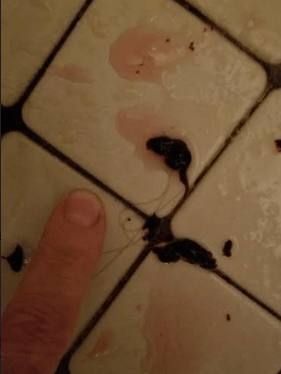
On October 5, 2018 my urine was a brownish ketchup color.  On the following day I painlessly passed a blood clot, and that was the end of the blood tinged urine.

Screen shot 2018-11-11 at 3.16.20 PM.png

Nancy informed me that this is called gross hematuria, a condition the Mayo clinic states is sometimes impossible to determine the cause of.   She ordered a CAT scan, which I had on October 30, and a cystoscopy.   She also told me I’d retained a few ounces of urine in my bladder and had to begin taking Flomax, no matter the side effects I complained of the last time I took it, years ago.   The cystoscopy was scheduled for November 8.  A few hours before my appointment I had a call from your office rescheduling the exam for December 6.  I called Glenice who promised me a return call from you that I have not yet had.

I understand the imperatives of corporate medicine, but I don’t think you could defend this to your urology students as good medical practice.   I have no results from the CAT scan, have been given no medical opinion, have not seen the doctor I paid to see on October 25, have had no return call from him after the cystoscopy was cancelled.   Might the CAT scan results eliminate the need for the cystoscopy?  What, if anything, did the CT scan show?    Is this isolated instance of gross hematuria something I can safely put in the rearview mirror or should I be worried about the possibility that it may be a sign of late stage prostate or bladder cancer?  

I am currently being treated for idiopathic membranous nephropathy and my initial call was to my nephrologist.   He told me hematuria is not a known effect of my kidney disease and said I should call my urologist.  I got the earliest appointment with your office.  A month later I still know exactly nothing.

You can email me, text me at ______, or call that number any time after 1 pm. I don’t think you — or anyone–  would be satisfied with this kind of treatment from your doctor (leaving aside the very long waits for a blood test– which neglected to include the creatine test required for the CT scan– the appointment with your ANP, the hours waiting for the CT scan, the month long postponement of a diagnostic test).   Please advise.

Eliot

(I discovered, after writing it, that there is no place to actually fucking send it… you’ve got to admire corporate medicine, baby.  During regular office hours I can call and possibly even get an email address to send it to)

USA!  USA!!!!


[1]  Correction,  one always has to read the fine print carefully when dealing with corporate vampires.   There is no email contact information available for the department of urology, this is where the URL on the business card takes you, to the corporate not-actual-contact page of these Hippocratic oath taking corporate dickheads.   I can’t wait to get the hospital’s next solicitation letter telling me about the wonderful, selfless work they are doing, without profit, for the community.


I’ve Waited Long

I am typing in the room where my mother’s ashes sit in a box in a beautiful paper bag.   The elegant bag is in the corner, out of my view, and I haven’t looked at it in a long time, but it is a distinctive bag.   The bag is brown paper on the outside, a pure slate gray on the inside.   My mother would like the bag.   She has no worries now, nor any wishes, either.  I decided years ago that I’d scatter her ashes in the Long Island Sound at the public beach at Wading River, but we haven’t done it so far, in eight and a half years.   I haven’t been to that beach in more than fifty years, who knows if you can even get on the beach now without a resident pass?   When I was there last there were swings, seesaws and a sliding pond on the sand, and a small parking lot with maybe eight spots painted on the once black shore road.

The idea of scattering my mother’s ashes in the water at Wading River was a sentimental one.  I  think of those months in that rented green and white bungalow a hundred yards from the lapping water as the happiest summers of her life, but who knows?   She always said she wanted to live near the water, and for a couple of summers we did.   I don’t know if she was happy there or not, hearing the waves breaking at night.  What I do know is that at the moment she truly doesn’t care.   Her concern at the end was about not being eaten by worms and bugs, the thought terrified her.  I assured her it would never happen and it will never happen.  

The scattering of her ashes is more a poetic matter, really.   Every so often it gives me a pang, that I haven’t managed to scatter her ashes into the gently lapping Long Island Sound,  that her ashes are sitting there in that elegant paper bag.  On the other hand, I am positive she doesn’t mind, even if she would chide me about my long failure to do it, if she were somehow able to.

That I can sit here, a few feet from her ashes, writing thoughtfully about it in words almost nobody will ever see, is a blessing and my form of daily meditation.   Thinking these thoughts, molding them into sections that I then comb carefully for readability, focuses my spirit, clarifies my beliefs, sharpens my sense of purpose.   That I have little clue about the only thing the world understands — attaining financial success — does not distract me while I work.  The hard work of vainly striving is not a remote consideration while I concentrate on making my words express my thoughts, my heart, as clearly as I can.

                                                                           ii 

I had a call just now from a one-time good friend of my mother’s, a woman a year older than my mother.   My mother would have been ninety last May, this woman was ninety-one last month, and still going strong.  God bless her, as we say.  Her mind is sharp, her language is crisp, she is upright and walking and driving great distances– still a force at ninety-one.   In the course of narrating a lot of horrors she asked me to keep to myself, while assuring me that she is up to the challenges, taking them one day at a time, she mentioned something that gave her a glimmer of hope in these dark times.

She attended an interfaith vigil the other day, the great throng of several faiths who had gathered was inspiring to her.   The hall was very crowded, with a big crowd outside also.   Somebody came through the mass of people outside and ushered her inside to a seat she didn’t want.  “I can stand, I’m perfectly fine,” she insisted, “give the seat to someone who needs it.”   In the end, she took the seat, though she felt bad about it.   Her ninety-two year-old friend, who had declined the seat in another part of the crowded hall, regretted it afterwards as her lower back tightened up painfully after standing on the concrete floor for a couple of hours.   Better to be seated than aching, I say more and more often now.

Small mercies take on a bigger and bigger significance as life goes on.   We see few enough of them in the world now, as so many nations stand on the brink of merciless horrors many of us believed were a barbaric relic of a bygone, insane age.  I’m talking about a small mercy like finding a vacant bench at the point of a walk when your arthritic knees are barking.   The relief you feel, taking the weight off your troubled bones, a gift you give yourself, provided by a merciful side of the universe and gratefully accepted.

There was a lot on this woman’s mind, and much of it I agreed not to share with anyone, so there’s that.   At one point, God bless her, she couldn’t resist giving me just a little shit about not calling her lately, after I’d spent hours on the phone last month advising her about some very vexing things– and sent her several more pages about my father’s life that she was too vexed to really take in.   

                                                                  iii

After the Saudis murdered a journalist in their consulate in Turkey last month there was a period of several weeks during which the vicious, smiling thirty-four year-old Crown Prince had his advisors and marketing folks make up and spin multiple lies about what happened to the disappeared critic of the regime.  Our president, also born to great wealth that made him feel truly exceptional since childhood, stalled along with the Crown fucking Prince of Saudi Arabia, a fundamentalist Islamic monarchy.   “We have to wait until  the Saudis finish investigating whether they murdered this vicious, lying journalist, which they strongly deny, look, they strongly deny it, like Justice Kavanaugh denied all those lies against him  — whatever happened to the presumption of innocence that liberals used to talk about?  Here they go, rushing to call MBS a murderer, which we don’t know, we may never know, certainly not until he’s done investigating whether he is or not, look, this kid is a gem, a great, great future king– no presumption of innocence for him?   Typical of the lying haters and hypocrites, funders and defenders of the raping, leprosy and smallpox infected terrorist hoards advancing on us …”

All we have, any of us, is the impression we leave behind on those who knew us. We are whispers, after our death, not even ghosts.   The example of how we lived is the only thing we leave to the world of people who knew us.   The power we may have wielded over others is nothing, it is how we used that power that is remembered, that lessons for the living can be drawn from.

I had an old friend who lives the frenetic, embattled life of a successful suburban citizen.   His many stresses and frustrations have few, if any, safe outlets.  It appears that I became his best option for relief.   More and more, particularly since I’ve devoted myself, from before my mother’s death, to restraining my angry reactions as much as I can, he took to provoking me.    I pointed this out to him each time he did it, but he always argued that he was not provoking me, that I just get mad unfairly, that maybe I was the one with the provocation problem, not him.    I had more than one opportunity to throw him on the ground and kick him, but I breathed and fought my way to remaining as peaceful as I could.   This restraint apparently goaded him to ever greater provocations.

In the end, he provoked me into detailing the many things I don’t respect about him.  I don’t know if I mentioned his lack of basic courage, which I think is probably encompassed in the unfortunate phrase I do recall using “moral retard”.   In the wake of this his wife called me, basically offering me an ultimatum.   You have to forgive him, she told me, because he loves you, we all love you.  

I explained why it’s impossible to forgive someone who takes no responsibility for hurtful things they repeatedly do.   Futile, really, since those hurtful things continue on and on into the future if they are not acknowledged and corrected.   The only option, to pretend everything is fine because people tell you that they love you, is not one I’m willing to take, even for the high moral cause of professed love.

Besides, I told her, love is the way you treat people, what you reflexively do when you see a loved one in pain.   Love is action, not a word.  I told her to let her husband know that I’ll be happy to hear from him once he gets some insight in the therapy he assures me he is working hard at.  “That’s not going to happen,” his wife told me, and it had the ring of truth.   He would rather lose his oldest friend than admit that the annoyingly superior fuck might have been even partially right.  Zero sum, baby, he can’t help himself.  If you don’t win, you lose.  What could be worse than that?  Ask the president.

It began to bug me more and more that because I’d taken a principled stance in regard to an old friendship I’d lost the longtime friendship of his wife and his two sons, as well as the friendship of a close mutual friend, apparently enraged at how badly I’ve hurt his troubled old friend.   I called the guy on Halloween (spooky, I know), to ask him three questions that had formed in my head.   I left a voicemail.   I heard nothing back from him, though I’d spontaneously left him the option of doing nothing, saying I’d email him the questions if I didn’t hear back.

A few hours later I rethought my offer.  What was the point of sending questions to someone who could not even reply to a voicemail?  It would only increase my aggravation if I never heard back, give him an easy, an effortless, final provocation.  I called again, left a second message, asking him to text, email or call me if he was willing to help me by answering three questions.  

Two days later, having heard nothing, I texted him, asking if he was out of town or too weak and unJewish to respond.   “Weak and unJewish”, an admittedly provocative formulation (especially to a Jew who fervently prays every morning), but, in context, restrained, I thought, particularly after two days of silence by way of reply.

I soon got the texts one would expect, explaining how he’d heard the first message and thought he’d be getting an email, and then no email came, and then, belatedly, he saw the other voicemail from me but didn’t actually hear it until after my recent text a few hours earlier and so on and so forth and so, you see, there was a rationale to all the delay, a hazard of digital communication (which is what I’d called to avoid in the first place) and, yes, please send him the three questions.

I sent this:

It depresses me that people I was friendly with and had no quarrel with, your wife, your sons, R___, have all vanished from my life as a result of our falling out.  Not to mention you.   I understand your wife and kids have to take your side, whatever it is, but still.   And you can’t even pick up the phone and return a missed call? (rhetorical question)

What was my final, unforgivable act against you?

What did you tell R____ that made him cut off communication with me?   When he left the US we were seemingly the best of friends, he was apologizing that we’d only managed to squeeze in one quick visit when he first arrived.  Then, as a prelude to complete radio silence,  I got a reference to “other developments over the last year or so” that presumably magnified the differences between us beyond the point of possible friendship.

Did you talk to your rabbi in the days before Yom Kippur and, if so, what did he tell you?    I don’t think it’s possible that a rabbi would advise someone to make no further attempt at reconciliation with his oldest friend during the Ten Days of Repentance.   I conclude you didn’t discuss it with your spiritual adviser.   I think you should consider this seven minute discussion on apology, forgiveness and atonement: 

https://www.wnycstudios.org/story/metoo-men-repent

I heard back quickly by email.  He’d received my questions, but I’d have to give him a few days to answer them.

I took a breath and typed back: OK.

Storytelling 101 — part six

Stories, we humans need them for many reasons.   They make us feel better about contradictions that are otherwise impossible to reconcile.   They bolster our ideals, confirm our worst doubts, or clinch the deal on the things we already know.  They cause us to walk forward, united with brothers and sisters, millions of them, not alone in a terrifyingly cold universe.   We do not live random, meaningless lives that end in inevitable death, we are part of a larger story, connected to our ancestors, our living loved ones, our lives nurturing the lives of those who come after us.  There is great comfort in a good story.

It was a bit of a shock to hear the story today, three weeks after the murder of Saudi journalist Jamal Khashoggi, told by the dictatorial leader of Turkey, speaking to his parliament and the world beyond.   Erdogan announced unequivocally that the journalist had been the victim of premeditated murder in the Saudi consulate in Istanbul.   He asked pointedly where the body of the murdered man is.    

Our president has been very coy about this whole affair involving our cherished Saudi allies, telling Americans that we have to wait for the Saudi investigation into the alleged murder to be complete, so that we have all the facts.    Meanwhile, he dispatched the U.S. Secretary of State, and more recently the Secretary of the Treasury, to Riyadh and CIA Director Gina Haspel to Istanbul.    

It may be an odd thing, to some of us, that the president was waiting for the alleged murderer to finish investigating whether they had committed a murder, but in the rush of ongoing chaotic events, there hasn’t been much time for most people to even consider this troubling story.   Besides, POTUS reminded us, the sacred democratic presumption of innocence was once again being discarded by people rushing to find someone they don’t like guilty until proven innocent.   Very unfair!   It’s not like the Saudi royal family is in any way comparable to the hoards of Mexican rapists surging toward our own borders.  

The president compared this lynch mob mentality of those who feel the Saudis should be accountable for their crimes (including, of course, massive war crimes against the poorest nation in the Middle East) to the people who insisted there should be a full investigation into the multiple terrible allegations against innocent choir boy Brett Kavanaugh, or at least into the most credibly detailed of them.  A mob, a violent angry mob, motivated by tribal bloodlust, satisfied with nothing but the fatal lynching of a good man, a good tribal monarchy, presumed guilty until proven innocent, in the president’s telling.

The president was not wrong to make the connection between the aftermaths of the murder of Khashoggi and the allegations against Kavanaugh.   There were credible stories in both cases to check out and investigations to be concluded.  In Kavanaugh’s case a quick investigation proved he was innocent, at least to the satisfaction of these who mattered in the 51-49 vote.   In the murder of Khashoggi, after a few weeks of thorough investigation, the Saudi story was that the chubby sixty year-old journalist and critic of the thirty-three year old Crown Prince got pugnacious and decided to take on the fifteen armed men who were tasked with merely ‘interrogating’ him.   He resisted, starting a fist fight, and was, unfortunately, well, he died during the altercation.  

Subtle, but valuable, that passive voice.   In law school we were actually instructed about the only proper situation for a lawyer to use the passive voice.   If your client’s knife, in your client’s hand, was plunged into the heart of the now dead man, you can’t deny it, exactly, but you can soften it with the passive voice.   The knife, admittedly belonging to my client, was plunged into the heart of the victim.   Sounds so much better than the active voice since it highlights not the act itself, but facts that are not in dispute, facts that appear to damn your client.   So in the belated Saudi spin on Khashoggi’s last moments alive, it’s not that he was killed, so much, as that he, unfortunately, died.  Why wait more than two weeks to admit that the journalist was dead?   We had to investigate everything very, very thoroughly.  Where is the body?   No fucking idea.

Stories rule, in every situation we can think of.  Whose story do we believe?  Which story makes more sense?   Which story moves us more?   I was practicing my writing with a new nib last night and decided to copy Lincoln’s famous 272 word Gettysburg Address.    The poor Irish immigrants who were drafted into the slaughter to reluctantly fight for the Union — and die gruesome deaths, by the thousands–  were transformed in Lincoln’s immortal rhetoric into ‘honored dead’ devoted to that cause ‘to which they gave the last full measure of their devotion’. That their sacrifice not be in vain, Lincoln said in his marvelous short speech, should be our work going forward as we pursue Liberty in the nation dedicated to the proposition that all men are created equal.  

He gave that moving speech, appealing to the better angels of our nature [1], almost 155 years ago (it’ll be 155 years exactly on November 19th).   We have come very far since then in becoming a land honestly and tirelessly devoted to true liberty and equality for all.   Or we have come a few halting steps, and taken many more steps backwards.   Which is the more inspiring story?   Not much of a contest, I’d say.

It is, of course, like this in personal life too.  A man who has a long history of lying, stealing and committing fraud, a man who made death threats against his own wife and children in a moment of rage– well, your view of him will depend on which story you believe, based on your relationship to him.   He has a warm, loving side too, is a supremely sensitive reader of the moods and needs of everyone around him, he has a good heart.   He is a loving father, the death threats were a one time thing, he was very desperate!   The story becomes tricky only if you try to reconcile the two indisputable yet jarringly contradictory sides of this fellow.   For his part, the man will never admit he did anything wrong.   Either you have love in your heart or you’re a vicious asshole, is his position.    

The facts, we often think, matter.  This turns out to be a quaint belief.  The story is the only thing that matters.   Was Lincoln lying about the heroic dead who so nobly gave their lives that we might have a more just nation?   He was telling the story that needed to be told so that we did not conclude the massive number of American dead and dismembered had been merely a sickening instance of the intransigent, inhuman greed of a powerful few unleashing a river of American blood to protect their right to have complete control of their way of making a living, a way that makes most of us shudder today.

Likewise, if you put your friend in an unfair, untenable, even vicious situation, forcing him to convince you that he did not deliberately, or thoughtlessly, jeopardize your most sacred relationship, there is a way to put it that sounds infinitely better than that.  “That thing in the car” you can call it, if you confronted him in a car.  Now then, it was referred to directly.  It was a thing, like many other things.   Then you fucking overreacted and blew it up into this huge justification of why you can never fucking forgive me, you judgmental fucking piece of shit!   You’re dead!   You’re fucking dead!!!

As always, it’s all in how the story is told, my friends.


[1]  “We are not enemies, but friends. We must not be enemies. Though passion may have strained, it must not break our bonds of affection. The mystic chords of memory will swell when again touched, as surely they will be, by the better angels of our nature.”    source

Nurture the Creative Spark Inside

20180913_172332.jpg

Preserving the joy of creativity is essential to a happy life, in my experience.  I don’t know how you nurture the creative spark inside you, though I hope you handle that spark with great tenderness.  I wish you the blessing of doing something you love that transports you, involves you completely, makes you feel grateful to be doing it. The surest way to nurture this feeling is by truly loving the things you create and everything about the process of invention and refinement that leads to their creation.  

Speaking for myself, the reverb on a note sustained on the guitar is reason enough to love that note, continue to exercise vibrato upon it, to love the notes that preceded it, the ones to follow, to enjoy their interaction with the beat.   A good cook gets to eat well, feed others well with the best ingredients perfectly combined and prepared.  The sung note, melding with the harmony of a chord, with other voices, the sound of it all, a kind of miracle.  Pick whatever you love most, and love it from time to time.  Your love may light a love in others who cannot help but be a tiny bit inspired.   The world is better for that love.

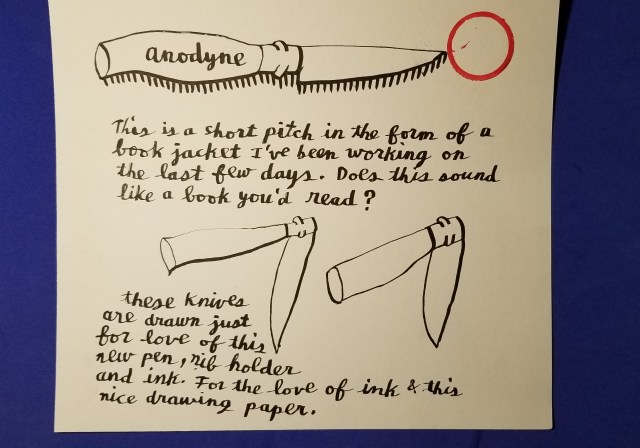
For me, late last night, finding this great, discarded Speedball C-4 nib, stuck in an old cork handled nib holder I’ve had for years, dipping it in ink and bringing it down toward a nice piece of drawing paper, with a low-medium tooth, made me excited to drag the ink across the page.   That thrill on contact, to see what a succulent line it was, was enough to make me wonder, did I actually have anything to write in my best flowing hand?  

It was no matter, just as much fun to draw the knife, pen the word ‘anodyne’ on its handle.  I thought how nice it would be to hand write the short note for the short Book Jacket copy I’m going to send to one of my oldest friends tonight.  


20180913_172332.jpg 

She would immediately wonder why the hell I’ve drawn folding knives, Opinels by the looks of ’em, all over my note explaining what the enclosed page was.   I answered that question as best I could, alongside the knives, and while I dipped the pen and wrote that answer I had no wonder about what to write to keep the pleasure of using this lovely nib going.  A pleasure on top of a pleasure.   Pretty good, in the scheme of things. 

Labor Day

I heard a piece on NPR just now about apprenticeship and somebody mentioned digging a ditch.   On Labor Day in America today I celebrate the time I spent the day digging a forty foot long ditch in the East Bay in earth that was like cement due to several years of drought.  This was back in the 1970s.  The signs in California bathrooms read “if it’s yellow, it’s mellow, if it’s brown, flush it down”.   Sekhnet’s friend Uncle Tony had a sign in his rustic bathroom that expressed a similar sentiment:  “on these isles of sun and fun, we never flush for number one.”

I was in my early twenties, broke and strong.   A friend negotiated the job for me.   This guy was a genius negotiator, always getting the best deal possible for himself.   I don’t know what his motivation was in making this particular deal, but as I remember it I was paid $20 for the long trench I was supposed to dig.   I didn’t kick.  I needed the money, and twenty back then was like a hundred today, and headed out in the morning with a borrowed mattock and shovel.  

The job required not only strength and determination but great delicacy, as it turned out, and a certain amount of ingenuity.  I was digging around a thin water pipe, buried about a foot deep in the hard ground, that connected the house to the water main.    I had to work around the old pipe, which was about the thickness of a big toe.   I discovered on my first swing that my friend had negotiated an absolute shit deal for me.   The heavy mattock hit the earth and barely dented it.  

It took a while, but using the pick end of the mattock I was able to poke holes in the baked earth on either side of the pipe and then sculpt out little chunks with the flat end, carefully working away from the pipe.   I worked shirtless under a decent sun, and I remember feeling glad that it wasn’t too hot out.   It was slow work, impossibly depressing at first, but I made steady progress from the sidewalk toward the house, across the the baked brown expanse of hard dirt that was previously a lawn.   I probably sang as I swung my mattock and later, and more to the point, my pickaxe.  My friend had dropped off a pickaxe with a handy sharper point, after he came by to check up on me during his lunch break.  The pickaxe helped.

It was just one of those days in the life of a young man with big dreams.  I was about three feet from the end of my work, had skillfully dug a channel around the thin pipe, and had maybe an hour left.   The muscles on my back were starting to twinge a bit, and I had slowed my pace.  The end of this shit day of work was quite near.  It had been a long and productive eight hours or so so far.    I was taking a few breaths, leaning on the mattock, when a friend rode up on her bicycle.     I told her I was almost done and started back to work.    

She was one of these people who know everything.   She is the expert on everything, without exception.  It turned out, according to her, that it had taken me so long because I was going about it all wrong.  My form with the mattock, apparently, was ridiculous.  To stop her unwanted lecture I smirked and handed her the mattock, which I’d been using to lift out the dirt the pickaxe had loosened around the pipe.   She told me to watch carefully as she showed me how it should be done.   She raised the mattock high over her head, almost tottering backward at its weight.   Then she brought it down hard, directly on the center of the ancient pipe.  

A geyser of water shot up high into the air as the pressurized water made its hissing escape.  The long trench immediately filled with water, the baked dirt of the former lawn was now mud.  I never heard her drop the mattock as I turned to kick her as hard as I could in the ass.   She was off on her bicycle before I could take any revenge at all, outside of hurling a few curses at her as she sped off.  

Thinking about it now, I realize that fuck who offered me $20 for that job got exactly what he paid for.   I have wised up over the years, finally casting out people like the great negotiator, a highly successful businessman who resembles nobody as much as Trump in his need to win at all costs and his inability to maintain friendships that are not purely transactional. The know-it-all lasted a few years longer, but in the end, the spectacle of her pummeling her feeble husband became too sickening to endure.  

I will always fondly remember that day digging that ditch in Albany (or maybe El Cerrito).  Oddly enough, I had a date that night, in those free love days.  I cheerfully rode my bike a few miles to Berkeley where I was going to have sex with a young woman I’d known for some time.   It was the first time we’d gone to bed.  I recall, in the middle of things, literally while we were making the beast with two backs, she had to excuse herself to go pee.  She may have had some kind of urinary tract infection, I think.   I don’t remember the rest, I may have fallen asleep while she was in the bathroom leaving some mellow yellow in the bowl.

The DU was not generous

My father, the Dreaded Unit, was not a generous person.  He gave us things, he provided a nice lifestyle for the family, he didn’t begrudge us what we needed or wanted, he just was not personally generous.   It seems easy enough to blame this on the “grinding poverty” he experienced until he was drafted into the Army.   Though the most generous kids I ever worked with were always the poorest.   My sister’s experience working with children has been the same.   We both, at different times and in different places, taught classes of well-to-do kids and classes of poor kids.   Certain rich kids were prone to grabbing the last cookie and shoving it into their mouth.   Poor kids always seem concerned that everyone gets a fair piece.  Of course, I over-generalize, there were wonderful rich kids and poor kids who were complete dicks.   When it came to sharing, and my sister will back me up, the poor kids unfailingly shared, rich kids not such unfailing sharers.  So my father’s poverty by itself does not explain his difficulty being generous.

Generosity is a trait, like kindness and fairness, that if not planted young has a hard time growing later in the depleted soil of a love-starved soul.  My father told me as he was dying, in that weakened voice as his life force ebbed, that he’d had never had any idea how to show affection.   “I’d never seen it done,” he told me, a slight pleading in his tone, alluding to the house of violence, poverty and madness he’d grown up in.   His mother and father never touched each other.   No affection was ever shown.

These days I am trying to learn each of the lessons of my father’s tragic life and put them into practice to live a better life.   Being unforgiving is closely related to a lack of generosity — you will not extend the pardon you yourself would want to be given in the same situation.   It is a terrible thing never to forgive.  I watched my father do it all his life, the man never forgave anyone, starting with himself.   Unforgiveness feeds a deeply destructive need, the need to feel completely vindicated in one’s anger.  We see it played out on a mass level today with our vengeful Insane Clown President, as Matt Taibbi dubbed him when writing about the 2016 campaign.

I am always impressed by generosity.   I recall going to the home of a Palestinian who lived in East Jerusalem, in the Old City.   He took everything out of his refrigerator, he and his children literally emptied it, and put it all on the table in front of us.  “Take, take,” he said, smiling, gesturing at everything.   There turned out to be more to the story, but this kind of generosity, holding nothing back, is a beautiful thing.   

What does it cost to be moved by something beautiful somebody has just done and saying “beautiful”?   The thing is beautiful, is there a price to saying so?   I don’t know, I can’t see one.   To some people, I suppose, it costs a lot.  It appears that way, anyway.    Maybe it’s related to envy, or distraction, or simply being bitter, I don’t really have a handle on that kind of reticence.  My mother didn’t have it.   She would read something I’d picked out for her and smile and say “it’s wonderful”.   I could tell she meant it.   My father would read the same piece looking for the fatal booby trap I’d hidden in there, the tell-tale adjective that would show the rigging about to collapse on his head.

What does it cost to give the benefit of the doubt?   You can give it once, be disappointed, give it again, remaining hopeful.   After enough disappointments you will stop extending this generous courtesy, but what does it cost to give it in the first place?   It requires trust, I suppose, a certain faith that good will is going to be returned.   It often is.   It often isn’t.   I think more often than not, good will is reciprocated.   My father did not think so.   It was hard for him to make himself vulnerable in any way.    

As he was dying he said:

I know a lot of people are sorry for what they did, yet at the time you don’t see anything but just a battle which there has to been winners or losers, and there’s no gradation.

 I know when we had our differences, I realize that it was nothing personal in the classic sense but I also know that it’s the only way that I could live… like I told mom, we always had these battles where she’s saying “we’ve got enough money, we’ve got enough money” — for me it was never enough. I’ve got to make sure that every dot is dotted, every ‘t’ is crossed because I don’t want her to want a thing.  So, it’s kind of a lifetime battle, I don’t know, I think now how much richer my life would have been if I hadn’t seen it as a battle—good versus evil.

I know we should have had this talk ten, fifteen years ago. I couldn’t reach that level because I was really thinking that it was going to be a battle and that there wasn’t any way I could make it into a dialogue, and that’s my fault. You’re supposed to have some fucking insight.


OK… All Right…

I have found, as I get older, that when I am alone, as happens in my life of contemplation, and I need to exert myself even slightly, I more and more often accompany the action with a reassuring “all right… OK…”    This involuntary self-encouragement is delivered in a slightly rough voice, but very softly.  It is as much a breath as a voice, really.    I don’t know where it comes from, except that such self-talk must go deep in the human experience.

It is unusual, in many lives, to have a gentle hand to guide us along.  Like many things we learn to do on our own, we sometimes provide our own gentle hand.   However otherwise gruff the voice is that encourages me to get up slowly after sitting for a long time, say, it is more than anything a gentle voice.   I don’t mind it at all.    I greatly prefer it to my outbursts.

I watched the last hour or so of the wonderful Princess Bride the other night.   It reminded me again, watching Peter Falk play a character years older than he was at the time, a kid’s grandfather, both gruff and extremely gentle, that Falk’s character was probably a main source of this voice.

The grandfather reads the end of the story, closes the book, says goodnight to his grandson and gets up to leave.   The boy asks his grandfather if he’ll come back and read it to him again the next day.    Falk turns at the door of the boy’s room,  bows his head slightly, like a vassal about to address his lord and says “as you wish.”